

SIST EN 16524:2021
(Main)Mechanical products - Methodology for reduction of environmental impacts in product design and development
General Information
- Abstract
This document describes a methodology for reducing the overall environmental impact through product design and development that is tailored to mechanical products as defined in 3.1.
This methodology is particularly well suited to the redesign of an existing product; it can also be applied for the design of a new product provided the necessary assumptions regarding a (virtual) reference product are taken.
It addresses companies which have decided to integrate an ecodesign approach to optimise environmental impacts within the product life cycle, in relation to the other product aspects, such as functionality, quality, costs, etc.
It also helps to meet some requirements of ISO 14001:2015 on the integration of environmental aspects in the design of products.
NOTE 1 This document targets persons who are directly involved in the design and development of mechanical products, as well as managers responsible for defining corporate policies, and decision-makers. The proposed methodology is intended to kick-start ecodesign initiatives within companies as part of a teaching and continuous improvement approach.
This document also includes a template that companies can use as part of the communication on their environmental approach.
This document is neither intended nor suitable to compare products (even similar) of different suppliers.
This document is neither intended nor suitable for product certification purposes.
NOTE 2 An example of implementation of the methodology is given in Annex D; the basic principles for the establishment of this method are given in Annex E.
- Status
- Published
- Public Enquiry End Date
- 09-Sep-2019
- Publication Date
- 10-Jan-2021
- Technical Committee
- VSN - Safety of machinery
- Current Stage
- 6060 - National Implementation/Publication (Adopted Project)
- Start Date
- 12-Nov-2020
- Due Date
- 17-Jan-2021
- Completion Date
- 11-Jan-2021

Overview
SIST EN 16524:2021 - Mechanical products: Methodology for reduction of environmental impacts in product design and development provides a pragmatic ecodesign methodology tailored to mechanical products (machinery, components, tools and similar). The standard is aimed at companies - particularly SMEs - that want to integrate an ecodesign approach to reduce environmental impacts across the product life cycle without necessarily performing a full Life Cycle Assessment (LCA). It is especially suited to the redesign of existing products but can also be applied during new product development using a virtual reference product.
Key topics and technical scope
- Purpose: Identify and reduce environmental aspects and impacts of mechanical products while preserving functionality, quality and cost constraints.
- Methodology structure: A preparatory strategic analysis (Step 0) followed by a staged method with documented steps:
- Step 1: Scoring environmental aspects of the reference product
- Step 2: Selection and ranking of design options (DO)
- Step 3: Choosing DO and environmental aspect (EA) indicators related to the reference product
- Step 4: Evaluating redesigns using DO and EA indicators
- Step 5: Final assessment and planning for future activities
- Tools and supporting material: Normative annexes include an environmental questionnaire (Annex A), an analysis algorithm (Annex B), examples of design options and indicators (Annex C), an implementation example (Annex D) and background on the algorithm (Annex E). Annex F discusses possible use of LCA data as input.
- Limitations: Not intended for product comparison across suppliers, for product certification, or as a calculation method for environmental footprint.
Practical applications and users
- Who should use it: Product designers, R&D engineers, design managers, sustainability officers and decision-makers in mechanical engineering and metalworking industries. It is particularly helpful for SMEs beginning ecodesign activities.
- Common uses:
- Redesigning existing products to lower environmental impacts (materials, energy use, end-of-life)
- Integrating environmental aspects into design workflows and corporate policy
- Communicating an internal environmental improvement approach using the provided template and environmental claim guidance
- Using available LCA or footprint data as supplementary inputs when available
- Benefits: Enables targeted, resource-efficient ecodesign interventions without the time and expertise demands of a full LCA; supports continuous improvement and alignment with environmental management goals.
Related standards and alignment
- Supports requirements of EN ISO 14001:2015 and is compatible with guidance in EN ISO 14006 on integrating ecodesign into environmental management systems.
- References LCA principles (EN ISO 14040/14044) as optional input; not intended to replace full LCA studies.
- Not a regulatory compliance tool for specific implementing measures (e.g., Ecodesign Directive), but useful for identifying relevant environmental aspects for design decisions.
Keywords: SIST EN 16524:2021, ecodesign methodology, mechanical products, environmental impact reduction, product design, LCA, EN ISO 14001, redesign, SMEs.
Relations
- Effective Date
- 11-Nov-2020
Get Certified
Connect with accredited certification bodies for this standard

BSI Group
BSI (British Standards Institution) is the business standards company that helps organizations make excellence a habit.

Bureau Veritas
Bureau Veritas is a world leader in laboratory testing, inspection and certification services.

DNV
DNV is an independent assurance and risk management provider.
Sponsored listings
Frequently Asked Questions
SIST EN 16524:2021 is a standard published by the Slovenian Institute for Standardization (SIST). Its full title is "Mechanical products - Methodology for reduction of environmental impacts in product design and development". This standard covers: This document describes a methodology for reducing the overall environmental impact through product design and development that is tailored to mechanical products as defined in 3.1. This methodology is particularly well suited to the redesign of an existing product; it can also be applied for the design of a new product provided the necessary assumptions regarding a (virtual) reference product are taken. It addresses companies which have decided to integrate an ecodesign approach to optimise environmental impacts within the product life cycle, in relation to the other product aspects, such as functionality, quality, costs, etc. It also helps to meet some requirements of ISO 14001:2015 on the integration of environmental aspects in the design of products. NOTE 1 This document targets persons who are directly involved in the design and development of mechanical products, as well as managers responsible for defining corporate policies, and decision-makers. The proposed methodology is intended to kick-start ecodesign initiatives within companies as part of a teaching and continuous improvement approach. This document also includes a template that companies can use as part of the communication on their environmental approach. This document is neither intended nor suitable to compare products (even similar) of different suppliers. This document is neither intended nor suitable for product certification purposes. NOTE 2 An example of implementation of the methodology is given in Annex D; the basic principles for the establishment of this method are given in Annex E.
This document describes a methodology for reducing the overall environmental impact through product design and development that is tailored to mechanical products as defined in 3.1. This methodology is particularly well suited to the redesign of an existing product; it can also be applied for the design of a new product provided the necessary assumptions regarding a (virtual) reference product are taken. It addresses companies which have decided to integrate an ecodesign approach to optimise environmental impacts within the product life cycle, in relation to the other product aspects, such as functionality, quality, costs, etc. It also helps to meet some requirements of ISO 14001:2015 on the integration of environmental aspects in the design of products. NOTE 1 This document targets persons who are directly involved in the design and development of mechanical products, as well as managers responsible for defining corporate policies, and decision-makers. The proposed methodology is intended to kick-start ecodesign initiatives within companies as part of a teaching and continuous improvement approach. This document also includes a template that companies can use as part of the communication on their environmental approach. This document is neither intended nor suitable to compare products (even similar) of different suppliers. This document is neither intended nor suitable for product certification purposes. NOTE 2 An example of implementation of the methodology is given in Annex D; the basic principles for the establishment of this method are given in Annex E.
SIST EN 16524:2021 is classified under the following ICS (International Classification for Standards) categories: 13.020.10 - Environmental management; 21.020 - Characteristics and design of machines, apparatus, equipment. The ICS classification helps identify the subject area and facilitates finding related standards.
SIST EN 16524:2021 has the following relationships with other standards: It is inter standard links to SIST-TS CEN/TS 16524:2014. Understanding these relationships helps ensure you are using the most current and applicable version of the standard.
SIST EN 16524:2021 is available in PDF format for immediate download after purchase. The document can be added to your cart and obtained through the secure checkout process. Digital delivery ensures instant access to the complete standard document.
Standards Content (Sample)
SLOVENSKI STANDARD
01-februar-2021
Nadomešča:
SIST-TS CEN/TS 16524:2014
Proizvodi strojne in kovinskopredelovalne industrije - Metodologija za zmanjšanje
vplivov na okolje pri načrtovanju in razvoju proizvodov
Mechanical products - Methodology for reduction of environmental impacts in product
design and development
Mechanische Produkte - Methodik zur Verminderung der Umweltauswirkungen bei
Produktgestaltung und Entwicklung
Produits mécaniques - Méthodologie de réduction des impacts environnementaux à la
conception et au développement des produits
Ta slovenski standard je istoveten z: EN 16524:2020
ICS:
13.020.10 Ravnanje z okoljem Environmental management
21.020 Značilnosti in načrtovanje Characteristics and design of
strojev, aparatov, opreme machines, apparatus,
equipment
2003-01.Slovenski inštitut za standardizacijo. Razmnoževanje celote ali delov tega standarda ni dovoljeno.
EN 16524
EUROPEAN STANDARD
NORME EUROPÉENNE
November 2020
EUROPÄISCHE NORM
ICS 13.020.10 Supersedes CEN/TS 16524:2013
English Version
Mechanical products - Methodology for reduction of
environmental impacts in product design and
development
Produits mécaniques - Méthodologie de réduction des Mechanische Produkte - Methodik zur Verminderung
impacts environnementaux à la conception et au der Umweltauswirkungen bei Produktgestaltung und
développement des produits Entwicklung
This European Standard was approved by CEN on 24 August 2020.
CEN members are bound to comply with the CEN/CENELEC Internal Regulations which stipulate the conditions for giving this
European Standard the status of a national standard without any alteration. Up-to-date lists and bibliographical references
concerning such national standards may be obtained on application to the CEN-CENELEC Management Centre or to any CEN
member.
This European Standard exists in three official versions (English, French, German). A version in any other language made by
translation under the responsibility of a CEN member into its own language and notified to the CEN-CENELEC Management
Centre has the same status as the official versions.
CEN members are the national standards bodies of Austria, Belgium, Bulgaria, Croatia, Cyprus, Czech Republic, Denmark, Estonia,
Finland, France, Germany, Greece, Hungary, Iceland, Ireland, Italy, Latvia, Lithuania, Luxembourg, Malta, Netherlands, Norway,
Poland, Portugal, Republic of North Macedonia, Romania, Serbia, Slovakia, Slovenia, Spain, Sweden, Switzerland, Turkey and
United Kingdom.
EUROPEAN COMMITTEE FOR STANDARDIZATION
COMITÉ EUROPÉEN DE NORMALISATION
EUROPÄISCHES KOMITEE FÜR NORMUNG
CEN-CENELEC Management Centre: Rue de la Science 23, B-1040 Brussels
© 2020 CEN All rights of exploitation in any form and by any means reserved Ref. No. EN 16524:2020 E
worldwide for CEN national Members.
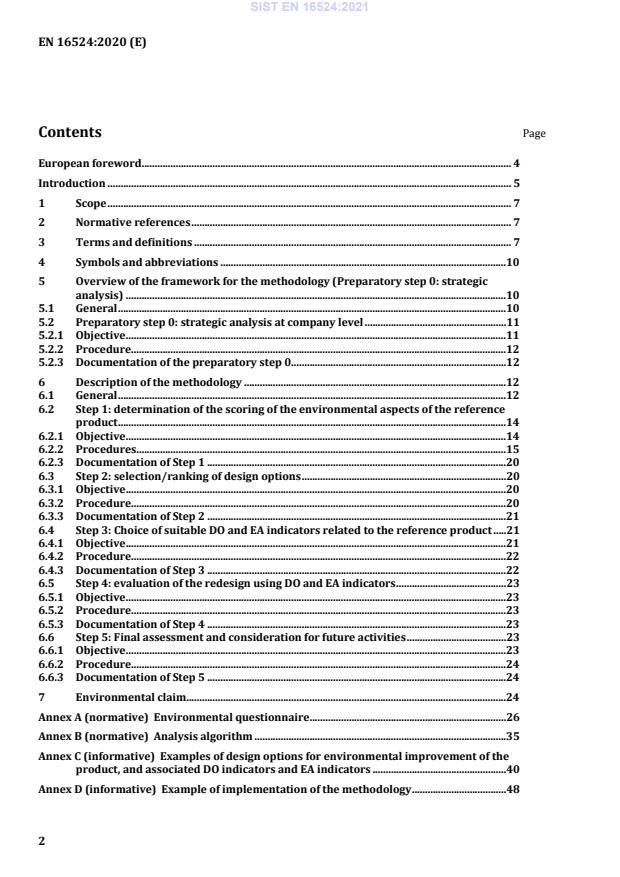
Contents Page
European foreword . 4
Introduction . 5
1 Scope . 7
2 Normative references . 7
3 Terms and definitions . 7
4 Symbols and abbreviations .10
5 Overview of the framework for the methodology (Preparatory step 0: strategic
analysis) .10
5.1 General .10
5.2 Preparatory step 0: strategic analysis at company level .11
5.2.1 Objective .11
5.2.2 Procedure.12
5.2.3 Documentation of the preparatory step 0 .12
6 Description of the methodology .12
6.1 General .12
6.2 Step 1: determination of the scoring of the environmental aspects of the reference
product .14
6.2.1 Objective .14
6.2.2 Procedures.15
6.2.3 Documentation of Step 1 .20
6.3 Step 2: selection/ranking of design options .20
6.3.1 Objective .20
6.3.2 Procedure.20
6.3.3 Documentation of Step 2 .21
6.4 Step 3: Choice of suitable DO and EA indicators related to the reference product .21
6.4.1 Objective .21
6.4.2 Procedure.22
6.4.3 Documentation of Step 3 .22
6.5 Step 4: evaluation of the redesign using DO and EA indicators .23
6.5.1 Objective .23
6.5.2 Procedure.23
6.5.3 Documentation of Step 4 .23
6.6 Step 5: Final assessment and consideration for future activities .23
6.6.1 Objective .23
6.6.2 Procedure.24
6.6.3 Documentation of Step 5 .24
7 Environmental claim .24
Annex A (normative) Environmental questionnaire .26
Annex B (normative) Analysis algorithm .35
Annex C (informative) Examples of design options for environmental improvement of the
product, and associated DO indicators and EA indicators .40
Annex D (informative) Example of implementation of the methodology .48
D.1 General . 48
D.2 Step 1 . 48
D.2.1 Description of the reference product and the project perimeter . 48
D.2.2 Bill of Materials . 48
D.2.3 Environmental questionnaire . 51
D.2.4 Inputs to the algorithm . 57
D.3 Steps 2 and 3 . 63
Annex E (informative) Background of the algorithm . 67
E.1 Construction of the algorithm . 67
E.1.1 Overview . 67
E.1.2 Rules for environmental analysis . 67
E.2 Consideration of legislation . 75
Annex F (informative) Possible use of Life Cycle Assessment (LCA) for determining the
score of each EA . 76
Annex G (informative) Correspondence between EN ISO 14001 and EN 16524. 81
Bibliography . 85
European foreword
This document (EN 16524:2020) has been prepared by Technical Committee CEN/TC 406 “Mechanical
products - Ecodesign methodology”, the secretariat of which is held by AFNOR.
This European Standard shall be given the status of a national standard, either by publication of an
identical text or by endorsement, at the latest by May 2021, and conflicting national standards shall be
withdrawn at the latest by May 2021.
Attention is drawn to the possibility that some of the elements of this document may be the subject of
patent rights. CEN shall not be held responsible for identifying any or all such patent rights.
This document supersedes CEN/TS 16524:2013.
The main changes compared to CEN/TS 16524:2013 are as follows:
— the document is to be converted into a European standard;
— the link with EN ISO 14001 has been strengthened for users willing to comply with that international
standard;
— Clause 5 has been added to detail the preparatory step before implementing the methodology, which
consists of an overview of the framework and the methodology;
— the life cycle analysis (LCA) is only referred to as an example of existing data on the product, when
available; and
— the purpose of the Annex F on the possible use of life cycle assessment for determining the score of
each environmental aspect has been clarified.
According to the CEN-CENELEC Internal Regulations, the national standards organisations of the
following countries are bound to implement this European Standard: Austria, Belgium, Bulgaria, Croatia,
Cyprus, Czech Republic, Denmark, Estonia, Finland, France, Germany, Greece, Hungary, Iceland, Ireland,
Italy, Latvia, Lithuania, Luxembourg, Malta, Netherlands, Norway, Poland, Portugal, Republic of North
Macedonia, Romania, Serbia, Slovakia, Slovenia, Spain, Sweden, Switzerland, Turkey and the United
Kingdom.
Introduction
Ecodesign methodologies can be divided into three types, depending on whether their purpose is the
environmental assessment of products, the environmental improvement of products or to enable the two
phases to be carried out during the same ecodesign project.
The environmental assessment phase of products in the ecodesign process can be an impediment for
companies (owing to need for expertise, time and resources). Therefore, the methodology discussed in
this document has been developed with the aim of helping designers to identify ways of improving the
environmental performance of a product without carrying out a complete environmental assessment of
the product (in terms of LCA).
Therefore, the approach consists for the company in restricting the scope of analysis to the characteristics
defined by the constraints of the product, which takes into account the technical factors of the product,
economic constraints, the practices of a company and its development strategies. Secondly, it consists of
exploring the potential for environmental improvement within this restricted field.
This document is intended to give companies, in particular small and medium enterprises (SMEs), a
pragmatic methodology to consider environmental aspects during their product design. It allows them
to:
— Identify the environmental aspects of a product, including but not limited to energy aspects;
— Reduce the environmental impact of a product, taking into account capabilities of the company;
— Inform clients and public authorities about the environmental improvement approach on a
mechanical product with this methodology (environmental claim).
The reduction of the environmental impact implies that the intended performance of the product (fitness
for use, durability, etc.) is maintained.
To implement this methodology, the company staff will have sufficient knowledge and expertise in
environmental issues; if not, external expertise can be addressed. When applying this methodology,
management of the company can enter a learning process with the aim of defining and/or confirming its
strategy for ecodesign, modifying its design process to enable the environmental issue to be taken into
account, and creating new knowledge.
The aim of this document is not to measure the actual environmental performance of a product, nor to
conduct a full life cycle assessment according to EN ISO 14040. Nevertheless, suitable data coming from
more detailed studies e.g. LCA, carbon footprint, etc. can be used as inputs for this methodology (see an
example in Annex F).
Figure 1 shows the relationship between this document and existing documents from ISO.
NOTE More specific methodologies can exist for specific mechanical products.
Figure 1 — Relationship between this document and existing ISO documents
This document can assist the company to comply with the requirement of EN ISO 14001 and the
recommendations of EN ISO 14006, to establish, implement and maintain a procedure to identify the
environmental aspects of its products.
This document is not intended to support or to demonstrate compliance with any specific implementing
measures of the Framework Directive 2009/125/EC (Energy-related Products). It can provide
methodologies for identifying the more relevant environmental aspects in order to propose alternative
design options to improve the environmental performance of the product.
This document is not intended for calculation of environmental footprint.
1 Scope
This document describes a methodology for reducing the overall environmental impact through product
design and development that is tailored to mechanical products as defined in 3.1.
This methodology is particularly well suited to the redesign of an existing product; it can also be applied
for the design of a new product provided the necessary assumptions regarding a (virtual) reference
product are taken.
It addresses companies which have decided to integrate an ecodesign approach to optimize
environmental impacts within the product life cycle, in relation to the other product aspects, such as
functionality, quality, costs, etc.
It also helps to meet some requirements of EN ISO 14001:2015 on the integration of environmental
aspects in the design of products.
NOTE 1 This document targets persons who are directly involved in the design and development of mechanical
products, as well as managers responsible for defining corporate policies, and decision-makers. The proposed
methodology is intended to kick-start ecodesign initiatives within companies as part of a continuous improvement
approach.
This document also includes a template that companies can use as part of the communication on their
environmental approach.
This document is neither intended nor suitable to compare products (even similar) of different suppliers.
This document is neither intended nor suitable for product certification purposes.
NOTE 2 An example for the implementation of the methodology is given in Annex D; the background of the
algorithm used for this methodology is explained in Annex E.
2 Normative references
There are no normative references in this document.
3 Terms and definitions
For the purposes of this document, the following terms and definitions apply.
ISO and IEC maintain terminological databases for use in standardization at the following addresses:
— IEC Electropedia: available at http://www.electropedia.org/
— ISO Online browsing platform: available at http://www.iso.org/obp
3.1
mechanical product
product manufactured by companies from mechanical engineering and metalworking industry
EXAMPLE Mechanical products such as capital goods (machinery, production systems, components), tools,
household goods, optical parts, measuring instruments.
3.2
reference product
existing product of the company to be re-designed, with the same intended use
Note 1 to entry: A similar product existing on the market, or the Technical Specification of a product can also be
used as a reference.
3.3
environmental aspect
EA
element of an organisation's activities or products or services that interacts or can interact with the
environment
Note 1 to entry: For this document, environmental aspects are categorized into Raw Materials acquisition,
Manufacturing, Use, Product End-of-life, Hazardous substances, Transport and distribution, Packaging.
[SOURCE: EN ISO 14001:2015, 3.2.2. Changes made to original terminological entry: abbreviation “EA”
has been added, note 1 and 2 to entry have been replaced by new note 1 to entry.]
3.4
design option
environmental design option
DO
measure intended to improve a specific environmental aspect within the product life cycle, in relation to
the other product aspects, such as functionality, quality, costs, etc.
3.5
scoring of environmental aspects
SEA
representation of the relative importance of the product's environmental aspects over its life cycle
Note 1 to entry: This SEA does not express the environmental performance of the product.
3.6
design option indicator
DO indicator
qualitative or quantitative indicator representative of a given design option, used to track this option
during the design phase
3.7
environmental aspect indicator
EA indicator
qualitative or quantitative indicator associated with a particular environmental aspect, as representative
as possible of this environmental aspect, used to keep a multi-criteria view of the environmental
performance of the product during its development
Note 1 to entry: “Multi-criteria view” means the consideration of all environmental aspects to avoid a shift of
impact (e.g. change of material can result in lower recyclability coefficient).
3.8
recoverability
ability of component parts, materials or both that can be diverted from an end-of-life stream to be
recovered
Note 1 to entry: See Figure 2.
[SOURCE: ISO 22628:2002, 3.9. Changes made to original terminological entry: Note 1 to entry has been
added.]
3.9
recyclability
ability of component parts, materials or both that can be diverted from an end-of-life stream to be
recycled
Note 1 to entry: See Figure 2.
[SOURCE: ISO 22628:2002, 3.7. Changes made to original terminological entry: Note 1 to entry has been
added.]
3.10
material recyclability coefficient
r
percentage by mass (mass fraction in percent) of a material potentially able to be recycled
3.11
reusability
ability of component parts that can be diverted from an end-of-life stream to be exploited
Note 1 to entry: See Figure 2.
Figure 2 — Different kinds of exploitation at the end-of-life stage
3.12
ecodesign
integration of environmental aspects into product design with the aim of improving the environmental
performance of the product throughout its whole life cycle
[SOURCE: Directive 2009/125/EC]
3.13
project team
multidisciplinary team with recognized environmental competencies, supported by management, and
involving all corporate functions likely to be impacted
EXAMPLE R&D, Design Office, Purchasing, Manufacture, Logistics, Marketing, etc.
4 Symbols and abbreviations
The abbreviated terms necessary for the understanding of this document are the following:
BOM Bill Of Materials or equivalent technical description of the product
DO Design Option
EA Environmental Aspect
EoL End-of-Life
ErP Energy related Products (European Directive)
ELV End-of-Life Vehicles (European Directive)
EL-R End-of-Life Recyclability
M Manufacturing aspect
Pkg Packaging aspect
PEL Product End-of-Life aspect
RM Raw Material aspect
S Hazardous Substances aspect
SEA Scoring of Environmental Aspect
T Transport and distribution aspect
U Use aspect
RoHS Restriction on Hazardous Substances (European Directive)
WEEE Waste Electrical and Electronic Equipment (European Directive)
5 Overview of the framework for the methodology (Preparatory step 0: strategic
analysis)
5.1 General
The methodology described in this document shall be applied by a multidisciplinary project team with
recognized environmental competencies, supported by management, and involving all corporate
functions likely to be impacted.
Management of the company shall be involved at the key steps of the methodology, especially when
ranking the design options and the development of associated technical solutions that require defining
the main actors, the needed time, and the available resources.
NOTE The team concept is used with the purpose of combining different competencies and functions, and does
not necessarily require different physical persons.
Figure 3 provides a framework in which context it can be assessed whether the application of the
methodology would be appropriate/beneficial for the company. There are two main go/no go points:
— The first after the general strategic and product analysis for the company,
— The second after the conclusion of the case study to extend the use of the methodology for other
products of the company.
Figure 3 — Framework to assess the opportunity to apply the methodology
5.2 Preparatory step 0: strategic analysis at company level
5.2.1 Objective
Before starting an ecodesign approach, it is worthwhile to better understand the context of the company
and the project, in terms of:
— Legal applicable requirements, market needs or requirements (specifications),
— Customers’ unexpressed needs (their own legal requirements or constraints),
— Feedbacks in the company (case studies, green procurement, existing practices for environment,
etc.),
— Available standards, ecolabels, practices in the sector,
— Competitors’ behaviours or practices (their communication on environmental issues, certification,
etc.),
— Possible Suppliers’ contributions.
5.2.2 Procedure
A benchmark on the various points enumerated above shall be done.
Based on the results of the strategic analysis combined with an economic analysis (which costs, which
gains, etc.), top management will have sufficient data to determine if ecodesign can serve the company’s
strategy and if it is relevant to launch an ecodesign project. The SWOT
(Strength/Weaknesses/Opportunities/Threats analysis) tool can be interesting to have a final decision.
5.2.3 Documentation of the preparatory step 0
— Report on strategic analysis, including all information mentioned above,
— Formal decision of the top management whether or not an ecodesign project (according to this
document) should be started.
6 Description of the methodology
6.1 General
After the preparatory step 0 (strategic analysis, see Clause 5), the methodology described in this
document, which is based on five steps set out below that are linked with the design and development
process for a product (see Figures 4 and 5), shall be applied:
— Step 1: determination of the scoring of the environmental aspects of the reference product,
— Step 2: selection/ranking of design options,
— Step 3: choice of suitable DO and EA indicators related to the reference product,
— Step 4: evaluation of the redesign using DO and EA indicators,
— Step 5: final assessment and consideration for future activities.
The objective and the procedure to be followed for each step are described in 6.2 to 6.6. The procedures
are specified in the form of instructions.
The output documents of each step are inputs for the next step and shall be validated by the project team
before going to this next step.
NOTE In this document, “methodology” is used for the overall approach of reducing environmental impacts;
“method” is used for specific tasks, such as an indicator calculation.
Figure 4 — Schematic illustration of the methodology
Figure 5 — Interrelation of the methodology with the design and development process
6.2 Step 1: determination of the scoring of the environmental aspects of the reference
product
6.2.1 Objective
This step shall make it possible to determine the scoring of the environmental aspects (SEA) of the
reference product which will be the base line for further improvements, i.e. to rank the seven
environmental aspects listed below according to their relative importance for the environmental impact
of the product:
— Raw materials (RM): aspect relating to the choice of materials, components (purchased), and fluids
used in the product composition (excluding packaging);
— Manufacturing (M): aspect relating to all the processes required to develop/manufacture the
complete product (excluding packaging), internally and externally (number of parts, “polluting”
operations, etc.);
— Use (U): aspect relating to all the resources required to use the product (energy consumption, type
of energy source, influence on energy consumption within an assembly, product requiring
consumables, servicing, product lifetime, etc.);
NOTE 1 This aspect combines the phases “installation and maintenance” and “use” of the
2009/125/EC Directive.
— End-of-life (PEL): aspect taking account of the reduction of the product impact at end-of-life and of
its recyclability coefficient;
— Hazardous substances (S): aspect relating to substances contained in a product likely to be regulated
by European legislation (for instance, heavy metals classified as hazardous or flame retardants
classified as hazardous);
NOTE 2 The phase “End-of-life” of the 2009/125/EC Directive is split into two aspects: end-of-life and hazardous
substances.
— Transport and distribution (T): aspect relating to the geographic distribution (regional, national,
European level, worldwide) of the number of suppliers and subcontractors, shipment volumes, etc;
— Packaging (Pkg.): aspect taking into account raw materials, transport, manufacturing, the amount,
the reuse, the recyclability, the biodegradability of packaging, etc.
NOTE 3 The phase “Packaging, transport and distribution” of the 2009/125/EC Directive is split into two
aspects: transport and distribution and packaging.
In other words, this ranking permits to identify which environmental aspects are significant for the
referenced product, allowing the company to concentrate its efforts on what is worth to improve.
NOTE 4 The proposed SEA is not aimed to compare two products, even similar. It is not intended to measure the
actual environmental performance of the product.
6.2.2 Procedures
6.2.2.1 Describe the reference product and the project perimeter
a) Product name (trade designation, project reference, etc.),
b) Description of the reference product,
c) Main technical characteristics of the product,
d) Types of markets aimed for the product:
1) B to B, state the industrial sectors,
2) B to C.
e) Known (stated) expectations from relevant market players in terms of strategies for optimizing the
environmental impact of the product (see Table C.1 for those strategies and examples of related
design options).
6.2.2.2 The Bill Of Materials or equivalent technical description of the product (BOM) and its packaging
should be drawn up. It comprises the list of parts, their mass, their material(s), their material
recyclability coefficient, the identified hazardous substances, and in case of purchased components, the
supplier name and location. A proposed template is given in Table 1.
If this BOM is not available, an estimation of the number of parts and the ratio of materials contained in
the product or the BOM of a similar product can be used as a first approach.
Decompose the product and its components up to the necessary level to represent:
— The recyclability coefficient (refer to question QB9 in Table A.1),
— The number of parts (refer to question QB1 in Table A.1),
— The knowledge of possible hazardous substances (refer to question QB11 in Table A.1).
For assemblies and other components that are not broken down to their most elementary level, such as
purchased components, assess the number of parts, nature and quantity of materials from technical data
sheet and maintenance notice, or by asking the supplier.
NOTE 1 Without this information, the component will be considered as one single non-homogeneous material,
and thus will penalise the recyclability coefficient.
For fasteners, count one single part per type of fastener of the same material.
For products with a high number of parts (e.g. more than 100), in order to optimize the time needed to
create the BOM, the decomposition into parts can stop at subassembly level; in such cases, the
subassembly may be decomposed into homogeneous materials rather than parts; columns 2 and 4 of
Table 1 are not filled.
NOTE 2 For such products, the relevance of meeting the exact numbers/masses of the parts diminishes
regarding its impact on the results of the environmental questionnaire D.2.3 and the analysis algorithm D.2.4.
Coating including painting can be counted as a separate part to pay specific attention to its environmental
impact.
Table 1 — Example of Bill of Materials
Product
Number of
Amount of Quantity of Mass of
Material
Unit Total
components
constituent parts in recyclable Identified
recyclability Supplier Supplier
mass mass
in the
Part subparts of the Material material hazardous
a b b
m N∙m
coefficient name location
product
a part product N∙m∙r substance
(kg) (kg)
r
n N (kg)
N∙n
Total Σ N∙n =
Total product mass Identified mass of the product, (kg)
c
Σ N∙m =
M (kg) =
tot
% identified mass Identified product recyclability coefficient,
d
of the =
T
r
= %
product
Packaging
Amount of Quantity of Number of Mass of
Material
Unit Total
constituent parts in components recyclable Identified
recyclability
Supplier Supplier
mass mass
Part subparts of the in the Material material hazardous
b b
a
m N∙m
coefficient
name location
a part packaging packaging N∙m∙r substance
(kg) (kg)
r
n N N∙n (kg)
a
Recognized (standardized) recyclability coefficient for the given material, or the estimated recyclability coefficient stated in this subclause.
b
In case of purchased parts.
c
Measured value of the product mass.
d
Estimated coefficient using a recognized (standardized) formula for the given product, or use of a choice as specified in 6.2.2.3 excluding packaging.
6.2.2.3 Calculation of recyclability coefficient
Some methodologies already exist to evaluate the recyclability coefficient.
First choice: Create your own data based on practical tests of disassembly and recycling of your product
or similar products or coming from collaboration with waste collection and treatment companies at end-
of-life (EoL) or eco-organization.
Second choice: Use data and methodology available for a specific product category (e.g. ISO 22628,
ISO 16714, IEC/TR 62635).
Third choice: When no recognized formula and data are available for the recyclability coefficient of the
reference product, use the following simplified Formula (1):
( N⋅ m⋅ r)
∑
T = ⋅100 % (1)
r
M
tot
where
T is the estimated recyclability coefficient (expressed in %);
r
M is the measured value of the total product mass (excluding packaging) (expressed in kg);
tot
N is the quantity of parts in the product;
m is the unit mass of a part (expressed in kg);
r is the material recycling rate, with the following typical values, except specific data
known by the company:
r = 0,95 for metallic materials,
r = 0,3 for plastic materials (source: Plastics Europe Association),
r = 0,8 for parts made of several unidentified metals,
r = 0,5 for parts made mainly of metals, plus 1 or 2 other non-metallic materials,
r = 0 for parts made of several plastics, for dual parts or metallic parts encased with
plastics,
r = 0,05 for elastomers (source: LRCCP — Laboratoire de Recherches et de Contrôle du
Caoutchouc et des Plastiques ),
r = 0,05 for electronic components,
r = 0,5 for glass.
NOTE 1 An example for drawing up the BOM is given in Table D.1.
NOTE 2 This simplified formula can be used as DO or EA indicator, subject to be based on specific data for r.
NOTE 3 Others values can be used if more relevant.
NOTE 4 For setting-up reference values to support the calculation of recyclability/recoverability rates of
electronic product, IEC/TR 62635 and JRC technical report [17] are used.
French Rubber and Plastics Research and Control Laboratory
6.2.2.4 Scoring of environmental aspects
6.2.2.4.1 Using the algorithm
Complete the environmental questionnaire stated in Annex A, answering all the questions using the
choices given in the questionnaire only (the answer “don't know” refers to the worst case scenario) and
justify your answers where applicable. These answers are used to produce the reference product's SEA
from the algorithm given in Annex B and also to provide input to the company's assessment on design
options and on the overall assessment.
Apply the analysis algorithm given in Annex B based on the answers to the questions (the reference of
the question from Annex A is identified on the algorithm).
6.2.2.4.2 Register the scores (1 to 4) obtained for each environmental aspect
NOTE 1 The so obtained SEA gives a description of the most important environmental aspects to consider during
the ecodesign of the product, even if these aspects are already partly considered by the company.
EXAMPLE 1 A product is made of renewable RM; however, the score for RM environmental aspect is at level 4
in the SEA. This score of 4 means that RM aspect plays a very important role in the global SEA of the product,
compared with the other aspects. If a company has already chosen renewable RM, it shows that this choice was
relevant and it will be possible to take advantage of it when ranking the design options (see 6.3), but this choice
does not modify the SEA.
EXAMPLE 2 A product has a very low energy consumption compared with another product of the product line;
however, the score for the environmental aspect U is at level 4 for both. The score of 4 means that U aspect (related
to energy consumption) plays a very important role in the SEA of both products, compared with the other
environmental aspects. This score does not allow the conclusion that one of both products is more energy-efficient.
For that, the use of indicators is necessary (see 6.4).
NOTE 2 These scores can be given in graph format (see Figure 6).
Figure 6 — Example for recording the result of scoring of the environmental aspects
NOTE 3 For companies who already have performed LCA on the reference product (or a similar product),
Annex F gives an example of possible use of corresponding LCA results to establish the EA scoring (Step 1 of the
methodology of this document).
6.2.3 Documentation of Step 1
The following documents shall be available as a result of Step 1:
— BOM of the reference product;
— completed questionnaire;
— SEA of the reference product;
They shall be used as inputs for Step 2.
6.3 Step 2: selection/ranking of design options
6.3.1 Objective
For each environmental aspect derived from Step 1, relevant design options (DO) on how to improve the
product's environmental performance shall be selected and ranked, taking into account the other
technical, economic and strategic constraints relating to the design project.
6.3.2 Procedure
6.3.2.1 Using Annex C, select, for each environmental aspect, the design options (DO) that are most
relevant to the reference product's SEA and register these options as specified in Table 2.
The DO specified in Annex C are general design options for the reference product. The company should
reconsider these general options and adapt them (where necessary) to be appropriate for the product
under study.
6.3.2.2 Rank the design options (DO) by weighting them using the environmental, technical,
economic and strategic scores, as stated in Table 2.
NOTE 1 Technical and economic scores allow prioritising the design solutions which confer to the product good
environmental performances. For example, when a product characteristic is already very good, possible action to
improve it is low. This does not contradict the fact that this environmental aspect is relevant and is not to be
downgraded; consequently, the corresponding DO is relevant from a technical perspective.
NOTE 2 Consistency between company strategy and environmental DOs is a key factor of the methodology. It
makes it necessary to engage and involve the top management of the company to ensure appropriate support when
the essential design choices are made.
6.3.2.3 Decide which DOs shall be retained. For each EA with a significant environmental score, retain
those DOs which have a higher final score.
NOTE A number of three DOs is considered to be reasonable.
Table 2 — Selection and ranking of design options
STEP 2
Design
Environmental Technical Economic Strategic Final
Design
option
score score score score score
EA option STEP 3 STEP 4
retained
a b c d e
(DO)
f
a
Allocate each DO with the environmental score (0 to 4) as obtained from the SEA.
b
Allocate each DO with a technical score (0 to 4) defined as follows:
0: improvement direction not technically feasible; not compatible with customer specifications;
1: DO that creates no conflict from a technical perspective, but the improvement directions can conflict
with other major constraints (large-scale investments, safety, etc.);
2: improvement direction likely to be considered, but preparatory R&D studies required; medium to long-
term;
3: existing technical solution; feasibility to be tested;
4: solution that can be rolled out to a short timescale, or solution already rolled out by the company, or
product characteristic that the company wants to promote.
c
Allocate each DO with an economic score (1 to 4) defined as follows:
1: High implementation cost
2: Reasonable investment (R&D studies, …)
3: Low cost solution
4: DO providing immediate payback
d
Allocate each DO with a strategic score (1 to 3) defined as follows:
1: solution that conflicts with other company strategic directions or with market expectation;
2: solution of “neutral” strategic importance but that offers certain advantages in terms of brand image (in
relation to other business sectors, stakeholder demands, etc.);
3: solution with a top-ranking strategic advantage (regulations/specifications/customer requests, savings
on certain steps in the life cycle, etc.).
e
Determine the final score for each of the design options by multiplying the 4 previous scores. The project
team may adapt the formula by weighting some of the scores, considering that the environmental score shall not
be weighted lower than the technical, economic and strategic scores. This approach allows the project team to
voluntary consider any important aspect which is not assessed as highest priority in the scoring diagram.
f
Answer by “Yes” or “No”.
6.3.3 Documentation of Step 2
The following documents shall be available as a result of Step 2:
— selection and ranking of considered design options,
— list of design options which have been retained for further consideration.
They shall be used as inputs for Step 3.
6.4 Step 3: Choice of suitable DO and EA indicators related to the reference product
6.4.1 Objective
Each design option, which has been retained, shall be linked to a qualitative or quantitative indicator,
referred to as the “DO indicator” (see examples in Table C.1), which is used to track the various possible
scenarios during the design phase.
--------------------
...