


oSIST prEN 50121-3-2:2025
(Main)Railway applications - Electromagnetic compatibility - Part 3-2: Rolling stock - Apparatus
Railway applications - Electromagnetic compatibility - Part 3-2: Rolling stock - Apparatus
This document applies to emission and immunity aspects of EMC for electrical and electronic apparatus intended for use on railway rolling stock. prEN 50121 3 2:2025 applies for the integration of apparatus on rolling stock.
The test frequency range defined in this document is considered to ensure the electromagnetic compatibility of the apparatus in the whole frequency range from 0 Hz (DC) to 400 GHz.
The application of tests depends on the particular apparatus, its configuration, its ports, its technology and its operating conditions.
This document takes into account the internal environment of the railway rolling stock and the external environment of the railway, and interference to the apparatus from equipment such as hand-held radio-transmitters.
This document does not apply to transient emissions when starting or stopping the apparatus.
The objective of this document is to define limits and test methods for electromagnetic emissions and immunity test requirements in relation to conducted and radiated disturbances.
These limits and tests represent essential electromagnetic compatibility requirements.
Emission requirements have been selected so as to ensure that disturbances generated by the apparatus operated normally on railway rolling stock do not exceed a level which could prevent other apparatus from operating as intended.
Likewise, the immunity requirements have been selected so as to ensure an adequate level of immunity for rolling stock apparatus.
Test requirements are specified for each port considered.
AC and DC traction power ports (see Table A.2) are not covered in this document.
Bahnanwendungen - Elektromagnetische Verträglichkeit - Teil 3-2: Bahnfahrzeuge - Geräte
Applications ferroviaires - Compatibilité électromagnétique - Partie 3-2: Matériel roulant - Appareils
Le présent document s'applique aux aspects d'émission et d'immunité de la CEM pour les appareils électriques et électroniques destinés à être utilisés sur le matériel roulant ferroviaire. Le prEN 50121 3 2:2025 s'applique à l'intégration des appareils sur le matériel roulant.
La gamme de fréquences d’essai définie dans le présent document est considérée comme suffisante pour assurer la compatibilité électromagnétique des appareils dans toute la gamme de fréquences de 0 Hz (CC) à 400 GHz.
L’application des essais dépend des appareils eux-mêmes, de leur configuration, de leurs accès, de leur technologie et de leurs conditions de fonctionnement.
Le présent document prend en compte l’environnement interne du matériel roulant ferroviaire et l'environnement externe du système ferroviaire, ainsi que les perturbations affectant les appareils provenant d'équipements tels que les émetteurs radioélectriques portables.
Le présent document ne s’applique pas aux émissions de transitoires lorsqu’on démarre ou lorsqu’on arrête les appareils.
L’objectif du présent document est de définir les limites et les méthodes d’essai concernant les exigences d’essai d’immunité et d’émission électromagnétiques en matière de perturbations conduites et rayonnées.
Ces limites et ces essais représentent les exigences essentielles de compatibilité électromagnétique.
Les exigences d’émission ont été choisies pour assurer que les perturbations générées par l’appareil qui fonctionne normalement à bord du matériel roulant ferroviaire ne dépassent pas un niveau qui pourrait empêcher d’autres appareils de fonctionner comme prévu.
De la même manière, les exigences d’immunité ont été choisies pour assurer un niveau approprié d’immunité pour les appareils du matériel roulant.
Les exigences d’essai sont spécifiées pour chaque accès considéré.
Les accès par l’alimentation de traction en courant alternatif et continu (voir Tableau A.2) ne sont pas couverts dans le présent document.
Železniške naprave - Elektromagnetna združljivost - 3-2. del: Vozna sredstva - Naprave
General Information
- Status
- Not Published
- Public Enquiry End Date
- 29-Sep-2025
- Technical Committee
- ŽEN - Electrical applications for railways
- Current Stage
- 4020 - Public enquire (PE) (Adopted Project)
- Start Date
- 14-May-2025
- Due Date
- 01-Oct-2025
- Completion Date
- 23-Jul-2025

Relations
- Effective Date
- 09-Apr-2024
- Effective Date
- 09-Apr-2024
Overview
oSIST prEN 50121-3-2:2025 is a Slovenian adoption of the European draft standard focusing on electromagnetic compatibility (EMC) for electrical and electronic apparatus intended for use on railway rolling stock. Published by SIST, this standard is part of the EN 50121 series, specifically targeting the emission and immunity aspects of on-board railway equipment. Its primary goal is to establish test methods and requirements to ensure that apparatus integrated into rolling stock do not cause or succumb to unwanted electromagnetic disturbances, covering a frequency range from 0 Hz (DC) up to 400 GHz.
Key Topics
- Electromagnetic Emissions and Immunity: The standard defines limits and methods for testing both conducted and radiated emissions from apparatus, as well as requirements for immunity to electromagnetic disturbances encountered within the railway environment.
- Frequency Range: EMC considerations under this standard extend across an extensive frequency spectrum (DC to 400 GHz), ensuring comprehensive coverage against potential disturbances.
- Applicability: Test requirements depend on the apparatus type, configuration, ports, technology, and operating conditions. The standard clearly identifies which tests apply to which equipment and under what circumstances.
- Ports and Connections: The tests are outlined per port, covering auxiliary AC/DC supply, battery supply, signal and communication lines, but explicitly excluding AC and DC traction power ports.
- Testing Conditions: Equipment must be tested in typical operating modes expected to generate the highest emissions or lowest immunity. The test plan should specify cabling, connected auxiliary devices, and voltage conditions.
- Compliance with Rolling Stock Integration: Apparatus meeting this standard can be integrated into rolling stock without affecting prior EMC compliance certifications at the vehicle level.
- Interference Consideration: Accounts for both internal (within the rolling stock) and external disturbances, including interference from devices such as hand-held radio transmitters.
Applications
prEN 50121-3-2:2025 is crucial for:
- Manufacturers of Electrical and Electronic Railway Equipment: Ensures their products meet essential EMC requirements for integration on trains and other rolling stock.
- Railway System Integrators: Facilitates the seamless incorporation of multiple apparatus types on a single vehicle, preventing mutual interference and ensuring safety and reliability.
- Testing and Certification Bodies: Provides clear test methods and acceptance criteria for verifying EMC compliance of railway apparatus prior to deployment.
- Operators and Maintenance Providers: Ensures that replacement or upgraded apparatus continue to meet EMC obligations, maintaining smooth railway operations.
Common apparatus in scope include train control electronics, communication and passenger information systems, lighting controllers, safety devices, and signal processing equipment.
Related Standards
prEN 50121-3-2:2025 is part of the broader EN 50121 series: Railway applications - Electromagnetic compatibility, including:
- EN 50121-1: General requirements for EMC in railway applications.
- EN 50121-2: Emission requirements for the whole railway system to the external environment.
- EN 50121-3-1: EMC requirements for train and complete rolling stock vehicles.
- EN 50121-4: EMC for signalling and telecommunications apparatus.
- EN 50121-5: EMC for fixed power supply installations.
- EN 50155: Electronic equipment used on rolling stock.
- EN 55016 Series: Test methods and equipment for electromagnetic emission and immunity measurements.
- EN 61000 Series: EMC testing and measurement techniques.
By adhering to oSIST prEN 50121-3-2:2025, railway sector stakeholders achieve enhanced railway safety, reduced radio frequency interference, and compatibility across increasingly complex rolling stock electronics-delivering compliance, safety, and interoperability for modern rail systems.
Get Certified
Connect with accredited certification bodies for this standard

IMQ S.p.A. (Certification)
Italian electrical product certification.

IRIS Certification (UNIFE)
International Railway Industry Standard certification.

SLG Prüf- und Zertifizierungs GmbH
German testing and certification body.
Sponsored listings
Frequently Asked Questions
oSIST prEN 50121-3-2:2025 is a draft published by the Slovenian Institute for Standardization (SIST). Its full title is "Railway applications - Electromagnetic compatibility - Part 3-2: Rolling stock - Apparatus". This standard covers: This document applies to emission and immunity aspects of EMC for electrical and electronic apparatus intended for use on railway rolling stock. prEN 50121 3 2:2025 applies for the integration of apparatus on rolling stock. The test frequency range defined in this document is considered to ensure the electromagnetic compatibility of the apparatus in the whole frequency range from 0 Hz (DC) to 400 GHz. The application of tests depends on the particular apparatus, its configuration, its ports, its technology and its operating conditions. This document takes into account the internal environment of the railway rolling stock and the external environment of the railway, and interference to the apparatus from equipment such as hand-held radio-transmitters. This document does not apply to transient emissions when starting or stopping the apparatus. The objective of this document is to define limits and test methods for electromagnetic emissions and immunity test requirements in relation to conducted and radiated disturbances. These limits and tests represent essential electromagnetic compatibility requirements. Emission requirements have been selected so as to ensure that disturbances generated by the apparatus operated normally on railway rolling stock do not exceed a level which could prevent other apparatus from operating as intended. Likewise, the immunity requirements have been selected so as to ensure an adequate level of immunity for rolling stock apparatus. Test requirements are specified for each port considered. AC and DC traction power ports (see Table A.2) are not covered in this document.
This document applies to emission and immunity aspects of EMC for electrical and electronic apparatus intended for use on railway rolling stock. prEN 50121 3 2:2025 applies for the integration of apparatus on rolling stock. The test frequency range defined in this document is considered to ensure the electromagnetic compatibility of the apparatus in the whole frequency range from 0 Hz (DC) to 400 GHz. The application of tests depends on the particular apparatus, its configuration, its ports, its technology and its operating conditions. This document takes into account the internal environment of the railway rolling stock and the external environment of the railway, and interference to the apparatus from equipment such as hand-held radio-transmitters. This document does not apply to transient emissions when starting or stopping the apparatus. The objective of this document is to define limits and test methods for electromagnetic emissions and immunity test requirements in relation to conducted and radiated disturbances. These limits and tests represent essential electromagnetic compatibility requirements. Emission requirements have been selected so as to ensure that disturbances generated by the apparatus operated normally on railway rolling stock do not exceed a level which could prevent other apparatus from operating as intended. Likewise, the immunity requirements have been selected so as to ensure an adequate level of immunity for rolling stock apparatus. Test requirements are specified for each port considered. AC and DC traction power ports (see Table A.2) are not covered in this document.
oSIST prEN 50121-3-2:2025 is classified under the following ICS (International Classification for Standards) categories: 29.280 - Electric traction equipment; 33.100.01 - Electromagnetic compatibility in general; 45.020 - Railway engineering in general; 45.060.01 - Railway rolling stock in general. The ICS classification helps identify the subject area and facilitates finding related standards.
oSIST prEN 50121-3-2:2025 has the following relationships with other standards: It is inter standard links to SIST EN 50121-3-2:2017, SIST EN 50121-3-2:2017/A1:2019. Understanding these relationships helps ensure you are using the most current and applicable version of the standard.
oSIST prEN 50121-3-2:2025 is available in PDF format for immediate download after purchase. The document can be added to your cart and obtained through the secure checkout process. Digital delivery ensures instant access to the complete standard document.
Standards Content (Sample)
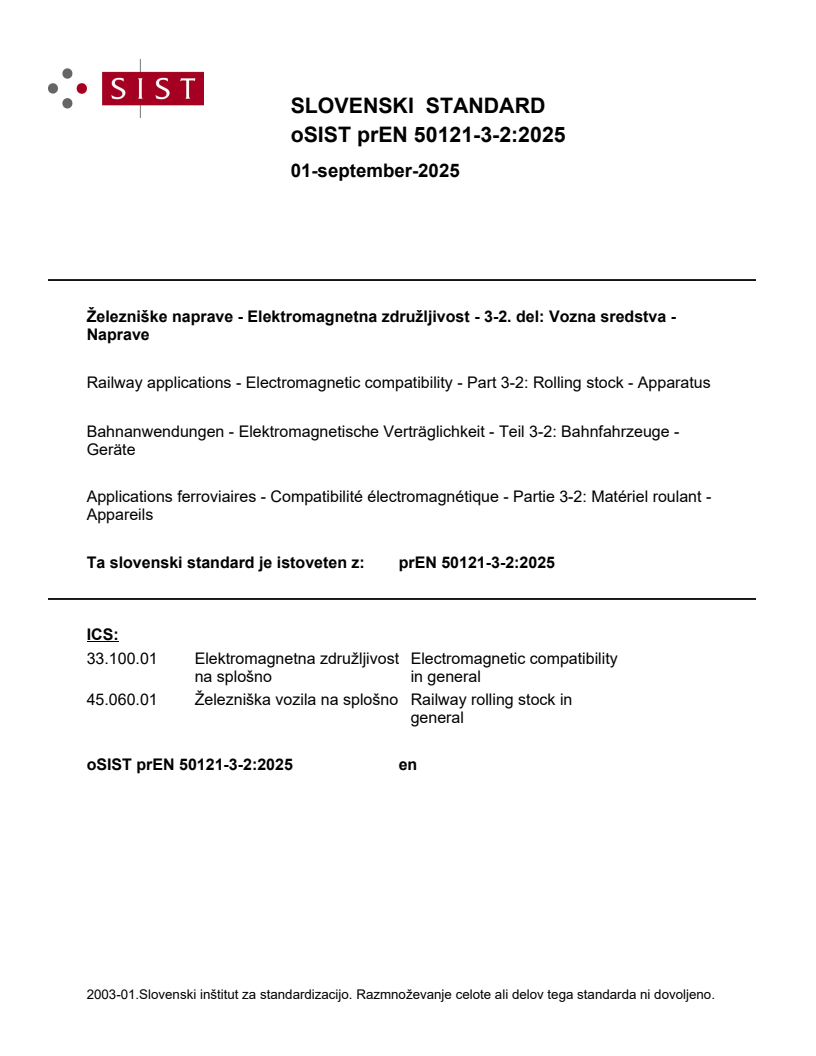
SLOVENSKI STANDARD
01-september-2025
Železniške naprave - Elektromagnetna združljivost - 3-2. del: Vozna sredstva -
Naprave
Railway applications - Electromagnetic compatibility - Part 3-2: Rolling stock - Apparatus
Bahnanwendungen - Elektromagnetische Verträglichkeit - Teil 3-2: Bahnfahrzeuge -
Geräte
Applications ferroviaires - Compatibilité électromagnétique - Partie 3-2: Matériel roulant -
Appareils
Ta slovenski standard je istoveten z: prEN 50121-3-2:2025
ICS:
33.100.01 Elektromagnetna združljivost Electromagnetic compatibility
na splošno in general
45.060.01 Železniška vozila na splošno Railway rolling stock in
general
2003-01.Slovenski inštitut za standardizacijo. Razmnoževanje celote ali delov tega standarda ni dovoljeno.
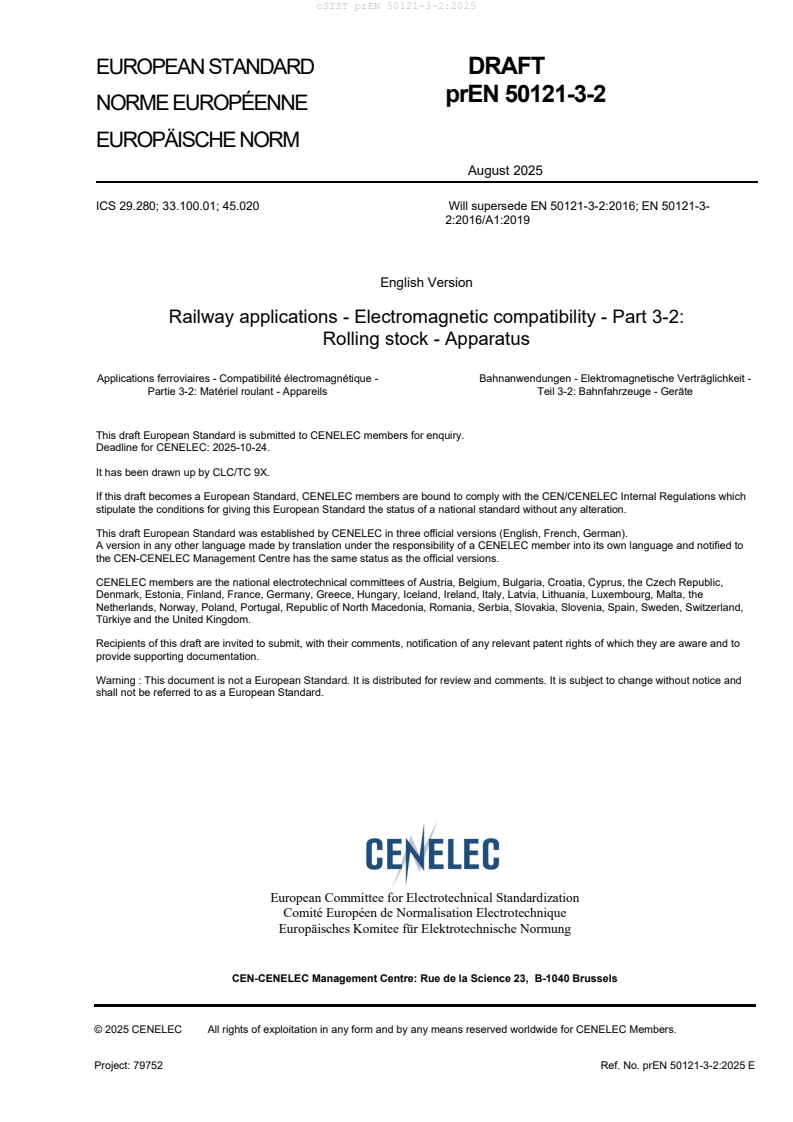
EUROPEAN STANDARD DRAFT
prEN 50121-3-2
NORME EUROPÉENNE
EUROPÄISCHE NORM
August 2025
ICS 29.280; 33.100.01; 45.020 Will supersede EN 50121-3-2:2016; EN 50121-3-
2:2016/A1:2019
English Version
Railway applications - Electromagnetic compatibility - Part 3-2:
Rolling stock - Apparatus
Applications ferroviaires - Compatibilité électromagnétique - Bahnanwendungen - Elektromagnetische Verträglichkeit -
Partie 3-2: Matériel roulant - Appareils Teil 3-2: Bahnfahrzeuge - Geräte
This draft European Standard is submitted to CENELEC members for enquiry.
Deadline for CENELEC: 2025-10-24.
It has been drawn up by CLC/TC 9X.
If this draft becomes a European Standard, CENELEC members are bound to comply with the CEN/CENELEC Internal Regulations which
stipulate the conditions for giving this European Standard the status of a national standard without any alteration.
This draft European Standard was established by CENELEC in three official versions (English, French, German).
A version in any other language made by translation under the responsibility of a CENELEC member into its own language and notified to
the CEN-CENELEC Management Centre has the same status as the official versions.
CENELEC members are the national electrotechnical committees of Austria, Belgium, Bulgaria, Croatia, Cyprus, the Czech Republic,
Denmark, Estonia, Finland, France, Germany, Greece, Hungary, Iceland, Ireland, Italy, Latvia, Lithuania, Luxembourg, Malta, the
Netherlands, Norway, Poland, Portugal, Republic of North Macedonia, Romania, Serbia, Slovakia, Slovenia, Spain, Sweden, Switzerland,
Türkiye and the United Kingdom.
Recipients of this draft are invited to submit, with their comments, notification of any relevant patent rights of which they are aware and to
provide supporting documentation.
Warning : This document is not a European Standard. It is distributed for review and comments. It is subject to change without notice and
shall not be referred to as a European Standard.
European Committee for Electrotechnical Standardization
Comité Européen de Normalisation Electrotechnique
Europäisches Komitee für Elektrotechnische Normung
CEN-CENELEC Management Centre: Rue de la Science 23, B-1040 Brussels
© 2025 CENELEC All rights of exploitation in any form and by any means reserved worldwide for CENELEC Members.
Project: 79752 Ref. No. prEN 50121-3-2:2025 E
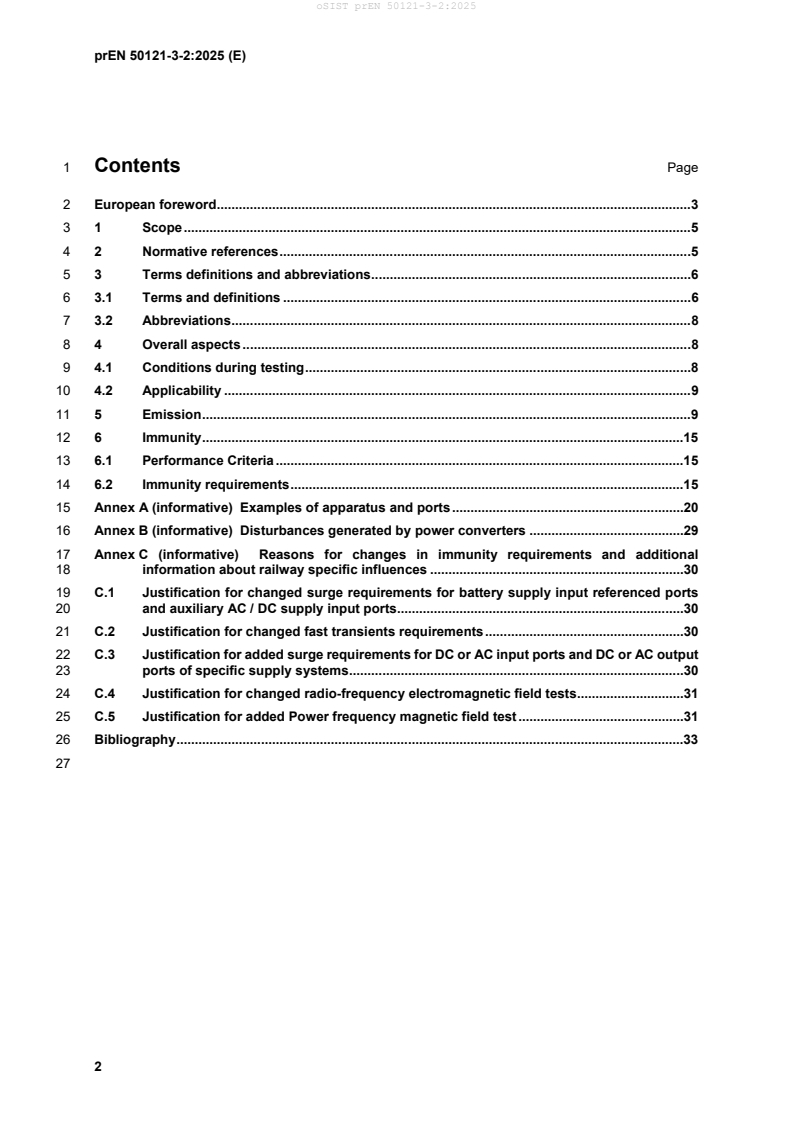
1 Contents Page
2 European foreword . 3
3 1 Scope . 5
4 2 Normative references . 5
5 3 Terms definitions and abbreviations . 6
6 3.1 Terms and definitions . 6
7 3.2 Abbreviations . 8
8 4 Overall aspects . 8
9 4.1 Conditions during testing . 8
10 4.2 Applicability . 9
11 5 Emission . 9
12 6 Immunity .15
13 6.1 Performance Criteria .15
14 6.2 Immunity requirements .15
15 Annex A (informative) Examples of apparatus and ports .20
16 Annex B (informative) Disturbances generated by power converters .29
17 Annex C (informative) Reasons for changes in immunity requirements and additional
18 information about railway specific influences .30
19 C.1 Justification for changed surge requirements for battery supply input referenced ports
20 and auxiliary AC / DC supply input ports.30
21 C.2 Justification for changed fast transients requirements .30
22 C.3 Justification for added surge requirements for DC or AC input ports and DC or AC output
23 ports of specific supply systems .30
24 C.4 Justification for changed radio-frequency electromagnetic field tests .31
25 C.5 Justification for added Power frequency magnetic field test .31
26 Bibliography .33
28 European foreword
29 This document (prEN 50121-3-2:2025) has been prepared by CLC/TC 9X “Electrical and electronic
30 applications for railways”.
31 This document is currently submitted to the Enquiry.
32 The following dates are proposed:
• latest date by which the existence of this (doa) dav + 6 months
document has to be announced at national
level
• latest date by which this document has to be (dop) dav + 12 months
implemented at national level by publication of
an identical national standard or by
endorsement
• latest date by which the national standards (dow) dav + 36 months
conflicting with this document have to be (to be confirmed or
withdrawn modified when voting)
33 This document has been prepared according to Decision 69/09 taken during the TC 9X meeting.
34 This document will supersede EN 50121-3-2:2016.
35 prEN 50121-3-2:2025 includes the following significant technical changes with respect to
36 EN 50121-3-2:2016:
37 — clarification added in scope, last paragraph;
38 — update of normative references;
39 — update of terms and definitions and abbreviations;
40 — new structure with Clause 4: Overall aspects, Clause 5: Emission and Clause 6: Immunity;
41 — conditions during testing summarized in new Clause 4.1;
42 — applicability summarized in new Clause 4.2;
43 — clarification of Clause 5, Emission;
44 — update of Tables 1 and 2, introduction of new Table 3 in Clause 5, Emission;
45 — update of Tables 4 to 6 in Clause 6, Immunity;
46 — update of informative Annex A, clarification in last sentence of first paragraph, new Figures A.6 and
47 A.7 included, new ports 23 and 24 added in Table A.2 and following figures;
48 — new informative Annex C with reasons for new immunity requirements and additional information
49 about railway specific influences included;
50 — deletion of Annex ZZ.
51 This European Standard is read in conjunction with prEN 50121-1:2025.
52 This standard forms Part 3-2 of the European Standard series EN 50121, published under the general
53 title “Railway applications - Electromagnetic compatibility”. The series consists of:
54 — Part 1: General;
55 — Part 2: Emission of the whole railway system to the outside world;
56 — Part 3-1: Rolling stock - Train and complete vehicle;
57 — Part 3-2: Rolling stock – Apparatus;
58 — Part 4: Emission and immunity of the signalling and telecommunications apparatus;
59 — Part 5: Emission and immunity of fixed power supply installations and apparatus.
60 1 Scope
61 This document applies to emission and immunity aspects of EMC for electrical and electronic apparatus
62 intended for use on railway rolling stock. prEN 50121-3-2:2025 applies for the integration of apparatus
63 on rolling stock.
64 The test frequency range defined in this document is considered to ensure the electromagnetic
65 compatibility of the apparatus in the whole frequency range from 0 Hz (DC) to 400 GHz.
66 The application of tests depends on the particular apparatus, its configuration, its ports, its technology
67 and its operating conditions.
68 This document takes into account the internal environment of the railway rolling stock and the external
69 environment of the railway, and interference to the apparatus from equipment such as hand-held radio-
70 transmitters.
71 This document does not apply to transient emissions when starting or stopping the apparatus.
72 The objective of this document is to define limits and test methods for electromagnetic emissions and
73 immunity test requirements in relation to conducted and radiated disturbances.
74 These limits and tests represent essential electromagnetic compatibility requirements.
75 Emission requirements have been selected so as to ensure that disturbances generated by the
76 apparatus operated normally on railway rolling stock do not exceed a level which could prevent other
77 apparatus from operating as intended.
78 Likewise, the immunity requirements have been selected so as to ensure an adequate level of immunity
79 for rolling stock apparatus.
80 Test requirements are specified for each port considered.
81 AC and DC traction power ports (see Table A.2) are not covered in this document.
82 2 Normative references
83 The following documents are referred to in the text in such a way that some or all of their content
84 constitutes requirements of this document. For dated references, only the edition cited applies. For
85 undated references, the latest edition of the referenced document (including any amendments) applies.
86 prEN 50121-1:2025, Railway applications - Electromagnetic compatibility - Part 1: General
87 EN 50155:2021, Railway applications - Rolling stock - Electronic equipment
88 EN 55016-1-1:2019, Specification for radio disturbance and immunity measuring apparatus and
89 methods - Part 1-1: Radio disturbance and immunity measuring apparatus - Measuring apparatus
90 (CISPR 16-1-1:2019)
91 EN 55016-1-2:2014, Specification for radio disturbance and immunity measuring apparatus and
92 methods - Part 1-2: Radio disturbance and immunity measuring apparatus - Coupling devices for
93 conducted disturbance measurements
94 EN 55016-1-4:2019, Specification for radio disturbance and immunity measuring apparatus and
95 methods - Part 1-4: Radio disturbance and immunity measuring apparatus - Antennas and test sites for
96 radiated disturbance measurements (CISPR 16-1-4:2019)
97 EN 55016-1-6:2015 , Specification for radio disturbance and immunity measuring apparatus and
98 methods - Part 1-6: Radio disturbance and immunity measuring apparatus - EMC antenna calibration
99 (CISPR 16-1-6:2014)
As impacted by EN 55016-1-2:2014/A1:2018.
As impacted by EN 55016-1-6:2015/A1:2017 and EN 55016-1-6:2015/A2:2022.
100 EN 55016-2-1:2014, Specification for radio disturbance and immunity measuring apparatus and
101 methods - Part 2-1: Methods of measurement of disturbances and immunity - Conducted disturbance
102 measurements (CISPR 16-2-1:2014)
103 EN 55016-2-3:2017, Specification for radio disturbance and immunity measuring apparatus and
104 methods - Part 2-3: Methods of measurement of disturbances and immunity - Radiated disturbance
105 measurements (CISPR 16-2-3:2016)
106 EN 61000-4-2:2009, Electromagnetic compatibility (EMC) - Part 4-2: Testing and measurement
107 techniques - Electrostatic discharge immunity test (IEC 61000-4-2:2008)
108 EN IEC 61000-4-3:2020, Electromagnetic compatibility (EMC) - Part 4-3 : Testing and measurement
109 techniques - Radiated, radio-frequency, electromagnetic field immunity test (IEC 61000-4-3:2020)
110 EN 61000-4-4:2012, Electromagnetic compatibility (EMC) - Part 4-4: Testing and measurement
111 techniques - Electrical fast transient/burst immunity test (IEC 61000-4-4:2012)
112 EN 61000-4-5:2014, Electromagnetic compatibility (EMC) - Part 4-5: Testing and measurement
113 techniques - Surge immunity test (IEC 61000-4-5:2014)
114 EN IEC 61000-4-6:2023, Electromagnetic compatibility (EMC) - Part 4-6: Testing and measurement
115 techniques - Immunity to conducted disturbances, induced by radio-frequency fields (IEC 61000-4-
116 6:2023)
117 EN 61000-4-8:2010, Electromagnetic compatibility (EMC) - Part 4-8: Testing and measurement
118 techniques - Power frequency magnetic field immunity test (IEC 61000-4-8:2009)
119 EN IEC 61000-4-20:2022, Electromagnetic compatibility (EMC) - Part 4-20: Testing and measurement
120 techniques - Emission and immunity testing in transverse electromagnetic (TEM) waveguides (IEC
121 61000-4-20:2022)
122 EN 61000-4-30:2015, Electromagnetic compatibility (EMC) - Part 4-30: Testing and measurement
123 techniques - Power quality measurement methods
124 EN IEC 61000-6-4:2019, Electromagnetic compatibility (EMC) - Part 6-4: Generic standards - Emission
125 standard for industrial environments (IEC 61000-6-4:2018)
126 IEC 60050-161:1990, International Electrotechnical Vocabulary. Chapter 161: Electromagnetic
127 compatibility
128 ETSI EN 301-489-1, V2.2.3, (11/2019), ElectroMagnetic Compatibility (EMC) standard for radio
129 equipment and services; Part 1: Common technical requirements; Harmonised Standard for
130 ElectroMagnetic Compatibility
131 ETSI EG 203 367 V1.1.1 (06/2016), Guide to the application of harmonised standards covering articles
132 3.1b and 3.2 of the Directive 2014/53/EU (RED) to multi-radio and combined radio and non-radio
133 equipment
134 3 Terms definitions and abbreviations
135 3.1 Terms and definitions
136 For the purposes of this document, the terms and definitions given in IEC 60050-161:1990 and the
137 following apply.
As impacted by EN 55016-2-1:2014/A1:2017 and EN 55016-2-1:2014/AC:2020-09.
As impacted by EN 55016-2-3:2017/A1:2019 and EN 55016-2-3:2017/A2:2023.
As impacted by EN 61000-4-30:2015/A1:2015 and EN 61000-4-30:2015/AC:2017-01.
138 ISO and IEC maintain terminology databases for use in standardization at the following addresses:
139 — ISO Online browsing platform: available at https://www.iso.org/obp/
140 — IEC Electropedia: available at https://www.electropedia.org/
141 3.1.1
142 apparatus
143 device or assembly of devices which can be used as an independent unit for specific functions
144 3.1.2
145 port
146 particular interface of an equipment which couples this equipment with
147 the external electromagnetic environment (161-01-01) and through which the equipment is influenced
148 by this environment
149 EXAMPLE Examples of ports of interest are shown in Figure 1. The enclosure port is the physical boundary
150 of the apparatus (e.g. enclosure). The enclosure port provides for radiated and electrostatic discharge (161-01-22)
151 energy transfer, whereas the other ports provide for conducted energy transfer.
154 Figure 1 — Equipment ports
155 Note 1 to entry: Ports in the subject area of electromagnetic compatibility are specific cases of the port
156 defined in 131-12-60.
157 Note 2 to entry: Typical examples of rolling stock apparatus with their ports are listed in informative Annex A.
158 [SOURCE: IEC 60050-161:1990, 161-01-27, modified – added note 2 to entry]
159 3.1.3
160 power port
161 high voltage port of auxiliary directly supplied from the traction DC link, only excluding the 3 Phase
162 output (resulting auxiliary system, supplying the auxiliaries of the train / locomotive), distinguishing
163 between auxiliary systems only with elements dedicated to each other and those being ‘open’
164 Note 1 to entry: Also, any kind of connection to the traction system from traction battery systems, except those
165 probably directly feeding auxiliary systems.
166 Note 2 to entry: Also, any kind of connection to the traction system from fuel cell systems, except those probably
167 directly feeding auxiliary systems.
168 Note 3 to entry: Also, any kind of main (already in the standard) or auxiliary Diesel engine/generator connection
169 to the traction system, except for those probably directly feeding auxiliary systems.
170 EXAMPLE DC bus of traction converter, traction battery, fuel cell.
171 3.1.4
172 battery supply port
173 port connected to the battery of the train
174 3.1.5
175 supply port
176 auxiliary AC or DC supply port (input and output)
177 EXAMPLE 230 V AC input / output from aux. converter, 24V DC)
178 3.1.6
179 specific AC or DC supply system
180 supply system, not directly connected to the battery voltage supply system (see Figure A.7)
181 3.1.7
182 battery referenced port
183 port directly connected (with at least one pole or without galvanic isolation) to the battery
184 3.2 Abbreviations
185 For the purposes of this document, the following abbreviations apply.
AC Alternating Current
AM Amplitude Modulation
AMN Artificial Mains Network
CISPR Comité International Spécial des Perturbations Radioélectriques
DC Direct Current
EMC Electro Magnetic Compatibility
ETSI European Telecommunications Standards Institute
EUT Equipment Under Test
FAR Fully Anechoic Room
FSOATS Free Space Open Area Test Site
I/O Input / Output
OATS Open Area Test Site
PC Personal Computer
RED Radio Equipment Directive
RMS Root Mean Square
SAC Semi Anechoic Chamber
TEM Transverse Electromagnetic Mode
THD Total Harmonic Distortion
TV Television
186 4 Overall aspects
187 4.1 Conditions during testing
188 It is not always possible to test every function of the apparatus. The tests shall be made at a typical
189 operating mode considered by the manufacturer to produce the largest emission or maximum
190 susceptibility as appropriate in the frequency band being investigated consistent with normal
191 applications. The conditions during testing shall be defined in a test plan.
192 If the apparatus is part of a system, or can be connected to auxiliary apparatus, then the apparatus shall
193 be tested while connected to the representative configuration considering the auxiliary apparatus and
194 the cabling necessary to exercise the ports.
195 The configuration, cabling and mode of operation shall be specified in the test plan.
196 If the apparatus has a large number of identical ports (same input or output electronic circuits, loads,
197 connected equipment, etc.), then the following rules apply:
198 — For conducted emission and immunity measurements at least one of the identical ports with worst-
199 case conditions (or more than one if needed) shall be selected for testing to ensure that all different
200 types of ports are covered.
201 — For radiated emission measurements a sufficient number of the identical ports shall be selected to
202 simulate worst-case operating conditions and to ensure that all the different types of termination
203 are covered.
204 The tests shall be carried out at the specified nominal power supply voltage.
205 For equipment with a wide input voltage range the following rules apply:
206 — For emission tests (conducted and radiated) equipment shall be tested at its lowest specified
207 nominal voltage and its highest specified nominal input voltage.
208 (e.g.: equipment specified for a wide input voltage range DC 24 V – DC 48 V: the emission tests
209 are carried out at DC 24 V and at DC 48 V – equipment specified for a wide input voltage range DC
210 24 V – DC 110 V: the emission tests are carried out at DC 24 V and at DC 110 V).
211 — For immunity tests (conducted and radiated) equipment shall be tested at its highest specified
212 nominal input voltage.
213 (e.g.: equipment specified for a wide input voltage range DC 24 V – DC 48 V: the immunity tests
214 are carried out at DC 48 V – equipment specified for a wide input voltage range DC 24 V – DC
215 110 V: the immunity tests are carried out at DC 110 V).
216 4.2 Applicability
217 The measurements in this document shall be made on the relevant ports of the apparatus.
218 It may be determined from consideration of the electrical characteristics, the connection and the usage
219 of a particular apparatus that some of the tests are not applicable (e.g. radiated immunity of induction
220 motors, transformers; see Table A.1 for additional information). The justification not to test has to be
221 recorded in the test plan and test report.
222 Regarding radiated emission traction converters and auxiliary converters over 50 kVA cannot be tested
223 individually but when the vehicle is tested as a whole in accordance with prEN 50121-3-1:2025.
224 If not otherwise specified, the EMC tests shall be type tests.
225 Apparatus in compliance with prEN 50121-3-2:2025 which is incorporated into a rolling stock does not
226 affect the already proven compliance of the rolling stock with prEN 50121-3-1:2025.
227 Apparatus in the scope of the radio equipment directive (RED) shall comply with the EMC-requirements
228 given in this document except for radio function in the exclusion frequency bands defined in the relevant
229 ETSI EMC standards (if exist) or otherwise in Clause 4.3 of ETSI EN 301 489-1, V2.2.3 (11/2019).
230 For combined equipment according ETSI EG 203 367 V1.1.1 Emission or immunity tests shall be
231 performed in the exclusion frequency bands in order to evaluate non-radio functions. For radio function
232 in the exclusion band the possible performance degradation (e.g. emission level higher than the limits
233 defined in this document or degradation in performance during the immunity tests) shall be accepted
234 and detailed in the EMC test report”.
235 No specific tests are defined for earth ports, due to the high conductivity and low impedance of the
236 vehicle body.
237 5 Emission
238 The emission tests and limits for apparatus covered by this standard are given on a port by port basis.
239 Measurements shall be performed in well-defined and reproducible conditions for each type of
240 disturbance.
241 No transient emission tests are needed, because their effect is considered to be covered by the test
242 levels applied during the transient immunity tests.
243 The test requirements for conducted emissions, with which the equipment shall comply, are given in
244 Table 1 and 2
245 The enclosure port of the equipment shall comply with the radiated emission test requirements defined
246 in EN IEC 61000-6-4:2019, Clause 9. For a better reading of this document, part of the test requirements
247 for radiated emissions for the enclosure port are reproduced in Table 3.
248 The description of the test, the test methods and the test set-up are given in Basic Standards which are
249 referred to in Tables 1, 2 and 3.
250 The contents of these Basic Standards are not repeated here, however modifications or additional
251 information needed for the practical application of the tests are given in this document.
252 NOTE The reference to “Basic Standard“ is intended to be limited to those parts of the standard that give the
253 description of the test, the test methods and the test set-up.
254 Table 1 — Conducted emission – Auxiliary AC or DC supply ports (input and output), ports connected to a specific supply system (DC or AC)
Table Measurement Frequency Limits Measurement specifics Limitations and restrictions
a, b, and c
clause network range
dB(µV)
MHz
Detector
1.1 AMN 0,15 to 0,5 99 Instrumentation, EN 55016-1-1:2019, Clauses 4 Relevant for port 9, 16 and
and 6 24 in Figures A.1 to A.7.
Quasi-peak
Networks, EN 55016-1-2:2014, 4.4
0,5 to 30 93
Method, EN 55016-2-1:2014, Clause 7
Quasi-peak
Set-up, EN 55016-2-1:2014, Clause 7
1.2 50 Hz to THD < 8 % EN 61000-4-30 This test only apply to AC
supply outlet port for public
2 kHz (THD: total harmonic
use only
distortion)
d
The AMN characteristics shall be 50 Ω / 50 μH as defined in EN 55016-1-2:2014, 4.4, unless this network interferes with the operation of the EUT. In these
cases, the AMN characteristics
...