

oSIST prEN 18462:2026
(Main)Furniture - Circularity - Evaluation method for maintenance, repair and refurbishing capability
- Abstract
This document provides an evaluation method including a set of criteria for evaluating the ability of priority parts of products to be maintained, repaired and refurbished that lead to an extension of the lifetime of a product.
The evaluation criteria are intended to support the user in designing a product which can be easily maintained, repaired and refurbished irrespective of materials or construction methods used.
The evaluation method does not include usefulness and/or cost-effectiveness of the repair and refurbishment or assessing the overall degree of circularity of furniture products. For this additional complementary evaluation methods for other aspects are necessary.
- Status
- Not Published
- Public Enquiry End Date
- 02-Jan-2027
- Technical Committee
- POH - Furniture
- Current Stage
- 4020 - Public enquire (PE) (Adopted Project)
- Start Date
- 02-Nov-2026
- Due Date
- 22-Mar-2027

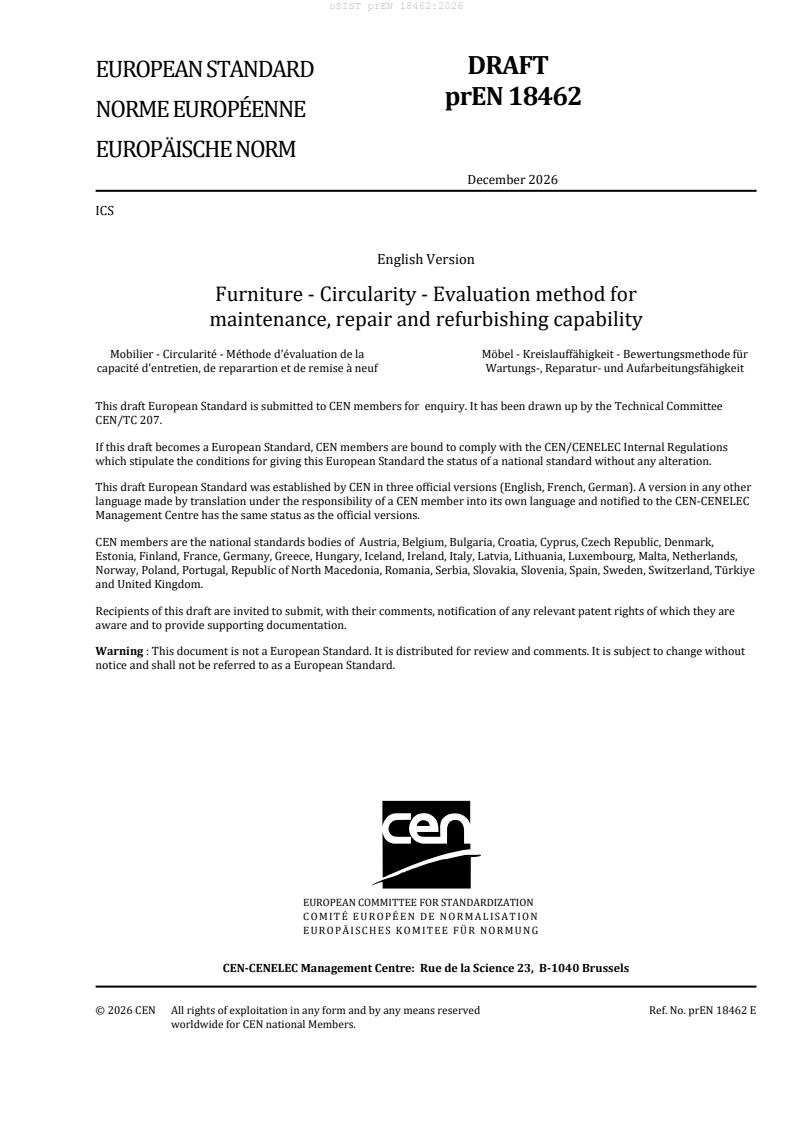
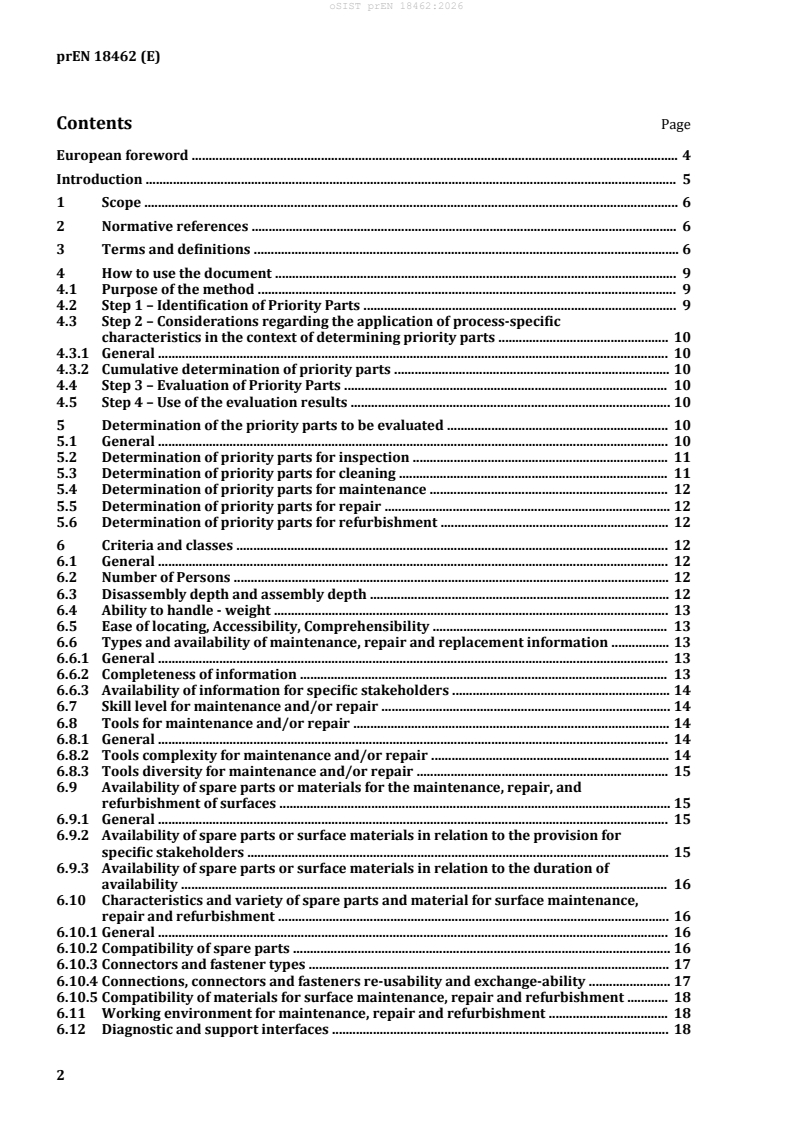
oSIST prEN 18462:2026 is a draft European Standard from the European Committee for Standardization (CEN) on furniture circularity. It specifies an evaluation method for deciding whether priority parts of furniture can be maintained, repaired and refurbished so the product life can be extended. The method is aimed at designers, engineers, manufacturers and quality managers who need a common way to judge and compare design choices.
What does oSIST prEN 18462:2026 specify?
oSIST prEN 18462:2026 specifies a criterion-based method for evaluating the maintainability, repairability and refurbishing capability of priority parts of furniture. It focuses on how easily those parts can be handled in practice, rather than on the economic value of repair or on an overall circularity score.
The document is organized into scope, terms and definitions, guidance on how to use the method, rules for determining priority parts, and criteria and classes for evaluation. Clause 2 states that there are no normative references.
The informative annexes expand the main method and show how to apply it.
| Annex | What it covers |
|---|---|
| Annex A | Structure and content of instructions related to this document |
| Annex B | Criteria for the ability to maintain, repair and refurbish |
| Annex C | Determination of the priority parts |
What are the key requirements of oSIST prEN 18462:2026?
oSIST prEN 18462:2026 sets out a stepwise method: identify priority parts, evaluate them against defined criteria, then use the results to improve the product design. In practice, that means the document is meant to support design decisions, not to certify a product or rank it by a single score.
1. Identify priority parts before evaluating anything
Clause 5 says the manufacturer should first determine which parts matter most for function, reliability, durability and lifespan. Parts linked to the product’s primary or secondary function, and parts that affect surface technical function, are the main focus.
This matters because not every part needs the same level of attention. The method is built around parts whose failure or wear would most strongly affect the furniture’s use.
2. Use the right evidence when selecting priority parts
Clause 5 points to multiple sources for identifying priority parts, including regulatory requirements, the manufacturer, suppliers, repair or maintenance organizations, scientific literature, study reports and customer feedback. For products already on the market, it also points to complaint data, physical testing, material and part testing and calculations such as FEM. For new designs, it adds testing and risk analysis such as FMEA.
In practice, the user is expected to base the prioritization on evidence, not guesswork. That helps make the evaluation defendable and repeatable.
3. Treat inspection, cleaning, maintenance, repair and refurbishment as related but different processes
Clause 5 separates the processes and explains how they relate. Inspection applies to the whole product, cleaning focuses on visible parts and soiling, maintenance keeps the product in a condition for its intended purpose, repair restores a defective product or part, and refurbishment combines inspection, maintenance and repair.
This matters because the same part can be relevant for one process and not another. It also means refurbishment is assessed as the combined case, so its priority parts include those found for inspection, maintenance and repair.
4. Evaluate each priority part with the clause 6 criteria
Clause 6 uses ordered classes for the main practical factors that affect maintainability and repairability. These include the number of persons needed, disassembly and assembly depth, ability to handle weight, ease of locating and accessing parts, and the comprehensibility of connections.
For a designer, this means the product should be arranged so that priority parts are reachable, understandable and removable without unnecessary effort. For a buyer or quality manager, it gives a way to compare different designs or suppliers on practical repair effort.
5. Check whether the necessary information is available to the right people
Clause 6 also evaluates the completeness of cleaning, maintenance and repair information, and whether that information is available to relevant stakeholders, independent service providers or manufacturer-authorized service providers. Annex A gives a recommended structure for instructions, including safety information, tools, preparatory measures, maintenance plans, diagnosis, spare parts, dis/re-assembly and repair procedures.
This matters because a part may be physically repairable but still difficult to service if the instructions are unclear or unavailable. The document therefore treats information access as part of circular design.
6. Consider skills, tools, spare parts, materials and interfaces
Clause 6 includes criteria for the skill level required, the complexity and diversity of tools, the availability and compatibility of spare parts and surface materials, the reusability or exchangeability of connectors and fasteners, the working environment, and diagnostic and support interfaces. Annex B shows which criteria apply to maintenance, repair and refurbishment, and which apply differently for repair cases such as replacing a defective part, repairing a removed part and reinstalling it, or repairing a part in place.
In practice, this means the product should be designed for the level of service access that will actually be needed. If a special workshop, special tools or manufacturer access is required, that affects the evaluation.
7. Use the results to improve the design
Clause 4 says the results can be documented in tables or matrices, compared across design options or suppliers, and used to improve the product by simplifying disassembly or extending spare-part availability. Annex C supports this with a process flow and examples.
This is the practical purpose of the document: not just to score a product, but to show where design changes can improve repair and refurbishment capability.
What terms does oSIST prEN 18462:2026 define?
oSIST prEN 18462:2026 defines the terms used to evaluate furniture circularity so readers can apply the method consistently.
- Product - a furniture object used in domestic, office, public, outdoor, educational or other institutional settings; in this document, product and furniture can be used synonymously.
- Part - a sub-unit of a product, including connectors and fasteners, and it may be an assembly, sub-assembly or component.
- Inspection - the process of examining a product so that parts needing maintenance or repair can be identified.
- Maintenance - actions taken to keep a product in a condition where it can fulfil its intended purpose.
- Repair - actions taken to return a defective product or part to a condition where it fulfils its intended purpose.
- Refurbishment - actions to prepare, clean, test, service and, where necessary, repair a product so that its performance or functionality is restored within the original intended use and performance range.
- Lifespan - the period during which the product functions for its intended purpose.
- Surface technical function - a secondary function of the outer layer of a product that serves protection, hygiene or functional improvement; the document treats surface overall appearance as a separate, tertiary matter.
Who uses oSIST prEN 18462:2026?
oSIST prEN 18462:2026 is intended for furniture designers, engineers, manufacturers and quality managers. It gives them a common method for designing products so that priority parts are easier to maintain, repair and refurbish.
It is also useful for organizations that evaluate repairability and refurbishing conditions, such as maintenance and repair providers, product suppliers and teams comparing design variants or suppliers. The document is especially relevant during the design and construction phase, when decisions about parts, interfaces, instructions and spare-part strategy have the biggest effect.
Which standards are used with oSIST prEN 18462:2026?
oSIST prEN 18462:2026 states that there are no normative references, but it cites several standards as sources for terms and related methods.
| Standard | What it contributes |
|---|---|
| EN 17902:2023 | Provides related circularity terminology and an aligned dis/re-assembly capability context; Annex A also points to its informative Annex I for dis/re-assembly instructions |
| EN 45560:2024 | Supplies the definition of component |
| EN 45552:2020 | Supplies the definition of primary function |
| EN 62542:2013 | Supplies the definitions of secondary function and tertiary function |
| EN 15338 | Appears in Annex C as an example for drawer runner reliability levels |
What does the oSIST prEN 18462:2026 document contain?
oSIST prEN 18462:2026 contains class tables for the practical factors that affect maintenance, repair and refurbishing capability, including people needed, steps required, weight, access, information, skills, tools, spare parts, compatibility, working environment and diagnostic interfaces. These tables are used for design evaluation and comparison, not for reproducing a repair procedure.
Annex A sets out the content that maintenance, repair and refurbishment instructions should cover, from safety information and tools to diagnosis, spare parts and substantial modifications. Annex B maps which criteria apply to maintenance, repair and refurbishment, and distinguishes among three repair cases.
Annex C provides a flowchart for determining priority parts and a worked drawer example showing how intended use, reliability and design quality affect the priority-part decision. It is intended to help users apply Clause 5 in practice when evaluating real furniture designs.
Frequently Asked Questions
oSIST prEN 18462:2026 is a draft published by the Slovenian Institute for Standardization (SIST). Its full title is "Furniture - Circularity - Evaluation method for maintenance, repair and refurbishing capability". This standard covers: This document provides an evaluation method including a set of criteria for evaluating the ability of priority parts of products to be maintained, repaired and refurbished that lead to an extension of the lifetime of a product. The evaluation criteria are intended to support the user in designing a product which can be easily maintained, repaired and refurbished irrespective of materials or construction methods used. The evaluation method does not include usefulness and/or cost-effectiveness of the repair and refurbishment or assessing the overall degree of circularity of furniture products. For this additional complementary evaluation methods for other aspects are necessary.
This document provides an evaluation method including a set of criteria for evaluating the ability of priority parts of products to be maintained, repaired and refurbished that lead to an extension of the lifetime of a product. The evaluation criteria are intended to support the user in designing a product which can be easily maintained, repaired and refurbished irrespective of materials or construction methods used. The evaluation method does not include usefulness and/or cost-effectiveness of the repair and refurbishment or assessing the overall degree of circularity of furniture products. For this additional complementary evaluation methods for other aspects are necessary.
oSIST prEN 18462:2026 is classified under the following ICS (International Classification for Standards) categories: 97.140 - Furniture. The ICS classification helps identify the subject area and facilitates finding related standards.
oSIST prEN 18462:2026 is associated with the following European legislation: EU Directives/Regulations: 2009/125/EC. When a standard is cited in the Official Journal of the European Union, products manufactured in conformity with it benefit from a presumption of conformity with the essential requirements of the corresponding EU directive or regulation.
oSIST prEN 18462:2026 is available in PDF format for immediate download after purchase. The document can be added to your cart and obtained through the secure checkout process. Digital delivery ensures instant access to the complete standard document.
Standards Content (Sample)
Contents
- Introduction
- 1 Scope
- 2 Normative references
- 3 Terms and definitions
- 3.1 product
- 3.2 component
- 3.3 part
- 3.4 inspection
- 3.5 cleaning
- 3.6 maintenance
- 3.7 repair
- 3.8 refurbishment
- 3.9 lifespan
- 3.10 function
- 3.11 primary function
- 3.12 secondary function
- 3.13 tertiary function
- 3.14 reliability
- 3.15 durability
- 3.16 surface
- 3.17 surface technical function
- 3.18 Surface overall appearance
- 3.19 surface reliability
- 3.20 surface durability
- 3.21 disassembly step
- 3.22 assembly step
- 4 How to use the document
- 4.1 Purpose of the method
- 4.2 Step 1 – Identification of Priority Parts
- 4.3 Step 2 – Considerations regarding the application of process-specific
- 4.4 Step 3 – Evaluation of Priority Parts
- 4.5 Step 4 – Use of the evaluation results
- 5 Determination of the priority parts to be evaluated
- 5.1 General
- 5.2 Determination of priority parts for inspection
- 5.3 Determination of priority parts for cleaning
- 5.4 Determination of priority parts for maintenance
- 5.5 Determination of priority parts for repair
- 5.6 Determination of priority parts for refurbishment
- 6 Criteria and classes
- 6.1 General
- 6.2 Number of Persons
- 6.3 Disassembly depth and assembly depth
- 6.4 Ability to handle - weight
- 6.5 Ease of locating, Accessibility, Comprehensibility
- 6.6 Types and availability of maintenance, repair and replacement information
- 6.7 Skill level for maintenance and/or repair
- 6.8 Tools for maintenance and/or repair
- 6.9 Availability of spare parts or materials for the maintenance, repair, and
- 6.11 Working environment for maintenance, repair and refurbishment
- 6.12 Diagnostic and support interfaces
- Annex A
- Annex B
- Annex C
- Bibliography
Introduction
Core elements for sustainable products and their circularity are in the longevity of products and the supporting measures and strategies to extend the lifespan of products. These measures include the maintenance, repair and refurbishment of products and/or their parts and/or their surfaces. They thus reflect the terms addressed in current European legislation Proposal for Ecodesign for Sustainable Products Regulation[1].
The decision as to whether a furniture or parts including their surfaces, should be repaired or refurbished depends on a number of factors. These may be economic, legal and/or sustainability aspects. When considering the parts, the concept of prioritising parts is applied, which is mentioned by the Joint Research Centre of the EU Commission in its study on ESPR and has already been applied in EN 17902:2023 [2].
In addition, occupational health and safety can be taken into account during maintenance, repair and refurbishment.
This document provides an evaluation method and thus expertise for the design and construction phase of the products and their priority parts.
This document is intended to support designers and engineers in designing furniture in such a way that the costs of maintenance, repair and refurbishment after placement on the market can be kept as low as possible.
The costs themselves and the assessment of the economic efficiency of a repair or refurbishment are not considered, since this decision is made by other stakeholders, taking into account other factors such as sustainability aspects and emotional attachment to the furniture. For this purpose, there are defined criteria with corresponding classes for evaluating their implementation and corresponding possibilities for further improvement.
oSIST prEN 18462:2026 prEN 18462 (E)
1 Scope
This document provides an evaluation method including a set of criteria for evaluating the ability of priority parts of products to be maintained, repaired and refurbished that lead to an extension of the lifetime of a product.
The evaluation criteria are intended to support the user of this document in designing a product which can be easily maintained, repaired and refurbished irrespective of materials or construction methods used.
The evaluation method does not consider usefulness and/or cost-effectiveness of the repair and refurbishment.
This document does not include requirements.
For assessing the overall degree of circularity of furniture products, additional complementary evaluation methods need to be considered.
2 Normative references
There are no normative references in this document.
3 Terms and definitions
For the purposes of this document, the following terms and definitions apply. - ISO Online browsing platform: available at http://www.iso.org/obp - IEC Electropedia: available at http://www.electropedia.org/
3.1 product
physical-based object designed or utilized as furniture in domestic, office, public, outdoor areas, educational and other institutions Note 1 to entry: The terms product and furniture can be used synonymously. [SOURCE: EN 17902:2023 [2], 3.1]
3.2 component
constituent of a product (3.1) which cannot be fragmented without losing its particular function (3.10) [SOURCE: EN 45560:2024 [3], 3.3.1]
3.3 part
sub-unit of a product (3.1), including connectors and fasteners as component (3.2) Note 1 to entry: A part can be understood as an assembly, sub-assembly or a component. [SOURCE: EN 17902:2023 [2], 3.2 amended]
3.4 inspection
process in which the product (3.1) is examined for limitations of primary or secondary functions so that parts requiring maintenance (3.6) or repair (3.7) can be identified
oSIST prEN 18462:2026 prEN 18462 (E)
3.5 cleaning
one or more measures carried out to clean the visible parts from soiling and to contribute to the reduction or prevention of signs of wear or impairment of appearance Note 1 to entry: In addition to the regular cleaning of certain parts, cleaning can also serve as a preparatory step for maintenance (e.g. lubrication).
3.6 maintenance
one or more actions carried out to keep a product (3.1) in a condition where it is able to fulfil its intended purpose Note 1 to entry: Cleaning in itself does not constitute maintenance. [SOURCE: [1] REGULATION (EU) 2024/1781, Article 2 (19)]
3.7 repair
one or more actions carried out to return a defective product (3.1) or waste to a condition where it fulfils its intended purpose Note 1 to entry: Repairs are carried out on the product or the part when installed, removing or replacing the part concerned.
Note 2 to entry: The term waste is not considered here because the ESPR definition of refurbishment does not use the term waste and repairing waste does not make sense in the context of this document. [SOURCE: [1] REGULATION (EU) 2024/1781, Article 2 (20)]
3.8 refurbishment
actions carried out to prepare, clean, test, service and, where necessary, repair (3.7) a product (3.1) or a discarded product (3.1) in order to restore its performance or functionality within the intended use and range of performance originally conceived at the design stage at the time of the placing of the product (3.1) on the market [SOURCE: [1] REGULATION (EU) 2024/1781, Article 2 (18)]
3.9 lifespan
time period under which the product (3.1) functions for its intended purpose Note 1 to entry: Lifespan can be based on regulatory requirements or the average or usual reliability (3.14) of products.
3.10 function
intended purpose a product (3.1) is designed for
3.11 primary function
function (3.10) fulfilling the intended use Note 1 to entry: More than one primary function is possible.
[SOURCE: EN 45552:2020 [4], 3.1.2.1]
oSIST prEN 18462:2026 prEN 18462 (E)
3.12 secondary function
function (3.10) that supplements or enhances a primary function (3.11) [SOURCE: EN 62542:2013 [5], 5.14 amended]
3.13 tertiary function
function (3.10) other than a primary function (3.11) or a secondary function (3.12) [SOURCE: EN 62542:2013 [5], 5.16, modified examples deleted]
3.14 reliability
probability that a product (3.1) functions as required under given conditions for a given duration without an occurrence which results in a primary function (3.11) orsecondary function (3.12) of the product (3.1) no longer being performed [SOURCE: [1] REGULATION (EU) 2024/1781, Article 2 (23)]
3.15 durability
ability of a product (3.1) to maintain over time its function (3.10) and performance under specified conditions of use, maintenance (3.6) and repair (3.7) Note 1 to entry: Functional durability includes the possibility of extending the use phase by one or more repairs. [SOURCE: [1] REGULATION (EU) 2024/1781, Article 2 (22)]
3.16 surface
outer boundary of a piece of furniture or parts thereof Note 1 to entry: A surface interacts with its surroundings and the user. Note 2 to entry: A surface includes hard substrates (e.g. solid wood, wood-based materials, stone, plastic) and coverings of soft substrates (e.g. foams).
3.17 surface technical function
is a secondary function (3.12) and refers to the specific design of an outer layer to fulfil practical purposes in terms of protection, hygiene and functional improvement in the position of use
3.18 Surface overall appearance
is a tertiary function (3.13) and results from the overall interaction of visual and tactile properties in the area visible and tangible to the user in the position of use Note 1 to entry: Visual and tactile properties are, e.g. colour, gloss, texture, roughness, reflection and structure.
3.19 surface reliability
probability that a surface (3.16) will maintain its technical function (3.10) under given conditions for a given duration without an occurrence that causes the surface technical function (3.17) no longer be performed Note 1 to entry: Surface resistance as the basis for the reliability of furniture surfaces can be determined using various standards.
oSIST prEN 18462:2026 prEN 18462 (E)
3.20 surface durability
ability of a surface (3.16) to maintain its technical function (3.10) over time under specified conditions of use, maintenance (3.6) and repair (3.7)
3.21 disassembly step
each stage of the process that ends with the removal of a part (3.3) [SOURCE: EN 17902:2023 [2], 3.6]
3.22 assembly step
each stage of the process that ends with the assembly of a part (3.3) [SOURCE: EN 17902:2023 [2], 3.7]
4 How to use the document
4.1 Purpose of the method
The purpose of the methodology described in this document is to develop and design products in such a way that their durability (3.15) is optimized based on the reliability (3.14) of the parts and the ease of maintenance, repair and refurbishing.
By systematically applying this method, manufacturers, their designers and quality managers can ensure that their products have a long lifespan and meet customer expectations. The methodology described in this document is to:
- Identify priority parts of a furniture product in Clause 5.
- Evaluate how easily these parts can be maintained, repaired, or refurbished.
- Use standardized criteria and classes to ensure comparability and transparency. The procedure described in this document is divided into the following steps:
4.2 Step 1 – Identification of Priority Parts
The concept of ‘priority parts’ is based on the recognition that not all parts of a piece of furniture are equally relevant to its functionality and reliability.
A priority part has a strong influence on:
- the functionality (primary function / secondary function) of the product,
- the reliability and durability and thus the lifespan of the product,
- and the technical function of the surface which has an influence on surface reliability (3.19) and surface durability (3.20) .
NOTE 1 The overall appearance of the surface has a subjective design quality function in which subjectively perceptible, personal effects or impressions of the product under consideration and not objectively quantifiable and measurable effects on the functionality of the product play a corresponding role. Therefore, as a tertiary function, the overall appearance cannot be used for assessment in connection with the priority parts and the effect on functionality and reliability.
NOTE 2 Parts that are not visible or are of minor importance in normal use, as well as irregularities that are only visible in raking light, are excluded from the assessment.
oSIST prEN 18462:2026 prEN 18462 (E) There are several sources of information for identifying priority parts as detailed under 5.1. Examples for priority parts see Annex C.
4.3 Step 2 – Considerations regarding the application of process-specific
characteristics in the context of determining priority parts
4.3.1 General
The document considers different processes (inspection (3.4), cleaning (3.5), maintenance (3.6), repair (3.7), refurbishment (3.8)) and their influencing factors and effects in relation to the durability of the product.
4.3.2 Cumulative determination of priority parts
In this approach, the parts to be prioritized are determined directly for the refurbishment process, as this represents the sum of all other processes, as explained in 5.6.
4.4 Step 3 – Evaluation of Priority Parts
Each priority part is evaluated using defined criteria and classes under Clause 6. For detailed information, see Clause 6.
NOTE Table C.1 in Annex C provides an overview of the relevance and applicability of the individual criteria to the respective processes.
4.5 Step 4 – Use of the evaluation results
- Document the evaluation of the prioritised parts in tables or matrices (per criterion, per class).
- Compare different designs (aesthetic and technical solutions), or suppliers.
- Use the results of the evaluation to improve the design in terms of circularity by making changes to previously identified priority parts (e.g. by simplifying disassembly, extending the availability of spare parts) so that they either lead to a different result in the classification or increase the reliability of the part in a way that it is no longer considered as a priority part. For detailed information, see informative Annex C.
5 Determination of the priority parts to be evaluated
5.1 General
In order to assess the ability to maintain, repair or refurbish a product, a list of priority parts needs to be drawn up.
Not all parts are equally relevant for maintenance, repair or refurbishment and therefore priority parts need to be determined by the manufacturer considering the intended use, based on experience or data from products on the market or through testing etc.
In order to carry out this prioritisation, all parts should first be considered in the design process (new design or design revision) in terms of their reliability. To this end, relevant data should be collected and evaluated.
The following list of information sources, which is not exhaustive and, where available, can provide valuable guidance, should be consulted.
- Regulatory requirements;
oSIST prEN 18462:2026 prEN 18462 (E) - Product manufacturer; - Parts manufacturer or supplier; - Repair or maintenance organisations; - Scientific literature and study reports; - Customer feedback.
In the case of products already existing on the market or products newly introduced onto the market and created on the basis of existing technologies or designs (empirical values are available here), the following lists of data, not exhaustive and if available, should be used:
- Complaint evaluation (field data, statistical evaluation);
- if necessary supplement with:
- Furniture testing (physical testing);
- Part and material testing, [physical testing, statistical evaluation];
- Calculations via e.g. Finite Element Method (FEM).
For products newly introduced onto the market and based on new technologies or new designs (no empirical values are available here):
- Furniture testing (physical testing);
- Part and material testing, (physical testing, statistical evaluation], data are usually provided by the supplier);
- Risk analysis such as Failure Mode and Effects Analysis (FMEA)/ Design-FMEA. To assess the priority of parts, a distinction is made between inspection (3.4) , cleaning (3.5) and maintenance (3.6) and repair (3.7) .
The influencing factors to be taken into account when determining priority parts, and the process involved, are described in more detail in Annex C.
In the definition of refurbishment (3.8) , the measures inspection (3.4) , maintenance (3.6) and repair (3.7) are included, so that the determination of the priority parts for these measures also determines the priority parts for refurbishment (3.8) .
The concept of defining priority parts is also used in EN 17902:2023 [2].
5.2 Determination of priority parts for inspection
As the inspection (3.4) concerns the entire product (3.1) , it is not necessary to define priority parts.
5.3 Determination of priority parts for cleaning
A priority part for cleaning (3.5) is a part (3.3) that is relevant to the function (3.10) or Surface overall appearance (3.18) of the product (3.1) and whose possible soiling when used as intended can lead to it no longer functioning reliably and visible parts becoming visually unsightly. Priority parts that can no longer be cleaned are considered defective and should be repaired or replaced.
oSIST prEN 18462:2026 prEN 18462 (E)
5.4 Determination of priority parts for maintenance
A priority part for maintenance (3.6) is a part (3.3) that is relevant to the function (3.10) or Surface overall appearance (3.18) of the product (3.1) . Due to a lack of maintenance (3.6) , can cause to no longer function reliably when used as intended.
5.5 Determination of priority parts for repair
A priority part for repair is a part that is relevant to the primary function (3.11) or secondary function (3.12) or surface technical function (3.17) of the product (3.1) and whose time in which it functions reliably is shorter than the average lifespan (3.9) of the product (3.1) . Reasonably foreseeable misuse should also be considered as sources of part failure that requires repair. When assessing the repairability of priority parts, various scenarios may arise and should be considered on a case-by-case basis. These possible scenarios are described in Table B.2 of Annex B.
5.6 Determination of priority parts for refurbishment
refurbishment (3.8) combines inspection (3.4) , maintenance (3.6) and repair (3.7) . In this respect, the priority parts of the product (3.1) under consideration for refurbishment (3.8) are to be considered as the sum of the priority parts under 5.2 to 5.5.
6 Criteria and classes
6.1 General
The criteria and classes per criterion to be considered and assessed for the evaluation of the ability to maintain, repair and refurbish priority parts are listed below. NOTE Some of the following criteria in this document, are in alignment with EN 17902:2023 [2], and looking at the same aspect with a different focus.
6.2 Number of Persons
The number of persons needed for the maintenance, repair or refurbishment process can be assessed using classes of criteria in Table 1.
Table 1 — Classes for number of persons Class Description A 1 person B 2 persons C > 2 persons
6.3 Disassembly depth and assembly depth
Classes of criteria in Table 2 include the disassembly steps (3.21) and assembly steps (3.22) and are defined as an operation that ends with the removal or assembly of a part. If fasteners or connectors are not visible, the disassembly sequence may require further steps to locate the fasteners or connectors, e.g. by removing caps, trims.
Table 2 — Classes for dis/re-assembly depth Class Description A ≤ 5 steps B > 5 to ≤ 15 steps
oSIST prEN 18462:2026 prEN 18462 (E) Class Description C > 15 steps
6.4 Ability to handle - weight
The manageability of parts in regard to their weight can be assessed using a description of classes provided in Table 3 include the weight in relation to the manageability of parts and are defined by the single heaviest part (mass in kg) that is handled during the process. The determination of the heaviest part includes the priority part.
Table 3 — Classes for weight Class Description A ≤ 5 kg B > 5 kg to ≤ 10 kg C > 10 kg to ≤ 15 kg D > 15 kg
6.5 Ease of locating, Accessibility, Comprehensibility
Classes of criteria in Table 4 include the ease of locating of priority parts and its connections points, connectors and fasteners. Accessibility describes the ability to allow the operator physical access to the priority parts and the connection points, connectors and fasteners, if applicable, with the necessary tools. Comprehensibility of connections describes the ability to understand how the connection works. Table 4 — Classes for ease of locating, access and comprehension Class Description A located, accessed and understood directly, without additional information B located, accessed and understood only via additional information (e.g. stickers, dis/re-assembly instructions) or for other parts to first be disassembled C not locatable, not accessed or not understood
6.6 Types and availability of maintenance, repair and replacement information
6.6.1 General
Types and availability of maintenance and repair information refers to both the completeness of the information and its availability for different target stakeholder groups. These two perspectives are evaluated one after the other.
...