

SIST EN 16139:2025
(Main)Furniture - Strength, durability and safety - Requirements for non-domestic seating
General Information
- Abstract
This document specifies requirements for the safety, strength and durability of all types of non-domestic seating intended to be used by adults with a weight of not more than 110 kg, including office visitor chairs.
This document does not apply to ranked seating, office work chairs, chairs for educational institutions, outdoor seating and to links for linked seating for which other European Standards exist. It does also not apply to work chairs for industrial use.
This document does not include requirements for the durability of upholstery materials, castors, reclining and tilting mechanisms and seat height adjustment mechanisms.
This document does not include requirements for the resistance to ageing, degradation and flammability.
This document does not include requirements for electrical safety.
Annex A (normative) contains test methods for finger entrapment and shear and compression.
Annex B (normative) contains a seat side-to-side durability test at D-G points.
Annex C (normative) contains a test method for Leg rest durability.
Annex D (normative) contains the determination of seat loading point for seating with suspended flexible material.
Annex E (informative) contains additional drop tests.
Annex F (informative) contains information on the level of test severity in relation to applications.
Annex G (informative) contains recommended dimensions for non-domestic chairs.
Annex H (informative) contains a rationale for single column seating.
- Status
- Published
- Public Enquiry End Date
- 02-Oct-2022
- Publication Date
- 24-Aug-2025
- Technical Committee
- POH - Furniture
- Current Stage
- 6060 - National Implementation/Publication (Adopted Project)
- Start Date
- 20-Aug-2025
- Due Date
- 25-Oct-2025
- Completion Date
- 25-Aug-2025

Overview
EN 16139:2025 - published by CEN - sets requirements and test methods for the safety, strength and durability of non-domestic seating intended for adults up to 110 kg (including office visitor chairs). It replaces EN 16139:2013 and introduces new provisions such as definitions for single column seating, side-to-side durability tests and leg rest requirements. The standard excludes ranked seating, office work chairs, educational seating, outdoor seating, linked seating covered by other standards and industrial work chairs. It also does not cover electrical safety, resistance to ageing/flame, or durability of upholstery, castors and certain mechanisms.
Key topics and technical requirements
- Scope and exclusions: applies to a broad range of non-domestic chairs (visitor chairs, meeting seating) but explicitly excludes several specialised seating types.
- Safety design: requirements to minimise injury (rounded/chamfered edges, burr-free accessible parts, secure load-bearing components).
- Shear, compression and finger entrapment: normative test methods in Annex A for finger entrapment and shear/compression points.
- Strength and durability tests: general test methods referenced (including EN 1728:2012) and specific durability procedures.
- Stability and loading: stability testing (EN 1022 referenced) and determination of seat loading points, including Annex D for seating with suspended flexible material.
- Single column seating: new definition and side-to-side durability requirements with test method in Annex B; rationale in Annex H.
- Leg rest: new static and durability requirements with test procedure in Annex C (normative).
- Additional informative guidance: Annex E (drop tests), Annex F (test severity vs applications), Annex G (recommended dimensions).
Practical applications and users
- Manufacturers and product designers: to design and verify non-domestic chairs meet European safety and durability expectations.
- Test laboratories and certification bodies: to perform the normative test methods (finger entrapment, side-to-side durability, leg rest, etc.).
- Specifiers, procurement teams and facility managers: to define performance requirements for furniture in offices, meeting rooms, waiting areas and other non-domestic environments.
- Standards committees and compliance professionals: to align product documentation and testing with CEN requirements.
Related standards
- EN 1728:2012 - Seating test methods for strength and durability (referenced)
- EN 1022 - Determination of stability for seating
- EN 17684 (under preparation) - will address electrically operated furniture requirements
Keywords: EN 16139:2025, non-domestic seating, safety, strength, durability, test methods, CEN, single column seating, finger entrapment, seat side-to-side durability.
Relations
- Effective Date
- 01-Oct-2025
- Effective Date
- 01-Oct-2025
- Effective Date
- 28-Jan-2026
- Effective Date
- 28-Jan-2026
Frequently Asked Questions
SIST EN 16139:2025 is a standard published by the Slovenian Institute for Standardization (SIST). Its full title is "Furniture - Strength, durability and safety - Requirements for non-domestic seating". This standard covers: This document specifies requirements for the safety, strength and durability of all types of non-domestic seating intended to be used by adults with a weight of not more than 110 kg, including office visitor chairs. This document does not apply to ranked seating, office work chairs, chairs for educational institutions, outdoor seating and to links for linked seating for which other European Standards exist. It does also not apply to work chairs for industrial use. This document does not include requirements for the durability of upholstery materials, castors, reclining and tilting mechanisms and seat height adjustment mechanisms. This document does not include requirements for the resistance to ageing, degradation and flammability. This document does not include requirements for electrical safety. Annex A (normative) contains test methods for finger entrapment and shear and compression. Annex B (normative) contains a seat side-to-side durability test at D-G points. Annex C (normative) contains a test method for Leg rest durability. Annex D (normative) contains the determination of seat loading point for seating with suspended flexible material. Annex E (informative) contains additional drop tests. Annex F (informative) contains information on the level of test severity in relation to applications. Annex G (informative) contains recommended dimensions for non-domestic chairs. Annex H (informative) contains a rationale for single column seating.
This document specifies requirements for the safety, strength and durability of all types of non-domestic seating intended to be used by adults with a weight of not more than 110 kg, including office visitor chairs. This document does not apply to ranked seating, office work chairs, chairs for educational institutions, outdoor seating and to links for linked seating for which other European Standards exist. It does also not apply to work chairs for industrial use. This document does not include requirements for the durability of upholstery materials, castors, reclining and tilting mechanisms and seat height adjustment mechanisms. This document does not include requirements for the resistance to ageing, degradation and flammability. This document does not include requirements for electrical safety. Annex A (normative) contains test methods for finger entrapment and shear and compression. Annex B (normative) contains a seat side-to-side durability test at D-G points. Annex C (normative) contains a test method for Leg rest durability. Annex D (normative) contains the determination of seat loading point for seating with suspended flexible material. Annex E (informative) contains additional drop tests. Annex F (informative) contains information on the level of test severity in relation to applications. Annex G (informative) contains recommended dimensions for non-domestic chairs. Annex H (informative) contains a rationale for single column seating.
SIST EN 16139:2025 is classified under the following ICS (International Classification for Standards) categories: 97.140 - Furniture. The ICS classification helps identify the subject area and facilitates finding related standards.
SIST EN 16139:2025 has the following relationships with other standards: It is inter standard links to SIST EN 16139:2013/AC:2014, SIST EN 16139:2013, SIST EN 1728:2012, SIST EN 1022:2024. Understanding these relationships helps ensure you are using the most current and applicable version of the standard.
SIST EN 16139:2025 is available in PDF format for immediate download after purchase. The document can be added to your cart and obtained through the secure checkout process. Digital delivery ensures instant access to the complete standard document.
Standards Content (Sample)
SLOVENSKI STANDARD
01-oktober-2025
Nadomešča:
SIST EN 16139:2013
SIST EN 16139:2013/AC:2014
Pohištvo - Trdnost, trajnost in varnost - Zahteve za sedežno pohištvo za javno
uporabo
Furniture - Strength, durability and safety - Requirements for non-domestic seating
Möbel - Festigkeit, Dauerhaltbarkeit und Sicherheit - Anforderungen an Sitzmöbel für
den Nicht-Wohnbereich
Mobilier - Résistance, durabilité et sécurité - Exigences applicables aux sièges à usage
collectif
Ta slovenski standard je istoveten z: EN 16139:2025
ICS:
97.140 Pohištvo Furniture
2003-01.Slovenski inštitut za standardizacijo. Razmnoževanje celote ali delov tega standarda ni dovoljeno.
EN 16139
EUROPEAN STANDARD
NORME EUROPÉENNE
July 2025
EUROPÄISCHE NORM
ICS 97.140 Supersedes EN 16139:2013
English Version
Furniture - Safety, strength and durability - Requirements
and test methods for non-domestic seating
Mobilier - Sécurité, résistance et durabilité - Exigences Möbel - Sicherheit, Festigkeit und Dauerhaltbarkeit -
et méthodes d'essai applicables aux sièges à usage non Anforderungen und Prüfverfahren für Sitzmöbel für
domestique den Nicht-Wohnbereich
This European Standard was corrected and reissued by the CEN-CENELEC Management Centre on 30 July 2025.
This European Standard was approved by CEN on 7 April 2025.
CEN members are bound to comply with the CEN/CENELEC Internal Regulations which stipulate the conditions for giving this
European Standard the status of a national standard without any alteration. Up-to-date lists and bibliographical references
concerning such national standards may be obtained on application to the CEN-CENELEC Management Centre or to any CEN
member.
This European Standard exists in three official versions (English, French, German). A version in any other language made by
translation under the responsibility of a CEN member into its own language and notified to the CEN-CENELEC Management
Centre has the same status as the official versions.
CEN members are the national standards bodies of Austria, Belgium, Bulgaria, Croatia, Cyprus, Czech Republic, Denmark, Estonia,
Finland, France, Germany, Greece, Hungary, Iceland, Ireland, Italy, Latvia, Lithuania, Luxembourg, Malta, Netherlands, Norway,
Poland, Portugal, Republic of North Macedonia, Romania, Serbia, Slovakia, Slovenia, Spain, Sweden, Switzerland, Türkiye and
United Kingdom.
EUROPEAN COMMITTEE FOR STANDARDIZATION
COMITÉ EUROPÉEN DE NORMALISATIO N
EUROPÄISCHES KOMITEE FÜR NORMUN G
CEN-CENELEC Management Centre: Rue de la Science 23, B-1040 Brussels
© 2025 CEN All rights of exploitation in any form and by any means reserved Ref. No. EN 16139:2025 E
worldwide for CEN national Members.
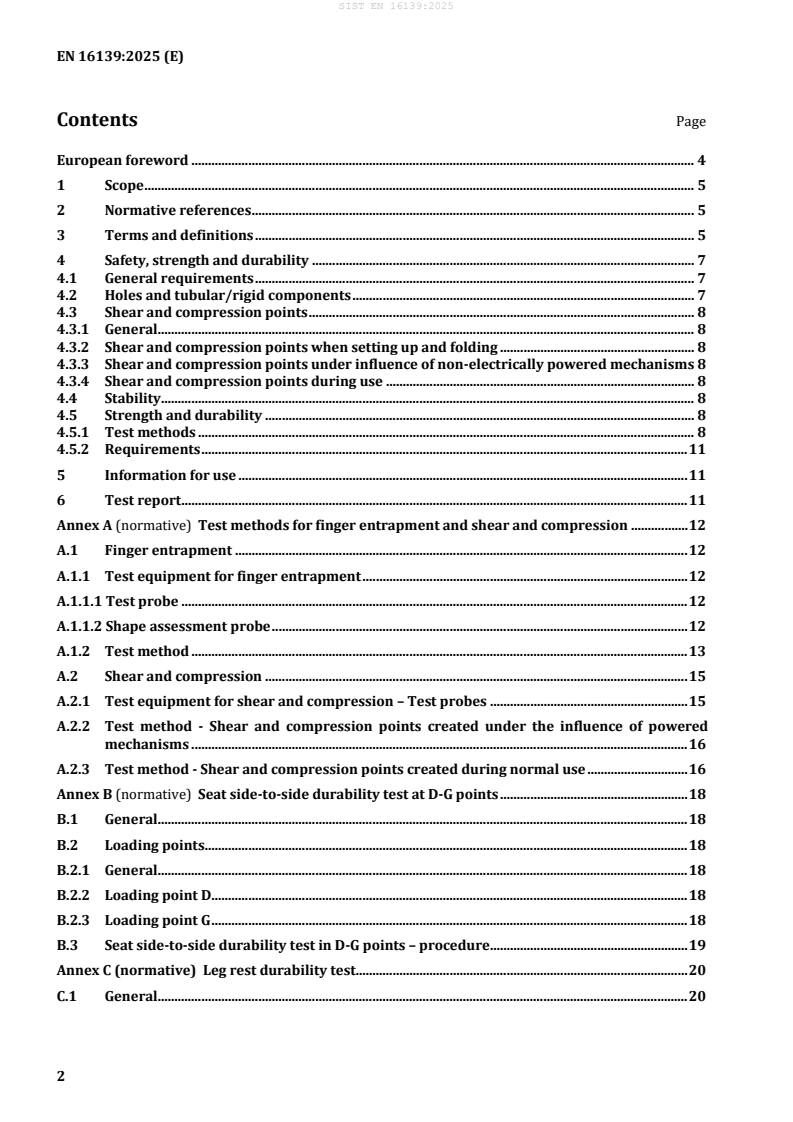
Contents Page
European foreword . 4
1 Scope . 5
2 Normative references . 5
3 Terms and definitions . 5
4 Safety, strength and durability . 7
4.1 General requirements . 7
4.2 Holes and tubular/rigid components . 7
4.3 Shear and compression points . 8
4.3.1 General. 8
4.3.2 Shear and compression points when setting up and folding . 8
4.3.3 Shear and compression points under influence of non-electrically powered mechanisms 8
4.3.4 Shear and compression points during use . 8
4.4 Stability . 8
4.5 Strength and durability . 8
4.5.1 Test methods . 8
4.5.2 Requirements . 11
5 Information for use . 11
6 Test report . 11
Annex A (normative) Test methods for finger entrapment and shear and compression . 12
A.1 Finger entrapment . 12
A.1.1 Test equipment for finger entrapment . 12
A.1.1.1 Test probe . 12
A.1.1.2 Shape assessment probe . 12
A.1.2 Test method . 13
A.2 Shear and compression . 15
A.2.1 Test equipment for shear and compression – Test probes . 15
A.2.2 Test method - Shear and compression points created under the influence of powered
mechanisms . 16
A.2.3 Test method - Shear and compression points created during normal use . 16
Annex B (normative) Seat side-to-side durability test at D-G points . 18
B.1 General. 18
B.2 Loading points . 18
B.2.1 General. 18
B.2.2 Loading point D. 18
B.2.3 Loading point G . 18
B.3 Seat side-to-side durability test in D-G points – procedure . 19
Annex C (normative) Leg rest durability test. 20
C.1 General. 20
C.2 Test method . 20
Annex D (normative) Determination of seat loading point for seating with suspended flexible
material . 23
Annex E (informative) Additional drop tests . 24
Annex F (informative) Test severity in relation to applications . 25
Annex G (informative) Recommended dimensions for non-domestic chairs . 26
Annex H (informative) Rationale for single column seating . 27
H.1 For term 3.7 Single column seating . 27
H.2 For Table 1, selection of applicability . 27
H.3 For Table 1, test 5. Arm rest sideways static load test EN 1728:2012, 6.10 . 27
H.4 For Table 1, test 10. Seat side-to-side durability test Annex . 27
H.5 For Table 1, test 14 and 15 (test not applicable for swivelling seating) . 27
H.6 For Table 1, test 16. Seat impact test EN 1728:2012, 6.24 . 28
Bibliography . 29
European foreword
This document (EN 16139:2025) has been prepared by Technical Committee CEN/TC 207 “Furniture”,
the secretariat of which is held by UNI.
This European Standard shall be given the status of a national standard, either by publication of an
identical text or by endorsement, at the latest by January 2026, and conflicting national standards shall
be withdrawn at the latest by January 2026.
Attention is drawn to the possibility that some of the elements of this document may be the subject of
patent rights. CEN shall not be held responsible for identifying any or all such patent rights.
This document will supersede EN 16139:2013.
a) introduction of definition and requirements for single column seating;
b) the order of the annexes has been changed, with the normative annexes being placed before the
informative;
c) changes to Annex C (informative) in terms of recommended dimensions;
d) introduction of “side to side” durability requirements for “single column seating” and “side to side”
test method in Annex B (normative);
e) new Annex H (informative) new rationale for “single column seating”;
f) new Annex A (normative) Test methods for finger entrapment and shear and compression;
g) removal of requirement for rolling resistance of unloaded chairs;
h) new introduction of “leg rest” static requirement;
i) new Annex C (normative) introduction of “leg rest” durability requirement with a “leg rest” test
method;
j) introduction of “backward fall test” requirement;
k) new Annex D (normative) Determination of seat loading point for seating with suspended flexible
material.
Any feedback and questions on this document should be directed to the users’ national standards body.
A complete listing of these bodies can be found on the CEN website.
According to the CEN-CENELEC Internal Regulations, the national standards organisations of the
following countries are bound to implement this European Standard: Austria, Belgium, Bulgaria, Croatia,
Cyprus, Czech Republic, Denmark, Estonia, Finland, France, Germany, Greece, Hungary, Iceland, Ireland,
Italy, Latvia, Lithuania, Luxembourg, Malta, Netherlands, Norway, Poland, Portugal, Republic of North
Macedonia, Romania, Serbia, Slovakia, Slovenia, Spain, Sweden, Switzerland, Türkiye and the United
Kingdom.
1 Scope
This document specifies requirements for the safety, strength and durability of all types of non-domestic
seating intended to be used by adults with a weight of not more than 110 kg, including office visitor chairs.
This document does not apply to ranked seating, office work chairs, chairs for educational institutions,
outdoor seating and to links for linked seating for which other European Standards exist. It does also not
apply to work chairs for industrial use.
This document does not include requirements for the durability of upholstery materials, castors, reclining
and tilting mechanisms and seat height adjustment mechanisms.
This document does not include requirements for the resistance to ageing, degradation and flammability.
This document does not include requirements for electrical safety.
Annex A (normative) contains test methods for finger entrapment and shear and compression.
Annex B (normative) contains a seat side-to-side durability test at D-G points.
Annex C (normative) contains a test method for Leg rest durability.
Annex D (normative) contains the determination of seat loading point for seating with suspended flexible
material.
Annex E (informative) contains additional drop tests.
Annex F (informative) contains information on the level of test severity in relation to applications.
Annex G (informative) contains recommended dimensions for non-domestic chairs.
Annex H (informative) contains a rationale for single column seating.
2 Normative references
The following documents are referred to in the text in such a way that some or all of their content
constitutes requirements of this document. For dated references, only the edition cited applies. For
undated references, the latest edition of the referenced document (including any amendments) applies.
EN 1022, Furniture — Seating — Determination of stability
EN 1728:2012, Furniture — Seating — Test methods for the determination of strength and durability
3 Terms and definitions
For the purposes of this document, the following terms and definitions apply.
ISO and IEC maintain terminology databases for use in standardization at the following addresses:
• IEC Electropedia: available at https://www.electropedia.org/
• ISO Online browsing platform: available at https://www.iso.org/obp
3.1
accessible part
part to which access can easily be gained by the user when the seating is in its intended configuration of
use and for which the probability of unintentional user contact is high
3.2
castors
assembly comprising a housing, one or more wheels and at least one axes
3.3
leg rest
extension of the seat area intended to support the legs of the sitter
Note 1 to entry: A leg rest may or may not be permanently attached to the seat. Some leg rests may not be
designed to support the load of the user.
3.4
footrest
component intended as an occasional support for the feet or to assist getting on and off an item of seating
Note 1 to entry: A footrest may be a part of the structure of the underframe of a chair or stool.
3.5
visitor chair
seating for one person used in the office environment additional to the office work chair
Note 1 to entry: It is used for meetings or collaborative work as well as for reading, writing, listening and waiting.
3.6
single column seating
item of seating whose upper part, which includes the seat, is mounted on a single support with a
dimension of up to 120 mm at its narrowest point
Note 1 to entry: This includes e.g. chairs with gas lifts and with or without swivel function.
3.7
median plane
vertical plane passing through the geometric centre of the seat, dividing the seat from side to side into
two equal parts
Note 1 to entry: See Figure 1.
Key
1 median plane
Figure 1 — Median plane
4 Safety, strength and durability
4.1 General requirements
The seating shall be designed so as to minimize the risk of injury to the user.
All parts of the seating with which the user comes into contact during intended use, shall be designed so
that physical injury and damage are avoided.
This requirement is met when:
a) edges and corners of the seating which are directly in contact with the user are rounded or
chamfered;
b) all other edges and corners accessible during intended use are free from burrs and/or sharp edges.
Movable and adjustable parts shall be designed so that injuries and inadvertent operation are avoided.
It shall not be possible for any load bearing part of the seating to come loose unintentionally.
For non-domestic chairs, see Annex G (Informative) that contains recommended dimensions for non-
domestic chairs.
4.2 Holes and tubular/rigid components
There shall be no holes in the ends of tubular components or holes in rigid components in accessible parts
between 8 mm and 12 mm, unless the depth of penetration is less than 10 mm. This requirement is
fulfilled if there is no hazard present when tested in accordance with A.1.
4.3 Shear and compression points
4.3.1 General
The requirements contained within 4.3.2, 4.3.3 and 4.3.4 do not apply to electrically operated furniture.
NOTE The requirements for electrically operated furniture will be provided in EN 17684 which is under
preparation.
4.3.2 Shear and compression points when setting up and folding
Unless 4.3.3 or 4.3.4 are applicable, shear and compression points that are created only during setting up
and folding are acceptable, because the user can be assumed to be in control of his/her movements and
to be able to cease applying the force immediately upon experiencing pain.
The edges of parts moving relative to each other and creating shear and compression points shall be as
specified in 4.1.
4.3.3 Shear and compression points under influence of non-electrically powered mechanisms
With the exception of operation of doors, flaps, lids and extension elements, there shall be no areas where
the distance between two accessible parts moving relative to each other can be less than 25 mm, and
more than 8 mm in any position during movement that could present a risk of injury to the user, created
by parts of the furniture operated by powered mechanisms, e.g. mechanical springs and gas lifts.
This requirement is fulfilled if there is no hazard present when tested in accordance with A.2.2.
NOTE Further guidance of the accessible parts is given in CEN/TR 17202.
4.3.4 Shear and compression points during use
With the exception of operation of doors, flaps, lids and extension elements, there shall be no areas where
the distance between two accessible parts moving relative to each other can be less than 18 mm, and
more than 8 mm in any position that could present a risk of injury to the user, created by loads applied
during normal use.
The loads used for durability tests within Table 1 are considered representative of normal use.
This requirement is fulfilled if there is no hazard present when tested in accordance with A.2.3.
4.4 Stability
The seating shall fulfil the relevant requirements of EN 1022 after having completed the relevant tests
listed in Table 1.
4.5 Strength and durability
4.5.1 Test methods
Seating shall be tested on the same sample for safety, strength and durability according to and in the
order given in Table 1 and in accordance with the test conditions contained in EN 1728:2012.
Seating with a seat and back made of one piece of flexible material suspended in the upper part of the
backrest and the front of the seat shall be tested according to Annex D. For this type of seating, only the
tests on seat shall be carried out.
The following tests described in Table 1 are considered to be relevant for safety.
Test No.: 1, 2, 4.1, 4.2, 6, 7.1, 7.2, 8, 9, 10, 11, 12, 13, 14, 15, 16.
Annex E (Informative) contains additional drop tests
The guidance for selecting level L1 or L2 with due respect for the end use of the product is given
in Annex F.
Annex H (Informative) contains a rationale for single column seating.
Table 1 — Safety, strength and durability tests
Level
Test Application Reference Test parameters
L1 L2
Seat static and EN 1728:2012,
1. All Seat: force, N 1 600 2 000
back static load 6.4
Back: force, N 560 700
a
test
(min. force, 410) (min. force, 410)
10 times
2. Seat front edge All EN 1728:2012, Force, N 1 300 1 600
a e
static load test 6.5
10 times
EN 1728:2012,
3. Vertical static load All Force, N 600 900
a b
on back 6.6
Seat load, N 1 300 1 800
10 times
4.1 Foot rest static All EN 1728:2012, Force, N 1 300 1 600
a d
load test 6.8
Minimum 750 750
seat force, N
Maximum 1600 2000
seat force, N
10 times
4.2 Leg rest static load All EN 1728:2012, Force, N 1 300 1 600
a
test 6.9
10 times
5. Arm rest sideways All EN 1728:2012, Force, N 400 900
a
static load test 6.10
10 times
6. Arm rest All EN 1728:2012, Force, N 750 900
downwards static 6.11
5 times
load test
7.1 Vertical upwards For seating EN 1728:2012, Seat force, N - 1 200
static load on arm which 6.13.1
Lift 10 times,
rests intended to
during ≥ 10 s
be moved
when
occupied
7.2 Vertical upwards Stacking EN 1728:2012, Specified load, kg Weight of 8 Weight o
...