

SIST EN 50617-1:2025
(Main)Railway applications - Technical parameters of train detection systems for the interoperability of the trans-European railway system - Part 1: Track circuits
General Information
- Abstract
This document specifies the technical parameters of track circuits associated with the interference current emissions limits for RST in the context of interoperability defined in the form of Frequency Management in ERA/ERTMS/033281 v4.0. The limits for compatibility between rolling stock and track circuits addressed in this document allow provision for known interference phenomena linked to traction power supply including associated protection (over voltage, short-circuit current and basic transient effects like in-rush current and power cut-off), and other known sources of interference.
This document is intended to be used to assess compliance of track circuits and other forms of train detection systems using the rails as part of their detection principles, in the context of the European Directive on the interoperability of the trans-European railway system and the associated technical specification for interoperability relating to the control-command and signalling track-side subsystems.
The document describes technical parameters to consider for achieving the compatibility of the track circuit with the emissions limits defined in the frequency management for rolling stock (ERA/ERTMS/033281 v4.0). These parameters are structured and allocated according to their basic references as follows:
- technical track circuit parameters;
- train based parameters;
- track based parameters;
- environmental and other parameters including EMC.
Each parameter is defined by a short general description, the definition of the requirement, the relation to other standards and a procedure to show the fulfilment of the requirement as far as necessary. An overview of the safety relevance of each parameter is given - in the context of this document - in a separate table.
This document is applicable to track circuits on all lines, including non-electrified lines. However, for track circuits intended to be installed only on non-electrified lines, some parameters can be disapplied.
- Status
- Published
- Public Enquiry End Date
- 30-Mar-2022
- Publication Date
- 09-Dec-2024
- Technical Committee
- ŽEN - Electrical applications for railways
- Current Stage
- 6060 - National Implementation/Publication (Adopted Project)
- Start Date
- 20-Nov-2024
- Due Date
- 25-Jan-2025
- Completion Date
- 10-Dec-2024

Overview
SIST EN 50617-1:2025 is a crucial European standard from CLC addressing the technical parameters of train detection systems, specifically focusing on track circuits to ensure the interoperability of the trans-European railway system. This standard defines the parameters essential for compatibility between rolling stock and track circuits, including interference current emission limits and frequency management as outlined in ERA/ERTMS/033281 v4.0. The document serves railway infrastructure managers, manufacturers, and rolling stock operators by providing structured requirements that uphold safety, compatibility, and compliance with the European Directive on rail system interoperability.
Key aspects addressed include technical track circuit parameters, train-based features, track considerations, and environmental and electromagnetic compatibility factors. SIST EN 50617-1:2025 applies to track circuits on both electrified and non-electrified railway lines across Europe.
Key Topics
Track Circuit Technical Parameters:
- Focus on dynamic shunt impedance, track circuit length, non-detection zones, detection of broken rails, and insulated rail joint (IRJ) failure detection.
- Requirements for compatibility with emission limits and frequency management for rolling stock.
Interference Current Emissions:
- Defines limits to manage electromagnetic interference affecting train detection systems, ensuring safe and reliable operation across different railway electrification schemes.
Frequency Management:
- Outlines operational frequency bands for track circuits and emission limits for rolling stock, aligned with ERA/ERTMS/033281 v4.0.
Safety and Compliance:
- Each track circuit parameter is linked to its relevance for railway safety, with guidance for compliance assessment based on EN 50129:2018 and related safety standards.
Environmental and EMC Factors:
- Considers external factors such as weather, power supply quality, ballast resistance, and electromagnetic compatibility affecting the performance of train detection systems.
Applications
SIST EN 50617-1:2025 is implemented across the European railway sector to ensure uniform technical requirements for train detection systems, promoting safe and seamless operation across borders. Primary applications include:
Rail Infrastructure Management:
- Ensures new and existing track circuits comply with harmonized interoperability requirements, supporting cross-border rail traffic and system expansions.
Rolling Stock Integration:
- Rolling stock manufacturers use these parameters to design vehicles compatible with track circuits throughout the trans-European rail network.
System Upgrades and Renewals:
- Infrastructure owners reference this standard when replacing or updating signaling systems to meet current emission and frequency management limits.
Safety Assessments and Regulatory Compliance:
- Provides a framework for safety-related evaluations of train detection systems, supporting authorities in verifying technical conformity and operational integrity.
Design and Maintenance Guidance:
- Offers practical descriptions for track circuit parameters, environmental considerations, and failure detection, aiding in both system design and ongoing maintenance.
Related Standards
- ENE/ERTMS/033281 v4.0: Interface specification between control-command/signaling trackside and other subsystems, foundation for frequency management and emission limits.
- EN 50121-4: Railway applications - Electromagnetic compatibility for signaling and telecommunications apparatus.
- EN 50122 Series: Fixed installations - Electrical safety and earthing in railway applications.
- EN 50129: Communication, signaling, and processing systems - Safety-related electronic systems.
- CLC/TS 50238-2 and 50238-3: Technical specifications for electromagnetic compatibility in train detection systems.
- EN 50126 Series: Reliability, Availability, Maintainability, and Safety (RAMS) framework for railway applications.
SIST EN 50617-1:2025 ensures reliable, safe, and interoperable railway operations by standardizing technical requirements for track circuits within the trans-European rail network, supporting both infrastructure development and ongoing system operation.
Relations
- Effective Date
- 03-Feb-2026
- Effective Date
- 01-Jan-2025
Get Certified
Connect with accredited certification bodies for this standard

IMQ S.p.A. (Certification)
Italian electrical product certification.

IRIS Certification (UNIFE)
International Railway Industry Standard certification.

SLG Prüf- und Zertifizierungs GmbH
German testing and certification body.
Sponsored listings
Frequently Asked Questions
SIST EN 50617-1:2025 is a standard published by the Slovenian Institute for Standardization (SIST). Its full title is "Railway applications - Technical parameters of train detection systems for the interoperability of the trans-European railway system - Part 1: Track circuits". This standard covers: This document specifies the technical parameters of track circuits associated with the interference current emissions limits for RST in the context of interoperability defined in the form of Frequency Management in ERA/ERTMS/033281 v4.0. The limits for compatibility between rolling stock and track circuits addressed in this document allow provision for known interference phenomena linked to traction power supply including associated protection (over voltage, short-circuit current and basic transient effects like in-rush current and power cut-off), and other known sources of interference. This document is intended to be used to assess compliance of track circuits and other forms of train detection systems using the rails as part of their detection principles, in the context of the European Directive on the interoperability of the trans-European railway system and the associated technical specification for interoperability relating to the control-command and signalling track-side subsystems. The document describes technical parameters to consider for achieving the compatibility of the track circuit with the emissions limits defined in the frequency management for rolling stock (ERA/ERTMS/033281 v4.0). These parameters are structured and allocated according to their basic references as follows: - technical track circuit parameters; - train based parameters; - track based parameters; - environmental and other parameters including EMC. Each parameter is defined by a short general description, the definition of the requirement, the relation to other standards and a procedure to show the fulfilment of the requirement as far as necessary. An overview of the safety relevance of each parameter is given - in the context of this document - in a separate table. This document is applicable to track circuits on all lines, including non-electrified lines. However, for track circuits intended to be installed only on non-electrified lines, some parameters can be disapplied.
This document specifies the technical parameters of track circuits associated with the interference current emissions limits for RST in the context of interoperability defined in the form of Frequency Management in ERA/ERTMS/033281 v4.0. The limits for compatibility between rolling stock and track circuits addressed in this document allow provision for known interference phenomena linked to traction power supply including associated protection (over voltage, short-circuit current and basic transient effects like in-rush current and power cut-off), and other known sources of interference. This document is intended to be used to assess compliance of track circuits and other forms of train detection systems using the rails as part of their detection principles, in the context of the European Directive on the interoperability of the trans-European railway system and the associated technical specification for interoperability relating to the control-command and signalling track-side subsystems. The document describes technical parameters to consider for achieving the compatibility of the track circuit with the emissions limits defined in the frequency management for rolling stock (ERA/ERTMS/033281 v4.0). These parameters are structured and allocated according to their basic references as follows: - technical track circuit parameters; - train based parameters; - track based parameters; - environmental and other parameters including EMC. Each parameter is defined by a short general description, the definition of the requirement, the relation to other standards and a procedure to show the fulfilment of the requirement as far as necessary. An overview of the safety relevance of each parameter is given - in the context of this document - in a separate table. This document is applicable to track circuits on all lines, including non-electrified lines. However, for track circuits intended to be installed only on non-electrified lines, some parameters can be disapplied.
SIST EN 50617-1:2025 is classified under the following ICS (International Classification for Standards) categories: 29.260.99 - Other electrical equipment for working in special conditions; 45.020 - Railway engineering in general. The ICS classification helps identify the subject area and facilitates finding related standards.
SIST EN 50617-1:2025 has the following relationships with other standards: It is inter standard links to SIST EN 50238-1:2021, SIST EN 50617-1:2015. Understanding these relationships helps ensure you are using the most current and applicable version of the standard.
SIST EN 50617-1:2025 is associated with the following European legislation: Standardization Mandates: M/591. When a standard is cited in the Official Journal of the European Union, products manufactured in conformity with it benefit from a presumption of conformity with the essential requirements of the corresponding EU directive or regulation.
SIST EN 50617-1:2025 is available in PDF format for immediate download after purchase. The document can be added to your cart and obtained through the secure checkout process. Digital delivery ensures instant access to the complete standard document.
Standards Content (Sample)
SLOVENSKI STANDARD
01-januar-2025
Železniške naprave - Tehnični parametri sistemov za ugotavljanje lokacije vlakov,
ki zagotavljajo medobratovalnost vseevropskega železniškega sistema - 1. del:
Tirni tokokrog
Railway applications - Technical parameters of train detection systems for the
interoperability of the trans-European railway system - Part 1: Track circuits
Bahnanwendungen - Technische Parameter von Gleisfreimeldesystemen für die
Interoperabilität des transeuropäischen Eisenbahnsystems - Teil 1: Gleisstromkreise
Applications ferroviaires - Paramètres techniques des systèmes de détection des trains
pour lInteropérabilité du système ferroviaire transeuropéen - Partie 1: Circuits de voie
Ta slovenski standard je istoveten z: EN 50617-1:2024
ICS:
45.020 Železniška tehnika na Railway engineering in
splošno general
2003-01.Slovenski inštitut za standardizacijo. Razmnoževanje celote ali delov tega standarda ni dovoljeno.
EUROPEAN STANDARD EN 50617-1
NORME EUROPÉENNE
EUROPÄISCHE NORM November 2024
ICS 29.260.99 Supersedes EN 50617-1:2015
English Version
Railway applications - Technical parameters of train detection
systems for the interoperability of the trans-European railway
system - Part 1: Track circuits
Applications ferroviaires - Paramètres techniques des Bahnanwendungen - Technische Parameter von
systèmes de détection des trains pour l'interopérabilité du Gleisfreimeldesystemen für die Interoperabilität des
système ferroviaire transeuropéen - Partie 1: Circuits de transeuropäischen Eisenbahnsystems - Teil 1:
voie Gleisstromkreise
This European Standard was approved by CENELEC on 2024-08-19. CENELEC members are bound to comply with the CEN/CENELEC
Internal Regulations which stipulate the conditions for giving this European Standard the status of a national standard without any alteration.
Up-to-date lists and bibliographical references concerning such national standards may be obtained on application to the CEN-CENELEC
Management Centre or to any CENELEC member.
This European Standard exists in three official versions (English, French, German). A version in any other language made by translation
under the responsibility of a CENELEC member into its own language and notified to the CEN-CENELEC Management Centre has the
same status as the official versions.
CENELEC members are the national electrotechnical committees of Austria, Belgium, Bulgaria, Croatia, Cyprus, the Czech Republic,
Denmark, Estonia, Finland, France, Germany, Greece, Hungary, Iceland, Ireland, Italy, Latvia, Lithuania, Luxembourg, Malta, the
Netherlands, Norway, Poland, Portugal, Republic of North Macedonia, Romania, Serbia, Slovakia, Slovenia, Spain, Sweden, Switzerland,
Türkiye and the United Kingdom.
European Committee for Electrotechnical Standardization
Comité Européen de Normalisation Electrotechnique
Europäisches Komitee für Elektrotechnische Normung
CEN-CENELEC Management Centre: Rue de la Science 23, B-1040 Brussels
© 2024 CENELEC All rights of exploitation in any form and by any means reserved worldwide for CENELEC Members.
Ref. No. EN 50617-1:2024 E
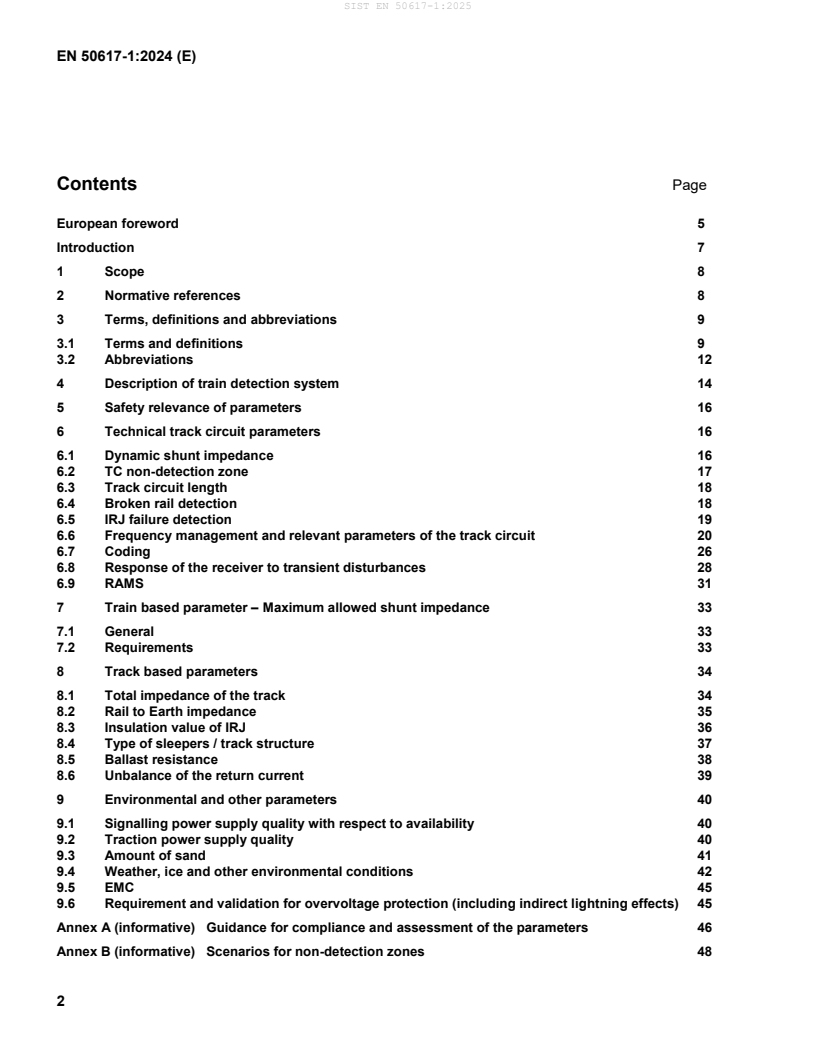
Contents Page
European foreword 5
Introduction 7
1 Scope 8
2 Normative references 8
3 Terms, definitions and abbreviations 9
3.1 Terms and definitions 9
3.2 Abbreviations 12
4 Description of train detection system 14
5 Safety relevance of parameters 16
6 Technical track circuit parameters 16
6.1 Dynamic shunt impedance 16
6.2 TC non-detection zone 17
6.3 Track circuit length 18
6.4 Broken rail detection 18
6.5 IRJ failure detection 19
6.6 Frequency management and relevant parameters of the track circuit 20
6.7 Coding 26
6.8 Response of the receiver to transient disturbances 28
6.9 RAMS 31
7 Train based parameter – Maximum allowed shunt impedance 33
7.1 General 33
7.2 Requirements 33
8 Track based parameters 34
8.1 Total impedance of the track 34
8.2 Rail to Earth impedance 35
8.3 Insulation value of IRJ 36
8.4 Type of sleepers / track structure 37
8.5 Ballast resistance 38
8.6 Unbalance of the return current 39
9 Environmental and other parameters 40
9.1 Signalling power supply quality with respect to availability 40
9.2 Traction power supply quality 40
9.3 Amount of sand 41
9.4 Weather, ice and other environmental conditions 42
9.5 EMC 45
9.6 Requirement and validation for overvoltage protection (including indirect lightning effects) 45
Annex A (informative) Guidance for compliance and assessment of the parameters 46
Annex B (informative) Scenarios for non-detection zones 48
B.1 Non-detection zone in S&C area between staggered isolated rail joints (distance x in
Figure B.1) 48
B.2 Overlap of a dead zone in S&C area 48
B.3 Equipotential wires in S&C area 50
B.4 Zone without detection in electrical joints 51
Annex C (informative) Track circuit length 54
C.1 Introduction 54
C.2 Example of TC with S-bond 54
Annex D (informative) Scenarios for broken rail Relation Track circuit – Broken rail detection 56
D.1 Basic principle 56
D.2 Fail safe system 57
D.3 Examples where the broken rail detection is not possible 58
Annex E (informative) Frequency management – User manual 59
E.1 Frequencies and immunity limits 59
E.2 Compatibility case structure 59
Annex F (informative) Example of elements of maintenance for existing track circuits 60
Annex G (informative) Example of management of shunt impedance 64
Annex H (informative) Rail to ground impedance: Track circuit effects 66
H.1 Physical factors 66
H.2 Symmetric rail- ground resistance 66
H.3 Values from experience 67
H.4 Asymmetric rail- ground resistance 67
H.5 Touch Potential Effects 67
Annex I (informative) Example of mechanical test for IRJ 69
I.1 General 69
I.2 Testing program 69
Annex J (informative) Example of existing requirement for the type of sleepers / track structure 72
J.1 General 72
J.2 Minimum value for a ballast resistance 72
J.3 Infrabel 72
J.4 DB 72
Annex K (informative) Out of Band Limits (OOB) proposal 74
K.1 Introduction 74
K.2 Out of band emission limits for influencing unit: DC power systems 74
K.3 Out of band emission limits for influencing unit: 25 kV 50 Hz AC power systems 76
K.4 Validation of OOB limits based on OOB magnetic fields limits defined in ERA/ERTMS/033281
v.4.0 79
Annex L (informative) Informative table describing the correspondence between this European
Standard and the Commission Regulation (EU) N° 2016/919 on the technical specification for
interoperability relating to the control-command and signalling subsystems of the rail system
in the European Union and Directive (EU) 2016/797 80
L.1 Introduction 80
L.2 Table of correspondence 80
Bibliography 82
European foreword
This document (EN 50617-1:2024) has been prepared by CLC/SC 9XA “Communication, signalling and processing
systems” of CLC/TC 9X “Electrical and electronic applications for railways”.
The following dates are fixed:
• latest date by which this document has to be (dop) 2025-11-30
implemented at national level by publication of
an identical national standard or by
endorsement
• latest date by which the national standards (dow) 2027-11-30
conflicting with this document have to be
withdrawn
This document supersedes EN 50617-1:2015.
— Clause 6: Technical parameters have been enhanced to provide the requirements to demonstrate compliance
with the Frequency Management published in ERA/ERTMS/033281 v4.0;
— Clause 7: It is now amended and consistent with ERA/ERTMS/033281 v4.0;
— Clause 8: Track parameters have been re-defined;
— Clause 9 has been enhanced with practical examples;
— Annex A: Parameters are revisited for consistency;
— Annex E: New Table has been added for parameters of track circuits which are already defined as compatible
with the Frequency Management in ERA/ERTMS/033281 v4.0. A subclause is introduced to define the link
between the current standard and the new standard being developed for Measurements of RST emissions for
compatibility with track circuits by SC9XB/WG34;
— Annex F “Vehicle Impedance / guidance for RST design to support the FrM” has been deleted, consequently
the Annexes G to K have been renumbered as Annexes F to J;
— New Annex K: New informative annex which defines proposed Out of Band Frequency Limits for 25 kV 50 Hz
and DC power networks.
— Annex L has been deleted. A new Annex L was added.
EN 50617, Railway applications – Technical parameters of train detection systems, will consist of
— Part 1: Track circuits;
— Part 2: Axle counters.
Attention is drawn to the possibility that some of the elements of this document may be the subject of patent rights.
CEN-CENELEC shall not be held responsible for identifying any or all such patent rights.
Any feedback and questions on this document should be directed to the users’ national standards body/national
committee. A complete listing of these bodies can be found on the CEN and CENELEC websites.
Introduction
The working group SC9XA WGA4-2 has developed the limits for electromagnetic compatibility between rolling stock
and train detection systems, specifically track circuits and axle counter systems and correspondingly published two
technical specifications CLC/TS 50238-2 and CLC/TS 50238-3. These limits and associated measurement
methods are based on preferred existing systems (as defined in CLC/TS 50238-2 and CLC/TS 50238-3) which are
well established and still put forward for signalling renewals by infrastructure managers.
To meet the requirements for compatibility between train detection systems and rolling stock in the future and to
achieve interoperability and free movement within the European Union, ERA/ERTMS/033281 v4.0 defines the
relevant parameters for compatibility of rolling stock with track circuits and axle counter systems.
The train detection systems, track circuits and axle counters are an integral part of the CCS trackside subsystem in
the context of the Rail Interoperability Directive. The relevant technical parameters are enumerated in the CCS and
LOC&PAS TSI and ERA/ERTMS/033281 v4.0. ERA/ERTMS/033281 v4.0 specifies the parameters for rolling stock
relevant to compatibility with the infrastructure. This document covers all relevant technical parameters of train
detection systems (track circuits) in a manner that provides a presumption of conformity with interoperability
requirements, but is not limited to interoperable lines. This document refers whenever needed to
ERA/ERTMS/033281 v4.0. Although the demand for FrM is driven by Interoperability requirements, it is independent
from the drive to introduce systems like ERTMS level 3 or level 2.
This document is based on the current understanding of the railway experts represented at WGA4-2 that track
circuits and axle counter systems will continue to be the essential two train detection systems for the foreseeable
future.
The published specification CLC/TS 50238-2 can be used to ascertain conformity of rolling stock with existing
individual (preferred) track circuits.
In this document, the defined parameters are structured and allocated according to their basic references as follows:
— track circuit system parameters;
— train based parameters;
— track based parameters;
— environmental and other parameters.
Where possible, the parameters as defined are consistent with other European Standards.
Each parameter is defined by a short general description, the definition of the requirement, the relation to other
standards and a procedure to show the fulfilment of the requirement as far as necessary. An overview of the safety
relevance of each parameter is given – in the context of this document – in a separate table.
1 Scope
This document specifies the technical parameters of track circuits associated with the interference current emissions
limits for RST in the context of interoperability defined in the form of Frequency Management in
ERA/ERTMS/033281 v4.0. The limits for compatibility between rolling stock and track circuits addressed in this
document allow provision for known interference phenomena linked to traction power supply including associated
protection (over voltage, short-circuit current and basic transient effects like in-rush current and power cut-off), and
other known sources of interference.
This document is intended to be used to assess compliance of track circuits and other forms of train detection
systems using the rails as part of their detection principles, in the context of the European Directive on the
interoperability of the trans-European railway system and the associated technical specification for interoperability
relating to the control-command and signalling track-side subsystems.
The document describes technical parameters to consider for achieving the compatibility of the track circuit with the
emissions limits defined in the frequency management for rolling stock (ERA/ERTMS/033281 v4.0). These
parameters are structured and allocated according to their basic references as follows:
— technical track circuit parameters;
— train based parameters;
— track based parameters;
— environmental and other parameters including EMC.
Each parameter is defined by a short general description, the definition of the requirement, the relation to other
standards and a procedure to show the fulfilment of the requirement as far as necessary. An overview of the safety
relevance of each parameter is given – in the context of this document – in a separate table.
This document is applicable to track circuits on all lines, including non-electrified lines. However, for track circuits
intended to be installed only on non-electrified lines, some parameters can be disapplied.
2 Normative references
The following documents are referred to in the text in such a way that some or all of their content constitutes
requirements of this document. For dated references, only the edition cited applies. For undated references, the
latest edition of the referenced document (including any amendments) applies.
EN 13146-5:2012 , Railway applications - Track - Test methods for fastening systems - Part 5: Determination of
electrical resistance
EN 50121-4:2016 , Railway applications - Electromagnetic compatibility - Part 4: Emission and immunity of the
signalling and telecommunications apparatus
EN 50122-1:2011 , Railway applications - Fixed installations - Electrical safety, earthing and the return circuit –
Part 1: Protective provisions against electric shock
As impacted by EN 13146-5:2012/AC:2017.
As impacted by EN 50121-4:2016/A1:2019.
As impacted by EN 50122-1:2011/A1:2011, EN 50122-1:2011/A2:2016, EN 50122-1:2011/A3:2016,
EN 50122-1:2011/A4:2017 and EN 50122-1:2011/AC:2012.
EN 50122-2:2010, Railway applications - Fixed installations - Electrical safety, earthing and the return circuit -
Part 2: Provisions against the effects of stray currents caused by d.c. traction systems
EN 50122-3:2010, Railway applications - Fixed installations - Electrical safety, earthing and the return circuit -
Part 3: Mutual Interaction of a.c. and d.c. traction systems
EN 50124-2:2017, Railway applications - Insulation coordination - Part 2: Overvoltages and related protection
EN 50125-3:2003, Railway applications - Environmental conditions for equipment - Part 3: Equipment for signalling
and telecommunications
EN 50126-1:2017, Railway Applications - The Specification and Demonstration of Reliability, Availability,
Maintainability and Safety (RAMS) - Part 1: Generic RAMS Process
EN 50126-2:2017, Railway Applications - The Specification and Demonstration of Reliability, Availability,
Maintainability and Safety (RAMS) - Part 2: Systems Approach to Safety
EN 50128:2011 , Railway applications - Communication, signalling and processing systems - Software for railway
control and protection systems
EN 50129:2018 , Railway applications - Communication, signalling and processing systems - Safety related
electronic systems for signalling
EN 50160:2010, Voltage characteristics of electricity supplied by public electricity networks
EN 60529:1991 , Degrees of protection provided by enclosures (IP Code) (IEC 60529:1989)
EN IEC 60721-3-4:2019, Classification of environmental conditions - Part 3-4: Classification of groups of
environmental parameters and their severities - Stationary use at non-weatherprotected locations
(IEC 60721-3-4:2019)
ERA/ERTMS/033281 v4.0 — Interfaces between control-command and signalling trackside and other subsystems
3 Terms, definitions and abbreviations
3.1 Terms and definitions
For the purposes of this document, the following terms and definitions apply.
ISO and IEC maintain terminology databases for use in standardization at the following addresses:
— IEC Electropedia: available at https://www.electropedia.org/
— ISO Online browsing platform: available at https://www.iso.org/obp
As impacted by EN 50128:2011/AC:2014, EN 50128:2011/A1:2020, and EN 50128:2011/A2:2020.
As impacted by EN 50129:2018/AC:2019-04.
As impacted by EN 60529:1991/A1:2000, EN 60529:1991/A2:2013, EN 60529:1991/A2:2013/AC:2019-02,
EN 60529:1991/AC:2016-12, and EN 60529:1991/corrigendum May 1993;
3.1.1
ballast resistance
insulation of the track, or insulation between both rails
Note 1 to entry: Its value is linked to the environment of the track circuit (weather conditions, hygrometry, cleanliness of the
ballast, crosstie type, etc.).
Note 2 to entry: Admittance between both rails being proportional to track circuit zone length, ballast resistance Rb is inversely
proportional to the track circuit length and measured in Ω.km.
Note 3 to entry: The ballast resistance is defined for 1 km track length.
3.1.2
broken rail
complete disconnection in one rail which results in electrical isolation
3.1.3
dynamic shunt impedance
equivalent impedance seen from the TC REC for a detection of RST wheelset
Note 1 to entry: It includes the electrical resistance between the running surfaces of the opposite wheels of a wheelset,
resistance between wheel and rail, and track impedance.
Note 2 to entry: A maximum allowed shunt impedance (static conditions) shall be defined by the manufacturer/designer.
3.1.4
electrical subsystem
ES
smallest unit which is practicably accessible for interference current measurements
Note 1 to entry: See Figure 1 and Figure 2.
Note 2 to entry: An ES is fed from the line voltage via distribution lines inside a TU. Internally, an ES may consist of one or
several interference sources (such as traction and / or auxiliary converters) which cannot practicably be evaluated individually.
3.1.5
influencing unit
IU
rolling stock influencing the train detection system
Note 1 to entry: One influencing unit comprises all coupled / connected vehicles, e.g. complete train with single or multiple
traction, single vehicle, multiple connected / coupled vehicles and wagons, e.g. one complete passenger train, consisting of one
or more TUs and coaches.
Note 2 to entry: The influencing unit can consist of several “Traction Units“ (TU).
Figure 1 — Definition of IU, TU and ES
[SOURCE: CLC/TS 50238-2:2020, 3.1.2, modified - Notes 1 and 2 to entry have been amended. Note 3 to entry
has been omitted. Figure 1 has been replaced.]
3.1.6
maximum allowed shunt impedance
value which guarantees the occupation of the track circuit (defined by the manufacturer/designer)
3.1.7
neutral section
section of a contact line provided with a sectioning point at each end to prevent successive electrical sections
differing in voltage, phase or frequency being connected together by the passage of current collectors
[SOURCE: IEC 60050-811:2017, 811-36-16]
3.1.8
return current unbalance
ratio of the difference of current in the 2 rails
II−
rr12
×100% , where II, are the currents in both rails
rr12
II+
rr12
Note 1 to entry: Other definition of return current unbalance: I – I . It shall be documented in the TC descriptions which definition
r1 r2
has been considered to define the limit of TC.
3.1.9
S-bond
equipotential cable in some electrical joint type
3.1.10
track section clear
state of the track section which the TC output state gives the information that the track section is clear of RST
3.1.11
track section occupied
TC output state which corresponds to the information either that the track section is occupied by a vehicle or that
the TC is not able to clear the track section (e.g. in case of failure)
3.1.12
traction unit
TU
locomotive, motor coach or train unit
Note 1 to entry: Each TU is fed from one pantograph or collector (or UIC busbar in case of coaches / wagons). One TU may be
— one locomotive;
— one electric multiple unit, with one or several Electrical Subsystems (ES) in one or several cars;
— one complete passenger train, consisting of individual passenger coaches with or without a locomotive;
— one complete freight train, consisting of individual freight wagons with or without a locomotive.
Figure 2 — Term clarification for Traction unit (TU) and Influencing Unit (IU)
[SOURCE: IEC 60050-811:2017, 811-02-04, modified – The Note 1 to entry has been added. Figure 2 has been
added.]
3.2 Abbreviations
For the purposes of this document, the following abbreviations apply.
AC Alternating current
AFTC Audio Frequency Track Circuit
CCS Control-command and signalling
DC Direct current
EMC Electromagnetic compatibility
EMU Electrical multiple unit
ERA European Railway Agency
ERTMS European Rail Traffic Management System
EUREMCO European Electromagnetic Compatibility project
ES Electrical subsystem
I Steady-state interference current limit for RST (one influencing unit)
FFT Fast Fourier Transform
FrM Frequency management
IM Infrastructure manager
IP Ingress Protection Rating
IRJ Insulated rail joint
ITU International Telecommunications Union
IU Influencing unit
LOC&PAS Locomotives and passenger rolling stock
MTBF Mean Time Between Failures
MTTR Mean Time to Repair
NSA National Safety Authority
OHS Overhead system
RAMS Reliability, Availability, Maintainability and Safety
Rb Ballast resistance
REC Receiver
RSF Right Side Failure
RST Rolling stock
S&C Switch and crossing
SIL Safety Integrity Level
SMS Safety Management System
T Pick-up delay time of the track circuit
pi
TC Track circuit
TDS Train detection system
TR Transmitter
TSI Technical Specification for Interoperability
TU Traction unit
WSF Wrong side failure
4 Description of train detection system
Train detection systems for route proving are fully automatic and are integrated into railway signalling and safety
systems. The train detection is part of the route proving procedure and contributes to safe railway operation.
The train detection equipment provides information about whether track sections are ‘clear’ or ‘occupied’.
This document applies to train detection systems using the rails to detect the presence of a vehicle, also known as
track circuits.
Rails are the transmission path between the TC TR and REC. When the RST is standing over the track circuit, any
of its wheelsets present a short circuit between the two rails causing the status of the track circuit to change to
‘occupied’.
Figure 3 defines the logical components of a track circuit system. This includes the track evaluation units, the track
connection units (receivers and transmitters) and the track connections. The track connection units contain also
coupling units providing electrical coupling (e.g. filtering) between the rails and the receiver/transmitter.
The logical system boundary of a track circuit system is given by an interface to the next level operational train
control system (e.g. Interlocking). The physical boundaries of a track section are given by insulated mechanical or
electrical based joints.
Figure 3 — System boundary for track circuit system
Track circuit is a general description of a whole range of train detection equipment based on the shunt caused by
the wheel sets of a train. Today there are many different types in use throughout Europe.
5 Safety relevance of parameters
The safety case of track circuit shall be determined according to EN 50129:2018.
Each parameter described in the following clauses may or may not have an influence on the safety level. According
to the design of the track circuit and the specific technical environment for the application, the safety relevance of
parameters shall be defined on a case by case basis. Guidance for usual safety relevance of each parameter is
given in Annex A.
6 Technical track circuit parameters
6.1 Dynamic shunt impedance
6.1.1 General
The dynamic shunt is a complex parameter that is crucial for the safe operation of a track circuit. This subclause
defines the primary parameters for track circuit design.
The dynamic shunt can only partially be affected by the track circuit design; the higher the transmitter voltage, the
less likely that debris between wheel and track will prevent the current to flow with Loss of Shunt as result. The
dynamic shunt can only partially be affected by the vehicle design; the impedance of the wheelset is generally a
small part of the total impedance of the dynamic shunt, the number of wheelsets, the more wheelsets the less likely
the chance that all wheelsets become isolated with Loss of Shunt as result. Any exercise to clean the railhead or
the wheel can remove many, but not all sorts of debris. The major factor for Loss of Shunt however is debris, like
sand, rust, leaves and compressed smashed leaves forming an isolating resin on the track, the wheels or both,
resulting in varying impedances between the wheelset and tracks. In addition, rail traffic (number of wheelsets per
day, different type of wheel profiles, classic block brakes) can also reduce the formation of debris. Non-detection
of a railway vehicle present over the section controlled by the track vacancy detection system shall be considered
as a hazardous situation also known as a wrong side failure. This is very much dependent on the dynamic shunt
impedance.
The dynamic shunt is the resulting impedance between the two rails of the track circuit as depicted in Figure 4. The
dynamic shunt consists of all parallel wheelsets including the resistance between wheels and rail. The dynamic
shunt is called dynamic because both the number of wheelsets and the resistance between the running surfaces of
the opposite wheels of a wheelset and the rail can vary per wheelset. The only constant is the electrical resistance
between the running surfaces of the opposite wheels of a wheelset which is defined in [ERA/ERTMS/033281 v4.0,
3.1.9].
Key
R ballast resistance
b
R resistance between wheel and rail (amongst others depending on contamination (e.g. rust)) and the
contact
dimension of contact area
Z impedance between the running surfaces of the opposite wheels of a wheelset
wheelset
NOTE 1 Rcontact can also have non-linear behaviour, caused by for example voltage dependent mechanisms.
NOTE 2 The electrical resistance (real part of the impedance) between the running surfaces of the opposite wheels of a
wheelset is usually measured. In addition, the electrical reactance between the running surfaces of the opposite wheels of a
wheelset can be measured due to the relevance for audio and higher frequency track circuits.
Figure 4 — Ballast resistance/Shunt impedance
Shunt impedance is made of R + Z + R .
contact wheelset contact
The value of the dynamic shunt impedance cannot be specified. Therefore, it is necessary to specify the maximum
allowed shunt impedance which shall not be exceeded to avoid WSF.
6.1.2 Requirements
The maximum allowed shunt impedance is specified by the track circuit manufacturer in the safety case prepared
according to EN 50129:2018.
The influence of (short) Loss of Shunt shall be included in the SMS of the IM or design of the interlocking, this is an
exported constraint for the infrastructure manager.
6.2 TC non-detection zone
6.2.1 General
The TC non-detection zone is an area of the TC where the RST is not detected.
If a vehicle with a very short distance between the first and the last wheelset (e.g. maintenance car) does not interact
with at least one of the two adjacent track circuits, the train detection system will qualify the two adjacent
corresponding track sections as clear.
NOTE This is a temporary effect (except if the railway vehicle remains stationary in this position).
This parameter only applies to countries where these non-detection zones are operationally permissible.
The scenarios for non-detection zones are given in Annex B.
The length of the TC non-detection zone will depend on the position of IRJ on the 2 rails, and/or the dynamic shunt.
6.2.2 Requirements
The maximum length of a non-detection zone between two adjacent track circuits shall not be longer than the
minimum distance between first and last axle defined in ERA/ERTMS/033281 v4.0.
The assessment shall be performed by field test with the dynamic shunt resistance specified by the manufacturer.
6.3 Track circuit length
6.3.1 General
The track circuit length is the length within which an RST is detected.
Examples of minimum track circuit length determination are given in Annex C.
6.3.2 TC minimum length of detection - Requirement
The minimum length of a detection zone shall be longer than the maximum axle to axle distance defined in
ERA/ERTMS/033281 v4.0.
The minimum length of a detection zone shall be long enough to ensure that the interlocking systems have seen
the passing train:
— when using relay technique, taking into account the delay-time of each relay in the complete circuit;
— when using programmable logic control technology (incl. microprocessors), taking into account the maximum
cycle time of the control system.
It shall be shown in the safety case that the track circuit is able to react properly for the requested maximum speed
for its application.
6.3.3 TC maximum length of detection - Requirement
It shall be determined in the safety case that the track circuit is able to react properly with the maximal length defined
in the specification of the TC.
NOTE The maximum length of detection depends, among other things, on the maximum shunt resistance and ballast
resistance for the specific track circuit.
6.4 Broken rail detection
6.4.1 General
TCs are able to detect a broken rail if specified by design.
The first broken rail might not be detected if there is a parallel path with low impedance. In this case the broken rail
causes an RSF but the train is detected. In case of a second broken rail in the same rail, the vehicle might not be
detected leading to a WSF. In the context of overall railway safety, broken rails may lead to a potential derailment.
The track circuit considers a rail as broken when there is no more electrical contact between the two parts of the
rail at each side of the crack (i.e. vertical crack). When only part of the rail is lost (only the feet or only the head),
the track circuit is not able to detect this kind of cracks because electrical continuity is still maintained along the
broken rail.
According to ERA/ERTMS/033281 v4.0, the minimum distance between the axles of a vehicle is 3 m. Consequently,
when the distance between the two cracks is less than 3 m, these cracks are considered as only one broken rail.
Otherwise, two broken rails are considered because the smallest vehicle may be lost. For a list of scenarios, see
Annex D.
This parameter only applies to countries where broken rail detection is implemented/required. The national rules
and/or (customer) requirements shall be transferred to specific parameters/values for the track circuit.
6.4.2 Requirements
If broken rail detection is required to be provided as part of the functionality of TDS, the track circuit shall be able to
detect the first broken rail.
For broken rail detection, single rail track circuits based on single rail insulation are not allowed.
The risk of broken rail non-detection in S&C areas shall be minimized by design (for example, due to parallel paths,
see Annex D).
A test or simulation shall be done for the worst-case conditions. The test shall be conducted as part of the initial
type test of the track circuit.
The compensation of the inductance of the rail or the use of high impedances in the parallel way may be
implemented to detect the broken rail. The manufacturer shall specify limit values in these cases.
The minimum impedance of the parallel path shall be defined considering the following factors:
— The working frequency of the track circuit and the infrastructure environment.
— The margin of the sensitivity level of the receiver between the tuning of the track circuit receiver and the
considered worst case to detect the first broken rail. The first failure shall not lead to a WSF but shall be
detected reliably, or else the required safety will be compromised.
EXAMPLE The following examples of parameters for broken rail detection can be deemed as acceptable by design:
— In S&C areas, the parallel path is limited to 50 m, to facilitate broken rail detection.
— The rail insulation is maintained as specified, and not lower than 5 Ω.km.
— 95 % of broken rails within the TC are detected by the track circuit. If 95 % detection cannot be achieved for a particular
application, the track circuit needs to be split in two.
— A special national case exists in the Czech Republic, where 100 % broken rail detection is required. Specific parameters
for design and installation of track circuits are therefore applicable, which cannot be harmonized.
6.5 IRJ failure detection
6.5.1 General
IRJ are placed to stop the TC signal within the TC section borders. Depending on the design, they can be used in
place of electrical joints.
In case of an IRJ failure, the signal from the TR of the adjacent TC section can power REC of the considered TC
section.
6.5.2 Requirement
If the IRJ failure detection function is required, the failure of an IRJ shall be analysed in the safety case. See also
8.3.
6.6 Frequency management and relevant parameters of the track circuit
6.6.1 Frequencies and immunity limits
6.6.1.1 General
FrM for RST concerning emission limits for compatibility with track circuit are defined by ERA/ERTMS/033281 v4.0
document. For the future interoperable system, this FrM allows on one hand, common frequency ranges for the
operational channels of track circuits in all EU member states protected by compatibility limits for RST authorized
into service, and on the other hand defines frequency ranges with less restrictions for power converter harmonics
of RST.
The FrM is expressed in terms of interference current limits versus frequency that are applicable for a single
influencing unit of RST to be considered under normal and foreseeable degraded conditions.
The coupling between the RST emission and the TC receiver represents a certain transfer function. This transfer
function depends on many factors:
— consideration of WSF and/or RSF interference cases dictate different compatibility margins;
— return current unbalance between the two rails (see 8.6.2);
— presence of harmonics from the railway power supply (e.g. from substation or other vehicles) and impedance
of the RST limiting the current;
— number of influencing units in the same feeding section;
— parallel way for the return current path (e.g. equipotential bonding);
— resonance effect of the infrastructure;
— design of the track circuit (e.g. transformers or tuning ratio);
— modulation within a DC substation of traction harmonics and substation harmonics.
Frequency Management defined by the ERA/ERTMS/033281 v4.0 inherently includes the complex envelope of the
several transfer functions related to European preferred track circuits recognized throughout the standardization
process established for the document CLC/TS 50238-2:2020.
The parameters used to demonstrate compliance to the Frequency Management are listed in Annex E.
6.6.1.2 Requirements for out of band limits
The out of band limits are still under technical evaluation from European Railway Agency.
An informative proposal is included in Annex K.
6.6.2 Validation of immunity
6.6.2.1 Introduction
The immunity of the track circuit shall be established through laboratory testing. Field tests can be skipped, if
comparable information can be shown or know how from former field tests exists. The applicable test limits shall be
further defined depending on the application of track circuit (single/double rail or single/multiple track layout),
unbalance in the return cold path, multiple receivers and hysteresis in the receiver, if applicable. The environmental
conditions of the application shall be covered in the test and the safety case for the track circuit.
6.6.2.2 Track circuit receiver immunity test in laboratory
For the immunity test the whole train detection system can be taken into account. The different application scenarios
to be evaluated against FrM limits shall be documented without having to repeat any practical testing, so long as
there is good confidence and a suitable margin for uncertainty in the models that the transfer functions are based
upon.
This flow diagram of Figure 5 is intended to be followed:
— for each noise frequency step,
— for RSF condition immunity test (i.e. with track circuit is set and track circuit is empty),
— for receiver input signal only; to translate into rail current limit, additional transfer function between receiver
current and rail current may be required (depending on the track circuit),
— the diagram is suitable for both in-band and out of band receiver characterization. The only difference is the
selection of frequencies and maximum interference signal.
A reasonable maximum level should be derived from either the maximum allowed receiver input current or maximum
reasonable traction current in the out of band range. Note that the level at the receiver input and the level in the
traction current are related to each other via an implementation specific transfer function.
NOTE For example, 1,4 A at receiver input can be considered reasonably high.
For the connection between Environment, track section length and frequency a margin shall be included in the
documents of manufacturer.
Figure 5 — Example for Track Circuit Receiver immunity test
6.6.2.3 Test configuration in laboratory
The purpose of the following test procedure is to just understand and validate the immunity of the track circuit as
a complete fixed installation, which is different from the immunity of the receiver alone. The use of a sine wave
test signal is sufficiently justified for this purpose as the main purpose of this test is to establish the transfer function
between the emission limit for RST defined in the FrM and the TC immunity
The tests in the laboratory are to research the susceptibility threshold of the TC REC with a simulated equivalent
of the track. The following example concerns a test configuration for RSF.
If different test methods are used to measure the limits of a track circuit, they shall be described by the
manufacturer in the track circuit description.
This is a quasi worst-case scenario for RSF with the substation connected at one end via the shorting bond and
the RST connected via the other bond (see Figure 6). The test consists of injecting current in a typical track circuit,
to establish the track circuit susceptibility to rolling stock interference.
Figure 6 — RSF interference scenario
The source of disturbance (current generator) produces sinusoidal signals (see Figure 7). The interference source
is applied between the two shorting bonds at the extremities of the track circuit. The track circuit rails are simulated
with the nominal inductance and resistance depending on the length and type of the considered TC.
The current from the source of disturbance flows through both rails. The unbalance is simulated with a resistor
placed between two sections of one rail.
This can only be done if the characteristic of the track is not influenced by the unbalance resistor (the unbalance
resistor is much smaller than the source impedance of the sending side). Otherwise the unbalance shall be created
with a cable loop over the track or with a cable through a toroidal transformer inducing the desired unbalance.
The test is performed for all working frequencies of TC, and for some most significant track circuit configurations
(length, coding, unbalance).
Figure 7 — Block diagram for the simulation of disturbance (example)
NOTE The ballast is considered as a perfect isolator for the needs of the test.
6.6.2.4 Testing equipment specification
The testing equipment shall cover the whole dynamic range in terms of level and frequency as defined in E.1 for
the type of track circuit.
6.6.2.5 Testing procedure
This procedure may be followed when necessary to establish if individual track circuits defined in national rules or
new track circuits are compliant with the FrM limits defined in ERA/ERTMS/032882. The TC complies with the FrM
if the susceptibility limits established from the tests are higher than the defined limits in the TSI FrM for the relevant
frequency band with a compatibility margin and the TC filter curve is inside the border of the FRM areas defined.
This is true for all considered configurations.
— Preparation of test:
— The unbalance shall be configured in one rail. The FrM level shall be selected according to the RAMS
analysis. The generated interference current and the track circuit own signalling current are measured
as defined in 6.6.2.3. The track circuit signalling current is the resultant current measured as differential
current between the rails.
— Without disturbance, the track circuit shall be calibrated according to the usual procedure with the lowest
acceptable level from th
...