

kSIST FprEN 16319:2026
(Main)Inorganic fertilizers and liming materials - Determination of specific elements - Determination of cadmium, chromium, copper, lead, nickel and zinc by inductively coupled plasma-atomic emission spectrometry (ICP-AES) after aqua regia dissolution
- Abstract
This document specifies a method for the determination of the content of cadmium, chromium, copper, lead, nickel and zinc in fertilizers and liming materials using inductively coupled plasma-atomic emission spectrometry (ICP-AES) after aqua regia dissolution. Limits of quantification are dependent on the sample matrix as well as on the instrument, but can roughly be expected to be 0,3 mg/kg for cadmium (Cd) and 1 mg/kg for chromium (Cr), copper (Cu), nickel (Ni), lead (Pb) and zinc (Zn).
This document is applicable to fertilizing product blends, where the blend is a mix of at least two of the following components: fertilizers, liming materials, soil improvers, growing media, inhibitors, plant biostimulants and where the following category: inorganic fertilizers and liming materials is the highest % in the blend by mass or volume, or in the case of liquid form by dry mass. If inorganic fertilizers and liming materials is not the highest % in the blend, the European Standard for the highest % of the blend applies. In case a fertilizing product blend is composed of components in equal quantity, the user decides which standard to apply.
NOTE 1 Variations in analytical methods for fertilizing product blends can lead to differing results as some components or matrix interactions can affect the outcome. Validation procedures have shown that developed standard methods are robust and reliable across diverse product compositions, but possible interferences and unexpected results when analysing fertilizing product blends are possible.
NOTE 2 The term fertilizer is used throughout this document and is taken to include liming materials unless otherwise indicated.
NOTE 3 Dissolution by aqua regia is equivalent to digestion and extract and digest are equivalent terms in this sense for the purposes of this document.
- Status
- Not Published
- Public Enquiry End Date
- 01-Dec-2025
- Technical Committee
- KAT - Soil quality
- Current Stage
- 5020 - Formal vote (FV) (Adopted Project)
- Start Date
- 07-May-2026
- Due Date
- 25-Jun-2026
- Completion Date
- 29-May-2026

kSIST FprEN 16319:2026 is a draft European Standard published by SIST and prepared by CEN for the chemical determination of cadmium, chromium, copper, lead, nickel and zinc in inorganic fertilizers and liming materials. It specifies aqua regia dissolution followed by inductively coupled plasma-atomic emission spectrometry (ICP-AES), so laboratories can prepare a digest, measure the six elements and report results in mg/kg. The document also applies to certain fertilizing product blends when inorganic fertilizers and liming materials are the highest share in the blend.
What does kSIST FprEN 16319:2026 specify?
kSIST FprEN 16319:2026 specifies a test method for the content of cadmium, chromium, copper, lead, nickel and zinc in fertilizers and liming materials after aqua regia dissolution and ICP-AES measurement. It also sets the framework for how to prepare the sample, calibrate the instrument, calculate results and report the test.
The scope includes fertilizing product blends made from at least two components such as fertilizers, liming materials, soil improvers, growing media, inhibitors and plant biostimulants, provided that inorganic fertilizers and liming materials are the highest share in the blend by mass or volume, or by dry mass for liquids. If another component group is dominant, the standard for that dominant group applies. The document uses the word fertilizer to include liming materials unless stated otherwise.
The expected limits of quantification depend on the matrix and the instrument, but are roughly 0,3 mg/kg for cadmium and 1 mg/kg for chromium, copper, nickel, lead and zinc.
The document is organized into Clauses 1 to 11 and informative Annexes A, B and ZA.
| Annex | What it covers |
|---|---|
| Annex A | Adjustment of the procedure to 150 ml, 100 ml or 50 ml final volumes |
| Annex B | Results of the inter-laboratory study |
| Annex ZA | Relationship with Regulation (EU) 2019/1009 |
What are the key requirements of kSIST FprEN 16319:2026?
kSIST FprEN 16319:2026 requires a controlled digestion, instrument calibration and result calculation chain. In practice, the method is built so that the laboratory can trace every result back to a prepared digest, a calibration set and a calculation based on the actual sample mass and dilution.
Sample digestion and solution preparation
Clause 4 states that the sample is boiled in aqua regia under reflux for 2 hours, then measured by ICP-AES. Clause 8.1 gives the working digestion procedure, including weighing the sample, adding hydrochloric acid and nitric acid, waiting for initial reaction to subside, then heating to reflux. This matters because the digestion has to release the target elements into solution without losing material by foaming or incomplete dissolution.
The document allows the digest to be filtered or centrifuged if needed, and it allows storage of the extracts in tightly closed vessels for up to 15 days. Annex A gives adjusted sample masses and acid volumes for alternative final volumes of 150 ml, 100 ml or 50 ml, which is useful when using graphite blocks or smaller heating set-ups.
Calibration and matrix control
Clause 8.4 requires calibration solutions prepared from working standard solutions and the mixed acid solution. At least four calibration solutions are needed for each element, including a blank calibration solution. This means the instrument must be calibrated across a suitable working range before sample measurements begin.
Clause 8.2 addresses unknown matrices by recommending a spiked test solution. The spike recovery is used to correct matrix effects, and the document says the spike should normally be between 0,4 and 2 times the expected sample concentration. If recovery is outside 70 % to 130 %, the determination should be repeated. For a buyer or quality manager, this is the document’s main safeguard when analysing complex or variable fertilizer blends.
Instrument operation and interferences
Clause 8.5 requires ICP-AES conditions to be optimized according to the manufacturer’s instructions, including gas flows, plasma power, sample uptake and replicate settings. The method allows axial, radial or dual plasma viewing. It also notes that selectivity, detection limits, precision, linear range and interferences must be established for the individual instrument.
The document highlights spectral interferences and suggests ways to manage them, including external calibration with spike recovery, standard additions, matrix matching, internal standardization and dilution. It also gives recommended emission lines and notes that other lines may be used if their suitability has been verified. In practice, the laboratory has to choose wavelengths and corrections that work for its own instrument and sample types.
Calculation of results
Clause 9 gives the calculation steps for spike recovery, corrected concentration and the element content in the sample. The final result is expressed as mg/kg of fertilizer, on a dry matter basis, and the calculation uses the blank value, digest volume, sample mass, dilution factor and dry matter content. Dry matter content is taken according to EN 14787:2005. This is important because the method does not stop at instrument readout - it defines how to convert measured solution concentrations into product results.
Precision and reporting
Clause 10 summarizes precision from an inter-laboratory study and gives repeatability and reproducibility limits for the tested matrices. For a laboratory, these limits are the reference for judging whether duplicate results are acceptably close. Clause 11 sets the minimum test report content, including sample identification, the method used, digestion procedure, results, sampling information if known and any departures or incidents that could have influenced the result.
What terms does kSIST FprEN 16319:2026 define?
kSIST FprEN 16319:2026 defines the key analytical terms needed to read the method correctly.
- Analyte - the parameter being determined, here one of the six elements.
- Blank calibration solution - a calibration solution prepared without the analytes.
- Blank test solution - a solution prepared like the sample solution but without the test portion.
- Calibration solution - the solution used to calibrate the instrument.
- Digestion - mineralization of organic matter and dissolution of the mineral part of the sample.
- Digest - the solution obtained after digestion.
- Stock solution - a solution with accurately known analyte concentration(s).
- Test sample solution - the solution prepared from the test sample after extraction or digestion.
Who uses kSIST FprEN 16319:2026?
kSIST FprEN 16319:2026 is used by laboratories that test fertilizers, liming materials and qualifying fertilizing product blends for elemental content. It is also relevant to manufacturers, quality control teams, conformity assessment bodies and regulatory users who need a common method for cadmium, chromium, copper, lead, nickel and zinc.
It is especially useful where results support product release, routine control, or compliance with EU fertilising product requirements. Annex ZA shows its role in relation to Regulation (EU) 2019/1009.
What changed in kSIST FprEN 16319:2026 from the previous edition?
kSIST FprEN 16319:2026 supersedes EN 16319:2013+A1:2015. The foreword states these technical changes:
- copper and zinc are included in Clause 1, Clause 6 and Clause 8;
- the extraction procedure in 8.1 is adapted for technical progress, including graphite blocks and smaller acid volumes;
- normative references and the bibliography are updated;
- the terms and definitions are updated;
- Clause 10 on precision is updated;
- Annex B is updated with inter-laboratory study results;
- Annex ZA is added.
Which standards are used with kSIST FprEN 16319:2026?
kSIST FprEN 16319:2026 relies on several named standards to complete the method.
- EN 1482-2:2024 - general sample preparation provisions for fertilizers, liming materials and inhibitors.
- EN 12944-1:1999 - general vocabulary for fertilizers and liming materials.
- EN 12944-2:1999 - vocabulary for fertilizer terms.
- EN 12944-3:2019 - vocabulary for liming material terms.
- EN 14787:2005 - water content determination used in the dry matter correction.
- ISO 5725-1 and ISO 5725-3 - the statistical basis used for the precision study in Clause 10.
Clause 5 also cites EN 1482-1 as a recommended sampling method.
What does the kSIST FprEN 16319:2026 document contain?
kSIST FprEN 16319:2026 contains the full analytical procedure, from digestion to reporting. Clause 8 covers sample digestion, blank preparation, spiking, calibration, measurement and interferences, while Clause 9 gives the formulas for spike recovery, corrected concentration and final content in mg/kg.
The document also contains calibration information in Table 1 and recommended wavelengths with possible interferences in Table 2. Clause 10 and Tables 3 to 8 give repeatability and reproducibility data for the tested matrices, and Annex B presents the inter-laboratory study behind those figures.
Annex A provides recalculated sample masses and acid volumes for smaller or different final volumes. Annex ZA maps the method to the relevant safety requirements of Regulation (EU) 2019/1009 for EU fertilising products.
Relations
- Effective Date
- 29-Jan-2025
Get Certified
Connect with accredited certification bodies for this standard

ECOCERT
Organic and sustainability certification.

Control Union Certifications
Global certification for agriculture and sustainability.

FSC International
Forest Stewardship Council certification.
Sponsored listings
Frequently Asked Questions
kSIST FprEN 16319:2026 is a draft published by the Slovenian Institute for Standardization (SIST). Its full title is "Inorganic fertilizers and liming materials - Determination of specific elements - Determination of cadmium, chromium, copper, lead, nickel and zinc by inductively coupled plasma-atomic emission spectrometry (ICP-AES) after aqua regia dissolution". This standard covers: This document specifies a method for the determination of the content of cadmium, chromium, copper, lead, nickel and zinc in fertilizers and liming materials using inductively coupled plasma-atomic emission spectrometry (ICP-AES) after aqua regia dissolution. Limits of quantification are dependent on the sample matrix as well as on the instrument, but can roughly be expected to be 0,3 mg/kg for cadmium (Cd) and 1 mg/kg for chromium (Cr), copper (Cu), nickel (Ni), lead (Pb) and zinc (Zn). This document is applicable to fertilizing product blends, where the blend is a mix of at least two of the following components: fertilizers, liming materials, soil improvers, growing media, inhibitors, plant biostimulants and where the following category: inorganic fertilizers and liming materials is the highest % in the blend by mass or volume, or in the case of liquid form by dry mass. If inorganic fertilizers and liming materials is not the highest % in the blend, the European Standard for the highest % of the blend applies. In case a fertilizing product blend is composed of components in equal quantity, the user decides which standard to apply. NOTE 1 Variations in analytical methods for fertilizing product blends can lead to differing results as some components or matrix interactions can affect the outcome. Validation procedures have shown that developed standard methods are robust and reliable across diverse product compositions, but possible interferences and unexpected results when analysing fertilizing product blends are possible. NOTE 2 The term fertilizer is used throughout this document and is taken to include liming materials unless otherwise indicated. NOTE 3 Dissolution by aqua regia is equivalent to digestion and extract and digest are equivalent terms in this sense for the purposes of this document.
This document specifies a method for the determination of the content of cadmium, chromium, copper, lead, nickel and zinc in fertilizers and liming materials using inductively coupled plasma-atomic emission spectrometry (ICP-AES) after aqua regia dissolution. Limits of quantification are dependent on the sample matrix as well as on the instrument, but can roughly be expected to be 0,3 mg/kg for cadmium (Cd) and 1 mg/kg for chromium (Cr), copper (Cu), nickel (Ni), lead (Pb) and zinc (Zn). This document is applicable to fertilizing product blends, where the blend is a mix of at least two of the following components: fertilizers, liming materials, soil improvers, growing media, inhibitors, plant biostimulants and where the following category: inorganic fertilizers and liming materials is the highest % in the blend by mass or volume, or in the case of liquid form by dry mass. If inorganic fertilizers and liming materials is not the highest % in the blend, the European Standard for the highest % of the blend applies. In case a fertilizing product blend is composed of components in equal quantity, the user decides which standard to apply. NOTE 1 Variations in analytical methods for fertilizing product blends can lead to differing results as some components or matrix interactions can affect the outcome. Validation procedures have shown that developed standard methods are robust and reliable across diverse product compositions, but possible interferences and unexpected results when analysing fertilizing product blends are possible. NOTE 2 The term fertilizer is used throughout this document and is taken to include liming materials unless otherwise indicated. NOTE 3 Dissolution by aqua regia is equivalent to digestion and extract and digest are equivalent terms in this sense for the purposes of this document.
kSIST FprEN 16319:2026 is classified under the following ICS (International Classification for Standards) categories: 65.080 - Fertilizers; 71.040.50 - Physicochemical methods of analysis. The ICS classification helps identify the subject area and facilitates finding related standards.
kSIST FprEN 16319:2026 has the following relationships with other standards: It is inter standard links to SIST EN 16319:2013+A1:2016. Understanding these relationships helps ensure you are using the most current and applicable version of the standard.
kSIST FprEN 16319:2026 is associated with the following European legislation: EU Directives/Regulations: 2019/1009; Standardization Mandates: M/564, M/564 AMD 1, M/564 AMD 2. When a standard is cited in the Official Journal of the European Union, products manufactured in conformity with it benefit from a presumption of conformity with the essential requirements of the corresponding EU directive or regulation.
kSIST FprEN 16319:2026 is available in PDF format for immediate download after purchase. The document can be added to your cart and obtained through the secure checkout process. Digital delivery ensures instant access to the complete standard document.
Standards Content (Sample)
SLOVENSKI STANDARD
oSIST prEN 16319:2025
01-november-2025
Anorganska gnojila in sredstva za apnjenje - Določanje specifičnih elementov -
Določanje kadmija, kroma, bakra, svinca, niklja in cinka z atomsko emisijsko
spektrometrijo z induktivno sklopljeno plazmo (ICP-AES) po raztapljanju v
zlatotopki
Inorganic fertilizers and liming materials - Determination of specific elements -
Determination of cadmium, chromium, copper, lead, nickel and zinc by inductively
coupled plasma-atomic emission spectrometry (ICP-AES) after aqua regia dissolution
Anorganische Düngemittel und Kalkdünger - Bestimmung spezifischer Elemente -
Bestimmung von Cadmium, Chrom, Kupfer, Blei, Nickel und Zink durch induktiv
gekoppelte Plasma-Atomemissionsspektrometrie (ICP‑AES) nach Auflösung in
Königswasser
Engrais inorganiques et amendements minéraux basiques - Dosage des éléments
spécifiques - Détermination du cadmium, du chrome, du cuivre, du plomb, du nickel et
du zinc par spectrométrie d’émission atomique avec plasma induit par haute fréquence
(ICP-AES) après digestion à l’eau régale
Ta slovenski standard je istoveten z: prEN 16319
ICS:
65.080 Gnojila Fertilizers
71.040.50 Fizikalnokemijske analitske Physicochemical methods of
metode analysis
oSIST prEN 16319:2025 en,fr,de
2003-01.Slovenski inštitut za standardizacijo. Razmnoževanje celote ali delov tega standarda ni dovoljeno.
oSIST prEN 16319:2025
oSIST prEN 16319:2025
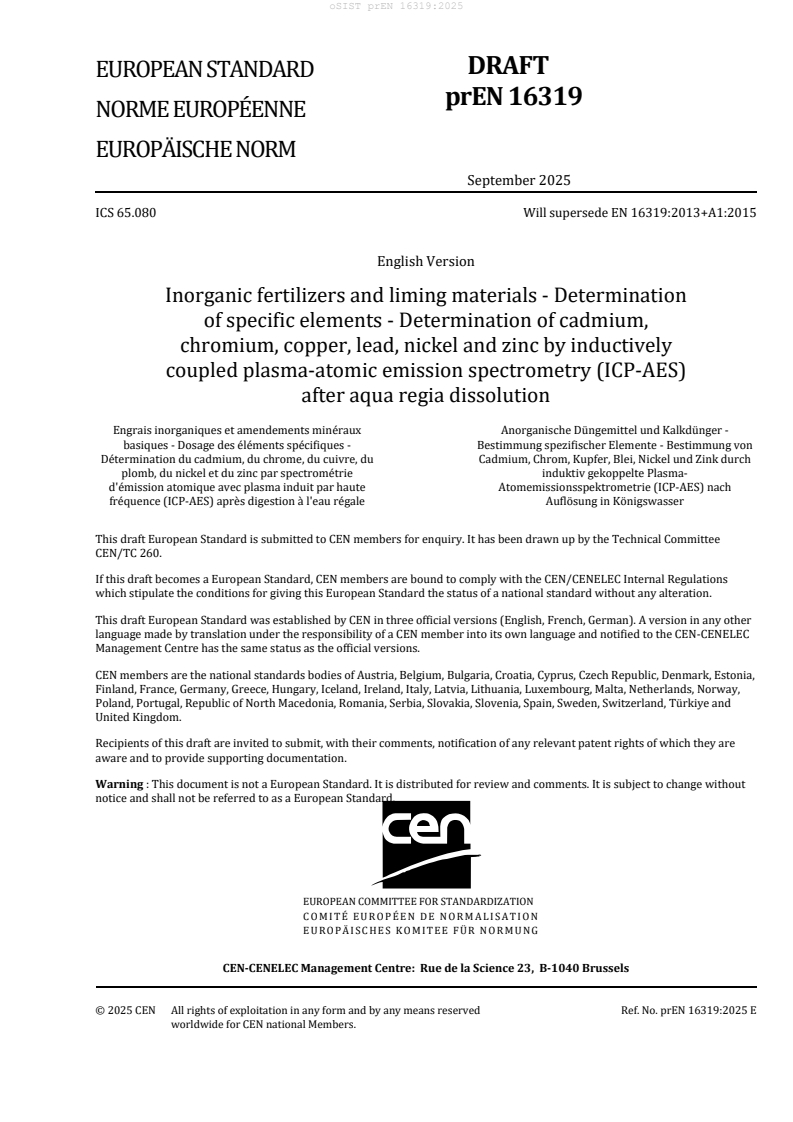
DRAFT
EUROPEAN STANDARD
prEN 16319
NORME EUROPÉENNE
EUROPÄISCHE NORM
September 2025
ICS 65.080 Will supersede EN 16319:2013+A1:2015
English Version
Inorganic fertilizers and liming materials - Determination
of specific elements - Determination of cadmium,
chromium, copper, lead, nickel and zinc by inductively
coupled plasma-atomic emission spectrometry (ICP-AES)
after aqua regia dissolution
Engrais inorganiques et amendements minéraux Anorganische Düngemittel und Kalkdünger -
basiques - Dosage des éléments spécifiques - Bestimmung spezifischer Elemente - Bestimmung von
Détermination du cadmium, du chrome, du cuivre, du Cadmium, Chrom, Kupfer, Blei, Nickel und Zink durch
plomb, du nickel et du zinc par spectrométrie induktiv gekoppelte Plasma-
d'émission atomique avec plasma induit par haute Atomemissionsspektrometrie (ICP-AES) nach
fréquence (ICP-AES) après digestion à l'eau régale Auflösung in Königswasser
This draft European Standard is submitted to CEN members for enquiry. It has been drawn up by the Technical Committee
CEN/TC 260.
If this draft becomes a European Standard, CEN members are bound to comply with the CEN/CENELEC Internal Regulations
which stipulate the conditions for giving this European Standard the status of a national standard without any alteration.
This draft European Standard was established by CEN in three official versions (English, French, German). A version in any other
language made by translation under the responsibility of a CEN member into its own language and notified to the CEN-CENELEC
Management Centre has the same status as the official versions.
CEN members are the national standards bodies of Austria, Belgium, Bulgaria, Croatia, Cyprus, Czech Republic, Denmark, Estonia,
Finland, France, Germany, Greece, Hungary, Iceland, Ireland, Italy, Latvia, Lithuania, Luxembourg, Malta, Netherlands, Norway,
Poland, Portugal, Republic of North Macedonia, Romania, Serbia, Slovakia, Slovenia, Spain, Sweden, Switzerland, Türkiye and
United Kingdom.
Recipients of this draft are invited to submit, with their comments, notification of any relevant patent rights of which they are
aware and to provide supporting documentation.
Warning : This document is not a European Standard. It is distributed for review and comments. It is subject to change without
notice and shall not be referred to as a European Standard.
EUROPEAN COMMITTEE FOR STANDARDIZATION
COMITÉ EUROPÉEN DE NORMALISATION
EUROPÄISCHES KOMITEE FÜR NORMUNG
CEN-CENELEC Management Centre: Rue de la Science 23, B-1040 Brussels
© 2025 CEN All rights of exploitation in any form and by any means reserved Ref. No. prEN 16319:2025 E
worldwide for CEN national Members.
oSIST prEN 16319:2025
prEN 16319:2025 (E)
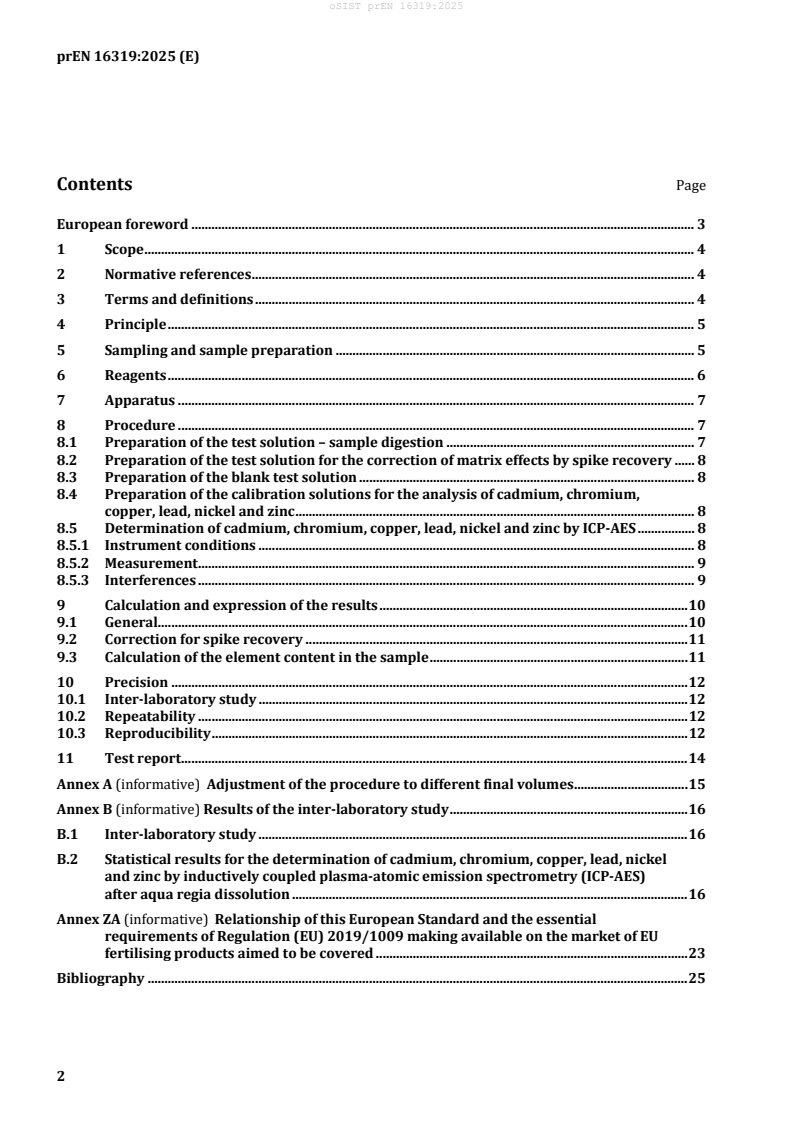
Contents Page
European foreword . 3
1 Scope . 4
2 Normative references . 4
3 Terms and definitions . 4
4 Principle . 5
5 Sampling and sample preparation . 5
6 Reagents . 6
7 Apparatus . 7
8 Procedure . 7
8.1 Preparation of the test solution – sample digestion . 7
8.2 Preparation of the test solution for the correction of matrix effects by spike recovery . 8
8.3 Preparation of the blank test solution . 8
8.4 Preparation of the calibration solutions for the analysis of cadmium, chromium,
copper, lead, nickel and zinc . 8
8.5 Determination of cadmium, chromium, copper, lead, nickel and zinc by ICP-AES . 8
8.5.1 Instrument conditions . 8
8.5.2 Measurement . 9
8.5.3 Interferences . 9
9 Calculation and expression of the results . 10
9.1 General. 10
9.2 Correction for spike recovery . 11
9.3 Calculation of the element content in the sample . 11
10 Precision . 12
10.1 Inter-laboratory study . 12
10.2 Repeatability . 12
10.3 Reproducibility . 12
11 Test report . 14
Annex A (informative) Adjustment of the procedure to different final volumes . 15
Annex B (informative) Results of the inter-laboratory study . 16
B.1 Inter-laboratory study . 16
B.2 Statistical results for the determination of cadmium, chromium, copper, lead, nickel
and zinc by inductively coupled plasma-atomic emission spectrometry (ICP-AES)
after aqua regia dissolution . 16
Annex ZA (informative) Relationship of this European Standard and the essential
requirements of Regulation (EU) 2019/1009 making available on the market of EU
fertilising products aimed to be covered . 23
Bibliography . 25
oSIST prEN 16319:2025
prEN 16319:2025 (E)
European foreword
This document (prEN 16319:2025) has been prepared by Technical Committee CEN/TC 260 “Fertilizers
and liming materials”, the secretariat of which is held by DIN.
This document is currently submitted to the CEN Enquiry.
This document will supersede EN 16319:2013+A1:2015.
In comparison with EN 16319:2013+A1:2015, the following technical modifications have been made:
— determination of Cu and Zn included in Clause 1 (Scope), Clause 6 (Reagents) and Clause 8
(Procedure) of the text;
— extraction procedure adapted (8.1) for technical progress (graphite blocks and smaller volumes of
acids included);
— normative references and bibliography updated;
— terms and definitions updated;
— Clause 10 (Precision) updated;
— Annex B updated (results of inter-laboratory study added);
— Annex ZA added.
This document has been prepared under a standardization request addressed to CEN by the European
Commission. The Standing Committee of the EFTA States subsequently approves these requests for its
Member States.
For the relationship with EU Legislation, see informative Annex ZA, which is an integral part of this
document.
oSIST prEN 16319:2025
prEN 16319:2025 (E)
1 Scope
This document specifies a method for the determination of the content of cadmium, chromium, copper,
lead, nickel and zinc in fertilizers and liming materials using inductively coupled plasma-atomic emission
spectrometry (ICP-AES) after aqua regia dissolution. Limits of quantification are dependent on the
sample matrix as well as on the instrument, but can roughly be expected to be 0,3 mg/kg for Cd and
1 mg/kg for Cr, Cu, Ni, Pb and Zn.
This document is applicable to the fertilizing products blends where a blend is a mix of at least two of the
following components: fertilizers, liming materials, soil improvers, growing media, inhibitors, plant
biostimulants and where the following category: inorganic fertilizers and liming materials is the
highest % in the blend by mass or volume, or in the case of liquid form by dry mass. If inorganic fertilizers
and liming materials is not the highest % in the blend, the European Standard for the highest % of the
blend applies. In case a fertilizing product blend is composed of components in equal quantity, the user
decides which standard to apply.
NOTE 1 The term fertilizer is used throughout this document and needs to be taken to include liming materials
unless otherwise indicated.
NOTE 2 Dissolution by aqua regia is equivalent to digestion and extract and digest are equivalent terms in this
sense for the purposes of this standard.
2 Normative references
The following documents are referred to in the text in such a way that some or all of their content
constitutes requirements of this document. For dated references, only the edition cited applies. For
undated references, the latest edition of the referenced document (including any amendments) applies.
EN 1482-2:2024, Fertilizers, liming materials and inhibitors — Sampling and sample preparation —
Part 2: General sample preparation provisions
EN 12944-1:1999, Fertilizers and liming materials — Vocabulary — Part 1: General terms
EN 12944-2:1999, Fertilizers and liming materials — Vocabulary — Part 2: Terms relating to fertilizers
EN 12944-3:2019, Fertilizers and liming materials — Vocabulary — Part 3: Terms relating to liming
materials
EN 14787:2005, Fertilizers and liming materials — Determination of water content — Guidelines and
recommendations
3 Terms and definitions
For the purposes of this document, the terms and definitions given in EN 12944-1:1999,
EN 12944-2:1999 and EN 12944-3:2019, and the following apply.
ISO and IEC maintain terminology databases for use in standardization at the following addresses:
— ISO Online browsing platform: available at https://www.iso.org/obp/
— IEC Electropedia: available at https://www.electropedia.org/
As impacted by EN 12944-1:1999/AC:2000.
As impacted by EN 12944-2:1999/AC:2000.
oSIST prEN 16319:2025
prEN 16319:2025 (E)
3.1
analyte
parameter to be determined
3.2
blank calibration solution
solution prepared in the same way as the calibration solution but leaving out the analytes
3.3
blank test solution
solution prepared in the same way as the test sample solution but omitting the test portion
3.4
calibration solution
solution used to calibrate the instrument, prepared from stock solutions by adding acids, buffer, reference
element and salts as needed
3.5
digestion
mineralization of the organic matter of a sample and dissolution of its mineral part, more or less
completely, when reacting with a reagent mixture
3.6
digest
solution received after mineralization of the organic matter of a sample and dissolution of its mineral
part, more or less completely, when reacting with a reagent mixture
3.7
stock solution
solution with accurately known analyte concentration(s), prepared from pure chemicals (6.5)
3.8
test sample solution
solution prepared after extraction or digestion of the test sample according to appropriate specifications
4 Principle
The samples are digested by boiling in aqua regia for two hours under reflux conditions. The
concentrations of the elements in the digests are measured by inductively coupled plasma–atomic
emission spectrometry (ICP-AES). Multi-element determinations using sequential or simultaneous
optical systems and axial, radial or dual viewing of the plasma may be used.
5 Sampling and sample preparation
Sampling is not part of the method specified in this document. A recommended sampling method is given
in EN 1482-1.
It is important that the laboratory receives a sample that is representative of both the product under
consideration and the given analysis, respectively. The sample should not have been damaged or changed
during transport or storage.
Sample preparation shall be carried out in accordance with EN 1482-2:2024.
oSIST prEN 16319:2025
prEN 16319:2025 (E)
6 Reagents
Use only reagents of recognized analytical grade. The concentration of the analyte or interfering
substances in the reagents and the water should be negligible compared to the lowest concentration to
be determined.
6.1 Water with a specific conductivity not higher than 0,2 mS/m at 25 °C, free from the elements to be
determined.
6.2 Hydrochloric acid, c(HCl) = 12 mol/l; 37 % volume fraction; ρ ≈ 1,18 g/ml.
6.3 Nitric acid, c(HNO ) = 16 mol/l; not less than 65 % volume fraction; ρ ≈ 1,42 g/ml.
6.4 Mixed solution of 0,8 mol/l nitric acid and 1,8 mol/l hydrochloric acid.
Mix 150 ml of hydrochloric acid (6.2) and 50 ml nitric acid (6.3) to 1,0 l volumetric flask and fill by water
(6.1) to the mark.
6.5 Standard stock solutions, cadmium, chromium, copper, lead, nickel and zinc standard stock
solutions, e.g. ρ = 1 000 mg/l for each element.
Use suitable stock solutions. Both single-element stock solutions and multi-element stock solutions with
adequate specification stating the acid used and the preparation technique are commercially available. It
is recommended to use commercially available standard stock solutions for cadmium, chromium, copper
lead, nickel, and zinc. Multi-element stock solutions are usually available at the individual mass
concentration ρ = 100 mg/l for each element. These solutions are considered to be stable for more than
one year, but in reference to guaranteed stability, the recommendations of the manufacturer should be
considered. Alternatively, the stock solutions may be prepared by dissolution of high purity metals.
6.6 Working standard solutions.
Depending on the scope, different working standard solutions might be necessary.
In general, when combining elements in working standard solutions, their chemical compatibility shall
be regarded. Spectral interferences from other elements present in working standard solutions also need
to be considered. Various combinations of elements at different concentrations may be used, provided
that the standard stock solutions (6.5) are diluted with the same acid and in equal concentration as the
acid in the test solution.
6.6.1 Working standard solution I, ρ = 100 mg/l for cadmium, chromium, copper, lead, nickel and
zinc.
Use commercially available solution of this concentration for each element or pipette 10,0 ml of each
standard stock solution of cadmium, chromium, copper, lead, nickel and zinc (6.5) to 100,0 ml with the
mixed acid solution (6.4) in the same 100 ml flask. If non-equal concentrations of cadmium, chromium,
copper, lead, nickel and zinc are needed, dilute the required volumes into 100,0 ml. This solution is used
to prepare spiked test solutions and standard and calibration solutions.
6.6.2 Working standard solution II, ρ = 10 mg/l for cadmium, chromium, copper, lead, nickel and
zinc.
Pipette 10,0 ml of the working standard solution I of cadmium, chromium, copper, lead, nickel and zinc
(6.6.1) to 100,0 ml with the mixed acid solution (6.4) in a 100 ml flask. If non-equal concentrations of
cadmium, chromium, copper, lead, nickel and zinc are needed, dilute the required volume from the
standard stock solutions (6.5) into 100,0 ml. This solution is used to prepare spiked test solutions and
calibration solutions.
oSIST prEN 16319:2025
prEN 16319:2025 (E)
7 Apparatus
7.1 Common laboratory glassware.
7.2 Analytical balance, capable of weighing to the nearest 1 mg.
7.3 Apparatus for thermal heating digestion with digestion vessels.
7.4 Inductively coupled plasma-atomic emission spectrometer, with axial, radial or dual viewing
of the plasma.
The settings of the working conditions (e.g. gas flows, RF or plasma power, sample uptake rate,
integration time and number of replicates) shall be optimized according to the manufacturer’s
instructions.
7.5 Filter paper, ash free and of recognized and tested quality.
8 Procedure
CAUTION — Suitable precautions shall be taken to avoid any contact of laboratory staff with acid fumes.
The digestion procedure shall be carried out in a well-ventilated fume cupboard.
8.1 Preparation of the test solution – sample digestion
Weigh 1,5 g to 3 g of the prepared sample, to the nearest 0,001 g and transfer it to a suitable reaction
vessel. Liquid samples are preferably weighed directly into the reaction vessel. Moisten the sample with
about 0,5 ml to 1,0 ml of water (6.1) and add, whilst mixing, (21 ± 0,1) ml of hydrochloric acid (6.2)
followed by (7 ± 0,1) ml of nitric acid (6.3) drop by drop if necessary to reduce foaming. Connect a
condenser to the reaction vessel and let the mixture stand at room temperature until any effervescence
almost ceases to allow for slow oxidation of any organic mass in the sample. Transfer to the heating device
and raise the temperature of the reaction mixture slowly to reflux conditions. Maintain for 2 h, ensuring
that the condensation zone is lower than 1/3 of the height of the condenser, then allow to cool. Rinse the
condenser a further with 10 ml of water (6.1).
Transfer the digested sample quantitatively into a 150 ml volumetric flask and dilute to the mark with
water (6.1).
Test solutions may be filtered or centrifuged, if necessary. Use ash-free filter paper of recognized and
tested quality (7.5) and discard the first portion of the filtrate (approximately 20 ml).
Carry out the measurement immediately or store the extracts in tightly closed vessels for up to 15 days.
The procedure may be modified for the use of 100 ml or 50 ml volumetric flasks or graduated plastic
tubes, especially when using heating blocks with different heating zones or graphite blocks. In this case
the mass of the sample and volumes of the acids should be changed accordingly. For more information
see Annex A.
Test solutions are diluted with the mixed acid solution (6.4) to obtain the concentration of the elements
in the calibration range.
NOTE The digestion procedure using microwave digestion can be applied if the user demonstrates equivalence
of the results.
oSIST prEN 16319:2025
prEN 16319:2025 (E)
8.2 Preparation of the test solution for the correction of matrix effects by spike recovery
For an unknown matrix a spiked test solution with a known addition of a (multi-element) standard
solution is recommended. The addition of a spike of the standard solution shall be between 0,4 and 2
times the expected sample mass concentration without changing the matrix of the test solution. It is
important that the total dilution of the test solution 8.1 is equal to the dilution of the spiked test solution
8.2.
EXAMPLE Spiking procedure: pipette 10 ml of a test sample solution or diluted digest into two test tubes, add
0,1 ml of a standard solution (6.6.1) into the first test tube and 0,1 ml of blank test solution (8.3) into the second
test tube. Mix well and measure. To achieve a higher concentration of an element by spiking, stock solutions of
higher concentration may be used.
8.3 Preparation of the blank test solution
Carry out a blank test at the same time as the extraction with only the reagents and follow the same
procedure as for the samples.
8.4 Preparation of the calibration solutions for the analysis of cadmium, chromium,
copper, lead, nickel and zinc
Prepare the calibration solutions by dilution of suitable working standard solutions (6.6.1 and 6.6.2) with
the mixed acid solution (6.4). Pipette 0 ml, 0,1 ml, 0,5 ml, 1 ml and 5 ml of working standard solution II
(6.6.2) into five 100 ml volumetric flasks respectively and 1 ml, 2 ml and 5 ml of working standard
solution I (6.6.1) into three other 100 ml volumetric flasks respectively. Fill the volumetric flasks to the
mark with the mixed acid solution (6.4). An overview of the concentrations in the calibration solutions is
given in Table 1. Different concentrations of elements in the calibration solutions are possible.
NOTE Autosamplers equipped with autodilution systems can be applied for instrument calibration using stock
solutions (6.5) or working standard solutions (6.6).
Table 1 — Calibration solutions
calibration solution number 1 2 3 4 5 6 7 8
concentration mg/l 0 0,01 0,05 0,1 0,5 1 2 5
Small differences in acid concentration between test sample solutions and calibration solutions do not
affect the measurement.
Use solutions number 1, 2, 3, 4, 5, 6 and 7 for calibration of cadmium and use solutions 1, 4, 5, 6, 7 and 8
for calibration of chromium, copper, lead, nickel and zinc. A different calibration range may be used if the
curve is linear. At least 4 calibration solutions should be used to calibrate each element, including blank
calibration solution (solution number 1).
8.5 Determination of cadmium, chromium, copper, lead, nickel and zinc by ICP-AES
8.5.1 Instrument conditions
Due to differences between various kinds of instruments, no detailed instructions can be given to operate
the specific instrument. The instruction provided by the manufacturer for waiting time, instrument
stability, gas flows, plasma conditions, nebulizer conditions, sample uptake rate, etc. should be followed.
Selectivity, limits of detection and quantification, precision, linear working range, and interferences
should be established separately for an individual instrument.
oSIST prEN 16319:2025
prEN 16319:2025 (E)
8.5.2 Measurement
Aspirate the calibration solutions, followed by the blank test solution (8.3) and the test sample solutions
(8.1), or the spiked test sample solution (8.2) if used into t
...