

SIST EN 17988-2:2025
(Main)Circular design of fishing gear and aquaculture equipment - Part 2: User manual and labelling
General Information
- Abstract
This document specifies the requirements for the user manuals and labelling that accompany circular designed fishing gear and aquaculture equipment containing plastics, to ensure traceability and proper management during the lifetime of its components.
- Status
- Published
- Public Enquiry End Date
- 17-Oct-2023
- Publication Date
- 11-Dec-2024
- Technical Committee
- I13 - Imaginarni 13
- Current Stage
- 6060 - National Implementation/Publication (Adopted Project)
- Start Date
- 10-Dec-2024
- Due Date
- 14-Feb-2025
- Completion Date
- 12-Dec-2024

Overview
SIST EN 17988-2:2025, developed by CEN, addresses the requirements for user manuals and labelling for circularly designed fishing gear and aquaculture equipment containing plastics. This standard supports the traceability and effective management of equipment and components throughout their lifecycle, aligning with the principles of circular economy and sustainability. The document plays a vital role in helping stakeholders such as manufacturers, fishers, aquaculture companies, recyclers, and regulatory bodies to ensure responsible and traceable handling of fishing gear and aquaculture equipment, especially those containing plastics.
Key Topics
User Manual Content and Structure
- Manuals must provide comprehensive information for all stakeholders involved, including conceptual, instructional, and reference details.
- Requirements cover all lifecycle stages: selection of materials, manufacturing, use, maintenance, end-of-use, and recycling.
- Guidelines are influenced by EN IEC/IEEE 82079-1:2019 standards to ensure clarity, usability, and completeness for users.
Labelling Requirements
- Equipment must be labelled for unique identification, including material composition, and should support traceability and reporting.
- Labels may include geolocation and owner identification to aid in loss prevention, recovery, and responsible disposal.
- Placement and implementation of labelling must comply with regulatory and technical specifications.
Stakeholder Responsibilities
- Manufacturers, importers, distributors, users, collectors, and recyclers each have specific information needs addressed in the standard.
- Extended Producer Responsibility (EPR) is encouraged for all plastics-containing fishing gear and aquaculture equipment.
Lifecycle Management
- The standard covers instructions for proper use, regular maintenance, disassembly for repair and recycling, and procedures for responsible end-of-use actions.
- Promotes documentation and tracking of component materials, recycled content, and safe handling or disposal of hazardous substances.
Applications
SIST EN 17988-2:2025 has broad applications across the value chain of the fishing and aquaculture industries:
Manufacturers & Importers
- Must develop user manuals and labels to support traceability, durability, and recyclability.
- Required to share information on material composition and end-of-use processes.
Fishers & Aquaculture Operators
- Use detailed manuals to extend equipment life, ensure safe maintenance, and comply with legal obligations for gear reporting and traceability.
Maintenance Providers & Repairers
- Manuals facilitate efficient disassembly, maintenance, and preparation of equipment for reuse or recycling.
Recyclers & Waste Handlers
- Benefit from clear labelling and documented material information to optimize sorting, processing, and recycling.
Regulatory Authorities
- Use standardised documentation and labelling to monitor compliance and report on collection, reuse, and recycling rates as required by EU directives.
Practical value: The standard enhances sustainability by making fishing gear and aquaculture equipment more easily traceable, reusable, and recyclable. It supports reduced environmental impact by minimizing marine plastics pollution and promoting responsible product lifecycle management.
Related Standards
EN 17988 Series
- Part 1: General requirements and guidelines
- Part 3: Technical requirements and guidelines
- Part 4: Environmental and circularity requirements
- Part 5: Circular business models
- Part 6: Digitalization of component information
Referenced Standards
- EN IEC/IEEE 82079-1:2019 - Principles for user manuals and information for use
- CEN/TS 18101 - Terms and definitions for circular design of fishing gear and aquaculture equipment
Relevant EU Directives
- Port Reception Facilities (PRF) Directive
- Single Use Plastics (SUP) Directive
Keywords: circular design, fishing gear, aquaculture equipment, user manuals, labelling, traceability, plastics, sustainability, recyclability, environmental standards
By following SIST EN 17988-2:2025, stakeholders in the fishing and aquaculture sectors can ensure compliance, improve resource management, and contribute to the sustainability goals driven by European and international initiatives.
Relations
- Effective Date
- 28-Jan-2026
- Effective Date
- 28-Jan-2026
- Effective Date
- 28-Jan-2026
- Effective Date
- 28-Jan-2026
- Effective Date
- 28-Jan-2026
- Effective Date
- 28-Jan-2026
- Effective Date
- 28-Jan-2026
- Effective Date
- 28-Jan-2026
- Effective Date
- 28-Jan-2026
- Effective Date
- 28-Jan-2026
Get Certified
Connect with accredited certification bodies for this standard

BSI Group
BSI (British Standards Institution) is the business standards company that helps organizations make excellence a habit.

Bureau Veritas
Bureau Veritas is a world leader in laboratory testing, inspection and certification services.

DNV
DNV is an independent assurance and risk management provider.
Sponsored listings
Frequently Asked Questions
SIST EN 17988-2:2025 is a standard published by the Slovenian Institute for Standardization (SIST). Its full title is "Circular design of fishing gear and aquaculture equipment - Part 2: User manual and labelling". This standard covers: This document specifies the requirements for the user manuals and labelling that accompany circular designed fishing gear and aquaculture equipment containing plastics, to ensure traceability and proper management during the lifetime of its components.
This document specifies the requirements for the user manuals and labelling that accompany circular designed fishing gear and aquaculture equipment containing plastics, to ensure traceability and proper management during the lifetime of its components.
SIST EN 17988-2:2025 is classified under the following ICS (International Classification for Standards) categories: 13.020.20 - Environmental economics. Sustainability; 65.150 - Fishing and fish breeding. The ICS classification helps identify the subject area and facilitates finding related standards.
SIST EN 17988-2:2025 has the following relationships with other standards: It is inter standard links to SIST-TS CEN/TS 18101:2025, SIST EN ISO 19211:2025, SIST EN 17988-5:2025, SIST EN ISO 5361:2023, SIST EN 17988-1:2025, SIST EN ISO 23368:2022, SIST EN 17988-6:2025, SIST EN ISO 16628:2022, SIST EN ISO 5367:2023, SIST EN 17988-4:2025. Understanding these relationships helps ensure you are using the most current and applicable version of the standard.
SIST EN 17988-2:2025 is associated with the following European legislation: EU Directives/Regulations: 2014/53/EU, 2019/904; Standardization Mandates: M/574, M/585. When a standard is cited in the Official Journal of the European Union, products manufactured in conformity with it benefit from a presumption of conformity with the essential requirements of the corresponding EU directive or regulation.
SIST EN 17988-2:2025 is available in PDF format for immediate download after purchase. The document can be added to your cart and obtained through the secure checkout process. Digital delivery ensures instant access to the complete standard document.
Standards Content (Sample)
SLOVENSKI STANDARD
01-februar-2025
Krožna zasnova ribolovnega orodja in opreme za akvakulturo - 2. del: Priročnik za
uporabo in označevanje
Circular design of fishing gear and aquaculture equipment - Part 2: User manual and
labelling
Kreislaufwirtschaft von Fischfanggeräten und Aquakulturausrüstungen - Teil 2:
Benutzerhandbuch und Kennzeichnung
Circularité et recyclabilité des engins de pêche et des équipements d’aquaculture -
Partie 2 : Manuels utilisateur et étiquetage
Ta slovenski standard je istoveten z: EN 17988-2:2024
ICS:
13.020.20 Okoljska ekonomija. Environmental economics.
Trajnostnost Sustainability
65.150 Ribolov in ribogojstvo Fishing and fish breeding
2003-01.Slovenski inštitut za standardizacijo. Razmnoževanje celote ali delov tega standarda ni dovoljeno.
EN 17988-2
EUROPEAN STANDARD
NORME EUROPÉENNE
November 2024
EUROPÄISCHE NORM
ICS 13.020.20; 65.150
English Version
Circular design of fishing gear and aquaculture equipment
- Part 2: User manuals and labelling
Circularité et recyclabilité des engins de pêche et des Kreislaufwirtschaft von Fischfanggeräten und
équipements d'aquaculture - Partie 2 : Manuels Aquakulturausrüstungen - Teil 2: Benutzerhandbuch
utilisateur et étiquetage und Kennzeichnung
This European Standard was approved by CEN on 30 September 2024.
CEN members are bound to comply with the CEN/CENELEC Internal Regulations which stipulate the conditions for giving this
European Standard the status of a national standard without any alteration. Up-to-date lists and bibliographical references
concerning such national standards may be obtained on application to the CEN-CENELEC Management Centre or to any CEN
member.
This European Standard exists in three official versions (English, French, German). A version in any other language made by
translation under the responsibility of a CEN member into its own language and notified to the CEN-CENELEC Management
Centre has the same status as the official versions.
CEN members are the national standards bodies of Austria, Belgium, Bulgaria, Croatia, Cyprus, Czech Republic, Denmark, Estonia,
Finland, France, Germany, Greece, Hungary, Iceland, Ireland, Italy, Latvia, Lithuania, Luxembourg, Malta, Netherlands, Norway,
Poland, Portugal, Republic of North Macedonia, Romania, Serbia, Slovakia, Slovenia, Spain, Sweden, Switzerland, Türkiye and
United Kingdom.
EUROPEAN COMMITTEE FOR STANDARDIZATION
COMITÉ EUROPÉEN DE NORMALISATION
EUROPÄISCHES KOMITEE FÜR NORMUNG
CEN-CENELEC Management Centre: Rue de la Science 23, B-1040 Brussels
© 2024 CEN All rights of exploitation in any form and by any means reserved Ref. No. EN 17988-2:2024 E
worldwide for CEN national Members.
EN 17899-2:2024 (E)
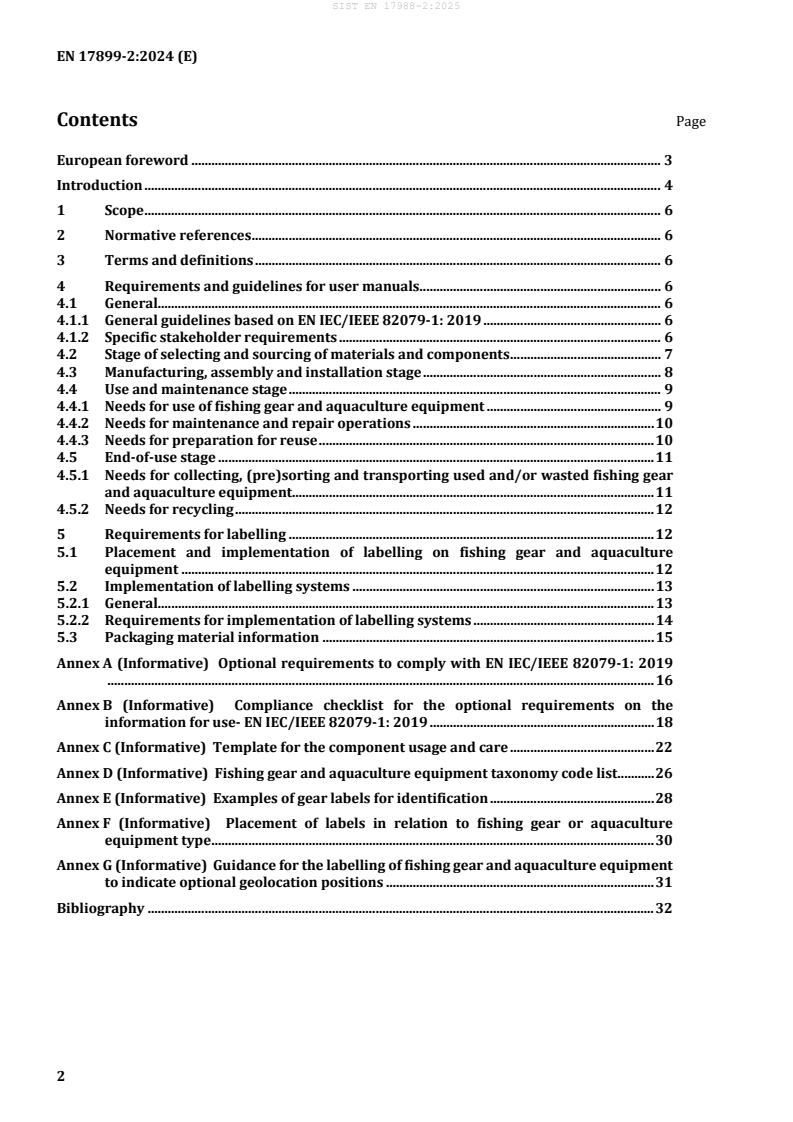
Contents Page
European foreword . 3
Introduction . 4
1 Scope . 6
2 Normative references . 6
3 Terms and definitions . 6
4 Requirements and guidelines for user manuals. 6
4.1 General. 6
4.1.1 General guidelines based on EN IEC/IEEE 82079-1: 2019 . 6
4.1.2 Specific stakeholder requirements . 6
4.2 Stage of selecting and sourcing of materials and components . 7
4.3 Manufacturing, assembly and installation stage . 8
4.4 Use and maintenance stage . 9
4.4.1 Needs for use of fishing gear and aquaculture equipment . 9
4.4.2 Needs for maintenance and repair operations . 10
4.4.3 Needs for preparation for reuse . 10
4.5 End-of-use stage . 11
4.5.1 Needs for collecting, (pre)sorting and transporting used and/or wasted fishing gear
and aquaculture equipment. 11
4.5.2 Needs for recycling . 12
5 Requirements for labelling . 12
5.1 Placement and implementation of labelling on fishing gear and aquaculture
equipment . 12
5.2 Implementation of labelling systems . 13
5.2.1 General. 13
5.2.2 Requirements for implementation of labelling systems . 14
5.3 Packaging material information . 15
Annex A (Informative) Optional requirements to comply with EN IEC/IEEE 82079-1: 2019
................................................................................................................................................................... 16
Annex B (Informative) Compliance checklist for the optional requirements on the
information for use- EN IEC/IEEE 82079-1: 2019 . 18
Annex C (Informative) Template for the component usage and care . 22
Annex D (Informative) Fishing gear and aquaculture equipment taxonomy code list. 26
Annex E (Informative) Examples of gear labels for identification . 28
Annex F (Informative) Placement of labels in relation to fishing gear or aquaculture
equipment type . 30
Annex G (Informative) Guidance for the labelling of fishing gear and aquaculture equipment
to indicate optional geolocation positions . 31
Bibliography . 32
European foreword
This document (EN 17988-2:2024) has been prepared by Technical Committee CEN/TC 466 “Circularity
and recyclability of fishing gear and aquaculture equipment”, the secretariat of which is held by NEN.
This European Standard shall be given the status of a national standard, either by publication of an
identical text or by endorsement, at the latest by May 2025, and conflicting national standards shall be
withdrawn at the latest by May 2025.
Attention is drawn to the possibility that some of the elements of this document may be the subject of
patent rights. CEN shall not be held responsible for identifying any or all such patent rights.
This document has been prepared under a standardization request addressed to CEN by the European
Commission (M/574). The Standing Committee of the EFTA States subsequently approves these requests
for its Member States.
This document is part of the EN 17988 series.
The EN 17988 series consists of the following parts, under the general title Circular design of fishing gear
and aquaculture equipment:
— Part 1: General requirements and guidelines
— Part 2: User manuals and labelling
— Part 3: Technical requirements and guidelines
— Part 4: Environmental and circularity requirements and guidelines
— Part 5: Circular business models
— Part 6: Requirements and guidelines for digitalization of information of components of fishing gear
and aquaculture equipment
Any feedback and questions on this document should be directed to the users’ national standards body.
A complete listing of these bodies can be found on the CEN website.
According to the CEN-CENELEC Internal Regulations, the national standards organisations of the
following countries are bound to implement this European Standard: Austria, Belgium, Bulgaria, Croatia,
Cyprus, Czech Republic, Denmark, Estonia, Finland, France, Germany, Greece, Hungary, Iceland, Ireland,
Italy, Latvia, Lithuania, Luxembourg, Malta, Netherlands, Norway, Poland, Portugal, Republic of North
Macedonia, Romania, Serbia, Slovakia, Slovenia, Spain, Sweden, Switzerland, Türkiye and the United
Kingdom.
EN 17899-2:2024 (E)
Introduction
As part of the European Green Deal, launched in 2019, the European Commission introduced measures
to move to a climate neutral and circular economy, together with a digital transition. One of the targets
in the transition to a circular economy was to reduce the amount of waste released into the environment
by decreasing the amount of waste generated, increasing the amount of waste collected and re-
introducing the materials regenerated from waste into the production of new products.
Specifically, the accumulation of plastics in marine and other aquatic environments were addressed in
two directives:
— The revised Port Reception Facilities (PRF) Directive [1] encourages fishers and aquaculturists to
bring not only their own end-of-use gear but also bring ashore abandoned, lost or otherwise
discarded (ALD) fishing gear and aquaculture equipment, thus encouraging waste to be carried back
to port.
— The Single Use Plastics (SUP) Directive [2], which lays down rules concerning different plastic
products, including fishing gear and aquaculture equipment containing plastics, and sets
requirements to the Member States to establish Extended Producer Responsibility (EPR) schemes.
Concerning fishing gear, it also contains rules on minimum national annual collection rates, together
with reporting on fishing gear placed on the market and waste fishing gear collected in ports.
In 2021, the standardization request M/574 on the circular design of fishing gear [3] was passed by the
European Commission and the parliament and accepted by CEN, which forms the basis for this series of
documents (EN 17988 series). While the term ‘fishing gear’ is used predominantly in the SUP Directive
and M/574, both documents encompass aquaculture equipment.
The purpose of this series of documents is to provide stakeholders with requirements, recommendations
and guidelines to address the different aspects of circular design of fishing gear and aquaculture
equipment containing plastics, encourage preparing for reuse and facilitate recyclability at end-of-use.
These requirements are intended to be applied from the design phase across the entire life cycle of the
fishing gear and aquaculture equipment. This includes but is not limited to: manufacturing, use,
maintenance, repair, collection, sorting, preparation for recycling, reuse, remanufacture, disposal, uptake
of recycled content and recycling.
Although this standard is written for fishing gear and aquaculture equipment containing plastics, the
requirements, recommendations and guidelines are also applicable to other materials.
This series of documents does not address other important design criteria such as fishing or farming
efficiency. When implementing the requirements, recommendations and guidelines provided in these
documents, balanced trade-offs between all relevant criteria need to be taken into account.
This series of documents aims to contribute to the following UN Sustainable Development Goals (SDGs)
[4]:
— 9 Industry, innovation, and infrastructure,
— 12 Responsible consumption and production,
— 14 Life below water, in particular target 14.1: ‘By 2025, prevent and significantly reduce marine
pollution of all kinds, in particular from land-based activities, including marine debris and nutrient
pollution.’
For a full outline of the parts of the standard, and how the parts relate to each other, see part 1.
Part 2 specifies the requirements, recommendations and guidelines for user manuals and labelling (and
other information) that accompanies circular designed fishing gear and aquaculture equipment. This will
enable traceability and proper management during the lifetime of fishing gear and aquaculture
equipment.
The aim of part 2 is to provide requirements, recommendations and guidelines for producers
(manufacturers and importers) of fishing gear and aquaculture equipment, netting and raw materials. In
addition, this part can also be relevant for other stakeholders, such as those involved in the end-of-use of
fishing gear and aquaculture equipment. Stakeholders that will need to be provided with user manuals
include fishers, aquaculture companies, collectors (of wasted gear), sorters, those who are doing
maintenance (including washing and cleaning), and distributors. Information that needs to be provided
to authorities can also be covered by user manuals or labelling.
Note to the reader on normative language: In this document, the following verbal forms are used in
accordance with the CEN/CENELEC Internal Regulations Part 3, Clause 7:
— “shall” indicates a requirement;
— “should” indicates a recommendation;
— “may” indicates a permission;
— “can” indicates a possibility or a capability;
— “must” indicates an external constraint.
EN 17899-2:2024 (E)
1 Scope
This document specifies the requirements for the user manuals and labelling that accompany circular
designed fishing gear and aquaculture equipment containing plastics, to ensure traceability and proper
management during the lifetime of its components.
2 Normative references
The following documents are referred to in the text in such a way that some or all of their content
constitutes requirements of this document. For dated references, only the edition cited applies. For
undated references, the latest edition of the referenced document (including any amendments) applies.
CEN/TS 18101, Circular design of fishing gear and aquaculture equipment - Terms and definitions
3 Terms and definitions
For the purposes of this document, the terms and definitions given in CEN/TS 18101 apply.
ISO and IEC maintain terminology databases for use in standardization at the following addresses:
— ISO Online browsing platform: available at https://www.iso.org/obp/
— IEC Electropedia: available at https://www.electropedia.org/
4 Requirements and guidelines for user manuals
4.1 General
4.1.1 General guidelines based on EN IEC/IEEE 82079-1: 2019
EN IEC/IEEE 82079-1 [6] provides general principles and detailed requirements for the design and
formulation of all types of instructions for users. The requirements in EN IEC/IEEE 82079-1: 2019 help
set the guidelines for the user manuals of fishing gear and aquaculture equipment.
The content for ‘information for use’ is based on three pillars and applies to all stages of the fishing gear
and aquaculture equipment life cycle:
a) Conceptual information: concepts, explanations and descriptions that enable the target groups to
perform tasks by understanding their purpose and the principles of operation of the supported
fishing gear or aquaculture equipment.
b) Instructional information: procedures and task-oriented step-by-step instructions.
c) Reference information: troubleshooting, maintenance schedule or codes.
See Annex A (informative) and B (informative) for the general requirements and a checklist from
EN IEC/IEEE 82079-1: 2019.
4.1.2 Specific stakeholder requirements
Fishing gear and aquaculture equipment manufacturers shall provide user manuals to stakeholders
where applicable.
Fishing gear and aquaculture equipment manufacturers shall identify which stakeholders need to be
provided with user manuals. When preparing instructions for use, the needs and capabilities of the
intended stakeholders shall be addressed.
Stakeholders that shall be taken into account, where applicable, include:
— distributors;
— users of fishing gear and aquaculture equipment (including fishers, aquaculturists);
— those who repair fishing gear and aquaculture equipment;
— those who provide maintenance services (for example washing and cleaning);
— those who collect, sort (including pre-sorting) and transport used or wasted fishing gear and
aquaculture equipment;
— recyclers; and
— EPR bodies.
Other stakeholders, such as authorities, should also be considered.
The user manuals shall include the information and needs listed in clauses 4.2, 4.3, 4.4 and 4.5 that are
applicable for the identified stakeholders.
4.2 Stage of selecting and sourcing of materials and components
a) Conceptual information
At this stage in the life cycle, information on materials and components needs to be aggregated in
order to be added and collated once the fishing gear aquaculture equipment and its components are
assembled or manufactured.
The information gathered at this stage will be used throughout the development of the user manual.
This guarantees proper care of the product to maximize its lifetime and allows preparation for the
different stage in its life cycle, such as reuse, repair, refurbish, remanufacture, repurpose, recycling,
recovery and disposal. See Clause 6.2 of EN 17988-1: 2024 [5] for more information on the different
life cycle stages of fishing gear and aquaculture equipment.
b) Instructional information
The user manual shall include information on:
— The materials, including aggregation of data for reporting and the amount of recycled material
used in the fishing gear and aquaculture equipment, where applicable.
The user manual should include information on:
— EPR relevance. See EN 17988-1:2024, Clause 6.6 [5] for an explanation on EPR.
— Installation care for materials. For example, lubrication requirements and avoiding contact with
certain types of surfaces or chemicals during installation, as described in Annex C
— Use and maintenance
— Storage conditions to maximise lifetime.
— Precautions, where applicable. For example, occupational health and safety and for
environmental concerns.
EN 17899-2:2024 (E)
— Information on mechanical limitations of the fishing gear and aquaculture equipment. For
example: avoid compression, cyclic loading or other stresses that can reduce the lifetime of
the fishing gear and aquaculture equipment.
— End-of-use
— End-of-use treatment options.
— Disposal of materials with specific requirements such as biocides.
c) Reference information
Not applicable.
4.3 Manufacturing, assembly and installation stage
a) Conceptual information
At this stage in the life cycle of a product, the manual should be set up integrating the information
from the materials and components, using a holistic approach and stipulating circularity for the user
and downstream stakeholders. The user manual shall take into account the concepts described in the
next two paragraphs and emphasize the importance of circularity of materials and components and
the possibilities to reuse, repair and recycle materials and components.
Fishers and aquaculturists customise their fishing gear and aquaculture equipment for the particular
circumstances in which they operate, including adapting nets, ropes and floats to target species and
for functionality at sea. Fishing gear and aquaculture equipment, therefore, can be composed of
different types of plastics, metal pieces (including metal weights), natural materials (for example,
wood in trawl doors) and are sometimes treated with copper-based antifouling coatings.
Typically, local net lofts assemble fishing gear and aquaculture equipment, while the manufacturing
of raw materials and components is generally done by other companies. Components can also be sold
directly to users who then assemble the final fishing gear and/or aquaculture equipment themselves,
or use the components to replace or repair parts of other gear and/or equipment. Other users
purchase fully assembled fishing gear and/or aquaculture equipment directly from manufacturers
and suppliers, and are often involved in design and specification.
b) Instructional information
The user manual shall include information on:
— Assembly
— This shall include a description of the fishing gear or aquaculture equipment design which
allows for the easy identification of the components.
— This can be done by using a drawing or diagram or using other alternative tools that will
guarantee the identification of the components within the gear. An example of such design
is provided in Annex C.
— Components
— This shall include a description of good practices to increase the durability of components.
— This shall include a preventive maintenance plan.
— This shall include possible end-of-use options for the components.
— Installation
— This shall include proper installation guidelines to guarantee maximum durability for the
components and their circularity.
— Materials
— This shall include the information described in clause 4.2 regarding the types of materials,
quantities, potential end-of-use and proper care for the materials used in each
(sub)component.
— See EN 17988-4 [7] for more information on environmental and circularity requirements
and guidelines.
NOTE The materials are chosen based on strength, durability, accessibility, weight and cost.
There are four envisaged dominant polymer types, namely: PA6 (polyamide 6), PET (polyester), PP
(polypropylene) and PE (polyethylene). The use of specific plastics can vary greatly, with many gears
constructed from more than one type.
— Gear taxonomy
— Each Member State can set up their own additional taxonomies. However, reporting on
fishing gear and aquaculture equipment collected as waste should at least be comparable to
the reporting on fishing gear and aquaculture equipment placed on the market. This enables
the definition and monitoring of collection targets.
— Detailed information on gear taxonomy can be found in Annex D.
c) Reference information
Not applicable.
4.4 Use and maintenance stage
4.4.1 Needs for use of fishing gear and aquaculture equipment
a) Conceptual information
Providing information on correct use allows the user to care for the fishing gear and aquaculture
equipment to extend the durability and allow for reuse, repair and recycle at the end-of-use stage.
See Annex C for examples on how to provide information on component usage and care.
b) Instructional information
The user manual shall include information on:
— Materials (see Clause 4.3).
— Maintenance, including information on preventive maintenance.
The user manual should include information on:
EN 17899-2:2024 (E)
— Proper guidelines for installation and removal to guarantee the maximum durability for the
components, when appropriate.
— Precautions and information to avoid that fishing gear or aquaculture equipment gets damaged
or lost. For example, strengths or weights of material and utilities, or weather conditions.
— Necessary materials that need to be made available for proper usage and preventive
maintenance during the lifetime of the fishing gear and aquaculture equipment.
c) Reference information
See Annex E for examples of gear labels, and Annex F for the suggested placement of labels in relation
to gear type based on the FAO Report of the expert consultation on the marking of fishing gear [10].
4.4.2 Needs for maintenance and repair operations
a) Conceptual information
Including information on maintenance and repair allows fishing gear and aquaculture equipment to
retain its characteristics and extend its durability.
b) Instructional information
The user manual shall include information on:
— Materials (see clause 4.3).
— Disassembly and dismantling for maintenance.
— Maintenance, including information on preventive maintenance.
— Repair, including spare parts and materials for reparation.
— Expected lifetime of components.
The user manual shall include information on:
— An adequate maintenance schedule, to avoid premature degradation and loss of fishing gear and
aquaculture equipment.
The user manual should include information on:
— Step-by-step instructions for maintenance, preferably linking the components to the list, table
and design as presented in Annex C.
c) Reference information
Not applicable.
4.4.3 Needs for preparation for reuse
a) Conceptual information
Information on lifetime allows the user or refurbishing company to extend the usage and avoid
premature disposal of the material.
Component lifetime is typically described in years or number of cycles. Nevertheless, the component
lifetime described can only be used for reference purposes. The actual component lifetime will vary
according to the region, conditions in which the material is used, and frequency and haul load in each
cycle.
b) Instructional information
The user manual shall include information on:
— Materials (see Clause 4.3).
— Disassembly and dismantling for reuse.
— Precautions, where applicable. For example, occupational health and safety and for
environmental concerns.
The user manual can include information on:
— Organizations that provide take-back systems for reuse.
c) Reference information
See Annex C for information on component lifetime.
4.5 End-of-use stage
4.5.1 Needs for collecting, (pre)sorting and transporting used and/or wasted fishing gear and
aquaculture equipment
a) Conceptual information
Providing information on collecting, (pre)sorting and transporting used and/or wasted fishing gear
and aquaculture equipment maximizes the value that can be obtained, as it aids prioritization of
circularity practices according to the different R-strategies. See Clause 6.2 of EN 17988-1: 2024 [5]
for more information on the different circular economy strategies.
Giving information on fishing gear and aquaculture equipment design and materials allows for
efficient and effective separation and sorting at the end-of-use stage. See Annex C for information on
component usage and care.
b) Instructional information
The user manual shall include information on:
— Disassembly and dismantling of the individual components, with the aim of maximizing reuse
and recycling. This information can be presented either as text or as a diagram.
— Precautions, where applicable. For example, occupational health and safety and for
environmental concerns.
— Circularity of materials of which the fishing gear and aquaculture equipment is comprised,
allowing the stakeholders to increase the efficiency of the process of collecting, (pre)sorting and
transporting.
The user manual should include information on:
EN 17899-2:2024 (E)
— Precautions, where applicable. For example, occupational health and safety and for
environmental concerns.
The user manual can include information on:
— The preferred destination of the sorted material in order to maximize its circularity potential.
c) Reference information
Not applicable.
4.5.2 Needs for recycling
a) Conceptual information
Materials and quantity information is necessary to aid an efficient recycling process. Moreover, it is
important to include information regarding presence of regulated substances of concern (SoC).
b) Instructional information
The user manual shall include information on:
— Pre-processing prior to recycling. Pre-processing includes washing, shredding, manual
separation, density separation and a final washing. This is mainly important when the fishing
gear or aquaculture equipment is expected to be comprised of mixed materials.
NOTE Fishing gear and aquaculture equipment disposed of responsibly can often be cleaned and
separated, reducing processing procedures.
— Precautions, where applicable. For example, occupational health and safety and for
environmental concerns.
— Regulatory information regarding presence of SVHC.
— Information on whether specific mixed materials are included which can be recycled without
separation
c) Reference information
See Annex C for information on recycling.
5 Requirements for labelling
5.1 Placement and implementation of labelling on fishing gear and aquaculture
equipment
The labelling shall comply with labelling systems that are required by applicable regulations, and by this
series of standards.
The labelling shall include information on:
— Fishing gear or aquaculture equipment ID. The fishing gear or aquaculture equipment ID shall include
material identification and shall be linked to the technical specifications of the fishing gear or
aquaculture equipment.
The labelling can include information on:
— Geolocation ID. Geolocation identifies the position of the fishing gear. An identifier can be attached to
the fishing gear or aquaculture equipment itself or to marking equipment used to visualize the fishing
gear or aquaculture equipment (the latter is the most common for stationary gear and aquaculture
equipment.). The principal benefit of geolocation is that it offers the possibility for tracking and
tracing, and therefore the possibility of locating ALD fishing gear and aquaculture equipment, which
can then be put back in use, recycled or disposed of properly.
NOTE It is advisable to check applicable regulatory traceability requirements.
— Owner ID. Fishing gear or aquaculture equipment can be labelled with the owner’s ID. It is less likely
to be intentionally discarded, and is also easier to return to an owner in case of accidental loss. If
included, the labelling can include resources to identify and locate the owner of fishing gear or
aquaculture equipment. If used, this system shall be designed to cover changes of ownership.
Where applicable, a system for labelling fishing gear and aquaculture equipment shall contain practical
means of:
— Identifying the fishing gear, aquaculture equipment and material components, for example through
marking equipment. See Annex E for examples of marking and labelling for identification.
— Placement of appropriate labelling on fishing gear and aquaculture equipment to facilitate access to
information. See Annex F for suggested information on placement of labels/marks in relation to gear
type.
— Implementing a system for labelling fishing gear and aquaculture equipment, as described in Clause
5.2
— Information on how the labelling system can facilitate mechanisms to support the recycling or reuse
of fishing gear and aquaculture equipment.
— Information on how the labelling system can facilitate end-of-use actions to collect, sort, repair, reuse,
refurbish or recycle the fishing gear or aquaculture equipment (for example maps over collection
spots).
A system for labelling fishing gear and aquaculture equipment can contain practical means of locating
and identifying ownership of fishing gear and aquaculture equipment. See Annex G for guidance on the
labelling of fishing gear to indicate geolocation positions.
5.2 Implementation of labelling systems
5.2.1 General
End-to-end sustainable traceability depends on several components and systems working in conjunction.
This includes unique identification, consistent and reproducible data collection, and information-sharing
practices. To be compliant with regulations and accomplish business needs, companies should practice
record keeping and data sharing with value chain partners.
Labelling of fishing gear and aquaculture equipment should be considered in the context of broader
management of fisheries and aquaculture measures, which support sustainable fisheries and aquaculture
as well as healthy oceans, including the reduction, minimization and elimination of ALD fishing gear and
aquaculture equipment.
EN 17899-2:2024 (E)
5.2.2 Requirements for implementation of labelling systems
Responsibilities for designing and implementing the labelling systems can be shared among different
stakeholders. For example, owners, EPR organizations and manufacturers of fishing gear and aquaculture
equipment and components.
The labelling system shall:
— be used for the labelling of fishing gear or aquaculture equipment;
— ensure compliance with procedures for reporting, data storage, retrieval and information exchange.
The labelling system can ensure the identification of the fisheries, fishing gears, vessels, aquaculture
organizations and equipment or areas to which the system applies, and can ensure specification of
conditions for implementation and potential exemptions from the agreed system.
The systems for the labelling of fishing gear and aquaculture equipment should be designed to make their
implementation as feasible as possible to ensure their adoption.
Where applicable, traceability needs shall be taken into account. To extend internal traceability to meet
the business needs of interoperable, end-to-end traceability throughout the value chain, the following
steps for businesses across the value chain can be taken into account:
— Where the labelling of fishing gear and aquaculture equipment is implemented by relevant national,
sub-national or regional requirements, implementation of a labelling system for fishing gear and
aquaculture equipment can be a condition of any new fishing authorization or license for fishing or
aquaculture.
— Where there is no fishing authorization or license to fish required, a system of labelling of fishing gear
and equipment can be implemented as part of the fisheries or aquaculture management system when
necessary and practical.
An owner of fishing gear or aquaculture equipment subject to a labelling system should be allocated a
unique identifier and label to be applied to all fishing gear and aquaculture equipment owned by the
organization or person. When the fishing gear is associated with a registered fishing vessel, if applicable,
the label allocated for the fishing gear should match the vessel registration details (e.g. the port letters
and numbers or International Maritime Organization (IMO) number, if available).
Connecting an internal traceability system to up and downstream systems can be more complicated and
is, where not demanded by regulations, optional. The following points are of highest importance:
— Labels should be of a type and design approved by the competent authority, fitted in accordance with
technical specifications, and if applicable, available international standards.
— These labels can be documented in the form of records for fishing gear and aquaculture equipment
or through a fishing licensing or authorization system for fishing or aquaculture plants. Information
associated with the label should be recorded and incorporated into the existing fishery licensing or
authorization system, if applicable.
5.3 Packaging material information
If information regarding the materials used for the packaging is included, the information shall comply
with alphanumerical codes.
NOTE 1 Legal requirements and guidelines on packaging labelling and providing information regarding the
materials used for the packaging can be applicable.
NOTE 2 See EU decision 97/129/EC [9] for information on alphanumerical codes.
EN 17899-2:2024 (E)
Annex A
(Informative)
Optional requirements to comply with EN IEC/IEEE 82079-1: 2019
EN IEC/IEEE 82079-1: 2019 [6] provides general principles and detailed requirements for the design and
formulation of all types of user manuals. The standard provides requirements on the content, structure,
quality, process, media and format of the ’information for use’, which is considered an integral part of a
product and covers more than instructions/activities or operations to be performed by or with the
product.
EN IEC/IEEE 82079-1: 2019 implements four main principles of minimalism:
— Choose an action-oriented approach. This principle reflects the self-centredness of minimalism.
— Anchor the tool in the task domain. This principle asks designers to select training tasks that are
meaningful for the user.
— Support error recognition and recovery. There are several ways to increase user competence and
comfort levels in handling mistakes.
— Support reading to do, study and locate. Designs shall fit as much as possible the diverging needs and
propensities of the intended audience. This principle reflects the self-centredness of minimalism.
Some of the most important requirements on usability that can be found throughout the
EN IEC/IEEE 82079-1: 2019 standards to help write user-friendly information are as follows:
— Make sure the information for use is usable and relevant for the target audiences with respect to their
expected tasks and goals.
— The Information for use should meet the target audiences’ needs for information quality by being
complete, correct, concise, consistent, comprehensible, accessible and that it applies the principles of
minimalism.
— Use consistent terminology.
— List and explain unavoidable acronyms, abbreviations and technical terms.
— Make sure that information for use is easily searchable, contains convenient navigation and
unambiguous content.
— Include predefined information types.
— Use consistent formatting.
— Include navigation, such as page numbering or a table of contents.
— Use text fonts, safety signs and graphical symbols that are clearly legible for the target audiences, both
for print and electronic media (recommended minimum text font sizes and heights of safety signs and
graphical symbols are listed in a table that is included in the standard).
— Base the media and format of the information for use on the needs of the target audiences.
Also, the EN IEC/IEEE 82079-1: 2019 standard emphasizes that both the intended use of the product and
the reasonably foreseeable misuse should be included.
Further, the EN IEC/IEEE 82079-1: 2019 standard mentions including the following elements in
information for use:
— Identification of the information for use, the supported product and the supplier.
— Information regarding retaining the information.
— Presentational conventions. For example, the use of a particular typeface for text to be entered by the
user, keyboard keys, or menu items. The conventions can best be listed, and their meaning explained.
— Explanation of terminology. Also, if the information for use of a complex system contains several
documents from more than one supplier, you should explain the meaning of the different terms used.
— Explanation of abbreviations, technical terms, safety signs, graphical symbols and markings.
— Safety related information such as safety signs and product safety labels, safety notes and warning
messages.
— Signal words for warning messages for harm to persons (DANGER, WARNING, CAUTION) or damage
to property (NOTICE, BEWARE, TAKE CARE).
— Repacking information.
— Transportation and storage information.
— Installation information.
— Commissioning information.
— Modification information and/or restrictions.
— Operation information.
— Information on exceptional and emergency situations.
— All information needed during the life cycle of the supported product such as information on
maintenance, replacement of parts, repair and troubleshooting.
— The standard also suggests that information can be structured around so called leading criteria, such
as tasks, the product life cycle, target audience and the product’s functions.
— In order to do so, tasks can be structured by the order in which tasks are performed.
— When structured around the life cycle of the product, the product’s life cycle stages, such as design,
delivery, installing, operating, preparing for reuse, servicing, repairing, recycling, recovery and
disposing, can be used.
The EN IEC/IEEE 82079-1: 2019 standard has become less strict when it comes to the media and format
of the information for use and should be based on the needs of the target audiences.
EN 17899-2:2024 (E)
Annex B
(Informative)
Compliance checklist for the optional requirements on the information for
use- EN IEC/IEEE 82079-1: 2019
1. The following applies to information for use of all fishing gear and aquaculture equipment
products:
— It provides the necessary information for the target audiences to make safe, efficient, and
effective use of a supported product.
— It is an integral part of the supported product.
— It is usable and relevant for the target audiences with respect to their expected tasks and goals.
— It promotes the safe operation and maintenance of the supported.
— It meets the target audiences’ needs for information quality by being complete, correct, concise,
comprehensible, accessible and by applying the principles of minimalism.
— The content of the information for use covers the needs of the target audiences for the safe,
effective and efficient use of the product, applying the principle of minimalism.
— It describes the intended use and reasonably foreseeable misuse.
— Information product can be identified.
— The supported product can be identified in the information for use.
— The supplier can be identified in the information for use.
— The importance of retaining printed information for use is emphasized.
— Presentational conventions are listed and explained.
— Consistent terminology is used.
— Unavoidable acronyms, abbreviations and technical terms are listed and explained.
— Safety signs, graphical symbols, pictograms, and markings placed on the supported product and
packaging are explained.
— It contains a general description of the supported product, including a visualization.
— The product description includes the product’s specifications.
— Supplied accessories, consumables and spare parts are mentioned.
— Where legal requirements, safety, or technical reasons prohibit the installation, operation, o
...