

oSIST prEN 18261:2025
(Main)Compost and digestate - Determination of polycyclic aromatic hydrocarbons (PAH) by gas chromatography (GC) and high performance liquid chromatography (HPLC)
- Abstract
This document specifies a method for quantitative determination of 16 polycyclic aromatic hydrocarbons (PAH) (see Table 1) in compost or digestate, using GC-MS, GCMS/MS or HPLC-UV-DAD/FLD covering a wide range of PAH contamination levels (see Table 1).
Table 1 — Target analytes of this document
[...table not reproduced...]
The limit of detection depends on the determinants, the equipment used, the quality of chemicals used for the extraction of the sample and the clean-up of the extract.
This document contains decision tables based on the properties of the sample and the extraction and clean-up procedure used.
The method is applicable to the analysis of other PAH not specified in Table 1, provided suitability is proven by proper in-house validation experiments.
NOTE 1 When using fluorescence detection, acenaphthylene cannot be measured.
NOTE 2 This method has been validated in an interlaboratory study with specific products that were present on the market during the study (as included in Annex B, being composted bark (20 mm to 40 mm), biowaste compost (Rottegrad 3),green compost (Rottegrad 5,0 mm to 15 mm), solid digestate (centrifuged and dried, raw sieved 0 mm to 12 mm) and growing media blend 1 (white peat, green compost, wood fibre, lime, inorganic fertilizer)).
- Status
- Not Published
- Public Enquiry End Date
- 19-Dec-2025
- Technical Committee
- KAT - Soil quality
- Current Stage
- 4020 - Public enquire (PE) (Adopted Project)
- Start Date
- 22-Oct-2025
- Due Date
- 11-Mar-2026
- Completion Date
- 19-Dec-2025
- Mandate
- M/XXX - M/XXX

oSIST prEN 18261:2025 is a CEN draft European Standard for compost and digestate that specifies how to determine 16 polycyclic aromatic hydrocarbons (PAH). It gives a quantitative method using GC-MS, GC-MS/MS or HPLC-UV-DAD/FLD, and it is aimed at laboratories that need comparable PAH results on compost, digestate and related product matrices.
What does oSIST prEN 18261:2025 specify?
oSIST prEN 18261:2025 specifies the scope of the PAH measurement method, the sample handling steps, the analytical principle, and the reporting and validation framework. It covers compost or digestate and is organized as a main method with supporting annexes for examples and validation data.
The document states that sampling itself is handled elsewhere, and it points users to a separate sampling standard. It also allows other PAH outside the 16 target analytes when a laboratory demonstrates suitability by in-house validation.
| Annex | What it covers |
|---|---|
| Annex A | Examples of instrumental conditions and chromatograms for GC-MS, HPLC fluorescence and GC-MS/MS |
| Annex B | Performance characteristics from an interlaboratory study |
What are the key requirements of oSIST prEN 18261:2025?
The method is modular and matrix-dependent
Clause 4 makes oSIST prEN 18261:2025 a performance-based method. The laboratory selects suitable extraction, clean-up and detection modules according to the matrix and has to show that the chosen combination meets the performance criteria.
That matters in practice because compost and digestate vary a lot in water content, organic load and interfering compounds. The document does not force one fixed workflow; instead, it requires the laboratory to justify the path it uses.
Sampling, storage and pre-treatment control the quality of the result
Clause 9 sends sampling to EN 12579:2024, and Clause 10 sets expectations for storage and pre-treatment. Samples should be representative, kept intact during transport, and analyzed as soon as possible. Digestate storage follows EN ISO 5667-15, and dry samples may be stored in the dark at room temperature for up to one month.
Clause 10 also links drying and particle size reduction to the sample matrix. Complete drying is needed for Soxhlet extraction or PLE, and particle size reduction may be needed to make the test portion homogeneous. In practice, the laboratory has to prepare the sample so that PAH distribution is representative before extraction starts.
Extraction and clean-up are chosen according to the sample
Clause 11.2 requires a blank test for the chosen procedure, and the blank must stay below 50 % of the lowest reporting limit. Clauses 11.3 to 11.5 describe several extraction and clean-up options, including acetone/hexane-like solvent with agitation or sonication, Soxhlet extraction, PLE, and a sodium chloride assisted agitation procedure.
Clean-up options are aluminium oxide, silica gel, or gel permeation chromatography. This is important because the method expects the analyst to remove matrix interferences only as far as needed. Alternative clean-up procedures are allowed if they remove interfering peaks and still give at least 80 % recovery for relevant PAH and internal standards.
GC-MS uses internal standards and strict identification criteria
Clause 11.7 covers GC-MS and GC-MS/MS. The method uses a capillary column with a low-polarity stationary phase, and for GC-MS a minimum of four deuterated internal standards shall be used. Identification follows EN ISO 22892 and depends on retention behavior plus diagnostic ions.
The clause also highlights critical separations, including the pairs benzo[b]fluoranthene and benzo[k]fluoranthene, and benzo[a]pyrene and benzo[e]pyrene. In practice, the laboratory has to prove that its column and settings separate the target compounds well enough for reliable reporting.
HPLC uses UV and/or fluorescence detection, with one important limitation
Clause 11.8 covers HPLC with reversed-phase separation, UV detection, fluorescence detection, or both. Identification is based on retention time, and it may be confirmed by spectral comparison, a diode array detector, an independent method such as gas chromatography, or dual-wavelength checks.
A key limitation is stated in the scope and detection section: when fluorescence detection is used, acenaphthylene cannot be measured. That matters for method selection because the lab must choose GC or another detection route if acenaphthylene is needed.
Calibration, recoveries and reporting are tightly controlled
Clauses 11.7.3, 11.8.4, 11.7.6 and 11.8.6 define calibration and calculation. GC-MS uses internal-standard calibration, while HPLC uses external standards. Initial calibration uses at least five standard solutions, and calibration verification is performed against the established range.
Clause 12 treats the method as performance-based and expects recoveries in the 50 % to 110 % range. Clause 11.7.6 requires the internal standard recovery to be at least 50 %. Clause 14 requires the report to name the standard, identify the sample, state the extraction, clean-up and detection modules used, and give the result, deviations and dates. Results are reported in mg/kg dry matter and rounded to two significant figures.
What terms does oSIST prEN 18261:2025 define?
- polycyclic aromatic hydrocarbons (PAH) - the family of aromatic analytes measured by this document, covering the 16 target compounds listed in the scope.
- critical pair - a pair of PAH that must be separated to a predefined degree so the chromatographic result remains valid.
- internal standard - a known amount of compound added from the start of the procedure to track losses and matrix effects through the whole analysis.
- injection standard - a compound mixture added just before GC-MS injection to monitor instrument response and support recovery checks.
- extraction standard - a PAH added before extraction to check extraction efficiency, but not used for quantification.
- GC-MS - gas chromatography with mass spectrometric detection, used here for separation and identification of the target PAH.
- HPLC-UV-DAD/FLD - high performance liquid chromatography with ultraviolet, diode array and/or fluorescence detection, used as the alternative detection route.
Who uses oSIST prEN 18261:2025?
oSIST prEN 18261:2025 is used by laboratories that test compost, digestate, soil improvers and growing media for PAH contamination. It is relevant to routine analytical labs, contract labs, product-control laboratories and validation teams that need comparable results across batches and matrices.
It also supports organizations that oversee product quality or regulatory compliance, because the method tells the laboratory how to prepare the sample, which analytical route to use, and what to put in the report. In practice, it is the reference for technicians who run the instruments and for quality managers who need defensible, documented results.
Which standards are used with oSIST prEN 18261:2025?
- CEN/TS 17732:2022 - provides the terminology used for soil improvers and growing media.
- EN 12579:2024 - covers sampling of soil improvers and growing media.
- prEN 13040-1:2025 - supports sample preparation and the determination of dry matter and moisture content.
- EN ISO 5667-15 - gives guidance for the preservation and handling of sludge and sediment samples, used here for digestate storage.
- EN ISO 16720 - supports freeze-drying as a sample pre-treatment step.
- EN ISO 22892 - gives the identification criteria for target compounds by GC-MS.
- ISO 5725-2 - is used for the validation approach and the evaluation of repeatability and reproducibility.
- ISO 8466-1 and ISO 8466-2 - support linear and nonlinear calibration strategies.
- EN 17503:2022 - is named as the horizontal method framework the document was developed in accordance with.
- EN ISO 18475 - is named as a close methodological reference for GC-MS work on environmental solid matrices.
What does the oSIST prEN 18261:2025 document contain?
oSIST prEN 18261:2025 contains the reagent lists, apparatus requirements, extraction procedures, clean-up procedures, chromatographic settings, calibration rules, identification criteria and calculation formulas needed to measure PAH in compost and digestate. It also includes tables for target analytes, diagnostic ions and method decision points.
Annex A gives example GC-MS, HPLC fluorescence and GC-MS/MS conditions together with chromatograms, which helps laboratories set up or check their instruments. Annex B provides interlaboratory performance data for five matrices, which is the main evidence base for precision and reproducibility.
Get Certified
Connect with accredited certification bodies for this standard

Control Union Certifications
Global certification for agriculture and sustainability.

ECOCERT
Organic and sustainability certification.

FSC International
Forest Stewardship Council certification.
Sponsored listings
Frequently Asked Questions
oSIST prEN 18261:2025 is a draft published by the Slovenian Institute for Standardization (SIST). Its full title is "Compost and digestate - Determination of polycyclic aromatic hydrocarbons (PAH) by gas chromatography (GC) and high performance liquid chromatography (HPLC)". This standard covers: This document specifies a method for quantitative determination of 16 polycyclic aromatic hydrocarbons (PAH) (see Table 1) in compost or digestate, using GC-MS, GCMS/MS or HPLC-UV-DAD/FLD covering a wide range of PAH contamination levels (see Table 1). Table 1 — Target analytes of this document [...table not reproduced...] The limit of detection depends on the determinants, the equipment used, the quality of chemicals used for the extraction of the sample and the clean-up of the extract. This document contains decision tables based on the properties of the sample and the extraction and clean-up procedure used. The method is applicable to the analysis of other PAH not specified in Table 1, provided suitability is proven by proper in-house validation experiments. NOTE 1 When using fluorescence detection, acenaphthylene cannot be measured. NOTE 2 This method has been validated in an interlaboratory study with specific products that were present on the market during the study (as included in Annex B, being composted bark (20 mm to 40 mm), biowaste compost (Rottegrad 3),green compost (Rottegrad 5,0 mm to 15 mm), solid digestate (centrifuged and dried, raw sieved 0 mm to 12 mm) and growing media blend 1 (white peat, green compost, wood fibre, lime, inorganic fertilizer)).
This document specifies a method for quantitative determination of 16 polycyclic aromatic hydrocarbons (PAH) (see Table 1) in compost or digestate, using GC-MS, GCMS/MS or HPLC-UV-DAD/FLD covering a wide range of PAH contamination levels (see Table 1). Table 1 — Target analytes of this document [...table not reproduced...] The limit of detection depends on the determinants, the equipment used, the quality of chemicals used for the extraction of the sample and the clean-up of the extract. This document contains decision tables based on the properties of the sample and the extraction and clean-up procedure used. The method is applicable to the analysis of other PAH not specified in Table 1, provided suitability is proven by proper in-house validation experiments. NOTE 1 When using fluorescence detection, acenaphthylene cannot be measured. NOTE 2 This method has been validated in an interlaboratory study with specific products that were present on the market during the study (as included in Annex B, being composted bark (20 mm to 40 mm), biowaste compost (Rottegrad 3),green compost (Rottegrad 5,0 mm to 15 mm), solid digestate (centrifuged and dried, raw sieved 0 mm to 12 mm) and growing media blend 1 (white peat, green compost, wood fibre, lime, inorganic fertilizer)).
oSIST prEN 18261:2025 is classified under the following ICS (International Classification for Standards) categories: 65.080 - Fertilizers. The ICS classification helps identify the subject area and facilitates finding related standards.
oSIST prEN 18261:2025 is associated with the following European legislation: EU Directives/Regulations: 2003/2003, 2019/1009; Standardization Mandates: M/564, M/564 AMD 1, M/564 AMD 2, M/588, M/XXX. When a standard is cited in the Official Journal of the European Union, products manufactured in conformity with it benefit from a presumption of conformity with the essential requirements of the corresponding EU directive or regulation.
oSIST prEN 18261:2025 is available in PDF format for immediate download after purchase. The document can be added to your cart and obtained through the secure checkout process. Digital delivery ensures instant access to the complete standard document.
Standards Content (Sample)
SLOVENSKI STANDARD
01-december-2025
Kompost in degestat - Določanje policikličnih aromatskih ogljikovodikov (PAH) s
plinsko kromatografijo (GC) in s tekočinsko kromatografijo visoke ločljivosti
(HPLC)
Compost and digestate - Determination of polycyclic aromatic hydrocarbons (PAH) by
gas chromatography (GC) and high performance liquid chromatography (HPLC)
Kompost und Gärreste - Bestimmung von polycyclischen aromatischen
Kohlenwasserstoffen (PAK) mittels Gaschromatographie (GC) und Hochleistungs-
Flüssigkeitschromatographie (HPLC)
Compost et digestat - Dosage des hydrocarbures aromatiques polycycliques (HAP) par
chromatographie en phase gazeuse (CG) et chromatographie liquide à haute
performance (HPLC)
Ta slovenski standard je istoveten z: prEN 18261
ICS:
65.080 Gnojila Fertilizers
2003-01.Slovenski inštitut za standardizacijo. Razmnoževanje celote ali delov tega standarda ni dovoljeno.
DRAFT
EUROPEAN STANDARD
prEN 18261
NORME EUROPÉENNE
EUROPÄISCHE NORM
October 2025
ICS 65.080
English Version
Compost and digestate - Determination of polycyclic
aromatic hydrocarbons (PAH) by gas chromatography
(GC) and high performance liquid chromatography (HPLC)
Compost et digestat - Dosage des hydrocarbures Kompost und Gärreste - Bestimmung von
aromatiques polycycliques (HAP) par chromatographie polycyclischen aromatischen Kohlenwasserstoffen
en phase gazeuse (CG) et chromatographie liquide à (PAK) mittels Gaschromatographie (GC) und
haute performance (HPLC) Hochleistungs-Flüssigkeitschromatographie (HPLC)
This draft European Standard is submitted to CEN members for enquiry. It has been drawn up by the Technical Committee
CEN/TC 223.
If this draft becomes a European Standard, CEN members are bound to comply with the CEN/CENELEC Internal Regulations
which stipulate the conditions for giving this European Standard the status of a national standard without any alteration.
This draft European Standard was established by CEN in three official versions (English, French, German). A version in any other
language made by translation under the responsibility of a CEN member into its own language and notified to the CEN-CENELEC
Management Centre has the same status as the official versions.
CEN members are the national standards bodies of Austria, Belgium, Bulgaria, Croatia, Cyprus, Czech Republic, Denmark, Estonia,
Finland, France, Germany, Greece, Hungary, Iceland, Ireland, Italy, Latvia, Lithuania, Luxembourg, Malta, Netherlands, Norway,
Poland, Portugal, Republic of North Macedonia, Romania, Serbia, Slovakia, Slovenia, Spain, Sweden, Switzerland, Türkiye and
United Kingdom.
Recipients of this draft are invited to submit, with their comments, notification of any relevant patent rights of which they are
aware and to provide supporting documentation.
Warning : This document is not a European Standard. It is distributed for review and comments. It is subject to change without
notice and shall not be referred to as a European Standard.
EUROPEAN COMMITTEE FOR STANDARDIZATION
COMITÉ EUROPÉEN DE NORMALISATION
EUROPÄISCHES KOMITEE FÜR NORMUNG
CEN-CENELEC Management Centre: Rue de la Science 23, B-1040 Brussels
© 2025 CEN All rights of exploitation in any form and by any means reserved Ref. No. prEN 18261:2025 E
worldwide for CEN national Members.
prEN 18261:2025 (E)
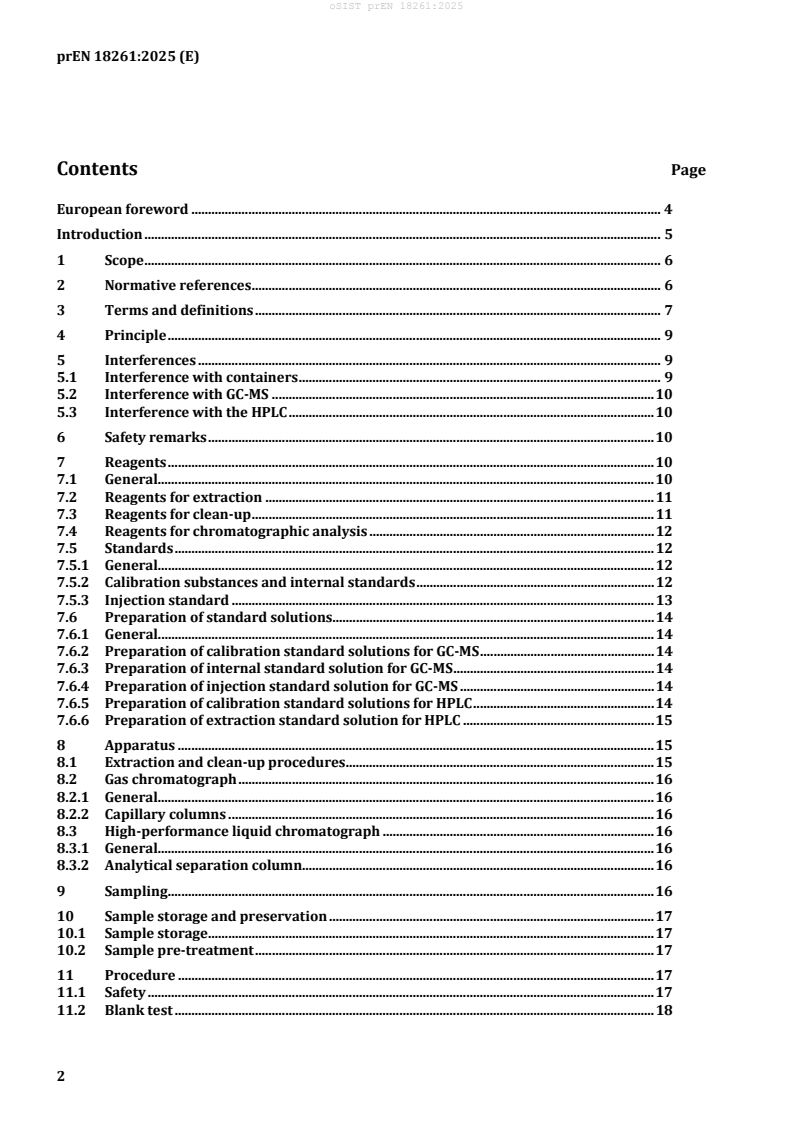
Contents Page
European foreword . 4
Introduction . 5
1 Scope . 6
2 Normative references . 6
3 Terms and definitions . 7
4 Principle . 9
5 Interferences . 9
5.1 Interference with containers . 9
5.2 Interference with GC-MS . 10
5.3 Interference with the HPLC . 10
6 Safety remarks . 10
7 Reagents . 10
7.1 General. 10
7.2 Reagents for extraction . 11
7.3 Reagents for clean-up . 11
7.4 Reagents for chromatographic analysis . 12
7.5 Standards . 12
7.5.1 General. 12
7.5.2 Calibration substances and internal standards . 12
7.5.3 Injection standard . 13
7.6 Preparation of standard solutions. 14
7.6.1 General. 14
7.6.2 Preparation of calibration standard solutions for GC-MS . 14
7.6.3 Preparation of internal standard solution for GC-MS . 14
7.6.4 Preparation of injection standard solution for GC-MS . 14
7.6.5 Preparation of calibration standard solutions for HPLC . 14
7.6.6 Preparation of extraction standard solution for HPLC . 15
8 Apparatus . 15
8.1 Extraction and clean-up procedures . 15
8.2 Gas chromatograph . 16
8.2.1 General. 16
8.2.2 Capillary columns . 16
8.3 High-performance liquid chromatograph . 16
8.3.1 General. 16
8.3.2 Analytical separation column. 16
9 Sampling . 16
10 Sample storage and preservation . 17
10.1 Sample storage . 17
10.2 Sample pre-treatment . 17
11 Procedure . 17
11.1 Safety . 17
11.2 Blank test . 18
prEN 18261:2025 (E)
11.3 Extraction . 18
11.3.1 General . 18
11.3.2 Extraction procedure 1: acetone/hexane-like solvent and agitation or sonication . 18
11.3.3 Extraction procedure 2: Soxhlet extraction . 19
11.3.4 Extraction procedure 3: Pressurized liquid extraction (PLE) . 19
11.3.5 Extraction procedure 3: acetone/hexane-like solvent/sodium chloride and agitation
................................................................................................................................................................... 19
11.4 Concentration . 20
11.4.1 General . 20
11.4.2 For HPLC analysis . 20
11.5 Clean-up of the extract . 21
11.5.1 General . 21
11.5.2 Clean-up A – Aluminium oxide . 21
11.5.3 Clean-up B – Silica gel . 22
11.5.4 Clean-up C – Gel permeation chromatography . 22
11.6 Addition of the injection standard . 22
11.7 GC-MS analysis . 22
11.7.1 Settings of the gas chromatograph . 22
11.7.2 Mass spectrometric (MS) conditions . 23
11.7.3 Calibration of the method using an internal standard . 24
11.7.4 Measurement . 25
11.7.5 Identification . 25
11.7.6 Check on method performance . 26
11.7.7 Calculation . 27
11.8 High-performance liquid chromatographic analysis (HPLC) . 27
11.8.1 General . 27
11.8.2 Setting the HPLC . 28
11.8.3 Detection . 28
11.8.4 Calibration. 29
11.8.5 Measurement . 29
11.8.6 Calculation . 30
12 Performance characteristics . 30
13 Precision . 30
14 Test report . 30
15 Validation of the method . 31
15.1 Validation in accordance with ISO 5725-2 . 31
15.2 Performance characteristics . 31
Annex A (informative) Examples of instrumental conditions and chromatograms . 32
A.1 Measurement of PAH with GC-MS . 32
A.2 Measurement of PAH with HPLC fluorescence . 38
A.3 Example for measurement conditions of PAH with GC-MS/MS . 43
Annex B (informative) Performance characteristics of the method . 45
Bibliography . 62
prEN 18261:2025 (E)
European foreword
This document (prEN 18261:2025) has been prepared by Technical Committee CEN/TC 223 “Soil
improvers and growing media”, the secretariat of which is held by NEN.
This document is currently submitted to CEN Enquiry.
This document has been prepared under a standardization request addressed to CEN by the European
Commission. The Standing Committee of the EFTA States subsequently approves these requests for its
Member States.
prEN 18261:2025 (E)
Introduction
This document is applicable for compost and digestate.
Polycyclic aromatic hydrocarbons (PAH) are ubiquitous because they are released in appreciable
quantities every year into the environment through the combustion of organic matters such as coal, fuel
oils, petrol, wood, refuse and plant materials. Since some of these PAH compounds are carcinogenic or
mutagenic, their presence in the environment (air, water, soil, sediment and waste) is regularly
monitored and controlled. At present determination of PAH is carried out in these matrices in most of the
routine laboratories following the prescribed steps specified for sampling, pre-treatment, extraction,
clean-up by measurement of specific PAH by means of gas chromatography in combination with mass
spectrometric detection (GC-MS or GC-MS/MS) or by high performance liquid chromatography (HPLC)
in combination with UV-DAD- or fluorescence detection (HPLC-UV-DAD/FLD). Both the GC-MS and the
HPLC methods are included in this horizontal standard.
This document was developed in accordance with EN 17503:2022.
Considered the different matrices and possible interfering compounds, this document does not contain
one single possible way of working. Several choices are possible, relating to clean-up. Quantification with
both GC-MS-detection and HPLC-DAD-UV/FLD is possible. Three different extraction procedures are
described and three clean-up procedures. The use of internal and injection standards is described in
order to have an internal check on choice of the extraction and clean-up procedure. The method is as far
as possible in agreement with the method described for polychlorinated biphenyls (PCB) (EN ISO 18475).
prEN 18261:2025 (E)
1 Scope
This document specifies different methods for quantitative determination of 16 polycyclic aromatic
hydrocarbons (PAH) (see Table 1) in compost or digestate, using GC-MS, GCMS/MS or HPLC-UV-
DAD/FLD covering a wide range of PAH contamination levels (see Table 1).
When using fluorescence detection, acenaphthylene cannot be measured.
Table 1 — Target analytes of this document
a
Target analyte CAS-RN
Naphthalene 91–20–3
Acenaphthene 83–32–9
Acenaphthylene 208–96–8
Fluorene 86–73–7
Anthracene 120–12–7
Phenanthrene 85–01–8
Fluoranthene 206–44–0
Pyrene 129–00–0
Benz[a]anthracene 56–55–3
Chrysene 218–01–9
Benzo[b]fluoranthene 205–99–2
Benzo[k]fluoranthene 207–08–9
Benzo[a]pyrene 50–32–8
Indeno[1,2,3-cd]pyrene 193–39–5
Dibenz[a,h]anthracene 53–70–3
Benzo[ghi]perylene 191–24–2
a
CAS-RN Chemical Abstracts Service Registry Number.
The limit of detection depends on the determinants, the equipment used, the quality of chemicals used
for the extraction of the sample and the clean-up of the extract.
This document contains decision tables based on the properties of the sample and the extraction and
clean-up procedure to be used.
The method may be applied to the analysis of other PAH not specified in the scope, provided suitability
is proven by proper in-house validation experiments.
2 Normative references
The following documents are referred to in the text in such a way that some or all of their content
constitutes requirements of this document. For dated references, only the edition cited applies. For
undated references, the latest edition of the referenced document (including any amendments) applies.
CEN/TS 17732:2022, Soil improvers and growing media — Terminology
EN 12579:2024, Soil improvers and growing media — Sampling
prEN 18261:2025 (E)
prEN 13040-1:2025, Soil improvers and growing media — Sample preparation — Part 1: Sample
preparation for chemical and physical tests, determination of dry matter content, moisture content and
laboratory bulk density
EN ISO 5667-15, Water quality — Sampling — Part 15: Guidance on the preservation and handling of
sludge and sediment samples
EN ISO 16720, Soil quality — Pretreatment of samples by freeze-drying for subsequent analysis
EN ISO 22892, Soil quality — Guidelines for the identification of target compounds by gas chromatography
and mass spectrometry
3 Terms and definitions
For the purposes of this document, the terms and definitions given in CEN/TS 17732:2022 and the
following apply.
3.1
critical pair
pair of PAH that shall be separated to a predefined degree to ensure chromatographic separation meets
minimum quality criteria
prEN 18261:2025 (E)
Figure 1 — Example of a chromatogram of a critical pair
∆t
R 2 × (1)
YY +
a b
where
R is the peak separation;
Δ t is the difference in retention times of the two peaks a and b in seconds (s);
Y is the peak width at the base of peak a in seconds (s);
a
Y is the peak width at the base of peak b in seconds (s)
b
3.2
internal standard
compound added in a known amount to the sample from the beginning of the protocol and enabling
analytical coverage throughout the procedure, and that is used to correct for losses during sample
preparation and analysis by accounting for all-system matrix effects (recoveries, ionization effect,
variability of the detector response of the instrument for example)
=
prEN 18261:2025 (E)
Note 1 to entry: isotopically labelled mostly deuterated PAH or native PAH are unlikely to be present in the sample
[SOURCE: EN ISO 21253-2:2019, 3.10, modified — Note 1 to entry has been adapted]
3.3
injection standard
standard mixture added to a sample before injection into the GC-MS apparatus, to monitor variability of
instrument response and to calculate internal standard recovery
[SOURCE: ISO 28540:2011, 3.4]
3.4
extraction standard
PAH that is unlikely to be present in samples added to the sample prior to extraction, used for checking
the extraction efficiency and not used for quantification purposes
4 Principle
Due to the multi matrix character of this document, different procedures for different steps (modules)
are allowed. Which modules should be used depends on the sample. A recommendation is given in this
document. Performance criteria are described and it is the responsibility of the laboratories applying this
document to show that these criteria are met. Using of spiking internal standards allows an overall check
on the efficiency of a specific combination of modules for a specific sample. But the use of internal
standards does not necessarily give the information regarding the extensive extraction efficiency of the
native PAH bonded to the matrix.
After pre-treatment, the sample is extracted with a suitable solvent.
The extract is concentrated by evaporation. If necessary, interfering compounds are removed by a clean-
up method suitable for the specific matrix, after the concentration step.
If a solvent exchange for HPLC analysis is necessary, the concentrated extract is taken up in an
appropriate less volatile water miscible polar solvent and the non-polar extract residue is removed under
a gentle flux of inert gas.
The extract is analysed by GC-MS or GC-MS/MS using a capillary column with a stationary phase of low
polarity or by HPLC-UV-DAD/FLD with an appropriate reversed phase column.
PAH are identified and quantified with GC-MS or GC-MSMS by comparison of relative retention times and
relative peak heights (or peak areas) with respect to internal standards added, and with HPLC by using
the corresponding variables of the extraction standard solutions. The efficiency of the procedure depends
on the composition of the matrix that is investigated.
5 Interferences
5.1 Interference with containers
Use sample containers of materials (preferably of steel, aluminium or glass) that do not affect the sample
during the contact time. Avoid plastics and other organic materials during sampling, sample storage or
extraction. Keep the samples from direct sunlight and prolonged exposure to light.
During storage of the samples, losses of PAH may occur due to adsorption on the walls of the containers.
The extent of the losses depends on the storage time.
prEN 18261:2025 (E)
5.2 Interference with GC-MS
Substances that co-elute with the target PAH can interfere with the determination. These interferences
can lead to incompletely resolved signals and can, depending on their magnitude, affect accuracy and
precision of the analytical results. Peak overlap does not allow an interpretation of the result.
Asymmetrical peaks and peaks broader than the corresponding peaks of the reference substance suggest
interferences.
Chromatographic separation between dibenz[a,h]anthracene and indeno[1,2,3-cd]pyrene are mostly
critical. Due to their molecular mass differences, quantification may be made by mass selective detection.
When incomplete resolution is encountered, peak integration shall be checked and, if necessary,
corrected.
Sufficient separation (e.g. R = 0,8) between the peaks of benzo[b]fluoranthene and benzo[k]fluoranthene
as well as of benzo[a]pyrene and benzo[e]pyrene shall be set as quality criteria for the capillary column.
Benzo[b]fluoranthene and benzo[j]fluoranthene cannot be separated. It can happen that the signal of
triphenylene is not completely separated from the signals of benz[a]anthracene and chrysene. In this case
it shall be stated in the report.
5.3 Interference with the HPLC
Substances that show either fluorescence or quenching and co-elute with the PAHs to be determined can
interfere with the determination. These interferences can lead to incompletely resolved signals and can,
depending on their magnitude, affect accuracy and precision of the analytical results. Peak overlap does
not allow an interpretation of the result. Asymmetrical peaks and peaks being broader than the
corresponding peaks of the reference substance suggest interferences. This problem can arise for
naphthalene and phenanthrene depending on the selectivity of the phases used.
Incomplete removal of the solvents used for sample extraction and clean-up can lead to poor
reproducibility of the retention times and wider peaks or double peaks especially for the 2- and 3-ring
PAHs. Extracts shall be diluted sufficiently with acetonitrile for the HPLC-analysis, otherwise the
detection of naphthalene and 3-ring PAH may be interfered with by a broad toluene peak.
Usually the signal of perylene is incompletely resolved from the signal of benzo[b]fluoranthene, but by
choosing a selective wavelength, the perylene peak can be suppressed.
6 Safety remarks
Certain PAH are highly carcinogenic and shall be handled with extreme care. Avoid contact with solid
materials, solvent extracts and solutions of standard PAH. It is strongly advised that standard solutions
are prepared centrally in suitably equipped laboratories or are purchased from suppliers specialized in
their preparation.
PAH contamination of vessels may be detected by irradiation with 366 nm UV-light.
Solvent solutions containing PAH shall be disposed of in a manner approved for disposal of toxic wastes.
For the handling of hexane precautions shall be taken because of its neurotoxic properties.
National regulations should be followed with respect to all hazards associated with this method.
7 Reagents
7.1 General
All reagents shall be of recognized analytical grade. The purity of the reagents used shall be checked by
running a blank test as described in 11.2. The blank result shall be less than 50 % of the lowest reporting
limit for each PAH.
prEN 18261:2025 (E)
7.2 Reagents for extraction
7.2.1 Acetone, (2-propanone), (CH ) CO.
3 2
7.2.2 Toluene, C H .
7 8
7.2.3 Petroleum ether, boiling range 40 °C to 60 °C.
Hexane-like solvents with a boiling range between 40 °C and 98 °C are allowed.
7.2.4 Sodium sulfate, Na SO .
2 4
The anhydrous sodium sulfate shall be kept carefully sealed.
7.2.5 Distilled water or water of equivalent quality, H O.
7.2.6 Sodium chloride, NaCl.
7.2.7 Keeper substance (high boiling compound, e.g. octane, nonane)
7.3 Reagents for clean-up
7.3.1 Clean-up “A” using aluminium oxide
7.3.1.1 Aluminium oxide, Al O
2 3
Basic or neutral, specific surface 200 m /g, activity Super I [9].
7.3.1.2 Deactivated aluminium oxide
Deactivated with water by approximately 100 g/kg.
Add approximately 10 g of water (7.2.5) to 90 g of aluminium oxide (7.3.1.1). Shake until all lumps have
disappeared. Allow the aluminium oxide to condition before use for some 16 h, sealed from the air, use it
for maximum of two weeks.
The activity depends on the water content. It may be necessary to adjust the water content.
Commercially available aluminium oxides with 100 g/kg mass fraction water may also be used.
7.3.2 Clean-up “B” using silica gel 60 for column chromatography
7.3.2.1 Silica gel 60, particle size 63 µm to 200 µm.
7.3.2.2 Silica gel 60, water content (mass fraction) w(H O) = 10 %.
Silica gel 60 (7.3.2.1), heated for at least 3 h at 450 °C, cooled down and stored in a desiccator containing
magnesium perchlorate or a suitable drying agent. Before use, heat for at least for 5 h at 130 °C in a drying
oven. Then allow cooling in a desiccator. Put the silica gel in a stoppered flask and add 10 % water (7.2.5)
(mass fraction), shake for 5 min intensively until all lumps have disappeared and then for 2 h in a shaking
device (8.1.3). Store the deactivated silica gel in the absence of air, use it for a maximum of two weeks.
7.3.3 Clean-up “C” using gel permeation chromatography (GPC)
prEN 18261:2025 (E)
7.3.3.1 Bio-Beads® S-X3
7.3.3.2 Ethyl acetate, C H O
4 8 2
7.3.3.3 Cyclohexane, C H
6 12
Preparation of GPC, for example: Put 50 g Bio-Beads® S-X3 (7.3.3.1) into a 500 ml Erlenmeyer flask and
add 300 ml elution mixture made up of cyclohexane (7.3.3.3) and ethyl acetate (7.3.3.2) 1 : 1 (volume
fraction) in order to allow the beads to swell. After swirling for a short time until no lumps are left,
maintain the flask closed for 24 h. Drain the slurry into the chromatography tube for GPC. After
approximately three days, push in the plungers of the column so that a filling level of approximately 35 cm
is obtained. To further compress the gel, pump approximately 2 l of elution mixture through the column
−1
at a flow rate of 5 ml · min and push in the plungers to obtain a filling level of approximately 33 cm.
7.4 Reagents for chromatographic analysis
7.4.1 GC-Analysis
7.4.1.1 Carrier gas for GC-MS
Operating gases of high purity and in accordance with the manufacturer’s specifications.
7.4.2 HPLC-analysis
7.4.2.1 Acetonitrile (CH CN) or methanol (CH OH), HPLC purity grade.
3 3
7.4.2.2 Ultra-pure water, HPLC purity grade.
7.4.2.3 Helium, He, of suitable purity for degasification of solvents.
7.5 Standards
7.5.1 General
Choose the internal and/or extraction standards whose physical and chemical properties (such as
extraction behaviour, retention time) are similar to those of the compounds to be analysed. For GC-MS a
minimum of four deuterated internal standards shall be used as internal standards for evaluation of
results.
7.5.2 Calibration substances and internal standards
Table 2 contains native and deuterated PAH to be used for calibration. Verify the stability of the internal
standards regularly.
Bio-Beads® is an example of a suitable product available commercially. This information is given for convenience
of users of this document and does not constitute an endorsement by CEN of this product. Equivalent products can
be used if they can be shown to lead to the same results.
prEN 18261:2025 (E)
Table 2 — Native PAH and deuterated PAH
PAH reference substances Internal standard substances (deuterated PAHs)
Naphthalene (CAS-RN 91-20-3) Naphthalene-d8 (CAS-RN 1146-65-2)
Acenaphthene (CAS-RN 83-32-9) Acenaphthene-d10 (CAS-RN 15067-26-2)
Acenaphthylene (CAS-RN 208-96-8) Acenaphthylene-d8 (CAS-RN 93951-97-4)
Fluorene (CAS-RN 86-73-7) Fluorene-d10 (CAS-RN 81103-79-9)
Anthracene (CAS-RN 120-12-7) Anthracene-d10 (CAS-RN 1719-06-8)
Phenanthrene (CAS-RN 85-01-8) Phenanthrene-d10 (CAS-RN 1517-22-2)
Fluoranthene (CAS-RN 206-44-0) Fluoranthene-d10 (CAS-RN 93951-69-0)
Pyrene (CAS-RN 129-00-0) Pyrene-d10 (CAS-RN 1718- 52–1)
Benz[a]anthracene (CAS-RN 56-55-3) Benz[a]anthracene-d12 (CAS-RN 1718-53-2)
Chrysene (CAS-RN 218-01-9) Chrysene-d12 (CAS-RN 1719-03-5)
Benzo[b]fluoranthene (CAS-RN 205-99-2) Benzo[b]fluoranthene-d12 (CAS-RN 93951-98-5)
Benzo[k]fluoranthene (CAS-RN 207-08-9) Benzo[k]fluoranthene-d12 (CAS-RN 93952-01-3)
a
Benzo[j]fluoranthene (CAS-RN 205-82-3)
Benzo[a]pyrene (CAS-RN 50-32-8) Benzo[a]pyrene-d12 (CAS-RN 63466-71-7)
a
Benzo[e]pyrene (CAS-RN 192-97-2)
Indeno[1,2,3-cd]pyrene (CAS-RN 193-39-5) Indeno[1,2,3-cd]pyrene-d12 (CAS-RN 203578-33-0)
Dibenz[a,h]anthracene (CAS-RN 53-70-3) Dibenz[a,h]anthracene -d14 (CAS-RN 13250-98-1)
Benzo[ghi]perylene (CAS-RN 191-24-2) Benzo[ghi]perylene-d12 (CAS-RN 93951-66-7)
a
Not part of 16 target analytes, but applicable for resolution check for the separation with benzo[a]pyrene for GC
measurements
C -labelled PAH standards may also be used as internal standards.
NOTE Certified solutions of PAH, and single solid PAH substances with certified purity are available from a
limited number of suppliers.
When highly contaminated samples are analysed, an aliquot of the extract is often used for further clean-
up. This makes the costs of analyses caused by the use of deuterated standard very high. In these cases,
it is allowed to add the internal standard in two steps:
— Step 1: addition of unlabelled internal standards to the sample;
— Step 2: addition of deuterated compounds to the aliquot of the extract used for clean-up.
For HPLC 6-methylchrysene, 1-methylnaphthalene or other alkylated PAH which are not present in the
sample and which are sufficient separated from the target PAH may be used as internal or extraction
standard.
7.5.3 Injection standard
If required for GC-MS a deuterated PAH such as 1-methylnaphthalene-d10, triphenylene-d12 and
perylene-d12 may be added to the final extract before GC-MS injection to verify the recovery of the
deuterated internal standards.
prEN 18261:2025 (E)
7.6 Preparation of standard solutions
7.6.1 General
The procedure for the preparation of standard solutions for GC-MS and HPLC is the same only different
solvents are used.
Because of the dangerous nature of the substances to be used, commercially available – preferably
certified – standard solutions or mixed standard solutions are preferred. It is very strongly recommended
to avoid skin contact.
The working standard solutions shall be in the same solvent as the extract.
Store the primary and diluted standard solutions in a dark place at a temperature of (5 ± 3) °C. The
solutions are stable for at least one year, provided that evaporation of solvent is negligible.
PAH to analyse present in mixed standard solutions should be separated by the chromatographic
columns used (see 3.1, 5.2, 5.3).
7.6.2 Preparation of calibration standard solutions for GC-MS
Prepare individual concentrated primary standard solutions of about 0,4 mg/ml in hexane-like solvent
(7.2.3) by weighing approximately 10 mg of each of the calibration standards (7.5.2, Table 2 left column)
to the nearest 0,1 mg and dissolving them in 25 ml of hexane-like solvent.
Combine small quantities (2 ml to 10 ml) of these individual primary standard solutions into a mixed
standard solution of PAH.
7.6.3 Preparation of internal standard solution for GC-MS
Prepare a concentrated primary internal standard solution, containing at least four different components
(7.5.2, Table 2 right column), of about 0,4 mg/ml in one of the solvents used for extraction (adequate
solvents are specified in 11.3.2, 11.3.3 and 11.3.4) by weighing approximately 10 mg of each of the chosen
internal standards to the nearest 0,1 mg and dissolving them in 25 ml of extraction solvent or hexane-
like solvent. Prepare from this a secondary internal standard solution with such a concentration that the
added amount gives a peak with measurable peak area or peak height in the chromatogram (at least
10 times the detection limit).
If the two-step procedure for GC-MS is used, make two different internal standard solutions, one
containing the non-labelled compounds. At least two unlabelled compounds shall be used in the first
internal standard solution and at least four deuterated compounds in the second solution.
7.6.4 Preparation of injection standard solution for GC-MS
Prepare a concentrated primary injection standard solution, containing at least one compound (7.5.3), of
about 0,4 mg/ml in an appropriate solvent as the one used for the extract, by weighing approximately
10 mg of the chosen injection standards to the nearest 0,1 mg and dissolving it in 25 ml. Prepare from
this a secondary injection standard solution with such a concentration that the added amount gives a
peak with measurable peak area or peak height in the chromatogram (at least 10 times the detection
limit).
7.6.5 Preparation of calibration standard solutions for HPLC
Prepare individual concentrated primary standard solutions of about 0,4 mg/ml in acetonitrile (7.4.2.1)
by weighing approximately 10 mg of each of the calibration standards (7.5.2, Table 2 left column) to the
nearest 0,1 mg and dissolving them in 25 ml of acetonitrile.
Combine small quantities (2 ml to 10 ml) of these individual primary standard solutions into a mixed
standard solution of PAH.
prEN 18261:2025 (E)
7.6.6 Preparation of extraction standard solution for HPLC
Prepare a concentrated primary extraction standard solution, containing one or more alkylated PAH e.g.
6-methylchrysene, 1-methylnaphthalene of about 0,4 mg/ml in acetonitrile (7.4.2.1) by weighing
approximately 10 mg of each of the chosen standards to the nearest 0,1 mg and dissolving them in 25 ml
of acetonitrile. Prepare from this a secondary extraction standard solution with such a concentration that
the added amount gives a peak with measurable peak area or peak height in the chromatogram (at least
10 times the detection limit).
8 Apparatus
8.1 Extraction and clean-up procedures
8.1.1 General
Usual laboratory glassware.
All glassware and material that comes into contact with the sample or extract shall be thoroughly cleaned.
8.1.2 Sample bottles, made of glass, stainless steel, aluminium, perfluoroalkoxy or fluorinated
ethylene propylene with glass stopper or screw top and polytetrafluoroethylene (PTFE) seal of
appropriate volume.
WARNING — For safety reasons, biologically active digestate samples shall not be stored in a sealed
container.
8.1.3 Shaking device, with horizontal movement (200 strokes to 300 strokes per min) or an end-over-
end shaking device.
8.1.4 Water bath, adjustable up to 100 °C.
8.1.5 Separating funnels of appropriate volume.
8.1.6 Conical flasks of appropriate volume.
8.1.7 Soxhlet extraction apparatus, consisting of round bottom flask, e.g. 100 ml, Soxhlet extractors
and Soxhlet thimbles, e.g. 27 mm × 100 mm, vertical condensers, e.g. 300 mm, heating device.
8.1.8 Concentrator, Kuderna Danish type
Other evaporators, e.g. a rotary evaporator, may be used if found to be equally suitable.
8.1.9 Boiling chips, glass or porcelain beads.
8.1.10 Quartz wool or silanized glass wool
WARNING — Working with quartz wool imposes a risk to health through the release of fine quartz
particles. Inhalation of these should be prevented by using a fume cupboard and wearing a dust mask.
8.1.11 Calibrated test tubes, with a nominal capacity of 10 ml to 15 ml and ground glass stopper.
8.1.12 Chromatography tubes (Chromatography column of glass, 5 mm to 10 mm inside diameter,
length e.g. 600 mm).
8.1.13 Sonication apparatus.
prEN 18261:2025 (E)
8.1.14 Pressurized Liquid Extraction equipment (PLE), combining elevated temperature and
pressure with liquid solvents to achieve extraction of the analytes from the solid matrix.
8.1.15 Gel permeation chromatograph, kind of liquid chromatograph which separates molecules on
the basis of their size by using columns packed with very small, porous particles.
8.2 Gas chromatograph
8.2.1 General
Gas chromatograph equipped with a non-discriminating injection system, capillary column and a mass
spectrometric detector (GC-MS or GC-MS/MS).
8.2.2 Capillary columns
Low to medium capillary columns such as 5 % phenyl-methyl silicone stationary phase coated onto fused
silica capillary column or an equivalent chemically bonded phase column.
Their dimensions should be sufficient to separate the critical pairs mentioned in 5.2. In general column
length is typically 25 m to 60 m, internal diameter 0,18 mm to 0,325 mm and film thickness 0,1 µm to
0,5 µm
8.3 High-performance liquid chromatograph
8.3.1 General
A HPLC system equipped according to requirements with ultraviolet (UV) and a fluorescence detection
(FLD) system and a data evaluation system, including:
— degassing assembly, e.g. for degassing with vacuum or helium;
— analytical pumps, capable of binary gradient elution;
— column thermostat, capable of maintaining the temperature constant to within ±0,5 °C;
— fluorescence detector capable of programming at least six pairs of wavelengths, including
damping/amplification, equipped with monochromator(s);
— UV detector (with variable wavelength) or diode array.
8.3.2 Analytical separation column
A reversed phase HPLC column meeting the separation requirements described in Annex A.
9 Sampling
Sampling is not part of the method specified in this document. Follow EN 12579:2024 dealing with soil
improvers and growing media. It is important that the laboratory receives a sample that is representative
of the product under consideration. The sample should not have been damaged or changed during
transport or storage.
prEN 18261:2025 (E)
10 Sample storage and preservation
10.1 Sample storage
The samples shall be analysed as soon as possible after sampling.
If necessary, digestate samples shall be stored in accordance with EN ISO 5667-15.
Dried samples may be stored at room temperature in a dark place up to one month.
During storage of the samples, losses of PAH can occur due to adsorption to the walls of the containers.
The extent of the losses depends on the storage time.
10.2 Sample pre-treatment
Suitable pre-treatment of samples according to EN 16179 (compost) [3], if not otherwise specified, and
considering the specific drying procedures as specified in Table 3 to obtain a test sample.
Complete drying of the sample is essential if Soxhlet or PLE is used for extraction. Complete drying is also
recommended if the sample shall be stored for a long period.
Table 3 — Drying techniques for samples of different matrices for subsequent analyses of PAH
Matrix Drying technique
Freeze drying Na SO Drying No drying
2 4
according to T < 40 °C
EN ISO 16720
a b a
Digestate x x x
a a
Compost x x x x
a
Loss of naphthalene is possi
...