

SIST EN 12067-2:2023
(Main)Safety and control devices for burners and appliances burning gaseous or liquid fuels - Control functions in electronic systems - Part 2: Fuel/air ratio control/supervision of the electronic types
General Information
- Abstract
EN 13611:2019, Clause 1 is replaced by the following:
This document specifies the safety, design, construction and performance requirements, and testing for electronic fuel/air ratio control systems (ERC), electronic fuel/air ratio supervision systems (ERS) and electronic fuel/air ratio trim systems (ERT) intended for use with burners and appliances burning gaseous or liquid fuels. It also describes the procedures for evaluating these requirements and specifies information necessary for installation and use.
This document is applicable to:
- closed loop fuel/air ratio control systems, see 3.101;
- fuel/air ratio supervision systems, see 3.102;
- closed loop fuel/air ratio trim systems, see 3.103;
and does not differentiate into classification by heat input.
NOTE The documents for burners, appliances or processes which use ERC, ERS or ERT can override the requirements of this document.
- Status
- Published
- Public Enquiry End Date
- 02-Mar-2020
- Publication Date
- 09-Jan-2023
- Technical Committee
- PLN - Gas appliances for domestic use
- Current Stage
- 6060 - National Implementation/Publication (Adopted Project)
- Start Date
- 21-Dec-2022
- Due Date
- 25-Feb-2023
- Completion Date
- 10-Jan-2023



Overview
SIST EN 12067-2:2023 (identical to EN 12067-2:2022) is a European standard that defines safety, design, construction, performance and testing requirements for electronic fuel/air ratio systems used with burners and appliances burning gaseous or liquid fuels. It covers three device types: electronic fuel/air ratio control (ERC), supervision (ERS) and trim systems (ERT). The standard also specifies evaluation procedures and the information manufacturers must provide for installation and safe use.
Key topics and technical requirements
This part of EN 12067 focuses on control functions in electronic systems and includes requirements and test methods for:
- Scope and classification
- Applicability to closed‑loop fuel/air ratio control, supervision and trim systems
- No differentiation by heat input
- Design and construction
- Mechanical and electronic construction, materials, gas connections and protection against internal faults
- Performance and testing
- Leak‑tightness, rated flow, torsion/bending, durability and long‑term performance
- Functional requirements and data‑exchange interfaces
- Electrical and EMC requirements
- Supply variation, immunity to disturbances, surge and electrostatic discharge testing
- Safety integrity and functional safety
- Methods for determining Safety Integrity Level (SIL) and Performance Level (PL) (normative annexes)
- Marking, documentation and instructions
- Required user information, warning notices and installation guidance
- Integration and environmental guidance
- Annexes provide guidelines for mechanical/electrical integration into appliances and environmental considerations
Relevant normative and informative annexes include calculation methods, component fault modes, seals and materials lists, and guidance on appliance‑level risk evaluation.
Practical applications and who uses this standard
SIST EN 12067-2:2023 is intended for professionals involved with burner and appliance safety and control, including:
- Manufacturers of electronic fuel/air ratio control systems (ERC, ERS, ERT)
- Appliance and burner designers integrating fuel/air controls
- System integrators and OEMs implementing closed‑loop control
- Test laboratories and certification bodies performing compliance testing
- Safety engineers, installers and maintenance personnel ensuring safe operation
- Regulatory and conformity assessment authorities referencing EN for CE marking and directives
This standard helps ensure reliable fuel/air ratio control, reduce combustion risks (fire, explosion, poisoning) and support conformity with European directives referenced in the annexes.
Related standards and references
- Aligned with EN 13611:2019
- Annexes reference applicable EU regulations/directives (e.g., gas appliance and pressure equipment directives) and contain mapping to essential requirements for regulatory compliance.
Keywords: EN 12067-2, SIST EN 12067-2:2023, fuel/air ratio control, electronic fuel/air ratio systems, ERC ERS ERT, burners, safety requirements, EMC, SIL, Performance Level.
Relations
- Effective Date
- 01-Feb-2023
- Effective Date
- 09-Feb-2026
- Effective Date
- 09-Feb-2026
- Effective Date
- 09-Feb-2026
- Effective Date
- 09-Feb-2026
- Effective Date
- 09-Feb-2026
- Effective Date
- 09-Feb-2026
- Effective Date
- 09-Feb-2026
- Effective Date
- 09-Feb-2026
- Effective Date
- 09-Feb-2026
- Effective Date
- 09-Feb-2026
- Effective Date
- 09-Feb-2026
- Effective Date
- 09-Feb-2026
- Effective Date
- 09-Feb-2026
- Effective Date
- 09-Feb-2026
Get Certified
Connect with accredited certification bodies for this standard

DNV
DNV is an independent assurance and risk management provider.

Lloyd's Register
Lloyd's Register is a global professional services organisation specialising in engineering and technology.
DNV Energy Systems
Energy and renewable energy certification.
Sponsored listings
Frequently Asked Questions
SIST EN 12067-2:2023 is a standard published by the Slovenian Institute for Standardization (SIST). Its full title is "Safety and control devices for burners and appliances burning gaseous or liquid fuels - Control functions in electronic systems - Part 2: Fuel/air ratio control/supervision of the electronic types". This standard covers: EN 13611:2019, Clause 1 is replaced by the following: This document specifies the safety, design, construction and performance requirements, and testing for electronic fuel/air ratio control systems (ERC), electronic fuel/air ratio supervision systems (ERS) and electronic fuel/air ratio trim systems (ERT) intended for use with burners and appliances burning gaseous or liquid fuels. It also describes the procedures for evaluating these requirements and specifies information necessary for installation and use. This document is applicable to: - closed loop fuel/air ratio control systems, see 3.101; - fuel/air ratio supervision systems, see 3.102; - closed loop fuel/air ratio trim systems, see 3.103; and does not differentiate into classification by heat input. NOTE The documents for burners, appliances or processes which use ERC, ERS or ERT can override the requirements of this document.
EN 13611:2019, Clause 1 is replaced by the following: This document specifies the safety, design, construction and performance requirements, and testing for electronic fuel/air ratio control systems (ERC), electronic fuel/air ratio supervision systems (ERS) and electronic fuel/air ratio trim systems (ERT) intended for use with burners and appliances burning gaseous or liquid fuels. It also describes the procedures for evaluating these requirements and specifies information necessary for installation and use. This document is applicable to: - closed loop fuel/air ratio control systems, see 3.101; - fuel/air ratio supervision systems, see 3.102; - closed loop fuel/air ratio trim systems, see 3.103; and does not differentiate into classification by heat input. NOTE The documents for burners, appliances or processes which use ERC, ERS or ERT can override the requirements of this document.
SIST EN 12067-2:2023 is classified under the following ICS (International Classification for Standards) categories: 23.060.40 - Pressure regulators; 27.060.20 - Gas fuel burners. The ICS classification helps identify the subject area and facilitates finding related standards.
SIST EN 12067-2:2023 has the following relationships with other standards: It is inter standard links to SIST EN 12067-2:2004, SIST EN 60529:1997, SIST EN 60335-1:2012/A15:2021, SIST EN 60335-1:2012/A1:2019, SIST EN 60204-1:2018, SIST EN 60529:1997/A1:2000, SIST EN IEC 60730-2-14:2019, SIST EN 61010-2-202:2017, SIST EN 60529:1997/A2:2014, SIST EN 60335-1:2012/A14:2019, SIST EN 61000-6-4:2007, SIST EN 60730-1:2016/A2:2022, SIST EN 60730-2-5:2015, SIST EN 60335-1:2012/A11:2014, SIST EN IEC 61000-6-2:2019. Understanding these relationships helps ensure you are using the most current and applicable version of the standard.
SIST EN 12067-2:2023 is associated with the following European legislation: EU Directives/Regulations: 2016/426; Standardization Mandates: M/BC/CEN/89/6. When a standard is cited in the Official Journal of the European Union, products manufactured in conformity with it benefit from a presumption of conformity with the essential requirements of the corresponding EU directive or regulation.
SIST EN 12067-2:2023 is available in PDF format for immediate download after purchase. The document can be added to your cart and obtained through the secure checkout process. Digital delivery ensures instant access to the complete standard document.
Standards Content (Sample)
SLOVENSKI STANDARD
01-februar-2023
Nadomešča:
SIST EN 12067-2:2004
Varnostne in nadzorne naprave za gorilnike in aparate na plin ali tekoča goriva -
Regulacijske in nadzorne funkcije v elektronskih sistemih - 2. del: Regulacija in
nadzor razmerja goriva in zraka za elektronski tip
Safety and control devices for burners and appliances burning gaseous or liquid fuels -
Control functions in electronic systems - Part 2: Fuel/air ratio control/supervision of the
electronic types
Sicherheits- und Regeleinrichtungen für Brenner und Brennstoffgeräte für gasförmige
oder flüssige Brennstoffe - Regel- und Steuerfunktionen in elektronischen Systemen -
Teil 2: Elektronische Gas-Luft-Verbundregel- und Überwachungseinrichtungen
Dispositifs de commande et de sécurité pour les brûleurs et les appareils utilisant des
combustibles gazeux ou liquides - Dispositifs électroniques de régulation - Partie 2 :
Régulation et surveillance du rapport air/combustible de type électronique
Ta slovenski standard je istoveten z: EN 12067-2:2022
ICS:
23.060.40 Tlačni regulatorji Pressure regulators
27.060.20 Plinski gorilniki Gas fuel burners
2003-01.Slovenski inštitut za standardizacijo. Razmnoževanje celote ali delov tega standarda ni dovoljeno.
EN 12067-2
EUROPEAN STANDARD
NORME EUROPÉENNE
November 2022
EUROPÄISCHE NORM
ICS 23.060.40; 27.060.20 Supersedes EN 12067-2:2004
English Version
Safety and control devices for burners and appliances
burning gaseous or liquid fuels - Control functions in
electronic systems - Part 2: Fuel/air ratio
control/supervision of the electronic type
Dispositifs de commande et de sécurité pour les Sicherheits- und Regeleinrichtungen für Brenner und
brûleurs et les appareils utilisant des combustibles Brennstoffgeräte für gasförmige oder flüssige
gazeux ou liquides - Dispositifs électroniques de Brennstoffe - Regel- und Steuerfunktionen in
régulation - Partie 2 : Régulation et surveillance du elektronischen Systemen - Teil 2: Elektronische Gas-
rapport air/combustible de type électronique Luft-Verbundregel- und Überwachungseinrichtungen
This European Standard was approved by CEN on 2 October 2022.
CEN members are bound to comply with the CEN/CENELEC Internal Regulations which stipulate the conditions for giving this
European Standard the status of a national standard without any alteration. Up-to-date lists and bibliographical references
concerning such national standards may be obtained on application to the CEN-CENELEC Management Centre or to any CEN
member.
This European Standard exists in three official versions (English, French, German). A version in any other language made by
translation under the responsibility of a CEN member into its own language and notified to the CEN-CENELEC Management
Centre has the same status as the official versions.
CEN members are the national standards bodies of Austria, Belgium, Bulgaria, Croatia, Cyprus, Czech Republic, Denmark, Estonia,
Finland, France, Germany, Greece, Hungary, Iceland, Ireland, Italy, Latvia, Lithuania, Luxembourg, Malta, Netherlands, Norway,
Poland, Portugal, Republic of North Macedonia, Romania, Serbia, Slovakia, Slovenia, Spain, Sweden, Switzerland, Türkiye and
United Kingdom.
EUROPEAN COMMITTEE FOR STANDARDIZATION
COMITÉ EUROPÉEN DE NORMALISATION
EUROPÄISCHES KOMITEE FÜR NORMUNG
CEN-CENELEC Management Centre: Rue de la Science 23, B-1040 Brussels
© 2022 CEN All rights of exploitation in any form and by any means reserved Ref. No. EN 12067-2:2022 E
worldwide for CEN national Members.
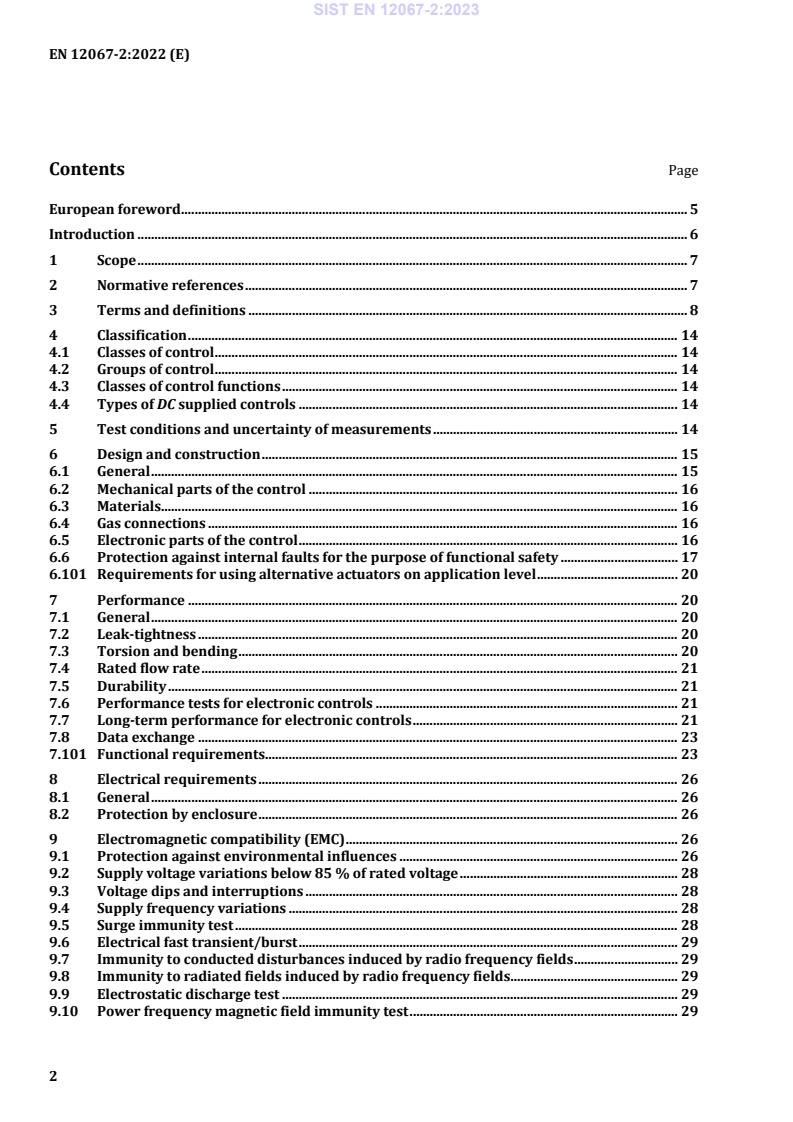
Contents Page
European foreword . 5
Introduction . 6
1 Scope . 7
2 Normative references . 7
3 Terms and definitions . 8
4 Classification . 14
4.1 Classes of control . 14
4.2 Groups of control . 14
4.3 Classes of control functions . 14
4.4 Types of DC supplied controls . 14
5 Test conditions and uncertainty of measurements . 14
6 Design and construction . 15
6.1 General . 15
6.2 Mechanical parts of the control . 16
6.3 Materials . 16
6.4 Gas connections . 16
6.5 Electronic parts of the control . 16
6.6 Protection against internal faults for the purpose of functional safety . 17
6.101 Requirements for using alternative actuators on application level . 20
7 Performance . 20
7.1 General . 20
7.2 Leak-tightness . 20
7.3 Torsion and bending . 20
7.4 Rated flow rate . 21
7.5 Durability . 21
7.6 Performance tests for electronic controls . 21
7.7 Long-term performance for electronic controls . 21
7.8 Data exchange . 23
7.101 Functional requirements. 23
8 Electrical requirements . 26
8.1 General . 26
8.2 Protection by enclosure . 26
9 Electromagnetic compatibility (EMC) . 26
9.1 Protection against environmental influences . 26
9.2 Supply voltage variations below 85 % of rated voltage . 28
9.3 Voltage dips and interruptions . 28
9.4 Supply frequency variations . 28
9.5 Surge immunity test . 28
9.6 Electrical fast transient/burst . 29
9.7 Immunity to conducted disturbances induced by radio frequency fields . 29
9.8 Immunity to radiated fields induced by radio frequency fields. 29
9.9 Electrostatic discharge test . 29
9.10 Power frequency magnetic field immunity test . 29
9.11 Harmonics and interharmonics including mains signalling at AC power port, low
frequency immunity tests . 30
10 Marking, instructions . 30
10.1 Marking . 30
10.2 Instructions . 30
10.3 Warning notice . 32
Annex A (informative) Abbreviations and symbols . 33
Annex B (informative) Leak-tightness tests for gas controls − volumetric method . 34
Annex C (informative) Leak-tightness tests for gas controls − pressure loss method . 35
Annex D (normative) Calculation of pressure loss into leakage rate . 36
Annex E (normative) Electrical/electronic component fault modes . 37
Annex F (normative) Additional requirements for safety accessories and pressure
accessories as defined in 2014/68/EU . 38
Annex G (normative) Materials for pressurized parts . 39
Annex H (normative) Additional materials for pressurized parts . 40
Annex I (normative) Requirements for controls used in DC supplied burners and
appliances burning gaseous or liquid fuels. 41
Annex J (normative) Method for the determination of a Safety integrity level (SIL) . 42
Annex K (normative) Method for the determination of a Performance Level (PL) . 43
Annex L (informative) Relationship between Safety Integrity Level (SIL) and Performance
Level (PL) . 44
Annex M (normative) Reset functions . 45
Annex N (informative) Guidance document on Environmental Aspects . 46
Annex O (normative) Seals of elastomer, cork and synthetic fibre mixtures . 47
Annex AA (normative) Declaration for sensors, actuators and repeatability . 48
Annex BB (normative) Special requirements for single position feed-back potentiometers
in electromechanical actuators . 52
BB.1 Requirements . 52
BB.2 Endurance test . 52
Annex CC (informative) Overall fuel/air ratio accuracy . 53
CC.1 General . 53
CC.2 Method A: . 53
CC.3 Method B: . 53
Annex DD (informative) Guideline for the integration of an ERC, ERS or ERT into the
appliance. 55
DD.1 General . 55
DD.2 Integrational aspects . 55
DD.3 Rules for mechanical integration . 56
DD.4 Rules for electrical integration . 56
DD.5 Rules for functional integration/functional tests of the appliance . 56
DD.6 Responsibility matrix . 56
Annex EE (informative) Guideline for the definition of limits for safe operation of the
appliance . 57
EE.1 Introduction . 57
EE.2 General aspects . 57
EE.3 Rules for the evaluation of the risk of explosion . 58
EE.4 Rules for the evaluation of the risk of poisoning . 59
EE.5 Rules for the evaluation of the risk of fire . 61
EE.6 Rules for the evaluation of the risks due to vibration . 62
Annex FF (normative) Requirements for using alternative actuators on application level . 63
FF.1 General . 63
FF.2 Requirements for the use of alternative actuators . 63
FF.3 Documentation . 65
Annex ZA (informative) Relationship between this European Standard and the essential
requirements of Directive 2009/142/EC aimed to be covered . 66
Annex ZB (informative) Relationship between this European Standard and the essential
requirements of Regulation (EU) 2016/426 aimed to be covered . 67
Annex ZC (informative) Relationship between this European Standard and the essential
requirements of Directive 2014/68/EU aimed to be covered . 68
Bibliography . 69
European foreword
This document (EN 12067-2:2022) has been prepared by Technical Committee CEN/TC 58 “Safety and
control devices for burners and appliances burning gaseous or liquid fuels”, the secretariat of which is
held by BSI.
This European Standard shall be given the status of a national standard, either by publication of an
identical text or by endorsement, at the latest by May 2023, and conflicting national standards shall be
withdrawn at the latest by November 2025.
Attention is drawn to the possibility that some of the elements of this document may be the subject of
patent rights. CEN shall not be held responsible for identifying any or all such patent rights.
This document supersedes EN 12067-2:2004.
The following significant changes compared to the previous edition have been incorporated in this
document:
a) alignment with EN 13611:2019;
b) title change to include liquid fuel and to bring it in line with the title of EN 13611:2019;
c) integration of the requirements for fuel/air ratio using oil as the fuel;
d) addition of the control types ERS and ERT;
e) update to EN 60730-1:2016;
f) update of requirements for fault reaction time and fault tolerating time;
g) update of the Annexes for sensors and actuators (see Annex AA);
h) inclusion of the use of pressure and combustion products sensing devices already conforming to
EN 1854:— , EN 60730-2-6:2016, and EN 16340:2014 respectively;
i) new Annex Guideline for the integration of ERC, ERS or ERT into the appliances (see Annex DD);
j) new Annex Guideline for the definition of limits for safe operation on the appliance (see
Annex EE);
k) new Annex Requirements for using alternative actuators on application level (see Annex FF).
Any feedback and questions on this document should be directed to the users’ national standards body.
A complete listing of these bodies can be found on the CEN website.
According to the CEN-CENELEC Internal Regulations, the national standards organisations of the
following countries are bound to implement this European Standard: Austria, Belgium, Bulgaria,
Croatia, Cyprus, Czech Republic, Denmark, Estonia, Finland, France, Germany, Greece, Hungary, Iceland,
Ireland, Italy, Latvia, Lithuania, Luxembourg, Malta, Netherlands, Norway, Poland, Portugal, Republic of
North Macedonia, Romania, Serbia, Slovakia, Slovenia, Spain, Sweden, Switzerland, Türkiye and the
United Kingdom.
Introduction
This document is intended to be used in conjunction with EN 13611:2019.
This document refers to clauses of EN 13611:2019 or adapts clauses by stating “with the following
modification”, “with the following addition”, “is replaced by the following” or “is not applicable” in the
corresponding clause.
This document adds clauses or subclauses to the structure of EN 13611:2019 which are particular to
this document. Subclauses which are additional to those in EN 13611:2019 are numbered starting from
101. Additional Annexes are designated as Annex AA, Annex BB, Annex CC, etc. It should be noted that
these clauses, subclauses and Annexes are not indicated as an addition.
If by reference to EN 13611:2019 the term “control” is given, this term should be read as fuel/air ratio
control/supervision system”.
EN 12067-2 compliance for electronic fuel/air ratio control/supervision system cannot be claimed
based upon SIL classification according to EN 61508.
SIL classification cannot be claimed based upon compliance with this document only. A supplementary
method for SIL determination is specified in EN 13611:2019, Annex J.
1 Scope
EN 13611:2019, Clause 1 is replaced by the following:
This document specifies the safety, design, construction and performance requirements, and testing for
electronic fuel/air ratio control systems (ERC), electronic fuel/air ratio supervision systems (ERS) and
electronic fuel/air ratio trim systems (ERT) intended for use with burners and appliances burning
gaseous or liquid fuels. It also describes the procedures for evaluating these requirements and specifies
information necessary for installation and use.
This document is applicable to:
— closed loop fuel/air ratio control systems, see 3.101;
— fuel/air ratio supervision systems, see 3.102;
— closed loop fuel/air ratio trim systems, see 3.103;
and does not differentiate into classification by heat input.
NOTE The documents for burners, appliances or processes which use ERC, ERS or ERT can override the
requirements of this document.
2 Normative references
EN 13611:2019, Clause 2 applies with the following additions:
The following documents are referred to in the text in such a way that some or all of their content
constitutes requirements of this document. For dated references, only the edition cited applies. For
undated references, the latest edition of the referenced document (including any amendments) applies.
EN 298:2022, Automatic burner control systems for burners and appliances burning gaseous or liquid
fuels
EN 267:2020, Forced draught burners for liquid fuels
EN 676:2020, Forced draught burners for gaseous fuels
EN 1854:— , Safety and control devices for burners and appliances burning gaseous and/or liquid fuels —
Pressure sensing devices for gas burners and gas burning appliances
EN 13611:2019 , Safety and control devices for burners and appliances burning gaseous and/or liquid
fuels — General requirements
EN 16340:2014, Safety and control devices for burners and appliances burning gaseous or liquid fuels —
Combustion product sensing devices
EN 60204-1:2018, Safety of machinery — Electrical equipment of machines — Part 1: General
requirements (IEC 60204-1:2016)
EN 60335-1:2012 , Household and similar electrical appliances — Safety — Part 1: General requirements
(IEC 60335-1:2010)
Under preparation. Stage at the time of publication: FprEN 1854:2022.
As impacted by EN 13611:2019/AC:2021.
EN 60529:1991 , Degrees of protection provided by enclosures (IP Code) (IEC 60529:1989)
EN 60730-1:2016 , Automatic electrical controls — Part 1: General requirements (IEC 60730-1:2013,
modified)
EN 60730-2-5:2015 , Automatic electrical controls — Part 2-5: Particular requirements for automatic
electrical burner control systems (IEC 60730-2-5:2013)
EN 60730-2-6:2016 , Automatic electrical controls — Part 2-6: Particular requirements for automatic
electrical pressure sensing controls including mechanical requirements (IEC 60730-2-6:2015)
EN IEC 60730-2-14:2019 , Automatic electrical controls — Part 2-14: Particular requirements for
electric actuators (IEC 60730-2-14:2017)
EN IEC 61000-6-2:2019, Electromagnetic compatibility (EMC) — Part 6-2: Generic standards —
Immunity standard for industrial environments (IEC 61000-6-2:2016)
EN 61000-6-4:2007 , Electromagnetic compatibility (EMC) — Part 6-4: Generic standards — Emission
standard for industrial environments (IEC 61000-6-4:2006)
EN 61010-2-202:2017, Safety requirements for electrical equipment for measurement, control and
laboratory use — Part 2-202: Particular requirements for electrically operated valve actuators
(IEC 61010-2-202:2016)
3 Terms and definitions
For the purposes of this document, the terms and definitions given in EN 13611:2019 apply with the
following modifications.
ISO and IEC maintain terminology databases for use in standardization at the following addresses:
• ISO Online browsing platform: available at https://www.iso.org/obp
• IEC Electropedia: available at https://www.electropedia.org/
As impacted by EN 60335-1:2012/AC:2014, EN 60335-1:2012/A11:2014, EN 60335-1:2012/A13:2017,
EN 60335-1:2012/A1:2019, EN 60335-1:2012/A2:2019, EN 60335-1:2012/A14:2019 and EN 60335-
1:2012/A15:2021.
As impacted by EN 60529:1991/corrigendum May 1993, EN 60529:1991/A1:2000, EN 60529:1991/A2:2013
and EN 60529:1991/AC:2016-12.
As impacted by EN 60730-1:2016/A1:2019 and EN 60730-1:2016/A2:2022.
As impacted by EN 60730-2-5:2015/A1:2019 and EN 60730-2-5:2015/A2:2021.
As impacted by EN 60730-2-6:2016/A1:2020.
As impacted by EN IEC 60730-2-14:2019/A2:2021 and EN IEC 60730-2-14:2019/A1:2022.
As impacted by EN 61000-6-4:2007/A1:2011.
3.101
electronic fuel/air ratio control system
ERC
closed loop system consisting of the electronic control unit, actuating elements for the fuel flow and the
air flow as a minimum, and allocated feedback signal(s)
Note 1 to entry: Figure 1 shows an example of different feedback alternatives. For details, see also Table 1.
Key
1 electronic control unit (ECU) 8 sensor flame
2 combustion process 9 sensor flue gas
3 actuator air 10 actuator air feedback
4 actuator fuel 11 actuator fuel feedback
5 sensor air 12 automatic burner control system
6 sensor fuel
7 sensor fuel/air mixture scope of ERC
a
From the ERC point of view, 12 acts in case a safe state is requested by 1 to de-energize the safety
shut-off valves.
Figure 1 — Scope of the electronic fuel/air ratio control system (ERC)
3.102
electronic fuel/air ratio supervision system
ERS
supervision system consisting of electronic control unit and sensor(s), providing at least one output
signal to indicate if the fuel/air ratio is outside of the safe area of the application
Note 1 to entry: Figure 2 shows an example of different feedback alternatives. For details, see also Table 1.
Key
1 electronic control unit (ECU) 8 sensor flame
2 combustion process 9 sensor flue gas
3 actuator air 10 actuator air feedback
4 actuator fuel 11 actuator fuel feedback
5 sensor air 12 automatic burner control system
6 sensor fuel 13 arbitrary control
7 sensor fuel/air mixture scope of ERS
a
From the ERS point of view, 12 acts in case a safe state is requested by 1 to de-energize the safety
shut-off valves.
Figure 2 — Scope of the electronic fuel/air ratio supervision system (ERS)
3.103
electronic fuel/air ratio trim system
ERT
closed loop system consisting of the electronic control unit, actuating element(s) or control output(s) to
influence the fuel/air ratio controlled by other means, and the allocated feedback signal(s)
Note 1 to entry: Figure 3 shows an example of different feedback alternatives. For details, see also Table 1.
Key
1 electronic control unit (ECU) 9 sensor flue gas
2 combustion process 10 actuator air feedback
3 actuator air 11 actuator fuel feedback
4 actuator fuel 12 automatic burner control system
5 sensor air 13 arbitrary control
6 sensor fuel 14 trimsignal air
7 sensor fuel/air mixture 15 trimsignal fuel
8 sensor flame scope of ERT
a
From the ERT point of view, 12 acts in case a safe state is requested by 1 to de-energize the safety
shut-off valves.
Figure 3 — Scope of the electronic fuel/air ratio trim system (ERT)
3.104
electronic control unit
ECU
electronic main control module incorporating all inputs and outputs for the ERC, ERS or ERT function
3.105
actuator
device for controlling the amount of fuel and/or air
3.106
sensor
device which gives a signal related to a physical property to which it responds
3.107
combustion process
chemical reaction between fuel and air to produce heat
3.108
safe state
state of the system with the following characteristics:
a) the system passively assumes a state in which the output signal(s) ensure a safe situation under all
circumstances or;
b) the system actively executes a protective action causing it to shutdown and lock-out, or;
c) the system remains in operation, continuing to satisfy all safety related functional requirements
3.109
fault tolerating time
FTT
time between the occurrence of a fault and reaching a safe state, which is tolerated by the application
without resulting in a hazardous situation
Note 1 to entry: For illustration of the fault tolerating time, see Figure 4 or Figure 5.
3.110
fault reaction time control
FRTc
time that the ERC, ERS or ERT needs from the moment the fault condition reaches the sensor to the
moment of an initialization to reach a safe state
Note 1 to entry: For illustration of the fault reaction time control for ERC and ERS, see Figure 4.
Key
1 fuel/air ratio moves outside of the safe area of 5 amplified signal passes filter
the application
2 effect of fault condition reaches the sensor 6 effect of fault condition is flagged by limit switch
3 sensor e.g. position sensors, flue gas sensors 7 flag is processed by automatic burner control
outputs effect of fault
4 sensor output is amplified 8 safe state is reached
Figure 4 — Relationship between fault tolerating time and fault reaction time control for ERC
and ERS
Note 2 to entry: For illustration of the fault reaction time control for ERT, see Figure 5.
Key
1 fuel/air ratio moves outside the safe area 5 amplified signal passes filter
of the application
2 effect of fault condition reaches the 6 effect of fault condition is flagged by limit switch
sensor
3 sensor e.g. position sensors, flue gas 7 flag may be processed by optional control*
outputs effect of fault system to initiate a safe state
4 sensor output is amplified 8 shut-off element or actuating element influences
the fuel/air ratio to reach a safe state.
*Examples for optional control are key 12 or key 13 in Figure 3. An optional control can only be used to
reach a safe state if the control has the required safety class for this function. If an ERT doesn’t use
optional control to reach a safe state, key 14 and key 15 in Figure 3 are examples.
Figure 5 — Relationship between fault tolerating time and fault reaction time control for ERT
3.111
non-volatile lock-out
safety-shutdown condition of the system, where a restart can only be accomplished by a manual reset of
the system and by no other means
[SOURCE: EN 298:2022, 3.121.1]
3.112
volatile lock-out
safety-shutdown condition of the system, where a restart can only be accomplished by either a manual
reset of the system or an interruption of the mains power and its subsequent restoration
[SOURCE: EN 298:2022, 3.121.2]
3.113
normal operation
operation of the ERC, ERS or ERT control system within its specification including the effect of
influences which may occur during intended operation
Note 1 to entry: Examples of influences on sensors are given in Table AA.1.
3.114
abnormal operation
operation under the effect of internal failures of the ERC, ERS or ERT control system
3.115
form closure construction
construction ensuring non-slippage of a connection between at least two mechanical components
3.116
accuracy
ability to provide an indicated value close to the true value
3.117
adaptive control function
ACF
control function, intended to maintain λ constant in a range Δλ by adapting the flow of fuel, and/or the
flow of air and/or other physical quantity to compensate changes in input parameters relevant for the
combustion process
Note 1 to entry: Changes in input parameters could be for example the composition of the fuel or the
combustion air temperature.
4 Classification
4.1 Classes of control
EN 13611:2019, 4.1 is not applicable.
4.2 Groups of control
Shall be according to EN 13611:2019, 4.2.
4.3 Classes of control functions
Shall be according to EN 13611:2019, 4.3 with the following addition:
— ERC is a class C control function;
— ERS is a class C control function;
— ERT is a class C control function.
If the control functions as given above are combined with each other or with other fuel/air ratio control
systems technologies, e.g. pneumatic, mechanical, then they may have a lower class of control function if
the entire ERC, ERS or ERT complies with class C control function, see 6.6.
4.4 Types of DC supplied controls
Shall be according to EN 13611:2019, 4.4.
5 Test conditions and uncertainty of measurements
Shall be according to EN 13611:2019, Clause 5.
6 Design and construction
6.1 General
Shall be according to EN 13611:2019, 6.1 with the following addition:
6.1.101 General structure and feedback types
The ERC shall consist of at least two actuators and at least one sensor; see Figure 1 and Table 1 which
shall be considered together.
The ERS shall consist of at least one sensor and one output to initiate reaching a safe state; see Figure 2
and Table 1 which shall be considered together.
The ERT shall consist of at least one output to trim the fuel/air ratio and at least one sensor; see
Figure 3 and Table 1 which shall be considered together.
The ERC, ERS or ERT shall have continuous self-checking functions. In periods of time where the ERC,
ERS or ERT is not active, e.g. in stand-by, any fault in its control function shall move to or remain in a
safe state.
An ERC, ERS or ERT shall use a feedback system which ensures the fuel/air ratio meets the
requirements of 7.101.6.
For the analysis of the system safety, the complete system shall be taken into account. This shall include
the peripheral elements, e.g. servo motors, actuators, positional devices, sensors, variable speed
controls for combustion air fans and combustion analysis feedback systems.
Table 1 — Acceptable feedback types
Actuator feedback Actuator output Process feedback
feedback
Position Speed Flow/Δp p Fuel/ Flame Flue
b
air gas
ratio
Valve /
X X X
Actuator
damper
Air
a, d
fan X X X
Valve /
X X X
damper X X X
d, e
Actuator
pump X X
X
Fuel
pressure /
flow X X
regulator
c c
At least 2 feedbacks (1 fuel, 1 air) required At least 1 feedback required
a
If a fan speed signal is used as means to control the air flow, proof of air flow cannot rely on fan rotation only. A
possible additional signal can be derived from an independent air proving device at least checked during start up.
b
A feedback signal which is directly related to the mechanical part of the actuator.
c
The two actuator feedbacks and the process feedback are alternatives.
d
A feedback signal from a variable speed control, e.g. a frequency converter, cannot be used as long as this feedback
signal is not derived through a class C control function representing the actual speed.
e
for pumps used on oil burners
6.2 Mechanical parts of the control
Shall be according to EN 13611:2019, 6.2 with the following addition:
6.2.101 Special requirements for electromechanical actuators with position feed-back sensors
The mechanical connection between the actuator and the actuator feed-back sensor, which represents
e.g. the position as a representative value of the flow, shall be of form closure construction or of
adequate design. This requirement shall include the complete connection up to the shaft of the control
element (e.g. butterfly valve, air damper).
Screws, pins and other components which are necessary to ensure form closure shall be secured, e.g. by
glue.
6.3 Materials
Shall be according to EN 13611:2019, 6.3 with the following addition in 6.3.1:
6.3.1 General material requirements
Shall be according to EN 13611:2019, 6.3.1 with the following addition:
The following aspects shall be considered for fuel/air ratio components constructed of non-metallic
material under the conditions of their intended use:
— dimensional stability;
— flow characteristics of the material;
— possible heat shrinkage;
— durability.
6.4 Gas connections
EN 13611:2019, 6.4 is not applicable.
6.5 Electronic parts of the control
6.5.1 General
6.5.1.101 Requirements
Shall be according to EN 13611:2019, 6.5.1 with the following modification:
Replace the third paragraph.
The ERC, ERS or ERT shall be designed such that changes in critical component values (such as those
affecting timing, sequence, accuracy) within the worst case specifications of the components, including
the long-term stability, shall result in the control continuing to function in accordance with this
document.
6.5.1.102 Test
Compliance shall be checked by worst case analysis.
6.5.2 Switching elements
6.5.2.1 Requirements
Shall be according to EN 13611:2019, 6.5.2.1 with the following addition after the NOTE:
The requirement to include at least two operating elements does not apply to ERC, ERS, ERT which are
not intended to energize shut-off valves directly. This applies also for ERC, ERS or ERT providing a hard-
wired safety interlock with the automatic burner control system (refer to Figures 1, 2, and 3, arrow
1↔12).
6.5.2.2 Test of protecting measures against failure of switching elements
Shall be according to EN 13611:2019, 6.5.2.2.
6.5.3 Electrical components
Shall be according to EN 13611:2019, 6.5.3.
6.6 Protection against internal faults for the purpose of functional safety
6.6.1 Design and construction requirements
Shall be according to EN 13611:2019, 6.6.1 with the following addition:
Whenever the terms lock-out or safety-shutdown are used within EN 13611:2019, 6.6.3 and 6.6.4 they
shall be replaced by the term safe state.
6.6.2 Class A
Shall be according to EN 13611:2019, 6.6.2.
6.6.3 Class B
6.6.3.1 Design and construction requirements
Shall be according to EN 13611:2019, 6.6.3.1 with the following addition:
Class B control functions for ERC, ERS or ERT are only to be used in combinations as given in 4.3.
ERC, ERS or ERT with class B control functions shall be designed such that under single fault conditions
they conform to 6.6.3.2 and – if applicable – 6.6.3.3, when tested under the test conditions and criteria
of 6.6.5.
For the purpose of the fault assessment the effect of internal failures in accordance with Annex AA shall
also be considered.
6.6.3.2 First fault
EN 13611:2019, 6.6.3.2 is replaced by the following:
Any first fault (see Annex E) in any one component or any one fault together with any other fault arising
from that first fault shall result in either:
a) the ERC, ERS or ERT passively assuming a safe state (3.108, a));
b) within the fault reaction time control (FRTc) the ERC, ERS or ERT actively executing a protective
action causing it to proceed to a safe state (3.108, b)). If in lock-out, a subsequent reset from lock-
out under the same fault condition shall result in the ERC, ERS or ERT returning to lock-out;
c) for ERS where its control signal processing (Figure 2, Keys 5 – 11) is independent from the process
control (Figure 2, Key 13) or not used, the ERS continuing to operate, the fault being identified
during the next start-up sequence, or any other measure that is capable of detecting the fault during
actual burner operation or shut down within 24h, whichever occurs first, the result being a) or b);
d) the ERC, ERS or ERT remaining operational in accordance with the safety related functional
requirements of this document (3.108, c)).
The fault reaction time control (FRTc) shall be as specified in the instructions, considering 7.101.4.
6.6.3.3 Faults introduced during lock-out or safety-shutdown
EN 13611:2019, 6.6.3.3 is replaced by the following:
Whenever the ERC, ERS or ERT is in an inoperative safe state without an internal fault, with all safety
related output terminals being de-energized, or safety related output signals representing a safe
situation, the following requirements apply.
Any first fault (together with any other fault arising from that fault) in any one component (see
Annex E), induced while the ERC, ERS or ERT in an inoperative safe state, shall result in either:
a) the ERC, ERS or ERT remaining in this safe state;
b) the ERC, ERS or ERT proceeding to another inoperative safe state;
c) the ERC, ERS or ERT returning to operation again resulting in 6.6.3.3 a) or b);
d) the ERC, ERS or ERT returning to operation in accordance with the safety related functional
requirements of this document.
The fault reaction time control (FRTc) shall be as specified in the instructions, considering 7.101.4.
6.6.4 Class C
6.6.4.1 Design and construction requirements
EN 13611:2019, 6.6.4.1 is replaced by the following:
The ERC, ERS or ERT shall be fail-safe. ERC, ERS or ERT which meet the requirements of 6.6.4 and, if
applicable, 6.6.1, are considered to be inherently fail-safe.
For the purpose of the fault assessment the effect of internal failures in accordance with Annex AA shall
also be considered.
The circuitry and the construction of the ERC, ERS or ERT shall meet the requirements of 7.101. They
shall be appraised in accordance with the requirements to 6.6.4.2, 6.6.4.3 and 6.6.4
...