

SIST EN 302 665 V1.1.1:2010
(Main)Intelligent Transport Systems (ITS) - Communications Architecture
- Abstract
The present document specifies the global communication architecture of communications for Intelligent Transport Systems (ITSC). This version of the present document is dedicated to the road transport context. The present document on the ITSC architecture specifies mandatory and optional elements and interfaces of ITSC. Some elements of ITS applications, especially those directly related to ITSC, are also considered. The present document is enabling different implementation architectures as presented in the informative annex B.
- Status
- Published
- Public Enquiry End Date
- 31-May-2010
- Publication Date
- 08-Nov-2010
- Technical Committee
- MOC - Mobile Communications
- Current Stage
- 6060 - National Implementation/Publication (Adopted Project)
- Start Date
- 18-Oct-2010
- Due Date
- 23-Dec-2010
- Completion Date
- 09-Nov-2010
Buy Documents
ETSI EN 302 665 V1.0.0 (2010-03) - Intelligent Transport Systems (ITS); Communications Architecture
ETSI EN 302 665 V1.1.0 (2010-07) - Intelligent Transport Systems (ITS); Communications Architecture
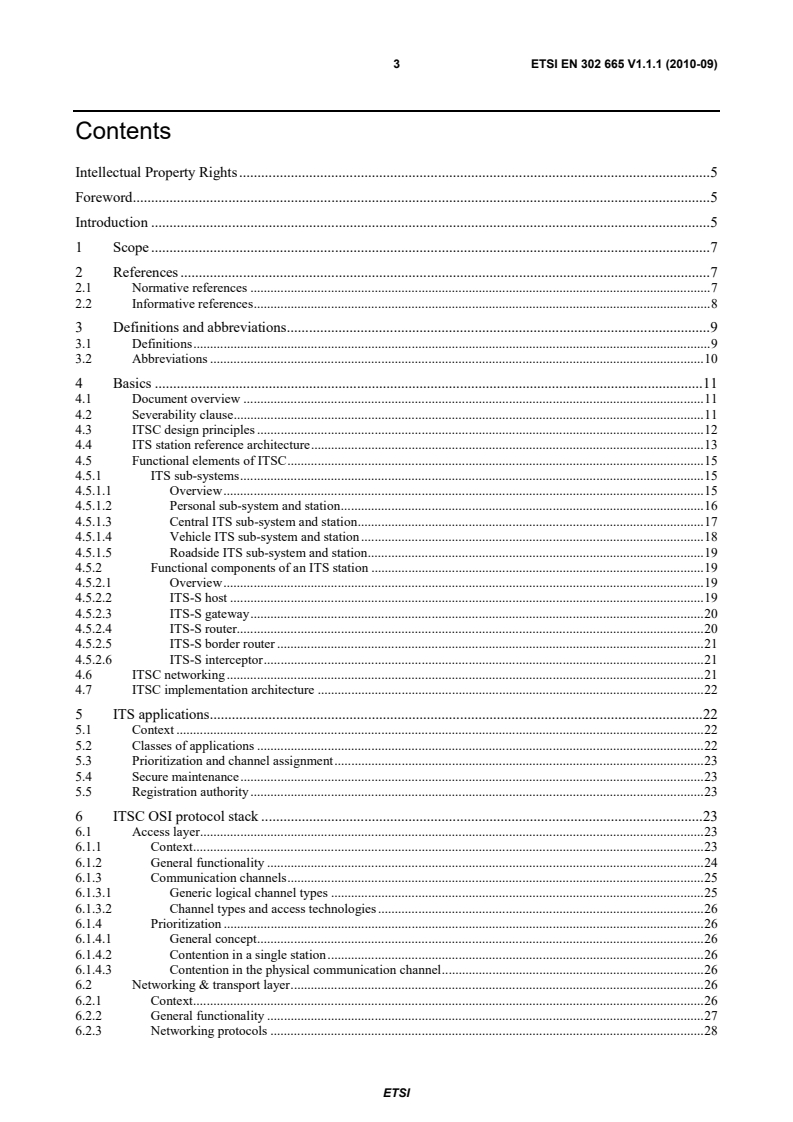
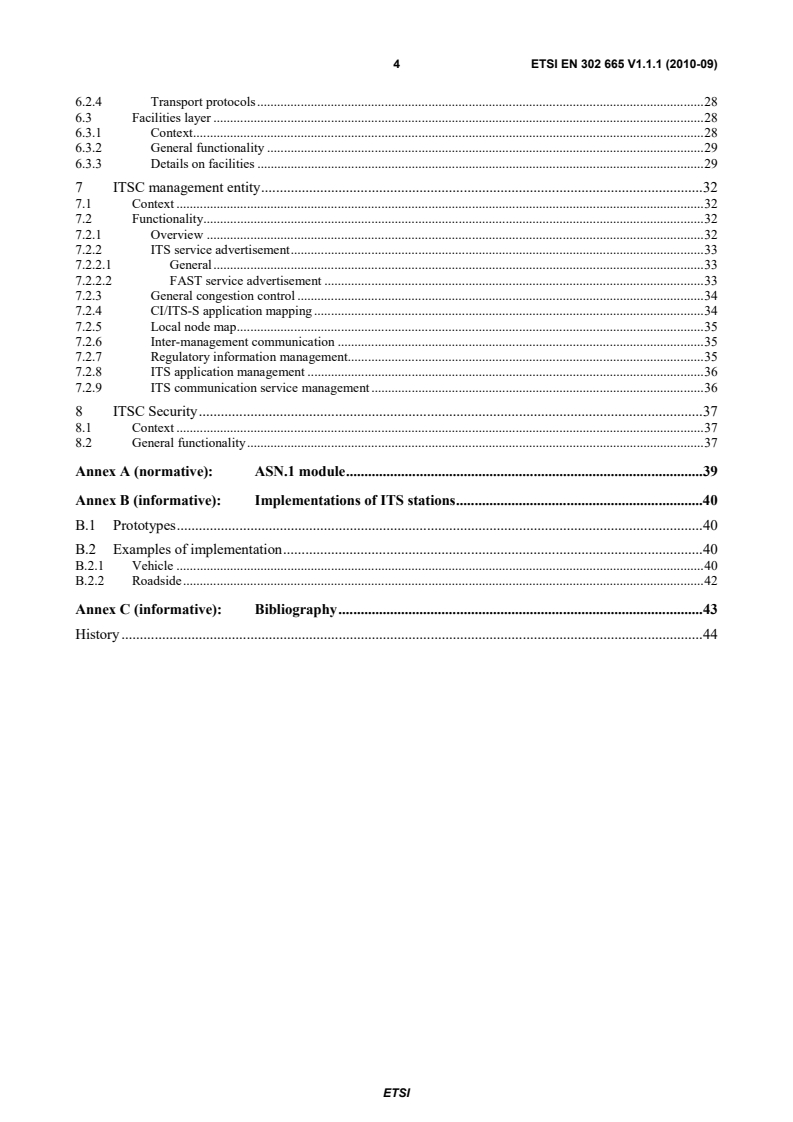
ETSI EN 302 665 V1.1.1 (2010-09) - Intelligent Transport Systems (ITS); Communications Architecture

SIST EN 302 665 V1.1.1:2010 is the Slovenian adoption of ETSI EN 302 665 V1.1.1, which specifies the Intelligent Transport Systems (ITS) communications architecture. It defines the global communication architecture for Intelligent Transport Systems Communications (ITSC) in the road transport context, including mandatory and optional elements, interfaces, and supporting functions used by ITS stations. The standard is structured as a toolbox, so it supports different implementation architectures rather than a single fixed design.
What does SIST EN 302 665 V1.1.1:2010 specify?
SIST EN 302 665 V1.1.1:2010 specifies the global communication architecture for ITSC in the road transport context. It describes the main architectural elements, how they connect, and how applications, management, and security fit into an ITS station.
The scope includes mandatory and optional ITSC elements and interfaces, and it also considers some ITS application elements that are directly related to communication. The architecture is intended to support different implementation choices, including stations built from several physical units.
The document also keeps some boundaries clear: access to proprietary networks and the interfaces to in-vehicle components such as ECUs are outside the scope of the architecture description.
| Annex | What it covers |
|---|---|
| Annex A | Normative ASN.1 module for the document |
| Annex B | Informative examples of ITS station implementations |
| Annex C | Informative bibliography |
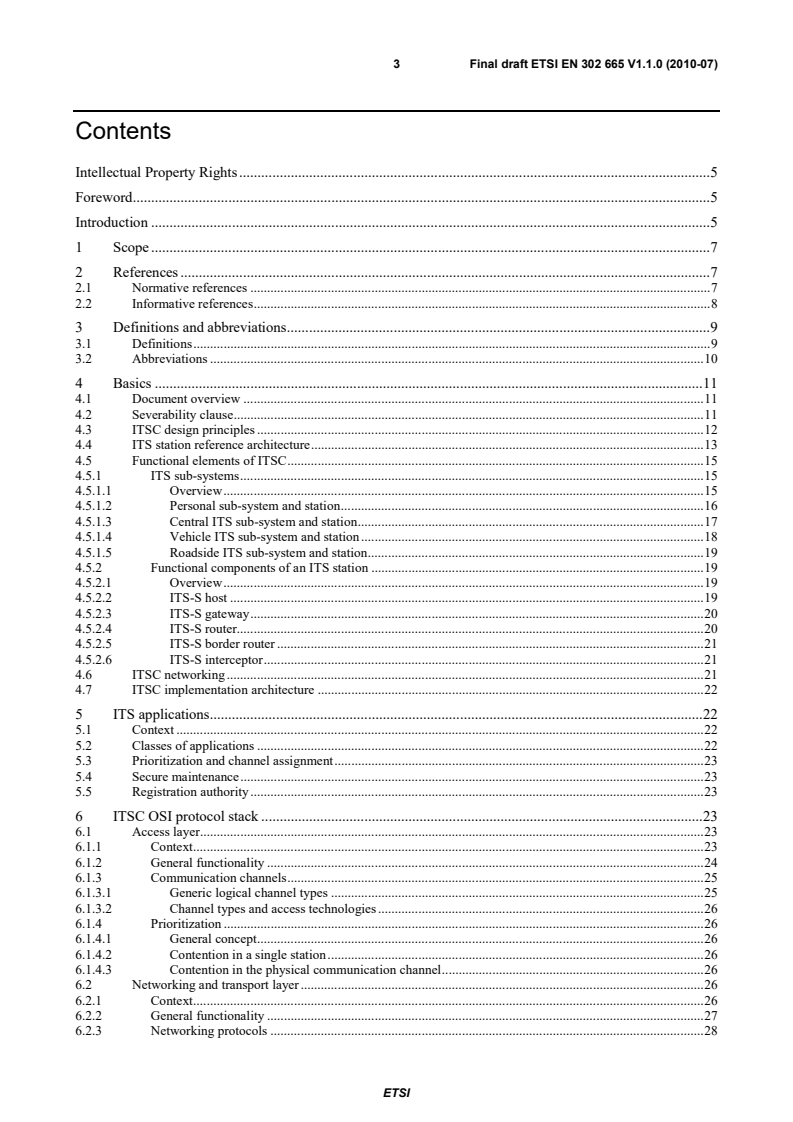
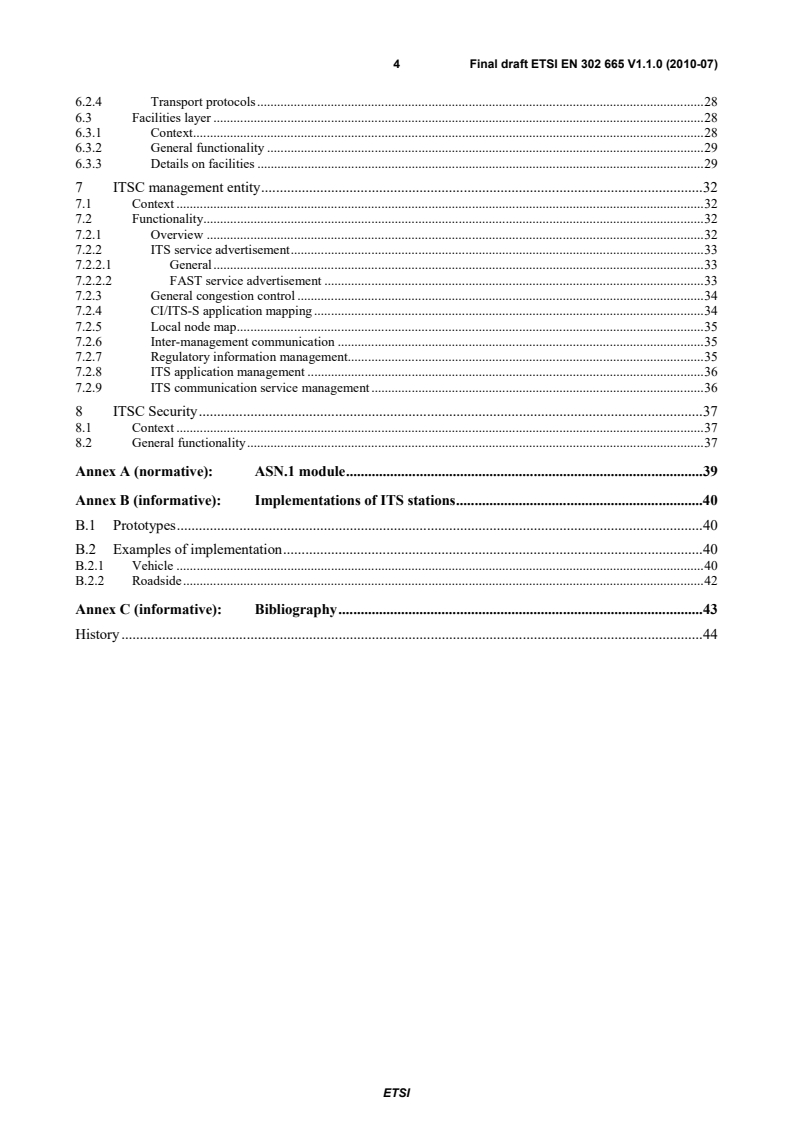
The main clauses are organized as follows: Clause 4 gives the basics and reference architecture, Clause 5 covers ITS applications, Clause 6 covers the ITSC OSI protocol stack, Clause 7 covers the ITSC management entity, and Clause 8 covers the ITSC security entity.
What are the key requirements of SIST EN 302 665 V1.1.1:2010?
SIST EN 302 665 V1.1.1:2010 defines ITSC as a layered architecture based on the Open Systems Interconnection (OSI) model, extended to include ITS applications, management, and security. In practice, this means implementers need to place functions in the right layer and use the defined interfaces between them.
Architecture, layers, and interfaces
The architecture separates Access, Networking & Transport, and Facilities, and it adds Management and Security entities around them. Clause 4 says the functional blocks connect through service access points, observable interfaces, or APIs, and that service primitive types and parameters are specified using ASN.1 Packed Encoding Rules (PER). That matters because interoperability depends on both the interface behavior and the exact data encoding.
ITS sub-systems and station components
Clause 4 identifies personal, central, vehicle, and roadside ITS sub-systems. Each sub-system contains an ITS station, and a station may be realized in one physical unit or spread across several units linked by an ITS station-internal network. This is important for design because one architecture can cover a handheld device, a vehicle installation, or a roadside unit without changing the overall model.
Clause 4.5.2 also defines the main station components: ITS-S host, ITS-S gateway, ITS-S router, ITS-S border router, and ITS-S interceptor. These roles tell engineers where application functions live, where protocol conversion happens, and how ITS equipment connects to adjacent networks.
ITS applications, priorities, and identifiers
Clause 5 groups ITS applications into Road Safety, Traffic Efficiency, and Other Applications. It requires each ITS application to be assigned a priority and a logical channel type, and each application class or application to have a unique application identifier. In practice, this is what lets a station decide which traffic gets preferred access and how application messages are handled on the network.
Clause 5 also requires secure maintenance of ITS applications, including installation, de-installation, and updates, and it links that to a registration authority. That matters because software lifecycle control is part of the communications architecture, not an afterthought.
Access layer and logical channels
Clause 6.1 defines the Access Layer as PHY plus DLL, with optional adaptation for legacy technologies through a communication adaptation layer (CAL), management adaptation entity (MAE), and security adaptation entity (SAE). It also defines logical channels (LCHs), including LCH0 for management communications, LCH1 for service advertisement, and LCH2 for data exchange.
This section also allows prioritization at two levels - in the DLL for contention inside a station, or in the PHY for contention on the shared medium. That matters because a designer must map application urgency to channel access behavior, not just to message content.
Networking, transport, and facilities support
Clause 6.2 allows several networking approaches, including GeoNetworking, IPv6 networking, IPv6 over GeoNetworking, CALM FAST, and other IPv6 or non-IP approaches, with transport options such as UDP and TCP. Clause 6.3 then defines the Facilities layer functions that support applications, such as data presentation, addressing support, position and time support, Local Dynamic Map (LDM) support, relevance checking, common message management, and support for DSRC legacy applications.
This is the part of the architecture that turns raw connectivity into usable ITS behavior. In practice, it is where stations prepare, filter, combine, and route information for road safety and traffic services.
Management, congestion control, and security
Clause 7 describes service advertisement, general congestion control, CI/ITS-S application mapping, local node map handling, inter-management communication, regulatory information management, ITS application management, and ITS communication service management. These functions matter because ITS stations operate in dynamic radio conditions and need to adapt channel choice, message repetition, and service behavior.
Clause 8 defines security functions such as firewall and intrusion management, authentication, authorisation, identity, crypto key and certificate management, a Security Information Base (SIB), and Hardware Security Modules (HSM). This is the part of the architecture that protects communications, software, and station behavior.
What terms does SIST EN 302 665 V1.1.1:2010 define?
- ITS station (ITS-S) - The functional entity defined by the ITS station reference architecture.
- ITS-S host - The part of an ITS station that contains ITS-S applications and the station functions they need.
- ITS-S gateway - A component that connects two different OSI protocol stacks at layers 5 to 7 and can convert protocols.
- ITS-S router - A component that connects two different ITS protocol stacks at layer 3, without including Applications and Facilities.
- ITS-S border router - A router-like component for connection to an external network that may not follow ITS management and security principles.
- ITS application - An association of two or more complementary ITS-S applications that together provide an ITS service.
- Local Dynamic Map (LDM) - A station data function that keeps dynamic objects and road-related information referenced and time-stamped for ITS use.
Who uses SIST EN 302 665 V1.1.1:2010?
SIST EN 302 665 V1.1.1:2010 is used by engineers, architects, and integrators designing ITS stations for vehicles, roadside equipment, central ITS systems, and portable devices. It is also relevant to developers of ITS-S applications that use service advertisement, periodic messages, event messages, and channel selection.
Road transport organizations, infrastructure operators, and suppliers use it when they need to define how station functions are split, how applications are prioritized, and how security and management are organized. Test and verification teams can also use it as the architecture basis for checking interfaces, message handling, and station behavior.
What changed in SIST EN 302 665 V1.1.1:2010 from the previous edition?
The document history shows the progression from V1.0.0 to V1.1.0 and then to the published V1.1.1 version. This page identifies V1.1.1 as the current published edition.
Which standards are used with SIST EN 302 665 V1.1.1:2010?
The architecture relies on a small set of core standards for model, encoding, networking, and management. The most important ones are:
- ETSI TS 102 636-3 - Provides GeoNetworking network architecture.
- ETSI ES 202 663 - Gives the European profile for the 5 GHz physical and medium access control layer.
- ITU-T X.901 and ISO/IEC 7498-1 - Provide the distributed processing and OSI reference model background.
- ISO/IEC 8825-2 - Provides ASN.1 PER encoding rules used for service primitives and the Annex A module.
- ISO/IEC 21210, 21214, 21215, 21217, 21218, 24102, and 29281 - Cover IPv6 networking, IR and M5 media, CALM architecture, lower layer SAPs, management, and non-IP networking.
- IEEE 802-2001 - Provides the local and metropolitan area network overview and architecture.
The text also points to related standards for implementation details such as IEEE 802.11, IEEE 1609, ETSI GeoNetworking, ITS application services, cross-layer management interfaces, and the Local Dynamic Map.
What does the SIST EN 302 665 V1.1.1:2010 document contain?
The document contains the reference architecture for ITS communications, including figures for the station model, the layer model, and the relationships between applications, management, and security. It also describes station types and example implementations for vehicle and roadside cases.
Annex A contains the normative ASN.1 module, which defines the logical channel types used by the architecture. Annex B gives implementation examples, including different vehicle and roadside configurations. Annex C lists bibliographic references used by the document.
Buy Documents
ETSI EN 302 665 V1.0.0 (2010-03) - Intelligent Transport Systems (ITS); Communications Architecture
ETSI EN 302 665 V1.1.0 (2010-07) - Intelligent Transport Systems (ITS); Communications Architecture
ETSI EN 302 665 V1.1.1 (2010-09) - Intelligent Transport Systems (ITS); Communications Architecture
Get Certified
Connect with accredited certification bodies for this standard

BSI Group
BSI (British Standards Institution) is the business standards company that helps organizations make excellence a habit.

NYCE
Mexican standards and certification body.
Sponsored listings
Frequently Asked Questions
SIST EN 302 665 V1.1.1:2010 is a standard published by the Slovenian Institute for Standardization (SIST). Its full title is "Intelligent Transport Systems (ITS) - Communications Architecture". This standard covers: The present document specifies the global communication architecture of communications for Intelligent Transport Systems (ITSC). This version of the present document is dedicated to the road transport context. The present document on the ITSC architecture specifies mandatory and optional elements and interfaces of ITSC. Some elements of ITS applications, especially those directly related to ITSC, are also considered. The present document is enabling different implementation architectures as presented in the informative annex B.
The present document specifies the global communication architecture of communications for Intelligent Transport Systems (ITSC). This version of the present document is dedicated to the road transport context. The present document on the ITSC architecture specifies mandatory and optional elements and interfaces of ITSC. Some elements of ITS applications, especially those directly related to ITSC, are also considered. The present document is enabling different implementation architectures as presented in the informative annex B.
SIST EN 302 665 V1.1.1:2010 is classified under the following ICS (International Classification for Standards) categories: 35.240.60 - IT applications in transport. The ICS classification helps identify the subject area and facilitates finding related standards.
SIST EN 302 665 V1.1.1:2010 is available in PDF format for immediate download after purchase. The document can be added to your cart and obtained through the secure checkout process. Digital delivery ensures instant access to the complete standard document.
Standards Content (Sample)
Draft ETSI EN 302 665 V1.0.0 (2010-03)
European Standard (Telecommunications series)
Intelligent Transport Systems (ITS);
Communications Architecture
2 Draft ETSI EN 302 665 V1.0.0 (2010-03)
Reference
DEN/ITS-0020012
Keywords
ITS, architecture, interworking, transmission
ETSI
650 Route des Lucioles
F-06921 Sophia Antipolis Cedex - FRANCE
Tel.: +33 4 92 94 42 00 Fax: +33 4 93 65 47 16
Siret N° 348 623 562 00017 - NAF 742 C
Association à but non lucratif enregistrée à la
Sous-Préfecture de Grasse (06) N° 7803/88
Important notice
Individual copies of the present document can be downloaded from:
http://www.etsi.org
The present document may be made available in more than one electronic version or in print. In any case of existing or
perceived difference in contents between such versions, the reference version is the Portable Document Format (PDF).
In case of dispute, the reference shall be the printing on ETSI printers of the PDF version kept on a specific network drive
within ETSI Secretariat.
Users of the present document should be aware that the document may be subject to revision or change of status.
Information on the current status of this and other ETSI documents is available at
http://portal.etsi.org/tb/status/status.asp
If you find errors in the present document, please send your comment to one of the following services:
http://portal.etsi.org/chaircor/ETSI_support.asp
Copyright Notification
No part may be reproduced except as authorized by written permission.
The copyright and the foregoing restriction extend to reproduction in all media.
© European Telecommunications Standards Institute 2010.
All rights reserved.
TM TM TM TM
DECT , PLUGTESTS , UMTS , TIPHON , the TIPHON logo and the ETSI logo are Trade Marks of ETSI registered
for the benefit of its Members.
TM
3GPP is a Trade Mark of ETSI registered for the benefit of its Members and of the 3GPP Organizational Partners.
LTE™ is a Trade Mark of ETSI currently being registered
for the benefit of its Members and of the 3GPP Organizational Partners.
GSM® and the GSM logo are Trade Marks registered and owned by the GSM Association.
ETSI
3 Draft ETSI EN 302 665 V1.0.0 (2010-03)
Contents
Intellectual Property Rights . 5
Foreword . 5
Introduction . 5
1 Scope . 7
2 References . 7
2.1 Normative references . 7
2.2 Informative references . 8
3 Definitions and abbreviations . 9
3.1 Definitions . 9
3.2 Abbreviations . 10
4 Basics . 11
4.1 Document overview . 11
4.2 Severability clause . 12
4.3 ITSC design principles . 12
4.4 ITS station reference architecture . 14
4.5 Functional elements of ITSC . 16
4.5.1 ITS sub-systems . 16
4.5.1.1 Overview . 16
4.5.1.2 Personal sub-system and station . 17
4.5.1.3 Central ITS sub-system and station . 18
4.5.1.4 Vehicle ITS sub-system and station . 19
4.5.1.5 Roadside ITS sub-system and station . 20
4.5.2 Functional components of an ITS station . 20
4.5.2.1 Overview . 20
4.5.2.2 ITS-S host . 20
4.5.2.3 ITS-S gateway . 21
4.5.2.4 ITS-S router. 21
4.5.2.5 ITS-S border router . 22
4.5.2.6 ITS-S interceptor . 22
4.6 ITSC networking . 22
4.7 ITSC implementation architecture . 23
5 ITS applications . 23
5.1 Context . 23
5.2 Classes of applications . 23
5.3 Prioritization and channel assignment . 24
5.4 Secure maintenance . 24
5.5 Registration authority . 24
6 ITSC OSI protocol stack . 24
6.1 Access layer . 24
6.1.1 Context . 24
6.1.2 General functionality . 25
6.1.3 Communication channels . 26
6.1.3.1 Generic logical channel types . 26
6.1.3.2 Channel types and access technologies . 27
6.1.4 Prioritization . 27
6.1.4.1 General concept . 27
6.1.4.2 Contention in a single station . 27
6.1.4.3 Contention in the physical communication channel . 27
6.2 Networking and transport layer . 27
6.2.1 Context . 27
6.2.2 General functionality . 28
6.2.3 Networking protocols . 29
ETSI
4 Draft ETSI EN 302 665 V1.0.0 (2010-03)
6.2.4 Transport protocols . 29
6.3 Facilities layer . 29
6.3.1 Context . 29
6.3.2 General functionality . 30
6.3.3 Details on facilities . 30
7 ITSC management entity . 33
7.1 Context . 33
7.2 Functionality . 33
7.2.1 Overview . 33
7.2.2 ITS service advertisement . 34
7.2.2.1 General . 34
7.2.2.2 FAST service advertisement . 34
7.2.3 General congestion control . 35
7.2.4 CI/ITS-S application mapping . 35
7.2.5 Local node map . 36
7.2.6 Inter-management communication . 36
7.2.7 Regulatory information management. 36
7.2.8 ITS application management . 37
7.2.9 ITS communication service management . 37
8 ITSC Security . 38
8.1 Context . 38
8.2 General functionality . 38
Annex A (normative): ASN.1 module . 40
Annex B (informative): Implementations of ITS stations . 41
B.1 Prototypes . 41
B.2 Examples of implementation . 41
B.2.1 Vehicle . 41
B.2.2 Roadside . 43
Annex C (informative): Bibliography . 44
History . 45
ETSI
5 Draft ETSI EN 302 665 V1.0.0 (2010-03)
Intellectual Property Rights
IPRs essential or potentially essential to the present document may have been declared to ETSI. The information
pertaining to these essential IPRs, if any, is publicly available for ETSI members and non-members, and can be found
in ETSI SR 000 314: "Intellectual Property Rights (IPRs); Essential, or potentially Essential, IPRs notified to ETSI in
respect of ETSI standards", which is available from the ETSI Secretariat. Latest updates are available on the ETSI Web
server (http://webapp.etsi.org/IPR/home.asp).
Pursuant to the ETSI IPR Policy, no investigation, including IPR searches, has been carried out by ETSI. No guarantee
can be given as to the existence of other IPRs not referenced in ETSI SR 000 314 (or the updates on the ETSI Web
server) which are, or may be, or may become, essential to the present document.
Foreword
This European Standard (Telecommunications series) has been produced by ETSI Technical Committee Intelligent
Transport System (ITS), and is now submitted for the Public Enquiry phase of the ETSI standards Two-step Approval
Procedure.
The present document is in support of early implementations. ETSI TC ITS welcomes feedback in order to facilitate
future revisions.
Proposed national transposition dates
Date of latest announcement of this EN (doa): 3 months after ETSI publication
Date of latest publication of new National Standard
or endorsement of this EN (dop/e): 6 months after doa
Date of withdrawal of any conflicting National Standard (dow): 6 months after doa
Introduction
Intelligent Transport Systems (ITS) are systems to support transportation of goods and humans with information and
communication technologies in order to efficiently and safely use the transport infrastructure and transport means (cars,
trains, planes, ships). Elements of ITS are standardized in various standardisation organisations, both on an international
level at e.g. ISO TC204, and on regional levels, e.g. in Europe at ETSI TC ITS and at CEN TC278.
The present document specifies the architecture of communications in ITS (ITSC) supporting a variety of existing and
new access technologies and ITS applications. The term ITSC denotes communications protocols, related management
and additional functionality. The present document is arranged as a tool-box, i.e. conformance with the present
document does not require to implement the whole functionality illustrated and partly specified in the present document.
ITSC is to a large extent independent from specific communication technologies and specific ITS applications. The
ITSC architecture is intended to be an open systems architecture, i.e. an architecture that is open and not proprietary.
Activities related to the scope of the present document are e.g. the European projects:
• COMeSafety (http://www.comesafety.org),
• COOPERS (http://www.coopers-ip.eu),
• CVIS (http://www.cvisproject.org),
• FRAME (http://frame-online.net),
• GeoNet (http://www.geonet-project.eu/),
ETSI
6 Draft ETSI EN 302 665 V1.0.0 (2010-03)
• KAREN (http://www.frame-online.net/home.htm),
• Pre-Drive C2X (http://www.pre-drive-c2x.eu),
• SAFESPOT (http://www.safespot-eu.org),
• SEVECOM (http://www.sevecom.org),
the industry activity:
• C2C-CC (http://www.car-to-car.org)
the standardisation work being conducted at:
• ISO TC204 (Intelligent Transport Systems)
- WG16 CALM (Communications Access for Land Mobiles) (http://www.isotc204wg16.org),
- WG18, jointly developing standards with CEN TC278 WG16 on cooperative systems,
• IEEE 802.11 [i.1] /p and 1609 WAVE,
other research projects.
ITS applications make use of wireless communications:
• Communications between mobile ITS stations (vehicles), and between mobile ITS stations and fixed ITS
stations (roadside installations), with single-hops or multiple hops between the source and destination ITS
stations.
• Access to public and private (local) networks including the global Internet.
• Infrastructure and satellite broadcast.
ETSI
7 Draft ETSI EN 302 665 V1.0.0 (2010-03)
1 Scope
The present document specifies the global communication architecture of communications for Intelligent Transport
Systems (ITSC). This version of the present document is dedicated to the road transport context.
The present document on the ITSC architecture specifies mandatory and optional elements and interfaces of ITSC.
Some elements of ITS applications, especially those directly related to ITSC, are also considered.
The present document is enabling different implementation architectures as presented in the informative annex B.
2 References
References are either specific (identified by date of publication and/or edition number or version number) or
non-specific.
• For a specific reference, subsequent revisions do not apply.
• Non-specific reference may be made only to a complete document or a part thereof and only in the following
cases:
- if it is accepted that it will be possible to use all future changes of the referenced document for the
purposes of the referring document;
- for informative references.
Referenced documents which are not found to be publicly available in the expected location might be found at
http://docbox.etsi.org/Reference.
NOTE: While any hyperlinks included in this clause were valid at the time of publication ETSI cannot guarantee
their long term validity.
2.1 Normative references
The following referenced documents are indispensable for the application of the present document. For dated
references, only the edition cited applies. For non-specific references, the latest edition of the referenced document
(including any amendments) applies.
[1] ETSI TS 102 636-3: "Intelligent Transport Systems (ITS); Vehicular Communications;
GeoNetworking; Part 3: Network architecture".
[2] ETSI ES 202 663: "Intelligent Transport Systems (ITS); European profile standard for the physical
and medium access control layer of Intelligent Transport Systems operating in the 5 GHz
frequency band".
[3] ITU-T Recommendation X.901: "Information technology - Open distributed processing -
Reference Model: Overview".
[4] ISO/IEC 7498-1: "Information technology - Open Systems Interconnection - Basic Reference
Model: The Basic Model".
[5] ISO/IEC 8825-2: "Information technology - ASN.1 encoding rules: Specification of Packed
Encoding Rules (PER)".
[6] ISO/IEC 21210: "Intelligent Transport Systems - Communications access for land mobiles
(CALM) - IPv6 networking".
[7] ISO/IEC 21214: "Intelligent Transport Systems - Communications access for land mobiles
(CALM) - IR medium".
ETSI
8 Draft ETSI EN 302 665 V1.0.0 (2010-03)
[8] ISO/IEC IS 21215: "Intelligent Transport Systems - Communications access for land mobiles
(CALM) - M5 medium".
[9] ISO/IEC 21217: "Intelligent Transport Systems - Communications access for land mobiles
(CALM) - Architecture".
[10] ISO/IEC 21218: "Intelligent Transport Systems - Communications access for land mobiles
(CALM) - Lower layer service access points".
[11] ISO/IEC 24102: "Intelligent Transport Systems - Communications access for land mobiles
(CALM) - Management".
[12] ISO/IEC 29281: "Intelligent Transport Systems - Communications access for land mobiles
(CALM) - Non-IP networking".
[13] IEEE Standard 802-2001: "IEEE Standard for Local and Metropolitan Area Networks: Overview
and Architecture".
2.2 Informative references
The following referenced documents are not essential to the use of the present document but they assist the user with
regard to a particular subject area. For non-specific references, the latest version of the referenced document (including
any amendments) applies.
[i.1] IEEE 802.11: "IEEE Standard for Information Technology-Telecommunications and information
exchange between systems-Local and metropolitan area networks-Specific requirements;
Part 11: Wireless LAN Medium Access Control (MAC) and Physical Layer (PHY)
Specifications".
[i.2] IEEE 1609: "Trial-Use Standard for Wireless Access in Vehicular Environments (WAVE)".
[i.3] CEN EN 12253: "Road transport and traffic telematics - Dedicated Short Range, Communication
(DSRC) - Physical layer using microwave at 5,8 GHz".
[i.4] CEN EN 12795: "Road transport and traffic telematics - Dedicated Short Range, Communication
(DSRC) - DSRC data link layer: medium access and logical link control".
[i.5] CEN EN 12834: "Road transport and traffic telematics - Dedicated Short Range Communication
(DSRC) - DSRC application layer".
[i.6] ETSI TS 102 636 (all parts): "Intelligent Transport Systems (ITS); Vehicular Communications;
GeoNetworking".
[i.7] ETSI TS 102 636-6-1: "Intelligent Transport Systems (ITS); Vehicular Communications;
GeoNetworking; Part 6: Internet Integration; Subpart 1: Transmission of IPv6 Packets".
[i.8] ETSI TS 102 637-2: "Intelligent Transport Systems (ITS); Vehicular Communications; Basic Set
of Applications; Part 2: Specification of Co-operative Awareness Basic Service".
[i.9] ETSI TS 102 637-3: "Intelligent Transport Systems (ITS); Vehicular Communications; Basic Set
of Application; Part 3: Specification of Decentralized Environmental Notification Basic Service".
[i.10] ETSI TS 102 723-1: " Intelligent Transport Systems; OSI cross-layer topics; Part 1: Architecture
and addressing schemes".
[i.11] ETSI TS 102 723-2: " Intelligent Transport Systems; OSI cross-layer topics; Part 2: Management
information base".
[i.12] ETSI TS 102 723-3: "Intelligent Transport Systems; OSI cross-layer topics; Part 3: Interface
between management entity and access layer".
[i.13] ETSI TS 102 723-4: "Intelligent Transport Systems; OSI cross-layer topics; Part 4: Interface
between management entity and network and transport layers".
ETSI
9 Draft ETSI EN 302 665 V1.0.0 (2010-03)
[i.14] ETSI TS 102 723-5: "Intelligent Transport Systems; OSI cross-layer topics; Part 5: Interface
between management entity and facilities layer".
[i.15] ETSI TS 102 723-6: "Intelligent Transport Systems; OSI cross-layer topics; Part 6: Interface
between management entity and security entity".
[i.16] ETSI TS 102 723-7: "Intelligent Transport Systems; OSI cross-layer topics; Part 7: Interface
between security entity and access layer".
[i.17] ETSI TS 102 723-8: "Intelligent Transport Systems; OSI cross-layer topics; Part 8: Interface
between security entity and network and transport layers".
[i.18] ETSI TS 102 723-9: "Intelligent Transport Systems; OSI cross-layer topics; Part 9: Interface
between security entity and facilities layer".
[i.19] ETSI TS 102 723-10: "Intelligent Transport Systems; OSI cross-layer topics; Part 10: Interface
between access layer and network and transport layers".
[i.20] ETSI TS 102 723-11: "Intelligent Transport Systems; OSI cross-layer topics; Part 11: Interface
between network and transport layers and facilities layer".
[i.21] ETSI EN 302 895: "Intelligent Transport Systems (ITS); Vehicular Communications; Basic Set of
Applications; Local Dynamic Map (LDM) Specification".
3 Definitions and abbreviations
3.1 Definitions
For the purposes of the present document, the terms and definitions given in [3], [4], [9], [10], [11], [12], [13] and the
following apply:
access layer: OSI physical and data link layers for ITSC
central ITS station: ITS station in a central ITS sub-system
central ITS sub-system: ITS sub-system in the context of an ITS centre
communication adaptation layer: optional upper part of the access layer for legacy access technologies
communication interface: instantiation of a specific access layer technology and protocol, e.g. ITS-G5, GPRS, UMTS
FA interface: interface between the facilities layer and the ITS-S applications entity
facilities layer: OSI layers five, six and seven for ITSC
generic domain: collection of legacy elements used for ITS/ITSC
IN interface: interface between the access layer and the networking & transport layer
inter-management communication: ITSC station-internal communication between management entities
in-vehicle network: implementation of the ITS station-internal network in a vehicle
ITS application: association of two or more complementary ITS-S applications
ITS domain: collection of elements used for ITS/ITSC being specified in dedicated ITS/ITSC standards
ITS service: service provided by an ITS application to the user of ITS
ITS station: functional entity specified by the ITS station (ITS-S) reference architecture
ITS sub-system: sub-system of ITS with ITSC components for a specific context
ETSI
10 Draft ETSI EN 302 665 V1.0.0 (2010-03)
ITS-S application: fragment of an ITS application available at an ITS station that uses ITS-S services to connect to one
or more other fragments of the same ITS application
ITS-S border router: routing functionality based on the ITS station reference architecture connecting to legacy
networking protocols
ITS-S gateway: gateway functionality based on the ITS station reference architecture
ITS-S host: functionality of the whole ITS station reference architecture, i.e. especially also including ITS-S
applications
ITS-S interceptor: generic router/gateway functionality
ITS-S router: routing functionality based on the ITS station reference architecture
ITS-S service: communication functionality offered by an ITS-S to an ITS-S application
MA interface: interface between the communication and station management entity and the ITS-S applications entity
medium: physical entity upon which for the purpose of communications a signal is impressed or from which a signal is
received, e.g. wireless (radio waves with a given frequency range and bandwidth, light with a given wave length,
ultrasonics) or on a wire (electrical signal, optical signal)
MF interface: interface between the communication and station management entity and the facilities layer
MI interface: interface between the communication and station management entity and the access layer
MN interface: interface between the communication and station management entity and the networking & transport
layer
MS interface: interface between the communication and station management entity and the security entity
networking & transport layer: OSI layers three and four for ITSC
NF interface: interface between the networking and transport layer and the facilities layer
personal ITS station: ITS station in a personal ITS sub-system
personal ITS sub-system: ITS sub-system in the context of an portable device for ITS
roadside ITS station: ITS station in a roadside ITS sub-system
roadside ITS sub-system: ITS sub-system in the context of roadside ITS equipment
SA interface: interface between the security entity and the ITS-S applications entity
SF interface: interface between the security entity and the facilities layer
SI interface: interface between the security entity and the access layer
SN interface: interface between the security entity and the networking & transport layer
vehicle ITS station: ITS station in a vehicular ITS sub-system
vehicle ITS sub-system: ITS sub-system in the context of a ITS equipment used in a vehicle
3.2 Abbreviations
For the purposes of the present document, the abbreviations given in [4], [9], [10], [11], [12], [13] and the following
apply:
AL Access Layer
API Application Programming Interface
CAL Communication Adaptation Layer
CALM Communications Access for Land Mobiles
CAM Cooperative Awareness Message
ETSI
11 Draft ETSI EN 302 665 V1.0.0 (2010-03)
CEN Commission Européen de Normalisation
DENM Decentralized Environmental Notification Messages
DSRC Dedicated Short Range Communication
ECU Electronic Control Unit
FA name of interface between facilities layer and ITS-S applications
GPRS General Packet Radio Service
HSM Hardware Security Module
IETF Internet Engineering Task Force
IN name of interface between access layer and networking and transport layer
IP Internet Protocol
IPv6 Internet Protocol version 6
IR infra red incoherent light
ISO International Standards Organisation
ITS Intelligent Transport System
ITSC ITS Communications
ITS-S ITS-Station
IUMC Inter-Unit Management Communication
IVN In-Vehicle Network
LCH Logical CHannel
LCH0 LCH for management communications between ITS stations
LCH1 LCH for organization of communication and initialisation of sessions (service advertisement)
LCH2 LCH for data exchange in sessions
LCHx LCH with a defined meaning
LDM Local Dynamic Map
MA name of interface between management entity and ITS-S applications
MAE management adaptation entity
MF name of interface between management entity and facilities layer
MI name of interface between management entity and access layer
MIB Management Information Base
MN name of interface between management entity and networking & transport layer
MS name of interface between management entity and security entity
NF name of interface between networking & transport layer and facilities layer
OBE On-Board Equipment
PDA Personal Digital Assistant
PDU Protocol Data Unit
RSE Road Side Equipment
RTTT Road Transport and Traffic Telematics
SA name of interface between security entity and ITS-S applications
SAE Security Adaptation Entity
SF name of interface between security entity and facilities layer
SI name of interface between security entity and access layer
SIB Security Information Base
SN name of interface between security entity and networking & transport layer
UMTS Universal MobileTelecommunications System
4 Basics
4.1 Document overview
The present document specifies the global framework of ITS communications in the road transport domain, and selected
technical and procedural details of general applicability. Normative references to other ITS standards will be used if
applicable.
• Clause 4 specifies basic architectural elements of ITSC.
• Clause 5 specifies the general management of ITS applications with respect of ITSC.
• Clause NOTE: Further details are outside the scope of the present document.
ETSI
12 Draft ETSI EN 302 665 V1.0.0 (2010-03)
• 6 specifies general parts of the ITSC OSI protocol stack.
• Clause 7 specifies general parts of the ITSC management entity.
• Clause 8 specifies general parts of the ITSC security entity.
• The normative annex A specifies the ASN.1 module of the present document.
• The informative annex B describes examples of possible implementations of ITS stations.
4.2 Severability clause
The specification of ITSC is provided by:
• the set of ITSC standards prepared by ETSI TC ITS, and
• by other standards.
Elements of these standards partly may be mandatory, and partly may be optional. Thus these standards constitute a
ITSC tool-box.
4.3 ITSC design principles
ITSC is a new type of communication system dedicated to transportation scenarios, e.g. as illustrated in figure 1. It is
based on two domains:
• ITS domain; and
• Generic domain.
"ITS domain" refers to all elements of ITSC which are specified in ITS/ITSC standards. "Generic domain" refers to
other elements used for ITS/ITSC.
NOTE 1: In ISO TC204 WG16 these two domains are distinguished by the terms "CALM-aware" (= ITS domain)
and "Non-CALM-aware" (= generic domain).
ETSI
13 Draft ETSI EN 302 665 V1.0.0 (2010-03)
GPS/GALILEO
Satellite
Broadcast
Terrestrial
Broadcast
Portable
Cellular Portable
Cellular
Internet
Internet
Hot-Spot
(Wireless
LAN)
RSE-to-RSE
RSE
CEN
DSRC
ITS-G5
RSE RSE
vehicle-to-vehicle
IR
portable-to-
(e.g. ITS-G5, 60 GHz, IR)
vehicle
RSE
Figure 1: Scenario illustration
Essential aspects to be considered in the process of developing ITSC standards are presented in the following
informative non-exhaustive list:
• mobility of ITS stations causing high dynamics of their topology;
• potential support of any kind of communication technology, including Internet, public networks and legacy
TM
systems such as Bluetooth , technologies for road tolling (DSRC), …, i.e. abstraction from implementation
details;
• potential support of any kind of application including those:
- designed for ITSC;
- using the ITS station as a transparent communication means;
- using station-internal communications only.
• dynamic and flexible consideration of user needs, e.g. with respect to communications capacity (data rate),
communications cost (in terms of money), communications reliability, communications availability,
communications privacy;
• potential of efficient prioritization of application classes;
• potential of dedicated relations between applications and communication technologies dependent on regional
requirements, e.g. for road safety and traffic efficiency applications, for road tolling, etc.;
• support of modular implementations with multiple physical units networked in a single ITS station;
• support of profiling;
• global applicability.
ETSI
14 Draft ETSI EN 302 665 V1.0.0 (2010-03)
NOTE 2: Initial intensive work with the same design principles is being done at ISO TC204 WG16 under the
working title CALM (Communications Access for Land Mobiles). Some CALM international standards
[7], [8], [9] and [11] already were partly implemented and verified as part of the CVIS project.
4.4 ITS station reference architecture
The ITS station reference architecture explains the functionality contained in ITS stations which are part of ITS
sub-systems specified in clause 4.5.
The ITS station reference architecture follows the principles of the OSI model [4] for layered communication protocols
which is extended for inclusion of ITS applications.
Figure 2 presents the ITS station reference architecture. Possible details of the ITS station reference architecture are
presented in the informative figure 3.
The three lower blocks in the middle of figures 2 and 3 contain functionality of the OSI communication protocol stack
with:
• "Access" representing ITSC's OSI layers 1 and 2,
• "Networking & Transport" representing ITSC's OSI layers 3 and 4,
• "Facilities" representing ITSC's OSI layers 5, 6 and 7.
NOTE 1: The term "functionality" used in the present document does not at all imply specific functions to be
implemented. As an example, the GeoNetworking protocol may be implemented in an implementation of
an ITS-S router, but likely will not be present in an implementation of an ITS-S host.
The block "Applications" in figures 2 and 3 present the ITS-S applications making use of the ITS-S services to connect
to one or more other ITS-S applications. An association of two or more complementary ITS-S applications constitutes
an ITS application which provides an ITS service to a user of ITS.
NOTE 2: An example of two complementary ITS-S applications are a server application and a client application,
where the server application resides in one ITS station, and the client application resides in another ITS
station.
The left hand side of figures 2 and 3 present the entity "Management" which is in charge of managing communications
in the ITS station. This entity grants access to the Management Information Base (MIB) [i.11].
The right hand side of figures 2 and 3 present the entity "Security" which provides security services to the OSI
communication protocol stack, to the security entity and to the management entity. "Security" can also be considered as
a specific part of the management entity.
The functional blocks presented in figures 2 and 3 are interconnected either via observable interfaces or via service
access points (SAPs) as specified in [i.12], [i.13], [i.14], [i.15], [i.16], [i.17], [i.18], [i.19], [i.20], or via APIs. The
names of these interconnections are shown in the figures 2 and 3.
In all ITSC standards, the specification of SAPs shall only be informative functional specifications. However the type of
the service primitives and the type of the parameters used in the service primitives shall be specified using ASN.1
PER [5] in order to have a precise understanding of the functional meaning, and in order to be able to uniquely use the
parameters of service primitives inside testable Protocol Data Units (PDUs) [i.10], if applicable.
Although the concept of the layered OSI model is based on isolated layers as presented in figure 2, where each layer
contains a complete set of functionality as described above, ITSC provides further functionality related to several of
these layers. Such functionality is named cross-layer functionality.
ETSI
15 Draft ETSI EN 302 665 V1.0.0 (2010-03)
Figure 2: ITS station reference architecture/ITS-S host
t
n
n
e
o
i
t
m
F F
F
a F
e
M M S S
c
i g
l
a
p
n
p
a t
A )
n )
t
m
e B
I n
e
m
M
e -
m
g
t S
g
(
a
n
a
n
e e n
a
s
) a
t m
a
m
B e
n m
I
B
g
e e
l e
M
n a i t
n
( f
m
n
o o a
i e o i
e t a t c
r
i
g
s f
a p a
i
t m
a
a t
,
r
S n m
B n
N n r
N N N e
a
S o o
M M S o c
n i i
f
m t
s
o
n d
i a
u I
t
r z n
i t
a t
r a
n
n
m I o
e y
r
h
e
o d t
m
f k
n u
e -
n
I a a
g o
t
l t
t ,
r l a
n
p
n
n
e a n
e
y
o
e y a r
i
w
t
m
a c
m l e
M
a
- e r ,
e i
c
s g y
i y
g F t t t
s
a i i
a t
n r
o n
n r u n
e
a
c e
a h
C
t
m e d
I
M u
(
S
A
I I
I
M M I
S S
t
n
y
r e
o
t
m
a
e
l
g
u
a
g
n
e
a
R
m
S S
M M
Figure 3: Examples of possible elements in the ITS station reference architecture
ETSI
Management
Security
16 Draft ETSI EN 302 665 V1.0.0 (2010-03)
4.5 Functional elements of ITSC
4.5.1 ITS sub-systems
4.5.1.1 Overview
The following ITS sub-systems:
• personal ITS sub-system; in hand-held devices,
• central ITS sub-system; part of an ITS central system,
• vehicle ITS sub-system; in cars, trucks, etc., in motion or parked,
• roadside ITS sub-system; on gantries, poles, etc.,
are identified. These sub-systems are illustrated in figure 4.
Personal ITS sub-sytem
Vehicle ITS sub-sytem
ITS peer-to-peer
communications
Roadside ITS sub-sytem
Central ITS sub-sytem
Figure 4: Illustration of ITS sub-systems
Each of these ITS sub-systems contains an ITS station, i.e. the functionality described by the ITS station reference
architecture specified in clause 4.4. Dependent on the context, an ITS station typically will contain other functional
components presented in clause 4.5.2.
The functionality of an ITS station may be implemented in a single physical unit or in several physical units as
illustrated in annex B. Furthermore it is possible to structure the functionality, see clause 4.5.2, such that it is divided
into individually addressable entities within the same physical unit. In both cases the ITS station-internal network
presented in figure 12 is used to interconnect these units/entities, which may be reduced to a node in a single unit.
ETSI
17 Draft ETSI EN 302 665 V1.0.0 (2010-03)
4.5.1.2 Personal sub-system and station
The personal ITS sub-system provides the application and communication functionality of ITSC in hand-held devices,
such as PDAs, mobile phones, etc. It shall contain a personal ITS station. The device used as a personal ITS station may
also perform HMI functionality as part of an other ITS sub-system, connecting to this via the ITS station-internal
network presented in figure 12.
Figure 5: Personal ITS station in a personal sub-system
ETSI
18 Draft ETSI EN 302 665 V1.0.0 (2010-03)
4.5.1.3 Central ITS sub-system and station
The central ITS sub-system shall contain a central ITS station and may contain ITS-S interceptors specified in
clause 4.5.2.6
The ITS-S interceptors in the central ITS sub-system typically are a central ITS-S gateway and an ITS-S border router
as presented in the informative figure 6.
Central ITS station
ITS-S host
Central ITS-S gateway
ITS-S border router
ITS station-internal network
Central System
Figure 6: Central ITS station in a central sub-system
The central ITS-S gateway provides functionality to connect the components of the central system to the ITS station-
internal network presented in figure 12.
NOTE: Following the principles of the ITS-S interceptor , the access of the central ITS station to the components
of the central system may be implementation-specific, and not necessarily a proprietary network will be
used.
ETSI
19 Draft ETSI EN 302 665 V1.0.0 (2010-03)
4.5.1.4 Vehicle ITS sub-system and station
The vehicle ITS sub-system shall contain a vehicle ITS station and may contain ITS-S interceptors specified in
clause 4.5.2.6.
The ITS-S interceptors in the
...
Final draft ETSI EN 302 665 V1.1.0 (2010-07)
European Standard (Telecommunications series)
Intelligent Transport Systems (ITS);
Communications Architecture
2 Final draft ETSI EN 302 665 V1.1.0 (2010-07)
Reference
DEN/ITS-0020012
Keywords
architecture, interworking, ITS, transmission
ETSI
650 Route des Lucioles
F-06921 Sophia Antipolis Cedex - FRANCE
Tel.: +33 4 92 94 42 00 Fax: +33 4 93 65 47 16
Siret N° 348 623 562 00017 - NAF 742 C
Association à but non lucratif enregistrée à la
Sous-Préfecture de Grasse (06) N° 7803/88
Important notice
Individual copies of the present document can be downloaded from:
http://www.etsi.org
The present document may be made available in more than one electronic version or in print. In any case of existing or
perceived difference in contents between such versions, the reference version is the Portable Document Format (PDF).
In case of dispute, the reference shall be the printing on ETSI printers of the PDF version kept on a specific network drive
within ETSI Secretariat.
Users of the present document should be aware that the document may be subject to revision or change of status.
Information on the current status of this and other ETSI documents is available at
http://portal.etsi.org/tb/status/status.asp
If you find errors in the present document, please send your comment to one of the following services:
http://portal.etsi.org/chaircor/ETSI_support.asp
Copyright Notification
No part may be reproduced except as authorized by written permission.
The copyright and the foregoing restriction extend to reproduction in all media.
© European Telecommunications Standards Institute 2010.
All rights reserved.
TM TM TM TM
DECT , PLUGTESTS , UMTS , TIPHON , the TIPHON logo and the ETSI logo are Trade Marks of ETSI registered
for the benefit of its Members.
TM
3GPP is a Trade Mark of ETSI registered for the benefit of its Members and of the 3GPP Organizational Partners.
LTE™ is a Trade Mark of ETSI currently being registered
for the benefit of its Members and of the 3GPP Organizational Partners.
GSM® and the GSM logo are Trade Marks registered and owned by the GSM Association.
ETSI
3 Final draft ETSI EN 302 665 V1.1.0 (2010-07)
Contents
Intellectual Property Rights . 5
Foreword . 5
Introduction . 5
1 Scope . 7
2 References . 7
2.1 Normative references . 7
2.2 Informative references . 8
3 Definitions and abbreviations . 9
3.1 Definitions . 9
3.2 Abbreviations . 10
4 Basics . 11
4.1 Document overview . 11
4.2 Severability clause . 11
4.3 ITSC design principles . 12
4.4 ITS station reference architecture . 13
4.5 Functional elements of ITSC . 15
4.5.1 ITS sub-systems . 15
4.5.1.1 Overview . 15
4.5.1.2 Personal sub-system and station . 16
4.5.1.3 Central ITS sub-system and station . 17
4.5.1.4 Vehicle ITS sub-system and station . 18
4.5.1.5 Roadside ITS sub-system and station . 19
4.5.2 Functional components of an ITS station . 19
4.5.2.1 Overview . 19
4.5.2.2 ITS-S host . 19
4.5.2.3 ITS-S gateway . 20
4.5.2.4 ITS-S router. 20
4.5.2.5 ITS-S border router . 21
4.5.2.6 ITS-S interceptor . 21
4.6 ITSC networking . 21
4.7 ITSC implementation architecture . 22
5 ITS applications . 22
5.1 Context . 22
5.2 Classes of applications . 22
5.3 Prioritization and channel assignment . 23
5.4 Secure maintenance . 23
5.5 Registration authority . 23
6 ITSC OSI protocol stack . 23
6.1 Access layer . 23
6.1.1 Context . 23
6.1.2 General functionality . 24
6.1.3 Communication channels . 25
6.1.3.1 Generic logical channel types . 25
6.1.3.2 Channel types and access technologies . 26
6.1.4 Prioritization . 26
6.1.4.1 General concept . 26
6.1.4.2 Contention in a single station . 26
6.1.4.3 Contention in the physical communication channel . 26
6.2 Networking and transport layer . 26
6.2.1 Context . 26
6.2.2 General functionality . 27
6.2.3 Networking protocols . 28
ETSI
4 Final draft ETSI EN 302 665 V1.1.0 (2010-07)
6.2.4 Transport protocols . 28
6.3 Facilities layer . 28
6.3.1 Context . 28
6.3.2 General functionality . 29
6.3.3 Details on facilities . 29
7 ITSC management entity . 32
7.1 Context . 32
7.2 Functionality . 32
7.2.1 Overview . 32
7.2.2 ITS service advertisement . 33
7.2.2.1 General . 33
7.2.2.2 FAST service advertisement . 33
7.2.3 General congestion control . 34
7.2.4 CI/ITS-S application mapping . 34
7.2.5 Local node map . 35
7.2.6 Inter-management communication . 35
7.2.7 Regulatory information management. 35
7.2.8 ITS application management . 36
7.2.9 ITS communication service management . 36
8 ITSC Security . 37
8.1 Context . 37
8.2 General functionality . 37
Annex A (normative): ASN.1 module . 39
Annex B (informative): Implementations of ITS stations . 40
B.1 Prototypes . 40
B.2 Examples of implementation . 40
B.2.1 Vehicle . 40
B.2.2 Roadside . 42
Annex C (informative): Bibliography . 43
History . 44
ETSI
5 Final draft ETSI EN 302 665 V1.1.0 (2010-07)
Intellectual Property Rights
IPRs essential or potentially essential to the present document may have been declared to ETSI. The information
pertaining to these essential IPRs, if any, is publicly available for ETSI members and non-members, and can be found
in ETSI SR 000 314: "Intellectual Property Rights (IPRs); Essential, or potentially Essential, IPRs notified to ETSI in
respect of ETSI standards", which is available from the ETSI Secretariat. Latest updates are available on the ETSI Web
server (http://webapp.etsi.org/IPR/home.asp).
Pursuant to the ETSI IPR Policy, no investigation, including IPR searches, has been carried out by ETSI. No guarantee
can be given as to the existence of other IPRs not referenced in ETSI SR 000 314 (or the updates on the ETSI Web
server) which are, or may be, or may become, essential to the present document.
Foreword
This European Standard (Telecommunications series) has been produced by ETSI Technical Committee Intelligent
Transport System (ITS), and is now submitted for the Vote phase of the ETSI standards Two-step Approval Procedure.
The present document is in support of early implementations. ETSI TC ITS welcomes feedback in order to facilitate
future revisions.
Proposed national transposition dates
Date of latest announcement of this EN (doa): 3 months after ETSI publication
Date of latest publication of new National Standard
or endorsement of this EN (dop/e): 6 months after doa
Date of withdrawal of any conflicting National Standard (dow): 6 months after doa
Introduction
Intelligent Transport Systems (ITS) are systems to support transportation of goods and humans with information and
communication technologies in order to efficiently and safely use the transport infrastructure and transport means (cars,
trains, planes, ships). Elements of ITS are standardized in various standardisation organisations, both on an international
level at e.g. ISO TC204, and on regional levels, e.g. in Europe at ETSI TC ITS and at CEN TC278.
The present document specifies the architecture of communications in ITS (ITSC) supporting a variety of existing and
new access technologies and ITS applications. The term ITSC denotes communications protocols, related management
and additional functionality. The present document is arranged as a tool-box, i.e. conformance with the present
document does not require to implement the whole functionality illustrated and partly specified in the present document.
ITSC is to a large extent independent from specific communication technologies and specific ITS applications. The
ITSC architecture is intended to be an open systems architecture, i.e. an architecture that is open and not proprietary.
Activities related to the scope of the present document are e.g. the European projects:
• COMeSafety (http://www.comesafety.org),
• COOPERS (http://www.coopers-ip.eu),
• CVIS (http://www.cvisproject.org),
• FRAME (http://frame-online.net),
• GeoNet (http://www.geonet-project.eu/),
ETSI
6 Final draft ETSI EN 302 665 V1.1.0 (2010-07)
• KAREN (http://www.frame-online.net/home.htm),
• Pre-Drive C2X (http://www.pre-drive-c2x.eu),
• SAFESPOT (http://www.safespot-eu.org),
• SEVECOM (http://www.sevecom.org),
the industry activity:
• C2C-CC (http://www.car-to-car.org)
the standardisation work being conducted at:
• ISO TC204 (Intelligent Transport Systems)
- WG16 CALM (Communications Access for Land Mobiles) (http://www.isotc204wg16.org),
- WG18, jointly developing standards with CEN TC278 WG16 on cooperative systems,
• IEEE 802.11 [i.1] /p and 1609 WAVE,
other research projects.
ITS applications make use of wireless communications:
• Communications between mobile ITS stations (vehicles), and between mobile ITS stations and fixed ITS
stations (roadside installations), with single-hops or multiple hops between the source and destination ITS
stations.
• Access to public and private (local) networks including the global Internet.
• Infrastructure and satellite broadcast.
ETSI
7 Final draft ETSI EN 302 665 V1.1.0 (2010-07)
1 Scope
The present document specifies the global communication architecture of communications for Intelligent Transport
Systems (ITSC). This version of the present document is dedicated to the road transport context.
The present document on the ITSC architecture specifies mandatory and optional elements and interfaces of ITSC.
Some elements of ITS applications, especially those directly related to ITSC, are also considered.
The present document is enabling different implementation architectures as presented in the informative annex B.
2 References
References are either specific (identified by date of publication and/or edition number or version number) or
non-specific. For specific references, only the cited version applies. For non-specific references, the latest version of the
reference document (including any amendments) applies.
Referenced documents which are not found to be publicly available in the expected location might be found at
http://docbox.etsi.org/Reference.
NOTE: While any hyperlinks included in this clause were valid at the time of publication ETSI cannot guarantee
their long term validity.
2.1 Normative references
The following referenced documents are necessary for the application of the present document.
[1] ETSI TS 102 636-3: "Intelligent Transport Systems (ITS); Vehicular Communications;
GeoNetworking; Part 3: Network architecture".
[2] ETSI ES 202 663: "Intelligent Transport Systems (ITS); European profile standard for the physical
and medium access control layer of Intelligent Transport Systems operating in the 5 GHz
frequency band".
[3] ITU-T Recommendation X.901: "Information technology - Open distributed processing -
Reference Model: Overview".
[4] ISO/IEC 7498-1: "Information technology - Open Systems Interconnection - Basic Reference
Model: The Basic Model".
[5] ISO/IEC 8825-2: "Information technology - ASN.1 encoding rules: Specification of Packed
Encoding Rules (PER)".
[6] ISO/IEC 21210: "Intelligent Transport Systems - Communications access for land mobiles
(CALM) - IPv6 networking".
[7] ISO/IEC 21214: "Intelligent Transport Systems - Communications access for land mobiles
(CALM) - IR medium".
[8] ISO/IEC IS 21215: "Intelligent Transport Systems - Communications access for land mobiles
(CALM) - M5 medium".
[9] ISO/IEC 21217: "Intelligent Transport Systems - Communications access for land mobiles
(CALM) - Architecture".
[10] ISO/IEC 21218: "Intelligent Transport Systems - Communications access for land mobiles
(CALM) - Lower layer service access points".
[11] ISO/IEC 24102: "Intelligent Transport Systems - Communications access for land mobiles
(CALM) - Management".
ETSI
8 Final draft ETSI EN 302 665 V1.1.0 (2010-07)
[12] ISO/IEC 29281: "Intelligent Transport Systems - Communications access for land mobiles
(CALM) - Non-IP networking".
[13] IEEE Standard 802-2001: "IEEE Standard for Local and Metropolitan Area Networks: Overview
and Architecture".
2.2 Informative references
The following referenced documents are not necessary for the application of the present document but they assist the
user with regard to a particular subject area.
[i.1] IEEE 802.11: "IEEE Standard for Information Technology-Telecommunications and information
exchange between systems-Local and metropolitan area networks-Specific requirements;
Part 11: Wireless LAN Medium Access Control (MAC) and Physical Layer (PHY)
Specifications".
[i.2] IEEE 1609: "Trial-Use Standard for Wireless Access in Vehicular Environments (WAVE)".
[i.3] CEN EN 12253: "Road transport and traffic telematics - Dedicated Short Range, Communication
(DSRC) - Physical layer using microwave at 5,8 GHz".
[i.4] CEN EN 12795: "Road transport and traffic telematics - Dedicated Short Range, Communication
(DSRC) - DSRC data link layer: medium access and logical link control".
[i.5] CEN EN 12834: "Road transport and traffic telematics - Dedicated Short Range Communication
(DSRC) - DSRC application layer".
[i.6] ETSI TS 102 636 (all parts): "Intelligent Transport Systems (ITS); Vehicular Communications;
GeoNetworking".
[i.7] ETSI TS 102 636-6-1: "Intelligent Transport Systems (ITS); Vehicular Communications;
GeoNetworking; Part 6: Internet Integration; Subpart 1: Transmission of IPv6 Packets".
[i.8] ETSI TS 102 637-2: "Intelligent Transport Systems (ITS); Vehicular Communications; Basic Set
of Applications; Part 2: Specification of Co-operative Awareness Basic Service".
[i.9] ETSI TS 102 637-3: "Intelligent Transport Systems (ITS); Vehicular Communications; Basic Set
of Application; Part 3: Specification of Decentralized Environmental Notification Basic Service".
[i.10] ETSI TS 102 723-1: " Intelligent Transport Systems; OSI cross-layer topics; Part 1: Architecture
and addressing schemes".
[i.11] ETSI TS 102 723-2: " Intelligent Transport Systems; OSI cross-layer topics; Part 2: Management
information base".
[i.12] ETSI TS 102 723-3: "Intelligent Transport Systems; OSI cross-layer topics; Part 3: Interface
between management entity and access layer".
[i.13] ETSI TS 102 723-4: "Intelligent Transport Systems; OSI cross-layer topics; Part 4: Interface
between management entity and network and transport layers".
[i.14] ETSI TS 102 723-5: "Intelligent Transport Systems; OSI cross-layer topics; Part 5: Interface
between management entity and facilities layer".
[i.15] ETSI TS 102 723-6: "Intelligent Transport Systems; OSI cross-layer topics; Part 6: Interface
between management entity and security entity".
[i.16] ETSI TS 102 723-7: "Intelligent Transport Systems; OSI cross-layer topics; Part 7: Interface
between security entity and access layer".
[i.17] ETSI TS 102 723-8: "Intelligent Transport Systems; OSI cross-layer topics; Part 8: Interface
between security entity and network and transport layers".
[i.18] ETSI TS 102 723-9: "Intelligent Transport Systems; OSI cross-layer topics; Part 9: Interface
between security entity and facilities layer".
ETSI
9 Final draft ETSI EN 302 665 V1.1.0 (2010-07)
[i.19] ETSI TS 102 723-10: "Intelligent Transport Systems; OSI cross-layer topics; Part 10: Interface
between access layer and network and transport layers".
[i.20] ETSI TS 102 723-11: "Intelligent Transport Systems; OSI cross-layer topics; Part 11: Interface
between network and transport layers and facilities layer".
[i.21] ETSI EN 302 895: "Intelligent Transport Systems (ITS); Vehicular Communications; Basic Set of
Applications; Local Dynamic Map (LDM) Specification".
3 Definitions and abbreviations
3.1 Definitions
For the purposes of the present document, the terms and definitions given in [3], [4], [9], [10], [11], [12], [13] and the
following apply:
access layer: OSI physical and data link layers for ITSC
central ITS station: ITS station in a central ITS sub-system
central ITS sub-system: ITS sub-system in the context of an ITS centre
communication adaptation layer: optional upper part of the access layer for legacy access technologies
communication interface: instantiation of a specific access layer technology and protocol, e.g. ITS-G5, GPRS, UMTS
FA interface: interface between the facilities layer and the ITS-S applications entity
facilities layer: OSI layers five, six and seven for ITSC
generic domain: collection of legacy elements used for ITS/ITSC
IN interface: interface between the access layer and the networking & transport layer
inter-management communication: ITSC station-internal communication between management entities
in-vehicle network: implementation of the ITS station-internal network in a vehicle
ITS application: association of two or more complementary ITS-S applications
ITS domain: collection of elements used for ITS/ITSC being specified in dedicated ITS/ITSC standards
ITS service: service provided by an ITS application to the user of ITS
ITS station: functional entity specified by the ITS station (ITS-S) reference architecture
ITS sub-system: sub-system of ITS with ITSC components for a specific context
ITS-S application: fragment of an ITS application available at an ITS station that uses ITS-S services to connect to one
or more other fragments of the same ITS application
ITS-S border router: routing functionality based on the ITS station reference architecture connecting to legacy
networking protocols
ITS-S gateway: gateway functionality based on the ITS station reference architecture
ITS-S host: functionality of the whole ITS station reference architecture, i.e. especially also including ITS-S
applications
ITS-S interceptor: generic router/gateway functionality
ITS-S router: routing functionality based on the ITS station reference architecture
ITS-S service: communication functionality offered by an ITS-S to an ITS-S application
ETSI
10 Final draft ETSI EN 302 665 V1.1.0 (2010-07)
MA interface: interface between the communication and station management entity and the ITS-S applications entity
medium: physical entity upon which for the purpose of communications a signal is impressed or from which a signal is
received, e.g. wireless (radio waves with a given frequency range and bandwidth, light with a given wave length,
ultrasonics) or on a wire (electrical signal, optical signal)
MF interface: interface between the communication and station management entity and the facilities layer
MI interface: interface between the communication and station management entity and the access layer
MN interface: interface between the communication and station management entity and the networking & transport
layer
MS interface: interface between the communication and station management entity and the security entity
networking & transport layer: OSI layers three and four for ITSC
NF interface: interface between the networking and transport layer and the facilities layer
personal ITS station: ITS station in a personal ITS sub-system
personal ITS sub-system: ITS sub-system in the context of an portable device for ITS
roadside ITS station: ITS station in a roadside ITS sub-system
roadside ITS sub-system: ITS sub-system in the context of roadside ITS equipment
SA interface: interface between the security entity and the ITS-S applications entity
SF interface: interface between the security entity and the facilities layer
SI interface: interface between the security entity and the access layer
SN interface: interface between the security entity and the networking & transport layer
vehicle ITS station: ITS station in a vehicular ITS sub-system
vehicle ITS sub-system: ITS sub-system in the context of a ITS equipment used in a vehicle
3.2 Abbreviations
For the purposes of the present document, the abbreviations given in [4], [9], [10], [11], [12], [13] and the following
apply:
AL Access Layer
API Application Programming Interface
CAL Communication Adaptation Layer
CALM Communications Access for Land Mobiles
CAM Cooperative Awareness Message
CEN Commission Européen de Normalisation
DENM Decentralized Environmental Notification Messages
DSRC Dedicated Short Range Communication
ECU Electronic Control Unit
FA name of interface between facilities layer and ITS-S applications
GPRS General Packet Radio Service
HSM Hardware Security Module
IETF Internet Engineering Task Force
IN name of interface between access layer and networking and transport layer
IP Internet Protocol
IPv6 Internet Protocol version 6
IR infra red incoherent light
ISO International Standards Organisation
ITS Intelligent Transport System
ITSC ITS Communications
ITS-S ITS-Station
ETSI
11 Final draft ETSI EN 302 665 V1.1.0 (2010-07)
IUMC Inter-Unit Management Communication
IVN In-Vehicle Network
LCH Logical CHannel
LCH0 LCH for management communications between ITS stations
LCH1 LCH for organization of communication and initialisation of sessions (service advertisement)
LCH2 LCH for data exchange in sessions
LCHx LCH with a defined meaning
LDM Local Dynamic Map
MA name of interface between management entity and ITS-S applications
MAE management adaptation entity
MF name of interface between management entity and facilities layer
MI name of interface between management entity and access layer
MIB Management Information Base
MN name of interface between management entity and networking & transport layer
MS name of interface between management entity and security entity
NF name of interface between networking & transport layer and facilities layer
OBE On-Board Equipment
PDA Personal Digital Assistant
PDU Protocol Data Unit
RSE Road Side Equipment
RTTT Road Transport and Traffic Telematics
SA name of interface between security entity and ITS-S applications
SAE Security Adaptation Entity
SF name of interface between security entity and facilities layer
SI name of interface between security entity and access layer
SIB Security Information Base
SN name of interface between security entity and networking & transport layer
UMTS Universal MobileTelecommunications System
4 Basics
4.1 Document overview
The present document specifies the global framework of ITS communications in the road transport domain, and selected
technical and procedural details of general applicability. Normative references to other ITS standards will be used if
applicable.
• Clause 4 specifies basic architectural elements of ITSC.
• Clause 5 specifies the general management of ITS applications with respect of ITSC.
• Clause 6 specifies general parts of the ITSC OSI protocol stack.
• Clause 7 specifies general parts of the ITSC management entity.
• Clause 8 specifies general parts of the ITSC security entity.
• The normative annex A specifies the ASN.1 module of the present document.
• The informative annex B describes examples of possible implementations of ITS stations.
4.2 Severability clause
The specification of ITSC is provided by:
• the set of ITSC standards prepared by ETSI TC ITS; and
• by other standards.
ETSI
12 Final draft ETSI EN 302 665 V1.1.0 (2010-07)
Elements of these standards partly may be mandatory, and partly may be optional. Thus these standards constitute a
ITSC tool-box.
4.3 ITSC design principles
ITSC is a new type of communication system dedicated to transportation scenarios, e.g. as illustrated in figure 1. It is
based on two domains:
• ITS domain; and
• Generic domain.
"ITS domain" refers to all elements of ITSC which are specified in ITS/ITSC standards. "Generic domain" refers to
other elements used for ITS/ITSC.
NOTE 1: In ISO TC204 WG16 these two domains are distinguished by the terms "CALM-aware" (= ITS domain)
and "Non-CALM-aware" (= generic domain).
GPS/GALILEO
Satellite
Broadcast
Terrestrial
Broadcast
Portable
Cellular Portable
Cellular
Internet
Internet
Hot-Spot
(Wireless
LAN)
RSE-to-RSE
RSE
CEN
DSRC
ITS-G5
RSE RSE
vehicle-to-vehicle
IR
portable-to-
(e.g. ITS-G5, 60 GHz, IR)
vehicle
RSE
Figure 1: Scenario illustration
Essential aspects to be considered in the process of developing ITSC standards are presented in the following
informative non-exhaustive list:
• mobility of ITS stations causing high dynamics of their topology;
• potential support of any kind of communication technology, including Internet, public networks and legacy
TM
systems such as Bluetooth , technologies for road tolling (DSRC), …, i.e. abstraction from implementation
details;
ETSI
13 Final draft ETSI EN 302 665 V1.1.0 (2010-07)
• potential support of any kind of application including those:
- designed for ITSC;
- using the ITS station as a transparent communication means;
- using station-internal communications only.
• dynamic and flexible consideration of user needs, e.g. with respect to communications capacity (data rate),
communications cost (in terms of money), communications reliability, communications availability,
communications privacy;
• potential of efficient prioritization of application classes;
• potential of dedicated relations between applications and communication technologies dependent on regional
requirements, e.g. for road safety and traffic efficiency applications, for road tolling, etc.;
• support of modular implementations with multiple physical units networked in a single ITS station;
• support of profiling;
• global applicability.
NOTE 2: Initial intensive work with the same design principles is being done at ISO TC204 WG16 under the
working title CALM (Communications Access for Land Mobiles). Some CALM international standards
[7], [8], [9] and [11] already were partly implemented and verified as part of the CVIS project.
4.4 ITS station reference architecture
The ITS station reference architecture explains the functionality contained in ITS stations which are part of ITS
sub-systems specified in clause 4.5.
The ITS station reference architecture follows the principles of the OSI model [4] for layered communication protocols
which is extended for inclusion of ITS applications.
Figure 2 presents the ITS station reference architecture. Possible details of the ITS station reference architecture are
presented in the informative figure 3.
The three lower blocks in the middle of figures 2 and 3 contain functionality of the OSI communication protocol stack
with:
• "Access" representing ITSC's OSI layers 1 and 2,
• "Networking & Transport" representing ITSC's OSI layers 3 and 4,
• "Facilities" representing ITSC's OSI layers 5, 6 and 7.
NOTE 1: The term "functionality" used in the present document does not at all imply specific functions to be
implemented. As an example, the GeoNetworking protocol may be implemented in an implementation of
an ITS-S router, but likely will not be present in an implementation of an ITS-S host.
The block "Applications" in figures 2 and 3 present the ITS-S applications making use of the ITS-S services to connect
to one or more other ITS-S applications. An association of two or more complementary ITS-S applications constitutes
an ITS application which provides an ITS service to a user of ITS.
NOTE 2: An example of two complementary ITS-S applications are a server application and a client application,
where the server application resides in one ITS station, and the client application resides in another ITS
station.
The left hand side of figures 2 and 3 present the entity "Management" which is in charge of managing communications
in the ITS station. This entity grants access to the Management Information Base (MIB) [i.11].
The right hand side of figures 2 and 3 present the entity "Security" which provides security services to the OSI
communication protocol stack, to the security entity and to the management entity. "Security" can also be considered as
a specific part of the management entity.
ETSI
14 Final draft ETSI EN 302 665 V1.1.0 (2010-07)
The functional blocks presented in figures 2 and 3 are interconnected either via observable interfaces or via service
access points (SAPs) as specified in [i.12], [i.13], [i.14], [i.15], [i.16], [i.17], [i.18], [i.19], [i.20], or via APIs. The
names of these interconnections are shown in the figures 2 and 3.
In all ITSC standards, the specification of SAPs shall only be informative functional specifications. However the type of
the service primitives and the type of the parameters used in the service primitives shall be specified using ASN.1
PER [5] in order to have a precise understanding of the functional meaning, and in order to be able to uniquely use the
parameters of service primitives inside testable Protocol Data Units (PDUs) [i.10], if applicable.
Although the concept of the layered OSI model is based on isolated layers as presented in figure 2, where each layer
contains a complete set of functionality as described above, ITSC provides further functionality related to several of
these layers. Such functionality is named cross-layer functionality.
Figure 2: ITS station reference architecture/ITS-S host
ETSI
15 Final draft ETSI EN 302 665 V1.1.0 (2010-07)
t
n
n
e
o
i
t
m
F F
F F
a
e
M M S S
c
g
i
l
a
p
n
p
t
a
A )
n )
m t
B
e
n
I
e
m
M
e
-
m
g
t S
g
(
a
n a
n
e e n
a
s
) a
t m
a
B m
e
n m
I
B
e g
e
l e
M
n a i n t
( m f
o n
o a
i
e o i
e t a t c
r
i
g
s a f
p a
i
t a m
a t
,
r
S n m
B n n
N N N r
N e
a
S o o o
M M S i c
n i
f
t
m s
o n
d
i a
u I
t
r z n
t
a t i
a
r
n
n
I
m o
e y
r
h
d e
o t
m
f
k
n u
e
-
n
I a a
g o
t
t
l
t ,
r l a
n
p
n
n e a n
e y
e o
y a r
w i
t
a m c
m l e
M
e a
- r ,
e i
c
s g y y
i
g F t t t
s i
a i
a r t
n
o n
n
n r e u
a
c e
a h
C
t
m e d
I
M u
(
S
A
I I
I I
M M
S S
t
n
y
r
e
o
t
m
a e
l
g
u
a
g
n
e
a
R
m
S S
M M
Figure 3: Examples of possible elements in the ITS station reference architecture
4.5 Functional elements of ITSC
4.5.1 ITS sub-systems
4.5.1.1 Overview
The following ITS sub-systems:
• personal ITS sub-system; in hand-held devices,
• central ITS sub-system; part of an ITS central system,
• vehicle ITS sub-system; in cars, trucks, etc., in motion or parked,
• roadside ITS sub-system; on gantries, poles, etc.,
are identified. These sub-systems are illustrated in figure 4.
ETSI
Management
Security
16 Final draft ETSI EN 302 665 V1.1.0 (2010-07)
Personal ITS sub-sytem
Vehicle ITS sub-sytem
ITS peer-to-peer
communications
Roadside ITS sub-sytem
Central ITS sub-sytem
Figure 4: Illustration of ITS sub-systems
Each of these ITS sub-systems contains an ITS station, i.e. the functionality described by the ITS station reference
architecture specified in clause 4.4. Dependent on the context, an ITS station typically will contain other functional
components presented in clause 4.5.2.
The functionality of an ITS station may be implemented in a single physical unit or in several physical units as
illustrated in annex B. Furthermore it is possible to structure the functionality, see clause 4.5.2, such that it is divided
into individually addressable entities within the same physical unit. In both cases the ITS station-internal network
presented in figure 12 is used to interconnect these units/entities, which may be reduced to a node in a single unit.
4.5.1.2 Personal sub-system and station
The personal ITS sub-system provides the application and communication functionality of ITSC in hand-held devices,
such as PDAs, mobile phones, etc. It shall contain a personal ITS station. The device used as a personal ITS station may
also perform HMI functionality as part of an other ITS sub-system, connecting to this via the ITS station-internal
network presented in figure 12.
Figure 5: Personal ITS station in a personal sub-system
ETSI
17 Final draft ETSI EN 302 665 V1.1.0 (2010-07)
4.5.1.3 Central ITS sub-system and station
The central ITS sub-system shall contain a central ITS station and may contain ITS-S interceptors specified in
clause 4.5.2.6
The ITS-S interceptors in the central ITS sub-system typically are a central ITS-S gateway and an ITS-S border router
as presented in the informative figure 6.
Central ITS station
ITS-S host
Central ITS-S gateway
ITS-S border router
ITS station-internal network
Central System
Figure 6: Central ITS station in a central sub-system
The central ITS-S gateway provides functionality to connect the components of the central system to the ITS station-
internal network presented in figure 12.
NOTE: Following the principles of the ITS-S interceptor , the access of the central ITS station to the components
of the central system may be implementation-specific, and not necessarily a proprietary network will be
used.
ETSI
18 Final draft ETSI EN 302 665 V1.1.0 (2010-07)
4.5.1.4 Vehicle ITS sub-system and station
The vehicle ITS sub-system shall contain a vehicle ITS station and may contain ITS-S interceptors specified in
clause 4.5.2.6.
The ITS-S interceptors in the vehicle ITS sub-system typically are a vehicle ITS-S gateway and an ITS-S router as
presented in the informative figure 7.
Vehicle ITS station
ITS-S host
Vehicle ITS-S gateway
ITS-S router
ECU
ITS station-internal network
Proprietary in-vehicle network
ECU
Figure 7: Vehicle ITS station in a vehicle sub-system
The vehicle ITS-S gateway provides functionality to connect the components at the proprietary network presented in
figure 12, e.g. ECU, to the ITS station-internal network presented in figure 12. The interface to the in-vehicle
components such as EC
...
European Standard (Telecommunications series)
Intelligent Transport Systems (ITS);
Communications Architecture
2 ETSI EN 302 665 V1.1.1 (2010-09)
Reference
DEN/ITS-0020012
Keywords
architecture, interworking, ITS, transmission
ETSI
650 Route des Lucioles
F-06921 Sophia Antipolis Cedex - FRANCE
Tel.: +33 4 92 94 42 00 Fax: +33 4 93 65 47 16
Siret N° 348 623 562 00017 - NAF 742 C
Association à but non lucratif enregistrée à la
Sous-Préfecture de Grasse (06) N° 7803/88
Important notice
Individual copies of the present document can be downloaded from:
http://www.etsi.org
The present document may be made available in more than one electronic version or in print. In any case of existing or
perceived difference in contents between such versions, the reference version is the Portable Document Format (PDF).
In case of dispute, the reference shall be the printing on ETSI printers of the PDF version kept on a specific network drive
within ETSI Secretariat.
Users of the present document should be aware that the document may be subject to revision or change of status.
Information on the current status of this and other ETSI documents is available at
http://portal.etsi.org/tb/status/status.asp
If you find errors in the present document, please send your comment to one of the following services:
http://portal.etsi.org/chaircor/ETSI_support.asp
Copyright Notification
No part may be reproduced except as authorized by written permission.
The copyright and the foregoing restriction extend to reproduction in all media.
© European Telecommunications Standards Institute 2010.
All rights reserved.
TM TM TM TM
DECT , PLUGTESTS , UMTS , TIPHON , the TIPHON logo and the ETSI logo are Trade Marks of ETSI registered
for the benefit of its Members.
TM
3GPP is a Trade Mark of ETSI registered for the benefit of its Members and of the 3GPP Organizational Partners.
LTE™ is a Trade Mark of ETSI currently being registered
for the benefit of its Members and of the 3GPP Organizational Partners.
GSM® and the GSM logo are Trade Marks registered and owned by the GSM Association.
ETSI
3 ETSI EN 302 665 V1.1.1 (2010-09)
Contents
Intellectual Property Rights . 5
Foreword . 5
Introduction . 5
1 Scope . 7
2 References . 7
2.1 Normative references . 7
2.2 Informative references . 8
3 Definitions and abbreviations . 9
3.1 Definitions . 9
3.2 Abbreviations . 10
4 Basics . 11
4.1 Document overview . 11
4.2 Severability clause . 11
4.3 ITSC design principles . 12
4.4 ITS station reference architecture . 13
4.5 Functional elements of ITSC . 15
4.5.1 ITS sub-systems . 15
4.5.1.1 Overview . 15
4.5.1.2 Personal sub-system and station . 16
4.5.1.3 Central ITS sub-system and station . 17
4.5.1.4 Vehicle ITS sub-system and station . 18
4.5.1.5 Roadside ITS sub-system and station . 19
4.5.2 Functional components of an ITS station . 19
4.5.2.1 Overview . 19
4.5.2.2 ITS-S host . 19
4.5.2.3 ITS-S gateway . 20
4.5.2.4 ITS-S router. 20
4.5.2.5 ITS-S border router . 21
4.5.2.6 ITS-S interceptor . 21
4.6 ITSC networking . 21
4.7 ITSC implementation architecture . 22
5 ITS applications . 22
5.1 Context . 22
5.2 Classes of applications . 22
5.3 Prioritization and channel assignment . 23
5.4 Secure maintenance . 23
5.5 Registration authority . 23
6 ITSC OSI protocol stack . 23
6.1 Access layer . 23
6.1.1 Context . 23
6.1.2 General functionality . 24
6.1.3 Communication channels . 25
6.1.3.1 Generic logical channel types . 25
6.1.3.2 Channel types and access technologies . 26
6.1.4 Prioritization . 26
6.1.4.1 General concept . 26
6.1.4.2 Contention in a single station . 26
6.1.4.3 Contention in the physical communication channel . 26
6.2 Networking & transport layer . 26
6.2.1 Context . 26
6.2.2 General functionality . 27
6.2.3 Networking protocols . 28
ETSI
4 ETSI EN 302 665 V1.1.1 (2010-09)
6.2.4 Transport protocols . 28
6.3 Facilities layer . 28
6.3.1 Context . 28
6.3.2 General functionality . 29
6.3.3 Details on facilities . 29
7 ITSC management entity . 32
7.1 Context . 32
7.2 Functionality . 32
7.2.1 Overview . 32
7.2.2 ITS service advertisement . 33
7.2.2.1 General . 33
7.2.2.2 FAST service advertisement . 33
7.2.3 General congestion control . 34
7.2.4 CI/ITS-S application mapping . 34
7.2.5 Local node map . 35
7.2.6 Inter-management communication . 35
7.2.7 Regulatory information management. 35
7.2.8 ITS application management . 36
7.2.9 ITS communication service management . 36
8 ITSC Security . 37
8.1 Context . 37
8.2 General functionality . 37
Annex A (normative): ASN.1 module . 39
Annex B (informative): Implementations of ITS stations . 40
B.1 Prototypes . 40
B.2 Examples of implementation . 40
B.2.1 Vehicle . 40
B.2.2 Roadside . 42
Annex C (informative): Bibliography . 43
History . 44
ETSI
5 ETSI EN 302 665 V1.1.1 (2010-09)
Intellectual Property Rights
IPRs essential or potentially essential to the present document may have been declared to ETSI. The information
pertaining to these essential IPRs, if any, is publicly available for ETSI members and non-members, and can be found
in ETSI SR 000 314: "Intellectual Property Rights (IPRs); Essential, or potentially Essential, IPRs notified to ETSI in
respect of ETSI standards", which is available from the ETSI Secretariat. Latest updates are available on the ETSI Web
server (http://webapp.etsi.org/IPR/home.asp).
Pursuant to the ETSI IPR Policy, no investigation, including IPR searches, has been carried out by ETSI. No guarantee
can be given as to the existence of other IPRs not referenced in ETSI SR 000 314 (or the updates on the ETSI Web
server) which are, or may be, or may become, essential to the present document.
Foreword
This European Standard (Telecommunications series) has been produced by ETSI Technical Committee Intelligent
Transport System (ITS).
The present document is in support of early implementations. ETSI TC ITS welcomes feedback in order to facilitate
future revisions.
National transposition dates
Date of adoption of this EN: 17 September 2010
Date of latest announcement of this EN (doa): 31 December 2010
Date of latest publication of new National Standard
or endorsement of this EN (dop/e): 30 June 2011
Date of withdrawal of any conflicting National Standard (dow): 30 June 2011
Introduction
Intelligent Transport Systems (ITS) are systems to support transportation of goods and humans with information and
communication technologies in order to efficiently and safely use the transport infrastructure and transport means (cars,
trains, planes, ships). Elements of ITS are standardized in various standardisation organisations, both on an international
level at e.g. ISO TC204, and on regional levels, e.g. in Europe at ETSI TC ITS and at CEN TC278.
The present document specifies the architecture of communications in ITS (ITSC) supporting a variety of existing and
new access technologies and ITS applications. The term ITSC denotes communications protocols, related management
and additional functionality. The present document is arranged as a tool-box, i.e. conformance with the present
document does not require to implement the whole functionality illustrated and partly specified in the present document.
ITSC is to a large extent independent from specific communication technologies and specific ITS applications. The
ITSC architecture is intended to be an open systems architecture, i.e. an architecture that is open and not proprietary.
Activities related to the scope of the present document are e.g. the European projects:
• COMeSafety (http://www.comesafety.org),
• COOPERS (http://www.coopers-ip.eu),
• CVIS (http://www.cvisproject.org),
• FRAME (http://frame-online.net),
ETSI
6 ETSI EN 302 665 V1.1.1 (2010-09)
• GeoNet (http://www.geonet-project.eu/),
• KAREN (http://www.frame-online.net/),
• Pre-Drive C2X (http://www.pre-drive-c2x.eu),
• SAFESPOT (http://www.safespot-eu.org),
• SEVECOM (http://www.sevecom.org),
the industry activity:
• C2C-CC (http://www.car-to-car.org)
the standardisation work being conducted at:
• ISO TC204 (Intelligent Transport Systems)
- WG16 CALM (Communications Access for Land Mobiles) (http://www.isotc204wg16.org),
- WG18, jointly developing standards with CEN TC278 WG16 on cooperative systems,
• IEEE 802.11 [i.1] /p and 1609 WAVE,
other research projects.
ITS applications make use of wireless communications:
• Communications between mobile ITS stations (vehicles), and between mobile ITS stations and fixed ITS
stations (roadside installations), with single-hops or multiple hops between the source and destination ITS
stations.
• Access to public and private (local) networks including the global Internet.
• Infrastructure and satellite broadcast.
ETSI
7 ETSI EN 302 665 V1.1.1 (2010-09)
1 Scope
The present document specifies the global communication architecture of communications for Intelligent Transport
Systems (ITSC). This version of the present document is dedicated to the road transport context.
The present document on the ITSC architecture specifies mandatory and optional elements and interfaces of ITSC.
Some elements of ITS applications, especially those directly related to ITSC, are also considered.
The present document is enabling different implementation architectures as presented in the informative annex B.
2 References
References are either specific (identified by date of publication and/or edition number or version number) or
non-specific. For specific references, only the cited version applies. For non-specific references, the latest version of the
reference document (including any amendments) applies.
Referenced documents which are not found to be publicly available in the expected location might be found at
http://docbox.etsi.org/Reference.
NOTE: While any hyperlinks included in this clause were valid at the time of publication ETSI cannot guarantee
their long term validity.
2.1 Normative references
The following referenced documents are necessary for the application of the present document.
[1] ETSI TS 102 636-3: "Intelligent Transport Systems (ITS); Vehicular Communications;
GeoNetworking; Part 3: Network architecture".
[2] ETSI ES 202 663: "Intelligent Transport Systems (ITS); European profile standard for the physical
and medium access control layer of Intelligent Transport Systems operating in the 5 GHz
frequency band".
[3] ITU-T Recommendation X.901: "Information technology - Open distributed processing -
Reference Model: Overview".
[4] ISO/IEC 7498-1: "Information technology - Open Systems Interconnection - Basic Reference
Model: The Basic Model".
[5] ISO/IEC 8825-2: "Information technology - ASN.1 encoding rules: Specification of Packed
Encoding Rules (PER)".
[6] ISO/IEC 21210: "Intelligent Transport Systems - Communications access for land mobiles
(CALM) - IPv6 networking".
[7] ISO/IEC 21214: "Intelligent Transport Systems - Communications access for land mobiles
(CALM) - IR medium".
[8] ISO/IEC IS 21215: "Intelligent Transport Systems - Communications access for land mobiles
(CALM) - M5 medium".
[9] ISO/IEC 21217: "Intelligent Transport Systems - Communications access for land mobiles
(CALM) - Architecture".
[10] ISO/IEC 21218: "Intelligent Transport Systems - Communications access for land mobiles
(CALM) - Lower layer service access points".
[11] ISO/IEC 24102: "Intelligent Transport Systems - Communications access for land mobiles
(CALM) - Management".
ETSI
8 ETSI EN 302 665 V1.1.1 (2010-09)
[12] ISO/IEC 29281: "Intelligent Transport Systems - Communications access for land mobiles
(CALM) - Non-IP networking".
[13] IEEE Standard 802-2001: "IEEE Standard for Local and Metropolitan Area Networks: Overview
and Architecture".
2.2 Informative references
The following referenced documents are not necessary for the application of the present document but they assist the
user with regard to a particular subject area.
[i.1] IEEE 802.11: "IEEE Standard for Information Technology-Telecommunications and information
exchange between systems-Local and metropolitan area networks-Specific requirements;
Part 11: Wireless LAN Medium Access Control (MAC) and Physical Layer (PHY)
Specifications".
[i.2] IEEE 1609: "Trial-Use Standard for Wireless Access in Vehicular Environments (WAVE)".
[i.3] CEN EN 12253: "Road transport and traffic telematics - Dedicated Short Range, Communication
(DSRC) - Physical layer using microwave at 5,8 GHz".
[i.4] CEN EN 12795: "Road transport and traffic telematics - Dedicated Short Range, Communication
(DSRC) - DSRC data link layer: medium access and logical link control".
[i.5] CEN EN 12834: "Road transport and traffic telematics - Dedicated Short Range Communication
(DSRC) - DSRC application layer".
[i.6] ETSI TS 102 636 (all parts): "Intelligent Transport Systems (ITS); Vehicular Communications;
GeoNetworking".
[i.7] ETSI TS 102 636-6-1: "Intelligent Transport Systems (ITS); Vehicular Communications;
GeoNetworking; Part 6: Internet Integration; Subpart 1: Transmission of IPv6 Packets".
[i.8] ETSI TS 102 637-2: "Intelligent Transport Systems (ITS); Vehicular Communications; Basic Set
of Applications; Part 2: Specification of Co-operative Awareness Basic Service".
[i.9] ETSI TS 102 637-3: "Intelligent Transport Systems (ITS); Vehicular Communications; Basic Set
of Application; Part 3: Specification of Decentralized Environmental Notification Basic Service".
[i.10] ETSI TS 102 723-1: " Intelligent Transport Systems; OSI cross-layer topics; Part 1: Architecture
and addressing schemes".
[i.11] ETSI TS 102 723-2: " Intelligent Transport Systems; OSI cross-layer topics; Part 2: Management
information base".
[i.12] ETSI TS 102 723-3: "Intelligent Transport Systems; OSI cross-layer topics; Part 3: Interface
between management entity and access layer".
[i.13] ETSI TS 102 723-4: "Intelligent Transport Systems; OSI cross-layer topics; Part 4: Interface
between management entity and network and transport layers".
[i.14] ETSI TS 102 723-5: "Intelligent Transport Systems; OSI cross-layer topics; Part 5: Interface
between management entity and facilities layer".
[i.15] ETSI TS 102 723-6: "Intelligent Transport Systems; OSI cross-layer topics; Part 6: Interface
between management entity and security entity".
[i.16] ETSI TS 102 723-7: "Intelligent Transport Systems; OSI cross-layer topics; Part 7: Interface
between security entity and access layer".
[i.17] ETSI TS 102 723-8: "Intelligent Transport Systems; OSI cross-layer topics; Part 8: Interface
between security entity and network and transport layers".
[i.18] ETSI TS 102 723-9: "Intelligent Transport Systems; OSI cross-layer topics; Part 9: Interface
between security entity and facilities layer".
ETSI
9 ETSI EN 302 665 V1.1.1 (2010-09)
[i.19] ETSI TS 102 723-10: "Intelligent Transport Systems; OSI cross-layer topics; Part 10: Interface
between access layer and network and transport layers".
[i.20] ETSI TS 102 723-11: "Intelligent Transport Systems; OSI cross-layer topics; Part 11: Interface
between network and transport layers and facilities layer".
[i.21] ETSI EN 302 895: "Intelligent Transport Systems (ITS); Vehicular Communications; Basic Set of
Applications; Local Dynamic Map (LDM) Specification".
3 Definitions and abbreviations
3.1 Definitions
For the purposes of the present document, the terms and definitions given in [3], [4], [9], [10], [11], [12], [13] and the
following apply:
access layer: OSI physical and data link layers for ITSC
central ITS station: ITS station in a central ITS sub-system
central ITS sub-system: ITS sub-system in the context of an ITS centre
communication adaptation layer: optional upper part of the access layer for legacy access technologies
communication interface: instantiation of a specific access layer technology and protocol, e.g. ITS-G5, GPRS, UMTS
FA interface: interface between the facilities layer and the ITS-S applications entity
facilities layer: OSI layers five, six and seven for ITSC
generic domain: collection of legacy elements used for ITS/ITSC
IN interface: interface between the access layer and the networking & transport layer
inter-management communication: ITSC station-internal communication between management entities
in-vehicle network: implementation of the ITS station-internal network in a vehicle
ITS application: association of two or more complementary ITS-S applications
ITS domain: collection of elements used for ITS/ITSC being specified in dedicated ITS/ITSC standards
ITS service: service provided by an ITS application to the user of ITS
ITS station: functional entity specified by the ITS station (ITS-S) reference architecture
ITS sub-system: sub-system of ITS with ITSC components for a specific context
ITS-S application: fragment of an ITS application available at an ITS station that uses ITS-S services to connect to one
or more other fragments of the same ITS application
ITS-S border router: routing functionality based on the ITS station reference architecture connecting to legacy
networking protocols
ITS-S gateway: gateway functionality based on the ITS station reference architecture
ITS-S host: functionality of the whole ITS station reference architecture, i.e. especially also including ITS-S
applications
ITS-S interceptor: generic router/gateway functionality
ITS-S router: routing functionality based on the ITS station reference architecture
ITS-S service: communication functionality offered by an ITS-S to an ITS-S application
ETSI
10 ETSI EN 302 665 V1.1.1 (2010-09)
MA interface: interface between the communication and station management entity and the ITS-S applications entity
medium: physical entity upon which for the purpose of communications a signal is impressed or from which a signal is
received, e.g. wireless (radio waves with a given frequency range and bandwidth, light with a given wave length,
ultrasonics) or on a wire (electrical signal, optical signal)
MF interface: interface between the communication and station management entity and the facilities layer
MI interface: interface between the communication and station management entity and the access layer
MN interface: interface between the communication and station management entity and the networking & transport
layer
MS interface: interface between the communication and station management entity and the security entity
networking & transport layer: OSI layers three and four for ITSC
NF interface: interface between the networking & transport layer and the facilities layer
personal ITS station: ITS station in a personal ITS sub-system
personal ITS sub-system: ITS sub-system in the context of an portable device for ITS
roadside ITS station: ITS station in a roadside ITS sub-system
roadside ITS sub-system: ITS sub-system in the context of roadside ITS equipment
SA interface: interface between the security entity and the ITS-S applications entity
SF interface: interface between the security entity and the facilities layer
SI interface: interface between the security entity and the access layer
SN interface: interface between the security entity and the networking & transport layer
vehicle ITS station: ITS station in a vehicular ITS sub-system
vehicle ITS sub-system: ITS sub-system in the context of a ITS equipment used in a vehicle
3.2 Abbreviations
For the purposes of the present document, the abbreviations given in [4], [9], [10], [11], [12], [13] and the following
apply:
AL Access Layer
API Application Programming Interface
CAL Communication Adaptation Layer
CALM Communications Access for Land Mobiles
CAM Cooperative Awareness Message
CEN Commission Européen de Normalisation
DENM Decentralized Environmental Notification Messages
DSRC Dedicated Short Range Communication
ECU Electronic Control Unit
FA name of interface between facilities layer and ITS-S applications
GPRS General Packet Radio Service
HSM Hardware Security Module
IETF Internet Engineering Task Force
IN name of interface between access layer and networking & transport layer
IP Internet Protocol
IPv6 Internet Protocol version 6
IR infra red incoherent light
ISO International Standards Organisation
ITS Intelligent Transport System
ITSC ITS Communications
ITS-S ITS-Station
ETSI
11 ETSI EN 302 665 V1.1.1 (2010-09)
IUMC Inter-Unit Management Communication
IVN In-Vehicle Network
LCH Logical CHannel
LCH0 LCH number 0 for management communications between ITS stations
LCH1 LCH number 1 for organization of communication and initialisation of sessions (service
advertisement)
LCH2 LCH number 2 for data exchange in sessions
LCHx LCH number x with a defined meaning
LDM Local Dynamic Map
MA name of interface between management entity and ITS-S applications
MAE management adaptation entity
MF name of interface between management entity and facilities layer
MI name of interface between management entity and access layer
MIB Management Information Base
MN name of interface between management entity and networking & transport layer
MS name of interface between management entity and security entity
NF name of interface between networking & transport layer and facilities layer
OBE On-Board Equipment
PDA Personal Digital Assistant
PDU Protocol Data Unit
RSE Road Side Equipment
SA name of interface between security entity and ITS-S applications
SAE Security Adaptation Entity
SF name of interface between security entity and facilities layer
SI name of interface between security entity and access layer
SIB Security Information Base
SN name of interface between security entity and networking & transport layer
UMTS Universal MobileTelecommunications System
4 Basics
4.1 Document overview
The present document specifies the global framework of ITS communications in the road transport domain, and selected
technical and procedural details of general applicability. Normative references to other ITS standards will be used if
applicable.
• Clause 4 specifies basic architectural elements of ITSC.
• Clause 5 specifies the general management of ITS applications with respect of ITSC.
• Clause 6 specifies general parts of the ITSC OSI protocol stack.
• Clause 7 specifies general parts of the ITSC management entity.
• Clause 8 specifies general parts of the ITSC security entity.
• The normative annex A specifies the ASN.1 module of the present document.
• The informative annex B describes examples of possible implementations of ITS stations.
4.2 Severability clause
The specification of ITSC is provided by:
• the set of ITSC standards prepared by ETSI TC ITS; and
• by other standards.
ETSI
12 ETSI EN 302 665 V1.1.1 (2010-09)
Elements of these standards partly may be mandatory, and partly may be optional. Thus these standards constitute a
ITSC tool-box.
4.3 ITSC design principles
ITSC is a new type of communication system dedicated to transportation scenarios, e.g. as illustrated in figure 1. It is
based on two domains:
• ITS domain; and
• Generic domain.
"ITS domain" refers to all elements of ITSC which are specified in ITS/ITSC standards. "Generic domain" refers to
other elements used for ITS/ITSC.
NOTE 1: In ISO TC204 WG16 these two domains are distinguished by the terms "CALM-aware" (= ITS domain)
and "Non-CALM-aware" (= generic domain).
GPS/GALILEO
Satellite
Broadcast
Terrestrial
Broadcast
Portable
Cellular Portable
Cellular
Internet
Internet
Hot-Spot
(Wireless
LAN)
RSE-to-RSE
RSE
CEN
DSRC
ITS-G5
RSE RSE
vehicle-to-vehicle
IR
portable-to-
(e.g. ITS-G5, 60 GHz, IR)
vehicle
RSE
Figure 1: Scenario illustration
Essential aspects to be considered in the process of developing ITSC standards are presented in the following
informative non-exhaustive list:
• mobility of ITS stations causing high dynamics of their topology;
• potential support of any kind of communication technology, including Internet, public networks and legacy
TM
systems such as Bluetooth , technologies for road tolling (DSRC), …, i.e. abstraction from implementation
details;
ETSI
13 ETSI EN 302 665 V1.1.1 (2010-09)
• potential support of any kind of application including those:
- designed for ITSC;
- using the ITS station as a transparent communication means;
- using station-internal communications only.
• dynamic and flexible consideration of user needs, e.g. with respect to communications capacity (data rate),
communications cost (in terms of money), communications reliability, communications availability,
communications privacy;
• potential of efficient prioritization of application classes;
• potential of dedicated relations between applications and communication technologies dependent on regional
requirements, e.g. for road safety and traffic efficiency applications, for road tolling, etc.;
• support of modular implementations with multiple physical units networked in a single ITS station;
• support of profiling;
• global applicability.
NOTE 2: Initial intensive work with the same design principles is being done at ISO TC204 WG16 under the
working title CALM (Communications Access for Land Mobiles). Some CALM international standards
[7], [8], [9] and [11] already were partly implemented and verified as part of the CVIS project.
4.4 ITS station reference architecture
The ITS station reference architecture explains the functionality contained in ITS stations which are part of ITS
sub-systems specified in clause 4.5.
The ITS station reference architecture follows the principles of the OSI model [4] for layered communication protocols
which is extended for inclusion of ITS applications.
Figure 2 presents the ITS station reference architecture. Possible details of the ITS station reference architecture are
presented in the informative figure 3.
The three lower blocks in the middle of figures 2 and 3 contain functionality of the OSI communication protocol stack
with:
• "Access" representing ITSC's OSI layers 1 and 2,
• "Networking & Transport" representing ITSC's OSI layers 3 and 4,
• "Facilities" representing ITSC's OSI layers 5, 6 and 7.
NOTE 1: The term "functionality" used in the present document does not at all imply specific functions to be
implemented. As an example, the GeoNetworking protocol may be implemented in an implementation of
an ITS-S router, but likely will not be present in an implementation of an ITS-S host.
The block "Applications" in figures 2 and 3 present the ITS-S applications making use of the ITS-S services to connect
to one or more other ITS-S applications. An association of two or more complementary ITS-S applications constitutes
an ITS application which provides an ITS service to a user of ITS.
NOTE 2: An example of two complementary ITS-S applications are a server application and a client application,
where the server application resides in one ITS station, and the client application resides in another ITS
station.
The left hand side of figures 2 and 3 present the entity "Management" which is in charge of managing communications
in the ITS station. This entity grants access to the Management Information Base (MIB) [i.11].
The right hand side of figures 2 and 3 present the entity "Security" which provides security services to the OSI
communication protocol stack, to the security entity and to the management entity. "Security" can also be considered as
a specific part of the management entity.
ETSI
14 ETSI EN 302 665 V1.1.1 (2010-09)
The functional blocks presented in figures 2 and 3 are interconnected either via observable interfaces or via service
access points (SAPs) as specified in [i.12], [i.13], [i.14], [i.15], [i.16], [i.17], [i.18], [i.19], [i.20], or via APIs. The
names of these interconnections are shown in the figures 2 and 3.
In all ITSC standards, the specification of SAPs shall only be informative functional specifications. However the type of
the service primitives and the type of the parameters used in the service primitives shall be specified using ASN.1
PER [5] in order to have a precise understanding of the functional meaning, and in order to be able to uniquely use the
parameters of service primitives inside testable Protocol Data Units (PDUs) [i.10], if applicable.
Although the concept of the layered OSI model is based on isolated layers as presented in figure 2, where each layer
contains a complete set of functionality as described above, ITSC provides further functionality related to several of
these layers. Such functionality is named cross-layer functionality.
Figure 2: ITS station reference architecture/ITS-S host
ETSI
15 ETSI EN 302 665 V1.1.1 (2010-09)
t
n
n
e
o
i
t
m
F F
F F
a
e
M M S S
c
g
i
l
a
p
n
p
t
a
A )
n )
m t
B
e
n
I
e
m
M
e
-
m
g
t S
g
(
a
n a
n
e e n
a
s
) a
t m
a
B m
e
n m
I
B
e g
e
l e
M
n a i n t
( m f
o n
o a
i
e o i
e t a t c
r
i
g
s a f
p a
i
t a m
a t
,
r
S n m
B n n
N N N r
N e
a
S o o o
M M S i c
n i
f
t
m s
o n
d
i a
u I
t
r z n
t
a t i
a
r
n
n
I
m o
e y
r
h
d e
o t
m
f
k
n u
e
-
n
I a a
g o
t
t
l
t ,
r l a
n
p
n
n e a n
e y
e o
y a r
w i
t
a m c
m l e
M
e a
- r ,
e i
c
s g y y
i
g F t t t
s i
a i
a r t
n
o n
n
n r e u
a
c e
a h
C
t
m e d
I
M u
(
S
A
I I
I I
M M
S S
t
n
y
r
e
o
t
m
a e
l
g
u
a
g
n
e
a
R
m
S S
M M
Figure 3: Examples of possible elements in the ITS station reference architecture
4.5 Functional elements of ITSC
4.5.1 ITS sub-systems
4.5.1.1 Overview
The following ITS sub-systems:
• personal ITS sub-system; in hand-held devices,
• central ITS sub-system; part of an ITS central system,
• vehicle ITS sub-system; in cars, trucks, etc., in motion or parked,
• roadside ITS sub-system; on gantries, poles, etc.,
are identified. These sub-systems are illustrated in figure 4.
ETSI
Management
Security
16 ETSI EN 302 665 V1.1.1 (2010-09)
Personal ITS sub-sytem
Vehicle ITS sub-sytem
ITS peer-to-peer
communications
Roadside ITS sub-sytem
Central ITS sub-sytem
Figure 4: Illustration of ITS sub-systems
Each of these ITS sub-systems contains an ITS station, i.e. the functionality described by the ITS station reference
architecture specified in clause 4.4. Dependent on the context, an ITS station typically will contain other functional
components presented in clause 4.5.2.
The functionality of an ITS station may be implemented in a single physical unit or in several physical units as
illustrated in annex B. Furthermore it is possible to structure the functionality, see clause 4.5.2, such that it is divided
into individually addressable entities within the same physical unit. In both cases the ITS station-internal network
presented in figure 12 is used to interconnect these units/entities, which may be reduced to a node in a single unit.
4.5.1.2 Personal sub-system and station
The personal ITS sub-system provides the application and communication functionality of ITSC in hand-held devices,
such as PDAs, mobile phones, etc. It shall contain a personal ITS station. The device used as a personal ITS station may
also perform HMI functionality as part of an other ITS sub-system, connecting to this via the ITS station-internal
network presented in figure 12.
Figure 5: Personal ITS station in a personal sub-system
ETSI
17 ETSI EN 302 665 V1.1.1 (2010-09)
4.5.1.3 Central ITS sub-system and station
The central ITS sub-system shall contain a central ITS station and may contain ITS-S interceptors specified in
clause 4.5.2.6.
The ITS-S interceptors in the central ITS sub-system typically are a central ITS-S gateway and an ITS-S border router
as presented in the informative figure 6.
Central ITS station
ITS-S host
Central ITS-S gateway
ITS-S border router
ITS station-internal network
Central System
Figure 6: Central ITS station in a central sub-system
The central ITS-S gateway provides functionality to connect the components of the central system to the ITS station-
internal network presented in figure 12.
NOTE: Following the principles of the ITS-S interceptor , the access of the central ITS station to the components
of the central system may be implementation-specific, and not necessarily a proprietary network will be
used.
ETSI
18 ETSI EN 302 665 V1.1.1 (2010-09)
4.5.1.4 Vehicle ITS sub-system and station
The vehicle ITS sub-system shall contain a vehicle ITS station and may contain ITS-S interceptors specified in
clause 4.5.2.6.
The ITS-S interceptors in the vehicle ITS sub-system typically are a vehicle ITS-S gateway and an ITS-S router as
presented in the informative figure 7.
Vehicle ITS station
ITS-S host
Vehicle ITS-S gateway
ITS-S router
ECU
ITS station-internal network
Proprietary in-vehicle network
ECU
Figure 7: Vehicle ITS station in a vehicle sub-system
The vehicle ITS-S gateway provides functionality to connect the components at the proprietary network presented in
figure 12, e.g. ECU, to the ITS station-internal network presented in figure 12. The interface to the in-vehicle
components such as ECU is outside the scope of the present document. Access to components (ECU) may be achieved
also in an implementation specific way.
NOTE: Following the principles of the ITS-S interceptor , the access of the vehicle ITS station to the components
at the proprietary network may be implementation-
...
SLOVENSKI STANDARD
01-december-2010
Inteligentni transportni sistemi (ITS) - Komunikacijska arhitektura
Intelligent Transport Systems (ITS) - Communications Architecture
Ta slovenski standard je istoveten z: EN 302 665 Version 1.1.1
ICS:
35.240.60 Uporabniške rešitve IT v IT applications in transport
transportu in trgovini and trade
2003-01.Slovenski inštitut za standardizacijo. Razmnoževanje celote ali delov tega standarda ni dovoljeno.
European Standard (Telecommunications series)
Intelligent Transport Systems (ITS);
Communications Architecture
2 ETSI EN 302 665 V1.1.1 (2010-09)
Reference
DEN/ITS-0020012
Keywords
architecture, interworking, ITS, transmission
ETSI
650 Route des Lucioles
F-06921 Sophia Antipolis Cedex - FRANCE
Tel.: +33 4 92 94 42 00 Fax: +33 4 93 65 47 16
Siret N° 348 623 562 00017 - NAF 742 C
Association à but non lucratif enregistrée à la
Sous-Préfecture de Grasse (06) N° 7803/88
Important notice
Individual copies of the present document can be downloaded from:
http://www.etsi.org
The present document may be made available in more than one electronic version or in print. In any case of existing or
perceived difference in contents between such versions, the reference version is the Portable Document Format (PDF).
In case of dispute, the reference shall be the printing on ETSI printers of the PDF version kept on a specific network drive
within ETSI Secretariat.
Users of the present document should be aware that the document may be subject to revision or change of status.
Information on the current status of this and other ETSI documents is available at
http://portal.etsi.org/tb/status/status.asp
If you find errors in the present document, please send your comment to one of the following services:
http://portal.etsi.org/chaircor/ETSI_support.asp
Copyright Notification
No part may be reproduced except as authorized by written permission.
The copyright and the foregoing restriction extend to reproduction in all media.
© European Telecommunications Standards Institute 2010.
All rights reserved.
TM TM TM TM
DECT , PLUGTESTS , UMTS , TIPHON , the TIPHON logo and the ETSI logo are Trade Marks of ETSI registered
for the benefit of its Members.
TM
3GPP is a Trade Mark of ETSI registered for the benefit of its Members and of the 3GPP Organizational Partners.
LTE™ is a Trade Mark of ETSI currently being registered
for the benefit of its Members and of the 3GPP Organizational Partners.
GSM® and the GSM logo are Trade Marks registered and owned by the GSM Association.
ETSI
3 ETSI EN 302 665 V1.1.1 (2010-09)
Contents
Intellectual Property Rights . 5
Foreword . 5
Introduction . 5
1 Scope . 7
2 References . 7
2.1 Normative references . 7
2.2 Informative references . 8
3 Definitions and abbreviations . 9
3.1 Definitions . 9
3.2 Abbreviations . 10
4 Basics . 11
4.1 Document overview . 11
4.2 Severability clause . 11
4.3 ITSC design principles . 12
4.4 ITS station reference architecture . 13
4.5 Functional elements of ITSC . 15
4.5.1 ITS sub-systems . 15
4.5.1.1 Overview . 15
4.5.1.2 Personal sub-system and station . 16
4.5.1.3 Central ITS sub-system and station . 17
4.5.1.4 Vehicle ITS sub-system and station . 18
4.5.1.5 Roadside ITS sub-system and station . 19
4.5.2 Functional components of an ITS station . 19
4.5.2.1 Overview . 19
4.5.2.2 ITS-S host . 19
4.5.2.3 ITS-S gateway . 20
4.5.2.4 ITS-S router. 20
4.5.2.5 ITS-S border router . 21
4.5.2.6 ITS-S interceptor . 21
4.6 ITSC networking . 21
4.7 ITSC implementation architecture . 22
5 ITS applications . 22
5.1 Context . 22
5.2 Classes of applications . 22
5.3 Prioritization and channel assignment . 23
5.4 Secure maintenance . 23
5.5 Registration authority . 23
6 ITSC OSI protocol stack . 23
6.1 Access layer . 23
6.1.1 Context . 23
6.1.2 General functionality . 24
6.1.3 Communication channels . 25
6.1.3.1 Generic logical channel types . 25
6.1.3.2 Channel types and access technologies . 26
6.1.4 Prioritization . 26
6.1.4.1 General concept . 26
6.1.4.2 Contention in a single station . 26
6.1.4.3 Contention in the physical communication channel . 26
6.2 Networking & transport layer . 26
6.2.1 Context . 26
6.2.2 General functionality . 27
6.2.3 Networking protocols . 28
ETSI
4 ETSI EN 302 665 V1.1.1 (2010-09)
6.2.4 Transport protocols . 28
6.3 Facilities layer . 28
6.3.1 Context . 28
6.3.2 General functionality . 29
6.3.3 Details on facilities . 29
7 ITSC management entity . 32
7.1 Context . 32
7.2 Functionality . 32
7.2.1 Overview . 32
7.2.2 ITS service advertisement . 33
7.2.2.1 General . 33
7.2.2.2 FAST service advertisement . 33
7.2.3 General congestion control . 34
7.2.4 CI/ITS-S application mapping . 34
7.2.5 Local node map . 35
7.2.6 Inter-management communication . 35
7.2.7 Regulatory information management. 35
7.2.8 ITS application management . 36
7.2.9 ITS communication service management . 36
8 ITSC Security . 37
8.1 Context . 37
8.2 General functionality . 37
Annex A (normative): ASN.1 module . 39
Annex B (informative): Implementations of ITS stations . 40
B.1 Prototypes . 40
B.2 Examples of implementation . 40
B.2.1 Vehicle . 40
B.2.2 Roadside . 42
Annex C (informative): Bibliography . 43
History . 44
ETSI
5 ETSI EN 302 665 V1.1.1 (2010-09)
Intellectual Property Rights
IPRs essential or potentially essential to the present document may have been declared to ETSI. The information
pertaining to these essential IPRs, if any, is publicly available for ETSI members and non-members, and can be found
in ETSI SR 000 314: "Intellectual Property Rights (IPRs); Essential, or potentially Essential, IPRs notified to ETSI in
respect of ETSI standards", which is available from the ETSI Secretariat. Latest updates are available on the ETSI Web
server (http://webapp.etsi.org/IPR/home.asp).
Pursuant to the ETSI IPR Policy, no investigation, including IPR searches, has been carried out by ETSI. No guarantee
can be given as to the existence of other IPRs not referenced in ETSI SR 000 314 (or the updates on the ETSI Web
server) which are, or may be, or may become, essential to the present document.
Foreword
This European Standard (Telecommunications series) has been produced by ETSI Technical Committee Intelligent
Transport System (ITS).
The present document is in support of early implementations. ETSI TC ITS welcomes feedback in order to facilitate
future revisions.
National transposition dates
Date of adoption of this EN: 17 September 2010
Date of latest announcement of this EN (doa): 31 December 2010
Date of latest publication of new National Standard
or endorsement of this EN (dop/e): 30 June 2011
Date of withdrawal of any conflicting National Standard (dow): 30 June 2011
Introduction
Intelligent Transport Systems (ITS) are systems to support transportation of goods and humans with information and
communication technologies in order to efficiently and safely use the transport infrastructure and transport means (cars,
trains, planes, ships). Elements of ITS are standardized in various standardisation organisations, both on an international
level at e.g. ISO TC204, and on regional levels, e.g. in Europe at ETSI TC ITS and at CEN TC278.
The present document specifies the architecture of communications in ITS (ITSC) supporting a variety of existing and
new access technologies and ITS applications. The term ITSC denotes communications protocols, related management
and additional functionality. The present document is arranged as a tool-box, i.e. conformance with the present
document does not require to implement the whole functionality illustrated and partly specified in the present document.
ITSC is to a large extent independent from specific communication technologies and specific ITS applications. The
ITSC architecture is intended to be an open systems architecture, i.e. an architecture that is open and not proprietary.
Activities related to the scope of the present document are e.g. the European projects:
• COMeSafety (http://www.comesafety.org),
• COOPERS (http://www.coopers-ip.eu),
• CVIS (http://www.cvisproject.org),
• FRAME (http://frame-online.net),
ETSI
6 ETSI EN 302 665 V1.1.1 (2010-09)
• GeoNet (http://www.geonet-project.eu/),
• KAREN (http://www.frame-online.net/),
• Pre-Drive C2X (http://www.pre-drive-c2x.eu),
• SAFESPOT (http://www.safespot-eu.org),
• SEVECOM (http://www.sevecom.org),
the industry activity:
• C2C-CC (http://www.car-to-car.org)
the standardisation work being conducted at:
• ISO TC204 (Intelligent Transport Systems)
- WG16 CALM (Communications Access for Land Mobiles) (http://www.isotc204wg16.org),
- WG18, jointly developing standards with CEN TC278 WG16 on cooperative systems,
• IEEE 802.11 [i.1] /p and 1609 WAVE,
other research projects.
ITS applications make use of wireless communications:
• Communications between mobile ITS stations (vehicles), and between mobile ITS stations and fixed ITS
stations (roadside installations), with single-hops or multiple hops between the source and destination ITS
stations.
• Access to public and private (local) networks including the global Internet.
• Infrastructure and satellite broadcast.
ETSI
7 ETSI EN 302 665 V1.1.1 (2010-09)
1 Scope
The present document specifies the global communication architecture of communications for Intelligent Transport
Systems (ITSC). This version of the present document is dedicated to the road transport context.
The present document on the ITSC architecture specifies mandatory and optional elements and interfaces of ITSC.
Some elements of ITS applications, especially those directly related to ITSC, are also considered.
The present document is enabling different implementation architectures as presented in the informative annex B.
2 References
References are either specific (identified by date of publication and/or edition number or version number) or
non-specific. For specific references, only the cited version applies. For non-specific references, the latest version of the
reference document (including any amendments) applies.
Referenced documents which are not found to be publicly available in the expected location might be found at
http://docbox.etsi.org/Reference.
NOTE: While any hyperlinks included in this clause were valid at the time of publication ETSI cannot guarantee
their long term validity.
2.1 Normative references
The following referenced documents are necessary for the application of the present document.
[1] ETSI TS 102 636-3: "Intelligent Transport Systems (ITS); Vehicular Communications;
GeoNetworking; Part 3: Network architecture".
[2] ETSI ES 202 663: "Intelligent Transport Systems (ITS); European profile standard for the physical
and medium access control layer of Intelligent Transport Systems operating in the 5 GHz
frequency band".
[3] ITU-T Recommendation X.901: "Information technology - Open distributed processing -
Reference Model: Overview".
[4] ISO/IEC 7498-1: "Information technology - Open Systems Interconnection - Basic Reference
Model: The Basic Model".
[5] ISO/IEC 8825-2: "Information technology - ASN.1 encoding rules: Specification of Packed
Encoding Rules (PER)".
[6] ISO/IEC 21210: "Intelligent Transport Systems - Communications access for land mobiles
(CALM) - IPv6 networking".
[7] ISO/IEC 21214: "Intelligent Transport Systems - Communications access for land mobiles
(CALM) - IR medium".
[8] ISO/IEC IS 21215: "Intelligent Transport Systems - Communications access for land mobiles
(CALM) - M5 medium".
[9] ISO/IEC 21217: "Intelligent Transport Systems - Communications access for land mobiles
(CALM) - Architecture".
[10] ISO/IEC 21218: "Intelligent Transport Systems - Communications access for land mobiles
(CALM) - Lower layer service access points".
[11] ISO/IEC 24102: "Intelligent Transport Systems - Communications access for land mobiles
(CALM) - Management".
ETSI
8 ETSI EN 302 665 V1.1.1 (2010-09)
[12] ISO/IEC 29281: "Intelligent Transport Systems - Communications access for land mobiles
(CALM) - Non-IP networking".
[13] IEEE Standard 802-2001: "IEEE Standard for Local and Metropolitan Area Networks: Overview
and Architecture".
2.2 Informative references
The following referenced documents are not necessary for the application of the present document but they assist the
user with regard to a particular subject area.
[i.1] IEEE 802.11: "IEEE Standard for Information Technology-Telecommunications and information
exchange between systems-Local and metropolitan area networks-Specific requirements;
Part 11: Wireless LAN Medium Access Control (MAC) and Physical Layer (PHY)
Specifications".
[i.2] IEEE 1609: "Trial-Use Standard for Wireless Access in Vehicular Environments (WAVE)".
[i.3] CEN EN 12253: "Road transport and traffic telematics - Dedicated Short Range, Communication
(DSRC) - Physical layer using microwave at 5,8 GHz".
[i.4] CEN EN 12795: "Road transport and traffic telematics - Dedicated Short Range, Communication
(DSRC) - DSRC data link layer: medium access and logical link control".
[i.5] CEN EN 12834: "Road transport and traffic telematics - Dedicated Short Range Communication
(DSRC) - DSRC application layer".
[i.6] ETSI TS 102 636 (all parts): "Intelligent Transport Systems (ITS); Vehicular Communications;
GeoNetworking".
[i.7] ETSI TS 102 636-6-1: "Intelligent Transport Systems (ITS); Vehicular Communications;
GeoNetworking; Part 6: Internet Integration; Subpart 1: Transmission of IPv6 Packets".
[i.8] ETSI TS 102 637-2: "Intelligent Transport Systems (ITS); Vehicular Communications; Basic Set
of Applications; Part 2: Specification of Co-operative Awareness Basic Service".
[i.9] ETSI TS 102 637-3: "Intelligent Transport Systems (ITS); Vehicular Communications; Basic Set
of Application; Part 3: Specification of Decentralized Environmental Notification Basic Service".
[i.10] ETSI TS 102 723-1: " Intelligent Transport Systems; OSI cross-layer topics; Part 1: Architecture
and addressing schemes".
[i.11] ETSI TS 102 723-2: " Intelligent Transport Systems; OSI cross-layer topics; Part 2: Management
information base".
[i.12] ETSI TS 102 723-3: "Intelligent Transport Systems; OSI cross-layer topics; Part 3: Interface
between management entity and access layer".
[i.13] ETSI TS 102 723-4: "Intelligent Transport Systems; OSI cross-layer topics; Part 4: Interface
between management entity and network and transport layers".
[i.14] ETSI TS 102 723-5: "Intelligent Transport Systems; OSI cross-layer topics; Part 5: Interface
between management entity and facilities layer".
[i.15] ETSI TS 102 723-6: "Intelligent Transport Systems; OSI cross-layer topics; Part 6: Interface
between management entity and security entity".
[i.16] ETSI TS 102 723-7: "Intelligent Transport Systems; OSI cross-layer topics; Part 7: Interface
between security entity and access layer".
[i.17] ETSI TS 102 723-8: "Intelligent Transport Systems; OSI cross-layer topics; Part 8: Interface
between security entity and network and transport layers".
[i.18] ETSI TS 102 723-9: "Intelligent Transport Systems; OSI cross-layer topics; Part 9: Interface
between security entity and facilities layer".
ETSI
9 ETSI EN 302 665 V1.1.1 (2010-09)
[i.19] ETSI TS 102 723-10: "Intelligent Transport Systems; OSI cross-layer topics; Part 10: Interface
between access layer and network and transport layers".
[i.20] ETSI TS 102 723-11: "Intelligent Transport Systems; OSI cross-layer topics; Part 11: Interface
between network and transport layers and facilities layer".
[i.21] ETSI EN 302 895: "Intelligent Transport Systems (ITS); Vehicular Communications; Basic Set of
Applications; Local Dynamic Map (LDM) Specification".
3 Definitions and abbreviations
3.1 Definitions
For the purposes of the present document, the terms and definitions given in [3], [4], [9], [10], [11], [12], [13] and the
following apply:
access layer: OSI physical and data link layers for ITSC
central ITS station: ITS station in a central ITS sub-system
central ITS sub-system: ITS sub-system in the context of an ITS centre
communication adaptation layer: optional upper part of the access layer for legacy access technologies
communication interface: instantiation of a specific access layer technology and protocol, e.g. ITS-G5, GPRS, UMTS
FA interface: interface between the facilities layer and the ITS-S applications entity
facilities layer: OSI layers five, six and seven for ITSC
generic domain: collection of legacy elements used for ITS/ITSC
IN interface: interface between the access layer and the networking & transport layer
inter-management communication: ITSC station-internal communication between management entities
in-vehicle network: implementation of the ITS station-internal network in a vehicle
ITS application: association of two or more complementary ITS-S applications
ITS domain: collection of elements used for ITS/ITSC being specified in dedicated ITS/ITSC standards
ITS service: service provided by an ITS application to the user of ITS
ITS station: functional entity specified by the ITS station (ITS-S) reference architecture
ITS sub-system: sub-system of ITS with ITSC components for a specific context
ITS-S application: fragment of an ITS application available at an ITS station that uses ITS-S services to connect to one
or more other fragments of the same ITS application
ITS-S border router: routing functionality based on the ITS station reference architecture connecting to legacy
networking protocols
ITS-S gateway: gateway functionality based on the ITS station reference architecture
ITS-S host: functionality of the whole ITS station reference architecture, i.e. especially also including ITS-S
applications
ITS-S interceptor: generic router/gateway functionality
ITS-S router: routing functionality based on the ITS station reference architecture
ITS-S service: communication functionality offered by an ITS-S to an ITS-S application
ETSI
10 ETSI EN 302 665 V1.1.1 (2010-09)
MA interface: interface between the communication and station management entity and the ITS-S applications entity
medium: physical entity upon which for the purpose of communications a signal is impressed or from which a signal is
received, e.g. wireless (radio waves with a given frequency range and bandwidth, light with a given wave length,
ultrasonics) or on a wire (electrical signal, optical signal)
MF interface: interface between the communication and station management entity and the facilities layer
MI interface: interface between the communication and station management entity and the access layer
MN interface: interface between the communication and station management entity and the networking & transport
layer
MS interface: interface between the communication and station management entity and the security entity
networking & transport layer: OSI layers three and four for ITSC
NF interface: interface between the networking & transport layer and the facilities layer
personal ITS station: ITS station in a personal ITS sub-system
personal ITS sub-system: ITS sub-system in the context of an portable device for ITS
roadside ITS station: ITS station in a roadside ITS sub-system
roadside ITS sub-system: ITS sub-system in the context of roadside ITS equipment
SA interface: interface between the security entity and the ITS-S applications entity
SF interface: interface between the security entity and the facilities layer
SI interface: interface between the security entity and the access layer
SN interface: interface between the security entity and the networking & transport layer
vehicle ITS station: ITS station in a vehicular ITS sub-system
vehicle ITS sub-system: ITS sub-system in the context of a ITS equipment used in a vehicle
3.2 Abbreviations
For the purposes of the present document, the abbreviations given in [4], [9], [10], [11], [12], [13] and the following
apply:
AL Access Layer
API Application Programming Interface
CAL Communication Adaptation Layer
CALM Communications Access for Land Mobiles
CAM Cooperative Awareness Message
CEN Commission Européen de Normalisation
DENM Decentralized Environmental Notification Messages
DSRC Dedicated Short Range Communication
ECU Electronic Control Unit
FA name of interface between facilities layer and ITS-S applications
GPRS General Packet Radio Service
HSM Hardware Security Module
IETF Internet Engineering Task Force
IN name of interface between access layer and networking & transport layer
IP Internet Protocol
IPv6 Internet Protocol version 6
IR infra red incoherent light
ISO International Standards Organisation
ITS Intelligent Transport System
ITSC ITS Communications
ITS-S ITS-Station
ETSI
11 ETSI EN 302 665 V1.1.1 (2010-09)
IUMC Inter-Unit Management Communication
IVN In-Vehicle Network
LCH Logical CHannel
LCH0 LCH number 0 for management communications between ITS stations
LCH1 LCH number 1 for organization of communication and initialisation of sessions (service
advertisement)
LCH2 LCH number 2 for data exchange in sessions
LCHx LCH number x with a defined meaning
LDM Local Dynamic Map
MA name of interface between management entity and ITS-S applications
MAE management adaptation entity
MF name of interface between management entity and facilities layer
MI name of interface between management entity and access layer
MIB Management Information Base
MN name of interface between management entity and networking & transport layer
MS name of interface between management entity and security entity
NF name of interface between networking & transport layer and facilities layer
OBE On-Board Equipment
PDA Personal Digital Assistant
PDU Protocol Data Unit
RSE Road Side Equipment
SA name of interface between security entity and ITS-S applications
SAE Security Adaptation Entity
SF name of interface between security entity and facilities layer
SI name of interface between security entity and access layer
SIB Security Information Base
SN name of interface between security entity and networking & transport layer
UMTS Universal MobileTelecommunications System
4 Basics
4.1 Document overview
The present document specifies the global framework of ITS communications in the road transport domain, and selected
technical and procedural details of general applicability. Normative references to other ITS standards will be used if
applicable.
• Clause 4 specifies basic architectural elements of ITSC.
• Clause 5 specifies the general management of ITS applications with respect of ITSC.
• Clause 6 specifies general parts of the ITSC OSI protocol stack.
• Clause 7 specifies general parts of the ITSC management entity.
• Clause 8 specifies general parts of the ITSC security entity.
• The normative annex A specifies the ASN.1 module of the present document.
• The informative annex B describes examples of possible implementations of ITS stations.
4.2 Severability clause
The specification of ITSC is provided by:
• the set of ITSC standards prepared by ETSI TC ITS; and
• by other standards.
ETSI
12 ETSI EN 302 665 V1.1.1 (2010-09)
Elements of these standards partly may be mandatory, and partly may be optional. Thus these standards constitute a
ITSC tool-box.
4.3 ITSC design principles
ITSC is a new type of communication system dedicated to transportation scenarios, e.g. as illustrated in figure 1. It is
based on two domains:
• ITS domain; and
• Generic domain.
"ITS domain" refers to all elements of ITSC which are specified in ITS/ITSC standards. "Generic domain" refers to
other elements used for ITS/ITSC.
NOTE 1: In ISO TC204 WG16 these two domains are distinguished by the terms "CALM-aware" (= ITS domain)
and "Non-CALM-aware" (= generic domain).
GPS/GALILEO
Satellite
Broadcast
Terrestrial
Broadcast
Portable
Cellular Portable
Cellular
Internet
Internet
Hot-Spot
(Wireless
LAN)
RSE-to-RSE
RSE
CEN
DSRC
ITS-G5
RSE RSE
vehicle-to-vehicle
IR
portable-to-
(e.g. ITS-G5, 60 GHz, IR)
vehicle
RSE
Figure 1: Scenario illustration
Essential aspects to be considered in the process of developing ITSC standards are presented in the following
informative non-exhaustive list:
• mobility of ITS stations causing high dynamics of their topology;
• potential support of any kind of communication technology, including Internet, public networks and legacy
TM
systems such as Bluetooth , technologies for road tolling (DSRC), …, i.e. abstraction from implementation
details;
ETSI
13 ETSI EN 302 665 V1.1.1 (2010-09)
• potential support of any kind of application including those:
- designed for ITSC;
- using the ITS station as a transparent communication means;
- using station-internal communications only.
• dynamic and flexible consideration of user needs, e.g. with respect to communications capacity (data rate),
communications cost (in terms of money), communications reliability, communications availability,
communications privacy;
• potential of efficient prioritization of application classes;
• potential of dedicated relations between applications and communication technologies dependent on regional
requirements, e.g. for road safety and traffic efficiency applications, for road tolling, etc.;
• support of modular implementations with multiple physical units networked in a single ITS station;
• support of profiling;
• global applicability.
NOTE 2: Initial intensive work with the same design principles is being done at ISO TC204 WG16 under the
working title CALM (Communications Access for Land Mobiles). Some CALM international standards
[7], [8], [9] and [11] already were partly implemented and verified as part of the CVIS project.
4.4 ITS station reference architecture
The ITS station reference architecture explains the functionality contained in ITS stations which are part of ITS
sub-systems specified in clause 4.5.
The ITS station reference architecture follows the principles of the OSI model [4] for layered communication protocols
which is extended for inclusion of ITS applications.
Figure 2 presents the ITS station reference architecture. Possible details of the ITS station reference architecture are
presented in the informative figure 3.
The three lower blocks in the middle of figures 2 and 3 contain functionality of the OSI communication protocol stack
with:
• "Access" representing ITSC's OSI layers 1 and 2,
• "Networking & Transport" representing ITSC's OSI layers 3 and 4,
• "Facilities" representing ITSC's OSI layers 5, 6 and 7.
NOTE 1: The term "functionality" used in the present document does not at all imply specific functions to be
implemented. As an example, the GeoNetworking protocol may be implemented in an implementation of
an ITS-S router, but likely will not be present in an implementation of an ITS-S host.
The block "Applications" in figures 2 and 3 present the ITS-S applications making use of the ITS-S services to connect
to one or more other ITS-S applications. An association of two or more complementary ITS-S applications constitutes
an ITS application which provides an ITS service to a user of ITS.
NOTE 2: An example of two complementary ITS-S applications are a server application and a client application,
where the server application resides in one ITS station, and the client application resides in another ITS
station.
The left hand side of figures 2 and 3 present the entity "Management" which is in charge of managing communications
in the ITS station. This entity grants access to the Management Information Base (MIB) [i.11].
The right hand side of figures 2 and 3 present the entity "Security" which provides security services to the OSI
communication protocol stack, to the security entity and to the management entity. "Security" can also be considered as
a specific part of the management entity.
ETSI
14 ETSI EN 302 665 V1.1.1 (2010-09)
The functional blocks presented in figures 2 and 3 are interconnected either via observable interfaces or via service
access points (SAPs) as specified in [i.12], [i.13], [i.14], [i.15], [i.16], [i.17], [i.18], [i.19], [i.20], or via APIs. The
names of these interconnections are shown in the figures 2 and 3.
In all ITSC standards, the specification of SAPs shall only be informative functional specifications. However the type of
the service primitives and the type of the parameters used in the service primitives shall be specified using ASN.1
PER [5] in order to have a precise understanding of the functional meaning, and in order to be able to uniquely use the
parameters of service primitives inside testable Protocol Data Units (PDUs) [i.10], if applicable.
Although the concept of the layered OSI model is based on isolated layers as presented in figure 2, where each layer
contains a complete set of functionality as described above, ITSC provides further functionality related to several of
these layers. Such functionality is named cross-layer functionality.
Figure 2: ITS station reference architecture/ITS-S host
ETSI
15 ETSI EN 302 665 V1.1.1 (2010-09)
t
n
n
e
o
i
t
m
F F
F F
a
e
M M S S
c
g
i
l
a
p
n
p
t
a
A )
n )
m t
B
e
n
I
e
m
M
e
-
m
g
t S
g
(
a
n a
n
e e n
a
s
) a
t m
a
B m
e
n m
I
B
e g
e
l e
M
n a i n t
( m f
o n
o a
i
e o i
e t a t c
r
i
g
s a f
p a
i
t a m
a t
,
r
S n m
B n n
N N N r
N e
a
S o o o
M M S i c
n i
f
t
m s
o n
d
i a
u I
t
r z n
t
a t i
a
r
n
n
I
m o
e y
r
h
d e
o t
m
f
k
n u
e
-
n
I a a
g o
t
t
l
t ,
r l a
n
p
n
n e a n
e y
e o
y a r
w i
t
a m c
m l e
M
e a
- r ,
e i
c
s g y y
i
g F t t t
s i
a i
a r t
n
o n
n
n r e u
a
c e
a h
C
t
m e d
I
M u
(
S
A
I I
I I
M M
S S
t
n
y
r
e
o
t
m
a e
l
g
u
a
g
n
e
a
R
m
S S
M M
Figure 3: Examples of possible elements in the ITS station reference architecture
4.5 Functional elements of ITSC
4.5.1 ITS sub-systems
4.5.1.1 Overview
The following ITS sub-systems:
• personal ITS sub-system; in hand-held devices,
• central ITS sub-system; part of an ITS central system,
• vehicle ITS sub-system; in cars, trucks, etc., in motion or parked,
• roadside ITS sub-system; on gantries, poles, etc.,
are identified. These sub-systems are illustrated in figure 4.
ETSI
Management
Security
16 ETSI EN 302 665 V1.1.1 (2010-09)
Personal ITS sub-sytem
Vehicle ITS sub-sytem
ITS peer-to-peer
communications
Roadside ITS sub-sytem
Central ITS sub-sytem
Figure 4: Illustration of ITS sub-systems
Each of these ITS sub-systems contains an ITS station, i.e. the functionality described by the ITS station reference
architecture specified in clause 4.4. Dependent on the context, an ITS station typically will contain other functional
components presented in clause 4.5.2.
The functionality of an ITS station may be implemented in a single physical unit or in several physical units as
illustrated in annex B. Furthermore it is possible to structure the functionality, see clause 4.5.2, such that it is divided
into individually addressable entities within the same physical unit. In both cases the ITS station-internal network
presented in figure 12 is used to interconnect these units/entities, which may be reduced to a node in a single unit.
4.5.1.2 Personal sub-system and station
The personal ITS sub-system provides the application and communication functionality of ITSC in hand-held devices,
such as PDAs, mobile phones, etc. It shall contain a personal ITS station. The device used as a personal ITS station may
also perform HMI functionality as part of an other ITS sub-system, connecting to this via the ITS station-internal
network presented in figure 12.
Figure 5: Personal ITS station in a personal sub-system
ETSI
17 ETSI EN 302 665 V1.1.1 (2010-09)
4.5.1.3 Central ITS sub-system and station
The central ITS sub-system shall contain a central ITS station and may contain ITS-S interceptors specified in
clause 4.5.2.6.
The ITS-S interceptors in the central ITS sub-system typically are a central ITS-S gateway and an ITS-S border router
as presented in the informative figure 6.
Central ITS station
ITS-S host
Central ITS-S gateway
ITS-S border router
ITS station-internal network
Central System
Figure 6: Central ITS station in a central sub-system
The central ITS-S gateway provides functionality to connect the components of the central system to the ITS station-
internal network presented in figure 12.
NOTE: Following the principles of the ITS-S interceptor , the access of the central ITS station to the components
of the central system may be implementation-specific, and not necessarily a proprieta
...