

kSIST FprEN 17776:2026
(Main)Organic and organo-mineral fertilizers - Determination of the total organic carbon (TOC) content by dry combustion
- Abstract
This document specifies a method for the determination of total organic carbon (TOC) by elemental analysis using dry combustion. The method is applicable to organic and organo-mineral fertilizers containing more than 1 g carbon per kg of dry matter (0,1 %), with the exclusion of organo-mineral fertilizers containing urea-formaldehyde polymers or urea as long as there is no method available to assess carbon in urea-formaldehyde polymers or urea.
This document is applicable to the component materials “by-products”, or “recovered high-purity materials”, when used as components of fertilizing products, as well as the fertilizing products blends where a blend is a mix of at least two of the following components: fertilizers, liming materials, soil improvers, growing media, inhibitors, plant biostimulants and where the following category: organic fertilizers, organo-mineral fertilizers is the highest % in the blend by mass or volume, or in the case of liquid form by dry mass. If the organic fertilizer or the organo-mineral fertilizer is not the highest % in the blend, the European Standard for the highest % of the blend applies. In case a fertilizing product blend is composed of components in equal quantity, the user decides which standard to apply. Variations in analytical methods for fertilizing product blends can lead to differing results as some components or matrix interactions can affect the outcome. Validation procedures have shown that developed standard methods are robust and reliable across diverse product compositions, but possible interferences and unexpected results when analysing fertilizing product blends are possible.
This document is applicable and validated for several types of matrices as indicated in Annex B.
- Status
- Not Published
- Public Enquiry End Date
- 01-Apr-2026
- Technical Committee
- KAT - Soil quality
- Current Stage
- 5020 - Formal vote (FV) (Adopted Project)
- Start Date
- 02-Nov-2026
- Due Date
- 21-Dec-2026
- Completion Date
- 18-Nov-2026

kSIST FprEN 17776:2026 is a draft European Standard from CEN, published here by SIST. It specifies a dry-combustion elemental analysis method for determining total organic carbon (TOC) in organic and organo-mineral fertilizers, including certain by-products, recovered high-purity materials and fertilizing product blends. Laboratories, manufacturers and control bodies use it to measure TOC either directly after carbonate removal or indirectly from total carbon (TC) and total inorganic carbon (TIC).
What does kSIST FprEN 17776:2026 specify?
kSIST FprEN 17776:2026 specifies the scope, terminology, reagents, equipment, procedures, calculations, precision and reporting needed to determine TOC by dry combustion. The document is organized into Clauses 1 to 13, with Annex A giving an operational example and Annex B giving interlaboratory precision results.
It applies to organic and organo-mineral fertilizers with more than 1 g carbon per kg of dry matter, and it also covers component materials such as by-products and recovered high-purity materials when they are used in fertilizing products. It further applies to fertilizing product blends when organic fertilizers or organo-mineral fertilizers are the highest share in the blend, with special handling where the blend components are in equal quantity.
The document excludes organo-mineral fertilizers containing urea-formaldehyde polymers or urea when no method is available to assess carbon in those materials separately. That matters in practice because a lab must know when the standard applies directly and when another standard for the dominant blend component must be used instead.
| Annex | What it covers |
|---|---|
| Annex A | Example of operational information, including typical instruments, sample preparation choices and combustion conditions |
| Annex B | Results of the interlaboratory study and statistical precision data |
What are the key requirements of kSIST FprEN 17776:2026?
kSIST FprEN 17776:2026 requires the analyst to choose between two validated routes, prepare the sample correctly, control interferences, calibrate the instrument and report the result in a defined way. The main technical point is that TOC is measured either directly after removal of inorganic carbon, or indirectly as TC minus TIC.
Sample applicability and preparation
Clause 1 limits the method to organic and organo-mineral fertilizers, certain component materials, and specific fertilizing product blends. Clause 7 requires representative sampling and preparation in accordance with EN 1482-2, and recommends grinding for homogeneity with the laboratory sample passing a 0.5 mm sieve.
In practice, this means the result depends heavily on getting a representative, well-homogenized sample before any analysis begins. For liquids, the document allows either use of an inert absorbent material or drying before the sample is treated like a solid.
Method A - direct TOC determination
Clause 4.1 and 10.2 describe Method A, where inorganic carbon is removed by acid treatment and the released carbon dioxide from combustion is measured as TOC. The sample is burned in an oxygen-containing gas flow free of carbon dioxide, and the measurement can use infrared spectrometry, thermal conductivity detection or another suitable detector.
This route is direct, but it is not selective for organic carbon until the carbonate removal step is done correctly. For the user, that means careful acid handling, complete carbonate removal and attention to foaming, splashing and possible corrosion of the combustion system.
Method B - indirect TOC determination
Clause 4.2 and 10.3 describe Method B, where TOC is calculated from the difference between TC and TIC. TC is measured by combustion, TIC is measured separately by acidification and purging, and the final TOC is obtained by subtraction.
This approach is useful when the laboratory wants separate measurements for total and inorganic carbon. It also gives a practical check on samples where carbonate content may affect direct measurement.
Interferences and special corrections
Clause 6 warns that high carbonate levels can make complete carbonate removal difficult and can affect the reliability of TOC results. The clause also explains that carbon from urea and urea condensates, including crotonyliden diurea (CDU) and isobutyliden diurea (IBDU), is measured as organic carbon by this method unless corrected separately.
In practice, if those compounds are relevant, the laboratory should determine them separately with a suitable validated method and record the correction in the test report. Clause 11.2 gives the calculation route for subtracting their carbon contribution from TOC.
Reagents, apparatus and calibration
Clauses 8 and 9 specify the required reagent quality, carrier gas free of carbon dioxide and organic impurities, and the main apparatus items such as a precision balance, combustion equipment, vessels and a TIC purging unit for Method B. Clause 10.2.4 requires calibration when a relative detection method is used, with linearity checked over the working range.
For the laboratory, this means calibration is not just an instrument setting - it must be supported by suitable standards, a checked linear range and control measurements. The document also names suitable calibration substances and a separate control mixture for verifying performance.
Calculation, precision and reporting
Clause 11 gives the calculation approach for TOC on a dry-matter basis for Method A and TOC as TC minus TIC for Method B. It also provides the correction approach for urea, CDU and IBDU where relevant, using companion nitrogen standards.
Clause 12 summarizes repeatability and reproducibility from an interlaboratory study, and Clause 13 lists the information that must appear in the test report. In practice, the report must identify the sample, the method used, any pretreatment, the TOC result, any carbon subtracted for urea-related compounds, and any incidents or optional steps that could have affected the result.
What terms does kSIST FprEN 17776:2026 define?
kSIST FprEN 17776:2026 defines three core carbon terms and uses two method labels that are central to the procedure.
- Total organic carbon (TOC) - the carbon that becomes carbon dioxide by combustion and is not released as carbon dioxide by acid treatment; this is the main result the standard measures.
- Total inorganic carbon (TIC) - the carbon released as carbon dioxide by acid treatment; this is the part removed or measured separately to isolate TOC.
- Total carbon (TC) - the carbon present in the sample as organic, inorganic and elemental carbon; this is the starting point for Method B.
- Method A - the direct route in which inorganic carbon is removed before combustion, so the measured carbon dioxide represents TOC directly.
- Method B - the indirect route in which TOC is calculated from TC minus TIC, which is useful when separate carbon fractions are needed.
- CDU - crotonyliden diurea, a urea condensate whose carbon may need to be corrected separately.
- IBDU - isobutyliden diurea, another urea condensate covered by the correction approach in Clause 11.2.
Who uses kSIST FprEN 17776:2026?
kSIST FprEN 17776:2026 is used by laboratories that test fertilizers, by manufacturers that need product data for release or quality control, and by organizations checking compliance or comparing product batches. It is especially relevant for organic fertilizers, organo-mineral fertilizers, fertilizing product blends, and component materials such as CMC 11 and CMC 15.
The document is also useful for quality managers and buyers who need a repeatable laboratory method for specification checking. In practice, it helps users decide how to prepare the sample, what correction to apply, and what to put in the test report.
What changed in kSIST FprEN 17776:2026 from the previous edition?
kSIST FprEN 17776:2026 supersedes CEN/TS 17776:2022. The foreword lists these changes compared with the previous edition:
- the CEN Technical Specification was adopted as a European Standard
- the introduction was revised
- the scope was updated, with clarifications on fertilizing product blends
- the terms and definitions were revised
- the indirect method was added in Clause 10.3
- the principle of the indirect method was added in Clause 4.2
- the reagents clause was revised
- the formula for the indirect method was added in Clause 11.2
- Clause 12 on precision was added
- Annex B on interlaboratory results was added
- the bibliography was revised
Which standards are used with kSIST FprEN 17776:2026?
kSIST FprEN 17776:2026 relies on several companion standards for vocabulary, sampling, sample preparation and related measurements.
- EN 12944-1 and EN 12944-2 - provide the fertilizer and liming materials vocabulary used for the terms and definitions in the document.
- EN 1482-2 - gives the sample preparation rules that Clause 7 requires before analysis.
- EN 1482-1 and EN 1482-3 - are cited for recommended sampling methods.
- CEN/TS 17771 - provides the nitrogen content method used when correcting TOC for carbon derived from urea.
- EN 17864 - provides the nitrogen content method used when correcting for CDU and IBDU.
- prEN 17773 - provides the dry matter content used for TOC reporting on a dry-matter basis.
- EN 15936 - is named in the introduction as the method on which this approach is based for other solid matrices.
- ISO 8466-1 - supports the linear calibration check used in the calibration procedure.
- ISO 5725-2 - provides the precision framework used for repeatability and reproducibility in Clause 12.
What does the kSIST FprEN 17776:2026 document contain?
kSIST FprEN 17776:2026 contains the full analytical workflow from sampling and preparation through combustion, detection, calculation and reporting. It gives separate procedures for solid and liquid samples, including drying, use of inert absorbent material, acid treatment to remove inorganic carbon, combustion conditions and TIC measurement.
It also contains calibration guidance, control measurements, interferences and correction rules for urea-related compounds. Annex A gives example operating conditions for different laboratory setups, while Annex B gives the interlaboratory study materials and statistical precision results used to support the method.
The document includes a precision table with repeatability and reproducibility limits for several sample types, and Clause 13 lists the minimum test report information. That makes the standard useful not only for routine measurement, but also for method validation, quality control and laboratory reporting.
Relations
- Effective Date
- 01-Mar-2026
Get Certified
Connect with accredited certification bodies for this standard

Control Union Certifications
Global certification for agriculture and sustainability.

ECOCERT
Organic and sustainability certification.

FSC International
Forest Stewardship Council certification.
Sponsored listings
Frequently Asked Questions
kSIST FprEN 17776:2026 is a draft published by the Slovenian Institute for Standardization (SIST). Its full title is "Organic and organo-mineral fertilizers - Determination of the total organic carbon (TOC) content by dry combustion". This standard covers: This document specifies a method for the determination of total organic carbon (TOC) by elemental analysis using dry combustion. The method is applicable to organic and organo-mineral fertilizers containing more than 1 g carbon per kg of dry matter (0,1 %), with the exclusion of organo-mineral fertilizers containing urea-formaldehyde polymers or urea as long as there is no method available to assess carbon in urea-formaldehyde polymers or urea. This document is applicable to the component materials “by-products”, or “recovered high-purity materials”, when used as components of fertilizing products, as well as the fertilizing products blends where a blend is a mix of at least two of the following components: fertilizers, liming materials, soil improvers, growing media, inhibitors, plant biostimulants and where the following category: organic fertilizers, organo-mineral fertilizers is the highest % in the blend by mass or volume, or in the case of liquid form by dry mass. If the organic fertilizer or the organo-mineral fertilizer is not the highest % in the blend, the European Standard for the highest % of the blend applies. In case a fertilizing product blend is composed of components in equal quantity, the user decides which standard to apply. Variations in analytical methods for fertilizing product blends can lead to differing results as some components or matrix interactions can affect the outcome. Validation procedures have shown that developed standard methods are robust and reliable across diverse product compositions, but possible interferences and unexpected results when analysing fertilizing product blends are possible. This document is applicable and validated for several types of matrices as indicated in Annex B.
This document specifies a method for the determination of total organic carbon (TOC) by elemental analysis using dry combustion. The method is applicable to organic and organo-mineral fertilizers containing more than 1 g carbon per kg of dry matter (0,1 %), with the exclusion of organo-mineral fertilizers containing urea-formaldehyde polymers or urea as long as there is no method available to assess carbon in urea-formaldehyde polymers or urea. This document is applicable to the component materials “by-products”, or “recovered high-purity materials”, when used as components of fertilizing products, as well as the fertilizing products blends where a blend is a mix of at least two of the following components: fertilizers, liming materials, soil improvers, growing media, inhibitors, plant biostimulants and where the following category: organic fertilizers, organo-mineral fertilizers is the highest % in the blend by mass or volume, or in the case of liquid form by dry mass. If the organic fertilizer or the organo-mineral fertilizer is not the highest % in the blend, the European Standard for the highest % of the blend applies. In case a fertilizing product blend is composed of components in equal quantity, the user decides which standard to apply. Variations in analytical methods for fertilizing product blends can lead to differing results as some components or matrix interactions can affect the outcome. Validation procedures have shown that developed standard methods are robust and reliable across diverse product compositions, but possible interferences and unexpected results when analysing fertilizing product blends are possible. This document is applicable and validated for several types of matrices as indicated in Annex B.
kSIST FprEN 17776:2026 is classified under the following ICS (International Classification for Standards) categories: 65.080 - Fertilizers. The ICS classification helps identify the subject area and facilitates finding related standards.
kSIST FprEN 17776:2026 has the following relationships with other standards: It is inter standard links to SIST-TS CEN/TS 17776:2023. Understanding these relationships helps ensure you are using the most current and applicable version of the standard.
kSIST FprEN 17776:2026 is associated with the following European legislation: EU Directives/Regulations: 2019/1009; Standardization Mandates: M/564. When a standard is cited in the Official Journal of the European Union, products manufactured in conformity with it benefit from a presumption of conformity with the essential requirements of the corresponding EU directive or regulation.
kSIST FprEN 17776:2026 is available in PDF format for immediate download after purchase. The document can be added to your cart and obtained through the secure checkout process. Digital delivery ensures instant access to the complete standard document.
Standards Content (Sample)
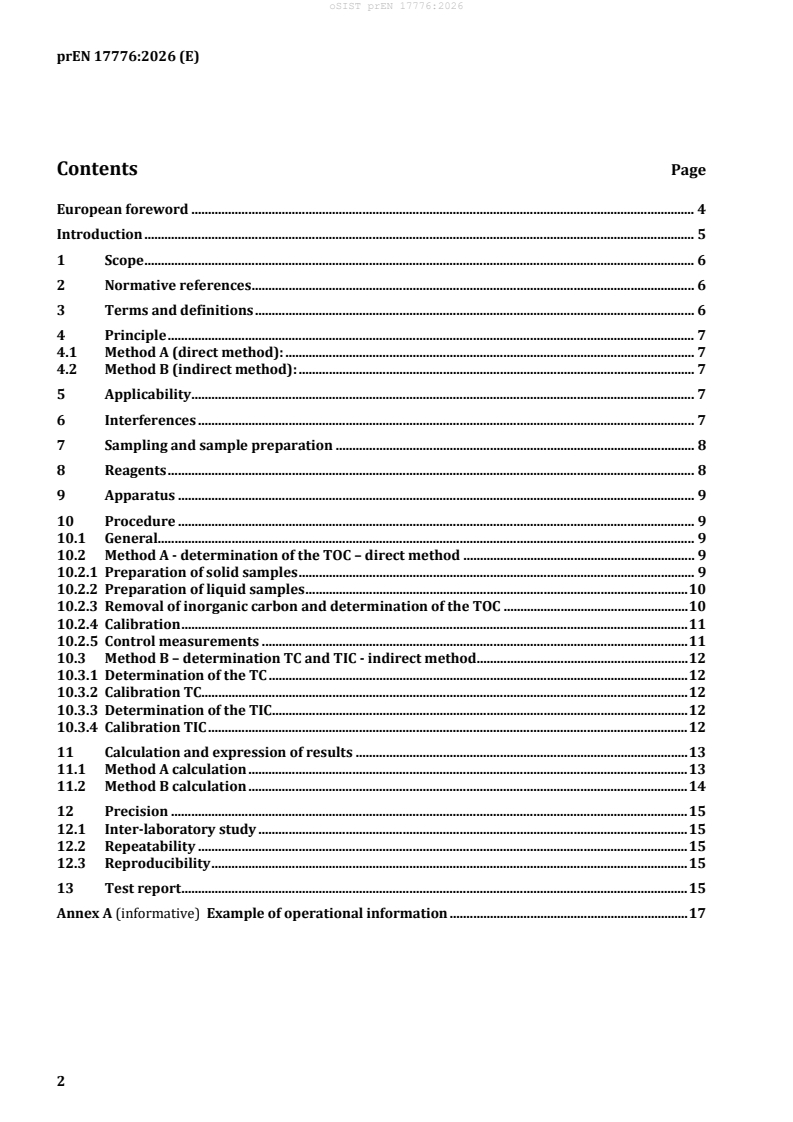
Contents
- Introduction
- 1 Scope
- 2 Normative references
- 3 Terms and definitions
- 3.1 total organic carbon
- 3.2 total inorganic carbon
- 3.3 total carbon
- 4 Principle
- 5 Applicability
- 6 Interferences
- 7 Sampling and sample preparation
- 8 Reagents
- 8.8 Tetrasodium ethylenediamine tetraacetate-tetra-hydrate, Na -EDTA ⋅ 4H O (C H N O Na ⋅
- 8.12 Control mixture
- 8.14 Non-oxidizing mineral acid used for carbon dioxide expulsion, e.g. phosphoric acid H PO
- 9 Apparatus
- 9.5 Drying system, thermostatically controlled and capable of maintaining temperature of
- 9.7 Evaporating dish or crucible, temperature tolerant laboratory vessel with a temperature
- 10 Procedure
- 10.1 General
- 10.2 Method A - determination of the TOC – direct method
- 10.3 Method B – determination TC and TIC - indirect method
- 11 Calculation and expression of results
- 11.1 Method A calculation
- 11.2 Method B calculation
- 12 Precision
- 12.1 Inter-laboratory study
- 12.2 Repeatability
- 12.3 Reproducibility
- 13 Test report
- Annex A
- Annex B
- Bibliography
Introduction
An EU fertilizing product consists solely of component materials complying with the requirements for one or more of the component material categories (CMCs), as specified in the Regulation (EU) 2019/1009 [1]. This regulation lays down the rules on the making available on the market of EU fertilizing products and the specific safety and quality requirements for the CMCs. By-products within the meaning of Directive 2008/98/EC have been classified as CMC 11 and recovered high purity materials as CMC 15, in Regulation (EU) 2019/1009 [1]. The method described in this document is based on the standard for determining organic carbon in sludges, biowaste, soil, and other solid matrices (EN 15936 [3]). WARNING — Persons using this document should be familiar with usual laboratory practice. This document does not purport to address all of the safety issues, if any, associated with its use. It is the responsibility of the user to establish appropriate health and safety practices and to ensure compliance with any national regulatory conditions.
IMPORTANT — It is absolutely essential that tests conducted according to this document are carried out by suitably trained staff.
oSIST prEN 17776:2026 prEN 17776:2026 (E)
1 Scope
This document specifies a method for the determination of total organic carbon (TOC) by elemental analysis using dry combustion. The method is applicable to organic and organo-mineral fertilizers containing more than 1 g carbon per kg of dry matter (0,1 %), with the exclusion of organo-mineral fertilizers containing urea-formaldehyde polymers or urea as long as there is no method available to assess carbon in urea-formaldehyde polymers or urea.
This document is applicable to the component materials “by-products”, or “recovered high-purity materials”, when used as components of fertilizing products, as well as the fertilizing products blends where a blend is a mix of at least two of the following components: fertilizers, liming materials, soil improvers, growing media, inhibitors, plant biostimulants and where the following category: organic fertilizers, organo-mineral fertilizers is the highest % in the blend by mass or volume, or in the case of liquid form by dry mass. If the organic fertilizer or the organo-mineral fertilizer is not the highest % in the blend, the European Standard for the highest % of the blend applies. In case a fertilizing product blend is composed of components in equal quantity, the user decides which standard to apply. Variations in analytical methods for fertilizing product blends can lead to differing results as some components or matrix interactions can affect the outcome. Validation procedures have shown that developed standard methods are robust and reliable across diverse product compositions, but possible interferences and unexpected results when analysing fertilizing product blends are possible. This document is applicable and validated for several types of matrices as indicated in Annex B.
2 Normative references
The following documents are referred to in the text in such a way that some or all of their content constitutes requirements of this document. For dated references, only the edition cited applies. For undated references, the latest edition of the referenced document (including any amendments) applies. CEN/TS 17771, Organic and organo-mineral fertilizers — Determination of the nitrogen content
prEN 17773 , Organic and organo-mineral fertilizers — Determination of the dry matter content EN 17864, Inorganic fertilizers — Determination of nitrogen content in IBDU (isobutylidenediurea) and CDU (crotonylidenediurea) EN 12944-1, Fertilizers and liming materials — Vocabulary — Part 1: General terms EN 12944-2, Fertilizers and liming materials — Vocabulary — Part 2: Terms relating to fertilizers EN 1482-2, Fertilizers, liming materials and inhibitors — Sampling and sample preparation — Part 2:
General sample preparation provisions
3 Terms and definitions
For the purposes of this document, the terms and definitions given in EN 12944-1 and EN 12944-2 and the following apply.
ISO and IEC maintain terminological databases for use in standardization at the following addresses:
ISO Online browsing platform: available at https://www.iso.org/obp IEC Electropedia: available at https://www.electropedia.org/
Under preparation.
oSIST prEN 17776:2026 prEN 17776:2026 (E)
3.1 total organic carbon
TOC quantity of carbon that is converted into carbon dioxide by combustion and which is not liberated as carbon dioxide by acid treatment
3.2 total inorganic carbon
TIC quantity of carbon that is liberated as carbon dioxide by acid treatment
3.3 total carbon
TC quantity of carbon present in the sample in the form of organic, inorganic and elemental carbon Note 1 to entry: Carbon derived from urea and polymers containing urea are not considered as organic in this document.
4 Principle
4.1 Method A (direct method):
The carbon dioxide released by the following combustion in an oxygen containing gas flow free of carbon dioxide, is measured by infrared spectrometry, thermal conductivity detection, or by the detector provided by the equipment used. To ensure complete combustion, catalysts and/or modifiers can be used. The released amount of carbon dioxide indicates the TOC. The carbonates present in the sample shall be previously removed by treating the sample with acid. The carbon dioxide released by the following combustion step indicates the TOC directly. 4.2 Method B (indirect method):
TOC is obtained by the difference between the results of the measurements of TC and TIC. The total carbon (TC) present in the sample is converted into carbon dioxide by combustion in an oxygen containing gas flow free of carbon dioxide. To ensure complete combustion, catalysts and/or modifiers can be used. The released amount of carbon dioxide is measured e.g. by infrared spectrometry, thermal conductivity detection, or other suitable techniques.
The TIC is determined separately from another sub-sample by means of acidification and purging of the released carbon dioxide. The carbon dioxide shall be measured by one of the techniques mentioned above.
5 Applicability
The methods 4.1 and 4.2 are applicable to organic and organo-mineral fertilizers both solid and liquid. The method 4.1 is not selective, because combustion occurs for both organic and inorganic carbon.
6 Interferences
In the case of experience with samples containing high amounts of carbonates (e.g. carbonates to TOC ratio higher than 10) the operator shall take care to correctly eliminate all the carbonates to make sure to produce reliable TOC results.
oSIST prEN 17776:2026 prEN 17776:2026 (E) When present, carbon from urea and urea-condensates carbides is determined as organic carbon using the method described in this document. An interpretation of the measured value may therefore be problematic in cases where the sample contains relevant levels of the above-mentioned components. If needed, these components shall be determined separately by means of a suitable validated method and be recorded in the test report.
Carbon from urea and urea-condensates (crotonyliden diurea, CDU and isobutyliden diurea, IBDU), determined separately using CEN/TS 17771 and EN 17864 shall be subtracted. If this is done this shall be reported by the laboratory.
7 Sampling and sample preparation
Sampling is not part of the method specified in this document. Recommended sampling methods are given in EN 1482-1 [5] and in EN 1482-3 [6].
It is important that the laboratory receives a sample that is representative of both the product under consideration and the given analysis. The sample should not have been damaged or changed during transport or storage.
Sample preparation shall be carried out in accordance with EN 1482-2. Grinding of the laboratory sample is recommended for homogeneity reasons. The sample shall then pass through a sieve of 0,5 mm.
8 Reagents
8.1 Water, with a specific conductivity not higher than 0,2 mS/m at 25 °C, free from the elements to be determined. All reagents shall be of recognized analytical grade. 8.2 Potassium hydrogen phthalate, C H O K.
8 5 4 8.3 Acetanilide, C H NO.
8 9 8.4 Atropine, C H NO .
17 23 3 8.5 Ethylenediaminetetraacetic acid, (EDTA), C H N O .
10 16 2 8 8.6 Diethylenetriaminepentaacetic acid, (DTPA), C H N O .
14 23 3 10 8.7 Sodium salicylate, C H O Na.
7 5 3
8.8 Tetrasodium ethylenediamine tetraacetate-tetra-hydrate, Na -EDTA ⋅ 4H O (C H N O Na ⋅
4 2 10 12 2 8 4 4H O), heated at 80 °C for 2 h.
Other forms of Na -EDTA hydrates may be used if the water content is exactly known. In these cases, the
composition of the control mixtures shall be recalculated accordingly (see also 8.12). 8.9 Aluminium oxide, Al O , neutral, granular size < 200 µm, annealed at 600 °C. 2 3 8.10 Calcium carbonate, CaCO .
8.11 Sodium carbonate, Na CO , anhydrous.
2 3
8.12 Control mixture
Control mixture prepared from sodium salicylate (8.7), calcium carbonate (8.10), Na -EDTA ⋅ 4H O (8.8) 4 2 and aluminium oxide (8.9) in a mass ratio of 1,00 : 4,36 : 1,97 : 8,40.
oSIST prEN 17776:2026 prEN 17776:2026 (E) The mixture shall be homogenized. It should contain 33,3 g/kg total inorganic carbon and 66,6 g/kg TOC (e.g. 6,36 g of sodium salicylate, 27,78 g of calcium carbonate, 12,50 g of Na -EDTA ⋅ 4H O, 53,36 g of 4 2 aluminium oxide).
8.13 Inert absorbent material for determination on fluid samples (such as Chromosorb ).
8.14 Non-oxidizing mineral acid used for carbon dioxide expulsion, e.g. phosphoric acid H PO
3 4 (w = 85 %).
NOTE Due to possible corrosion by hydrochloric acid, phosphoric acid is preferred. 8.15 Carrier gas, e.g. synthetic air, nitrogen, helium, oxygen or argon, free of carbon dioxide and organic impurities in accordance with the manufacturer's instructions.
9 Apparatus
9.1 Analytical balance, capable of weighing to the nearest 1 mg or better. 9.2 Equipment for determination of carbon in solids, with accessories. 9.3 Crucibles, capsules or boats, made of e.g. silver, tin, ceramics or platinum. Tin and nickel crucibles are not acid-resistant. In case of the necessity to remove inorganic carbon (see 10.2.3), silver or ceramics vessels shall be used.
9.4 Pasteur pipettes.
9.5 Drying system, thermostatically controlled and capable of maintaining temperature of
(105 ± 2) °C.
9.6 Desiccator, with an active drying agent such as silica gel.
9.7 Evaporating dish or crucible, temperature tolerant laboratory vessel with a temperature
resistance of at least 110 °C. Suitable materials are metallic, ceramic, borosilicate glass or quartz, porcelain, etc.
9.8 Purging unit for TIC determination, for Method B only.
10 Procedure
10.1 General
The mass of the test portion should be as large as possible and shall be chosen so that the liberated quantity of carbon dioxide lies within the working range of the equipment and calibration. See example in Table A.1.
10.2 Method A - determination of the TOC – direct method
10.2.1 Preparation of solid samples
For solid fertilizers dried samples shall be used.
...