

SIST EN 61169-32:2005
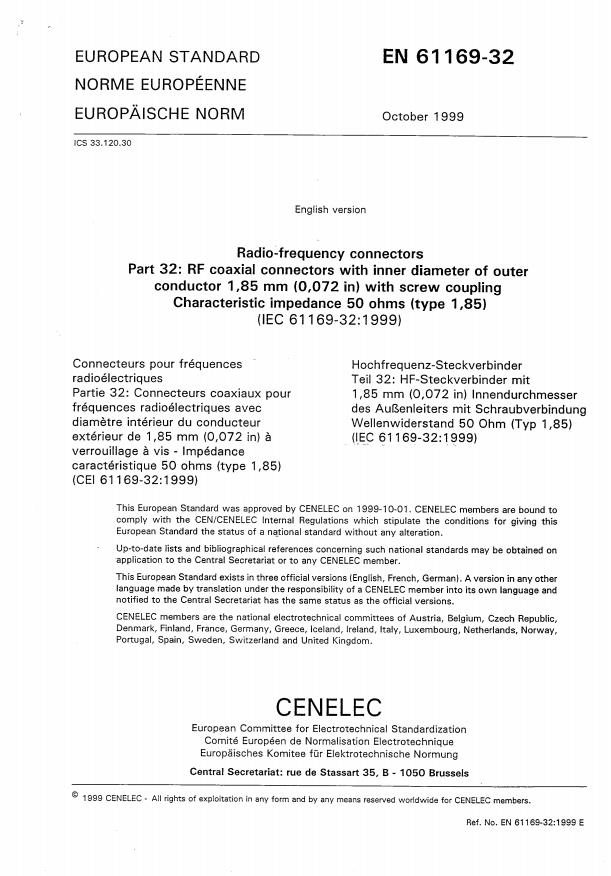
(Main)Radio-frequency connectors -- Part 32: RF coaxial connectors with inner diameter of outer conductor 1,85 mm (0,072 in) with screw coupling - Characteristic impedance 50 ohms (type 1,85)
General Information
- Abstract
These connectors are recommended for use with semi-rigid and flexible cable and in microwave applications requiring high performance. Have an operating frequency of up to 65 GHz.
- Status
- Published
- Publication Date
- 31-Jan-2005
- Technical Committee
- iTEL - Communication cables
- Current Stage
- 6060 - National Implementation/Publication (Adopted Project)
- Start Date
- 01-Feb-2005
- Due Date
- 01-Feb-2005
- Completion Date
- 01-Feb-2005

Overview
SIST EN 61169-32:2005 specifies the requirements and characteristics for type 1.85 RF coaxial connectors featuring a screw coupling mechanism and an inner diameter of the outer conductor of 1.85 mm (0.072 in). These connectors are designed for a nominal characteristic impedance of 50 ohms and support operation at frequencies up to 65 GHz. The standard is published by the CLC (European Committee for Electrotechnical Standardization) and is harmonized with IEC 61169-32.
Key Topics
- Connector Design: Detailed specifications for type 1.85 RF coaxial connectors, which enable secure screw coupling to ensure robust mechanical and electrical performance.
- Frequency Range: Designed for high-frequency applications, supporting operation up to 65 GHz, making them suitable for demanding microwave and RF environments.
- Cable Compatibility: The connectors are recommended for use with both semi-rigid and flexible cables, providing flexibility in integration with different transmission media.
- Performance Requirements: The standard covers essential performance aspects, such as impedance consistency, insertion loss, return loss, and connector durability.
- Testing and Quality Assurance: Specifies testing methods and acceptance criteria to guarantee reliable connector performance in high-frequency data transmission applications.
Applications
Type 1.85 RF coaxial connectors specified in SIST EN 61169-32:2005 are widely used in:
- Microwave Equipment: Ideal for high-frequency interconnections in microwave instruments, analyzers, and test systems.
- Telecommunications: Supports high-performance transmission in telecom infrastructures, including 5G test setups and advanced wireless communications.
- Aerospace and Defense: Suited for radar systems, satellite communications, and other aerospace or military-grade RF applications requiring reliable, high-frequency connections.
- Laboratory and Measurement: Preferred in lab environments for high-precision RF measurement systems, where frequency range and stability are critical.
- Broadcasting: Used in broadcasting equipment demanding minimal signal loss and consistent impedance at high frequencies.
Related Standards
Consider referencing these related standards for broader context and system compatibility:
- IEC 61169 Series: Provides specifications for a wide range of RF coaxial connectors, offering guidance across various connector types and applications.
- EN 61169-1: Covers general requirements and test methods applicable to all RF coaxial connectors within the IEC 61169 series.
- EN 61169-4: Specifies connectors with different dimensions and coupling mechanisms, useful for alternative system designs.
- EN 61169-7: Focuses on miniature RF coaxial connectors for limited space or lightweight applications.
- IEC 60169 Series: Earlier international standards for RF connectors, often referenced in legacy systems.
By adhering to SIST EN 61169-32:2005, manufacturers and system integrators ensure interoperability, performance, and reliability in high-frequency RF and microwave applications. This standard is vital for any project requiring precision, durability, and compliance in demanding radio-frequency applications.
Relations
- Effective Date
- 03-Feb-2026
- Effective Date
- 03-Feb-2026
- Effective Date
- 03-Feb-2026
- Effective Date
- 03-Feb-2026
- Effective Date
- 03-Feb-2026
- Effective Date
- 23-Sep-2025
Get Certified
Connect with accredited certification bodies for this standard

ANCE
Mexican certification and testing association.

Intertek Slovenia
Intertek testing, inspection, and certification services in Slovenia.

LNE (Laboratoire National de Métrologie et d'Essais)
French national laboratory for metrology and testing.
Sponsored listings
Frequently Asked Questions
SIST EN 61169-32:2005 is a standard published by the Slovenian Institute for Standardization (SIST). Its full title is "Radio-frequency connectors -- Part 32: RF coaxial connectors with inner diameter of outer conductor 1,85 mm (0,072 in) with screw coupling - Characteristic impedance 50 ohms (type 1,85)". This standard covers: These connectors are recommended for use with semi-rigid and flexible cable and in microwave applications requiring high performance. Have an operating frequency of up to 65 GHz.
These connectors are recommended for use with semi-rigid and flexible cable and in microwave applications requiring high performance. Have an operating frequency of up to 65 GHz.
SIST EN 61169-32:2005 is classified under the following ICS (International Classification for Standards) categories: 33.120.30 - RF connectors. The ICS classification helps identify the subject area and facilitates finding related standards.
SIST EN 61169-32:2005 has the following relationships with other standards: It is inter standard links to SIST EN 61169-1:1998, SIST EN IEC 60966-3:2024, SIST EN IEC 60966-2-1:2024, SIST EN IEC 63249-1:2021, SIST EN IEC 60966-1:2019, SIST EN 61169-32:2005/oprA1:2026. Understanding these relationships helps ensure you are using the most current and applicable version of the standard.
SIST EN 61169-32:2005 is available in PDF format for immediate download after purchase. The document can be added to your cart and obtained through the secure checkout process. Digital delivery ensures instant access to the complete standard document.
Standards Content (Sample)
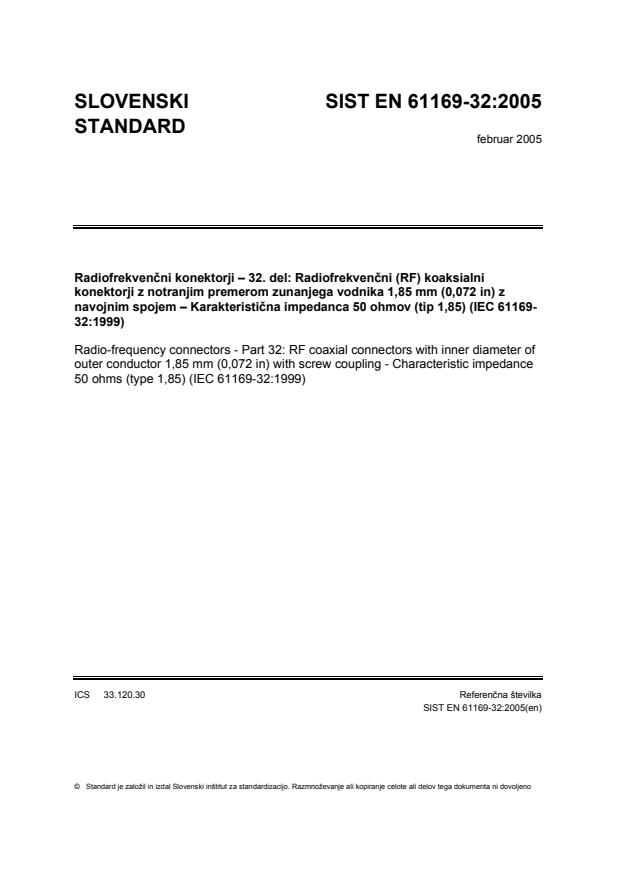
SLOVENSKI SIST EN 61169-32:2005
STANDARD
februar 2005
Radiofrekvenčni konektorji – 32. del: Radiofrekvenčni (RF) koaksialni
konektorji z notranjim premerom zunanjega vodnika 1,85 mm (0,072 in) z
navojnim spojem – Karakteristična impedanca 50 ohmov (tip 1,85) (IEC 61169-
32:1999)
Radio-frequency connectors - Part 32: RF coaxial connectors with inner diameter of
outer co
...