


SIST EN 13757-3:2013
(Main)Communication systems for and remote reading of meters - Part 3: Dedicated application layer
Communication systems for and remote reading of meters - Part 3: Dedicated application layer
This European Standard applies to communication systems for meters and remote reading of meters.
Kommunikationssysteme für Zähler und deren Fernablesung - Teil 3: Spezielle Anwendungsschicht
Dieses Dokument gilt für Kommunikationssysteme für Zähler und deren Fernablesung.
Systèmes de communication et de télérelevé de compteurs - Partie 3: Couche d'application spéciale
La présente Norme européenne s’applique aux systèmes de communication des compteurs et au télérelevé de compteurs.
Komunikacijski sistemi za merilnike in daljinsko odčitavanje - 3. del: Poseben aplikacijski sloj
Ta evropski standard se nanaša na komunikacijske sisteme za metre in daljinsko branje metrov.
General Information
- Status
- Withdrawn
- Public Enquiry End Date
- 24-Jun-2011
- Publication Date
- 30-May-2013
- Withdrawal Date
- 11-Apr-2018
- Technical Committee
- I13 - Imaginarni 13
- Current Stage
- 9900 - Withdrawal (Adopted Project)
- Start Date
- 12-Apr-2018
- Due Date
- 05-May-2018
- Completion Date
- 12-Apr-2018
Relations
- Effective Date
- 29-May-2013
- Replaced By
SIST EN 13757-7:2018 - Communication systems for meters - Part 7: Transport and security services - Effective Date
- 11-Apr-2018
- Effective Date
- 11-Apr-2018
- Revised
SIST EN 13757-7:2018 - Communication systems for meters - Part 7: Transport and security services - Effective Date
- 23-Mar-2016
- Effective Date
- 16-Dec-2015
- Effective Date
- 08-Aug-2009

Frequently Asked Questions
SIST EN 13757-3:2013 is a standard published by the Slovenian Institute for Standardization (SIST). Its full title is "Communication systems for and remote reading of meters - Part 3: Dedicated application layer". This standard covers: This European Standard applies to communication systems for meters and remote reading of meters.
This European Standard applies to communication systems for meters and remote reading of meters.
SIST EN 13757-3:2013 is classified under the following ICS (International Classification for Standards) categories: 33.200 - Telecontrol. Telemetering; 35.100.70 - Application layer. The ICS classification helps identify the subject area and facilitates finding related standards.
SIST EN 13757-3:2013 has the following relationships with other standards: It is inter standard links to SIST EN 13757-3:2005, SIST EN 13757-7:2018, SIST EN 13757-3:2018, SIST EN 13757-7:2018, SIST EN 13757-3:2018, SIST EN 13757-3:2005. Understanding these relationships helps ensure you are using the most current and applicable version of the standard.
SIST EN 13757-3:2013 is associated with the following European legislation: EU Directives/Regulations: 2004/22/EC; Standardization Mandates: M/441, M/490. When a standard is cited in the Official Journal of the European Union, products manufactured in conformity with it benefit from a presumption of conformity with the essential requirements of the corresponding EU directive or regulation.
SIST EN 13757-3:2013 is available in PDF format for immediate download after purchase. The document can be added to your cart and obtained through the secure checkout process. Digital delivery ensures instant access to the complete standard document.
Standards Content (Sample)
2003-01.Slovenski inštitut za standardizacijo. Razmnoževanje celote ali delov tega standarda ni dovoljeno.Kommunikationssysteme für Zähler und deren Fernablesung - Teil 3: Spezielle AnwendungsschichtSystèmes de communication et de télérelevé de compteurs - Partie 3: Couche d'application spécialeCommunication systems for and remote reading of meters - Part 3: Dedicated application layer35.100.70Uporabniški slojApplication layer33.200Daljinsko krmiljenje, daljinske meritve (telemetrija)Telecontrol. TelemeteringICS:Ta slovenski standard je istoveten z:EN 13757-3:2013SIST EN 13757-3:2013en,de01-julij-2013SIST EN 13757-3:2013SLOVENSKI
STANDARDSIST EN 13757-3:20051DGRPHãþD
EUROPEAN STANDARD NORME EUROPÉENNE EUROPÄISCHE NORM
EN 13757-3
May 2013 ICS 33.200; 35.100.70 Supersedes EN 13757-3:2004English Version
Communication systems for and remote reading of meters - Part 3: Dedicated application layer
Systèmes de communication et de télérelevé de compteurs - Partie 3: Couche d'application spéciale
Kommunikationssysteme für Zähler und deren Fernablesung - Teil 3: Spezielle Anwendungsschicht This European Standard was approved by CEN on 7 March 2013.
CEN members are bound to comply with the CEN/CENELEC Internal Regulations which stipulate the conditions for giving this European Standard the status of a national standard without any alteration. Up-to-date lists and bibliographical references concerning such national standards may be obtained on application to the CEN-CENELEC Management Centre or to any CEN member.
This European Standard exists in three official versions (English, French, German). A version in any other language made by translation under the responsibility of a CEN member into its own language and notified to the CEN-CENELEC Management Centre has the same status as the official versions.
CEN members are the national standards bodies of Austria, Belgium, Bulgaria, Croatia, Cyprus, Czech Republic, Denmark, Estonia, Finland, Former Yugoslav Republic of Macedonia, France, Germany, Greece, Hungary, Iceland, Ireland, Italy, Latvia, Lithuania, Luxembourg, Malta, Netherlands, Norway, Poland, Portugal, Romania, Slovakia, Slovenia, Spain, Sweden, Switzerland, Turkey and United Kingdom.
EUROPEAN COMMITTEE FOR STANDARDIZATION
COMITÉ EUROPÉEN DE NORMALISATION EUROPÄISCHES KOMITEE FÜR NORMUNG
Management Centre:
Avenue Marnix 17,
B-1000 Brussels © 2013 CEN All rights of exploitation in any form and by any means reserved worldwide for CEN national Members. Ref. No. EN 13757-3:2013: ESIST EN 13757-3:2013
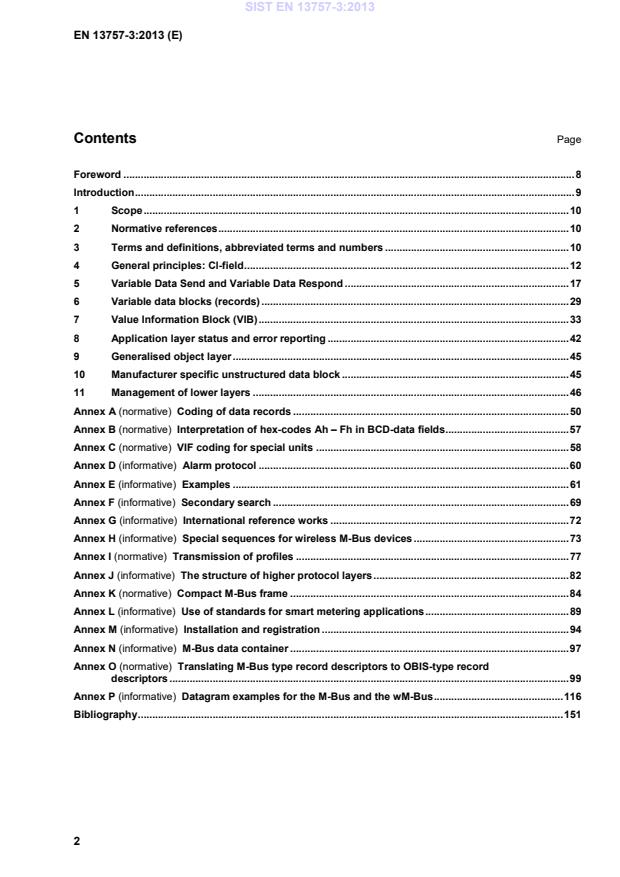
Coding of data records . 50 Annex B (normative)
Interpretation of hex-codes Ah – Fh in BCD-data fields . 57 Annex C (normative)
VIF coding for special units . 58 Annex D (informative)
Alarm protocol . 60 Annex E (informative)
Examples . 61 Annex F (informative)
Secondary search . 69 Annex G (informative)
International reference works . 72 Annex H (informative)
Special sequences for wireless M-Bus devices . 73 Annex I (normative)
Transmission of profiles . 77 Annex J (informative)
The structure of higher protocol layers . 82 Annex K (normative)
Compact M-Bus frame . 84 Annex L (informative)
Use of standards for smart metering applications . 89 Annex M (informative)
Installation and registration . 94 Annex N (informative)
M-Bus data container . 97 Annex O (normative)
Translating M-Bus type record descriptors to OBIS-type record descriptors . 99 Annex P (informative)
Datagram examples for the M-Bus and the wM-Bus . 116 Bibliography . 151
Tables Table 1 — CI-field codes used by the master or the slave . 12 Table 2 — Coding of the upper 4 bits of the first parameter after CI = 50h or 53h . 15 Table 3 — Variable data structure in answer send and respond direction . 17 Table 4 — Short data header . 18 Table 5 — Long data header . 18 Table 6 — Device type identification . 19 Table 7 — Coding of the status field . 22 Table 8 — Application errors coded with the status-field . 22 Table 9 — Meaning of status byte for partner messages . 23 Table 10 — General definition of the configuration field . 23 Table 11 — Definition of the mode bits (encryption method) . 24 Table 12 — Definition of the configuration field for encryption modes 2 and 3. 25 Table 13 — Definition of the configuration field for encryption mode 5 . 26 Table 14 — Initialisation vector mode 5 for the CBC-AES-128 . 26 Table 15 — Contents of meter message . 27 Table 16 — Contents of partner message . 28 Table 17 — Accessibility of a meter . 28 Table 18 — Address structure of the wireless link layer . 29 Table 19 — Structure of a data record (transmitted from left to right). 29 Table 20 — Coding of the Data Information Field (DIF) . 30 Table 21 — Coding of the data field . 30 Table 22 — DIF-coding for special functions . 31 Table 23 — Function field. 31 Table 24 — Coding of the Data Information Field Extension (DIFE) . 32 Table 25 — Coding of the Value Information Field (VIF) . 33 SIST EN 13757-3:2013
Part 1: Data exchange EN 13757-2, Communication systems for meters and remote reading of meters
Part 2: Physical and link layer EN 13757-4, Communication systems for meters and remote reading of meters
Part 4: Wireless meter readout (Radio meter reading for operation in the 868 MHz to 870 MHz SRD band) EN 13757-5, Communication systems for meters and remote reading of meters
Part 5: Wireless relaying EN 62056-21, Electricity metering
Data exchange for meter reading, tariff and load control
Part 21: Direct local data exchange (IEC 62056-21)
EN 62056-5-3, Electricity metering data exchange
The DLMS/COSEM Suite
Part 5-3: DLMS/COSEM application layer (IEC 62056-5-3:2013)
NOTE Further information and examples are available in the download area of http://www.m-bus.com. 3 Terms and definitions, abbreviated terms and numbers For the purposes of this document, the following terms and definitions apply. 3.1 Terms and definitions 3.1.1 byte an octet of bits 3.1.2 datagram unit of data transferred from source to destination Note 1 to entry:
In previous versions of EN 13757-3 datagram was called telegram. 3.1.3 message functional set of data transferred from source to destination Note 1 to entry:
A message may consist of one or more datagrams. 3.2 List of abbreviated terms ACC-DMD Access Demand SIST EN 13757-3:2013
ACK Acknowledge AES Advanced Encryption Standard BCD Binary Coded Decimal numbers CI Control Information field CBC Cipher Block Chaining CMD Command CNF-IR Confirm Installation Request DES Data Encryption Standard DIB Data Information Block DIF Data Information Field DIFE Data Information Field Extensions DLMS Device Language Message Specification DRH Data Record Header E Extension bit LSB Least Significant Byte LSBit Least Significant Bit MDH Manufacturer Data Header MSB Most Significant Byte MSBit Most Significant Bit OBIS Object Identification System (EN 62056-61) REQ-UD Request User Data (class 1 or 2) RSP_UD Respond User Data RSSI Received Signal Strength Indicator SM-CG Smart Meter Co-ordination Group SND-IR Send Installation Request SND-NKE Send Link Reset SND-NR Send – No Reply SND-UD Send User Data
VIB Value Information Block
VIFE Value Information Field Extensions 3.3 Hexadecimal and binary numbers Hexadecimal numbers are designated by a following "h" Binary numbers are designated by a following “b” Decimal numbers have no suffix! 4 General principles: Cl-field 4.1 Overview All higher protocol layer messages have a variable length. The length information is part of the link layer. It shall be known to the application layer in order to properly terminate its decoding of each datagram. Each message starts with a 1-byte CI (control information) field, which distinguishes between various message types and application functions and header length. It is also used to distinguish between true application layer communication and management commands for lower layers. The meaning of the remaining bytes of the message depends also on the value of the CI-field. The fixed header structures after CI-fields are: No data header (None) (0 bytes), as for CI=78h: If the message contains such a “none” header the meter identification is taken from the link layer; additional control fields for application layer (like configuration field) are non-existent. Short data header (4 bytes or more), as for CI=7Ah: If the message contains such a “short” header, the meter identification is taken from the link layer; data header length is at least 4 bytes. Additional bytes may follow in dependency of the selected encryption mode. If no encryption is applied (encryption mode 0), the header has the minimum length of 4 bytes. Long data header (12 bytes or more), as for CI=72h: If the message contains such a “long” header, this header contains (independent of transmission direction) the meter identification; data header length is at least 12 bytes. Additional bytes may follow in dependency of the selected encryption mode. If no encryption is applied (encryption mode 0), the header has the minimum length of 12 byte. When using a long data header, the meter application address is contained in this header, whereas the manufacturer assigned unique link layer address may be different (but still within the common universally unique address structure). This allows, for example, a wired to wireless converter to supply the supported meter application address in the long data header and its own address in the radio link layer. For a simple meter, which doesn’t need an additional converter, the short header is sufficient. Refer to Annex J for the details of the CI-field specific frame structure. Table 1 — CI-field codes used by the master or the slave CI-field Direction Header Higher layer protocol 00h-1Fh Reserved for DLMS-based applications
DLMS (See EN 13757-1) 20h-4Fh Reserved
50h Application reset or select to device None M-Bus SIST EN 13757-3:2013
5Ah Command to device Short
M-Bus
5Bh Command to device Long
M-Bus 5Ch Synchronise action
5Dh-5Fh Reserved
60h Command to device Long
Application layer DLMS/ COSEM with OBIS-Identifier (EN 62056-5-3)a 61h Command to device Short Application layer DLMS/ COSEM with OBIS-Identifier (EN 62056-5-3)a 62h-63h Reserved
64h Command to device Long Reserved for OBIS-type value descriptorsa 65h Command to device Short Reserved for OBIS-type value descriptorsa 66h-68h Reserved
69h Response from device (M-Bus-Format frame) None See Annex K 6Ah Response from device (M-Bus-Format frame) Short See Annex K 6Bh Response from device (M-Bus-Format frame) Long See Annex K 6Ch Time sync to device Long Generic 6Dh Time sync to device Long Generic 6Eh Application error from device Short Generic 6Fh Application error from device Long Generic 70h Application error from device None Generic 71h Alarm from device None Generic 72h Response from device Long M-Bus 73h
Response from device (M-Bus-Compact frame) Long See Annex K 74h Alarm from device Short Generic 75h Alarm from device Long Generic 76h-77h Reserved
78h Response from device None M-Bus
79h Response from device (M-Bus-Compact frame) None See Annex K SIST EN 13757-3:2013
See EN 13757-5 82h Reserved for network management data
See EN 13757-5 83h Network management data
See EN 13757-5 84h Transport layer to device (M-Bus-Compact frame expected) Long See Annex K 85h Transport layer to device (M-Bus-Format frame expected) Long See Annex K 86h-88h Reserved
See EN 13757-4, EN 13757-5 89h Reserved for network management data from device
See EN 13757-5 8Ah Transport layer from device Short See EN 13757-4 8Bh Transport layer from device Long See EN 13757-4 8Ch-8Fh Link layer extension
See EN 13757-4 90h-9Fh Reserved
A0h-B7h Manufacturer specific
B8h Set baud rate to 300 Bd
B9h Set baud rate to 600 Bd
BAh Set baud rate to 1 200 Bd
BBh Set baud rate to 2 400 Bd
BCh Set baud rate to 4 800 Bd
BDh Set baud rate to 9 600 Bd
BFh Set baud rate to 38 400 Bd
C0h-FFh Reserved
NOTE All SND_UD datagrams are acknowledged in the link layer, even if the function of these CI-fields is not implemented. a These application protocols also contain OBIS identifiers. In the M-Bus application protocol, these OBIS identifiers are not included, but they can be added afterwards. For generating the OBIS identifiers from M-Bus data records, Annex O shall be used.
Every data header for wireless M-Bus (EN 13757-4) shall contain at least:
access number; status byte; configuration field. Alternatively, the link extension (CI=8Ch – 8Fh) may be applied. NOTE Multi byte values in short or long header are transmitted with LSB first.
4.2 Application reset and application select (Cl = 50h, 53h) (optional) 4.2.1 Application reset With the CI-field 50h or 53h (without additional parameter), the master can release a reset of the application layer in the slaves. Each slave itself decides which parameters to change, e.g. which data output is default – after it has received such an application reset. 4.2.2 Application select with subcode (optional) It is allowed to use optional parameters after CI = 50h or 53h. In this case, the CI-field acts as application select. If more bytes follow, the first byte is the application select subcode. Further bytes are ignored. The application select subcode defines which message function and which sub message is requested by the master. The data type of this parameter is 8 bit binary. The upper 4 bits define the message type or message application and the lower 4 bits define the number of the sub message or datagram number (the meaning of this number is device specific). The lower 4 bits may be ignored for slaves which provide only a single datagram for each application. The use of the value zero for the number of the sub message means that all datagrams are requested. Slaves with only one type of message may ignore application select and the added parameters. The following codes can be used for the upper 4 bits of the first parameter: Table 2 — Coding of the upper 4 bits of the first parameter after CI = 50h or 53h Coding Description Examples 0000b All
0001b User data Consumption 0010b Simple billing Current and fixed date values + dates 0011b Enhanced billing Historic values 0100b Multi tariff billing
0111b Reserved
1000b Installation and startup Bus address, fixed dates 1001b Testing High resolution values 1010b Calibration
1011b Manufacturing
1100b Development
1101b Self test
1110b Reserved
1111b Reserved
4.3 Slave select (52h) (optional) The CI-field code 52h is used for the management of the optional secondary addressing (see 11.3). 4.4 Synchronise action (Cl = 5Ch) (optional) This CI-field can be used for synchronising functions in slaves and masters (e.g. clock synchronisation). Special actions or parameter loads may be prepared but their final execution is delayed until the reception of such a special CI-field command. No data follows this CI-code. NOTE Wireless M-Bus does not provide broadcast communication. Therefore, this function cannot be used for wireless M-Bus. 4.5 Clock synchronisation (CI = 6Ch, 6Dh) (optional) For wireless communication (but not limited to this one), the clock synchronisation is executed by a special protocol for clock synchronisation. For this protocol CI-fields 6Ch and 6Dh are used. Annex H.3 specifies the transmission of clock synchronisation to meter. Alternatively, the clock may set by an M-Bus-command. The communication partner may send date and time in all command messages to ensure that the meter can detect a replay of an old command. The meter shall not use this time stamp for synchronisation of its clock except when a dedicated action code (see Table 37) was added. 4.6 Report of application errors (slave to master) (Cl = 6Eh, 6Fh and 70h) (optional) For details of the report of general application errors, see 8.3. For error reporting of individual data elements, see 8.4. 4.7 Report of alarm status (slave to master) (Cl = 71h, 74h and 75h) (optional) For details of the report of alarm status errors, see Annex D. 4.8 Variable Data Send (master to slave) (CI = 51h, 5Ah, 5Bh, 60h, 61h, 64h, 65h) These CI-field codes are used to indicate a message of application data sent from master to slave.
The CI-fields 72h, 78h and 7Ah are used to transport the M-Bus protocol as described in this standard starting from Clause 6. For details, refer to Clause 5. The CI-fields 69h, 6Ah and 6Bh, as well as 73h, 79h and 7B, are used to transport the M-Bus protocol in the compact format. For details, refer to Annex K. The CI-fields CI = 7Ch and 7Dh are used to transport the COSEM-Protocol as described in EN13757-1 and EN 62056-5-3. The CI-fields CI = 7Eh and 7Fh are reserved so far for an alternative OBIS based protocol. 4.10 Baud rate switch commands B8h – BFh (optional) These optional commands can be used by a master to switch the baud rate of a slave. For details, see 11.2. 5 Variable Data Send and Variable Data Respond
5.1 Introduction The data headers of the Variable Data Send with the CI-field codes as listed in 4.8 are used to indicate the variable data structure in long frames (SND_UD) with optional fixed header. The data headers of the Variable Data Respond with the CI-field codes as listed in 4.9 are used to indicate the variable data structure in long frames (RSP_UD) with optional fixed header.
Table 3 shows the way this data is represented. Table 3 — Variable data structure in answer send and respond direction Data header (resp.) Variable data blocks (records) MDH(opt.) Optional manufacturer specific data) None header Short header Long header Variable number 1 byte Variable number
5.2 Structure of none data header
This structure has no data header. The first byte following the CI-field is the start of the first data record. This data structure does not support transmission properties like encryption, access number or an additional meter address.
The first 4 bytes after the CI-field consist of a block with a fixed length and structure (see Table 4). The short data header is used for systems supporting the physical and link layer of wireless M-bus communication (refer to EN 13757-4). In this standard, the link layer address contains the information fields of the manufacturer, the device type, the version and the identification number. If the meter address is identical with link layer address or the meter address was clearly selected before, then the 8 bytes of the meter address do not have to be added in the a
...
Questions, Comments and Discussion
Ask us and Technical Secretary will try to provide an answer. You can facilitate discussion about the standard in here.
Loading comments...