

SIST-TS CEN/TS 18020:2024
(Main)Construction products - Assessment of release of dangerous substances - Sampling and quantitative determination of asbestos in construction products
General Information
- Abstract
This document summarizes methods for sampling, sample preparation and identification of asbestos in construction products. This document specifies appropriate sample preparation procedures for the quantitative analysis of the asbestos mass fraction in natural, manufactured or recycled large mineral aggregates and construction products of fine mineral particle size materials. This document describes the identification of asbestos by polarized light microscopy (PLM) and dispersion staining, scanning electron microscopy (SEM) with energy dispersive X-ray analysis or transmission electron microscopy (TEM) with energy dispersive X-ray and electron diffraction analysis.
NOTE This document is intended for microscopists familiar with polarized light, transmission electron- and scanning electron microscopy methods and the other analytical techniques specified (see ISO 10312, ISO 13794, ISO 14966, [McCrone et al., 1984], [Su et al., 1995]). It is not the intention of this document to provide instructions on basic analytical techniques.
- Status
- Published
- Public Enquiry End Date
- 01-Jan-2024
- Publication Date
- 11-Aug-2024
- Technical Committee
- NES - Dangerous substances
- Current Stage
- 6060 - National Implementation/Publication (Adopted Project)
- Start Date
- 22-May-2024
- Due Date
- 27-Jul-2024
- Completion Date
- 12-Aug-2024

Overview
CEN/TS 18020:2024 - "Construction products: Assessment of release of dangerous substances - Sampling and quantitative determination of asbestos in construction products" - is a CEN Technical Specification that standardizes sampling, sample preparation and identification of asbestos in construction materials. Approved for provisional application in March 2024, the document defines procedures for quantitative determination of the asbestos mass fraction in natural, manufactured and recycled large mineral aggregates and in construction products made from fine mineral particles.
Key Topics
- Scope and purpose: Procedures for representative sampling, safe handling, and traceable analysis of asbestos in building materials and aggregates.
- Sample types covered: Large aggregates, recycled aggregates, fine-grain construction products and natural stone.
- Sample preparation: Guidelines for pulverisation, sieving, filter preparation and isolation of fibres for quantitative analysis.
- Analytical methods for identification:
- Polarized Light Microscopy (PLM) with dispersion staining
- Scanning Electron Microscopy (SEM) with Energy Dispersive X‑ray Analysis (EDXA)
- Transmission Electron Microscopy (TEM) with EDXA and electron diffraction
- Quantification and performance metrics: Procedures and formulas for calculating asbestos mass fraction, and discussion of method detection limit, limit of quantification, and comparability between methods.
- Quality and reporting: Requirements for sampling protocols, storage/transport, test reports and example report templates (informative annexes).
Applications
CEN/TS 18020:2024 is practical for organizations and professionals involved in asbestos assessment, including:
- Testing laboratories performing quantitative asbestos analysis and certification.
- Environmental and occupational health consultants assessing asbestos risk in buildings and demolition projects.
- Construction and demolition contractors planning safe removal or reuse of materials.
- Material manufacturers and recyclers evaluating recycled aggregates for naturally occurring asbestos (NOA).
- Regulators and authorities implementing compliance checks under REACH and CLP frameworks (asbestos classification and market restrictions are discussed in the specification).
The specification is intended for experienced microscopists and analysts familiar with PLM, SEM and TEM methods; it is not a primer on basic microscopy techniques.
Related standards
- ISO 10312, ISO 13794, ISO 14966 (referenced analytical methods and supporting techniques)
- Relevant EU regulations referenced in the introduction: REACH (EC No. 1907/2006) and CLP (EC No. 1272/2008)
Using CEN/TS 18020:2024 helps ensure consistent, traceable sampling and reliable quantitative asbestos determinations across laboratories and projects, reducing uncertainty in material reuse, demolition planning and regulatory compliance.
Get Certified
Connect with accredited certification bodies for this standard

DIBt (Deutsches Institut für Bautechnik)
German Institute for Building Technology.
DIN CERTCO
DIN Group product certification.

Kiwa BDA Testing
Building and construction product certification.
Sponsored listings
Frequently Asked Questions
SIST-TS CEN/TS 18020:2024 is a technical specification published by the Slovenian Institute for Standardization (SIST). Its full title is "Construction products - Assessment of release of dangerous substances - Sampling and quantitative determination of asbestos in construction products". This standard covers: This document summarizes methods for sampling, sample preparation and identification of asbestos in construction products. This document specifies appropriate sample preparation procedures for the quantitative analysis of the asbestos mass fraction in natural, manufactured or recycled large mineral aggregates and construction products of fine mineral particle size materials. This document describes the identification of asbestos by polarized light microscopy (PLM) and dispersion staining, scanning electron microscopy (SEM) with energy dispersive X-ray analysis or transmission electron microscopy (TEM) with energy dispersive X-ray and electron diffraction analysis. NOTE This document is intended for microscopists familiar with polarized light, transmission electron- and scanning electron microscopy methods and the other analytical techniques specified (see ISO 10312, ISO 13794, ISO 14966, [McCrone et al., 1984], [Su et al., 1995]). It is not the intention of this document to provide instructions on basic analytical techniques.
This document summarizes methods for sampling, sample preparation and identification of asbestos in construction products. This document specifies appropriate sample preparation procedures for the quantitative analysis of the asbestos mass fraction in natural, manufactured or recycled large mineral aggregates and construction products of fine mineral particle size materials. This document describes the identification of asbestos by polarized light microscopy (PLM) and dispersion staining, scanning electron microscopy (SEM) with energy dispersive X-ray analysis or transmission electron microscopy (TEM) with energy dispersive X-ray and electron diffraction analysis. NOTE This document is intended for microscopists familiar with polarized light, transmission electron- and scanning electron microscopy methods and the other analytical techniques specified (see ISO 10312, ISO 13794, ISO 14966, [McCrone et al., 1984], [Su et al., 1995]). It is not the intention of this document to provide instructions on basic analytical techniques.
SIST-TS CEN/TS 18020:2024 is classified under the following ICS (International Classification for Standards) categories: 13.300 - Protection against dangerous goods; 91.100.01 - Construction materials in general. The ICS classification helps identify the subject area and facilitates finding related standards.
SIST-TS CEN/TS 18020:2024 is associated with the following European legislation: EU Directives/Regulations: 305/2011; Standardization Mandates: M/366. When a standard is cited in the Official Journal of the European Union, products manufactured in conformity with it benefit from a presumption of conformity with the essential requirements of the corresponding EU directive or regulation.
SIST-TS CEN/TS 18020:2024 is available in PDF format for immediate download after purchase. The document can be added to your cart and obtained through the secure checkout process. Digital delivery ensures instant access to the complete standard document.
Standards Content (Sample)
SLOVENSKI STANDARD
01-september-2024
Gradbeni proizvodi - Ocenjevanje sproščanja nevarnih snovi - Vzorčenje in
kvantitativno določanje azbesta v gradbenih proizvodih
Construction products - Assessment of release of dangerous substances - Sampling and
quantitative determination of asbestos in construction products
Bauprodukte - Bewertung der Freisetzung von gefährlichen Stoffen - Probenahme und
qualitative Bestimmung von Asbest in Bauprodukten
Produits de construction - Evaluation de l'émission de substances dangereuses -
Échantillonnage et dosage qualitatif de lamiante dans les produits de construction
Ta slovenski standard je istoveten z: CEN/TS 18020:2024
ICS:
13.300 Varstvo pred nevarnimi Protection against dangerous
izdelki goods
91.100.01 Gradbeni materiali na Construction materials in
splošno general
2003-01.Slovenski inštitut za standardizacijo. Razmnoževanje celote ali delov tega standarda ni dovoljeno.
CEN/TS 18020
TECHNICAL SPECIFICATION
SPÉCIFICATION TECHNIQUE
March 2024
TECHNISCHE SPEZIFIKATION
ICS 13.300; 91.100.01
English Version
Construction products: Assessment of release of
dangerous substances - Sampling and quantitative
determination of asbestos in construction products
Produits de construction: Evaluation de l'émission de Bauprodukte: Bewertung der Freisetzung von
substances dangereuses - Échantillonnage et dosage gefährlichen Stoffen - Probenahme und qualitative
qualitatif de l'amiante dans les produits de Bestimmung von Asbest in Bauprodukten
construction
This Technical Specification (CEN/TS) was approved by CEN on 12 February 2024 for provisional application.
The period of validity of this CEN/TS is limited initially to three years. After two years the members of CEN will be requested to
submit their comments, particularly on the question whether the CEN/TS can be converted into a European Standard.
CEN members are required to announce the existence of this CEN/TS in the same way as for an EN and to make the CEN/TS
available promptly at national level in an appropriate form. It is permissible to keep conflicting national standards in force (in
parallel to the CEN/TS) until the final decision about the possible conversion of the CEN/TS into an EN is reached.
CEN members are the national standards bodies of Austria, Belgium, Bulgaria, Croatia, Cyprus, Czech Republic, Denmark, Estonia,
Finland, France, Germany, Greece, Hungary, Iceland, Ireland, Italy, Latvia, Lithuania, Luxembourg, Malta, Netherlands, Norway,
Poland, Portugal, Republic of North Macedonia, Romania, Serbia, Slovakia, Slovenia, Spain, Sweden, Switzerland, Türkiye and
United Kingdom.
EUROPEAN COMMITTEE FOR STANDARDIZATION
COMITÉ EUROPÉEN DE NORMALISATION
EUROPÄISCHES KOMITEE FÜR NORMUNG
CEN-CENELEC Management Centre: Rue de la Science 23, B-1040 Brussels
© 2024 CEN All rights of exploitation in any form and by any means reserved Ref. No. CEN/TS 18020:2024 E
worldwide for CEN national Members.
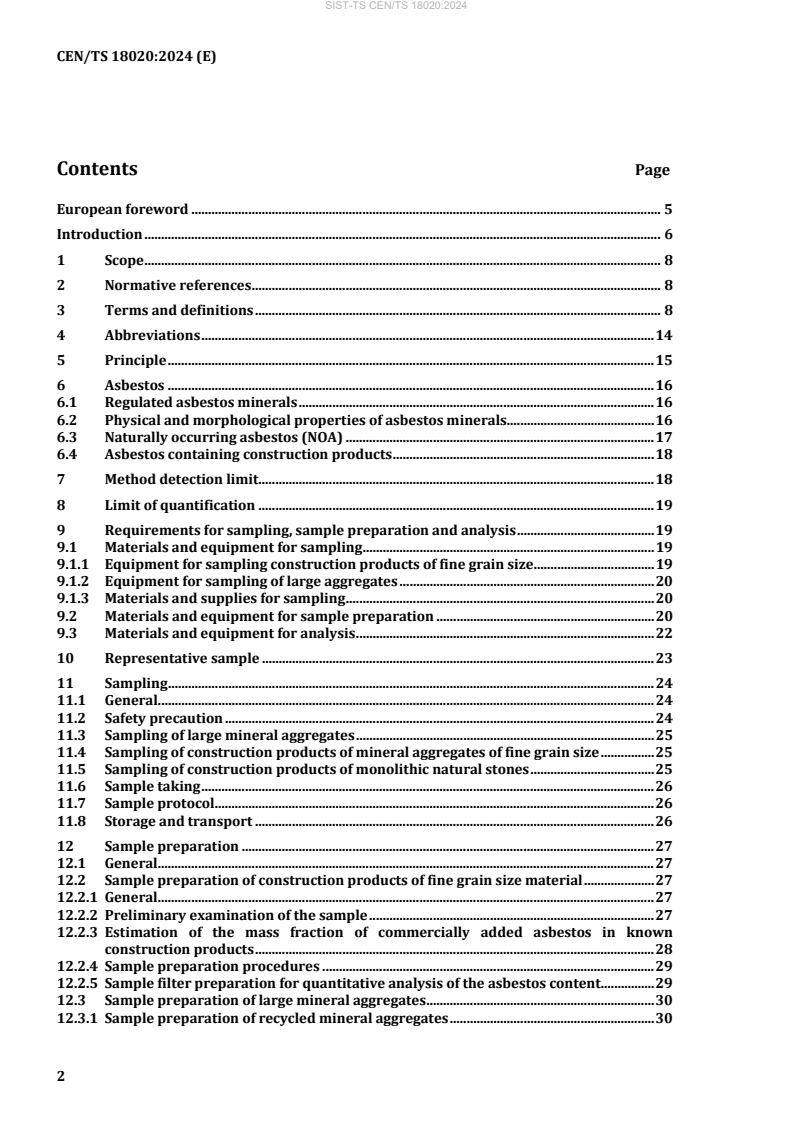
Contents Page
European foreword . 5
Introduction . 6
1 Scope . 8
2 Normative references . 8
3 Terms and definitions . 8
4 Abbreviations . 14
5 Principle . 15
6 Asbestos . 16
6.1 Regulated asbestos minerals . 16
6.2 Physical and morphological properties of asbestos minerals. 16
6.3 Naturally occurring asbestos (NOA) . 17
6.4 Asbestos containing construction products . 18
7 Method detection limit . 18
8 Limit of quantification . 19
9 Requirements for sampling, sample preparation and analysis . 19
9.1 Materials and equipment for sampling . 19
9.1.1 Equipment for sampling construction products of fine grain size . 19
9.1.2 Equipment for sampling of large aggregates . 20
9.1.3 Materials and supplies for sampling . 20
9.2 Materials and equipment for sample preparation . 20
9.3 Materials and equipment for analysis . 22
10 Representative sample . 23
11 Sampling . 24
11.1 General. 24
11.2 Safety precaution . 24
11.3 Sampling of large mineral aggregates . 25
11.4 Sampling of construction products of mineral aggregates of fine grain size . 25
11.5 Sampling of construction products of monolithic natural stones . 25
11.6 Sample taking . 26
11.7 Sample protocol . 26
11.8 Storage and transport . 26
12 Sample preparation . 27
12.1 General. 27
12.2 Sample preparation of construction products of fine grain size material . 27
12.2.1 General. 27
12.2.2 Preliminary examination of the sample . 27
12.2.3 Estimation of the mass fraction of commercially added asbestos in known
construction products . 28
12.2.4 Sample preparation procedures . 29
12.2.5 Sample filter preparation for quantitative analysis of the asbestos content . 29
12.3 Sample preparation of large mineral aggregates . 30
12.3.1 Sample preparation of recycled mineral aggregates . 30
12.3.2 Sieving of large mineral aggregates . 30
12.3.3 Sample preparation of sieve fractions for the detection and quantification of NOAs 31
12.3.4 Sample preparation of primary aggregates . 32
12.4 Sample preparation of construction products of natural stones . 32
13 Identification of asbestos . 32
13.1 General . 32
13.2 Reference materials . 32
13.3 Identification of asbestos by polarized light microscopy . 33
13.3.1 General . 33
13.3.2 Discrimination between asbestos and other elongated mineral fragments . 34
13.3.3 Limitation in the detection of asbestos. 34
13.3.4 PLM-specific sample preparation . 34
13.3.5 Interferences . 35
13.4 Identification of asbestos by scanning electron microscopy and EDXA . 35
13.4.1 General . 35
13.4.2 Analysis via EDXA spectra and peak height ratios normalized on silica (Si) with
reference spectra . 35
13.4.3 Discrimination between asbestos and other elongated mineral fragments . 36
13.4.4 Limitation in the detection of asbestos. 36
13.4.5 SEM specific sample preparation . 36
13.5 Identification of asbestos by transmission electron microscopy. 37
13.5.1 General . 37
13.5.2 Discrimination between asbestos and other elongated mineral fragments . 37
13.5.3 Limitation in the detection of asbestos. 37
13.5.4 Preparation of isolated fibres on TEM grids . 37
13.5.5 Preparation of filter . 37
14 Quantitative determination of asbestos mass fraction . 38
14.1 Quantitative determination of asbestos mass fraction from pulverised test sample on
a filter preparation . 38
14.1.1 General . 38
14.1.2 Calculation of mass fraction percentage of asbestos . 38
14.1.3 Method detection limit . 39
14.2 Determination of asbestos mass fraction of sieve fraction from mineral aggregates
................................................................................................................................................................... 39
14.2.1 Analysis of sieving fractions . 39
14.2.2 Calculation of mass fraction percentage of asbestos . 40
14.2.3 Method detection limit . 41
15 The comparability of the analytical methods . 41
16 Test report . 42
Annex A (informative) Types of commercial asbestos-containing material and optimum
analytical procedures . 44
Annex B (informative) Energy dispersive X-ray spectrum obtained from UICC reference
standard . 52
Annex C (informative) Criteria for interpretation of EDXA spectra . 56
Annex D (informative) Range of variation in the composition of asbestos . 57
Annex E (informative) Example of report on determination of asbestos mass fraction from
fibre measurement. 58
Annex F (informative) Example of report on determination of asbestos mass fraction in
samples from aggregates and recycled aggregates . 59
Annex G (informative) Report on determination of the limit of detection according to
VDI 3866-5 . 61
G.1 Method detection limit . 61
G.2 Measurement uncertainty . 62
G.3 Quantification limit . 63
Bibliography . 64
European foreword
This document (CEN/TS 18020:2024) has been prepared by Technical Committee CEN/TC 351
“Construction products: Assessment of release of dangerous substances”, the secretariat of which is held
by NEN.
Attention is drawn to the possibility that some of the elements of this document may be the subject of
patent rights. CEN shall not be held responsible for identifying any or all such patent rights.
This document has been prepared under a standardization request addressed to CEN by the European
Commission. The Standing Committee of the EFTA States subsequently approves these requests for its
Member States.
Any feedback and questions on this document should be directed to the users’ national standards body.
A complete listing of these bodies can be found on the CEN website.
According to the CEN/CENELEC Internal Regulations, the national standards organisations of the
following countries are bound to announce this Technical Specification: Austria, Belgium, Bulgaria,
Croatia, Cyprus, Czech Republic, Denmark, Estonia, Finland, France, Germany, Greece, Hungary, Iceland,
Ireland, Italy, Latvia, Lithuania, Luxembourg, Malta, Netherlands, Norway, Poland, Portugal, Republic of
North Macedonia, Romania, Serbia, Slovakia, Slovenia, Spain, Sweden, Switzerland, Türkiye and the
United Kingdom.
Introduction
Under regulation (EC) No 1272/2008 (the CLP regulation) of the European Union, asbestos is classified
as a carcinogen of group 1A [EC 1272/2008]. The REACH Regulation (EC) No. 1907/2006 prohibits the
placing on the market and use of asbestos fibres and of articles containing these fibres added intentionally
[EC 1907/2006]. Asbestos was banned in the 1990s at the international level in several European
countries and, since 2005, it has been completely banned within the European Union. Asbestos was used
in very large quantities for decades and was incorporated into many construction products which were
used in the construction of buildings and structures, as well as in industrial applications. Depending on
the country, buildings and structures constructed before 2005 may contain a variety of asbestos-
containing materials that still may pose a risk to building occupants and persons involved in construction
and demolition work [1999/77/EC].
Asbestos is a generic term encompassing six hydrated silicates with fibrous morphology comprising
chrysotile, amosite, crocidolite, anthophyllite, tremolite and actinolite, which are regulated by the
European Union through the REACH Regulation [EC 1907/2006]. Chrysotile, amosite, crocidolite or
anthophyllite were the asbestos types which were intentionally added in the past to construction
products. Chrysotile accounted for approximately 95 % of commercial asbestos consumption, and
amosite and crocidolite accounted for almost all of the remaining asbestos use. Tremolite asbestos and
actinolite asbestos were not extensively used commercially, however can appear as natural contaminants
in construction products (see ISO 22262-1).
Although the EU has now prohibited all asbestos use, there are several situations, however, which require
special attention to avoid “new construction products” which may contain asbestos being distributed in
the EU market. Several non-EU countries (primarily the Russian Federation, Kazakhstan, and China) still
mine and export asbestos and asbestos-containing products. Consequently, asbestos-containing products
manufactured in those countries and other countries where the importation of asbestos has not been
prohibited may enter the European market illegally. Naturally occurring asbestos (NOAs), which are not
technically enriched and processed, may be present as impurities in mineral raw materials, which are
used to manufacture new construction products. Even though European countries implement strict
quality control systems to prevent materials containing asbestos from re-entering new construction
products in the course of waste recycling [Cinderela, 2021], asbestos contamination may be found in
some cases. If a comprehensive asbestos survey and the consequent removal of all asbestos is not
conducted prior to demolition of a building or structure from the critical construction period (depending
on the country up to 2005), asbestos-containing materials (ACMs) may be present in the resulting
construction and demolition waste (C&D waste). Recycling of this waste may lead to contaminated
secondary raw materials (SRM) with ACMs and free asbestos fibres/bundles.
Therefore, in certain circumstances, manufacturers of products that may contain asbestos or traces of
asbestos need to declare the asbestos content of those products to meet all the legal requirements for CE
marking [EU 305/2011]. In most cases, the asbestos content in contaminated construction products
(excluding materials intentionally containing asbestos) is expected to be low. The need to quantify
asbestos in these materials depends on the maximum mass fraction that has been adopted by the
jurisdiction to define an ACM for the purpose of regulation. The method for sampling and quantitative
determination of asbestos in construction products can differ significantly. Quantitative determination of
asbestos in secondary raw materials derived from contaminated C&D waste requires a detailed
knowledge of the asbestos-containing manufactured products that were used in the past.
This document summarizes the procedures for the collection of samples, sample preparation and
qualitative analysis of construction products for the presence of commercially added and naturally
occurring asbestos. This document specifies procedures for the quantitative determination of the
asbestos mass fraction in natural, manufactured or recycled large mineral aggregates and construction
products of fine mineral particle size material. The methods used in this document to identify asbestos
are polarized light microscopy (PLM), scanning electron microscopy (SEM) and transmission electron
microscopy (TEM).
The method in this document will in future be validated for its robustness and its repeatability and
reproducibility, according to CEN Guide 13. The aim is to have a fully validated EN standard for the
assessment of asbestos in construction products in the end, with which producers of construction
products can declare the absence or the content of asbestos fibres in their products. More information on
CEN/TC 351 and its way of working in general is available from www.centc351.org.
1 Scope
This document summarizes methods for sampling, sample preparation and identification of asbestos in
construction products. This document specifies appropriate sample preparation procedures for the
quantitative analysis of the asbestos mass fraction in natural, manufactured or recycled large mineral
aggregates and construction products of fine mineral particle size materials. This document describes the
identification of asbestos by polarized light microscopy (PLM) and dispersion staining, scanning electron
microscopy (SEM) with energy dispersive X-ray analysis or transmission electron microscopy (TEM)
with energy dispersive X-ray and electron diffraction analysis.
NOTE This document is intended for microscopists familiar with polarized light, transmission electron- and
scanning electron microscopy methods and the other analytical techniques specified (see ISO 10312, ISO 13794,
ISO 14966, [McCrone et al., 1984], [Su et al., 1995]). It is not the intention of this document to provide instructions
on basic analytical techniques.
2 Normative references
There are no normative references in this document.
3 Terms and definitions
For the purposes of this document, the following terms and definitions apply.
ISO and IEC maintain terminology databases for use in standardization at the following addresses:
— ISO Online browsing platform: available at https://www.iso.org/obp/
— IEC Electropedia: available at https://www.electropedia.org/
3.1
aspect ratio
ratio of length to width of a particle
[SOURCE: ISO 22262-2:2014, 3.8]
3.2
alpha refractive index
α
lowest refractive index exhibited by a fibre
[SOURCE: ISO 22262-1:2012, 2.3]
3.3
amphibole
group of rock-forming ferromagnesium silicate minerals, closely related in crystal form and composition,
and having the nominal Formula (1)
A B C T O (OH,F,Cl) (1)
0-1 2 5 8 22 2
where
A is K, Na;
B 2+
is Fe , Mn, Mg, Ca, Na;
C 3+ 2+
is Al, Cr, Ti, Fe , Mg, Fe ;
T 3+
is Si, Al, Cr, Fe , Ti.
Note 1 to entry In some varieties of amphibole, these elements can be partially substituted by Li, Pb, or Zn.
Amphibole is characterised by a cross-linked double chain of Si-O tetrahedra with a silicon:oxygen ratio of 4:11, by
columnar or fibrous prismatic crystals and by good prismatic cleavage in two directions parallel to the crystal faces
and intersecting at angles of about 56° and 124°.
[SOURCE: ISO 22262-1:2012, 2.4]
3.4
amphibole asbestos
amphibole in an asbestiform habit
[SOURCE: ISO 22262-1:2012, 2.5]
3.5
asbestiform
specific type of mineral fibrosity in which the fibres and fibrils possess high tensile strength and flexibility
[SOURCE: ISO 22262-1:2012, 2.8]
3.6
asbestos
group of silicate minerals belonging to the serpentine and amphibole groups which have crystallised in
the asbestiform habit, causing them to be easily separated into long, thin, flexible, strong fibres when
crushed or processed
Note 1 to entry: The Chemical Abstracts Service (CAS) registry numbers of the most common asbestos varieties are:
chrysotile (12001-29-5), crocidolite (12001-28-4), grunerite asbestos (amosite) (12172-73-5), anthophyllite
asbestos (77536-67-5), tremolite asbestos (77536-68-6) and actinolite asbestos (77536-66-4).
[SOURCE: ISO 22262-1:2012, 2.9]
3.7
asbestos containing material
ACM
any material containing any asbestos above trace amounts
[SOURCE: HSG 248:2021, 4.20]
3.8
birefringence
quantitative expression of the maximum difference in refractive index due to double refraction
[SOURCE: ISO 22262-1:2012, 2.12]
3.9
chrysotile
fibrous mineral of the serpentine group which has the nominal composition as in Formula (2)
Mg Si O (OH) (2)
3 2 5 4
Note 1 to entry: Most natural chrysotile deviates little from this nominal composition. In some varieties of
3+ 3+ 2+ 3+
chrysotile, minor substitution of silicon by Al may occur. Minor substitution of magnesium by Al , Fe , Fe ,
2+ 2+ 2+
Ni , Mn and Co may also be present. Chrysotile is the most prevalent type of asbestos.
[SOURCE: ISO 22262-1:2012, 2.14]
3.10
cleavage
breaking of a mineral along one of its crystallographic directions
[SOURCE: ISO 22262-1:2012, 2.15]
3.11
cleavage fragment
fragment of a crystal that is bounded by cleavage faces
Note 1 to entry: Crushing of non-asbestiform amphibole generally yields elongated fragments that conform to the
definition of a fibre, but rarely have aspect ratios exceeding 10:1.
[SOURCE: ISO 22262-1:2012, 2.16]
3.12
construction and demolition waste
C&D waste
waste which arises from construction, renovation or demolition activities
[SOURCE: ISO 24161:2022, 3.1.2.4]
3.13
dispersion staining
effect produced when a transparent object is immersed in a surrounding medium, the refractive index of
which is equal to that of the object at a wavelength in the visible range, but which has a significantly
higher optical dispersion than the object
Note 1 to entry: Only the light refracted at the edges of the object is imaged, and this gives rise to colours at the
interface between the object and the surrounding medium. The particular colour is a measure of the wavelength at
which the refractive index of the object and that of the medium are equal.
[SOURCE: ISO 22262-1:2012, 2.20]
3.14
electron diffraction
technique in electron microscopy by which the crystal structure of a specimen is examined
[SOURCE: ISO 22262-1:2012, 2.21]
3.15
energy dispersive X-ray analysis
EDXA
measurement of the energies and intensities of X-rays by use of a solid-state detector and multichannel
analyser system
[SOURCE: ISO 22262-1:2012, 2.23]
3.16
extinction
condition in which an optically anisotropic object appears dark when observed between crossed polars
[SOURCE: ISO 22262-1:2012, 2.25]
3.17
fibre
elongated particle which has parallel or stepped sides
Note 1 to entry: For the purposes of this part of ISO 22262, a fibre is defined to have an aspect ratio greater than or
equal to 3:1.
[SOURCE: ISO 22262-1:2012, 2.28]
3.18
fibre bundle
structure composed of parallel, smaller diameter fibres attached along their lengths
Note 1 to entry: A fibre bundle may exhibit diverging fibres at one or both ends.
[SOURCE: ISO 22262-1:2012, 2.29]
3.19
fibril
single fibre of asbestos which cannot be further separated longitudinally into smaller components
without losing its fibrous properties or appearances
[SOURCE: ISO 22262-1:2012, 2.27]
3.20
gamma refractive index
γ
highest refractive index exhibited by a fibre
[SOURCE: ISO 22262-1:2012, 2.30]
3.21
habit
characteristic crystal growth form, or combination of these forms, of a mineral, including characteristic
irregularities
[SOURCE: ISO 22262-1:2012, 2.31]
3.22
laboratory sample
sample or subsample(s) sent to or received by the laboratory
Note 1 to entry: When the laboratory sample is further prepared by subdividing, cutting, sawing, coring, mixing,
drying, grinding, and curing or by combinations of these operations, the result is the test sample. When no
preparation of the laboratory sample is required, the laboratory sample is the test sample. A test portion is removed
from the test sample for the performance of the test/ analysis or for the preparation of a test specimen.
Note 2 to entry: The laboratory sample is the final sample from the point of view of sample collection but it is the
initial sample from the point of view of the laboratory.
[SOURCE: EN 16687:2023, 3.2.2.1]
3.23
limit of quantification
LOQ
lowest amount of asbestos that can be determined with an acceptable level of accuracy and precision,
generally determined as three times the method detection limit
[SOURCE: EN 16687:2023, 3.1.1.14, modified – 'an analyte (determinand)' replaced by 'asbestos']
3.24
matrix
main composition of the product dictating the manner of sample preparation
[SOURCE: EN 16687:2023, 3.1.1.2, modified – 'product' deleted, reference to type of digestion or
extraction removed]
3.25
method detection limit
MDL
lowest amount that can be detected with a specified analytical method including sample preparation with
a defined statistical probability
[SOURCE: EN 16687:2023, 3.1.1.12, modified – 'analyte concentration' replaced by 'amount'; Note 1 to
entry removed]
3.26
overall population
entire volume of material about which information is required
Note 1 to entry: For example, the overall population might be the output of a construction product over the whole
lifetime of the plant.
Note 2 to entry: See ‘population’.
[SOURCE: CEN/TR 15310-1:2006, 2.12, modified – ‘waste’ replaced by ‘construction product’]
3.27
pleochroism
property of an optically anisotropic medium by which it exhibits different brightness and/or colour for
different directions of light propagation, or for different vibrations, on account of variation in selective
spectral absorption of transmitted light
[SOURCE: ISO 22262-1:2012, 2.38]
3.28
polarizer
polar placed in the light path before the object
[SOURCE: ISO 22262-1:2012, 2.40]
3.29
polarized light
light in which the vibrations are partially or completely suppressed in certain directions at any given
instant
Note 1 to entry: The vector of vibration may describe a linear, circular or elliptical shape.
[SOURCE: ISO 22262-1:2012, 2.39]
3.30
population
totality of items under consideration
Note 1 to entry: The population will generally be a convenient, well-defined subset of the overall population (e.g. a
year’s production) that is believed to be typical of that wider population.
[SOURCE: CEN/TR 15310-1:2006, 2.15 modified – reference to ‘waste’ removed]
3.31
refractive index
n
ratio of the speed of light (more exactly, the phase velocity) in a vacuum to that in a given medium
[SOURCE: ISO 22262-1:2012, 2.42]
3.32
sample
portion of material selected from a larger quantity of material
[SOURCE: EN 16687:2023, 3.2.1.5, modified – Notes to entry removed]
3.33
secondary material
secondary raw material
material recovered from previous use or from waste which substitutes primary materials
[SOURCE: EN 15804:2012+A2:2019, 3.30, modified – synonym added; Note 1 to entry removed]
3.34
serpentine
group of common rock-forming minerals having the nominal Formula (3)
Mg Si O (OH) (3)
3 2 5 4
[SOURCE: ISO 22262-1:2012, 2.45]
3.35
sub-population
defined part of the population that will be targeted for the purposes of sampling
[SOURCE: CEN/TR 15310-1:2006, 2.36]
3.36
sub-sample
sample obtained by procedures in which the items of interest are randomly distributed in parts of equal
or unequal size
Note 1 to entry: A sub-sample may be:
a) portion of the sample obtained by selection or division;
b) the final sample of multistage sample-preparation.
[SOURCE: EN 16687:2023, 3.2.2.24]
3.37
test portion
analytical portion
amount of the test sample taken for testing/analysis purposes, usually of known dimension, mass or
volume
[SOURCE: EN 16687:2023, 3.2.2.3, modified – examples removed]
3.38
test sample
analytical sample
sample, prepared from the laboratory sample, from which test portions are removed for testing or for
analysis
[SOURCE: EN 16687:2023, 3.2.2.2]
4 Abbreviations
eV Electron volt
ED Electron diffraction
EDXA Energy dispersive X-ray analysis
HEPA High-efficiency particulate air
NOTE High-efficiency particulate absorbing and high-efficiency particulate
absolute are also used.
keV Kilo electron volt
LOQ Limit of quantification
MEC Mixed ester of cellulose
MDL Method detection limit
NOA Naturally occurring asbestos
PC Polycarbonate
PLM Polarized light microscopy
SEM Scanning electron microscopy
TEM Transmission electron microscopy
UICC Union for International Cancer Control
5 Principle
An appropriate sample strategy is carefully chosen based on nature of the material and a representative
sample is extracted from the material to be examined.
For uniform construction products consisting of fine mineral particles like floor coverings or cement
slabs, a visual inspection is conducted, followed by examination under a stereo-binocular microscope to
determine the product type and composition. The results of this preliminary examination determine the
further treatment of the sample. If suspected fibres are already visible and can be extracted using
tweezers, they are mounted on the respective sample holder for qualitative analysis using PLM, SEM, or
TEM. If no fibres are visible in the stereo-binocular microscope or the asbestos content will be quantified,
the sample is further processed for analysis. Matrix reduction techniques are employed that facilitate the
detection of asbestos fibres in the remaining material. Pulverisation of the subsample and the preparation
of uniformly distributed sample filters enhance the method detection limit and allow for the
quantification of the asbestos mass content through volumetric measurements of asbestos
fibres/bundles.
Samples of large mineral aggregates derived from mono and mixed materials, are separated through
successive sieving steps prior to examination. Separation of the particle size spectrum facilitates the
identification of asbestos particles. If particles of materials containing commercially added asbestos
(ACMs) are detected during inspection, the asbestos content of these ACMs may be estimated and
assigned to product groups by comparing them with reference samples of known asbestos content. Free
fibres/fibre bundles are determined using gravimetric methods or by volumetric measurements. In cases
where there is evidence of naturally occurring asbestos (NOAs), subsamples of the sieve fractions are
pulverised, and the asbestos content is quantified using the filter preparation method. The total asbestos
content in the sample is then calculated.
Primary aggregates or construction products made of monolithic natural stones may contain impurities
of NOAs. If the samples consist of only coarse aggregates or large pieces of monolithic natural stones, a
subsample of pre-crushed material is pulverised and the asbestos amount is quantified using filter
preparation. If the primary aggregates contain both coarse and fine particles, the sample is separated
through successive sieving steps, and subsamples from each sieve fraction are pulverised and quantified.
Asbestos fibres or bundles are identified based on morphology, colour, pleochroism, and the refractive
indices with PLM. The identification of asbestos by SEM is carried out using energy dispersive X-ray
analysis (EDXA), TEM with energy dispersive X-ray and electron diffraction analysis.
6 Asbestos
6.1 Regulated asbestos minerals
A mineral is a naturally occurring inorganic, crystalline substance with a specific chemical composition
and crystal structure. Varieties of minerals are distinguished when the physical appearance or properties
of a mineral are modified by minor changes in the chemical composition, crystal structure, and condition
of crystallization ([NIOSH, 2009], [NRC, 1984]). Silicate minerals can have a fibrous or non-fibrous habit.
The terms ‘asbestos’ or ‘asbestiform minerals’ refer specifically to those mineral varieties occurring in
hairlike, poly-filamentous bundles and consisting of flexible fibres of relatively small diameter and long
length. Six such minerals are defined as asbestos, all of which are harmful to health and carcinogenic.
Chrysotile, or ‘white asbestos’, belongs to the serpentine group of minerals; actinolite, amosite, or ‘brown
asbestos’, anthophyllite, crocidolite, or ‘blue asbestos’, and tremolite belong to the amphibole group of
minerals.
Asbestos fibres are naturally occurring minerals found in environments where the original rock mass has
undergone metamorphism. Asbestos fibres are formed by the gradual growth of mineral crystals in
cracks, or veins, found in soft rock formations. The crystals grow across the vein, and the width of the
vein determines the resulting asbestos fibre length. Since the asbestiform and non-asbestiform mineral
habits originate from the same surrounding rock material, they may have the same chemical composition
([Campbell et al., 1977], [NRC, 1984]).
Distinguishing between the asbestiform and non-asbestiform habits can be challenging, especially when
examining individual fibres. The “non-asbestiform” habit refers to asbestos minerals with crystals that
grow in two or three dimensions and often cleave into fragments rather than breaking into fibrils. 6.2
describes the characteristics of the asbestiform habit of minerals and provides guidance on how to
differentiate them from the non-asbestiform type.
Due to its favourable properties, asbestos has been extensively used in various sectors of building
construction, particularly when combined with other building materials. These properties include
enormous resistance to heat and acid, fire resistance, good miscibility with cement, and its insulating
properties [NRC, 1984]. Table 1 depicts the six asbestos minerals regulated under Clause 6 of
[EC 552/2009].
Table 1 — Asbestos minerals regulated in [EC 552/2009]
Asbestos Cas-No.
Actinolite 77536–66–4
Amosite 12172–73–5
Anthophyllite 77536–67–5
Chrysotile 12001–29–5
132207–32–0
Crocidolite 12001–28–4
Tremolite 77536–68–6
6.2 Physical and morphological properties of asbestos minerals
The physical properties of the asbestiform fibres, which distinguish them from the non-asbestiform, are
summarized in [NRC, 1984], as follows:
— Enhanced strength and flexibility. The tensile strength of asbestos fibres can be 20 to 50 times greater
than that of non-asbestiform.
— Diameter dependent strength. The strength of the fibres per unit of cross-section area increases as
diameter decreases.
— Enhanced physical and chemical durability compared to the non-asbestiform.
— Improved surface structure.
In the light microscope the morphology of the asbestiform habit is generally recognized by the following
characteristics (see ISO 22262-1:2012, 7.2.3.7.1):
— the presence of fibre aspect ratios in the range of 20:1 or higher for fibres longer than 5 μm;
— longitudinal splitting into very thin fibrils, generally less than 0,5 μm in width;
— parallel fibres occurring in bundles;
— fibre bundles displaying splayed ends;
— fibres in the form of thin needles;
— matted masses of individual fibres;
— fibres showing curvature.
For further information see (ISO 22262-1, [Campbell et al., 1977] and [NRC, 1984]).
6.3 Naturally occurring asbestos (NOA)
The term “naturally occurring asbestos” (NOA) refers to asbestos fibres found in rocks and soil as a result
of natural geological processes, rather than being intentionally added to manufactured products. While
only a few commercial asbestos mining operations remain in operation worldwide, smaller, non-
economic deposits of asbestiform minerals are far more common [Lee et al., 2008].
Even if intentional commercial use of asbestos is prohibited and the handling of past commercially used
asbestos-containing products is regulated in the European Union, naturally occurring asbestos may still
be incorporated into construction products during the manufacturing process. However, there are
significant differences between commercially added asbestos and naturally occurring asbestos.
Commercially added asbestos consist of highly enriched fibres with long dimensions that have been
extracted from rocks in a complex process and combined, often in high concentrations, with other mineral
or/and inorganic and organic materials to manufacture a construction product with improved material
properties. On the other hand, naturally occurring asbestos minerals typically occur as impurities in
rocks, with low mass content, and the asbestos fibres are tightly associated with non-asbestos minerals
within the host rock matrix. To identify naturally occurring asbestos, the fibres need to be made
accessible for analysis by pulverising the sample material into a homogeneous powder. This preparation
step not only exposes the asbestos particles but also reveals other elongated mineral fragments from the
surrounding rock, which may have very similar chemical compositions. As a result, identifying asbestos
in natural rock products is particularly challenging because the morphology
...