

oSIST prEN IEC 61508-7:2025
(Main)Functional safety of electrical/electronic/programmable electronic safety-related systems - Part 7: Overview of techniques and measures
General Information
- Abstract
- Status
- Not Published
- Public Enquiry End Date
- 29-Apr-2025
- Technical Committee
- MOV - Measuring equipment for electromagnetic quantities
- Current Stage
- 4020 - Public enquire (PE) (Adopted Project)
- Start Date
- 18-Feb-2025
- Due Date
- 08-Jul-2025
- Completion Date
- 13-May-2025

Overview
oSIST prEN IEC 61508-7:2025, published by the Slovenski inštitut za standardizacijo (SIST), provides a comprehensive overview of techniques and measures for ensuring functional safety of electrical, electronic, and programmable electronic (E/E/PE) safety-related systems. As Part 7 in the IEC 61508 family, this standard serves as an informative reference, supporting organizations in selecting suitable design and engineering methods to manage risks, prevent failures, and achieve high performance in safety-critical industrial environments.
With its focus on functional safety, oSIST prEN IEC 61508-7:2025 underpins safe, reliable operation in sectors relying on E/E/PE systems, such as industrial process control, measurement, manufacturing automation, and IT applications in industry.
Key Topics
The standard offers an extensive catalogue of techniques and measures intended to:
- Control random hardware failures
- Avoid systematic failures
- Attain and demonstrate systematic capability, particularly in safety-related software
- Support safe lifecycle management of E/E/PE safety-related systems
Areas Covered
- Hardware Integrity: Techniques for failure detection, redundancy, monitoring, and protection (e.g., voltage control, power-down procedures, memory testing).
- Software Reliability: Structured specification, formal methods, defensive programming, modular design, and robust coding practices.
- System Design and Development: Use of proven and diverse hardware, traceability, functional safety assurance, structured and modular system engineering.
- Operation and Maintenance: Procedures for user/operator training, system modification controls, maintenance instructions, and error protection.
- Testing and Validation: Functional, black-box, statistical, and environmental testing for both hardware and software components.
- Environmental and Physical Protection: Safeguards against external influences such as electromagnetic interference and thermal conditions.
- Statistical Techniques: Methodologies for evaluating software and hardware performance in operational settings.
Applications
oSIST prEN IEC 61508-7:2025 is applicable across a wide range of industries that depend on the functional safety of E/E/PE safety-related systems, including:
- Industrial Automation: Enhances the design and maintenance of automated production lines and process control.
- Process Industries: Reinforces safety in chemical plants, refineries, and power generation facilities.
- Rail, Machinery, and Transportation: Supports safe operation of complex safety-critical systems in railway signaling, rolling stock, and industrial vehicles.
- IT in Industry: Contributes to the development of safety-related software applications in industrial environments.
- OEMs and Component Manufacturers: Assists in developing, integrating, and validating components and subsystems for safety performance.
Organizations use this standard to:
- Guide risk assessment and mitigation strategies
- Define and select suitable engineering techniques throughout system lifecycles
- Facilitate compliance with international safety regulations
- Improve reliability and performance of safety-related products and processes
Related Standards
oSIST prEN IEC 61508-7:2025 forms a vital part of the IEC 61508 series, widely recognized as the international baseline for functional safety of E/E/PE systems. Related key standards include:
- IEC 61508-1: General requirements for functional safety
- IEC 61508-2: Requirements for E/E/PE hardware
- IEC 61508-3: Software requirements for safety-related systems
- IEC 61511: Functional safety for the process industry sector
- IEC 62061/ISO 13849: Safety of machinery - functional safety of safety-related control systems
When implementing or certifying functional safety systems, reference to oSIST prEN IEC 61508-7:2025 and its related standards ensures an integrated approach to risk control, lifecycle management, and international best practices in safety engineering.
Keywords: functional safety, electrical safety, electronic safety, programmable safety-related systems, industrial process measurement, control, safety standards, SIST, IEC 61508
Relations
- Effective Date
- 23-Jan-2023
- Effective Date
- 11-Oct-2022
Get Certified
Connect with accredited certification bodies for this standard

BSI Group
BSI (British Standards Institution) is the business standards company that helps organizations make excellence a habit.

DVS-ZERT GmbH
German welding certification society.
CARES (UK Certification Authority for Reinforcing Steels)
UK certification for reinforcing steels and construction.
Sponsored listings
Frequently Asked Questions
oSIST prEN IEC 61508-7:2025 is a draft published by the Slovenian Institute for Standardization (SIST). Its full title is "Functional safety of electrical/electronic/programmable electronic safety-related systems - Part 7: Overview of techniques and measures". This standard covers: Functional safety of electrical/electronic/programmable electronic safety-related systems - Part 7: Overview of techniques and measures
Functional safety of electrical/electronic/programmable electronic safety-related systems - Part 7: Overview of techniques and measures
oSIST prEN IEC 61508-7:2025 is classified under the following ICS (International Classification for Standards) categories: 25.040.40 - Industrial process measurement and control; 35.240.50 - IT applications in industry. The ICS classification helps identify the subject area and facilitates finding related standards.
oSIST prEN IEC 61508-7:2025 has the following relationships with other standards: It is inter standard links to SIST EN 61508-7:2011, SIST EN 61508-7:2011. Understanding these relationships helps ensure you are using the most current and applicable version of the standard.
oSIST prEN IEC 61508-7:2025 is available in PDF format for immediate download after purchase. The document can be added to your cart and obtained through the secure checkout process. Digital delivery ensures instant access to the complete standard document.
Standards Content (Sample)
SLOVENSKI STANDARD
01-april-2025
Funkcijska varnost električnih/elektronskih/elektronsko programirljivih varnostnih
sistemov - 7. del: Pregled tehnik in ukrepov
Functional safety of electrical/electronic/programmable electronic safety-related systems
- Part 7: Overview of techniques and measures
Funktionale Sicherheit sicherheitsbezogener
elektrischer/elektronischer/programmierbarer elektronischer Systeme - Teil 7: Überblick
über Verfahren und Maßnahmen
Sécurité fonctionnelle des systèmes électriques / électroniques / électroniques
programmables relatifs à la sécurité - Partie 7: Présentation de techniques et mesures
Ta slovenski standard je istoveten z: prEN IEC 61508-7:2025
ICS:
25.040.40 Merjenje in krmiljenje Industrial process
industrijskih postopkov measurement and control
35.240.50 Uporabniške rešitve IT v IT applications in industry
industriji
2003-01.Slovenski inštitut za standardizacijo. Razmnoževanje celote ali delov tega standarda ni dovoljeno.
65A/1168/CDV
COMMITTEE DRAFT FOR VOTE (CDV)
PROJECT NUMBER:
IEC 61508-7 ED3
DATE OF CIRCULATION: CLOSING DATE FOR VOTING:
2025-02-14 2025-05-09
SUPERSEDES DOCUMENTS:
65A/1062A/CD, 65A/1081A/CC
IEC SC 65A : SYSTEM ASPECTS
SECRETARIAT: SECRETARY:
United Kingdom Ms Stephanie Lavy
OF INTEREST TO THE FOLLOWING COMMITTEES: HORIZONTAL FUNCTION(S):
TC 8,TC 9,TC 22,TC 31,TC 44,TC 45,TC 56,TC 61,TC
62,TC 65,SC 65B,SC 65C,SC 65E,TC 66,TC 72, TC
77,TC 80,TC 108,SyC AAL,SyC SM,SC 41
ASPECTS CONCERNED:
Safety
SUBMITTED FOR CENELEC PARALLEL VOTING NOT SUBMITTED FOR CENELEC PARALLEL VOTING
Attention IEC-CENELEC parallel voting
The attention of IEC National Committees, members of
CENELEC, is drawn to the fact that this Committee Draft
for Vote (CDV) is submitted for parallel voting.
The CENELEC members are invited to vote through the
CENELEC online voting system.
This document is still under study and subject to change. It should not be used for reference purposes.
Recipients of this document are invited to submit, with their comments, notification of any relevant patent rights of
which they are aware and to provide supporting documentation.
Recipients of this document are invited to submit, with their comments, notification of any relevant “In Some
Countries” clauses to be included should this proposal proceed. Recipients are reminded that the CDV stage is
the final stage for submitting ISC clauses. (SEE AC/22/2007 OR NEW GUIDANCE DOC).
TITLE:
Functional safety of electrical/electronic/programmable electronic safety-related systems -
Part 7: Overview of techniques and measures
PROPOSED STABILITY DATE: 2028
NOTE FROM TC/SC OFFICERS:
electronic file, to make a copy and to print out the content for the sole purpose of preparing National Committee positions.
You may not copy or "mirror" the file or printed version of the document, or any part of it, for any other purpose without
permission in writing from IEC.
IEC CDV 61508-7 IEC 2025 – 2 – 65A/1168/CDV
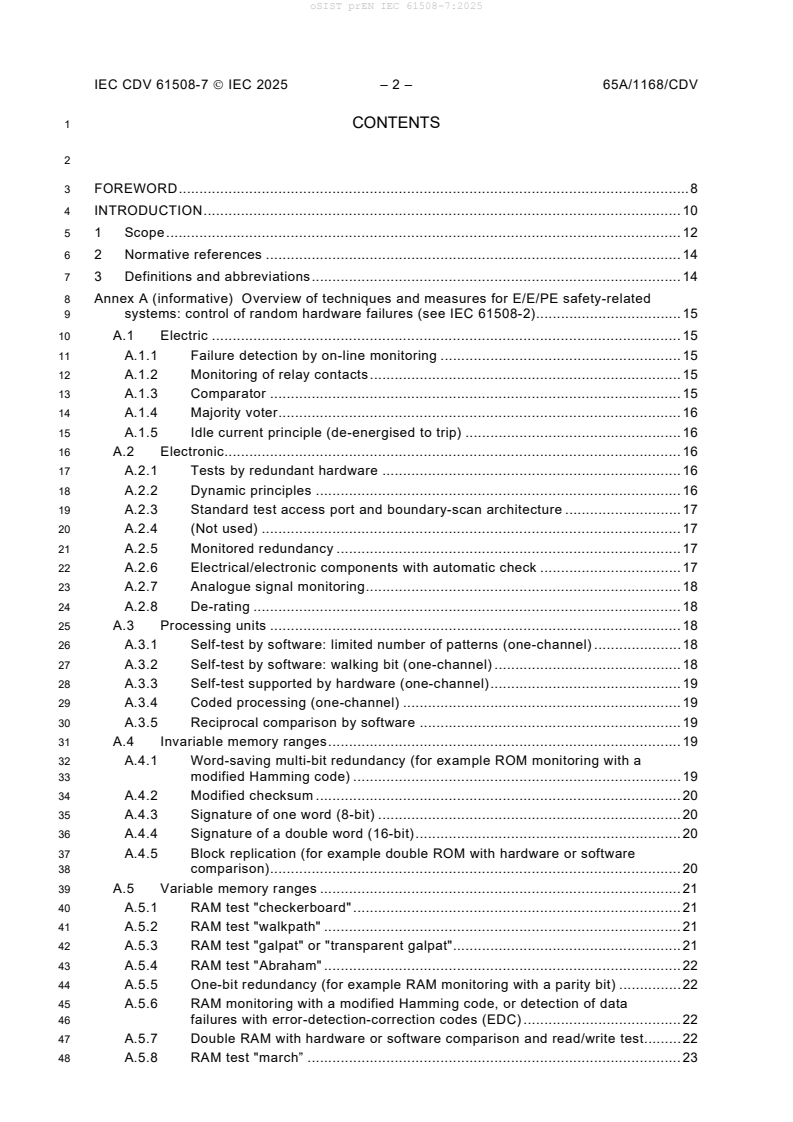
1 CONTENTS
3 FOREWORD . 8
4 INTRODUCTION . 10
5 1 Scope . 12
6 2 Normative references . 14
7 3 Definitions and abbreviations . 14
8 Annex A (informative) Overview of techniques and measures for E/E/PE safety-related
9 systems: control of random hardware failures (see IEC 61508-2) . 15
10 A.1 Electric . 15
11 A.1.1 Failure detection by on-line monitoring . 15
12 A.1.2 Monitoring of relay contacts . 15
13 A.1.3 Comparator . 15
14 A.1.4 Majority voter . 16
15 A.1.5 Idle current principle (de-energised to trip) . 16
16 A.2 Electronic. 16
17 A.2.1 Tests by redundant hardware . 16
18 A.2.2 Dynamic principles . 16
19 A.2.3 Standard test access port and boundary-scan architecture . 17
20 A.2.4 (Not used) . 17
21 A.2.5 Monitored redundancy . 17
22 A.2.6 Electrical/electronic components with automatic check . 17
23 A.2.7 Analogue signal monitoring . 18
24 A.2.8 De-rating . 18
25 A.3 Processing units . 18
26 A.3.1 Self-test by software: limited number of patterns (one-channel) . 18
27 A.3.2 Self-test by software: walking bit (one-channel) . 18
28 A.3.3 Self-test supported by hardware (one-channel) . 19
29 A.3.4 Coded processing (one-channel) . 19
30 A.3.5 Reciprocal comparison by software . 19
31 A.4 Invariable memory ranges . 19
32 A.4.1 Word-saving multi-bit redundancy (for example ROM monitoring with a
33 modified Hamming code) . 19
34 A.4.2 Modified checksum . 20
35 A.4.3 Signature of one word (8-bit) . 20
36 A.4.4 Signature of a double word (16-bit) . 20
37 A.4.5 Block replication (for example double ROM with hardware or software
38 comparison) . 20
39 A.5 Variable memory ranges . 21
40 A.5.1 RAM test "checkerboard" . 21
41 A.5.2 RAM test "walkpath" . 21
42 A.5.3 RAM test "galpat" or "transparent galpat". 21
43 A.5.4 RAM test "Abraham" . 22
44 A.5.5 One-bit redundancy (for example RAM monitoring with a parity bit) . 22
45 A.5.6 RAM monitoring with a modified Hamming code, or detection of data
46 failures with error-detection-correction codes (EDC) . 22
47 A.5.7 Double RAM with hardware or software comparison and read/write test. 22
48 A.5.8 RAM test "march” . 23
IEC CDV 61508-7 IEC 2025 – 3 – 65A/1168/CDV
49 A.6 I/O-units and interfaces (external communication) . 23
50 A.6.1 Test pattern . 23
51 A.6.2 Code protection . 23
52 A.6.3 Multi-channel parallel output . 24
53 A.6.4 Monitored outputs . 24
54 A.6.5 Input comparison/voting . 24
55 A.7 Data paths (internal communication) . 24
56 A.7.1 One-bit hardware redundancy . 24
57 A.7.2 Multi-bit hardware redundancy . 24
58 A.7.3 Complete hardware redundancy . 25
59 A.7.4 Inspection using test patterns . 25
60 A.7.5 Transmission redundancy . 25
61 A.7.6 Information redundancy . 25
62 A.8 Power supply . 25
63 A.8.1 Overvoltage protection with safety shut-off . 25
64 A.8.2 Voltage control (secondary) . 26
65 A.8.3 Power-down with safety shut-off . 26
66 A.9 Temporal and logical program sequence monitoring . 26
67 A.9.1 Watch-dog with separate time base without time-window . 26
68 A.9.2 Watch-dog with separate time base and time-window . 26
69 A.9.3 Logical monitoring of program sequence. 26
70 A.9.4 Combination of temporal and logical monitoring of program sequences . 27
71 A.9.5 Temporal monitoring with on-line check . 27
72 A.10 Ventilation and heating . 27
73 A.10.1 Temperature sensor . 27
74 A.10.2 Fan control . 27
75 A.10.3 Actuation of the safety shut-off via thermal fuse. 27
76 A.10.4 Staggered message from thermo-sensors and conditional alarm . 27
77 A.10.5 Connection of forced-air cooling and status indication . 28
78 A.11 Communication and mass-storage . 28
79 A.11.1 Separation of electrical energy lines from information lines . 28
80 A.11.2 Spatial separation of multiple lines . 28
81 A.11.3 Design for immunity to electromagnetic interference . 28
82 A.11.4 Antivalent signal transmission. 29
83 A.12 Sensors . 29
84 A.12.1 Reference sensor . 29
85 A.12.2 Positive-activated switch . 29
86 A.13 Final elements (actuators) . 30
87 A.13.1 Monitoring . 30
88 A.13.2 Cross-monitoring of multiple actuators . 30
89 A.14 Measures against the physical environment . 30
90 Annex B (informative) Overview of techniques and measures for E/E/PE safety related
91 systems: avoidance of systematic failures (see IEC 61508-2 and IEC 61508-3) . 31
92 B.1 General measures and techniques . 31
93 B.1.1 Project management . 31
94 B.1.2 Documentation . 32
95 B.1.3 Separation of E/E/PE system safety functions from non-safety functions . 33
96 B.1.4 Diverse hardware . 33
97 B.1.5 Traceability . 33
IEC CDV 61508-7 IEC 2025 – 4 – 65A/1168/CDV
98 B.1.6 Functional Safety Assurance Role Independence . 34
99 B.2 E/E/PE system design requirements specification . 36
100 B.2.1 Structured specification . 36
101 B.2.2 Formal methods . 37
102 B.2.3 Semi-formal methods . 38
103 B.2.4 Computer-aided specification tools . 40
104 B.2.5 Checklists . 41
105 B.2.6 Inspection of the specification . 42
106 B.3 E/E/PE system design and development . 43
107 B.3.1 Observance of guidelines and standards . 43
108 B.3.2 Structured design . 43
109 B.3.3 Use of well-tried components . 43
110 B.3.4 Modularisation . 44
111 B.3.5 Computer-aided design tools . 44
112 B.3.6 Simulation . 45
113 B.3.7 Inspection (reviews and analysis) . 45
114 B.3.8 Walk-through . 45
115 B.4 E/E/PE system operation and maintenance procedures . 46
116 B.4.1 Operation and maintenance instructions . 46
117 B.4.2 User friendliness . 46
118 B.4.3 Maintenance friendliness . 47
119 B.4.4 Limited operation possibilities . 47
120 B.4.5 Operation only by skilled operators . 47
121 B.4.6 Protection against operator mistakes . 48
122 B.4.7 (Not used) . 48
123 B.4.8 Modification protection . 48
124 B.4.9 Input acknowledgement . 48
125 B.5 E/E/PE system integration . 48
126 B.5.1 Functional testing . 49
127 B.5.2 Black-box testing . 49
128 B.5.3 Statistical testing . 50
129 B.5.4 Field experience . 50
130 B.6 E/E/PE system safety validation . 51
131 B.6.1 Functional testing under environmental conditions . 51
132 B.6.2 Electromagnetic interference immunity testing . 52
133 B.6.3 Static analysis . 52
134 B.6.4 Dynamic analysis and testing . 53
135 B.6.5 Failure analysis . 53
136 B.6.6 Worst-case analysis . 59
137 B.6.7 Expanded functional testing . 60
138 B.6.8 Worst-case testing . 60
139 B.6.9 Fault insertion testing . 60
140 Annex C (informative) Overview of techniques and measures for achieving systematic
141 capability for software (see IEC 61508-3) . 62
142 C.1 General . 62
143 C.2 Requirements and detailed design . 62
144 C.2.1 Structured methods . 62
145 C.2.2 Data flow diagrams . 64
146 C.2.3 Structure diagrams . 65
IEC CDV 61508-7 IEC 2025 – 5 – 65A/1168/CDV
147 C.2.4 Not used . 66
148 C.2.5 Defensive programming . 66
149 C.2.6 Design and coding standards . 67
150 C.2.7 Structured programming . 71
151 C.2.8 Information hiding/encapsulation . 72
152 C.2.9 Modular approach . 72
153 C.2.10 Use of trusted/verified software elements . 73
154 C.2.11 Not Used . 75
155 C.2.12 Aim: To maintain consistency between lifecycle stages. . 75
156 C.2.13 Stateless software design (or limited state design) . 76
157 C.2.14 Offline numerical analysis . 77
158 C.2.15 Message sequence charts . 77
159 C.3 Architecture design . 77
160 C.3.1 Fault detection and diagnosis . 77
161 C.3.2 Error detecting and correcting codes . 78
162 C.3.3 Failure assertion programming . 78
163 C.3.4 Diverse monitor . 79
164 C.3.5 Software diversity (diverse programming) . 80
165 C.3.6 Backward recovery . 80
166 C.3.7 Re-try fault recovery mechanisms . 81
167 C.3.8 Graceful degradation . 81
168 C.3.9 Not Used . 82
169 C.3.10 Dynamic reconfiguration . 82
170 C.3.11 Safety and Performance in real time: Time-Triggered Architecture . 82
171 C.3.12 UML . 83
172 C.4 Development tools and programming languages . 85
173 C.4.1 Strongly typed programming languages . 85
174 C.4.2 Language subsets . 85
175 C.4.3 Not used . 85
176 C.4.4 Not used . 86
177 C.4.5 Suitable programming languages . 86
178 C.4.6 Automatic software generation . 88
179 C.4.7 Test management and automation tools. 89
180 C.5 Verification and modification . 89
181 C.5.1 Probabilistic testing . 89
182 C.5.2 Data recording and analysis . 90
183 C.5.3 Interface testing . 90
184 C.5.4 Boundary value analysis . 91
185 C.5.5 Error guessing . 91
186 C.5.6 Error seeding . 92
187 C.5.7 Equivalence classes and input partition testing . 92
188 C.5.8 Structure-based testing. 93
189 C.5.9 Control flow analysis. 94
190 C.5.10 Data flow analysis . 94
191 C.5.11 Symbolic execution . 95
192 C.5.12 Formal proof (verification) . 95
193 C.5.13 Complexity metrics . 96
194 C.5.14 Formal inspections . 97
195 C.5.15 Walk-through (software) . 98
IEC CDV 61508-7 IEC 2025 – 6 – 65A/1168/CDV
196 C.5.16 Design review . 98
197 C.5.17 Prototyping/animation . 99
198 C.5.18 Process simulation . 99
199 C.5.19 Performance requirements . 100
200 C.5.20 Performance modelling . 100
201 C.5.21 Avalanche/stress testing . 101
202 C.5.22 Response timing and memory constraints . 101
203 C.5.23 Impact analysis . 102
204 C.5.24 Software configuration management . 102
205 C.5.25 Regression validation . 103
206 C.5.26 Animation of specification and design . 103
207 C.5.27 Model based testing (test case generation) . 104
208 C.6 Functional safety assessment . 106
209 C.6.1 Decision tables (truth tables) . 106
210 C.6.2 Software failure analysis . 106
211 C.6.3 Common cause failure analysis . 115
212 C.6.4 Reliability block diagrams . 115
213 C.6.5 V&V Methods and Techniques Supporting IEC61508-3 Cl 7.3.2.3 . 116
214 Table C.6.5 : V&V Methods and Techniques supporting Part 3 Clause 7.3.2.3 . 117
215 Annex D (informative) Statistical evaluation techniques for in service software
216 elements . 119
217 D.1 Introduction . 119
218 D.2 Theoretical aspects . 119
219 D.2.1 General . 119
220 D.2.2 References . 119
221 D.2.3 Terms and Definitions . 119
222 D.2.4 Estimates of Software Statistical Parameters . 120
223 D.2.5 The Sum Total of Operational Data Required . 122
224 D.2.6 Required Conditions for Operational History to be an Effective Guide to
225 Future Use . 123
226 D.3 Deployment aspects. 123
227 D.3.1 Statistical evaluation deployment guidance . 123
228 D.3.2 Some Examples of Difficulties with Software Statistical Modelling. 125
229 D.4 Route 2s proven in use claim . 127
230 D.5 Bibliography . 127
231 Annex E (informative) Overview of techniques and measures for design of complex
232 integrated circuits . 129
233 Annex F (informative) Definitions of properties of software lifecycle phases . 130
234 Annex G (informative) Guidance for the development of safety-related object oriented
235 software . 136
236 Annex H (informative) NOTE The overview of techniques and measures contained in
237 this annex has been moved ot IEC 61508-2-1. . 138
238 Bibliography . 139
239 Index . 142
241 Figure 1 – Overall framework of IEC 61508 . 13
242 Figure C.6.2.1 – Typical (qualitative) software functional fault tree. . 110
IEC CDV 61508-7 IEC 2025 – 7 – 65A/1168/CDV
244 Table B.1 – Significance of Independence Concern vs. Functional Safety Assurance
245 Activity . 35
246 Table B.2 – Effectiveness of Independence Measure vs. Independence Concern . 35
247 Table B.3 – Effectiveness of Independence Measure vs. Functional Safety Assurance
248 Activity . 36
249 Table C.1 – Recommendations for specific programming languages . 87
250 Table C.6.2.1 - Example of the Guidewords as used in SHARD . 110
251 Table C.6.2.2 - Example of the Guidewords as used in SHARD . 113
252 Table D.1 – Failure-free observations required to reach confidence in a failure
253 probability per demand . 121
254 Table D.2 – Failure-free hours of observation required to reach confidence in a failure
255 probability per hour . 122
256 Table F.1 – Software Safety Requirements Specification . 130
257 Table F.2 – Software design and development: software architecture design . 131
258 Table F.2 – Software design and development: support tools and programming
259 language . 132
260 Table F.2 – Software design and development: detailed design . 132
261 Table F.2 – Software design and development: software module testing and integration . 133
262 Table F.2 – Programmable electronics integration (hardware and software) . 133
263 Table F.2 – Software aspects of system safety validation . 134
264 Table F.2 – Software modification . 134
265 Table F.2 – Software verification . 135
266 Table F.2 – Functional safety assessment . 135
267 Table G.1 – Object Oriented Software Architecture . 136
268 Table G.2 – Object Oriented Detailed Design . 137
269 Table G.2 – Some Oriented Detailed terms . 137
IEC CDV 61508-7 IEC 2025 – 8 – 65A/1168/CDV
272 INTERNATIONAL ELECTROTECHNICAL COMMISSION
273 ____________
275 FUNCTIONAL SAFETY OF ELECTRICAL/ELECTRONIC/
276 PROGRAMMABLE ELECTRONIC SAFETY-RELATED SYSTEMS –
278 Part 7: Overview of techniques and measures
280 FOREWORD
281 1) The International Electrotechnical Commission (IEC) is a worldwide organization for standardization comprising
282 all national electrotechnical committees (IEC National Committees). The object of IEC is to promote international
283 co-operation on all questions concerning standardization in the electrical and electronic fields. To this end and
284 in addition to other activities, IEC publishes International Standards, Technical Specifications, Technical Reports,
285 Publicly Available Specifications (PAS) and Guides (hereafter referred to as “IEC Publication(s)”). Their
286 preparation is entrusted to technical committees; any IEC National Committee interested in the subject dealt with
287 may participate in this preparatory work. International, governmental and non-governmental organizations liaising
288 with the IEC also participate in this preparation. IEC collaborates closely with the International Organization for
289 Standardization (ISO) in accordance with conditions determined by agreement between the two organizations.
290 2) The formal decisions or agreements of IEC on technical matters express, as nearly as possible, an international
291 consensus of opinion on the relevant subjects since each technical committee has representation from all
292 interested IEC National Committees.
293 3) IEC Publications have the form of recommendations for international use and are accepted by IEC National
294 Committees in that sense. While all reasonable efforts are made to ensure that the technical content of IEC
295 Publications is accurate, IEC cannot be held responsible for the way in which they are used or for any
296 misinterpretation by any end user.
297 4) In order to promote international uniformity, IEC National Committees undertake to apply IEC Publications
298 transparently to the maximum extent possible in their national and regional publications. Any divergence between
299 any IEC Publication and the corresponding national or regional publication shall be clearly indicated in the latter.
300 5) IEC itself does not provide any attestation of conformity. Independent certification bodies provide conformity
301 assessment services and, in some areas, access to IEC marks of conformity. IEC is not responsible for any
302 services carried out by independent certification bodies.
303 6) All users should ensure that they have the latest edition of this publication.
304 7) No liability shall attach to IEC or its directors, employees, servants or agents including individual experts and
305 members of its technical committees and IEC National Committees for any personal injury, property damage or
306 other damage of any nature whatsoever, whether direct or indirect, or for costs (including legal fees) and
307 expenses arising out of the publication, use of, or reliance upon, this IEC Publication or any other IEC
308 Publications.
309 8) Attention is drawn to the Normative references cited in this publication. Use of the referenced publications is
310 indispensable for the correct application of this publication.
311 9) IEC draws attention to the possibility that the implementation of this document may involve the use of (a)
312 patent(s). IEC takes no position concerning the evidence, validity or applicability of any claimed patent rights in
313 respect thereof. As of the date of publication of this document, IEC had not received notice of (a) patent(s), which
314 may be required to implement this document. However, implementers are cautioned that this may not represent
315 the latest information, which may be obtained from the patent database available at https://patents.iec.ch. IEC
316 shall not be held responsible for identifying any or all such patent rights.
317 IEC 61508-7 has been prepared by subcommittee 65A: System aspects, of IEC technical
318 committee 65: Industrial-process measurement, control and automation.
319 This third edition cancels and replaces the second edition published in 2010. This edition
320 constitutes a technical revision.
321 This edition has been subject to a thorough review and incorporates many comments received
322 at the various revision stages and:
323 • the contents of annex E have been moved to IEC 61508-2-1;
324 • A revision of Annex D covering proven in use to include new wording, explanations and
325 examples.
IEC CDV 61508-7 IEC 2025 – 9 – 65A/1168/CDV
326 The text of this International Standard is based on the following documents:
Draft Report on voting
XX/XX/FDIS XX/XX/RVD
328 Full information on the voting for its approval can be found in the report on voting indicated in
329 the above table.
330 The language used for the development of this International Standard is English.
331 This document was drafted in accordance with ISO/IEC Directives, Part 2, and developed in
332 accordance with ISO/IEC Directives, Part 1 and ISO/IEC Directives, IEC Supplement, available
333 at www.iec.ch/members_experts/refdocs. The main document types developed by IEC are
334 described in greater detail at www.iec.ch/publications.
335 A list of all parts of the IEC 61508 series, published under the general title Functional safety of
336 electrical / electronic / programmable electronic safety-related systems, can be found on the
337 IEC website.
338 The committee has decided that the contents of this document will remain unchanged until the
339 stability date indicated on the IEC website under webstore.iec.ch in the data related to the
340 specific document. At this date, the document will be
341 • reconfirmed,
342 • withdrawn,
343 • replaced by a revised edition, or
344 • amended.
IEC CDV 61508-7 IEC 2025 – 10 – 65A/1168/CDV
347 INTRODUCTION
348 Systems comprised of electrical and/or electronic elements have been used for many years to
349 perform safety functions in most application sectors. Computer-based systems (generically
350 referred to as programmable electronic systems) are being used in all application sectors to
351 perform non-safety functions and, increasingly, to perform safety functions. If computer system
352 technology is to be effectively and safely exploited, it is essential that those responsible for
353 making decisions have sufficient guidance on the safety aspects on which to make these
354 decisions.
355 This International Standard sets out a generic approach for all safety lifecycle activities for
356 systems comprised of electrical and/or electronic and/or programmable electronic (E/E/PE)
357 elements that are used to perform safety functions. This unified approach has been adopted in
358 order that a rational and consistent technical policy be developed for all electrically-based
359 safety-related systems. A major objective is to facilitate the development of product and
360 application sector international standards based on the IEC 61508 series.
361 NOTE 1 Examples of product and application sector international standards based on the IEC 61508 series are
362 given in the bibliography (see references [21], [22] and [37]).
363 In most situations, safety is achieved by a number of systems which rely on many technologies
364 (for example mechanical, hydraulic, pneumatic, electrical, electronic, programmable electronic).
365 Any safety strategy should therefore consider not only all the elements within an individual
366 system (for example sensors, controlling devices and actuators) but also all the safety-related
367 systems making up the total combination of safety-related systems. Therefore, while this
368 International Standard is concerned with E/E/PE safety-related systems, it may also provide a
369 framework within which safety-related systems based on other technologies may be considered.
370 It is recognized that there is a great variety of applications using E/E/PE safety-related systems
371 in a variety of application sectors and covering a wide range of complexity, hazard and risk
372 potentials. In any particular application, the required safety measures will be dependent on
373 many factors specific to the application. This International Standard, by being generic, will
374 enable such measures to be formulated in future product and application sector international
375 standards and in revisions of those that already exist.
376 This International Standard
377 – considers all relevant overall, E/E/PE system and software safety lifecycle phases (for
378 example, from initial concept, through design, implementation, operation and maintenance
379 to decommissioning) when E/E/PE systems are used to perform safety functions;
380 – has been conceived with a rapidly developing technology in mind; the framework is
381 sufficiently robust and comprehensive to cater for future developments;
382 – enables product and application sector international standards, dealing with E/E/PE safety-
383 related systems, to be developed; the development of product and application sector
384 international standards, within the framework of this document, should lead to a high level
385 of consistency (for example, of underlying principles, terminology etc.) both within
386 application sectors and across application sectors; this will have both safety and economic
387 benefits;
388 – provides a method for the development of the safety requirements specification necessary
389 to achieve the required functional safety for E/E/PE safety-r
...