


SIST EN 61108-4:2005
(Main)Maritime navigation and radiocommunication equipment and systems - Global navigation satellite systems (GNSS) -- Part 4: Shipborne DGPS and DGLONASS maritime radio beacon receiver equipment - Performance requirements, methods of testing and required test results
Maritime navigation and radiocommunication equipment and systems - Global navigation satellite systems (GNSS) -- Part 4: Shipborne DGPS and DGLONASS maritime radio beacon receiver equipment - Performance requirements, methods of testing and required test results
Specifies the minimum operational and performance requirements, methods of testing and required test results conforming to performance standards not inferior to those adopted by the IMO in resolution MSC.114(73). Takes into account IMO resolution A.694(17) and is associated with EN 60945.
Navigations- und Funkkommunikationsgeräte und -systeme für die Seeschifffahrt - Weltweite Navigations-Satellitensysteme (GNSS) -- Teil 4: DGPS- und DGLONASS-Seefunkbaken-Empfangsanlagen - Leistungsanforderungen, Prüfverfahren und geforderte Prüfergebnisse
Matériels et systèmes de navigation et de radiocommunication maritimes - Système mondial de navigation par satellite (GNSS) -- Partie 4: Equipement pour récepteur de balises radioélectriques DGLONASS et DGPS embarqués - Exigences d'exploitation et de fonctionnement, méthodes d'essai et résultats d'essai exigés
Specifies the minimum operational and performance requirements, methods of testing and required test results conforming to performance standards not inferior to those adopted by the IMO in resolution MSC.114(73). Takes into account IMO resolution A.694(17) and is associated with EN 60945.
Pomorska navigacijska in radiokomunikacijska oprema in sistemi – Globalni satelitski navigacijski sistemi (GNSS) – 4. del: Ladijska pomorska oprema sistemov DGPS in DGLONASS za sprejem radijskih svetilnikov – Zahteve za lastnosti, metode preskušanja in zahtevani preskus (IEC 61108-4:2004)
General Information
- Status
- Published
- Publication Date
- 30-Nov-2005
- Current Stage
- 6060 - National Implementation/Publication (Adopted Project)
- Start Date
- 01-Dec-2005
- Due Date
- 01-Dec-2005
- Completion Date
- 01-Dec-2005
Overview
EN 61108-4:2004 (IEC 61108-4:2004 adopted by CLC) defines minimum performance requirements, methods of testing and required test results for shipborne DGPS and DGLONASS maritime radio beacon receiver equipment used with Global Navigation Satellite Systems (GNSS). The standard ensures receivers meet operational and safety expectations at sea and are not inferior to IMO performance standards (MSC.114(73)), taking into account IMO A.694(17). It is associated with general maritime test requirements in EN/IEC 60945.
Key topics and technical requirements
The standard addresses both functional and technical aspects of maritime DGPS/DGLONASS beacon receivers, including:
- Performance requirements: operational behaviour, protection, integrity and display/control expectations for shipborne DGPS/DGLONASS receivers.
- Methods of testing: operational tests, technical tests, integrity checks and additional functionality tests that verify compliance.
- Technical characteristics: carrier frequency, frequency tolerance, message types and data transmission rates, dynamic range, bit error ratio and receiver selectivity/stability.
- Interfaces and data: guidance on IEC 61162-series digital interfaces (IEC 61162-1/2 and IEC 61162-3) and RTCM-type message handling.
- Protection and installation: external connection protection, installation practices to mitigate interference, and requirements for display and control.
- Test aids and annexes: noise/interference simulation (Annex A), word error rate (WER) measurement methodology (Annex B), testing for integrated equipment without output ports (Annex C), and installation/interference troubleshooting guidance (Annex D).
Note: the standard refers to ITU‑R M.823 for differential transmission characteristics (marine radio beacon frequencies typically in the ~285–325 kHz band, with Region‑1 ranges noted).
Practical applications
EN 61108-4 is used to:
- Certify and type‑approve shipborne DGPS/DGLONASS maritime radio beacon receivers.
- Define factory and sea‑trial test procedures for manufacturers and independent test laboratories.
- Inform equipment selection and procurement by shipowners, shipyards and integrators.
- Guide installation engineers and marine electricians in mitigating interference and ensuring correct interface integration with ship navigation systems.
Who uses this standard
- Maritime electronics manufacturers and R&D teams
- Test laboratories and certification bodies
- Shipyards, integrators and installers of navigation equipment
- Classification societies and flag state inspectors
- Ship operators and procurement officers specifying GNSS/DGPS equipment
Related standards
- IEC/EN 60945 - General maritime equipment test methods and requirements
- IEC 61162‑1 / IEC 61162‑2 / IEC 61162‑3 - Shipborne digital interfaces
- IMO MSC.114(73) - Performance standards for DGPS/DGLONASS maritime radio beacon equipment
- IMO A.694(17) - General requirements for GMDSS-related shipborne radio equipment
- ITU‑R M.823 - Differential transmission characteristics for marine radio beacons
Keywords: EN 61108-4, IEC 61108-4, DGPS, DGLONASS, maritime radio beacon receiver, GNSS, performance requirements, maritime navigation equipment, testing methods, maritime standards.

Frequently Asked Questions
SIST EN 61108-4:2005 is a standard published by the Slovenian Institute for Standardization (SIST). Its full title is "Maritime navigation and radiocommunication equipment and systems - Global navigation satellite systems (GNSS) -- Part 4: Shipborne DGPS and DGLONASS maritime radio beacon receiver equipment - Performance requirements, methods of testing and required test results". This standard covers: Specifies the minimum operational and performance requirements, methods of testing and required test results conforming to performance standards not inferior to those adopted by the IMO in resolution MSC.114(73). Takes into account IMO resolution A.694(17) and is associated with EN 60945.
Specifies the minimum operational and performance requirements, methods of testing and required test results conforming to performance standards not inferior to those adopted by the IMO in resolution MSC.114(73). Takes into account IMO resolution A.694(17) and is associated with EN 60945.
SIST EN 61108-4:2005 is classified under the following ICS (International Classification for Standards) categories: 47.020.70 - Navigation and control equipment. The ICS classification helps identify the subject area and facilitates finding related standards.
SIST EN 61108-4:2005 is available in PDF format for immediate download after purchase. The document can be added to your cart and obtained through the secure checkout process. Digital delivery ensures instant access to the complete standard document.
Standards Content (Sample)
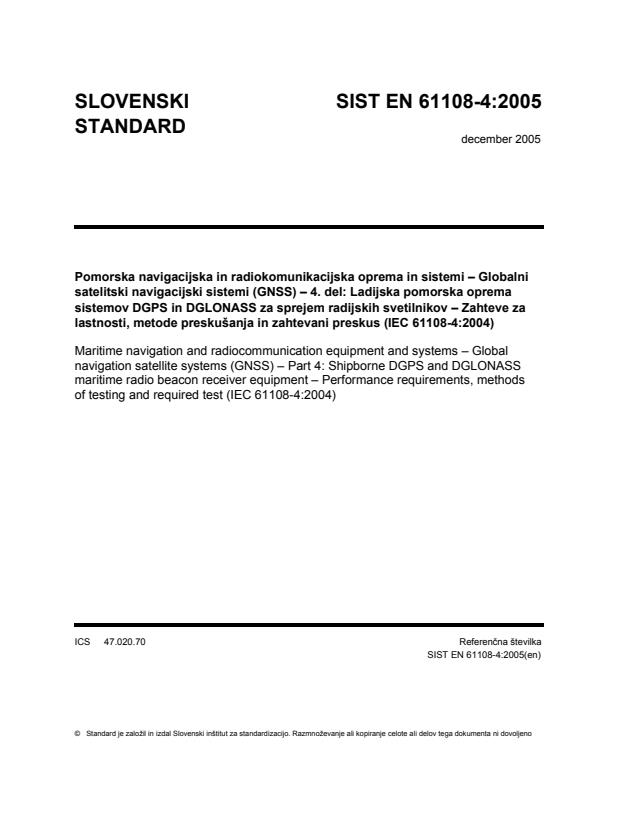
SLOVENSKI SIST EN 61108-4:2005
STANDARD
december 2005
Pomorska navigacijska in radiokomunikacijska oprema in sistemi – Globalni
satelitski navigacijski sistemi (GNSS) – 4. del: Ladijska pomorska oprema
sistemov DGPS in DGLONASS za sprejem radijskih svetilnikov – Zahteve za
lastnosti, metode preskušanja in zahtevani preskus (IEC 61108-4:2004)
Maritime navigation and radiocommunication equipment and systems – Global
navigation satellite systems (GNSS) – Part 4: Shipborne DGPS and DGLONASS
maritime radio beacon receiver equipment – Performance requirements, methods
of testing and required test (IEC 61108-4:2004)
ICS 47.020.70 Referenčna številka
© Standard je založil in izdal Slovenski inštitut za standardizacijo. Razmnoževanje ali kopiranje celote ali delov tega dokumenta ni dovoljeno
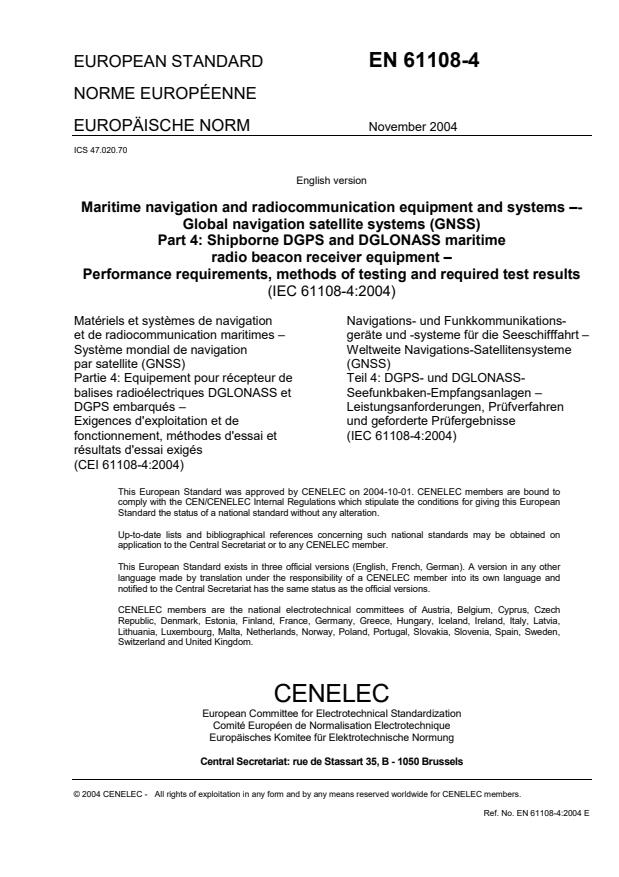
EUROPEAN STANDARD EN 61108-4
NORME EUROPÉENNE
EUROPÄISCHE NORM November 2004
ICS 47.020.70
English version
Maritime navigation and radiocommunication equipment and systems –-
Global navigation satellite systems (GNSS)
Part 4: Shipborne DGPS and DGLONASS maritime
radio beacon receiver equipment –
Performance requirements, methods of testing and required test results
(IEC 61108-4:2004)
Matériels et systèmes de navigation Navigations- und Funkkommunikations-
et de radiocommunication maritimes – geräte und -systeme für die Seeschifffahrt –
Système mondial de navigation Weltweite Navigations-Satellitensysteme
par satellite (GNSS) (GNSS)
Partie 4: Equipement pour récepteur de Teil 4: DGPS- und DGLONASS-
balises radioélectriques DGLONASS et Seefunkbaken-Empfangsanlagen –
DGPS embarqués – Leistungsanforderungen, Prüfverfahren
Exigences d'exploitation et de und geforderte Prüfergebnisse
fonctionnement, méthodes d'essai et (IEC 61108-4:2004)
résultats d'essai exigés
(CEI 61108-4:2004)
This European Standard was approved by CENELEC on 2004-10-01. CENELEC members are bound to
comply with the CEN/CENELEC Internal Regulations which stipulate the conditions for giving this European
Standard the status of a national standard without any alteration.
Up-to-date lists and bibliographical references concerning such national standards may be obtained on
application to the Central Secretariat or to any CENELEC member.
This European Standard exists in three official versions (English, French, German). A version in any other
language made by translation under the responsibility of a CENELEC member into its own language and
notified to the Central Secretariat has the same status as the official versions.
CENELEC members are the national electrotechnical committees of Austria, Belgium, Cyprus, Czech
Republic, Denmark, Estonia, Finland, France, Germany, Greece, Hungary, Iceland, Ireland, Italy, Latvia,
Lithuania, Luxembourg, Malta, Netherlands, Norway, Poland, Portugal, Slovakia, Slovenia, Spain, Sweden,
Switzerland and United Kingdom.
CENELEC
European Committee for Electrotechnical Standardization
Comité Européen de Normalisation Electrotechnique
Europäisches Komitee für Elektrotechnische Normung
Central Secretariat: rue de Stassart 35, B - 1050 Brussels
© 2004 CENELEC - All rights of exploitation in any form and by any means reserved worldwide for CENELEC members.
Ref. No. EN 61108-4:2004 E
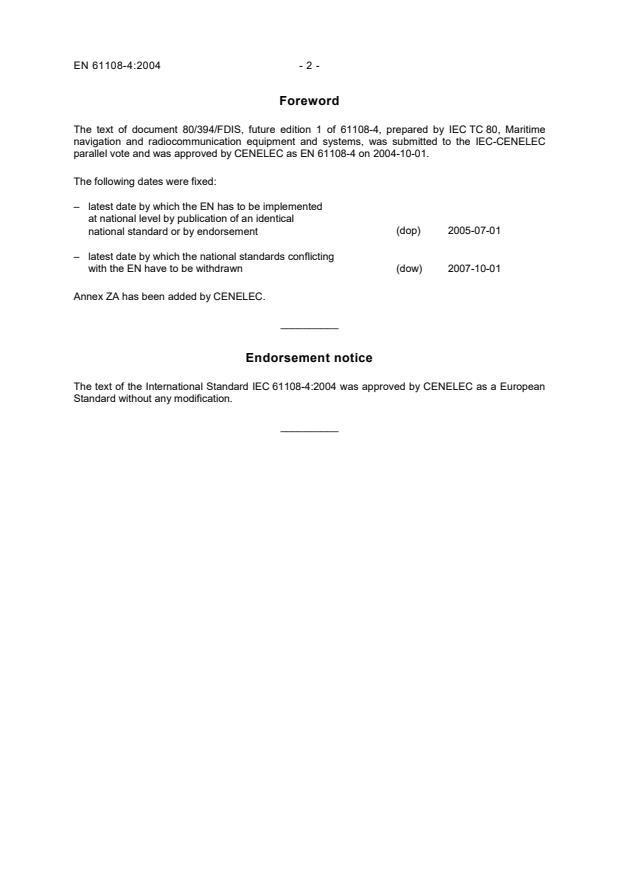
Foreword
The text of document 80/394/FDIS, future edition 1 of 61108-4, prepared by IEC TC 80, Maritime
navigation and radiocommunication equipment and systems, was submitted to the IEC-CENELEC
parallel vote and was approved by CENELEC as EN 61108-4 on 2004-10-01.
The following dates were fixed:
– latest date by which the EN has to be implemented
at national level by publication of an identical
national standard or by endorsement (dop) 2005-07-01
– latest date by which the national standards conflicting
with the EN have to be withdrawn (dow) 2007-10-01
Annex ZA has been added by CENELEC.
__________
Endorsement notice
The text of the International Standard IEC 61108-4:2004 was approved by CENELEC as a European
Standard without any modification.
__________
- 3 - EN 61108-4:2004
Annex ZA
(normative)
Normative references to international publications
with their corresponding European publications
The following referenced documents are indispensable for the application of this document. For dated
references, only the edition cited applies. For undated references, the latest edition of the referenced
document (including any amendments) applies.
NOTE Where an international publication has been modified by common modifications, indicated by (mod), the relevant
EN/HD applies.
Publication Year Title EN/HD Year
1) 2)
IEC 60945 - Maritime navigation and EN 60945 2002
radiocommunication equipment and
systems - General requirements -
Methods of testing and required test
results
1) 2)
IEC 61162-1 - Maritime navigation and EN 61162-1 2000
radiocommunication equipment and
systems - Digital interfaces
Part 1: Single talker and multiple listeners
1) 2)
IEC 61162-2 - Part 2: Single talker and multiple EN 61162-2 1998
listeners, high-speed transmission
1)
IMO Resolution - Performance standards for shipborne - -
MSC.114(73) DGPS and DGLONASS maritime radio
beacon receiver equipment
1)
IMO Resolution - General requirements for shipborne radio - -
A.694(17) equipment forming part of the global
maritime distress and safety system
(GMDSS) and for electronic navigational
aids
1)
ITU-R M.823-2 - Technical characteristics of differential - -
transmissions for global navigation
satellite systems (GNSS) from maritime
radio beacons in the frequency band
285 kHz-325 kHz (283,5 kHz-315 kHz in
Region 1)
1)
Undated reference.
2)
Valid edition at date of issue.
INTERNATIONAL IEC
STANDARD 61108-4
First edition
2004-07
Maritime navigation and radiocommunication
equipment and systems –
Global navigation satellite systems (GNSS) –
Part 4:
Shipborne DGPS and DGLONASS maritime
radio beacon receiver equipment –
Performance requirements, methods of
testing and required test results
© IEC 2004 ⎯ Copyright - all rights reserved
No part of this publication may be reproduced or utilized in any form or by any means, electronic or
mechanical, including photocopying and microfilm, without permission in writing from the publisher.
International Electrotechnical Commission, 3, rue de Varembé, PO Box 131, CH-1211 Geneva 20, Switzerland
Telephone: +41 22 919 02 11 Telefax: +41 22 919 03 00 E-mail: inmail@iec.ch Web: www.iec.ch
PRICE CODE
Commission Electrotechnique Internationale W
International Electrotechnical Commission
ɆɟɠɞɭɧɚɪɨɞɧɚɹɗɥɟɤɬɪɨɬɟɯɧɢɱɟɫɤɚɹɄɨɦɢɫɫɢɹ
For price, see current catalogue
– 2 – 61108-4 © IEC:2004(E)
CONTENTS
FOREWORD.4
1 Scope.6
2 Normative references .6
3 Terms, definitions and abbreviations .7
3.1 Definitions .7
3.2 Abbreviations .7
4 Performance requirements .7
4.1 Introduction .7
4.2 Composition .8
4.3 Functional requirements .8
4.4 Protection.9
4.5 Integrity.9
4.6 Interfaces .10
4.7 IEC 61162-1, IEC 61162-2 implementation .10
4.8 IEC 61162-3 implementation .10
4.9 Display and control.10
4.10 Installation .10
5 Technical characteristics .11
5.1 Carrier frequency .11
5.2 Frequency tolerance.11
5.3 Message types .11
5.4 Data transmission rate .11
5.5 Dynamic range .11
5.6 Maximum bit error ratio .11
5.7 Receiver selectivity and stability.11
5.8 Automatic frequency selection.12
5.9 Protection ratios .12
6 Methods of testing and required test results .13
6.1 General conditions of measurement and test signals .13
6.2 Operational tests .14
6.3 Protection of external connections.18
6.4 Integrity.18
6.5 Technical tests .18
6.6 Additional functionality tests .20
Annex A (normative) Simulation of noise situations for the test of shipborne DGPS
maritime radio beacon receiver equipment.21
A.1 Parameters describing noise .21
A.2 Noise models .22
A.3 Test procedures .26
Annex B (informative) Methodology for measuring WER .27
B.1 Recording the RTCM data stream.27
B.2 Analysing the RTCM data stream .27
B.3 Caution .27
61108-4 © IEC:2004(E) – 3 –
Annex C (normative) Tests that are specific to integrated equipment that does not
provide an output port for testing.30
C.1 General requirements .30
C.2 Test of WER display .30
C.3 Comments to Clause 6, methods of testing.30
Annex D (informative) Installation guidelines to counteract the effect of interference .31
D.1 Introduction .31
D.2 Antennas .31
D.3 General installation requirements .32
D.4 Noise/interference sources .34
D.5 Testing .34
D.6 Troubleshooting.35
Annex E (informative) Implementation using a concurrent process.36
Annex F (informative) Data interface guidance.38
Bibliography.39
Figure A.1 – Generating atmospherics according to Feldman.24
Figure A.2 – Test set-up using a PC to program a waveform synthesizer .26
Figure B.1 – Word error rate algorithm (first part) .28
Figure B.2 – Word error rate algorithm (second part) .29
Figure E.1 – Station status update .36
Figure E.2 – Navigation process .37
Table 1 – Message types (M823/1.2) .11
Table 2 – Protection ratios .12
Table A.1 – Parameters for different interference situations .23
Table A.2 – Characteristic parameters of the simulated situations.25
Table D.1 – Troubleshooting conditions .35
– 4 – 61108-4 © IEC:2004(E)
INTERNATIONAL ELECTROTECHNICAL COMMISSION
____________
MARITIME NAVIGATION AND RADIOCOMMUNICATION
EQUIPMENT AND SYSTEMS –
GLOBAL NAVIGATION SATELLITE SYSTEMS (GNSS) –
Part 4: Shipborne DGPS and DGLONASS maritime
radio beacon receiver equipment –
Performance requirements, methods of testing
and required test results
FOREWORD
1) The International Electrotechnical Commission (IEC) is a worldwide organization for standardization comprising
all national electrotechnical committees (IEC National Committees). The object of IEC is to promote
international co-operation on all questions concerning standardization in the electrical and electronic fields. To
this end and in addition to other activities, IEC publishes International Standards, Technical Specifications,
Technical Reports, Publicly Available Specifications (PAS) and Guides (hereafter referred to as “IEC
Publication(s)”). Their preparation is entrusted to technical committees; any IEC National Committee interested
in the subject dealt with may participate in this preparatory work. International, governmental and non-
governmental organizations liaising with the IEC also participate in this preparation. IEC collaborates closely
with the International Organization for Standardization (ISO) in accordance with conditions determined by
agreement between the two organizations.
2) The formal decisions or agreements of IEC on technical matters express, as nearly as possible, an international
consensus of opinion on the relevant subjects since each technical committee has representation from all
interested IEC National Committees.
3) IEC Publications have the form of recommendations for international use and are accepted by IEC National
Committees in that sense. While all reasonable efforts are made to ensure that the technical content of IEC
Publications is accurate, IEC cannot be held responsible for the way in which they are used or for any
misinterpretation by any end user.
4) In order to promote international uniformity, IEC National Committees undertake to apply IEC Publications
transparently to the maximum extent possible in their national and regional publications. Any divergence
between any IEC Publication and the corresponding national or regional publication shall be clearly indicated in
the latter.
5) IEC provides no marking procedure to indicate its approval and cannot be rendered responsible for any
equipment declared to be in conformity with an IEC Publication.
6) All users should ensure that they have the latest edition of this publication.
7) No liability shall attach to IEC or its directors, employees, servants or agents including individual experts and
members of its technical committees and IEC National Committees for any personal injury, property damage or
other damage of any nature whatsoever, whether direct or indirect, or for costs (including legal fees) and
expenses arising out of the publication, use of, or reliance upon, this IEC Publication or any other IEC
Publications.
8) Attention is drawn to the Normative references cited in this publication. Use of the referenced publications is
indispensable for the correct application of this publication.
9) Attention is drawn to the possibility that some of the elements of this IEC Publication may be the subject of
patent rights. IEC shall not be held responsible for identifying any or all such patent rights.
International Standard IEC 61108-4 has been prepared by IEC technical committee 80:
Maritime navigation and radiocommunication equipment and systems.
The text of this standard is based on the following documents:
FDIS Report on voting
80/394/FDIS 80/398/RVD
Full information on the voting for the approval of this standard can be found in the report on
voting indicated in the above table.
61108-4 © IEC:2004(E) – 5 –
This publication has been drafted in accordance with the ISO/IEC Directives, Part 2.
The committee has decided that the contents of this publication will remain unchanged until
the maintenance result date indicated on the IEC web site under "http://webstore.iec.ch" in
the data related to the specific publication. At this date, the publication will be
• reconfirmed;
• withdrawn;
• replaced by a revised edition, or
• amended.
IEC 61108 consists of the following parts, under the general title Maritime navigation and
radiocommunication equipment and systems – Global navigation satellite systems (GNSS):
Part 1: Global positioning system (GPS) – Receiver equipment – Performance standards,
methods of testing and required test results
Part 2: Global navigation satellite system (GLONASS) – Receiver equipment – Performance
standards, methods of testing and required test results
Part 3: (To be used at a later date)
A bilingual version of this publication may be issued at a later date.
– 6 – 61108-4 © IEC:2004(E)
MARITIME NAVIGATION AND RADIOCOMMUNICATION
EQUIPMENT AND SYSTEMS –
GLOBAL NAVIGATION SATELLITE SYSTEMS (GNSS) –
Part 4: Shipborne DGPS and DGLONASS maritime
radio beacon receiver equipment –
Performance requirements, methods of testing
and required test results
1 Scope
This part of IEC 61108 specifies the minimum operational and performance requirements,
methods of testing and required test results conforming to performance standards not inferior
to those adopted by the IMO in resolution MSC.114(73). In addition, it takes account of IMO
resolution A.694(17) and is associated with IEC 60945. When a requirement of this standard
is different from IEC 60945, the requirement in this standard shall take precedence.
This standard may be satisfied by equipment integral with GNSS equipment.
This standard is applicable to HSC.
All text of this standard, whose wording is identical to that in IMO resolution MSC.114(73) and
ITU-R M.823 is printed in italics and the resolution (abbreviated to – 114 and M.823
respectively ) and paragraph numbers are indicated in brackets i.e. (114/3.3 or M.823/3.3 ).
2 Normative references
The following referenced documents are indispensable for the application of this document.
For dated references, only the edition cited applies. For undated references, the latest edition
of the referenced document (including any amendments) applies.
IEC 60945, Maritime navigation and radiocommunication equipment and systems – General
requirements – Methods of testing and required test results
IEC 61162-1, Maritime navigation and radiocommunication equipment and systems – Digital
interfaces – Part 1: Single talker and multiple listeners
IEC 61162-2, Maritime navigation and radiocommunication equipment and systems – Digital
interfaces – Part 2: Single talker and multiple listeners, high speed transmission
IMO Resolution MSC.114(73), Revised recommendation on performance standards for
shipborne DGPS and DGLONASS maritime radio beacon receiver equipment
IMO Resolution A.694(17), General requirements for shipborne radio equipment forming part
of the Global Maritime Distress and Safety System (GMDSS) and for electronic navigational
aids
ITU-R M.823-2, Technical characteristics of differential transmissions for Global Navigation
Satellite Systems (GNSS) from maritime radio beacons in the frequency band 283,5 –
315 kHz in Region 1 and 285 – 325 kHz in Regions 2 and 3
61108-4 © IEC:2004(E) – 7 –
3 Terms, definitions and abbreviations
For the purposes of this standard the following definitions and abbreviations apply.
3.1 Definitions
3.1.1
Eurofix
the Eurofix datalink is a scheme for modulation of the Loran-C and Chayka signals to
establish a broadcast capability that can be used for distribution of GNSS corrections,
integrity data and other information. Similar developments in the US are referred to as
LORAN-COMM
3.1.2
global navigation satellite system (GNSS)
is a world-wide position, time and velocity radio determination system comprising space,
ground and user segments
3.1.3
integrity
is the ability to provide users with warnings within a specified time when the system should
not be used for navigation
3.2 Abbreviations
BER Bit error rate
bps Bits per second
DGLONASS Differential GLONASS
DGNSS Differential GNSS
DGPS Differential GPS
EGNOS European Geo-stationary Navigational Overlay System
EPFS Electronic position fixing system
EUT Equipment under test
MSAS Multi-Satellite Augmentation System
MSK Minimum shift keying
RTK Real-Time Kinematics
SNR Signal to noise ratio
UDRE User defined range error
VTS Vessel Tracking Services
WAAS Wide-Area Augmentation System
WER Word error rate
4 Performance requirements
4.1 Introduction
Differential services broadcast information for augmenting Global Positioning System (GPS)
and the Global Navigation Satellite System (GLONASS) to provide the accuracy and integrity
required for entrances and harbour approaches and other waters in which the freedom to
manoeuvre is limited. Various service providers are broadcasting differential information
applicable to localised areas. Different services provide information for augmenting GPS,
GLONASS, or both.(114/1.1)
– 8 – 61108-4 © IEC:2004(E)
Receiver equipment for the reception and proper de-modulating / decoding of differential GPS
and GLONASS maritime radio beacon broadcasts (fully compliant with ITU-R M.823) intended
for navigational purposes on ships with maximum speeds not exceeding 70 knots shall, in
addition to the general requirements contained in resolution A.694(17), comply with the
following minimum performance requirements.(114/1.2) As noted in Clause 1 – Scope: This
standard is applicable to HSC.
This standard covers the basic requirements of maritime radio beacon receiver equipment
providing augmentation information to position-fixing equipment, including health messages.
It does not cover other computational facilities which may be in the equipment.(114/1.3)
Additional functionality (e.g. use of differential corrections and integrity, from multiple beacon
reference stations, Eurofix, LORAN-COMM, VTS, FM subcarrier, commercial satellite, WAAS,
EGNOS, MSAS and RTK) is permitted if the manufacturer can demonstrate that this does not
degrade performance.
4.2 Composition
The words “DGPS and DGLONASS maritime radio beacon receiver equipment” as used in this
performance standard includes all the components and units necessary for the system to
properly perform its intended functions. The equipment shall include the following minimum
facilities:(114/2)
1) antenna capable of receiving DGPS or DGLONASS maritime radio beacon
signals;(114/2.1)
2) DGPS and DGLONASS maritime radio beacon receiver and processor; (114/2.2)
3) receiver control interface; (114/2.3) (See also 4.3 2))
4) data output interface (114/2.4) (See also 4.3 5)), and
5) broadcast station database capable of storing at least the following data for a minimum
of 1000 stations. These data elements can be initially downloaded and shall be
updated from DGNSS broadcasts:
ID , ID
REF1 REF2
BROADCAST STATION ID
BROADCAST STATION NAME
FREQUENCY
REFERENCE STATION POSITION
REFERENCE STATION DATUM
OFFICIAL OPERATION STATUS (operational, test, or not operational)
6) broadcast station database capable of calculating and storing at least the following
data for a minimum of 10 closest stations. The receiver shall update these data
elements from information included in DGNSS broadcasts:
TIME/DATE of UPDATE
REFERENCE STATION HEALTH
WORD ERROR RATE (WER)
DISTANCE (user to reference station(s))
4.3 Functional requirements
The DGPS and DGLONASS maritime radio beacon receiver equipment shall: (114/3)
1) operate in the band of 283,5 to 315 kHz in Region 1 and 285 to 325 kHz in Regions 2
and 3 in accordance with ITU-R M.823 (114/3.1). The receiver shall perform to the
requirements of this standard while subjected to typical radio frequency interference and
noise sources, as follows:
61108-4 © IEC:2004(E) – 9 –
– atmospheric noise (e.g. local thunderstorms);
– man-made noise (e.g. own ship, shipyard industrial, etc.);
– Gaussian noise;
– interference from LF and MF radio stations outside the band.
The specifications of these are further developed in Annex A.
– precipitation static (especially in the high latitudes) is not specified or tested against,
but H-field antennas are recommended to be used on ships that go to the high
latitudes that experience this environmental interference; (See Annex D.)
2) provide means of automatically and manually selecting the station; (114/3.2) When in
manual mode, operator action shall be required for a change and the receiver shall
provide an indication of other available stations. The database shall be continually
updated and utilised to select reference stations;(See Annex E.)
3) make the data available for use with a delay not exceeding 100 ms after its reception;
(114/3.3) The delay from the first bit of the modulated data to the last bit of the
decoded data output from the receiver shall be less than 100 ms plus the transmission
time of the message;
4) be capable of acquiring a signal in less than 45 s in the presence of electrical storms;
(114/3.4);
5) have an omni-directional antenna in the horizontal plane. (114/3.6) The difference
between the maximum and minimum signal strength shall be less than:
.1 5 dB over frequency range
.2 3 dB over azimuth
.3 3 dB over roll of 20°;
6) and make available the health status, of the station being used, to the system.
4.4 Protection
Precautions shall be taken to ensure that no permanent damage can result from an accidental
short circuit or grounding of the antenna or any of its input or output connections or any of the
DGPS and DGLONASS maritime radio beacon receiver equipment inputs or outputs for a
duration of five minutes. (114/4)
4.5 Integrity
The following functions shall be performed in either an integrated DGNSS receiver or an
associated GNSS receiver. As a consequence, there are no tests for these clauses within this
standard.
4.5.1 DGNSS integrity status
When in differential mode, the GNSS receiver shall give a DGNSS integrity indication:
a) if no DGNSS message is received within 10 s;
b) while in manual station selection mode and the selected station is unhealthy, unmonitored,
or signal quality is below threshold;
c) while in automatic station selection mode and the only available station is unhealthy,
unmonitored, or signal quality is below threshold.
4.5.2 GNSS integrity status
If the Range-rate Correction or the Pseudorange Correction of a satellite is out of tolerance,
the binary code in the ITU-R M.823-2 types 1, 9, 31 and 34 messages will indicate to the
GNSS receiver that the satellite shall not be used.
– 10 – 61108-4 © IEC:2004(E)
4.6 Interfaces
The equipment shall have at least one serial data output that conforms to the relevant
international marine interface standard; (114/3.5) as defined in IEC 61162-1, IEC 61162-2, or
IEC 61162-3 as appropriate.
4.7 IEC 61162-1, IEC 61162-2 implementation
Integrated equipment and stand-alone receivers shall use the following IEC 61162-1
messages for control and status reporting:
– MSK – MSK Receiver Interface (input/output)
– MSS – MSK Receiver Signal (output)
The Talker Identifier Mnemonic for stand-alone receivers is:
– COMMUNICATIONS: Data Receiver: CR
Stand-alone receivers shall use GGA, GNS or GLL (as defined in IEC 61162-1) to receive
position data from the GNSS receiver for its automatic functions. (input)
The DGNSS receiver shall provide ITU-R M.823 data output to a port for testing. See also
Annex F for informative guidance on ITU-R M.823 interface matters.
4.8 IEC 61162-3 implementation
Integrated equipment and stand-alone receivers shall use the following IEC 61162–3
parameter groups for control, status and data reporting:
– GNSS Position Data
– GNSS Differential Correction Receiver Signal Status
– GNSS Differential Correction Receiver Interface
– GNSS Differential Corrections
4.9 Display and control
The selected operational mode (manual or automatic) shall be clearly indicated or available
on an appropriate interface
The following information shall be available for display of the selected station and the next two
nearest stations (see 5) of 4.2):
– reference Station ID;
– station name;
– frequency;
– calculated distance to the station;
– station health (from message header);
– signal quality (acceptable < 10 % WER, unacceptable > 10 % WER).
4.10 Installation
For information guidance on installation see Annex D.
61108-4 © IEC:2004(E) – 11 –
5 Technical characteristics
5.1 Carrier frequency
The carrier frequency of the differential correction signal of a radio-beacon station is an
integer multiple of 500 Hz. (M.823/1.1)
5.2 Frequency tolerance
Frequency tolerance of the carrier is ±2 Hz. (M.823/1.2)
5.3 Message types
Table 1 is for information and shows message types which may be transmitted by a service
provider.
Table 1 – Message types (M823/1.2)
GPS Title GLONASS
message type number message type number
1 Differential GNSS corrections 31
(full set of satellites)
3 Reference station parameters 32
4 Reference Station Datum 4
5 Constellation health 33
6 Null frame 34 (N=0 or N=1)
7 Radio beacon almanacs 35
9 Subset differential GNSS corrections 34 (N>1)
(this may replace Types 1 or 31)
16 Special message 36
27 (see note) Extended beacon almanac N/A
NOTE New message now being implemented worldwide. Equipment for test from 2005 should
incorporate this message type.
5.4 Data transmission rate
The receiver shall be capable of receiving data at selectable rates of 25 (GLONASS only), 50,
100 and 200 bits/s. (M.823/1.6)
5.5 Dynamic range
The receiver shall have a dynamic range of 10 µV/m to 150 mV/m (M.823/1.11). 10µV/m is the
requirement to be met while tracking, 20 µV/m is the requirement for acquisition.
5.6 Maximum bit error ratio
–3
The receiver shall operate at a maximum bit error ratio of 1 × 10 in the presence of
Gaussian noise at a signal to noise ratio of 7 dB in the occupied bandwidth. (M.823/1.12)
5.7 Receiver selectivity and stability
The receiver shall have adequate selectivity and frequency stability to operate with
transmissions 500 Hz apart having frequency tolerances of ±2 Hz and protection ratios given
in Table 2. (M.823/1.14)
– 12 – 61108-4 © IEC:2004(E)
5.8 Automatic frequency selection
Automatic frequency selection as provided in the receiver, shall be capable of searching for,
receiving, collecting, storing and utilising beacon almanac information from Type 7 / 35
messages and any other relevant message. (M.823/1.17)
5.8.1 Switching criteria
The receivers shall switch from the current reference station when the Reference Station
Health or signal quality falls below the minimum criteria of 5.8.2 or is no longer the nearest
reference station. The receiver shall be able to select, tune and acquire valid ITU-R M.823
data within 10 s from the nearest reference station that meets minimum requirements for
Reference Station Health and signal quality. See informative Annex E for method of carrying
out this process.
5.8.2 Minimum requirements
The minimum requirements shall be:
5.8.2.1 Reference station health
– State 000-101 – reference station OK to use;
– State 110 (unmonitored) – do not use unless no other stations are available, and then the
user must be warned;
– State 111 – do not use reference station under any circumstances.
5.8.2.2 Signal quality
WER < 0,1 as measured over 25 ITU-R M.823 words, the measurement not being older than
5 min.
5.9 Protection ratios
The protection ratios to be applied shall be as in Table 2 (M.823-2 – Table 5)
Table 2 – Protection ratios
Frequency separation
between wanted and Protection ratio
interfering signal dB
kHz
Wanted Differential (G1D) Differential (G1D)
Interfering Radio beacon (A1A)* Differential (G1D)
0 15 15
0,5 –25 –22
1,0 –45 –36
1,5 –50 –42
2,0 –55 –47
* Applicable to radio beacons in the European maritime area under the 1985
Geneva Agreement.
61108-4 © IEC:2004(E) – 13 –
6 Methods of testing and required test results
This clause defines the type test ‘methods of measurement’ and ‘results required’ ensuring
that equipment complies with the requirements of Clauses 4 and 5.
6.1 General conditions of measurement and test signals
All the tests to the general requirements of IEC 60945 shall be carried out on the EUT. The
equipment shall comply with those requirements of IEC 60945 appropriate to its category, i.e.
'protected' (from the weather) or 'exposed' (to the weather).
The manufacturer shall declare which equipment or units are ‘protected’ or ‘exposed’. The
manufacturer shall declare the ‘preconditioning’ required before environmental checks.
For the purposes of this standard the following test related definitions shall apply:
Performance check – Reconfiguration of the EUT and checking, by non-quantitative visual
checks and by conducting the test procedure below, that the system is still operative for the
purposes of IEC 60945.
Performance test for the purposes of IEC 60945 – Reconfigure the EUT and perform test
6.2.2.2 a), with a signal level of 34 dBµV/m, ensuring that the system is compliant.
By inspection – a visual check of the equipment or documentation.
Test procedure: After manual frequency selection and a settling time of 30 s, the EUT shall
achieve continuous decoding with a WER of 0 % as measured using the methodology in
Annex B.
Test signal A shall be a sequence of ITU 823 message nine type 9-3s and one type 7 that
form a continuous parity loop. The station ID of test signal A shall be an ID of a station that is
stored in the almanac. The type 7 message shall give data for station B.
Test signal B shall contain ITU 823 messages – Type 9-3 and 3 for station. B. The station ID
of test signal B shall not be an ID of a station that is stored in the almanac.
Test signal C shall contain ITU 823 messages – Type 9-3. The station ID of test signal C
shall be an ID of a station that is stored in the almanac and is closer in distance to the EUT
than signal D from station D.
Test signal D shall contain ITU 823 messages – Type 9-3. The station ID of test signal D
shall be an ID of a station that is stored in the almanac and is not as close in distance to the
EUT as signal C from station C.
Test signal E shall contain 50 ITU 823 messages – Type 9-3 with health status "healthy",
followed by a sequence of 50 ITU 823 messages – Type 9-3 with health status "unhealthy".
The station ID of test signal E shall be an ID of a station that is stored in the almanac and is
closer in distance to the EUT than signal D from station D.
Test signal F shall contain 150 ITU 823 messages – Type 9-3 with a WER of zero, followed
by a sequence of 150 ITU 823 messages – Type 9-3 with a WER of 100 %. The station ID of
test signal E shall be an ID of a station that is stored in the almanac and is closer in distance
to the EUT than signal D from station D.
– 14 – 61108-4 © IEC:2004(E)
Test signal G shall contain 50 ITU 823 messages – Type 9-3 with health status "healthy",
followed by a sequence of 50 ITU 823 messages – Type 9-3 with health status "unmonitored".
The station ID of test signal G shall be an ID of a station that is stored in the almanac and is
closer in distance to the EUT than signal D from station D.
Test signal H shall contain 150 ITU 823 messages – Type 9-3 with a WER of 10 %. Test
signal H shall be a station listed in the almanac.
6.1.1 Test site
Tests will normally be carried out at test sites selected by the type test authority.
6.2 Operational tests
6.2.1 Composition
Show by demonstration and inspection that the requirements of 4.2 are met.
6.2.2 Operational frequency and bit rate
(See 4.3.1))
Check that the operational frequency and bit rate is as specified in 1) of 4.3 with the tests
below.
6.2.2.1 Carrier frequency
(See 5.1)
Test signal A shall be applied at 20 µV/m in the absence of noise and at 200 bps. All
receivers shall be tested throughout the entire band, i.e. 283,5 to 325 kHz at integer multiples
of 500 Hz. After manual frequency selection and a settling time of 30 s, the receivers shall
achieve continuous decoding with a word error rate (WER) of zero, as measured using the
methodology in Annex B, as measured over 30 s at the output port.
6.2.2.2 Dynamic range
(See 5.5)
a) Test signal A shall be applied at 20 µV/m in the absence of noise and at 200 bps. After
manual frequency selection and a settling time of 30 s, the EUT shall achieve continuous
decoding with a word error rate (WER) of zero, as measured using the methodology in
annex B, as measured over 30 s at the output port.
b) Reduce test signal A down to 10 µV/m in the absence of noise and at 200 bps. The EUT
shall achieve continuous tracking and decoding the signal with a word error rate (WER) of
zero, as measured using the methodology in Annex B, as measured over 30 s at the
output port.
c) Raise test signal A up to 150 mV/m in the absence of noise and at 200 bps. The EUT shall
achieve continuous tracking and decoding the signal with a word error rate (WER) of zero,
as measured using the methodology in Annex B, as measured over 30 s at the output port.
6.2.2.3 Data transmission rate
(See 5.4)
Repeat the above tests using the remaining bit rates (25, 50 and 100 bps) shall be tested at
283,5, 305 and 325 kHz. In these tests the receiver shall achieve continuous decoding with a
WER of zero as measured over 240 s (for 25 bps), 120 s (for 50 bps) and 60 s (for 100 bps).
61108-4 © IEC:2004(E) – 15 –
6.2.2.4 Frequency tolerance
(See 5.2)
Repeat the above tests using 200 bps at 283,5 kHz ± 2 Hz, 305 kHz ± 2 Hz and 325 kHz
± 2 Hz. In these tests, the receiver shall achieve continuous decoding with a WER of zero as
measured over 30 s.
6.2.3 Manual and automatic station selection
(see 4.3 2))
6.2.3.1 Manual method
Manual frequency/ station selection shall be demonstrated with the following test:-
Initial conditions: no signals in band. The signal level for these tests shall be 75 µV/m in the
absence of noise and at a data rate of 200 bps.
Test method and required results:
Step 1: select a frequency / station on the EUT;
Step 2: introduce test signal A on the adjacent channel;
Step 3: verify using the test procedure that a WER of 100 % is achieved for test signal A;
Step 4: introduce test signal B on the selected channel;
Step 5: verify using the test procedure that valid test signal B is being received on the
selected channel with a WER of zero.
6.2.3.2 Automatic method
Initial conditions: the signal level for these tests shall be 75 µV/m in the absence of noise and
at a data rate of 200 bps.
Position information (GGA, GLL, GNS or GNSS position data, as appropriate) shall be
provided to the beacon receiver.
6.2.3.2.1 Almanac test procedure
a) Check if the receiver works with almanac
Test method:
Step 1: reset receiver almanac;
Step 2: upload almanac into receiver where station A is included in the almanac and is the
closest station in distance to the EUT position;
Step 3: introduce test signal A.
Required result:
The EUT shall achieve continuous decoding of signal A with a WER of zero within 10 s as
measured using the methodology in Annex B.
b) Check update procedure of almanac
Test method:
Step 1: introduce test signal A for 5 min;
Step 2: introduce test signal B where station B is not in the almanac loaded in the previous
test and is the closest station in distance to the EUT position;
Step 3: allow the EUT to run for 10 s;
Step 4: download almanac or display its contents.
– 16 – 61108-4 © IEC:2004(E)
Required results:
The EUT shall achieve continuous decoding of signal B with a WER of zero as measured
using the methodology in Annex B and station B has been added to the almanac.
6.2.3.2.2 Automatic mode
a) Check closest station from almanac
Test method:
Step 1: introduce test signals C and D where station C is closer in distance to EUT
position than station D;
Step 2: turn on EUT;
Required results:
EUT is decoding signal C with a WER of zero within 10 s.
b) Change station if tracked station becomes unhealthy
Test method:
Step 1: introduce test signals E and D where station E is closer in distance to EUT
position than station D;
Step 2: turn on EUT;
Step 3: confirm that the EUT is decoding signal
...
Questions, Comments and Discussion
Ask us and Technical Secretary will try to provide an answer. You can facilitate discussion about the standard in here.
Loading comments...