

SIST EN 1994-1-1:2026/oprA1:2026
(Amendment)Eurocode 4 - Design of composite steel and concrete structures - Part 1-1: General rules and rules for buildings
- Abstract
1.1 Scope of EN 1994-1-1
(1) EN 1994-1-1 gives general rules for the design of steel and concrete composite structures and supplementary provisions specific for buildings.
NOTE Specific rules for bridges are given in EN 1994-2.
1.2 Assumptions
(1) The assumptions of EN 1990-1 apply to EN 1994-1-1.
(2) In addition to the general assumptions of EN 1990-1, the assumptions given in EN 1992-1-1, EN 1992-1-2, and EN 1993-1-1 apply to this document.
(3) EN 1994-1-1 is intended to be used in conjunction with EN 1990-1, EN 1991 (all parts), EN 1992-1-1, EN 1993 (all parts), EN 1997 (all parts), EN 1998 (all parts when steel and concrete composite structures are built in seismic regions), EN 1090-1, EN 1090-2, EN 1090-4, EN 13670 and ENs for construction products relevant to steel and concrete composite structures.
- Status
- Not Published
- Public Enquiry End Date
- 26-Nov-2026
- Technical Committee
- KON - Structures
- Current Stage
- 4020 - Public enquire (PE) (Adopted Project)
- Start Date
- 25-Sep-2026
- Due Date
- 12-Feb-2027

SIST EN 1994-1-1:2026/oprA1:2026 is the Slovenian adoption of the draft amendment prA1 to EN 1994-1-1:2026. It updates Eurocode 4, which gives general rules for the design of composite steel and concrete structures and supplementary provisions for buildings. It is intended for engineers and other professionals who design, verify, test or execute composite building members such as beams, slabs, columns and shear connections.
What does SIST EN 1994-1-1:2026/oprA1:2026 specify?
SIST EN 1994-1-1:2026/oprA1:2026 amends EN 1994-1-1:2026 for composite steel and concrete structures in buildings. The scope keeps bridge design outside this part and points bridge rules to EN 1994-2.
The amendment is organized as modifications to Clauses 0, 3, 5, 7, 8, 9 and 10, plus Annexes B, D, E, F, H, I and J, and a new Annex K. The bibliography is also updated.
| Annex | What it covers |
|---|---|
| Annex B | Standard tests |
| Annex D | Composite beams with web-openings |
| Annex E | Composite beams with web-openings and a stiff slab |
| Annex F | Headed studs that cause splitting forces in the direction of the slab thickness |
| Annex H | Design tension resistance of headed |
| Annex I | Additional rules for shallow floor beams |
| Annex J | Other flooring types using precast concrete slabs in buildings |
| Annex K | Guidance for the application of clause 9.2.3 Refined control of cracking of EN 1992-1-1 |
What are the key requirements of SIST EN 1994-1-1:2026/oprA1:2026?
The amendment mainly updates design rules, symbols and guidance for composite members, with the biggest practical impact on shear connection, cracking, openings and shallow floor beams.
- Clause 3 revises symbols and definitions, including the meaning of
R_mas maximum resistance based on mean material properties. In practice, calculation notes and software outputs need to use the updated symbol meanings consistently. - Clause 7 updates the note on shear lag to point to EN 1993-1-5:2024 for general provisions related to the steel part. This matters when the steel flange or plate width influences member resistance.
- Clause 8 revises several ultimate limit state rules, including updated coefficient expressions, a lower concrete flange depth condition in one check, and clearer wording for partial shear connection and non-linear resistance checks. In practice, designers need to recheck beam and column resistance where these rules apply.
- Clause 8 also updates composite column buckling guidance and the treatment of concrete-filled sections, including the stated geometric limits. This affects whether tabulated or simplified resistance values can be used.
- Clause 9 strengthens serviceability rules for shear connection. Shear connector resistance must come from 8.6, Annex B tests, CEN/TS 1994-1-102 or another source with the same reliability, and the connectors must be ductility category D2 or D3.
- Clause 9 adds stiffness guidance for headed studs in solid slabs, open trough sheeting and re-entrant sheeting, and points designers to Annex K for refined crack control. This is important where crack width and stiffness govern serviceability.
- Clause 10 updates design rules for composite slabs with profiled steel sheeting, including the validity of a transverse moment formula, a transverse moment increase in one case, and an alternative resistance check for a surface transverse to the sheeting direction. This matters for floor decks during construction and in the finished state.
- Annexes D, E, I and J refine special applications such as openings in composite beams, beams with stiff slabs, shallow floor beams and flooring with precast concrete slabs. Annex J also classifies certain non-preloaded bolt connectors with embedded nuts and holes as Ductility Category D1 unless test evidence justifies another category.
What terms does SIST EN 1994-1-1:2026/oprA1:2026 define?
R_m- maximum resistance based on mean values of material properties.- NWAC - normal weight concrete.
- LWAC - lightweight concrete.
w_k,cal- calculated characteristic crack width used in Annex K.k_w- factor used to convert mean crack width into calculated crack width.k_(1/r)- factor accounting for the increase of crack width due to curvature.- D1 / D2 / D3 - ductility categories for shear connectors, used when selecting and qualifying connector types.
n- modular ratio, used in the crack-control guidance.
Who uses SIST EN 1994-1-1:2026/oprA1:2026?
Structural engineers use this amendment when designing composite beams, columns, slabs, openings and shear connections in buildings. Quality managers, checking engineers and buyers use it when they need to confirm which test evidence, ductility category or execution standard supports a design.
Manufacturers and test laboratories also use it for connector qualification, standard tests and documentation. In practice, the document helps them align design checks with the required tests, material rules and execution standards.
What changed in SIST EN 1994-1-1:2026/oprA1:2026 from the previous edition?
This draft amendment modifies EN 1994-1-1:2026 and, if approved, will supersede it. The foreword notes that some changes are editorial corrections, while the technical changes update clauses on terms, materials, structural analysis, ultimate and serviceability limit states, composite slabs, standard tests, web openings, shallow floor beams, precast-slab flooring, cracking guidance and the bibliography. A new informative Annex K is also added.
Which standards are used with SIST EN 1994-1-1:2026/oprA1:2026?
| Standard | What it contributes |
|---|---|
| EN 1990-1 | General assumptions used with this document |
| EN 1991 (all parts) | Actions on structures |
| EN 1992-1-1 | Concrete design rules, including refined crack-control guidance |
| EN 1992-1-2 | Additional assumptions that apply here |
| EN 1993 (all parts) | Steel design rules used with composite design |
| EN 1993-1-5:2024 | Shear lag provisions for the steel part |
| EN 1993-1-13:2024 | Effective opening length for adjacent openings |
| EN 1997 (all parts) | Geotechnical design when relevant |
| EN 1998 (all parts) | Seismic design when composite structures are built in seismic regions |
| EN 1090-1, EN 1090-2, EN 1090-4 | Execution-related standards used with the Eurocodes |
| EN 13670 | Execution of concrete structures |
| EN 1994-2 | Bridge rules for composite steel and concrete structures |
| CEN/TS 1994-1-102:2025 | Test-based connector resistance and related guidance |
| EN 206 | Concrete specification, performance, production and conformity |
What does the SIST EN 1994-1-1:2026/oprA1:2026 document contain?
The document contains revised clauses, notes, figures, tables and formulas for composite building design. It updates resistance and stability checks, connector design and stiffness, cracking guidance, and several special-case annexes.
Annex K gives a worked method for refined crack-width control in composite beams using formulas for curvature effects, stress distribution and the difference between steel and concrete strain. Other annexes give test arrangements, opening checks, shallow floor beam rules and special flooring cases, so the document is used directly for design, verification, testing and execution support.
Relations
- Effective Date
- 24-Jun-2026
Get Certified
Connect with accredited certification bodies for this standard

DIBt (Deutsches Institut für Bautechnik)
German Institute for Building Technology.
DIN CERTCO
DIN Group product certification.

Aboma Certification B.V.
Specialized in construction, metal, and transport sectors.
Sponsored listings
Frequently Asked Questions
SIST EN 1994-1-1:2026/oprA1:2026 is a draft published by the Slovenian Institute for Standardization (SIST). Its full title is "Eurocode 4 - Design of composite steel and concrete structures - Part 1-1: General rules and rules for buildings". This standard covers: 1.1 Scope of EN 1994-1-1 (1) EN 1994-1-1 gives general rules for the design of steel and concrete composite structures and supplementary provisions specific for buildings. NOTE Specific rules for bridges are given in EN 1994-2. 1.2 Assumptions (1) The assumptions of EN 1990-1 apply to EN 1994-1-1. (2) In addition to the general assumptions of EN 1990-1, the assumptions given in EN 1992-1-1, EN 1992-1-2, and EN 1993-1-1 apply to this document. (3) EN 1994-1-1 is intended to be used in conjunction with EN 1990-1, EN 1991 (all parts), EN 1992-1-1, EN 1993 (all parts), EN 1997 (all parts), EN 1998 (all parts when steel and concrete composite structures are built in seismic regions), EN 1090-1, EN 1090-2, EN 1090-4, EN 13670 and ENs for construction products relevant to steel and concrete composite structures.
1.1 Scope of EN 1994-1-1 (1) EN 1994-1-1 gives general rules for the design of steel and concrete composite structures and supplementary provisions specific for buildings. NOTE Specific rules for bridges are given in EN 1994-2. 1.2 Assumptions (1) The assumptions of EN 1990-1 apply to EN 1994-1-1. (2) In addition to the general assumptions of EN 1990-1, the assumptions given in EN 1992-1-1, EN 1992-1-2, and EN 1993-1-1 apply to this document. (3) EN 1994-1-1 is intended to be used in conjunction with EN 1990-1, EN 1991 (all parts), EN 1992-1-1, EN 1993 (all parts), EN 1997 (all parts), EN 1998 (all parts when steel and concrete composite structures are built in seismic regions), EN 1090-1, EN 1090-2, EN 1090-4, EN 13670 and ENs for construction products relevant to steel and concrete composite structures.
SIST EN 1994-1-1:2026/oprA1:2026 is classified under the following ICS (International Classification for Standards) categories: 91.010.30 - Technical aspects; 91.080.13 - Steel structures; 91.080.40 - Concrete structures. The ICS classification helps identify the subject area and facilitates finding related standards.
SIST EN 1994-1-1:2026/oprA1:2026 has the following relationships with other standards: It is inter standard links to kSIST FprEN 1994-1-1:2025. Understanding these relationships helps ensure you are using the most current and applicable version of the standard.
SIST EN 1994-1-1:2026/oprA1:2026 is available in PDF format for immediate download after purchase. The document can be added to your cart and obtained through the secure checkout process. Digital delivery ensures instant access to the complete standard document.
Standards Content (Sample)
SLOVENSKI STANDARD
01-november-2026
Evrokod 4 - Projektiranje sovprežnih konstrukcij iz jekla in betona - 1-1. del:
Splošna pravila in pravila za stavbe
Eurocode 4 - Design of composite steel and concrete structures - Part 1-1: General rules
and rules for buildings
Eurocode 4 - Bemessung und Konstruktion von Verbundtragwerken aus Stahl und Beton
- Teil 1-1: Allgemeine Bemessungsregeln und Regeln für den Hochbau
Eurocode 4 - Calcul des structures mixtes acier-béton - Partie 1-1 : Règles générales et
règles pour les bâtiments
Ta slovenski standard je istoveten z: EN 1994-1-1:2026/prA1
ICS:
91.010.30 Tehnični vidiki Technical aspects
91.080.13 Jeklene konstrukcije Steel structures
91.080.40 Betonske konstrukcije Concrete structures
2003-01.Slovenski inštitut za standardizacijo. Razmnoževanje celote ali delov tega standarda ni dovoljeno.
DRAFT
EUROPEAN STANDARD
EN 1994-1-1:2026
NORME EUROPÉENNE
EUROPÄISCHE NORM
prA1
September 2026
ICS
English Version
Eurocode 4 - Design of composite steel and concrete
structures - Part 1-1: General rules and rules for buildings
Eurocode 4 - Calcul des structures mixtes acier-béton - Eurocode 4 - Bemessung und Konstruktion von
Partie 1-1 : Règles générales et règles pour les Verbundtragwerken aus Stahl und Beton - Teil 1-1:
bâtiments Allgemeine Bemessungsregeln und Regeln für den
Hochbau
This draft amendment is submitted to CEN members for enquiry. It has been drawn up by the Technical Committee CEN/TC 250.
This draft amendment A1, if approved, will modify the European Standard EN 1994-1-1:2026. If this draft becomes an
amendment, CEN members are bound to comply with the CEN/CENELEC Internal Regulations which stipulate the conditions for
inclusion of this amendment into the relevant national standard without any alteration.
This draft amendment was established by CEN in three official versions (English, French, German). A version in any other
language made by translation under the responsibility of a CEN member into its own language and notified to the CEN-CENELEC
Management Centre has the same status as the official versions.
CEN members are the national standards bodies of Austria, Belgium, Bulgaria, Croatia, Cyprus, Czech Republic, Denmark, Estonia,
Finland, France, Germany, Greece, Hungary, Iceland, Ireland, Italy, Latvia, Lithuania, Luxembourg, Malta, Netherlands, Norway,
Poland, Portugal, Republic of North Macedonia, Romania, Serbia, Slovakia, Slovenia, Spain, Sweden, Switzerland, Türkiye and
United Kingdom.
Recipients of this draft are invited to submit, with their comments, notification of any relevant patent rights of which they are
aware and to provide supporting documentation.
Warning : This document is not a European Standard. It is distributed for review and comments. It is subject to change without
notice and shall not be referred to as a European Standard.
EUROPEAN COMMITTEE FOR STANDARDIZATION
COMITÉ EUROPÉEN DE NORMALISATION
EUROPÄISCHES KOMITEE FÜR NORMUNG
CEN-CENELEC Management Centre: Rue de la Science 23, B-1040 Brussels
© 2026 CEN All rights of exploitation in any form and by any means reserved Ref. No. EN 1994-1-1:2026/prA1:2026 E
worldwide for CEN national Members.
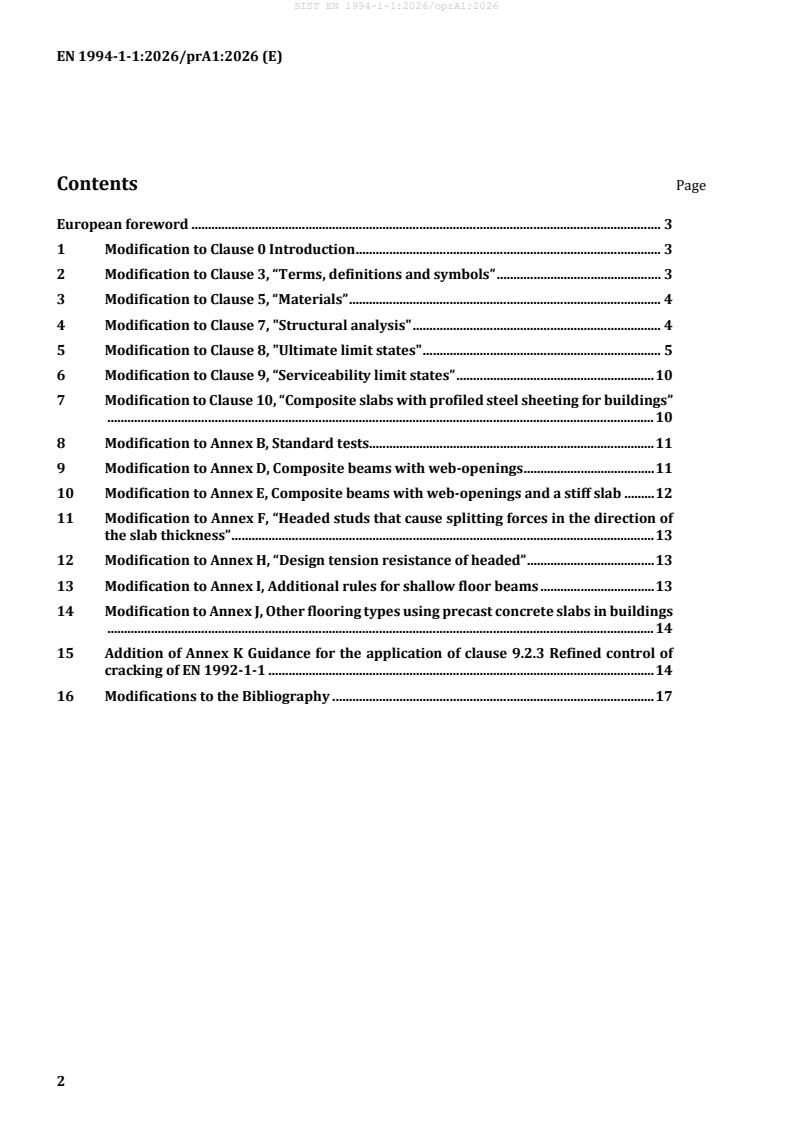
Contents Page
European foreword . 3
1 Modification to Clause 0 Introduction . 3
2 Modification to Clause 3, “Terms, definitions and symbols” . 3
3 Modification to Clause 5, “Materials” . 4
4 Modification to Clause 7, "Structural analysis" . 4
5 Modification to Clause 8, "Ultimate limit states" . 5
6 Modification to Clause 9, “Serviceability limit states” . 10
7 Modification to Clause 10, “Composite slabs with profiled steel sheeting for buildings”
................................................................................................................................................................... 10
8 Modification to Annex B, Standard tests . 11
9 Modification to Annex D, Composite beams with web-openings . 11
10 Modification to Annex E, Composite beams with web-openings and a stiff slab . 12
11 Modification to Annex F, “Headed studs that cause splitting forces in the direction of
the slab thickness” . 13
12 Modification to Annex H, “Design tension resistance of headed” . 13
13 Modification to Annex I, Additional rules for shallow floor beams . 13
14 Modification to Annex J, Other flooring types using precast concrete slabs in buildings
................................................................................................................................................................... 14
15 Addition of Annex K Guidance for the application of clause 9.2.3 Refined control of
cracking of EN 1992-1-1 . 14
16 Modifications to the Bibliography . 17
European foreword
This document (EN 1994-1-1:2026/prA1:2026) has been prepared by Technical Committee CEN/TC 250
“Structural Eurocodes”, the secretariat of which is held by BSI.
This document is currently submitted to the CEN Enquiry.
This document will supersede EN 1994-1-1:2026.
NOTE Some modifications are purely editorial corrections to improve the quality of the document and these
will not be tagged in the consolidated publication, as noted after the modification.
The first generation of EN Eurocodes was published between 2002 and 2007. This document forms part
of the second generation of the Eurocodes, which have been prepared under Mandate M/515 issued to
CEN by the European Commission and the European Free Trade Association.
The Eurocodes have been drafted to be used in conjunction with relevant execution, material, product
and test standards, and to identify requirements for execution, materials, products and testing that are
relied upon by the Eurocodes.
The Eurocodes recognise the responsibility of each Member State and have safeguarded their right to
determine values related to regulatory safety matters at national level through the use of National
Annexes.
1 Modification to Clause 0 Introduction
0.5 Add “Annex K” to the list of informative annexes in the paragraph: “National choice is allowed in EN
1994-1-1 on the application of the following informative annexes, in alphabetical order.”
2 Modification to Clause 3, “Terms, definitions and symbols”
3.2.1 Replace the definition of R with “Maximum resistance based on mean values of material properties”
m
3.2.1 In definition of V replace “acting on” with “in”.
a,Ed
3.2.1 In definition of V replace “acting on” with “in”.
c,Ed
3.2.1 In definition of V replace “acting on” with “in”.
Ed
3.2.1 In definition of P replace “acting on” with “in”.
s,Ed
3.2.1 In definition of P replace “acting on” with “in”.
ten,Ed
3.2.1 In definition of V replace “acting on” with “in”.
bT,Ed
3.2.1 In definition of V replace “acting on” with “in”.
iT,Ed
3.2.1 In definition of Voa,Ed replace “acting on” with “in”.
3.2.1 In definition of V replace “acting on” with “in”.
oc,Ed
3.2.1 In definition of V replace “acting on” with “in”.
o,Ed
3.2.1 In definition of V replace “acting on” with “in”.
tT,Ed
3.2.2 Add “w maximum deflection at the maximum resistance R ”
u m
3.5.2 Replace “s ” with “s”
3.8.3 In definition of ψ replace “acting on” with “in”.
ec,N
Add the following new clause
“3.11 Additional symbols used in Annex K
3.11.1 Latin lower case letters
a Distance from the outermost fibre in tension to the centre of the nearest reinforcement bar
z
c Cover from the concrete surface in tension to the surface of the closest bar
h Total height of the composite section
k Factor accounting for the increase of crack width due to curvature
1/r
k Factor accounting for the short-term (creep and shrinkage to be excluded) distribution of stresses
fl
between cracks
k Coefficient dependent on the duration and nature of load
t
k Factor to convert the mean crack width into a calculated crack width
w
z Depth of the neutral axis, measured from the most compressed fibre and determined with section
r
properties assuming a cracked concrete flange
3.11.2 Greek lower case letters
ε Strain in the most tensioned fibre concrete fibre determined using uncracked short-term section
properties
ε Strain in the least tensioned fibre concrete fibre determined using uncracked short-term section
properties
εcm Mean concrete strain due to external loads and shrinkage
ε Free shrinkage strain of concrete
cs
ε Mean steel strain due to external loads and shrinkage
sm
ρ Reinforcement ratio of the slab”
3 Modification to Clause 5, “Materials”
5.1(8) Replace “Annex M” with “Annex N”
5.1(8) Add a NOTE below “lightweight aggregate concrete.”:
“NOTE Guidance for the application of Recycled Aggregate Concrete is given in EN 206, EN 1992-1-1 and
the related National Annexes.”
5.4.2.1(1) Delete the word “see” before “Figure 5.1”
5.4.2.1(8) Delete this paragraph
4 Modification to Clause 7, "Structural analysis"
7.4.1.2(2) Replace the NOTE with “NOTE For general provisions related to shear lag of the steel part in
member design, see EN 1993-1-5:2024, Clause 5.”
7.5.3.2(3) Replace figure in Table 7.2, under “3 Stress distribution (compression positive) to fill steel plate
in black” with the following:
5 Modification to Clause 8, "Ultimate limit states"
8.2.1.2(2) Figure 8.3, in key 5 replace
“S355 with z /h ≤ 0,5: β = 1-0,4(z /h – 0,15) ≤ 1,0”
pl pl
with
“S355 with z /h ≤ 0,5: β = 1-0,333(z /h – 0,2) ≤ 1,0”
pl pl
Replace
“S420/S460 with z /h ≤ 0,4: β = 1-0,333(z /h – 0,2) ≤ 1,0”
pl pl
With
“S420/S460 with z /h ≤ 0,4: β = 1-0,4(z /h – 0,15) ≤ 1,0”.
pl pl
8.2.1.2(4) Replace “When the conditions in (2)b) are satisfied, the coefficient β may be taken as 1,0 if:”
With
“When the conditions in (2)b) (except that concerning the effective width of the concrete flange) are
satisfied, the coefficient β may be taken as 1,0 if:”
8.2.1.2(4)b) Replace “the concrete flange is considered to be either solid or with profiled sheeting and a
concrete depth h of at least 70 mm.”
c
With
“the concrete flange is considered to be either solid or with profiled sheeting and a concrete depth h of
c
at least 50 mm.”
8.2.1.3(2) Figure 8.4, replace “N ” with “N ” as follows:
C,t c,f
8.2.1.3(7) Replace figure 8.6 by moving βM horizontal branch to a lower position to improve clarity and
pl,Rd
both dotted lines must end at the value β M , as follows:
pl
8.2.2.4(3) Replace “acting on” with “in”.
8.2.2.5(1) Replace twice “acting on” with “in”.
8.3.2(2) Replace Figure 8.11 as follows:
8.3.3(3) Replace “acting on” with “in”.
8.6.3.3(1) Replace “For partial shear connection, either the calculated maximum slip should not exceed
the capacity given in 5.4.2.1 or degree of shear connection should comply with the limit in (2).”
with
“For partial shear connection, either the maximum slip should not exceed the slip capacity δ given in
uk
5.4.2.1 or the degree of shear connection should comply with the limit in (2).”
8.6.3.3(2) Modify the definition of nf to: ”number of connectors for full shear connection (N /P ) that are
cf Rd
required between the point of zero moment and the point of maximum moment”
8.6.6(1) Replace the whole of the paragraph with:
”Where non-linear theory according to 8.2.1.5 or 8.2.1.6 is used to determine the resistance, the
longitudinal shear force should be determined in accordance with 8.6.4, where the normal force in the
concrete flange may be determined in accordance with 8.2.1.5 or 8.2.1.6. Alternatively, more advanced
methods in accordance with 8.6.2 may be used.”
8.6.8.1 replace Figure 8.16 with the following:
𝐼𝐼𝐼𝐼
8.8.2(8) In the definition of 𝑁𝑁 replace
𝐸𝐸𝐸𝐸
“the design value N is that from global analysis.”
Ed
With
II
“The value of N may be taken as equal to the design value from the global analysis, N .”
Ed
Ed
8.8.2(8) In the definition of R replace
m
“is the mean value of resistance, obtained from non-linear analysis, as defined in (9);”
with
“is the maximum resistance of the column based on mean material properties when subject to non-linear
analysis in accordance with (9), see Figure 8.25;”
8.8.2(8) Add the following definition: “w maximum deflection of member at the maximum
u
resistance R ”.
m
8.8.2(8) In NOTE 1 replace “The mean value R of the resistance” with “The value of R ”
m m
8.8.2(9) Replace figure 8.25 as follows:
“
”
8.8.2(10) Add “and position along the column” to the end of the existing last sentence.
8.8.2(10) Add a new sentence at the end “The maximum value of γ should be used in the verification in
o
(9).”
8.8.3.2(4) Replace twice “acting on” with “in”
8.8.3.5(2) Table 8.7 Replace the text at the bottom of the table with the following:
“The values in the table above apply to composite columns with doubly-symmetric steel sections as
follow:
• Hot-rolled sections with h/b not greater than 2,4 and a flange thickness t not greater than
f
150mm.
• Hot-rolled sections with h/b greater than 2,4 and a flange thickness t not greater than 40mm.
f
• Welded sections with a flange thickness t not greater than 40mm
f
For hot-rolled sections with h/b greater than 2,4 and a flange thickness t greater than 40mm the buckling
f
curve for buckling about the yy axis should be reduced by one class (e.g. from b to c) and the member
imperfection increased to suit (e.g. from L/200 to L/150).
For welded sections with a flange thickness t greater than 40mm the buckling curve for buckling about
f
both axes should be reduced by one class and the member imperfection increased to suit.”
8.8.4.2(9) Replace figure 8.32 as follows: “
“
8.8.3.5(2) Table 8.7 Replace the text at the bottom of the table with the following:
“The values in the table above apply to composite columns with doubly-symmetric steel sections as
follow:
• Hot-rolled sections with h/b not greater than 2,4 and a flange thickness t not greater than
f
150mm.
• Hot-rolled sections with h/b greater than 2,4 and a flange thickness t not greater than 40mm.
f
• Welded sections with a flange thickness t not greater than 40mm
f
For hot-rolled sections with h/b greater than 2,4 and a flange thickness t greater than 40mm the buckling
f
curve for buckling about the yy axis should be reduced by one class (e.g. from b to c) and the member
imperfection increased to suit (e.g. from L/200 to L/150).
...