

kSIST FprEN 16087-2:2026
(Main)Soil improvers and growing media - Determination of the aerobic biological degradation rate of organic matter - Part 2: Self heating test for compost
- Abstract
This document specifies a method to determine the aerobic biological degradation rate of organic matter using a self-heating test. This method is only applicable to composted materials.
NOTE This method has been validated in an interlaboratory study with specific products that were present on the market during the study (as included in Annex A, being composted bark, biowaste compost and green compost).
- Status
- Not Published
- Public Enquiry End Date
- 19-Dec-2025
- Technical Committee
- KAT - Soil quality
- Current Stage
- 5020 - Formal vote (FV) (Adopted Project)
- Start Date
- 13-Oct-2026
- Due Date
- 01-Dec-2026
- Completion Date
- 16-Nov-2026

kSIST FprEN 16087-2:2026 is the SIST version of a draft European standard from CEN for the self-heating test for compost. It specifies a laboratory method for determining the aerobic biological degradation rate of organic matter in composted materials. It is written for laboratories, producers and other users who need a common test method for soil improvers and growing media.
What does kSIST FprEN 16087-2:2026 specify?
kSIST FprEN 16087-2:2026 specifies one test method: measuring self-heating in a Dewar vessel and using the maximum temperature as an indicator of aerobic biological activity. The method applies only to composted material.
The document is organized into clauses for scope, normative references, terms and definitions, principle, apparatus, sampling, procedure, expression of results, test report, and validation of the method. Annex A gives performance characteristics from the interlaboratory study.
| Annex | What it covers |
|---|---|
| Annex A | Performance characteristics of the method |
What are the key requirements of kSIST FprEN 16087-2:2026?
kSIST FprEN 16087-2:2026 requires the test to be run under controlled conditions so the temperature rise reflects the compost’s biological activity, not handling or storage effects. In practice, the sample has to be representative, prepared consistently, and measured in a defined setup.
Scope and sampling
Clause 6 says sampling is not part of the method and refers users to EN 12579:2024. The laboratory should receive a representative sample that has not been damaged or changed during transport or storage.
Sample handling and preparation
Clause 7 requires the self-heating test to be carried out as soon as possible after sampling. Short storage at 3 °C ± 2 °C is allowed for up to five days, and freezing is to be avoided. The sample is sieved to 10 mm, and if too much material remains on the sieve, the method is not appropriate for that product.
Moisture control
Clause 7.2.2 introduces the “fist test” to judge whether the compost is too dry, too moist, or in an acceptable moisture condition for microbial activity. If needed, the sample is moistened with tap water or air-dried before testing. In practice, this is important because moisture strongly affects biological activity and the temperature response.
Test setup and measurement
Clause 5 specifies the equipment: a 1.5 l Dewar vessel, a temperature measurement device with maximum-temperature recording, a 10 mm sieve, and a room or climate cabinet at 20 °C ± 2 °C. Clause 7.3 describes filling the vessel, placing the sensor in the sample, and leaving the vessel uncovered. If the test uses equipment without continuous recording, the temperature has to be measured in duplicate with time separation.
End point and result
Clause 8 states that the result is the maximum temperature reached by the sample, reported as T in °C, together with the corresponding Rottegrad. This gives users a simple way to compare compost activity and to classify the degree of decomposition.
Test report and validation
Clause 9 lists the minimum contents of the test report, including the document reference, sample identification, maximum temperature, and any optional or outside-method work cycles that may have influenced the result. Clause 10 says the method was validated in accordance with ISO 5725-2, and Annex A summarizes the interlaboratory performance data for three compost materials.
What terms does kSIST FprEN 16087-2:2026 define?
kSIST FprEN 16087-2:2026 uses the terms and definitions from CEN/TS 17732:2022.
- Aerobic biological activity - the biological activity measured here through the sample’s self-heating behavior.
- Self-heating test - the test in which compost is placed in a Dewar vessel and the temperature rise is recorded.
- Dewar vessel - the insulated vessel used to limit heat loss during the measurement.
- Rottegrad - the temperature-based decomposition class used to report the result.
- Fist test - the hand test used to judge and adjust compost moisture before measurement.
Who uses kSIST FprEN 16087-2:2026?
kSIST FprEN 16087-2:2026 is used by laboratories that test compost, and by producers, quality managers and technical staff working with soil improvers and growing media. It is also relevant for organizations that need comparable test results for product characterization, routine control, or validation work linked to composted materials.
The annex notes that the method was studied on composted bark, biowaste compost and green compost, so those are the kinds of materials for which the test performance was checked.
What changed in kSIST FprEN 16087-2:2026 from the previous edition?
kSIST FprEN 16087-2:2026 will supersede EN 16087-2:2011. The European foreword states one significant technical change: the description of the fist test was made more precise.
Which standards are used with kSIST FprEN 16087-2:2026?
kSIST FprEN 16087-2:2026 refers to these documents for requirements or supporting information:
- CEN/TS 17732:2022 - provides the terms and definitions used in the document.
- EN 12579:2024 - covers sampling of soil improvers and growing media.
- ISO 5725-2 - provides the statistical framework used for method validation and precision assessment.
What does the kSIST FprEN 16087-2:2026 document contain?
kSIST FprEN 16087-2:2026 contains the method principle, apparatus list, sampling guidance, detailed procedure, and the way to express and report results. It also includes validation information showing how the method was checked in an interlaboratory study.
Annex A gives the performance characteristics of the method for the compost materials studied. The bibliographic references point to the precision standard used for validation, the EU fertilising products regulation, and the published interlaboratory study report.
Relations
- Effective Date
- 01-Dec-2025
Get Certified
Connect with accredited certification bodies for this standard

Control Union Certifications
Global certification for agriculture and sustainability.

ECOCERT
Organic and sustainability certification.

FSC International
Forest Stewardship Council certification.
Sponsored listings
Frequently Asked Questions
kSIST FprEN 16087-2:2026 is a draft published by the Slovenian Institute for Standardization (SIST). Its full title is "Soil improvers and growing media - Determination of the aerobic biological degradation rate of organic matter - Part 2: Self heating test for compost". This standard covers: This document specifies a method to determine the aerobic biological degradation rate of organic matter using a self-heating test. This method is only applicable to composted materials. NOTE This method has been validated in an interlaboratory study with specific products that were present on the market during the study (as included in Annex A, being composted bark, biowaste compost and green compost).
This document specifies a method to determine the aerobic biological degradation rate of organic matter using a self-heating test. This method is only applicable to composted materials. NOTE This method has been validated in an interlaboratory study with specific products that were present on the market during the study (as included in Annex A, being composted bark, biowaste compost and green compost).
kSIST FprEN 16087-2:2026 is classified under the following ICS (International Classification for Standards) categories: 65.080 - Fertilizers. The ICS classification helps identify the subject area and facilitates finding related standards.
kSIST FprEN 16087-2:2026 has the following relationships with other standards: It is inter standard links to SIST EN 16087-2:2012. Understanding these relationships helps ensure you are using the most current and applicable version of the standard.
kSIST FprEN 16087-2:2026 is associated with the following European legislation: EU Directives/Regulations: 2019/1009; Standardization Mandates: M/564. When a standard is cited in the Official Journal of the European Union, products manufactured in conformity with it benefit from a presumption of conformity with the essential requirements of the corresponding EU directive or regulation.
kSIST FprEN 16087-2:2026 is available in PDF format for immediate download after purchase. The document can be added to your cart and obtained through the secure checkout process. Digital delivery ensures instant access to the complete standard document.
Standards Content (Sample)
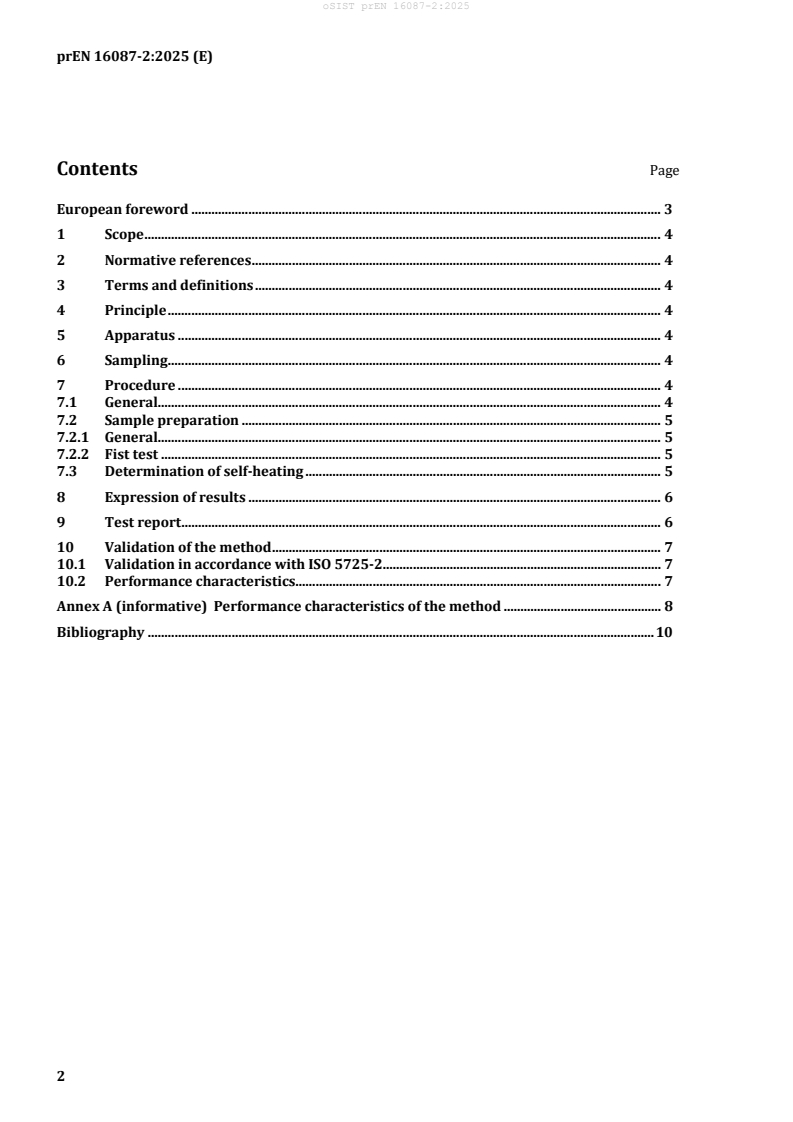
Contents
- 1 Scope
- 2 Normative references
- 3 Terms and definitions
- 4 Principle
- 5 Apparatus
- 5.2 Temperature measurement device, capable of recording a maximum temperature with an
- 6 Sampling
- 7 Procedure
- 7.1 General
- 7.2 Sample preparation
- 7.3 Determination of self-heating
- 8 Expression of results
- 9 Test report
- 10 Validation of the method
- 10.2 Performance characteristics
- Annex A
- Bibliography
1 Scope
This document specifies a method to determine the aerobic biological activity using a self-heating test. This method is only applicable to composted material.
2 Normative references
The following documents are referred to in the text in such a way that some or all of their content constitutes requirements of this document. For dated references, only the edition cited applies. For undated references, the latest edition of the referenced document (including any amendments) applies. CEN/TS 17732:2022, Soil improvers and growing media — Terminology EN 12579:2024, Soil improvers and growing media — Sampling
3 Terms and definitions
For the purposes of this document, the terms and definitions given in CEN/TS 17732:2022 apply. ISO and IEC maintain terminology databases for use in standardization at the following addresses:
- ISO Online browsing platform: available at https://www.iso.org/obp/
- IEC Electropedia: available at https://www.electropedia.org/
4 Principle
Measurement of self-heating in a Dewar vessel and measurement of the maximum temperature, where the temperature is an indicator of the state of aerobic biological activity.
5 Apparatus
5.1 Dewar vessel, with a volume of 1,5 l and an internal diameter of 100 mm ± 3 mm.
5.2 Temperature measurement device, capable of recording a maximum temperature with an
accuracy of ± 2 °C.
5.3 Sieve, square aperture with a 10 mm mesh size.
5.4 Temperature controlled room or climate cabinet, with a temperature of 20 °C ± 2 °C.
6 Sampling
Sampling is not part of the method specified in this document. Follow EN 12579:2024 dealing with soil improvers and growing media. It is important that the laboratory receives a sample that is representative of the product under consideration. The sample should not have been damaged or changed during transport or storage.
7 Procedure
7.1 General
The self-heating test shall be carried out as soon as possible after sampling. Storage of the sample at 3 °C ± 2 °C for a maximum of five days is possible.
oSIST prEN 16087-2:2025 prEN 16087-2:2025 Ensure that the temperature of the sample material corresponds to a temperature of 20 °C ± 2 °C at the beginning of the test.
Record the ambient temperature during the trial to ensure that the required temperature is maintained. Freezing of the samples shall be avoided as changes of the biological characteristics of the material are to be expected.
7.2 Sample preparation
7.2.1 General
For the measurement of the self-heating, the fresh test sample (3 l per single measurement) is sieved ≤ 10 mm (5.3). If more than 30 % of the material is retained on the sieve, the method is not appropriate. The moisture content is adjusted according to the results of a fist test (see 6.2.2). Optimal compost sample moisture conditions (30 % to 65 % mass percentage of the total mass) should be maintained for successful application of the self-heating procedure.
7.2.2 Fist test
The optimal moisture content shall be assessed by applying the ‘fist test’ to a subsample of compost. The fist test should be carried out wearing protective gloves. To ascertain that the moisture content of the compost is in an optimal range for microbial activity, the moisture content is adjusted if necessary prior to testing.
...