

oSIST prEN 17149-3:2021
(Main)Railway applications - Strength assessment of railway vehicle structures - Part 3: Fatigue strength assessment based on cumulative damage
General Information
- Abstract
This European Standard specifies a procedure for fatigue strength assessment of rail vehicle structures based on cumulative damage.
It is part of a series of standards that specifies procedures for strength assessments of structures of rail vehicles that are manufactured, operated and maintained according to standards valid for railway applications.
This document is applicable for variable amplitude load data with total number of cycles higher than 10000 cycles.
An endurance limit approach is outside the scope of this European Standard.
The assessment procedure of the series is restricted to ferrous materials and aluminium.
This document series does not define design load cases.
This document series is not applicable for corrosive conditions or elevated temperature operation in the creep range.
This series of standards is applicable to all kinds of rail vehicles, however it does not define in which cases a fatigue strength assessment using cumulative damage is to be applied.
- Status
- Not Published
- Public Enquiry End Date
- 15-Sep-2021
- Technical Committee
- IŽNP - Reilway applications
- Current Stage
- 4020 - Public enquire (PE) (Adopted Project)
- Start Date
- 01-Jul-2021
- Due Date
- 18-Nov-2021
- Completion Date
- 16-Sep-2021

Overview
prEN 17149-3 - Railway applications - Strength assessment of railway vehicle structures - Part 3: Fatigue strength assessment based on cumulative damage (CEN) defines a procedure for evaluating fatigue strength of rail vehicle structures using cumulative damage methods. The standard applies to variable-amplitude load histories with more than 10 000 cycles and is limited to ferrous materials and aluminium. It excludes endurance-limit approaches, corrosive environments, and elevated-temperature (creep-range) service. prEN 17149-3 is one part of the wider prEN 17149 series covering strength assessments for railway rolling stock.
Key topics and technical requirements
- Stress determination for parent material and welded joints, including nominal, structural and notch-stress approaches.
- Fatigue strength parameters for parent materials and welds: component fatigue strength, reference values, S–N curves and material properties.
- Cumulative damage rules and methods for damage summation using variable-amplitude spectra.
- Load and spectrum processing: conditioning, counting (e.g., cycle counting), mean-stress adjustment and omission rules for stress histories.
- Partial factors to cover uncertainties (loads, component strength, inspection and validation), enabling design/assessment safety margins.
- Welded joint specifics: reference S–N data, thickness and bending influences, residual stress factors, post‑weld improvement, quality and inspection class effects.
- Laboratory testing provisions to establish fatigue properties for parent materials and welds when needed.
- Informative and normative annexes (A–H) that provide procedures for mean-stress factors, casting defect guidance, reference tables for welded joints, thickness/bending considerations, and finite-element methods for structural stress evaluation.
- Limitations: the series does not set design load cases, does not mandate when to use cumulative-damage assessment, and is not applicable under corrosive or high-temperature creep conditions.
Applications and users
prEN 17149-3 is intended for practical use in:
- Design and verification of rail vehicle structural components (frames, bogie parts, body structures).
- Fatigue life prediction and residual life assessment using field-derived or simulated load spectra.
- Weld design optimization, inspection planning and post‑weld treatment decisions.
- Certification, validation and maintenance-planning activities by manufacturers, engineering consultancies, railway operators, and notified bodies. Typical users: structural and fatigue engineers, maintenance planners, approval authorities, and test laboratories.
Related standards
- Part of the prEN 17149 series (strength assessment of rail vehicle structures).
- Cross-references in the document include weld-quality classifications (e.g., EN 15085 for weld seam types) and other normative references used throughout the assessment procedure.
Keywords: prEN 17149-3, fatigue strength assessment, cumulative damage, railway vehicle structures, S–N curves, welded joints, ferrous materials, aluminium, CEN.
Get Certified
Connect with accredited certification bodies for this standard

IRIS Certification (UNIFE)
International Railway Industry Standard certification.

TÜV SÜD Rail GmbH
TÜV SÜD railway certification services.

Bureau Veritas Railway Certification
Railway and transportation certification.
Sponsored listings
Frequently Asked Questions
oSIST prEN 17149-3:2021 is a draft published by the Slovenian Institute for Standardization (SIST). Its full title is "Railway applications - Strength assessment of railway vehicle structures - Part 3: Fatigue strength assessment based on cumulative damage". This standard covers: This European Standard specifies a procedure for fatigue strength assessment of rail vehicle structures based on cumulative damage. It is part of a series of standards that specifies procedures for strength assessments of structures of rail vehicles that are manufactured, operated and maintained according to standards valid for railway applications. This document is applicable for variable amplitude load data with total number of cycles higher than 10000 cycles. An endurance limit approach is outside the scope of this European Standard. The assessment procedure of the series is restricted to ferrous materials and aluminium. This document series does not define design load cases. This document series is not applicable for corrosive conditions or elevated temperature operation in the creep range. This series of standards is applicable to all kinds of rail vehicles, however it does not define in which cases a fatigue strength assessment using cumulative damage is to be applied.
This European Standard specifies a procedure for fatigue strength assessment of rail vehicle structures based on cumulative damage. It is part of a series of standards that specifies procedures for strength assessments of structures of rail vehicles that are manufactured, operated and maintained according to standards valid for railway applications. This document is applicable for variable amplitude load data with total number of cycles higher than 10000 cycles. An endurance limit approach is outside the scope of this European Standard. The assessment procedure of the series is restricted to ferrous materials and aluminium. This document series does not define design load cases. This document series is not applicable for corrosive conditions or elevated temperature operation in the creep range. This series of standards is applicable to all kinds of rail vehicles, however it does not define in which cases a fatigue strength assessment using cumulative damage is to be applied.
oSIST prEN 17149-3:2021 is classified under the following ICS (International Classification for Standards) categories: 45.060.01 - Railway rolling stock in general. The ICS classification helps identify the subject area and facilitates finding related standards.
oSIST prEN 17149-3:2021 is available in PDF format for immediate download after purchase. The document can be added to your cart and obtained through the secure checkout process. Digital delivery ensures instant access to the complete standard document.
Standards Content (Sample)
SLOVENSKI STANDARD
01-september-2021
Železniške naprave - Ocenjevanje odpornosti konstrukcije železniških vozil - 3.
del: Ocena odpornosti proti utrujenosti na podlagi kumulativne škode
Railway applications - Strength assessment of railway vehicle structures - Part 3: Fatigue
strength assessment based on cumulative damage
Bahnanwendungen - Festigkeitsnachweis von Schienenfahrzeugstrukturen - Teil 3:
Betriebsfestigkeitsnachweis
Applications ferroviaires - Évaluation de la résistance des structures de véhicule
ferroviaire - Partie 3 : Évaluation de la résistance à la fatigue basée sur la méthode des
dommages cumulés
Ta slovenski standard je istoveten z: prEN 17149-3
ICS:
45.060.01 Železniška vozila na splošno Railway rolling stock in
general
2003-01.Slovenski inštitut za standardizacijo. Razmnoževanje celote ali delov tega standarda ni dovoljeno.
DRAFT
EUROPEAN STANDARD
NORME EUROPÉENNE
EUROPÄISCHE NORM
June 2021
ICS 45.060.01
English Version
Railway applications - Strength assessment of railway
vehicle structures - Part 3: Fatigue strength assessment
based on cumulative damage
Applications ferroviaires - Évaluation de la résistance Bahnanwendungen - Festigkeitsnachweis von
des structures de véhicule ferroviaire - Partie 3 : Schienenfahrzeugstrukturen - Teil 3:
Évaluation de la résistance à la fatigue basée sur la Betriebsfestigkeitsnachweis
méthode des dommages cumulés
This draft European Standard is submitted to CEN members for enquiry. It has been drawn up by the Technical Committee
CEN/TC 256.
If this draft becomes a European Standard, CEN members are bound to comply with the CEN/CENELEC Internal Regulations
which stipulate the conditions for giving this European Standard the status of a national standard without any alteration.
This draft European Standard was established by CEN in three official versions (English, French, German). A version in any other
language made by translation under the responsibility of a CEN member into its own language and notified to the CEN-CENELEC
Management Centre has the same status as the official versions.
CEN members are the national standards bodies of Austria, Belgium, Bulgaria, Croatia, Cyprus, Czech Republic, Denmark, Estonia,
Finland, France, Germany, Greece, Hungary, Iceland, Ireland, Italy, Latvia, Lithuania, Luxembourg, Malta, Netherlands, Norway,
Poland, Portugal, Republic of North Macedonia, Romania, Serbia, Slovakia, Slovenia, Spain, Sweden, Switzerland, Turkey and
United Kingdom.
Recipients of this draft are invited to submit, with their comments, notification of any relevant patent rights of which they are
aware and to provide supporting documentation.
Warning : This document is not a European Standard. It is distributed for review and comments. It is subject to change without
notice and shall not be referred to as a European Standard.
EUROPEAN COMMITTEE FOR STANDARDIZATION
COMITÉ EUROPÉEN DE NORMALISATION
EUROPÄISCHES KOMITEE FÜR NORMUNG
CEN-CENELEC Management Centre: Rue de la Science 23, B-1040 Brussels
© 2021 CEN All rights of exploitation in any form and by any means reserved Ref. No. prEN 17149-3:2021 E
worldwide for CEN national Members.
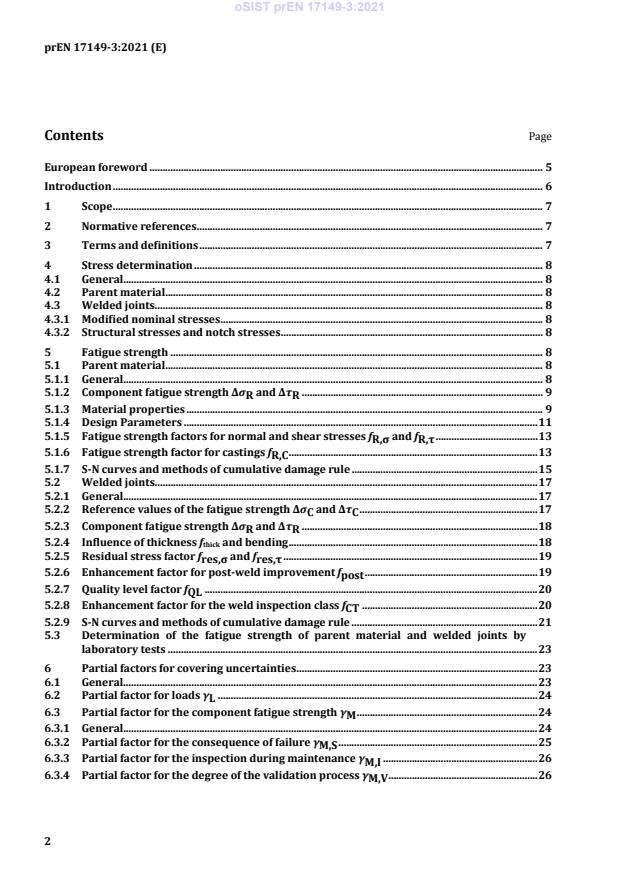
Contents Page
European foreword . 5
Introduction . 6
1 Scope . 7
2 Normative references . 7
3 Terms and definitions . 7
4 Stress determination . 8
4.1 General. 8
4.2 Parent material . 8
4.3 Welded joints . 8
4.3.1 Modified nominal stresses . 8
4.3.2 Structural stresses and notch stresses . 8
5 Fatigue strength . 8
5.1 Parent material . 8
5.1.1 General. 8
5.1.2 Component fatigue strength Δσ and Δτ . 9
R R
5.1.3 Material properties . 9
5.1.4 Design Parameters . 11
5.1.5 Fatigue strength factors for normal and shear stresses f and f . 13
R,σ R,τ
5.1.6 Fatigue strength factor for castings f . 13
R,C
5.1.7 S-N curves and methods of cumulative damage rule . 15
5.2 Welded joints . 17
5.2.1 General. 17
5.2.2 Reference values of the fatigue strength Δσ and Δτ . 17
C C
5.2.3 Component fatigue strength Δσ and Δτ . 18
R R
5.2.4 Influence of thickness f and bending . 18
thick
5.2.5 Residual stress factor f and f . 19
res,σ res,τ
5.2.6 Enhancement factor for post-weld improvement f . 19
post
5.2.7 Quality level factor f . 20
QL
5.2.8 Enhancement factor for the weld inspection class f . 20
CT
5.2.9 S-N curves and methods of cumulative damage rule . 21
5.3 Determination of the fatigue strength of parent material and welded joints by
laboratory tests . 23
6 Partial factors for covering uncertainties . 23
6.1 General. 23
6.2 Partial factor for loads γ . 24
L
6.3 Partial factor for the component fatigue strength γ . 24
M
6.3.1 General. 24
6.3.2 Partial factor for the consequence of failure γ . 25
M,S
6.3.3 Partial factor for the inspection during maintenance γ . 26
M,I
6.3.4 Partial factor for the degree of the validation process γ . 26
M,V
prEN 17149:2021 (E)
7 Procedure of the fatigue strength assessment based on cumulative damage
calculation . 27
7.1 General . 27
7.2 Stress determination . 28
7.3 Determination of the stress spectrum . 28
7.3.1 Conditioning . 28
7.3.2 Stress history adjustment . 28
7.3.3 Counting . 28
7.3.4 Mean stress adjustment . 29
7.3.5 Omission . 29
7.4 Damage calculation for each single stress component . 30
7.4.1 General . 30
7.4.2 Determination of stress spectrum shape factor A . 31
eq
7.4.3 Determination of admissible damage sum D . 31
m
7.4.4 Determination of cumulative damage sum D and scaling factor x to reach the
it it
admissible damage sum . 31
7.5 Assessment of fatigue strength . 33
Annex A (informative) Procedure for determination of mean stress factors for parent
material and welded joints . 34
A.1 General . 34
A.2 Mean stress sensitivity . 34
A.2.1 Parent material . 34
A.2.2 Welded joints . 35
A.3 Determination of mean stress factors . 35
Annex B (informative) Specification example for permissible volumetric defects in castings
of steel, iron and aluminium . 39
B.1 General . 39
Annex C (informative) Material factors for parent material . 41
Annex D (normative) Reference values of the fatigue strength Δσ and Δτ for welded
C C
joints based on the nominal stress approach . 42
D.1 Explanation of the tables for reference values of the fatigue strength . 42
D.1.1 General . 42
D.1.2 Weld seam type according to EN 15085-3, Table B.1 . 42
D.1.3 Sketch of the joint . 42
D.1.4 Joint specific requirements . 43
D.1.5 Potential crack initiation point . 43
D.1.6 Feasibility for inspection . 43
D.1.7 Relevant thickness for the assessment of a welded joint . 43
D.1.8 Material . 43
D.1.9 Reference values of the fatigue strength Δσ and Δτ . 43
C C
D.1.10 Exponent m and number of cycles at the knee point of the S-N curve N . 43
D
D.1.11 Thickness correction exponents n n and n . 43
σ,┴, σ,|| τ
D.1.12 Fatigue strength factor for structural stresses f (Ω =0) . 44
struc
D.1.13 Lower limit of the plate thickness for the thickness correction t . 44
min
D.1.14 Parameter α used for the determination of f . 44
bend bend
D.2 Tables of reference values of the fatigue strength for welded joints . 45
D.3 Determination of fatigue strength based on comparative notch case models . 80
Annex E (informative) Thickness influence and consideration of bending for welded joints
for nominal and structural stress approach . 81
E.1 General. 81
E.2 Influence quantities . 81
E.2.1 Effective plate thickness t . 81
eff
E.2.2 Thickness correction factor f . 82
thick
E.2.3 Enhancement factor for bending f . 83
bend
E.3 Consideration methods. 84
Annex F (informative) Stress adjustment due to joint geometry for welded joints for
nominal stress approach . 86
F.1 General. 86
F.2 Methods for stress adjustment . 86
F.2.1 Adjustment implemented in the calculation model . 86
F.2.2 Adjustment in the stress evaluation . 86
Annex G (informative) Enhancement of reference value of the fatigue strength Δσ for load
C
carrying T- and cruciform joints with double fillet weld . 90
G.1 General. 90
G.2 Examples for the determination of the enhancement factor for cruciform joints . 90
Annex H (informative) Application of structural stress approach for welded joints of steel
and aluminium . 94
H.1 General for fatigue stress determination on weld toe . 94
H.2 Fatigue stress determination with Finite Element method . 95
H.2.1 Fatigue stress determination at the weld toe . 95
H.2.2 Fatigue stress determination at the root . 96
H.3 Fatigue strength assessment with structural stresses . 96
Annex I (informative) Application of notch stress approach for welded joints of steel and
aluminium . 98
I.1 General. 98
I.2 Calculation of notch stresses . 98
I.2.1 General. 98
I.2.2 Reference notch radius r for modelling of weld notches . 99
ref
I.2.3 Modelling of nominal weld cross sections . 99
I.2.4 Methods for notch stress calculation . 102
I.2.4.1 2D or 3D FEA analysis. 102
I.2.4.2 Mesh refinement . 102
I.2.4.3 Spot welds . 103
I.2.4.4 Weld notch factor K . 103
w
I.3 S-N curves . 103
I.3.1 Direct stress transverse to the weld . 103
I.3.2 Direct stress longitudinal to the weld . 104
I.3.3 Shear stress . 104
I.3.4 Characteristic values dependent on thickness effect . 105
Annex J (informative) Example for fatigue strength assessment . 106
J.1 Description . 106
J.2 Task . 107
J.3 Assessment . 107
Annex K (informative) Flow chart diagrams of fatigue strength assessment procedures . 113
Bibliography . 120
prEN 17149:2021 (E)
European foreword
This document (prEN 17149-3:2021) has been prepared by Technical Committee CEN/TC 256 “Railway
applications”, the secretariat of which is held by DIN.
This document is currently submitted to the CEN Enquiry.
This document is part of the series EN 17149 Railway applications — Strength assessment of railway
vehicle structures, which consists of the following parts:
Part 1: General
Part 3: Fatigue strength assessment based on cumulative damage
The following part is under preparation:
Part 2: Static strength assessment
Introduction
If a fatigue strength assessment is necessary for railway vehicle structures, this assessment may be
made with an endurance limit approach or a cumulative damage approach.
An endurance limit approach is based on the assessment of the stress amplitudes (e.g. derived from the
design load cases or from measurements) against the applicable endurance limit. Such an approach is
established in combination with the normative loads such as those defined in EN 12663 series or
EN 13749.
A fatigue strength assessment based on cumulative damage takes into consideration stress spectra with
varying amplitudes and numbers of cycles or stress time histories. This document provides the basic
procedure and criteria for a pragmatic method to be applied for fatigue strength assessments based on
the cumulative damage approach.
The main body of the document is based on the nominal stress approach, but the consideration of
variable amplitudes and cycles counts according to methods described in this standard may equally be
applied with the structural stress and the notch stress approach (additional information is included as
informative annexes).
Within this document the term fatigue strength assessment is always related to the cumulative damage
approach unless otherwise noted.
prEN 17149:2021 (E)
1 Scope
This document specifies a procedure for fatigue strength assessment of rail vehicle structures based on
cumulative damage.
It is part of a series of standards that specifies procedures for strength assessments of structures of rail
vehicles that are manufactured, operated and maintained according to standards valid for railway
applications.
This document is applicable for variable amplitude load data with total number of cycles higher than
10 000 cycles.
An endurance limit approach is outside the scope of this document.
The assessment procedure of the series is restricted to ferrous materials and aluminium.
This document series does not define design load cases.
This document series is not applicable for corrosive conditions or elevated temperature operation in
the creep range.
This series of standards is applicable to all kinds of rail vehicles; however it does not define in which
cases a fatigue strength assessment using cumulative damage is to be applied.
2 Normative references
The following documents are referred to in the text in such a way that some or all of their content
constitutes requirements of this document. For dated references, only the edition cited applies. For
undated references, the latest edition of the referenced document (including any amendments) applies.
1)
EN 15085-3:2007 , Railway applications — Welding of railway vehicles and components — Part 3:
Design requirements
2)
prEN 17149-1:202X , Railway applications — Strength assessment of railway vehicle structures — Part
1: General
ISO/TR 25901-1:2016, Welding and allied processes — Vocabulary — Part 1: General terms
3 Terms and definitions
For the purposes of this document, the terms and definitions, symbols and abbreviations given in
ISO/TR 25901-1:2016 and prEN 17149-1:202X apply.
ISO and IEC maintain terminological databases for use in standardization at the following addresses:
• IEC Electropedia: available at http://www.electropedia.org/
• ISO Online browsing platform: available at http://www.iso.org/obp
1)
document impacted by AC:2009.
2)
under development.
4 Stress determination
4.1 General
The stress spectrum used to perform the fatigue strength assessment based on cumulative damage
approach shall be expressed in terms of stress amplitudes, mean stresses and number of cycles to
represent the design life.
The design stress spectrum shall incorporate any necessary allowance to account for uncertainties in
their values. If relevant, this may be achieved by application of a partial factor γ on the representative
L
stress spectrum as specified in the application code. In 6.2 recommendations and requirements for the
partial factor γL are given.
NOTE EN 12663 series, EN 15827 and EN 13749 contain information on how to determine design loads for
cumulative damage assessment of railway vehicles.
The combination of the individual stress components direct and shear is considered in 7.5.
4.2 Parent material
The stresses for the parent material shall be determined by the nominal stress approach as described in
prEN 17149-1:202X.
4.3 Welded joints
4.3.1 Modified nominal stresses
The modified nominal stresses for welded joints shall be determined according to prEN 17149-1:202X,
5.3.
4.3.2 Structural stresses and notch stresses
For the fatigue strength assessment of welded joints, the structural stress approaches and the notch
stress approach may be applied. For the application of these approaches, the requirements for the
calculation of the relevant stresses and fatigue strength is described in the following informative
annexes:
Annex H for the structural stress approach and
Annex I for the notch stress approach.
5 Fatigue strength
5.1 Parent material
5.1.1 General
This clause describes the method for a derivation of the fatigue strength of parent material under the
following conditions:
materials used such as construction steel, weldable cast steel, cast iron (GJS and ADI), wrought
steel, cast aluminium, and wrought aluminium;
application temperature up to 100 °C for aluminium and up to 200 °C for steel;
plane stress tensor on the components surface (no significant stress component perpendicular to
the surface, e.g. press fit connection).
prEN 17149:2021 (E)
The restrictions defined above are met with most applications of parent material for railway vehicles, in
which case a simplified assessment method is appropriate. If the scope of the application is exceeded,
an assessment method shall be chosen which accounts for the specific application (e.g. high
temperatures and 3-dimensional stress states).
Annex C gives an overview over the applicable material factors.
5.1.2 Component fatigue strength Δσ and Δτ
R R
The fatigue strength is specified by S-N curves, which define the values of the component fatigue
strength Δσ and Δτ (in N/mm², unless stated otherwise) related to:
R R
𝑁𝑁 = 10 ,
𝐶𝐶
stress ratio 𝑅𝑅 =𝑅𝑅 =−1,
𝜎𝜎 𝜏𝜏
survival probability of 𝑃𝑃 = 97,5 %,
𝑠𝑠
membrane stresses.
The values of the component fatigue strength are determined with the following formulae:
( )
∆𝜎𝜎 𝑁𝑁 = 10 ,𝑅𝑅 =−1 =𝑅𝑅 ∙𝑓𝑓 ∙𝑓𝑓 ∙𝑓𝑓 (1)
R 𝐶𝐶 σ m R,σ SR,σ R,C
( )
∆𝜏𝜏 𝑁𝑁 = 10 ,𝑅𝑅 =−1 =𝑅𝑅 ∙𝑓𝑓 ∙𝑓𝑓 ∙𝑓𝑓 ∙𝑓𝑓 (2)
R 𝐶𝐶 τ m R,τ R,σ SR,τ R,C
5.1.3 Material properties
5.1.3.1 Tensile strength according to material standards R
m,N
R is the nominal tensile strength according to the material standards considering the actual sheet
m,N
thickness. For milled components, the thickness before milling (semi-finished product) shall be
considered.
For rolled sheets and extrusions an anisotropy factor f shall be considered in the direction transverse
A
to the main direction of rolling in accordance with Table 1, unless this is already considered or explicitly
excluded in the material standard or component specification. For other material applications 𝑓𝑓 = 1,0.
𝐴𝐴
𝑅𝑅 =𝑓𝑓 ∙𝑅𝑅 (3)
𝑚𝑚 𝐴𝐴 𝑚𝑚,𝑁𝑁
Table 1 — Anisotropy factor f for steel and aluminium
A
Material R f
m,N A
[N/mm²]
Rolled Steel ≤ 600 0,9
> 600 0,86
≤ 900
Rolled sheets and extrusions of aluminium ≤ 200 1,0
> 200 0,95
≤ 400
> 400 0,9
≤ 600
All other material applications 1,0
For heat-affected zones in the vicinity of welded joints the nominal tensile strength for the heat-affected
zone R shall be used instead of R . The value for R shall be derived from technical literature
m,HAZ m m,HAZ
(e.g. [2], [5]).
5.1.3.2 Tensile strength specified by drawing or specification R
m,S
Alternative to a material standard, the mechanical properties may be specified by the drawing or
specification.
R is the tensile strength according to a drawing or component specification. If higher values than
m,S
those defined in the material standards are specified for R and the values are checked only by
m,S
random testing, then the specified values are not sufficient reliable and therefore would be non-
conservative to use for the purposes of a fatigue strength assessment. To perform a fatigue strength
assessment with a survival probability of P = 97,5 % the tensile strength R defined by the drawing
S m,S
or component specification shall be reduced according to the following:
𝑅𝑅 = 0,94 ×𝑅𝑅
(4)
𝑚𝑚 𝑚𝑚,𝑆𝑆
The value of 0,94 is applicable if the strength value is checked by three random tests (e.g. hardness test
or tensile test). For other numbers of tests, this value shall be adjusted according to technical literature
(e.g. [2]).
If a validated P = 97,5 % value within the component is available, this value may be used without
S
further reduction.
The R values defined in material standards for a given wall thickness may be used for the purposes
m,N
of fatigue strength assessment with a survival probability of P = 97,5 %.
S
5.1.3.3 Influence of technological size
The assessment method described in this standard does not make any adjustment for the wall thickness
of the component. The strength properties used shall consider the appropriate wall thickness.
For components made from semi-finished products the strength properties shall consider the wall
thickness of the original semi-finished product.
prEN 17149:2021 (E)
5.1.3.4 Influence of application temperature
If the component operating temperature remains within the scope of applicability defined by this
standard, no further adjustment to account for the application temperature is required for the fatigue
strength assessment.
5.1.4 Design Parameters
5.1.4.1 Surface roughness factor f
SR
The surface roughness factor f is dependent on the nominal tensile strength R , the surface
SR m
roughness R and the manufacturing process and is defined by Formula (5) and Formula (6).
Z
𝑅𝑅 2 ×𝑅𝑅
Z m
𝑓𝑓 = 1−𝑎𝑎 ∙ log ∙ log (5)
SR,σ R,σ
[ ]
µ𝑚𝑚 𝑏𝑏
R
𝑅𝑅 2 ×𝑅𝑅
Z 𝑚𝑚
𝑓𝑓 = 1−𝑓𝑓 ∙𝑎𝑎 ∙ log ∙ log (6)
SR,τ R,τ R,σ
[ ]
µ𝑚𝑚 𝑏𝑏
R
a und b are given in Table 2. f is given in Table 4.
R,σ R R,τ
Table 2 — Factors a and b for steel and aluminium
Rσ R
Material a bR [N/mm²]
R,σ
Steel (rolled or forged) 0,22 400
Steel castings 0,20 400
Spheroidal graphite cast iron (GJS) 0,16 400
Ausferritic spheroidal graphite cast iron (ADI) 0,16 400
Aluminium 0,22 133
Cast aluminium 0,20 133
Typical values of the surface roughness R are given in Table 3.
Z
Table 3 — Typical values for R
Z
R Example
Z
[µm]
20 Machined surface
25 Plasma or laser cut plate edges of steel, before shot blasting
50 Oxyfuel flame cutting of steel
80 Roughly machined surface;
Shot blasted rolled sheet surface;
Rolled sheet and extrusions of aluminium
200 Rolled sheet surface of steel, not shot blasted;
Forging steel;
Casting surface;
Plasma or laser cut plate edges of aluminium
If explicit values for surface roughness are defined in the drawing or component specification those
values shall be used for the fatigue strength assessment. When applied to castings the benefit of
machined surfaces is only applicable if the machined surface is free from surface breaking defects.
For plate edges of rolled sheets the following requirements shall be applied:
Sharp corners and surface rolling flaws shall be removed by longitudinal grinding;
cracks or visible gouges are not permitted;
weld repairs are not permitted (should be treated as welded joint);
notch effects due to shape of edges shall be considered;
minimum corner radius or chamfer 1 mm;
all burrs shall be removed.
For plate edges of steel manufactured by plasma and laser cut the surface roughness factor f shall be
S,R
reduced by the factor 0,94 and for thermal cut by the factor 0,81.
For plate edges of aluminium, manufactured by plasma or laser cut a surface roughness of R = 200 μm
z
shall be applied independent of the actual surface roughness to account for the local metallurgical
effects. An improvement in the surface roughness factor is only applicable if the affected material
(typically 2 mm) is completely removed by machining after cutting.
The values are valid for nominal stress without the consideration of any stress gradients perpendicular
to the surface. In case of a stress gradient perpendicular to the surface (e.g. stress concentration) the
influence of the surface roughness may be reduced according to technical literature, e.g. [2].
5.1.4.2 Influence of stress gradient
In the assessment method described in this standard the benefit for the fatigue strength associated with
the stress gradient perpendicular to the surface at the assessment location is not included in the fatigue
strength values.
The beneficial effects of stress gradients may be considered according to technical literature, e.g. [2].
prEN 17149:2021 (E)
5.1.4.3 Influence of surface treatment
As a conservative approach in this simplified assessment method the benefit for the fatigue strength
associated with the surface treatment (e.g. peening) is not included.
The beneficial effects of the surface treatment may be considered according to technical literature,
e.g. [2].
5.1.5 Fatigue strength factors for normal and shear stresses f and f
R,σ R,τ
For the determination of the component fatigue strength (stress range) for parent material the fatigue
strength factors given in Table 4 shall be used. These fatigue strength factors are related to N = 10
C
cycles and a stress ratio of R = -1 and correspond to a survival probability of P = 97,5 %.
S
Table 4 — Fatigue strength factors for normal and shear stresses related to N = 10 cycles
C
Material f a
R,σ
f
R,τ
Steel (rolled or forged) 0,75 0,577
Steel castings 0,57 0,577
⁄
Spheroidal graphite cast iron (GJS) 117 N mm² 0,65
0,42 +
𝑅𝑅
m
Ausferritic spheroidal graphite cast iron (ADI) 295 N⁄mm² 0,7
𝑅𝑅
m
Aluminium 0,6 0,577
Cast aluminium 0,6 0,75
a
Ratio between the fatigue strength of shear stress and the one of direct stress.
NOTE For steel castings and spheroidal graphite cast iron, the fatigue strength factors fR,σ given in Table 4
are derived according to [2] (fatigue strength factor for alternating direct stresses fw,σ). The fatigue strength
factors represent the fatigue strength ratio with respect to stress range, these factors include a margin of 1,2 as
given in [2] to cover uncertainties. For aluminium, the fatigue strength factors given in Table 4 are determined
according to test results.
5.1.6 Fatigue strength factor for castings f
R,C
The NDT-level and the corresponding cast quality level applied for castings have an influence on the
fatigue strength values for the local assessment point within the cast component. The fatigue strength
factor for castings f accounts for the effects of any remaining defects on the fatigue strength within
R,C
the casting component. For all non-casting components f = 1,0.
R,C
In the case of structural castings, it is necessary to specify the quality requirements with respect to the
permitted volumetric and surface defect levels to guarantee the mechanical properties to be achieved in
regions subjected to high stresses. The relevant mechanical properties and quality requirements shall
be verified according to the component specification.
The fatigue strength factor for castings f shall be chosen in accordance with the cast quality achieved
R,C
in the cast component. If no specific data is available, Table 5 shows values which may be used for local
assessment points of the casting depending on the NDT-level during production and the verified quality
level according to Annex B.
Table 5 may be used for steel castings and spheroidal graphite cast iron. For cast aluminium parts a
similar procedure may be applied.
Table 5 — Fatigue strength factor for castings f (informative)
R,C
Volumetric inspection by NDT Inspection of surface conditions Fatigue Fatigue
strength factor strength factor
for steel for spheroidal
Relevant Quality level Relevant Quality class
castings graphite cast
Standard according to standard
a
ASTM
f iron (GJS, ADI)
R,C
f
R,C
EN 12680 (UT) Level 3 EN 1369 LM3, AM3, SM4 0,8 0,9
EN 12681 (RT)
EN 1370 4S1/5S2, VC2
EN 1371-1 LP3, AP3
SP3/CP3
Level 2 EN 1369 LM2, AM2 0,9 1,0
SM2
EN 1370 3S1/3S2, VC2
EN 1371-1 LP2, AP2
SP2/CP2
a
castings with elongation at rupture > 6 %
The specification of castings needs to assure appropriate cast quality to maintain the applicability of the
assessment method defined in this document. Informative Annex B gives an example for specification of
volumetric quality levels.
An enhancement of the fatigue strength factor f up to 1,0 is applicable, if the fatigue strength values
R,C
within the component are proven by corresponding tests with test specimen from these regions of the
component and corresponding quality assurance measures for the manufacturing process. A strength
assessment method that does not consider the internal casting defects (e.g. voids) in components
during the stress determination (e.g. a FEA model representing nominal geometry) should be restricted
to castings of quality level 3 or better. For components or parts of components that are not stressed
significantly inferior quality levels also may be applied. For an assessment of such castings it should be
considered that bigger defects can affect significantly the actual stress distributions (e.g. due to locally
reduced sections) and the fatigue strength factor for castings should be reduced accordingly.
prEN 17149:2021 (E)
5.1.7 S-N curves and methods of cumulative damage rule
For S-N curves of parent material all relevant information is given in Table 6 and Table 7.
Table 6 — Exponent beyond knee point of S-N curve, cut-off limit and damage sum limit
Cumulative damage rule Exponent beyond Cut-off limit Damage sum limit
knee point ND
Δσ D
L m,min
Elementary version of - 50% of strength at 1,0
Miner’s rule with cut-off N = 10 cycles
D
limit
Modified version of Miner’s 2×m-1 50% of strength at 1,0 for spheroidal graphite cast iron,
rule ND = 10 cycles (GJS, ADI),
0,3 for all other materials
Consistent version of m for austenitic - 1,0 for spheroidal graphite cast iron,
Miner’s rule steel and (GJS, ADI),
aluminium 0,3 for all other materials
In Figure 1, the principal representation of S-N curves are given for parent material for direct stress. For
S-N-curves of shear stresses the symbol σ is replaced by symbol τ.
Figure 1 — S-N curves for parent material for direct stresses: a) Miner elementary with cut-off
limit; b) Miner modified; c1) Miner consistent for ferritic steel, steel castings and spheroidal
graphite cast iron; c2) Miner consistent for austenitic steel and aluminium
For parent material, the knee point position N is at 10 cycles.
D
NOTE 1 For all parent material except for austenitic steel and aluminium, the stress at the knee point position
N is the endurance limit.
D
Since N = N the following formulae apply:
C
D
𝛥𝛥𝜎𝜎 (𝑅𝑅 =−1) =𝛥𝛥𝜎𝜎 (7)
𝐷𝐷 𝑅𝑅
𝛥𝛥𝜏𝜏 (𝑅𝑅 =−1) =𝛥𝛥𝜏𝜏 (8)
𝐷𝐷 𝑅𝑅
prEN 17149:2021 (E)
For parent materials austenitic steel and aluminium, the exponent beyond the knee point until a second
knee point at N = 10 cycles is given. This is only necessary for application of the cons
...