

kSIST FprEN 6067:2026
(Main)Aerospace series - Pin, quick release, self-retaining, positive locking, double acting - Button handle
- Abstract
This document specifies the dimensions, tolerances and the required characteristics of a quick release, self retaining, positive locking, double acting pin with button handle for aerospace application.
- Status
- Not Published
- Public Enquiry End Date
- 28-Jan-2025
- Technical Committee
- I13 - Imaginarni 13
- Current Stage
- 5020 - Formal vote (FV) (Adopted Project)
- Start Date
- 02-Jun-2026
- Due Date
- 21-Jul-2026
- Completion Date
- 09-Jun-2026

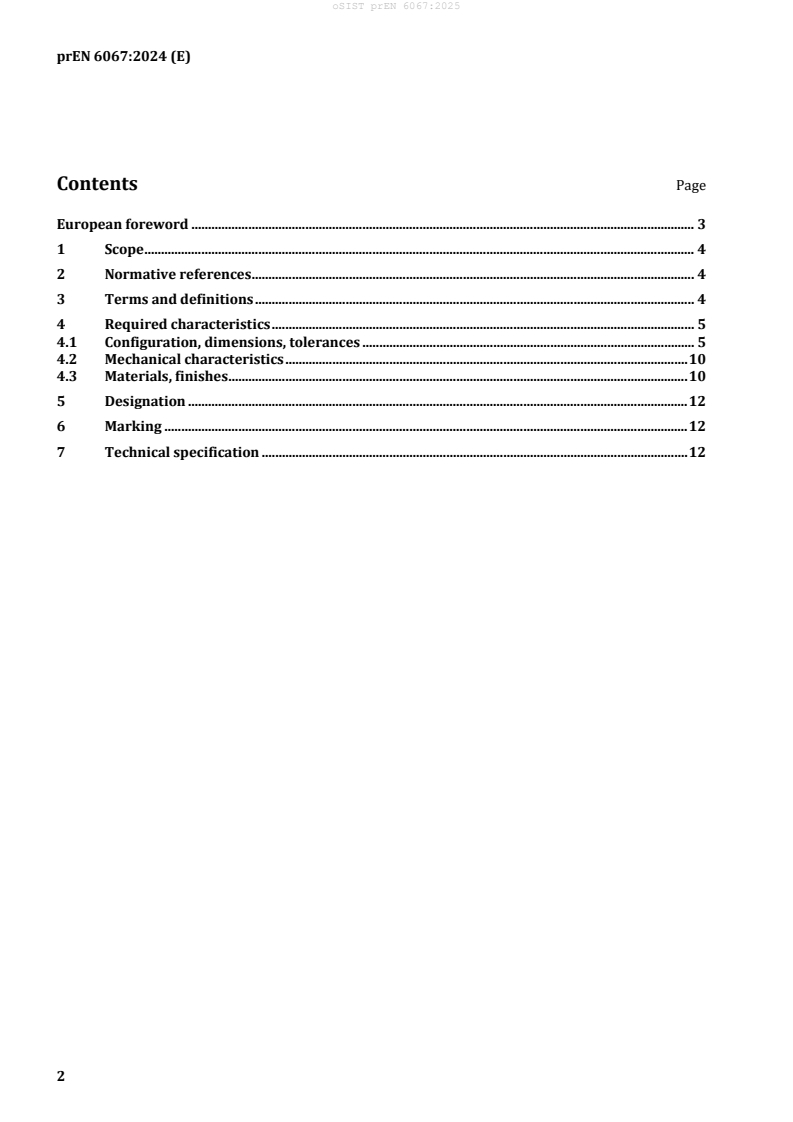
kSIST FprEN 6067:2026 is a SIST publication of the draft European Standard prEN 6067 for aerospace quick-release pins with a button handle. kSIST FprEN 6067:2026 specifies the dimensions, tolerances, required characteristics, designation, marking and technical specification for a quick release, self-retaining, positive locking, double acting pin used in aerospace applications.
What does kSIST FprEN 6067:2026 specify?
kSIST FprEN 6067:2026 specifies a family of button-handle quick-release pins for aerospace use, including their size system, mechanical performance and material/finish choices. The document is organized into clauses on scope, normative references, terms and definitions, required characteristics, designation, marking and technical specification.
The scope in Clause 1 is focused on the pin itself. In practice, that means the document is intended for selecting or specifying the part, not for describing an entire fastening system.
What are the key requirements of kSIST FprEN 6067:2026?
Clause 4 is the core of kSIST FprEN 6067:2026. It links the pin’s geometry, strength and surface treatment to tables and a figure, so the user can choose a standard part and check that the supplied part matches the intended configuration.
Configuration, dimensions and tolerances
Clause 4.1 and Figure 1 define the pin configuration and the main dimensional controls. The document identifies handle codes for T, L and R handles, and Table 1, Table 2 and Table 3 provide the size and grip-length coding system.
In practice, this is what a designer or buyer uses to select a pin that fits the installation space and the mating hole arrangement. Figure 1 also shows the main parts of the pin and notes how grip is measured before staking.
Mechanical characteristics
Clause 4.2 and Table 4 set the mechanical characteristics. The table ties each diameter code to minimum double shear and tensile strength values and to a recommended hole diameter.
This matters because the pin must carry the intended load and still fit the prepared hole correctly. For procurement and inspection, Table 4 is the basis for checking that the supplied size matches the required strength class.
Materials and finishes
Clause 4.3 and Table 5 specify the permitted materials and surface treatments for the body, spindle, button, spring, handle, tab, attaching ring, balls and ring handle. The table names alloy steel 4130, carbon steel, music wire and CRES materials, together with cadmium plating, passivation and heat-treatment conditions where applicable.
In practice, Table 5 is the key source for manufacturing control and incoming inspection. It tells the reader what material family and finish are acceptable for each part of the assembly.
Designation
Clause 5 gives the designation structure and an example format. The designation combines the handle code, diameter code and grip-length code.
This helps ordering and drawing control because one short designation identifies the selected variant. It also reduces ambiguity between handle styles and sizes.
Marking and technical specification
Clause 6 requires marking according to EN 2424, style P. Clause 7 points to NASM 23460 for the technical specification.
For users, that means the part must be identified in the standard aerospace marking style, and the detailed technical specification is taken from the referenced NASM document.
What changed in kSIST FprEN 6067:2026 from the previous edition?
The foreword states one significant technical change relative to ASD-STAN prEN 6067:2000: Table 4, covering material and finishes, was updated.
Which standards are used with kSIST FprEN 6067:2026?
kSIST FprEN 6067:2026 relies on several referenced standards for marking, materials and surface treatment:
- EN 2424 - marking of aerospace products
- AMS 2700 - passivation of corrosion resistant steels
- AMS 5678G - material for corrosion resistant steel
- AMS-QQ-P-416G - cadmium plating
- AMS-QQ-S-763D - corrosion resistant steel bars, wire, shapes and forgings
- AMS-S-6758B - 4130 steel bars and reforging stock
- AMS-T-6736B - 4130 or 8630 steel tubing
- ASTM A108 - carbon and alloy steel bar
- ASTM A228M - music spring wire
- ASTM A240M - stainless steel plate, sheet and strip
- ASTM A313M - stainless steel spring wire
- ASTM A967 - chemical passivation of stainless steel parts
- NASM 23460 - technical specification for the pin family
These references supply the material, finish and marking requirements that Clause 4 and Clause 6 depend on.
What does the kSIST FprEN 6067:2026 document contain?
kSIST FprEN 6067:2026 contains one main figure and five technical tables that work together to define the pin. Figure 1 shows the configuration and names the main parts, while Tables 1 to 3 cover dimensions, handle codes and grip lengths.
Table 4 gives the strength and hole-diameter data, and Table 5 gives the material and finish requirements for each element of the assembly. Clauses 5 to 7 then translate those technical definitions into designation, marking and technical specification rules for ordering, manufacturing and inspection.
Get Certified
Connect with accredited certification bodies for this standard

BUREAU VERITAS Certification Germany
Bureau Veritas certification in Germany.

Element Materials Technology
Materials testing and product certification.

AQMS Ltd.
AQMS provides ISO certification to SMEs across the UK.
Sponsored listings
Frequently Asked Questions
kSIST FprEN 6067:2026 is a draft published by the Slovenian Institute for Standardization (SIST). Its full title is "Aerospace series - Pin, quick release, self-retaining, positive locking, double acting - Button handle". This standard covers: This document specifies the dimensions, tolerances and the required characteristics of a quick release, self retaining, positive locking, double acting pin with button handle for aerospace application.
This document specifies the dimensions, tolerances and the required characteristics of a quick release, self retaining, positive locking, double acting pin with button handle for aerospace application.
kSIST FprEN 6067:2026 is classified under the following ICS (International Classification for Standards) categories: 49.030.40 - Pins, nails. The ICS classification helps identify the subject area and facilitates finding related standards.
kSIST FprEN 6067:2026 is available in PDF format for immediate download after purchase. The document can be added to your cart and obtained through the secure checkout process. Digital delivery ensures instant access to the complete standard document.
Standards Content (Sample)
SLOVENSKI STANDARD
oSIST prEN 6067:2025
01-januar-2025
Aeronavtika - Zatiči s sistemom za hitro odpiranje, samozaporni s pozitivnim
zaklepanjem, z dvojnim delovanjem - Ročaj z gumbom
Aerospace series - Pin, quick release, self-retaining, positive locking, double acting -
Button handle
Luft- und Raumfahrt - Kugelsperrbolzen, selbstsichernd, doppeltwirkend -
Druckknopfbetätigung
Série aérospatiale - Broche, à déclenchement rapide, imperdable, à verrouillage double
action - Poignée à bouton poussoir
Ta slovenski standard je istoveten z: prEN 6067
ICS:
49.030.40 Zatiči, žeblji Pins, nails
oSIST prEN 6067:2025 en,fr,de
2003-01.Slovenski inštitut za standardizacijo. Razmnoževanje celote ali delov tega standarda ni dovoljeno.
oSIST prEN 6067:2025
oSIST prEN 6067:2025
DRAFT
EUROPEAN STANDARD
prEN 6067
NORME EUROPÉENNE
EUROPÄISCHE NORM
November 2024
ICS 49.030.40
English Version
Aerospace series - Pin, quick release, self-retaining,
positive locking, double acting - Button handle
Série aérospatiale - Broche, à déclenchement rapide, Luft- und Raumfahrt - Kugelsperrbolzen,
imperdable, à verrouillage double action - Poignée à selbstsichernd, doppeltwirkend -
bouton poussoir Druckknopfbetätigung
This draft European Standard is submitted to CEN members for enquiry. It has been drawn up by the Technical Committee ASD-
STAN.
If this draft becomes a European Standard, CEN members are bound to comply with the CEN/CENELEC Internal Regulations
which stipulate the conditions for giving this European Standard the status of a national standard without any alteration.
This draft European Standard was established by CEN in three official versions (English, French, German). A version in any other
language made by translation under the responsibility of a CEN member into its own language and notified to the CEN-CENELEC
Management Centre has the same status as the official versions.
CEN members are the national standards bodies of Austria, Belgium, Bulgaria, Croatia, Cyprus, Czech Republic, Denmark, Estonia,
Finland, France, Germany, Greece, Hungary, Iceland, Ireland, Italy, Latvia, Lithuania, Luxembourg, Malta, Netherlands, Norway,
Poland, Portugal, Republic of North Macedonia, Romania, Serbia, Slovakia, Slovenia, Spain, Sweden, Switzerland, Türkiye and
United Kingdom.
Recipients of this draft are invited to submit, with their comments, notification of any relevant patent rights of which they are
aware and to provide supporting documentation.
Warning : This document is not a European Standard. It is distributed for review and comments. It is subject to change without
notice and shall not be referred to as a European Standard.
EUROPEAN COMMITTEE FOR STANDARDIZATION
COMITÉ EUROPÉEN DE NORMALISATION
EUROPÄISCHES KOMITEE FÜR NORMUNG
CEN-CENELEC Management Centre: Rue de la Science 23, B-1040 Brussels
© 2024 CEN All rights of exploitation in any form and by any means reserved Ref. No. prEN 6067:2024 E
worldwide for CEN national Members.
oSIST prEN 6067:2025
prEN 6067:2024 (E)
Contents Page
European foreword . 3
1 Scope . 4
2 Normative references . 4
3 Terms and definitions . 4
4 Required characteristics . 5
4.1 Configuration, dimensions, tolerances . 5
4.2 Mechanical characteristics . 10
4.3 Materials, finishes . 10
5 Designation . 12
6 Marking . 12
7 Technical specification . 12
oSIST prEN 6067:2025
prEN 6067:2024 (E)
European foreword
This document (prEN 6067:2024) has been prepared by ASD-STAN.
After enquiries and votes carried out in accordance with the rules of this Association, this document has
received the approval of the National Associations and the Official Services of the member countries of
ASD-STAN, prior to its presentation to CEN.
This document is currently submitted to the CEN Enquiry.
This document includes the following significant technical changes with respect to ASD-
STAN prEN 6067:2000:
— Table 4: Material, finishes was updated.
oSIST prEN 6067:2025
prEN 6067:2024 (E)
1 Scope
This document specifies the dimensions, tolerances and the required characteristics of a quick release,
self retaining, positive locking, double acting pin with button handle for aerospace application.
2 Normative references
The following documents are referred to in the text in such a way that some or all of their content
constitutes requirements of this document. For dated references, only the edition cited applies. For
undated references, the latest edition of the referenced document (including any amendments) applies.
EN 2424, Aerospace series — Marking of aerospace products
AMS 2700, Passivation of corrosion resistant steels
AMS 5678G, Steel, corrosion resistant, wire 17CR-7.1NI-1.1AL, cold drawn, precipitation-hardenable
AMS-QQ-P-416G, Plating, cadmium (electrodeposited)
AMS-QQ-S-763D, Steel, corrosion resistant, bars, wire, shapes, and forgings
AMS-S-6758B, Steel, chrome-molybdenum (4130) bars and reforging stock (Aircraft (Quality)
AMS-T-6736B, Tubing, chrome-molybdenum (4130 or 8630) steel, seamless and welded
ASTM A108, Standard specification for steel bar, carbon and alloy, cold finished
ASTM A228M, Standard specification for steel wire, music spring quality
ASTM A240M, Standard specification for chromium and chromium-nickel stainless steel plate, sheet, and
strip for pressure vessels and for general applications
ASTM A313M, Standard specification for stainless steel spring wire
ASTM A967, Standard specification for chemical passivation treatments for stainless steel parts
NASM 23460, Pin, quick-release, self-retaining, positive-locking
3 Terms and definitions
No terms and definitions are listed in this document.
ISO and IEC maintain terminology databases for use in standardization at the following addresses:
— ISO Online browsing platform: available at https://www.iso.org/obp/
— IEC Electropedia: available at https://www.electropedia.org/
Published by: Society of Automotive Engineers (SAE), available at: https://www.sae.org/.
Published by: American Society for Testing and Materials. (ASTM international), available at:
https://www.astm.org/.
Published by: Department of Defense (DoD), available at: https://assist.dla.mil/online/start/.
oSIST prEN 6067:2025
prEN 6067:2024 (E)
4 Required characteristics
4.1 Configuration, dimensions, tolerances
Configuration, dimensions and tolerances according to Figure 1, Table 1, Table 2, Table 3 and Table 4.
Dimensions and tolerances in inches (millimetres)
a) T handle: Code T
b) L handle: Code L
c) Ring handle: Code R
oSIST prEN 6067:2025
prEN 6067:2024 (E)
Key
1 body 7 tab
2 spindle 8 attaching ring
3 button 9 balls (180 °apart (2 required))
4 spring 10 ring handle
...