

SIST EN 61183:2002
(Main)Electroacoustics - Random-incidence and diffuse-field calibration of sound level meters
General Information
- Abstract
Describes a free-field calibration method for determining random-incidence sensitivity levels of sound level meters. Additionally, the standard describes a diffuse-field calibration method for determining diffuse-field sensitivity levels.
- Status
- Published
- Publication Date
- 31-Aug-2002
- Current Stage
- 6060 - National Implementation/Publication (Adopted Project)
- Start Date
- 01-Sep-2002
- Due Date
- 01-Sep-2002
- Completion Date
- 01-Sep-2002



Overview
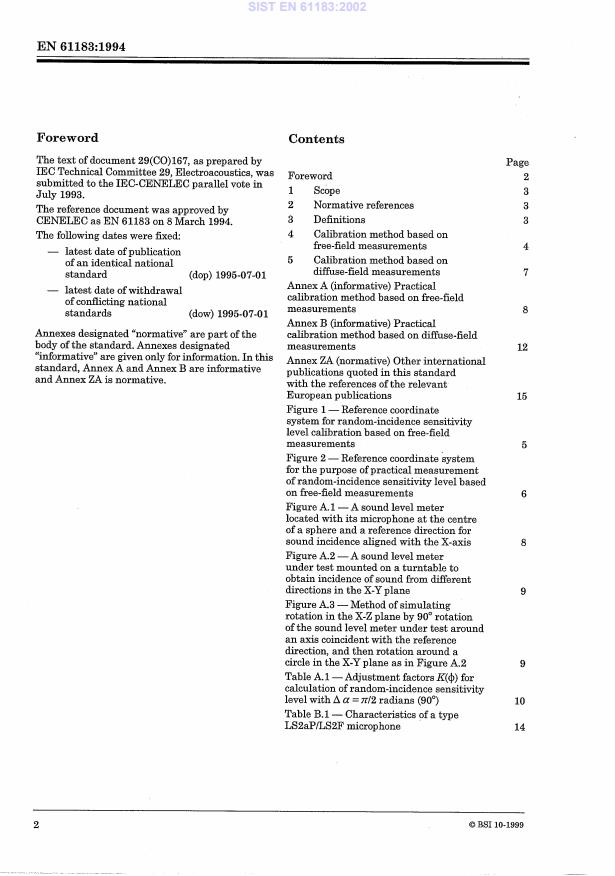
EN 61183:1994 (IEC 61183:1994) - adopted by CLC and mirrored in national editions (e.g., SIST EN 61183:2002) - is an electroacoustics standard that defines calibration methods for sound level meters in two acoustic fields: random-incidence (free-field) and diffuse-field. The document specifies how to determine the random‑incidence sensitivity and the diffuse‑field sensitivity of sound level meters so that measurements of environmental and industrial noise are accurate and comparable.
Key Topics
- Random-incidence calibration (free-field method): Procedures for determining sensitivity when sound arrives from multiple directions characteristic of stochastic or partially free-field conditions.
- Diffuse-field calibration: Methods to assess sensitivity in highly reverberant environments where sound energy is uniformly distributed from all directions.
- Measurement objectives: Establishing reproducible sensitivity levels that link instrument responses to defined acoustic reference conditions.
- Electroacoustic context: Applies specifically to microphone and sound level meter behaviour in acoustic fields representative of real-world noise measurement scenarios.
- Traceability and comparability: Ensures calibration results support traceable, repeatable measurements across laboratories and instruments.
(EN 61183:1994 provides the methodological framework; specific procedural parameters should be referenced in the full standard text.)
Applications
- Calibration laboratories performing third‑party verification and type‑approval of sound level meters.
- Environmental noise monitoring programs that require correct instrument response for outdoor or urban measurements.
- Occupational noise assessments in workplaces where diffuse or random incidence conditions affect meter readings.
- Manufacturers and R&D teams validating microphone and sound level meter designs against recognized acoustic calibration methods.
- Regulatory compliance and conformity assessment where documented calibration methods are required.
Who Uses This Standard
- Acoustic calibration laboratories and metrology institutes
- Environmental consultants and noise surveyors
- Occupational health and safety professionals
- Sound level meter manufacturers and test engineers
- Certification bodies and regulatory agencies
Related Standards
- National and international standards on sound level meter performance and calibration (see IEC/EN series for sound level meters and acoustic calibrators).
- Standards addressing instrument accuracy, field verification, and laboratory measurement procedures (for comprehensive compliance, consult the full standards list relevant to electroacoustics).
Keywords: EN 61183, IEC 61183, random-incidence calibration, diffuse-field calibration, sound level meters, electroacoustics, calibration laboratory, diffuse-field sensitivity, random‑incidence sensitivity.
Relations
- Effective Date
- 03-Feb-2026
- Effective Date
- 03-Feb-2026
- Effective Date
- 03-Feb-2026
- Effective Date
- 03-Feb-2026
- Referred By
SIST EN IEC 61252:2026 - Electroacoustics - Personal sound exposure meters (IEC 61252:2025) - Effective Date
- 03-Feb-2026
- Referred By
SIST EN 61672-2:2014 - Electroacoustics - Sound level meters - Part 2: Pattern evaluation tests - Effective Date
- 03-Feb-2026
- Referred By
SIST EN 61672-2:2004 - Electroacoustics - Sound level meters -- Part 2: Pattern evaluation tests - Effective Date
- 03-Feb-2026
- Effective Date
- 03-Feb-2026
Get Certified
Connect with accredited certification bodies for this standard

BSMI (Bureau of Standards, Metrology and Inspection)
Taiwan's standards and inspection authority.
Sponsored listings
Frequently Asked Questions
SIST EN 61183:2002 is a standard published by the Slovenian Institute for Standardization (SIST). Its full title is "Electroacoustics - Random-incidence and diffuse-field calibration of sound level meters". This standard covers: Describes a free-field calibration method for determining random-incidence sensitivity levels of sound level meters. Additionally, the standard describes a diffuse-field calibration method for determining diffuse-field sensitivity levels.
Describes a free-field calibration method for determining random-incidence sensitivity levels of sound level meters. Additionally, the standard describes a diffuse-field calibration method for determining diffuse-field sensitivity levels.
SIST EN 61183:2002 is classified under the following ICS (International Classification for Standards) categories: 17.140.50 - Electroacoustics. The ICS classification helps identify the subject area and facilitates finding related standards.
SIST EN 61183:2002 has the following relationships with other standards: It is inter standard links to SIST EN 60651:1997, SIST EN 60804:1998, SIST EN 61672-3:2014, SIST EN 61672-1:2014, SIST EN IEC 61252:2026, SIST EN 61672-2:2014, SIST EN 61672-2:2004, SIST EN 62585:2012. Understanding these relationships helps ensure you are using the most current and applicable version of the standard.
SIST EN 61183:2002 is available in PDF format for immediate download after purchase. The document can be added to your cart and obtained through the secure checkout process. Digital delivery ensures instant access to the complete standard document.
Standards Content (Sample)
SLOVENSKI STANDARD
01-september-2002
Electroacoustics - Random-incidence and diffuse-field calibration of sound level
meters (IEC 61183:1994)
Electroacoustics - Random-incidence and diffuse-field calibration of sound level meters
Elektroakustik - Kalibrierung von Schallpegelmessern in einem Schallfeld mit
stochastischem Schalleinfall und im diffusen Schallfeld
Electroacoustique - Etalonnage des sonomètres sous incidence aléatoire et en champs
diffus
Ta slovenski standard je istoveten z: EN 61183:1994
ICS:
17.140.50 Elektroakustika Electroacoustics
2003-01.Slovenski inštitut za standardizacijo. Razmnoževanje celote ali delov tega standarda ni dovoljeno.
SIST EN 61183:2
...