

SIST EN 302 636-4-1 V1.3.1:2017
(Main)Intelligent Transport Systems (ITS) - Vehicular Communications - GeoNetworking - Part 4: Geographical addressing and forwarding for point-to-point and point-to-multipoint communications - Sub-part 1: Media-Independent Functionality
General Information
- Abstract
REN/ITS-00349
- Status
- Published
- Public Enquiry End Date
- 31-Jul-2017
- Publication Date
- 06-Sep-2017
- Technical Committee
- MOC - Mobile Communications
- Current Stage
- 6060 - National Implementation/Publication (Adopted Project)
- Start Date
- 28-Aug-2017
- Due Date
- 02-Nov-2017
- Completion Date
- 07-Sep-2017
- Mandate
- M/453
Buy Documents

ETSI EN 302 636-4-1 V1.3.0 (2017-05) - Intelligent Transport Systems (ITS); Vehicular Communications; GeoNetworking; Part 4: Geographical addressing and forwarding for point-to-point and point-to-multipoint communications; Sub-part 1: Media-Independent Functionality

ETSI EN 302 636-4-1 V1.3.1 (2017-08) - Intelligent Transport Systems (ITS); Vehicular Communications; GeoNetworking; Part 4: Geographical addressing and forwarding for point-to-point and point-to-multipoint communications; Sub-part 1: Media-Independent Functionality

Overview
SIST EN 302 636-4-1 V1.3.1:2017 is a European Standard developed by SIST and ETSI that defines the media-independent functionality of the GeoNetworking protocol for Intelligent Transport Systems (ITS). This standard is a key part of the ITS vehicular communications suite and specifically addresses geographical addressing and forwarding for both point-to-point and point-to-multipoint communications. The focus on media-independent functionality ensures standardization and interoperability across various short-range wireless communication technologies, making it a crucial foundation for robust, scalable, and efficient ITS networking.
Key Topics
Media-Independent Functionality
The standard outlines the core protocol mechanisms that operate regardless of the underlying communication medium, promoting compatibility among different ITS access technologies.GeoNetworking Protocol
Provides an overview of network-layer routing based on geographical positioning, supporting dynamic, ad-hoc vehicular networks essential for traffic efficiency and road safety.Geographical Addressing and Forwarding
Describes the methods and structures for routing packets between individual ITS stations or across multiple stations within a defined geographical area.Support for Multiple Communication Types
Enables both point-to-point and point-to-multipoint (including broadcast and multicast) communications, essential for applications ranging from vehicle messaging to real-time traffic updates.Network Layer Services
Details the services offered, including address configuration, location services, beaconing, and packet forwarding-each critical for reliable vehicular communications.Interoperability and Scalability
Separating media-independent functions from media-dependent extensions aids developers and integrators in deploying ITS solutions over a variety of physical and wireless technologies, such as ITS-G5 or infrared, with minimal adaptation.
Applications
GeoNetworking as specified in SIST EN 302 636-4-1 V1.3.1:2017 supports a range of ITS applications that are vital for enhancing the efficiency and safety of modern transportation systems, including:
Vehicle-to-Vehicle (V2V) Communication:
Dynamic exchange of safety messages, traffic alerts, and cooperative maneuvers between vehicles.Vehicle-to-Infrastructure (V2I) Communication:
Interactions with roadside units and traffic management systems for real-time traffic control and information dissemination.Traffic Information and Management:
Distribution of real-time congestion, incident, and routing data to optimize travel and reduce environmental impacts.Emergency Services:
Rapid and reliable broadcast of critical information for first responders and public safety systems within specific geographic areas.Autonomous Driving Support:
Seamless, location-based communication among autonomous vehicles and smart road infrastructure.
Adopting the media-independent functionalities ensures broad deployment across different markets and environments, future-proofs ITS architectures, and simplifies integration with other intelligent mobility solutions.
Related Standards
SIST EN 302 636-4-1 V1.3.1:2017 is part of the broader GeoNetworking and ITS communications standardization initiative, and its deployment is supported by interoperability with the following related standards:
- ETSI EN 302 665: Intelligent Transport Systems (ITS) - Communications Architecture
- ETSI EN 302 636-1: GeoNetworking - Requirements
- ETSI EN 302 636-2: GeoNetworking - Scenarios
- ETSI EN 302 636-3: GeoNetworking - Network Architecture
- ETSI TS 102 636-4-2: Media-dependent functionalities (e.g., for ITS-G5)
- ETSI EN 302 636-5-1: Basic Transport Protocol for ITS
- ETSI EN 302 931: Geographical Area Definition
- ETSI TS 102 894-2: Applications and Facilities Layer Data Dictionary
These standards collectively ensure a comprehensive, interoperable ecosystem for intelligent transport solutions, supporting safety-critical and efficiency-driven ITS applications at the European and international level.
By implementing SIST EN 302 636-4-1 V1.3.1:2017, stakeholders ensure best practices for GeoNetworking, optimize vehicular communication strategies, and strengthen the foundation for next-generation ITS deployments.
Buy Documents
ETSI EN 302 636-4-1 V1.3.0 (2017-05) - Intelligent Transport Systems (ITS); Vehicular Communications; GeoNetworking; Part 4: Geographical addressing and forwarding for point-to-point and point-to-multipoint communications; Sub-part 1: Media-Independent Functionality
ETSI EN 302 636-4-1 V1.3.1 (2017-08) - Intelligent Transport Systems (ITS); Vehicular Communications; GeoNetworking; Part 4: Geographical addressing and forwarding for point-to-point and point-to-multipoint communications; Sub-part 1: Media-Independent Functionality
Get Certified
Connect with accredited certification bodies for this standard

BSI Group
BSI (British Standards Institution) is the business standards company that helps organizations make excellence a habit.

NYCE
Mexican standards and certification body.
Sponsored listings
Frequently Asked Questions
SIST EN 302 636-4-1 V1.3.1:2017 is a standard published by the Slovenian Institute for Standardization (SIST). Its full title is "Intelligent Transport Systems (ITS) - Vehicular Communications - GeoNetworking - Part 4: Geographical addressing and forwarding for point-to-point and point-to-multipoint communications - Sub-part 1: Media-Independent Functionality". This standard covers: REN/ITS-00349
REN/ITS-00349
SIST EN 302 636-4-1 V1.3.1:2017 is classified under the following ICS (International Classification for Standards) categories: 35.240.60 - IT applications in transport. The ICS classification helps identify the subject area and facilitates finding related standards.
SIST EN 302 636-4-1 V1.3.1:2017 is associated with the following European legislation: Standardization Mandates: M/453. When a standard is cited in the Official Journal of the European Union, products manufactured in conformity with it benefit from a presumption of conformity with the essential requirements of the corresponding EU directive or regulation.
SIST EN 302 636-4-1 V1.3.1:2017 is available in PDF format for immediate download after purchase. The document can be added to your cart and obtained through the secure checkout process. Digital delivery ensures instant access to the complete standard document.
Standards Content (Sample)
Draft ETSI EN 302 636-4-1 V1.3.0 (2017-05)
EUROPEAN STANDARD
Intelligent Transport Systems (ITS);
Vehicular Communications;
GeoNetworking;
Part 4: Geographical addressing and forwarding for
point-to-point and point-to-multipoint communications;
Sub-part 1: Media-Independent Functionality
2 Draft ETSI EN 302 636-4-1 V1.3.0 (2017-05)
Reference
REN/ITS-00349
Keywords
autonomic networking, ITS, network, safety
ETSI
650 Route des Lucioles
F-06921 Sophia Antipolis Cedex - FRANCE
Tel.: +33 4 92 94 42 00 Fax: +33 4 93 65 47 16
Siret N° 348 623 562 00017 - NAF 742 C
Association à but non lucratif enregistrée à la
Sous-Préfecture de Grasse (06) N° 7803/88
Important notice
The present document can be downloaded from:
http://www.etsi.org/standards-search
The present document may be made available in electronic versions and/or in print. The content of any electronic and/or
print versions of the present document shall not be modified without the prior written authorization of ETSI. In case of any
existing or perceived difference in contents between such versions and/or in print, the only prevailing document is the
print of the Portable Document Format (PDF) version kept on a specific network drive within ETSI Secretariat.
Users of the present document should be aware that the document may be subject to revision or change of status.
Information on the current status of this and other ETSI documents is available at
https://portal.etsi.org/TB/ETSIDeliverableStatus.aspx
If you find errors in the present document, please send your comment to one of the following services:
https://portal.etsi.org/People/CommiteeSupportStaff.aspx
Copyright Notification
No part may be reproduced or utilized in any form or by any means, electronic or mechanical, including photocopying
and microfilm except as authorized by written permission of ETSI.
The content of the PDF version shall not be modified without the written authorization of ETSI.
The copyright and the foregoing restriction extend to reproduction in all media.
© European Telecommunications Standards Institute 2017.
All rights reserved.
TM TM TM
DECT , PLUGTESTS , UMTS and the ETSI logo are Trade Marks of ETSI registered for the benefit of its Members.
TM
3GPP and LTE™ are Trade Marks of ETSI registered for the benefit of its Members and
of the 3GPP Organizational Partners.
oneM2M logo is protected for the benefit of its Members
GSM® and the GSM logo are Trade Marks registered and owned by the GSM Association.
ETSI
3 Draft ETSI EN 302 636-4-1 V1.3.0 (2017-05)
Contents
Intellectual Property Rights . 7
Foreword . 7
Modal verbs terminology . 7
Introduction . 7
1 Scope . 8
2 References . 8
2.1 Normative references . 8
2.2 Informative references . 9
3 Definitions, symbols and abbreviations . 9
3.1 Definitions . 9
3.2 Symbols . 10
3.3 Abbreviations . 10
4 Services provided by the GeoNetworking protocol . 11
5 Format convention . 12
6 GeoNetworking address . 13
6.1 General . 13
6.2 GeoNetworking address format . 13
6.3 Fields of the GeoNetworking address . 14
7 Security and privacy . 14
8 Data structures . 15
8.1 Location table . 15
8.1.1 General . 15
8.1.2 Minimum data elements of a Location Table Entry . 15
8.1.3 Maintenance of the Location Table . 16
8.2 Ego Position Vector. 16
8.2.1 General . 16
8.2.2 Minimum data elements . 16
8.2.3 Maintenance . 16
8.3 Sequence number . 16
8.3.1 General . 16
8.3.2 Maintenance . 17
8.4 Location service packet buffer . 17
8.4.1 General . 17
8.4.2 Buffer size . 17
8.4.3 Maintenance . 17
8.5 Forwarding packet buffer . 18
8.5.1 General . 18
8.5.2 Buffer size . 18
8.5.3 Maintenance . 18
9 GeoNetworking packet structure and formats . 19
9.1 Overview . 19
9.2 Packet structure . 19
9.2.1 General . 19
9.2.2 Overall packet structure . 19
9.2.3 Maximum Transmit Unit . 20
9.3 GeoNetworking header structure . 20
9.4 GeoNetworking Secured Packet . 20
9.5 Position vectors . 20
9.5.1 Overview . 20
9.5.2 Long Position Vector . 21
9.5.2.1 Structure . 21
ETSI
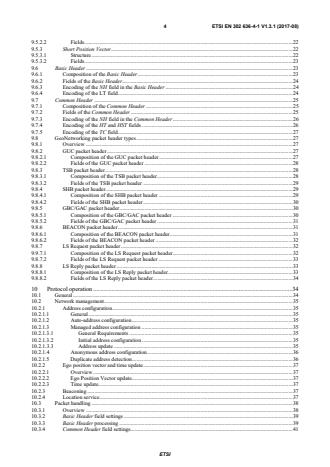
4 Draft ETSI EN 302 636-4-1 V1.3.0 (2017-05)
9.5.2.2 Fields . 21
9.5.3 Short Position Vector . 21
9.5.3.1 Structure . 21
9.5.3.2 Fields . 22
9.6 Basic Header . 22
9.6.1 Composition of the Basic Header . 22
9.6.2 Fields of the Basic Header . 23
9.6.3 Encoding of the NH field in the Basic Header . 23
9.6.4 Encoding of the LT field . 23
9.7 Common Header . 24
9.7.1 Composition of the Common Header . 24
9.7.2 Fields of the Common Header . 24
9.7.3 Encoding of the NH field in the Common Header . 25
9.7.4 Encoding of the HT and HST fields . 25
9.7.5 Encoding of the TC field . 26
9.8 GeoNetworking packet header types . 26
9.8.1 Overview . 26
9.8.2 GUC packet header . 26
9.8.2.1 Composition of the GUC packet header. 26
9.8.2.2 Fields of the GUC packet header . 27
9.8.3 TSB packet header . 27
9.8.3.1 Composition of the TSB packet header . 27
9.8.3.2 Fields of the TSB packet header . 28
9.8.4 SHB packet header. 28
9.8.4.1 Composition of the SHB packet header . 28
9.8.4.2 Fields of the SHB packet header . 29
9.8.5 GBC/GAC packet header . 29
9.8.5.1 Composition of the GBC/GAC packet header . 29
9.8.5.2 Fields of the GBC/GAC packet header . 30
9.8.6 BEACON packet header . 30
9.8.6.1 Composition of the BEACON packet header . 30
9.8.6.2 Fields of the BEACON packet header . 31
9.8.7 LS Request packet header . 31
9.9.7.1 Composition of the LS Request packet header. 31
9.8.7.2 Fields of the LS Request packet header . 32
9.8.8 LS Reply packet header . 32
9.8.8.1 Composition of the LS Reply packet header . 32
9.8.8.2 Fields of the LS Reply packet header . 33
10 Protocol operation . 33
10.1 General . 33
10.2 Network management . 34
10.2.1 Address configuration . 34
10.2.1.1 General . 34
10.2.1.2 Auto-address configuration . 34
10.2.1.3 Managed address configuration . 34
10.2.1.3.1 General Requirements . 34
10.2.1.3.2 Initial address configuration . 34
10.2.1.3.3 Address update . 34
10.2.1.4 Anonymous address configuration . 35
10.2.1.5 Duplicate address detection . 35
10.2.2 Ego position vector and time update . 36
10.2.2.1 Overview . 36
10.2.2.2 Ego Position Vector update . 36
10.2.2.3 Time update. 36
10.2.3 Beaconing . 36
10.2.4 Location service . 36
10.3 Packet handling . 37
10.3.1 Overview . 37
10.3.2 Basic Header field settings . 38
10.3.3 Basic Header processing . 38
10.3.4 Common Header field settings. 40
ETSI
5 Draft ETSI EN 302 636-4-1 V1.3.0 (2017-05)
10.3.5 Common Header processing . 41
10.3.6 Beacon packet handling . 41
10.3.6.1 General . 41
10.3.6.2 Source operations . 41
10.3.6.3 Receiver operations . 43
10.3.7 Location service packet handling . 43
10.3.7.1 Source operations . 43
10.3.7.1.1 Overview . 43
10.3.7.1.2 Operation for initial LS Request . 43
10.3.7.1.3 Operation for LS Request re-transmission. 44
10.3.7.1.4 Operation for LS Reply . 45
10.3.7.2 Forwarder operations . 45
10.3.7.3 Destination operations . 45
10.3.8 GUC packet handling. 47
10.3.8.1 General . 47
10.3.8.2 Source operations . 47
10.3.8.3 Forwarder operations . 49
10.3.8.4 Destination operations . 50
10.3.9 TSB packet handling . 51
10.3.9.1 General . 51
10.3.9.2 Source operations . 52
10.3.9.3 Forwarder and receiver operations . 53
10.3.10 SHB packet handling . 55
10.3.10.1 General . 55
10.3.10.2 Source operations . 55
10.3.10.3 Receiver operations . 56
10.3.11 GBC packet handling . 57
10.3.11.1 General . 57
10.3.11.2 Source operations . 57
10.3.11.3 Forwarder and receiver operations . 59
10.3.12 GAC packet handling. 61
10.3.12.1 General . 61
10.3.12.2 Source operations . 61
10.3.12.3 Forwarder and receiver operations . 61
Annex A (normative): Duplicate packet detection . 63
A.1 General . 63
A.2 SN-based duplicate packet detection . 63
Annex B (normative): Packet data rate and geographical area size control . 64
B.1 Overview . 64
B.2 Packet data rate control . 64
B.3 Geographical area size control . 64
Annex C (normative): Position vector update . 65
C.1 Overview . 65
C.2 Update of LocT position vector . 65
C.3 Update of GeoNetworking packet position vector . 66
Annex D (normative): GeoNetworking forwarding algorithm selection procedure . 67
Annex E (normative): Non-area forwarding algorithms . 68
E.1 Overview . 68
E.2 Greedy forwarding algorithm . 68
E.3 Non-area contention-based forwarding algorithm . 69
ETSI
6 Draft ETSI EN 302 636-4-1 V1.3.0 (2017-05)
Annex F (normative): Area forwarding algorithms . 72
F.1 Overview . 72
F.2 Simple GeoBroadcast forwarding algorithm . 72
F.3 Area contention-based forwarding algorithm . 72
F.4 Area advanced forwarding algorithm . 75
Annex G (normative): GeoNetworking traffic classification . 80
Annex H (normative): GeoNetworking protocol constants . 81
Annex I (informative): ASN.1 encoding of the GeoNetworking MIB . 83
I.1 Use of modules . 83
I.2 ASN.1 module . 83
Annex J (informative): GeoNetworking data services . 90
J.1 General . 90
J.2 GN-DATA.request . 90
J.3 GN-DATA.confirm . 91
J.4 GN-DATA.indication . 91
Annex K (informative): GeoNetworking management services . 93
K.1 General . 93
K.2 GN-MGMT.request . 93
K.3 GN-MGMT.response . 93
Annex L (informative): Interface to the Security entity . 94
L.1 Security services used by the GeoNetworking protocol . 94
Annex M (informative): Bibliography . 95
History . 96
ETSI
7 Draft ETSI EN 302 636-4-1 V1.3.0 (2017-05)
Intellectual Property Rights
IPRs essential or potentially essential to the present document may have been declared to ETSI. The information
pertaining to these essential IPRs, if any, is publicly available for ETSI members and non-members, and can be found
in ETSI SR 000 314: "Intellectual Property Rights (IPRs); Essential, or potentially Essential, IPRs notified to ETSI in
respect of ETSI standards", which is available from the ETSI Secretariat. Latest updates are available on the ETSI Web
server (https://ipr.etsi.org/).
Pursuant to the ETSI IPR Policy, no investigation, including IPR searches, has been carried out by ETSI. No guarantee
can be given as to the existence of other IPRs not referenced in ETSI SR 000 314 (or the updates on the ETSI Web
server) which are, or may be, or may become, essential to the present document.
Foreword
This draft European Standard (EN) has been produced by ETSI Technical Committee Intelligent Transport Systems
(ITS), and is now submitted for the combined Public Enquiry and Vote phase of the ETSI standards EN Approval
Procedure.
The present document is part 4, sub-part 1 of a multi-part deliverable. Full details of the entire series can be found in
part 1 [2].
Proposed national transposition dates
Date of latest announcement of this EN (doa): 3 months after ETSI publication
Date of latest publication of new National Standard
or endorsement of this EN (dop/e): 6 months after doa
Date of withdrawal of any conflicting National Standard (dow): 6 months after doa
Modal verbs terminology
In the present document "shall", "shall not", "should", "should not", "may", "need not", "will", "will not", "can" and
"cannot" are to be interpreted as described in clause 3.2 of the ETSI Drafting Rules (Verbal forms for the expression of
provisions).
"must" and "must not" are NOT allowed in ETSI deliverables except when used in direct citation.
Introduction
The GeoNetworking protocol is a network layer protocol that provides packet routing in an ad hoc network. It makes
use of geographical positions for packet transport. GeoNetworking supports the communication among individual ITS
stations as well as the distribution of packets in geographical areas.
GeoNetworking can be executed over different ITS access technologies for short-range wireless technologies, such as
ITS-G5 and infrared. The ITS access technologies for short-range wireless technologies have many technical
commonalities, but also differences. In order to reuse the GeoNetworking protocol specification for multiple ITS access
technologies, the specification is separated into media-independent and media-dependent functionalities.
Media-independent functionalities are those which are common to all ITS access technologies for short-range wireless
communication to be used for GeoNetworking. The media-dependent functionalities extend the media-independent
functionality for a specific ITS access technology. Therefore, the GeoNetworking protocol specification consists of the
standard for media-independent functionality and at least one standard for media-dependent functionality. However, it
should be noted that the media-dependent extensions do not represent distinct protocol entities.
ETSI
8 Draft ETSI EN 302 636-4-1 V1.3.0 (2017-05)
1 Scope
The present document specifies the media-independent functionality of the GeoNetworking protocol.
2 References
2.1 Normative references
References are either specific (identified by date of publication and/or edition number or version number) or
non-specific. For specific references, only the cited version applies. For non-specific references, the latest version of the
referenced document (including any amendments) applies.
Referenced documents which are not found to be publicly available in the expected location might be found at
http://docbox.etsi.org/Reference.
NOTE: While any hyperlinks included in this clause were valid at the time of publication, ETSI cannot guarantee
their long term validity.
The following referenced documents are necessary for the application of the present document.
[1] ETSI EN 302 665 (V1.1.1): "Intelligent Transport Systems (ITS); Communications Architecture".
[2] ETSI EN 302 636-1 (V1.2.1): "Intelligent Transport Systems (ITS); Vehicular Communications;
GeoNetworking; Part 1: Requirements".
[3] ETSI EN 302 636-2 (V1.2.1): "Intelligent Transport Systems (ITS); Vehicular Communications;
GeoNetworking; Part 2: Scenarios".
[4] ETSI EN 302 636-3 (V1.2.1): "Intelligent Transport Systems (ITS); Vehicular Communications;
GeoNetworking; Part 3: Network architecture".
[5] ETSI TS 102 636-4-2: "Intelligent Transport Systems (ITS); Vehicular Communications;
GeoNetworking; Part 4: Geographical addressing and forwarding for point-to-point and point-to-
multipoint communications; Sub-part 2: Media-dependent functionalities for ITS-G5".
[6] ETSI EN 302 636-5-1 (V1.2.1): "Intelligent Transport Systems (ITS); Vehicular Communications;
GeoNetworking; Part 5: Transport Protocols; Sub-part 1: Basic Transport Protocol".
[7] ETSI EN 302 636-6-1 (V1.2.1): "Intelligent Transport Systems (ITS); Vehicular Communications;
GeoNetworking; Part 6: Internet Integration; Sub-part 1: Transmission of IPv6 Packets over
GeoNetworking Protocols".
[8] ETSI EN 302 931 (V1.1.1): "Intelligent Transport Systems (ITS); Vehicular Communications;
Geographical Area Definition".
[9] ETSI TS 102 731: "Intelligent Transport Systems (ITS); Security; Security Services and
Architecture".
[10] ETSI TS 103 097: "Intelligent Transport Systems (ITS); Security; Security header and certificate
formats".
[11] ETSI TS 102 894-2: "Intelligent Transport Systems (ITS); Users and applications requirements;
Part 2: Applications and facilities layer common data dictionary".
ETSI
9 Draft ETSI EN 302 636-4-1 V1.3.0 (2017-05)
2.2 Informative references
References are either specific (identified by date of publication and/or edition number or version number) or
non-specific. For specific references, only the cited version applies. For non-specific references, the latest version of the
referenced document (including any amendments) applies.
NOTE: While any hyperlinks included in this clause were valid at the time of publication, ETSI cannot guarantee
their long term validity.
The following referenced documents are not necessary for the application of the present document but they assist the
user with regard to a particular subject area.
[i.1] ETSI EN 302 663: "Intelligent Transport Systems (ITS); Access layer specification for Intelligent
Transport Systems operating in the 5 GHz frequency band".
[i.2] ETSI TS 102 723-8: "Intelligent Transport Systems (ITS); OSI cross-layer topics; Part 8: Interface
between security entity and network and transport layer".
[i.3] ETSI TS 102 940: "Intelligent Transport Systems (ITS); Security; ITS communications security
architecture and security management".
[i.4] ISO/IEC 8802-2:1998: "Information technology-Telecommunications and information exchange
between systems-Local and metropolitan area networks-Specific requirements - Part 2: Logical
link control".
[i.5] IETF RFC 2578: "Structure of Management Information Version 2 (SMIv2)".
[i.6] National Imagery and Mapping Agency (NIMA), US Department of Defense: "World Geodetic
System 1984 - Its Definition and Relation with Local Geodetic Systems", Third Edition -
Amendment 1, NIMA TR 8350.2.
[i.7] IETF RFC 2579: "Textual Conventions for SMIv2".
[i.8] IEEE 802.3:2008™: "IEEE Standard for Information Technology - Telecommunications and
information exchange between systems-Local and metropolitan area networks - Specific
requirements - Part 3: Carrier Sense Multiple Access with Collision Detection (CSMA/CD)
Access Method and Physical Layer Specifications".
[i.9] ETSI TS 102 965: "Intelligent Transport Systems (ITS); Application Object Identifier (ITS-AID);
Registration".
3 Definitions, symbols and abbreviations
3.1 Definitions
For the purposes of the present document, the terms and definitions given in ETSI EN 302 665 [1], ETSI
EN 302 636-3 [4], ETSI EN 302 636-6-1 [7] and the following apply:
destination: receiver that processes a packet and delivers it to upper protocol entities, but does not relay the packet to
other GeoAdhoc routers
forwarder: GeoAdhoc router that processes a packet and relays it to other GeoAdhoc routers
GeoAdhoc router: ad hoc router that implements the GeoNetworking protocol
local position vector: position vector for the local GeoAdhoc router
neighbour: GeoAdhoc router in direct (single-hop) communication range
packet: GeoNetworking PDU
packet transport type: method of handling GeoNetworking packets
ETSI
10 Draft ETSI EN 302 636-4-1 V1.3.0 (2017-05)
position accuracy indicator: binary that indicates whether a position is within a specific confidence interval
position vector: position information of a GeoAdhoc router represented by a tuple of address, timestamp, geographical
position, speed, heading and corresponding accuracy information
receiver: GeoAdhoc router that processes a packet, delivers its data to upper protocol entities
sender: GeoAdhoc router that has sent the GeoNetworking packet
source: GeoAdhoc router that originates a GeoNetworking packet
traffic class: identifier assigned to a GeoNetworking packet that expresses its requirements on data transport
3.2 Symbols
For the purposes of the present document, the following symbols apply:
GEO_MAX Maximum size of the GeoNetworking packet header
H(GN_ADDR) Heading of the ITS-S GN_ADDR
LAT Latitude
LL_ADDR Link layer address that identifies the ITS-S at the link layer protocol entity in the ITS
Access Layer
LL_ADDR_NH Link layer address of the next hop
LONG Longitude
LS_PENDING Location Service pending flag
MTU_AL MTU of the ITS Access Layer
PAI(POS, GN_ADDR) Position accuracy indicator for geographical position POS of the ITS-S GN_ADDR
PDR(GN_ADDR) Packet data rate (exponential moving average)
POS(GN_ADDR) Geographical position of the ITS-S GN_ADDR
PV(GN_ADDR) Position vector of the ITS-S GN_ADDR
RAND[x,y] Function that returns a random (integer) number from a uniform distribution in the
given interval [x,y]
S(GN_ADDR) Speed of the ITS-S GN_ADDR
SN_MAX Largest possible value of the sequence number
SN(P) Value of the sequence number field carried in a GeoNetworking packet
T(LocTE) Lifetime of an entry in the location table
TO_CBF_MIN Timeout; minimum duration a packet is buffered in the CBF cache
TO_CBF_MAX Timeout; maximum duration a packet is buffered in the CBF cache
TST(GN_ADDR) Last timestamp received from a GeoAdhoc router
TST(P) Value of the timestamp field carried in a GeoNetworking packet
TST(TAI) Number of elapsed TAI milliseconds since 2004-01-01 00:00:00.000 UTC
3.3 Abbreviations
For the purposes of the present document, the abbreviations given in ETSI EN 302 665 [1], ETSI EN 302 636-3 [4],
ETSI EN 302 636-6-1 [7] and the following apply:
ASN Abstract Syntax Notation
BC BroadCast
BTP Basic Transport Protocol
CBF Contention-Based Forwarding
DAD Duplicate Address Detection
DE Destination
DPC Duplicate Packet Counter
DPL Duplicate Packet List
DPD Duplicate Packet Detection
EMA Exponential Moving Average
EPV Ego Position Vector
FCS Frame Check Sequence
FIFO First In First Out
GAC Geographically-Scoped Anycast
ETSI
11 Draft ETSI EN 302 636-4-1 V1.3.0 (2017-05)
GBC Geographically-Scoped Broadcast
GF Greedy Forwarding
GN GeoNetworking
GN_ADDR GeoNetworking ADDRess
GN6ASL GeoNetworking to IPv6 Adaptation Sub-Layer
GN6-SDU GN6 Service Data Unit
GN-PDU GeoNetworking Protocol Data Unit
GN-SDU GeoNetworking Service Data Unit
GUC Geographically-Scoped Unicast
HST Header Sub-Type
HT Header Type
LL Link Layer
LLC Logic Link Control
LocT Location Table
LocTE Location Table Entry
LPV Local Position Vector
LS Location Service
LT LifeTime
MAC Medium Access Control
MFR Most Forward within Radius
MHL Maximum Hop Limit
MHVB Multi-Hop Vehicular Broadcast
MIB Management Information Base
MID MAC ID
MTU Maximum Transmit Unit
NH Next Header
PAI Position Accuracy Indicator
PCI Protocol Control Information
PDR Packet Data Rate
PDU Protocol Data Unit
PL Payload Length
POS POSition
PV Position Vector
RHL Remaining Hop Limit
RTC Retransmit Counter
SCF Store Carry & Forward
SDU Service Data Unit
SE SEnder
SHB Single Hop Broadcast
SN Sequence Number
SO SOurce
SPV Short Position Vector
ST Station Type
TAI Temps Atomique International (International Atomic Time)
TC ID Traffic Class Identifier
TC Traffic Class
TSB
...
EUROPEAN STANDARD
Intelligent Transport Systems (ITS);
Vehicular Communications;
GeoNetworking;
Part 4: Geographical addressing and forwarding for
point-to-point and point-to-multipoint communications;
Sub-part 1: Media-Independent Functionality
2 ETSI EN 302 636-4-1 V1.3.1 (2017-08)
Reference
REN/ITS-00349
Keywords
autonomic networking, ITS, network, safety
ETSI
650 Route des Lucioles
F-06921 Sophia Antipolis Cedex - FRANCE
Tel.: +33 4 92 94 42 00 Fax: +33 4 93 65 47 16
Siret N° 348 623 562 00017 - NAF 742 C
Association à but non lucratif enregistrée à la
Sous-Préfecture de Grasse (06) N° 7803/88
Important notice
The present document can be downloaded from:
http://www.etsi.org/standards-search
The present document may be made available in electronic versions and/or in print. The content of any electronic and/or
print versions of the present document shall not be modified without the prior written authorization of ETSI. In case of any
existing or perceived difference in contents between such versions and/or in print, the only prevailing document is the
print of the Portable Document Format (PDF) version kept on a specific network drive within ETSI Secretariat.
Users of the present document should be aware that the document may be subject to revision or change of status.
Information on the current status of this and other ETSI documents is available at
https://portal.etsi.org/TB/ETSIDeliverableStatus.aspx
If you find errors in the present document, please send your comment to one of the following services:
https://portal.etsi.org/People/CommiteeSupportStaff.aspx
Copyright Notification
No part may be reproduced or utilized in any form or by any means, electronic or mechanical, including photocopying
and microfilm except as authorized by written permission of ETSI.
The content of the PDF version shall not be modified without the written authorization of ETSI.
The copyright and the foregoing restriction extend to reproduction in all media.
© ETSI 2017.
All rights reserved.
TM TM TM
DECT , PLUGTESTS , UMTS and the ETSI logo are trademarks of ETSI registered for the benefit of its Members.
TM
3GPP and LTE™ are trademarks of ETSI registered for the benefit of its Members and
of the 3GPP Organizational Partners.
oneM2M logo is protected for the benefit of its Members.
GSM® and the GSM logo are trademarks registered and owned by the GSM Association.
ETSI
3 ETSI EN 302 636-4-1 V1.3.1 (2017-08)
Contents
Intellectual Property Rights . 7
Foreword . 7
Modal verbs terminology . 7
Introduction . 8
1 Scope . 9
2 References . 9
2.1 Normative references . 9
2.2 Informative references . 10
3 Definitions, symbols and abbreviations . 10
3.1 Definitions . 10
3.2 Symbols . 11
3.3 Abbreviations . 11
4 Services provided by the GeoNetworking protocol . 12
5 Format convention . 13
6 GeoNetworking address . 14
6.1 General . 14
6.2 GeoNetworking address format . 14
6.3 Fields of the GeoNetworking address . 15
7 Security and privacy . 15
8 Data structures . 16
8.1 Location table . 16
8.1.1 General . 16
8.1.2 Minimum data elements of a Location Table Entry . 16
8.1.3 Maintenance of the Location Table . 17
8.2 Ego Position Vector. 17
8.2.1 General . 17
8.2.2 Minimum data elements . 17
8.2.3 Maintenance . 17
8.3 Sequence number . 17
8.3.1 General . 17
8.3.2 Maintenance . 18
8.4 Location service packet buffer . 18
8.4.1 General . 18
8.4.2 Buffer size . 18
8.4.3 Maintenance . 18
8.5 Forwarding packet buffer . 19
8.5.1 General . 19
8.5.2 Buffer size . 19
8.5.3 Maintenance . 19
9 GeoNetworking packet structure and formats . 20
9.1 Overview . 20
9.2 Packet structure . 20
9.2.1 General . 20
9.2.2 Overall packet structure . 20
9.2.3 Maximum Transmit Unit . 21
9.3 GeoNetworking header structure . 21
9.4 GeoNetworking Secured Packet . 21
9.5 Position vectors . 21
9.5.1 Overview . 21
9.5.2 Long Position Vector . 22
9.5.2.1 Structure . 22
ETSI
4 ETSI EN 302 636-4-1 V1.3.1 (2017-08)
9.5.2.2 Fields . 22
9.5.3 Short Position Vector . 22
9.5.3.1 Structure . 22
9.5.3.2 Fields . 23
9.6 Basic Header . 23
9.6.1 Composition of the Basic Header . 23
9.6.2 Fields of the Basic Header . 24
9.6.3 Encoding of the NH field in the Basic Header . 24
9.6.4 Encoding of the LT field . 24
9.7 Common Header . 25
9.7.1 Composition of the Common Header . 25
9.7.2 Fields of the Common Header . 25
9.7.3 Encoding of the NH field in the Common Header . 26
9.7.4 Encoding of the HT and HST fields . 26
9.7.5 Encoding of the TC field . 27
9.8 GeoNetworking packet header types . 27
9.8.1 Overview . 27
9.8.2 GUC packet header . 27
9.8.2.1 Composition of the GUC packet header. 27
9.8.2.2 Fields of the GUC packet header . 28
9.8.3 TSB packet header . 28
9.8.3.1 Composition of the TSB packet header . 28
9.8.3.2 Fields of the TSB packet header . 29
9.8.4 SHB packet header. 29
9.8.4.1 Composition of the SHB packet header . 29
9.8.4.2 Fields of the SHB packet header . 30
9.8.5 GBC/GAC packet header . 30
9.8.5.1 Composition of the GBC/GAC packet header . 30
9.8.5.2 Fields of the GBC/GAC packet header . 31
9.8.6 BEACON packet header . 31
9.8.6.1 Composition of the BEACON packet header . 31
9.8.6.2 Fields of the BEACON packet header . 32
9.8.7 LS Request packet header . 32
9.9.7.1 Composition of the LS Request packet header. 32
9.8.7.2 Fields of the LS Request packet header . 33
9.8.8 LS Reply packet header . 33
9.8.8.1 Composition of the LS Reply packet header . 33
9.8.8.2 Fields of the LS Reply packet header . 34
10 Protocol operation . 34
10.1 General . 34
10.2 Network management . 35
10.2.1 Address configuration . 35
10.2.1.1 General . 35
10.2.1.2 Auto-address configuration . 35
10.2.1.3 Managed address configuration . 35
10.2.1.3.1 General Requirements . 35
10.2.1.3.2 Initial address configuration . 35
10.2.1.3.3 Address update . 35
10.2.1.4 Anonymous address configuration . 36
10.2.1.5 Duplicate address detection . 36
10.2.2 Ego position vector and time update . 37
10.2.2.1 Overview . 37
10.2.2.2 Ego Position Vector update . 37
10.2.2.3 Time update. 37
10.2.3 Beaconing . 37
10.2.4 Location service . 37
10.3 Packet handling . 38
10.3.1 Overview . 38
10.3.2 Basic Header field settings . 39
10.3.3 Basic Header processing . 39
10.3.4 Common Header field settings. 41
ETSI
5 ETSI EN 302 636-4-1 V1.3.1 (2017-08)
10.3.5 Common Header processing . 42
10.3.6 Beacon packet handling . 42
10.3.6.1 General . 42
10.3.6.2 Source operations . 42
10.3.6.3 Receiver operations . 44
10.3.7 Location service packet handling . 44
10.3.7.1 Source operations . 44
10.3.7.1.1 Overview . 44
10.3.7.1.2 Operation for initial LS Request . 44
10.3.7.1.3 Operation for LS Request re-transmission. 45
10.3.7.1.4 Operation for LS Reply . 46
10.3.7.2 Forwarder operations . 46
10.3.7.3 Destination operations . 46
10.3.8 GUC packet handling. 48
10.3.8.1 General . 48
10.3.8.2 Source operations . 48
10.3.8.3 Forwarder operations . 50
10.3.8.4 Destination operations . 51
10.3.9 TSB packet handling . 52
10.3.9.1 General . 52
10.3.9.2 Source operations . 53
10.3.9.3 Forwarder and receiver operations . 54
10.3.10 SHB packet handling . 56
10.3.10.1 General . 56
10.3.10.2 Source operations . 56
10.3.10.3 Receiver operations . 57
10.3.11 GBC packet handling . 58
10.3.11.1 General . 58
10.3.11.2 Source operations . 58
10.3.11.3 Forwarder and receiver operations . 60
10.3.12 GAC packet handling. 62
10.3.12.1 General . 62
10.3.12.2 Source operations . 62
10.3.12.3 Forwarder and receiver operations . 62
Annex A (normative): Duplicate packet detection . 64
A.1 General . 64
A.2 SN-based duplicate packet detection . 64
Annex B (normative): Packet data rate and geographical area size control . 65
B.1 Overview . 65
B.2 Packet data rate control . 65
B.3 Geographical area size control . 65
Annex C (normative): Position vector update . 66
C.1 Overview . 66
C.2 Update of LocT position vector . 66
C.3 Update of GeoNetworking packet position vector . 67
Annex D (normative): GeoNetworking forwarding algorithm selection procedure . 68
Annex E (normative): Non-area forwarding algorithms . 69
E.1 Overview . 69
E.2 Greedy forwarding algorithm . 69
E.3 Non-area contention-based forwarding algorithm . 70
ETSI
6 ETSI EN 302 636-4-1 V1.3.1 (2017-08)
Annex F (normative): Area forwarding algorithms . 73
F.1 Overview . 73
F.2 Simple GeoBroadcast forwarding algorithm . 73
F.3 Area contention-based forwarding algorithm . 73
F.4 Area advanced forwarding algorithm . 76
Annex G (normative): GeoNetworking traffic classification . 81
Annex H (normative): GeoNetworking protocol constants . 82
Annex I (informative): ASN.1 encoding of the GeoNetworking MIB . 84
I.1 Use of modules . 84
I.2 ASN.1 module . 84
Annex J (informative): GeoNetworking data services . 91
J.1 General . 91
J.2 GN-DATA.request . 91
J.3 GN-DATA.confirm . 92
J.4 GN-DATA.indication . 92
Annex K (informative): GeoNetworking management services . 94
K.1 General . 94
K.2 GN-MGMT.request . 94
K.3 GN-MGMT.response . 94
Annex L (informative): Interface to the Security entity . 95
L.1 Security services used by the GeoNetworking protocol . 95
Annex M (informative): Bibliography . 96
History . 97
ETSI
7 ETSI EN 302 636-4-1 V1.3.1 (2017-08)
Intellectual Property Rights
Essential patents
IPRs essential or potentially essential to the present document may have been declared to ETSI. The information
pertaining to these essential IPRs, if any, is publicly available for ETSI members and non-members, and can be found
in ETSI SR 000 314: "Intellectual Property Rights (IPRs); Essential, or potentially Essential, IPRs notified to ETSI in
respect of ETSI standards", which is available from the ETSI Secretariat. Latest updates are available on the ETSI Web
server (https://ipr.etsi.org/).
Pursuant to the ETSI IPR Policy, no investigation, including IPR searches, has been carried out by ETSI. No guarantee
can be given as to the existence of other IPRs not referenced in ETSI SR 000 314 (or the updates on the ETSI Web
server) which are, or may be, or may become, essential to the present document.
Trademarks
The present document may include trademarks and/or tradenames which are asserted and/or registered by their owners.
ETSI claims no ownership of these except for any which are indicated as being the property of ETSI, and conveys no
right to use or reproduce any trademark and/or tradename. Mention of those trademarks in the present document does
not constitute an endorsement by ETSI of products, services or organizations associated with those trademarks.
Foreword
This European Standard (EN) has been produced by ETSI Technical Committee Intelligent Transport Systems (ITS).
The present document is part 4, sub-part 1 of a multi-part deliverable. Full details of the entire series can be found in
part 1 [2].
National transposition dates
Date of adoption of this EN: 21 August 2017
Date of latest announcement of this EN (doa): 30 November 2017
Date of latest publication of new National Standard
or endorsement of this EN (dop/e): 31 May 2018
Date of withdrawal of any conflicting National Standard (dow): 31 May 2018
Modal verbs terminology
In the present document "shall", "shall not", "should", "should not", "may", "need not", "will", "will not", "can" and
"cannot" are to be interpreted as described in clause 3.2 of the ETSI Drafting Rules (Verbal forms for the expression of
provisions).
"must" and "must not" are NOT allowed in ETSI deliverables except when used in direct citation.
ETSI
8 ETSI EN 302 636-4-1 V1.3.1 (2017-08)
Introduction
The GeoNetworking protocol is a network layer protocol that provides packet routing in an ad hoc network. It makes
use of geographical positions for packet transport. GeoNetworking supports the communication among individual ITS
stations as well as the distribution of packets in geographical areas.
GeoNetworking can be executed over different ITS access technologies for short-range wireless technologies, such as
ITS-G5 and infrared. The ITS access technologies for short-range wireless technologies have many technical
commonalities, but also differences. In order to reuse the GeoNetworking protocol specification for multiple ITS access
technologies, the specification is separated into media-independent and media-dependent functionalities.
Media-independent functionalities are those which are common to all ITS access technologies for short-range wireless
communication to be used for GeoNetworking. The media-dependent functionalities extend the media-independent
functionality for a specific ITS access technology. Therefore, the GeoNetworking protocol specification consists of the
standard for media-independent functionality and at least one standard for media-dependent functionality. However, it
should be noted that the media-dependent extensions do not represent distinct protocol entities.
ETSI
9 ETSI EN 302 636-4-1 V1.3.1 (2017-08)
1 Scope
The present document specifies the media-independent functionality of the GeoNetworking protocol.
2 References
2.1 Normative references
References are either specific (identified by date of publication and/or edition number or version number) or
non-specific. For specific references, only the cited version applies. For non-specific references, the latest version of the
referenced document (including any amendments) applies.
Referenced documents which are not found to be publicly available in the expected location might be found at
http://docbox.etsi.org/Reference.
NOTE: While any hyperlinks included in this clause were valid at the time of publication, ETSI cannot guarantee
their long term validity.
The following referenced documents are necessary for the application of the present document.
[1] ETSI EN 302 665 (V1.1.1): "Intelligent Transport Systems (ITS); Communications Architecture".
[2] ETSI EN 302 636-1 (V1.2.1): "Intelligent Transport Systems (ITS); Vehicular Communications;
GeoNetworking; Part 1: Requirements".
[3] ETSI EN 302 636-2 (V1.2.1): "Intelligent Transport Systems (ITS); Vehicular Communications;
GeoNetworking; Part 2: Scenarios".
[4] ETSI EN 302 636-3 (V1.2.1): "Intelligent Transport Systems (ITS); Vehicular Communications;
GeoNetworking; Part 3: Network architecture".
[5] ETSI TS 102 636-4-2: "Intelligent Transport Systems (ITS); Vehicular Communications;
GeoNetworking; Part 4: Geographical addressing and forwarding for point-to-point and point-to-
multipoint communications; Sub-part 2: Media-dependent functionalities for ITS-G5".
[6] ETSI EN 302 636-5-1 (V1.2.1): "Intelligent Transport Systems (ITS); Vehicular Communications;
GeoNetworking; Part 5: Transport Protocols; Sub-part 1: Basic Transport Protocol".
[7] ETSI EN 302 636-6-1 (V1.2.1): "Intelligent Transport Systems (ITS); Vehicular Communications;
GeoNetworking; Part 6: Internet Integration; Sub-part 1: Transmission of IPv6 Packets over
GeoNetworking Protocols".
[8] ETSI EN 302 931 (V1.1.1): "Intelligent Transport Systems (ITS); Vehicular Communications;
Geographical Area Definition".
[9] ETSI TS 102 731: "Intelligent Transport Systems (ITS); Security; Security Services and
Architecture".
[10] ETSI TS 103 097: "Intelligent Transport Systems (ITS); Security; Security header and certificate
formats".
[11] ETSI TS 102 894-2: "Intelligent Transport Systems (ITS); Users and applications requirements;
Part 2: Applications and facilities layer common data dictionary".
ETSI
10 ETSI EN 302 636-4-1 V1.3.1 (2017-08)
2.2 Informative references
References are either specific (identified by date of publication and/or edition number or version number) or
non-specific. For specific references, only the cited version applies. For non-specific references, the latest version of the
referenced document (including any amendments) applies.
NOTE: While any hyperlinks included in this clause were valid at the time of publication, ETSI cannot guarantee
their long term validity.
The following referenced documents are not necessary for the application of the present document but they assist the
user with regard to a particular subject area.
[i.1] ETSI EN 302 663: "Intelligent Transport Systems (ITS); Access layer specification for Intelligent
Transport Systems operating in the 5 GHz frequency band".
[i.2] ETSI TS 102 723-8: "Intelligent Transport Systems (ITS); OSI cross-layer topics; Part 8: Interface
between security entity and network and transport layer".
[i.3] ETSI TS 102 940: "Intelligent Transport Systems (ITS); Security; ITS communications security
architecture and security management".
[i.4] ISO/IEC 8802-2:1998: "Information technology-Telecommunications and information exchange
between systems-Local and metropolitan area networks-Specific requirements - Part 2: Logical
link control".
[i.5] IETF RFC 2578: "Structure of Management Information Version 2 (SMIv2)".
[i.6] National Imagery and Mapping Agency (NIMA), US Department of Defense: "World Geodetic
System 1984 - Its Definition and Relation with Local Geodetic Systems", Third Edition -
Amendment 1, NIMA TR 8350.2.
[i.7] IETF RFC 2579: "Textual Conventions for SMIv2".
[i.8] IEEE 802.3:2008™: "IEEE Standard for Information Technology - Telecommunications and
information exchange between systems-Local and metropolitan area networks - Specific
requirements - Part 3: Carrier Sense Multiple Access with Collision Detection (CSMA/CD)
Access Method and Physical Layer Specifications".
[i.9] ETSI TS 102 965: "Intelligent Transport Systems (ITS); Application Object Identifier (ITS-AID);
Registration".
3 Definitions, symbols and abbreviations
3.1 Definitions
For the purposes of the present document, the terms and definitions given in ETSI EN 302 665 [1], ETSI
EN 302 636-3 [4], ETSI EN 302 636-6-1 [7] and the following apply:
destination: receiver that processes a packet and delivers it to upper protocol entities, but does not relay the packet to
other GeoAdhoc routers
forwarder: GeoAdhoc router that processes a packet and relays it to other GeoAdhoc routers
GeoAdhoc router: ad hoc router that implements the GeoNetworking protocol
local position vector: position vector for the local GeoAdhoc router
neighbour: GeoAdhoc router in direct (single-hop) communication range
packet: GeoNetworking PDU
packet transport type: method of handling GeoNetworking packets
ETSI
11 ETSI EN 302 636-4-1 V1.3.1 (2017-08)
position accuracy indicator: binary that indicates whether a position is within a specific confidence interval
position vector: position information of a GeoAdhoc router represented by a tuple of address, timestamp, geographical
position, speed, heading and corresponding accuracy information
receiver: GeoAdhoc router that processes a packet, delivers its data to upper protocol entities
sender: GeoAdhoc router that has sent the GeoNetworking packet
source: GeoAdhoc router that originates a GeoNetworking packet
traffic class: identifier assigned to a GeoNetworking packet that expresses its requirements on data transport
3.2 Symbols
For the purposes of the present document, the following symbols apply:
GEO_MAX Maximum size of the GeoNetworking packet header
H(GN_ADDR) Heading of the ITS-S GN_ADDR
LAT Latitude
LL_ADDR Link layer address that identifies the ITS-S at the link layer protocol entity in the ITS
Access Layer
LL_ADDR_NH Link layer address of the next hop
LONG Longitude
LS_PENDING Location Service pending flag
MTU_AL MTU of the ITS Access Layer
PAI(POS, GN_ADDR) Position accuracy indicator for geographical position POS of the ITS-S GN_ADDR
PDR(GN_ADDR) Packet data rate (exponential moving average)
POS(GN_ADDR) Geographical position of the ITS-S GN_ADDR
PV(GN_ADDR) Position vector of the ITS-S GN_ADDR
RAND[x,y] Function that returns a random (integer) number from a uniform distribution in the
given interval [x,y]
S(GN_ADDR) Speed of the ITS-S GN_ADDR
SN_MAX Largest possible value of the sequence number
SN(P) Value of the sequence number field carried in a GeoNetworking packet
T(LocTE) Lifetime of an entry in the location table
TO_CBF_MIN Timeout; minimum duration a packet is buffered in the CBF cache
TO_CBF_MAX Timeout; maximum duration a packet is buffered in the CBF cache
TST(GN_ADDR) Last timestamp received from a GeoAdhoc router
TST(P) Value of the timestamp field carried in a GeoNetworking packet
TST(TAI) Number of elapsed TAI milliseconds since 2004-01-01 00:00:00.000 UTC
3.3 Abbreviations
For the purposes of the present document, the abbreviations given in ETSI EN 302 665 [1], ETSI EN 302 636-3 [4],
ETSI EN 302 636-6-1 [7] and the following apply:
ASN Abstract Syntax Notation
BC BroadCast
BTP Basic Transport Protocol
CBF Contention-Based Forwarding
DAD Duplicate Address Detection
DE Destination
DPC Duplicate Packet Counter
DPL Duplicate Packet List
DPD Duplicate Packet Detection
EMA Exponential Moving Average
EPV Ego Position Vector
FCS Frame Check Sequence
FIFO First In First Out
GAC Geographically-Scoped Anycast
ETSI
12 ETSI EN 302 636-4-1 V1.3.1 (2017-08)
GBC Geographically-Scoped Broadcast
GF Greedy Forwarding
GN GeoNetworking
GN_ADDR GeoNetworking ADDRess
GN6ASL GeoNetworking to IPv6 Adaptation Sub-Layer
GN6-SDU GN6 Service Data Unit
GN-PDU GeoNetworking Protocol Data Unit
GN-SDU GeoNetworking Service Data Unit
GUC Geographically-Scoped Unicast
HST Header Sub-Type
HT Header Type
LL Link Layer
LLC Logic Link Control
LocT Location Table
LocTE Location Table Entry
LPV Local Position Vector
LS Location Service
LT LifeTime
MAC Medium Access Control
MFR Most Forward within Radius
MHL Maximum Hop Limit
MHVB Multi-Hop Vehicular Broadcast
MIB Management Information Base
MID MAC ID
MTU Maximum Transmit Unit
NH Next Header
PAI Position Accuracy Indicator
PCI Protocol Control Information
PDR Packet Data Rate
PDU Protocol Data Unit
PL Payloa
...
2003-01.Slovenski inštitut za standardizacijo. Razmnoževanje celote ali delov tega standarda ni dovoljeno.Intelligent Transport Systems (ITS) - Vehicular Communications - GeoNetworking - Part 4: Geographical addressing and forwarding for point-to-point and point-to-multipoint communications - Sub-part 1: Media-Independent Functionality35.240.60Uporabniške rešitve IT v prometuIT applications in transportICS:Ta slovenski standard je istoveten z:ETSI EN 302 636-4-1 V1.3.1 (2017-08)SIST EN 302 636-4-1 V1.3.1:2017en01-oktober-2017SIST EN 302 636-4-1 V1.3.1:2017SLOVENSKI
STANDARD
EUROPEAN STANDARD SIST EN 302 636-4-1 V1.3.1:2017
ETSI ETSI EN 302 636-4-1 V1.3.1 (2017-08)2
Reference REN/ITS-00349 Keywords autonomic networking, ITS, network, safety ETSI 650 Route des Lucioles F-06921 Sophia Antipolis Cedex - FRANCE
Tel.: +33 4 92 94 42 00
Fax: +33 4 93 65 47 16
Siret N° 348 623 562 00017 - NAF 742 C Association à but non lucratif enregistrée à la Sous-Préfecture de Grasse (06) N° 7803/88
Important notice The present document can be downloaded from: http://www.etsi.org/standards-search The present document may be made available in electronic versions and/or in print. The content of any electronic and/or print versions of the present document shall not be modified without the prior written authorization of ETSI. In case of any existing or perceived difference in contents between such versions and/or in print, the only prevailing document is the print of the Portable Document Format (PDF) version kept on a specific network drive within ETSI Secretariat. Users of the present document should be aware that the document may be subject to revision or change of status. Information on the current status of this and other ETSI documents is available at https://portal.etsi.org/TB/ETSIDeliverableStatus.aspx If you find errors in the present document, please send your comment to one of the following services: https://portal.etsi.org/People/CommiteeSupportStaff.aspx Copyright Notification No part may be reproduced or utilized in any form or by any means, electronic or mechanical, including photocopying and microfilm except as authorized by written permission of ETSI. The content of the PDF version shall not be modified without the written authorization of ETSI. The copyright and the foregoing restriction extend to reproduction in all media.
© ETSI 2017. All rights reserved.
DECTTM, PLUGTESTSTM, UMTSTM and the ETSI logo are trademarks of ETSI registered for the benefit of its Members. 3GPPTM and LTE™ are trademarks of ETSI registered for the benefit of its Members and of the 3GPP Organizational Partners. oneM2M logo is protected for the benefit of its Members. GSM® and the GSM logo are trademarks registered and owned by the GSM Association. SIST EN 302 636-4-1 V1.3.1:2017
ETSI ETSI EN 302 636-4-1 V1.3.1 (2017-08)3 Contents Intellectual Property Rights . 7 Foreword . 7 Modal verbs terminology . 7 Introduction . 8 1 Scope . 9 2 References . 9 2.1 Normative references . 9 2.2 Informative references . 10 3 Definitions, symbols and abbreviations . 10 3.1 Definitions . 10 3.2 Symbols . 11 3.3 Abbreviations . 11 4 Services provided by the GeoNetworking protocol . 12 5 Format convention . 13 6 GeoNetworking address . 14 6.1 General . 14 6.2 GeoNetworking address format . 14 6.3 Fields of the GeoNetworking address . 15 7 Security and privacy . 15 8 Data structures . 16 8.1 Location table . 16 8.1.1 General . 16 8.1.2 Minimum data elements of a Location Table Entry . 16 8.1.3 Maintenance of the Location Table . 17 8.2 Ego Position Vector. 17 8.2.1 General . 17 8.2.2 Minimum data elements . 17 8.2.3 Maintenance . 17 8.3 Sequence number . 17 8.3.1 General . 17 8.3.2 Maintenance . 18 8.4 Location service packet buffer . 18 8.4.1 General . 18 8.4.2 Buffer size . 18 8.4.3 Maintenance . 18 8.5 Forwarding packet buffer . 19 8.5.1 General . 19 8.5.2 Buffer size . 19 8.5.3 Maintenance . 19 9 GeoNetworking packet structure and formats . 20 9.1 Overview . 20 9.2 Packet structure . 20 9.2.1 General . 20 9.2.2 Overall packet structure . 20 9.2.3 Maximum Transmit Unit . 21 9.3 GeoNetworking header structure . 21 9.4 GeoNetworking Secured Packet . 21 9.5 Position vectors . 21 9.5.1 Overview . 21 9.5.2 Long Position Vector . 22 9.5.2.1 Structure . 22 SIST EN 302 636-4-1 V1.3.1:2017
ETSI ETSI EN 302 636-4-1 V1.3.1 (2017-08)4 9.5.2.2 Fields . 22 9.5.3 Short Position Vector . 22 9.5.3.1 Structure . 22 9.5.3.2 Fields . 23 9.6 Basic Header . 23 9.6.1 Composition of the Basic Header . 23 9.6.2 Fields of the Basic Header . 24 9.6.3 Encoding of the NH field in the Basic Header . 24 9.6.4 Encoding of the LT field . 24 9.7 Common Header . 25 9.7.1 Composition of the Common Header . 25 9.7.2 Fields of the Common Header . 25 9.7.3 Encoding of the NH field in the Common Header . 26 9.7.4 Encoding of the HT and HST fields . 26 9.7.5 Encoding of the TC field . 27 9.8 GeoNetworking packet header types . 27 9.8.1 Overview . 27 9.8.2 GUC packet header . 27 9.8.2.1 Composition of the GUC packet header. 27 9.8.2.2 Fields of the GUC packet header . 28 9.8.3 TSB packet header . 28 9.8.3.1 Composition of the TSB packet header . 28 9.8.3.2 Fields of the TSB packet header . 29 9.8.4 SHB packet header. 29 9.8.4.1 Composition of the SHB packet header . 29 9.8.4.2 Fields of the SHB packet header . 30 9.8.5 GBC/GAC packet header . 30 9.8.5.1 Composition of the GBC/GAC packet header . 30 9.8.5.2 Fields of the GBC/GAC packet header . 31 9.8.6 BEACON packet header . 31 9.8.6.1 Composition of the BEACON packet header . 31 9.8.6.2 Fields of the BEACON packet header . 32 9.8.7 LS Request packet header . 32 9.9.7.1 Composition of the LS Request packet header. 32 9.8.7.2 Fields of the LS Request packet header . 33 9.8.8 LS Reply packet header . 33 9.8.8.1 Composition of the LS Reply packet header . 33 9.8.8.2 Fields of the LS Reply packet header . 34 10 Protocol operation . 34 10.1 General . 34 10.2 Network management . 35 10.2.1 Address configuration . 35 10.2.1.1 General . 35 10.2.1.2 Auto-address configuration . 35 10.2.1.3 Managed address configuration . 35 10.2.1.3.1 General Requirements . 35 10.2.1.3.2 Initial address configuration . 35 10.2.1.3.3 Address update . 35 10.2.1.4 Anonymous address configuration . 36 10.2.1.5 Duplicate address detection . 36 10.2.2 Ego position vector and time update . 37 10.2.2.1 Overview . 37 10.2.2.2 Ego Position Vector update . 37 10.2.2.3 Time update. 37 10.2.3 Beaconing . 37 10.2.4 Location service . 37 10.3 Packet handling . 38 10.3.1 Overview . 38 10.3.2 Basic Header field settings . 39 10.3.3 Basic Header processing . 39 10.3.4 Common Header field settings. 41 SIST EN 302 636-4-1 V1.3.1:2017
ETSI ETSI EN 302 636-4-1 V1.3.1 (2017-08)5 10.3.5 Common Header processing . 42 10.3.6 Beacon packet handling . 42 10.3.6.1 General . 42 10.3.6.2 Source operations . 42 10.3.6.3 Receiver operations . 44 10.3.7 Location service packet handling . 44 10.3.7.1 Source operations . 44 10.3.7.1.1 Overview . 44 10.3.7.1.2 Operation for initial LS Request . 44 10.3.7.1.3 Operation for LS Request re-transmission. 45 10.3.7.1.4 Operation for LS Reply . 46 10.3.7.2 Forwarder operations . 46 10.3.7.3 Destination operations . 46 10.3.8 GUC packet handling. 48 10.3.8.1 General . 48 10.3.8.2 Source operations . 48 10.3.8.3 Forwarder operations . 50 10.3.8.4 Destination operations . 51 10.3.9 TSB packet handling . 52 10.3.9.1 General . 52 10.3.9.2 Source operations . 53 10.3.9.3 Forwarder and receiver operations . 54 10.3.10 SHB packet handling . 56 10.3.10.1 General . 56 10.3.10.2 Source operations . 56 10.3.10.3 Receiver operations . 57 10.3.11 GBC packet handling . 58 10.3.11.1 General . 58 10.3.11.2 Source operations . 58 10.3.11.3 Forwarder and receiver operations . 60 10.3.12 GAC packet handling. 62 10.3.12.1 General . 62 10.3.12.2 Source operations . 62 10.3.12.3 Forwarder and receiver operations . 62 Annex A (normative): Duplicate packet detection . 64 A.1 General . 64 A.2 SN-based duplicate packet detection . 64 Annex B (normative): Packet data rate and geographical area size control . 65 B.1 Overview . 65 B.2 Packet data rate control . 65 B.3 Geographical area size control . 65 Annex C (normative): Position vector update . 66 C.1 Overview . 66 C.2 Update of LocT position vector . 66 C.3 Update of GeoNetworking packet position vector . 67 Annex D (normative): GeoNetworking forwarding algorithm selection procedure . 68 Annex E (normative): Non-area forwarding algorithms . 69 E.1 Overview . 69 E.2 Greedy forwarding algorithm . 69 E.3 Non-area contention-based forwarding algorithm . 70 SIST EN 302 636-4-1 V1.3.1:2017
ETSI ETSI EN 302 636-4-1 V1.3.1 (2017-08)6 Annex F (normative): Area forwarding algorithms . 73 F.1 Overview . 73 F.2 Simple GeoBroadcast forwarding algorithm . 73 F.3 Area contention-based forwarding algorithm . 73 F.4 Area advanced forwarding algorithm . 76 Annex G (normative): GeoNetworking traffic classification . 81 Annex H (normative): GeoNetworking protocol constants . 82 Annex I (informative): ASN.1 encoding of the GeoNetworking MIB . 84 I.1 Use of modules . 84 I.2 ASN.1 module . 84 Annex J (informative): GeoNetworking data services . 91 J.1 General . 91 J.2 GN-DATA.request . 91 J.3 GN-DATA.confirm . 92 J.4 GN-DATA.indication . 92 Annex K (informative): GeoNetworking management services . 94 K.1 General . 94 K.2 GN-MGMT.request . 94 K.3 GN-MGMT.response . 94 Annex L (informative): Interface to the Security entity . 95 L.1 Security services used by the GeoNetworking protocol . 95 Annex M (informative): Bibliography . 96 History . 97
ETSI ETSI EN 302 636-4-1 V1.3.1 (2017-08)7 Intellectual Property Rights Essential patents IPRs essential or potentially essential to the present document may have been declared to ETSI. The information pertaining to these essential IPRs, if any, is publicly available for ETSI members and non-members, and can be found in ETSI SR 000 314: "Intellectual Property Rights (IPRs); Essential, or potentially Essential, IPRs notified to ETSI in respect of ETSI standards", which is available from the ETSI Secretariat. Latest updates are available on the ETSI Web server (https://ipr.etsi.org/). Pursuant to the ETSI IPR Policy, no investigation, including IPR searches, has been carried out by ETSI. No guarantee can be given as to the existence of other IPRs not referenced in ETSI SR 000 314 (or the updates on the ETSI Web server) which are, or may be, or may become, essential to the present document. Trademarks The present document may include trademarks and/or tradenames which are asserted and/or registered by their owners. ETSI claims no ownership of these except for any which are indicated as being the property of ETSI, and conveys no right to use or reproduce any trademark and/or tradename. Mention of those trademarks in the present document does not constitute an endorsement by ETSI of products, services or organizations associated with those trademarks. Foreword This European Standard (EN) has been produced by ETSI Technical Committee Intelligent Transport Systems (ITS). The present document is part 4, sub-part 1 of a multi-part deliverable. Full details of the entire series can be found in part 1 [2].
National transposition dates Date of adoption of this EN: 21 August 2017 Date of latest announcement of this EN (doa): 30 November 2017 Date of latest publication of new National Standard or endorsement of this EN (dop/e):
31 May 2018 Date of withdrawal of any conflicting National Standard (dow): 31 May 2018
Modal verbs terminology In the present document "shall", "shall not", "should", "should not", "may", "need not", "will", "will not", "can" and "cannot" are to be interpreted as described in clause 3.2 of the ETSI Drafting Rules (Verbal forms for the expression of provisions). "must" and "must not" are NOT allowed in ETSI deliverables except when used in direct citation. SIST EN 302 636-4-1 V1.3.1:2017
ETSI ETSI EN 302 636-4-1 V1.3.1 (2017-08)8 Introduction The GeoNetworking protocol is a network layer protocol that provides packet routing in an ad hoc network. It makes use of geographical positions for packet transport. GeoNetworking supports the communication among individual ITS stations as well as the distribution of packets in geographical areas. GeoNetworking can be executed over different ITS access technologies for short-range wireless technologies, such as ITS-G5 and infrared. The ITS access technologies for short-range wireless technologies have many technical commonalities, but also differences. In order to reuse the GeoNetworking protocol specification for multiple ITS access technologies, the specification is separated into media-independent and media-dependent functionalities. Media-independent functionalities are those which are common to all ITS access technologies for short-range wireless communication to be used for GeoNetworking. The media-dependent functionalities extend the media-independent functionality for a specific ITS access technology. Therefore, the GeoNetworking protocol specification consists of the standard for media-independent functionality and at least one standard for media-dependent functionality. However, it should be noted that the media-dependent extensions do not represent distinct protocol entities.
ETSI ETSI EN 302 636-4-1 V1.3.1 (2017-08)9 1 Scope The present document specifies the media-independent functionality of the GeoNetworking protocol. 2 References 2.1 Normative references References are either specific (identified by date of publication and/or edition number or version number) or non-specific. For specific references, only the cited version applies. For non-specific references, the latest version of the referenced document (including any amendments) applies. Referenced documents which are not found to be publicly available in the expected location might be found at http://docbox.etsi.org/Reference. NOTE: While any hyperlinks included in this clause were valid at the time of publication, ETSI cannot guarantee their long term validity. The following referenced documents are necessary for the application of the present document. [1] ETSI EN 302 665 (V1.1.1): "Intelligent Transport Systems (ITS); Communications Architecture". [2] ETSI EN 302 636-1 (V1.2.1): "Intelligent Transport Systems (ITS); Vehicular Communications; GeoNetworking; Part 1: Requirements". [3] ETSI EN 302 636-2 (V1.2.1): "Intelligent Transport Systems (ITS); Vehicular Communications; GeoNetworking; Part 2: Scenarios". [4] ETSI EN 302 636-3 (V1.2.1): "Intelligent Transport Systems (ITS); Vehicular Communications; GeoNetworking; Part 3: Network architecture". [5] ETSI TS 102 636-4-2: "Intelligent Transport Systems (ITS); Vehicular Communications; GeoNetworking; Part 4: Geographical addressing and forwarding for point-to-point and point-to-multipoint communications; Sub-part 2: Media-dependent functionalities for ITS-G5". [6] ETSI EN 302 636-5-1 (V1.2.1): "Intelligent Transport Systems (ITS); Vehicular Communications; GeoNetworking; Part 5: Transport Protocols; Sub-part 1: Basic Transport Protocol". [7] ETSI EN 302 636-6-1 (V1.2.1): "Intelligent Transport Systems (ITS); Vehicular Communications; GeoNetworking; Part 6: Internet Integration; Sub-part 1: Transmission of IPv6 Packets over GeoNetworking Protocols". [8] ETSI EN 302 931 (V1.1.1): "Intelligent Transport Systems (ITS); Vehicular Communications; Geographical Area Definition". [9] ETSI TS 102 731: "Intelligent Transport Systems (ITS); Security; Security Services and Architecture". [10] ETSI TS 103 097: "Intelligent Transport Systems (ITS); Security; Security header and certificate formats". [11] ETSI TS 102 894-2: "Intelligent Transport Systems (ITS); Users and applications requirements; Part 2: Applications and facilities layer common data dictionary". SIST EN 302 636-4-1 V1.3.1:2017
ETSI ETSI EN 302 636-4-1 V1.3.1 (2017-08)10 2.2 Informative references References are either specific (identified by date of publication and/or edition number or version number) or non-specific. For specific references, only the cited version applies. For non-specific references, the latest version of the referenced document (including any amendments) applies. NOTE: While any hyperlinks included in this clause were valid at the time of publication, ETSI cannot guarantee their long term validity. The following referenced documents are not necessary for the application of the present document but they assist the user with regard to a particular subject area. [i.1] ETSI EN 302 663: "Intelligent Transport Systems (ITS); Access layer specification for Intelligent Transport Systems operating in the 5 GHz frequency band". [i.2] ETSI TS 102 723-8: "Intelligent Transport Systems (ITS); OSI cross-layer topics; Part 8: Interface between security entity and network and transport layer". [i.3] ETSI TS 102 940: "Intelligent Transport Systems (ITS); Security; ITS communications security architecture and security management". [i.4] ISO/IEC 8802-2:1998: "Information technology-Telecommunications and information exchange between systems-Local and metropolitan area networks-Specific requirements - Part 2: Logical link control". [i.5] IETF RFC 2578: "Structure of Management Information Version 2 (SMIv2)". [i.6] National Imagery and Mapping Agency (NIMA), US Department of Defense: "World Geodetic System 1984 - Its Definition and Relation with Local Geodetic Systems", Third Edition - Amendment 1, NIMA TR 8350.2. [i.7] IETF RFC 2579: "Textual Conventions for SMIv2". [i.8] IEEE 802.3:2008™: "IEEE Standard for Information Technology - Telecommunications and information exchange between systems-Local and metropolitan area networks - Specific requirements - Part 3: Carrier Sense Multiple Access with Collision Detection (CSMA/CD) Access Method and Physical Layer Specifications". [i.9] ETSI TS 102 965: "Intelligent Transport Systems (ITS); Application Object Identifier (ITS-AID); Registration". 3 Definitions, symbols and abbreviations 3.1 Definitions For the purposes of the present document, the terms and definitions given in ETSI EN 302 665 [1], ETSI EN 302 636-3 [4], ETSI EN 302 636-6-1 [7] and the following apply: destination: receiver that processes a packet and delivers it to upper protocol entities, but does not relay the packet to other GeoAdhoc routers forwarder: GeoAdhoc router that processes a packet and relays it to other GeoAdhoc routers GeoAdhoc router: ad hoc router that implements the GeoNetworking protocol local position vector: position vector for the local GeoAdhoc router neighbour: GeoAdhoc router in direct (single-hop) communication range packet: GeoNetworking PDU packet transport type: method of handling GeoNetworking packets SIST EN 302 636-4-1 V1.3.1:2017
ETSI ETSI EN 302 636-4-1 V1.3.1 (2017-08)11 position accuracy indicator: binary that indicates whether a position is within a specific confidence interval position vector: position information of a GeoAdhoc router represented by a tuple of address, timestamp, geographical position, speed, heading and corresponding accuracy information receiver: GeoAdhoc router that processes a packet, delivers its data to upper protocol entities sender: GeoAdhoc router that has sent the GeoNetworking packet source: GeoAdhoc router that originates a GeoNetworking packet traffic class: identifier assigned to a GeoNetworking packet that expresses its requirements on data transport 3.2 Symbols For the purposes of the present document, the following symbols apply: GEO_MAX Maximum size of the GeoNetworking packet header H(GN_ADDR) Heading of the ITS-S GN_ADDR LAT Latitude LL_ADDR Link layer address that identifies the ITS-S at the link layer protocol entity in the ITS Access Layer LL_ADDR_NH Link layer address of the next hop LONG Longitude LS_PENDING
Location Service pending flag MTU_AL MTU of the ITS Access Layer PAI(POS, GN_ADDR) Position accuracy indicator for geographical position POS of the ITS-S GN_ADDR PDR(GN_ADDR) Packet data rate (exponential moving average) POS(GN_ADDR) Geographical position of the ITS-S GN_ADDR PV(GN_ADDR) Position vector of the ITS-S GN_ADDR RAND[x,y] Function that returns a random (integer) number from a uniform distribution in the given interval [x,y] S(GN_ADDR) Speed of the ITS-S GN_ADDR SN_MAX Largest possible value of the sequence number SN(P) Value of the sequence number field carried in a GeoNetworking packet T(LocTE) Lifetime of an entry in the location table TO_CBF_MIN Timeout; minimum duration a packet is buffered in the CBF cache TO_CBF_MAX Timeout; maximum duration a packet is buffered in the CBF cache TST(GN_ADDR) Last timestamp received from a GeoAdhoc router TST(P) Value of the timestamp field carried in a GeoNetworking packet TST(TAI) Number of elapsed TAI milliseconds since 2004-01-01 00:00:00.000 UTC 3.3 Abbreviations For the purposes of the present document, the abbreviations given in ETSI EN 302 665 [1], ETSI EN 302 636-3 [4], ETSI EN 302 636-6-1 [7] and the following apply: ASN Abstract Syntax Notation BC BroadCast BTP Basic Transport Protocol CBF Contention-Based Forwarding DAD Duplicate Address Detection DE Destination DPC Duplicate Packet Counter DPL Duplicate Packet List DPD Duplicate Packet Detection EMA Exponential Moving Average EPV Ego Position Vector FCS Frame Check Sequence FIFO First In First Out GAC Geographically-Scoped Anycast SIST EN 302 636-4-1 V1.3.1:2017
ETSI ETSI EN 302 636-4-1 V1.3.1 (2017-08)12 GBC Geographically-Scoped Broadcast GF Greedy Forwarding GN GeoNetworking GN_ADDR GeoNetworking ADDRess GN6ASL GeoNetworking to IPv6 Adaptation Sub-Layer GN6-SDU GN6 Service Data Unit GN-PDU GeoNetworking Protocol Data Unit GN-SDU GeoNetworking Service Data Unit GUC Geographically-Scoped Unicast HST Header Sub-Type HT Header Type LL Link Layer LLC Logic Link Control LocT Location Table LocTE Location Table Entry LPV Local Position Vector LS Location Service LT LifeTime MAC Medium Access Control MFR Most Forward within Radius MHL Maximum Hop Limit MHVB Multi-Hop Vehicular Broadcast MIB Management Information Base MID MAC ID MTU Maximum Transmit Unit NH Next Header PAI Position Accuracy Indicator PCI Protocol Control Information PDR Packet Data Rate PDU Protocol Data Unit PL Payload Length POS POSition PV Position Vector RHL Remaining Hop Limit RTC Retransmit Counter SCF Store Carry & Forward SDU
...