

SIST EN 301 466 V1.2.1:2016
(Main)Technical characteristics and methods of measurement for two-way VHF radiotelephone apparatus for fixed installation in survival craft
General Information
- Abstract
The present document states the minimum technical characteristics required for VHF radiotelephone equipment, operating
in the bands between 156 MHz and 174 MHz allocated to the Maritime Mobile Services and suitable for fixed installations
in survival craft in accordance with the provisions of the Global Maritime Distress and Safety System (GMDSS).
The relevant requirements detailed in the Radio Regulations [5], International Convention for the Safety Of Life At Sea
SOLAS 1974 [4] and the International Maritime Organization Resolutions A.694 [i.3] and A.809 [i.2] as well as all relevant
requirements of CENELEC EN 60945 [i.5] are incorporated in the present document.
- Status
- Published
- Publication Date
- 21-Jan-2016
- Technical Committee
- MOC - Mobile Communications
- Current Stage
- 6060 - National Implementation/Publication (Adopted Project)
- Start Date
- 11-Jan-2016
- Due Date
- 17-Mar-2016
- Completion Date
- 22-Jan-2016
Buy Documents
Technical characteristics and methods of measurement for two-way VHF radiotelephone apparatus for fixed installation in survival craft - ERM TG26
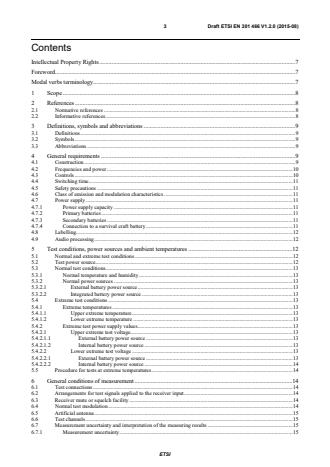
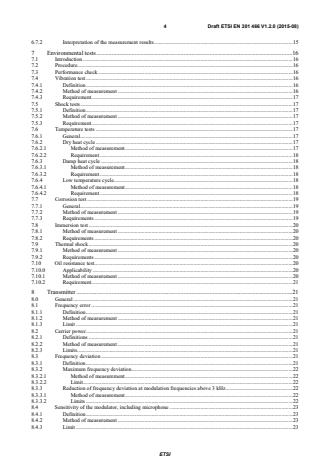
ETSI EN 301 466 V1.2.0 (2015-08) - Technical characteristics and methods of measurement for two-way VHF radiotelephone apparatus for fixed installation in survival craft

Overview
SIST EN 301 466 V1.2.1:2016 outlines the essential technical characteristics and measurement methods for two-way VHF radiotelephone equipment designed for fixed installation in survival craft. Targeting devices operating within the 156 MHz to 174 MHz bands allocated to Maritime Mobile Services, this European standard is integral to the Global Maritime Distress and Safety System (GMDSS). It ensures that VHF radio apparatus installed on survival craft meet established safety, performance, and reliability requirements, as detailed in the SOLAS 1974 Convention, International Maritime Organization (IMO) resolutions, and key international radio and maritime equipment standards.
Key Topics
Frequency Range & Emission Classes
- Equipment must function reliably in the 156 MHz to 174 MHz frequency range.
- Must comply with emission, modulation, and output power requirements as set by maritime authorities and international regulations.
Equipment Construction & Labelling
- Specifies criteria for robust construction vital for survival environments.
- Accurate labelling for identification and compliance is required.
Power Supply & Battery Operation
- Standards for external and integrated battery systems, including primary and secondary batteries.
- Requirements for connection compatibility with survival craft batteries.
Environmental & Safety Testing
- Extensive tests for vibration, shock, temperature extremes, corrosion, and immersion.
- Tests to simulate marine survival craft conditions and environmental exposures.
Transmitter & Receiver Performance
- Limits on transmitter frequency error, power output, modulation, and spurious emissions.
- Receiver sensitivity, selectivity, audio quality, squelch operation, and resistance to interference.
Measurement Methods
- Detailed protocols for testing under normal and extreme conditions to ensure compliance.
- Assessment of operational stability and performance reliability.
Applications
Maritime Survival Craft
The standard is specifically designed for VHF radiotelephone apparatus installed as fixed communication equipment in lifeboats, life rafts, and other types of survival craft, in line with international maritime safety regulations.GMDSS Compliance
Ensures that equipment used aboard survival craft conforms with GMDSS requirements, facilitating effective distress alerting, emergency communication, and coordination during maritime incidents.Inspection, Certification, and Maintenance
Used by ship inspectors, maritime safety authorities, and certification bodies to verify and maintain compliance of survival craft radio equipment.Equipment Manufacturers and Suppliers
Guides the design, production, and testing of maritime VHF radiotelephone equipment for the global market, ensuring reliability and safety at sea.
Related Standards
SOLAS 1974 (International Convention for the Safety of Life at Sea)
Sets overarching safety requirements for all sea-going vessels, forming the legal basis for mandatory safety equipment including VHF radios.IMO Resolution A.694(17) and A.809(19)
Detail specifications for the performance and approval of marine radio communication devices.CENELEC EN 60945
Covers the environmental testing and performance standards for marine navigation and communication equipment.ITU Radio Regulations
Establish spectrum allocations and operational protocols for maritime communication systems globally.
Keywords: VHF radiotelephone, survival craft radio, maritime safety, GMDSS, SOLAS, maritime communications standard, marine radio fixed installation, ETSI EN 301 466, battery operated VHF, two-way radio maritime, environmental testing marine electronics.
Buy Documents
Technical characteristics and methods of measurement for two-way VHF radiotelephone apparatus for fixed installation in survival craft - ERM TG26
ETSI EN 301 466 V1.2.0 (2015-08) - Technical characteristics and methods of measurement for two-way VHF radiotelephone apparatus for fixed installation in survival craft
Get Certified
Connect with accredited certification bodies for this standard

DNV
DNV is an independent assurance and risk management provider.

Lloyd's Register
Lloyd's Register is a global professional services organisation specialising in engineering and technology.

FSC International
Forest Stewardship Council certification.
Sponsored listings
Frequently Asked Questions
SIST EN 301 466 V1.2.1:2016 is a standard published by the Slovenian Institute for Standardization (SIST). Its full title is "Technical characteristics and methods of measurement for two-way VHF radiotelephone apparatus for fixed installation in survival craft". This standard covers: The present document states the minimum technical characteristics required for VHF radiotelephone equipment, operating in the bands between 156 MHz and 174 MHz allocated to the Maritime Mobile Services and suitable for fixed installations in survival craft in accordance with the provisions of the Global Maritime Distress and Safety System (GMDSS). The relevant requirements detailed in the Radio Regulations [5], International Convention for the Safety Of Life At Sea SOLAS 1974 [4] and the International Maritime Organization Resolutions A.694 [i.3] and A.809 [i.2] as well as all relevant requirements of CENELEC EN 60945 [i.5] are incorporated in the present document.
The present document states the minimum technical characteristics required for VHF radiotelephone equipment, operating in the bands between 156 MHz and 174 MHz allocated to the Maritime Mobile Services and suitable for fixed installations in survival craft in accordance with the provisions of the Global Maritime Distress and Safety System (GMDSS). The relevant requirements detailed in the Radio Regulations [5], International Convention for the Safety Of Life At Sea SOLAS 1974 [4] and the International Maritime Organization Resolutions A.694 [i.3] and A.809 [i.2] as well as all relevant requirements of CENELEC EN 60945 [i.5] are incorporated in the present document.
SIST EN 301 466 V1.2.1:2016 is classified under the following ICS (International Classification for Standards) categories: 33.060.20 - Receiving and transmitting equipment; 47.020.70 - Navigation and control equipment. The ICS classification helps identify the subject area and facilitates finding related standards.
SIST EN 301 466 V1.2.1:2016 is available in PDF format for immediate download after purchase. The document can be added to your cart and obtained through the secure checkout process. Digital delivery ensures instant access to the complete standard document.
Standards Content (Sample)
EUROPEAN STANDARD
Technical characteristics and methods of measurement
for two-way VHF radiotelephone apparatus
for fixed installation in survival craft
2 ETSI EN 301 466 V1.2.1 (2015-12)
Reference
REN/ERM-TG26-516
Keywords
emergency, GMDSS, maritime, radio, VHF
ETSI
650 Route des Lucioles
F-06921 Sophia Antipolis Cedex - FRANCE
Tel.: +33 4 92 94 42 00 Fax: +33 4 93 65 47 16
Siret N° 348 623 562 00017 - NAF 742 C
Association à but non lucratif enregistrée à la
Sous-Préfecture de Grasse (06) N° 7803/88
Important notice
The present document can be downloaded from:
http://www.etsi.org/standards-search
The present document may be made available in electronic versions and/or in print. The content of any electronic and/or
print versions of the present document shall not be modified without the prior written authorization of ETSI. In case of any
existing or perceived difference in contents between such versions and/or in print, the only prevailing document is the
print of the Portable Document Format (PDF) version kept on a specific network drive within ETSI Secretariat.
Users of the present document should be aware that the document may be subject to revision or change of status.
Information on the current status of this and other ETSI documents is available at
http://portal.etsi.org/tb/status/status.asp
If you find errors in the present document, please send your comment to one of the following services:
https://portal.etsi.org/People/CommiteeSupportStaff.aspx
Copyright Notification
No part may be reproduced or utilized in any form or by any means, electronic or mechanical, including photocopying
and microfilm except as authorized by written permission of ETSI.
The content of the PDF version shall not be modified without the written authorization of ETSI.
The copyright and the foregoing restriction extend to reproduction in all media.
© European Telecommunications Standards Institute 2015.
All rights reserved.
TM TM TM
DECT , PLUGTESTS , UMTS and the ETSI logo are Trade Marks of ETSI registered for the benefit of its Members.
TM
3GPP and LTE™ are Trade Marks of ETSI registered for the benefit of its Members and
of the 3GPP Organizational Partners.
GSM® and the GSM logo are Trade Marks registered and owned by the GSM Association.
ETSI
3 ETSI EN 301 466 V1.2.1 (2015-12)
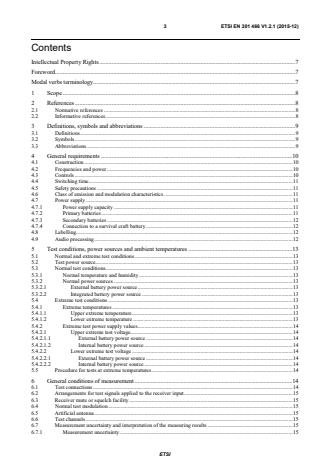
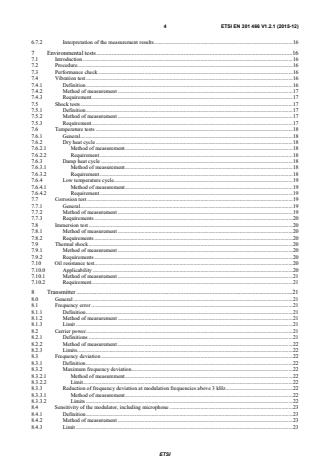
Contents
Intellectual Property Rights . 7
Foreword . 7
Modal verbs terminology . 7
1 Scope . 8
2 References . 8
2.1 Normative references . 8
2.2 Informative references . 8
3 Definitions, symbols and abbreviations . 9
3.1 Definitions . 9
3.2 Symbols . 9
3.3 Abbreviations . 9
4 General requirements . 10
4.1 Construction . 10
4.2 Frequencies and power . 10
4.3 Controls . 10
4.4 Switching time . 11
4.5 Safety precautions . 11
4.6 Class of emission and modulation characteristics . 11
4.7 Power supply . 11
4.7.1 Power supply capacity . 11
4.7.2 Primary batteries . 11
4.7.3 Secondary batteries . 12
4.7.4 Connection to a survival craft battery . 12
4.8 Labelling. 12
4.9 Audio processing . 12
5 Test conditions, power sources and ambient temperatures . 13
5.1 Normal and extreme test conditions . 13
5.2 Test power source . 13
5.3 Normal test conditions . 13
5.3.1 Normal temperature and humidity . 13
5.3.2 Normal power sources . 13
5.3.2.1 External battery power source . 13
5.3.2.2 Integrated battery power source . 13
5.4 Extreme test conditions . 13
5.4.1 Extreme temperatures . 13
5.4.1.1 Upper extreme temperature . 13
5.4.1.2 Lower extreme temperature . 13
5.4.2 Extreme test power supply values . 14
5.4.2.1 Upper extreme test voltage . 14
5.4.2.1.1 External battery power source . 14
5.4.2.1.2 Internal battery power source . 14
5.4.2.2 Lower extreme test voltage . 14
5.4.2.2.1 External battery power source . 14
5.4.2.2.2 Internal battery power source . 14
5.5 Procedure for tests at extreme temperatures . 14
6 General conditions of measurement . 14
6.1 Test connections . 14
6.2 Arrangements for test signals applied to the receiver input . 15
6.3 Receiver mute or squelch facility . 15
6.4 Normal test modulation . 15
6.5 Artificial antenna . 15
6.6 Test channels . 15
6.7 Measurement uncertainty and interpretation of the measuring results . 15
6.7.1 Measurement uncertainty . 15
ETSI
4 ETSI EN 301 466 V1.2.1 (2015-12)
6.7.2 Interpretation of the measurement results . 16
7 Environmental tests . 16
7.1 Introduction . 16
7.2 Procedure . 16
7.3 Performance check . 16
7.4 Vibration test . 16
7.4.1 Definition . 16
7.4.2 Method of measurement . 17
7.4.3 Requirement . 17
7.5 Shock tests . 17
7.5.1 Definition . 17
7.5.2 Method of measurement . 17
7.5.3 Requirement . 17
7.6 Temperature tests . 18
7.6.1 General . 18
7.6.2 Dry heat cycle . 18
7.6.2.1 Method of measurement . 18
7.6.2.2 Requirement . 18
7.6.3 Damp heat cycle . 18
7.6.3.1 Method of measurement . 18
7.6.3.2 Requirement . 18
7.6.4 Low temperature cycle . 19
7.6.4.1 Method of measurement . 19
7.6.4.2 Requirement . 19
7.7 Corrosion test . 19
7.7.1 General . 19
7.7.2 Method of measurement . 19
7.7.3 Requirements . 20
7.8 Immersion test . 20
7.8.1 Method of measurement . 20
7.8.2 Requirements . 20
7.9 Thermal shock . 20
7.9.1 Method of measurement . 20
7.9.2 Requirements . 20
7.10 Oil resistance test. 20
7.10.0 Applicability . 20
7.10.1 Method of measurement . 21
7.10.2 Requirement . 21
8 Transmitter . 21
8.0 General . 21
8.1 Frequency error . 21
8.1.1 Definition . 21
8.1.2 Method of measurement . 21
8.1.3 Limit . 21
8.2 Carrier power . 21
8.2.1 Definitions . 21
8.2.2 Method of measurement . 22
8.2.3 Limits . 22
8.3 Frequency deviation . 22
8.3.1 Definition . 22
8.3.2 Maximum frequency deviation . 22
8.3.2.1 Method of measurement . 22
8.3.2.2 Limit . 22
8.3.3 Reduction of frequency deviation at modulation frequencies above 3 kHz . 22
8.3.3.1 Method of measurement . 22
8.3.3.2 Limits . 22
8.4 Sensitivity of the modulator, including microphone . 23
8.4.1 Definition . 23
8.4.2 Method of measurement . 23
8.4.3 Limit . 23
ETSI
5 ETSI EN 301 466 V1.2.1 (2015-12)
8.5 Audio frequency response . 23
8.5.1 Definition . 23
8.5.2 Method of measurement . 23
8.5.3 Limit . 23
8.6 Audio frequency harmonic distortion of the emission. 24
8.6.1 Definition . 24
8.6.2 Method of measurement . 24
8.6.2.1 Normal test conditions . 24
8.6.2.2 Extreme test conditions . 24
8.6.3 Limit . 24
8.7 Adjacent channel power . 24
8.7.1 Definition . 24
8.7.2 Method of measurement . 24
8.7.3 Limit . 25
8.8 Conducted spurious emissions conveyed to the antenna . 25
8.8.1 Definition . 25
8.8.2 Method of measurement . 25
8.8.3 Limit . 25
8.9 Cabinet radiation and conducted spurious emissions other than those conveyed to the antenna . 25
8.9.1 Definitions . 25
8.9.2 Method of measurement . 25
8.9.3 Limits . 26
8.10 Residual modulation of the transmitter . 26
8.10.1 Definition . 26
8.10.2 Method of measurement . 26
8.10.3 Limit . 27
8.11 Transient frequency behaviour of the transmitter . 27
8.11.1 Definitions . 27
8.11.2 Method of measurement . 27
8.11.3 Limits . 28
9 Receiver . 30
9.1 Harmonic distortion and rated audio frequency output power . 30
9.1.1 Definition . 30
9.1.2 Methods of measurement . 30
9.1.3 Limits . 30
9.2 Audio frequency response . 30
9.2.1 Definition . 30
9.2.2 Method of measurement . 30
9.2.3 Limits . 31
9.3 Maximum usable sensitivity . 31
9.3.1 Definition . 31
9.3.2 Method of measurement . 31
9.3.3 Limits . 32
9.4 Co-channel rejection. 32
9.4.1 Definition . 32
9.4.2 Method of measurement . 32
9.4.3 Limit . 32
9.5 Adjacent channel selectivity . 32
9.5.1 Definition . 32
9.5.2 Method of measurement . 32
9.5.3 Limits . 33
9.6 Spurious response rejection . 33
9.6.1 Definition . 33
9.6.2 Method of measurement . 33
9.6.3 Limit . 33
9.7 Intermodulation response . 33
9.7.1 Definition . 33
9.7.2 Method of measurement . 33
9.7.3 Limit . 34
9.8 Blocking or desensitization . 34
9.8.1 Definition . 34
ETSI
6 ETSI EN 301 466 V1.2.1 (2015-12)
9.8.2 Method of measurement . 34
9.8.3 Limit . 34
9.9 Conducted spurious emissions . 34
9.9.1 Definition . 34
9.9.2 Method of measurement . 34
9.9.3 Limit . 34
9.10 Radiated spurious emissions. 35
9.10.1 Definition . 35
9.10.2 Method of measurements . 35
9.10.3 Limit . 35
9.11 Amplitude response of the receiver limiter . 36
9.11.1 Definition . 36
9.11.2 Method of measurement . 36
9.11.3 Limit . 36
9.12 Receiver noise . 36
9.12.1 Definition . 36
9.12.2 Method of measurement . 36
9.12.3 Limit . 36
9.13 Squelch operation . 36
9.13.1 Definition . 36
9.13.2 Method of measurement . 36
9.13.3 Limits . 37
9.14 Squelch hysteresis . 37
9.14.1 Definition . 37
9.14.2 Method of measurement . 37
9.14.3 Limit . 37
10 Secondary battery charger . 37
10.1 General . 37
10.2 Environmental tests . 38
10.2.1 Introduction. 38
10.2.2 Vibration test . 38
10.2.2.1 Definition . 38
10.2.2.2 Method of measurement . 38
10.2.2.3 Requirement . 38
10.2.3 Shock tests . 38
10.2.3.1 Definition . 38
10.2.3.2 Method of measurement . 38
10.2.3.3 Requirement . 39
10.2.4 Temperature tests . 39
10.2.4.1 General . 39
10.2.4.2 Dry heat cycle . 39
10.2.4.3 Damp heat cycle . 39
10.2.4.4 Low temperature cycle . 39
10.2.5 Corrosion test . 40
10.2.5.1 General . 40
10.2.5.2 Method of measurement . 40
10.2.5.3 Requirements . 40
10.3 Charging time . 40
Annex A (normative): Measuring receiver for adjacent channel power measurement . 41
A.1 Power measuring receiver specification . 41
A.1.0 Description . 41
A.1.1 IF filter . 41
A.1.2 Attenuation indicator . 42
A.1.3 rms value indicator . 42
A.1.4 Oscillator and amplifier . 42
History . 43
ETSI
7 ETSI EN 301 466 V1.2.1 (2015-12)
Intellectual Property Rights
IPRs essential or potentially essential to the present document may have been declared to ETSI. The information
pertaining to these essential IPRs, if any, is publicly available for ETSI members and non-members, and can be found
in ETSI SR 000 314: "Intellectual Property Rights (IPRs); Essential, or potentially Essential, IPRs notified to ETSI in
respect of ETSI standards", which is available from the ETSI Secretariat. Latest updates are available on the ETSI Web
server (http://ipr.etsi.org).
Pursuant to the ETSI IPR Policy, no investigation, including IPR searches, has been carried out by ETSI. No guarantee
can be given as to the existence of other IPRs not referenced in ETSI SR 000 314 (or the updates on the ETSI Web
server) which are, or may be, or may become, essential to the present document.
Foreword
This European Standard (EN) has been produced by ETSI Technical Committee Electromagnetic compatibility and
Radio spectrum Matters (ERM).
National transposition dates
Date of adoption of this EN: 7 December 2015
Date of latest announcement of this EN (doa): 31 March 2016
Date of latest publication of new National Standard
or endorsement of this EN (dop/e): 30 September 2016
Date of withdrawal of any conflicting National Standard (dow): 30 September 2017
Modal verbs terminology
In the present document "shall", "shall not", "should", "should not", "may", "need not", "will", "will not", "can" and
"cannot" are to be interpreted as described in clause 3.2 of the ETSI Drafting Rules (Verbal forms for the expression of
provisions).
"must" and "must not" are NOT allowed in ETSI deliverables except when used in direct citation.
ETSI
8 ETSI EN 301 466 V1.2.1 (2015-12)
1 Scope
The present document states the minimum technical characteristics required for VHF radiotelephone equipment, operating
in the bands between 156 MHz and 174 MHz allocated to the Maritime Mobile Services and suitable for fixed installations
in survival craft in accordance with the provisions of the Global Maritime Distress and Safety System (GMDSS).
The relevant requirements detailed in the Radio Regulations [5], International Convention for the Safety Of Life At Sea
SOLAS 1974 [4] and the International Maritime Organization Resolutions A.694 [i.3] and A.809 [i.2] as well as all relevant
requirements of CENELEC EN 60945 [i.5] are incorporated in the present document.
2 References
2.1 Normative references
References are either specific (identified by date of publication and/or edition number or version number) or
non-specific. For specific references, only the cited version applies. For non-specific references, the latest version of the
referenced document (including any amendments) applies.
Referenced documents which are not found to be publicly available in the expected location might be found at
http://docbox.etsi.org/Reference.
NOTE: While any hyperlinks included in this clause were valid at the time of publication, ETSI cannot guarantee
their long term validity.
The following referenced documents are necessary for the application of the present document.
[1] Recommendation ITU-T O.41 (1994): "Psophometer for use on telephone-type circuits".
[2] IEC 60068-2-27: 2008 Edition 4.0: "Environmental testing. Part 2-27: Tests - Test Ea and
guidance: Shock".
[3] ISO 25862 (2009): "Ships and marine technology -- Marine magnetic compasses, binnacles and
azimuth reading devices".
[4] SOLAS 1974: "International Maritime Organization (IMO), International Convention for the
Safety Of Life At Sea (SOLAS), (1974 as amended)".
[5] ITU Radio Regulations (2012), Appendix 18: "Table of transmitting frequencies in the VHF
maritime mobile band".
[6] ETSI TS 103 052: "Electromagnetic compatibility and Radio spectrum Matters (ERM); Radiated
measurement methods and general arrangements for test sites up to 100 GHz".
2.2 Informative references
References are either specific (identified by date of publication and/or edition number or version number) or
non-specific. For specific references, only the cited version applies. For non-specific references, the latest version of the
referenced document (including any amendments) applies.
NOTE: While any hyperlinks included in this clause were valid at the time of
...
Draft ETSI EN 301 466 V1.2.0 (2015-08)
EUROPEAN STANDARD
Technical characteristics and methods of measurement
for two-way VHF radiotelephone apparatus
for fixed installation in survival craft
2 Draft ETSI EN 301 466 V1.2.0 (2015-08)
Reference
REN/ERM-TG26-516
Keywords
emergency, GMDSS, maritime, radio, VHF
ETSI
650 Route des Lucioles
F-06921 Sophia Antipolis Cedex - FRANCE
Tel.: +33 4 92 94 42 00 Fax: +33 4 93 65 47 16
Siret N° 348 623 562 00017 - NAF 742 C
Association à but non lucratif enregistrée à la
Sous-Préfecture de Grasse (06) N° 7803/88
Important notice
The present document can be downloaded from:
http://www.etsi.org/standards-search
The present document may be made available in electronic versions and/or in print. The content of any electronic and/or
print versions of the present document shall not be modified without the prior written authorization of ETSI. In case of any
existing or perceived difference in contents between such versions and/or in print, the only prevailing document is the
print of the Portable Document Format (PDF) version kept on a specific network drive within ETSI Secretariat.
Users of the present document should be aware that the document may be subject to revision or change of status.
Information on the current status of this and other ETSI documents is available at
http://portal.etsi.org/tb/status/status.asp
If you find errors in the present document, please send your comment to one of the following services:
https://portal.etsi.org/People/CommiteeSupportStaff.aspx
Copyright Notification
No part may be reproduced or utilized in any form or by any means, electronic or mechanical, including photocopying
and microfilm except as authorized by written permission of ETSI.
The content of the PDF version shall not be modified without the written authorization of ETSI.
The copyright and the foregoing restriction extend to reproduction in all media.
© European Telecommunications Standards Institute 2015.
All rights reserved.
TM TM TM
DECT , PLUGTESTS , UMTS and the ETSI logo are Trade Marks of ETSI registered for the benefit of its Members.
TM
3GPP and LTE™ are Trade Marks of ETSI registered for the benefit of its Members and
of the 3GPP Organizational Partners.
GSM® and the GSM logo are Trade Marks registered and owned by the GSM Association.
ETSI
3 Draft ETSI EN 301 466 V1.2.0 (2015-08)
Contents
Intellectual Property Rights . 7
Foreword . 7
Modal verbs terminology . 7
1 Scope . 8
2 References . 8
2.1 Normative references . 8
2.2 Informative references . 8
3 Definitions, symbols and abbreviations . 9
3.1 Definitions . 9
3.2 Symbols . 9
3.3 Abbreviations . 9
4 General requirements . 9
4.1 Construction . 9
4.2 Frequencies and power . 10
4.3 Controls . 10
4.4 Switching time . 11
4.5 Safety precautions . 11
4.6 Class of emission and modulation characteristics . 11
4.7 Power supply . 11
4.7.1 Power supply capacity . 11
4.7.2 Primary batteries . 11
4.7.3 Secondary batteries . 11
4.7.4 Connection to a survival craft battery . 11
4.8 Labelling. 12
4.9 Audio processing . 12
5 Test conditions, power sources and ambient temperatures . 12
5.1 Normal and extreme test conditions . 12
5.2 Test power source . 12
5.3 Normal test conditions . 13
5.3.1 Normal temperature and humidity . 13
5.3.2 Normal power sources . 13
5.3.2.1 External battery power source . 13
5.3.2.2 Integrated battery power source . 13
5.4 Extreme test conditions . 13
5.4.1 Extreme temperatures . 13
5.4.1.1 Upper extreme temperature . 13
5.4.1.2 Lower extreme temperature . 13
5.4.2 Extreme test power supply values . 13
5.4.2.1 Upper extreme test voltage . 13
5.4.2.1.1 External battery power source . 13
5.4.2.1.2 Internal battery power source . 13
5.4.2.2 Lower extreme test voltage . 13
5.4.2.2.1 External battery power source . 13
5.4.2.2.2 Internal battery power source . 14
5.5 Procedure for tests at extreme temperatures . 14
6 General conditions of measurement . 14
6.1 Test connections . 14
6.2 Arrangements for test signals applied to the receiver input . 14
6.3 Receiver mute or squelch facility . 14
6.4 Normal test modulation . 14
6.5 Artificial antenna . 15
6.6 Test channels . 15
6.7 Measurement uncertainty and interpretation of the measuring results . 15
6.7.1 Measurement uncertainty . 15
ETSI
4 Draft ETSI EN 301 466 V1.2.0 (2015-08)
6.7.2 Interpretation of the measurement results . 15
7 Environmental tests . 16
7.1 Introduction . 16
7.2 Procedure . 16
7.3 Performance check . 16
7.4 Vibration test . 16
7.4.1 Definition . 16
7.4.2 Method of measurement . 16
7.4.3 Requirement . 17
7.5 Shock tests . 17
7.5.1 Definition . 17
7.5.2 Method of measurement . 17
7.5.3 Requirement . 17
7.6 Temperature tests . 17
7.6.1 General . 17
7.6.2 Dry heat cycle . 17
7.6.2.1 Method of measurement . 17
7.6.2.2 Requirement . 18
7.6.3 Damp heat cycle . 18
7.6.3.1 Method of measurement . 18
7.6.3.2 Requirement . 18
7.6.4 Low temperature cycle . 18
7.6.4.1 Method of measurement . 18
7.6.4.2 Requirement . 18
7.7 Corrosion test . 19
7.7.1 General . 19
7.7.2 Method of measurement . 19
7.7.3 Requirements . 19
7.8 Immersion test . 20
7.8.1 Method of measurement . 20
7.8.2 Requirements . 20
7.9 Thermal shock . 20
7.9.1 Method of measurement . 20
7.9.2 Requirements . 20
7.10 Oil resistance test. 20
7.10.0 Applicability . 20
7.10.1 Method of measurement . 20
7.10.2 Requirement . 21
8 Transmitter . 21
8.0 General . 21
8.1 Frequency error . 21
8.1.1 Definition . 21
8.1.2 Method of measurement . 21
8.1.3 Limit . 21
8.2 Carrier power . 21
8.2.1 Definitions . 21
8.2.2 Method of measurement . 21
8.2.3 Limits . 21
8.3 Frequency deviation . 21
8.3.1 Definition . 21
8.3.2 Maximum frequency deviation . 22
8.3.2.1 Method of measurement . 22
8.3.2.2 Limit . 22
8.3.3 Reduction of frequency deviation at modulation frequencies above 3 kHz . 22
8.3.3.1 Method of measurement . 22
8.3.3.2 Limits . 22
8.4 Sensitivity of the modulator, including microphone . 23
8.4.1 Definition . 23
8.4.2 Method of measurement . 23
8.4.3 Limit . 23
ETSI
5 Draft ETSI EN 301 466 V1.2.0 (2015-08)
8.5 Audio frequency response . 23
8.5.1 Definition . 23
8.5.2 Method of measurement . 23
8.5.3 Limit . 23
8.6 Audio frequency harmonic distortion of the emission. 23
8.6.1 Definition . 23
8.6.2 Method of measurement . 23
8.6.2.1 Normal test conditions . 23
8.6.2.2 Extreme test conditions . 23
8.6.3 Limit . 23
8.7 Adjacent channel power . 24
8.7.1 Definition . 24
8.7.2 Method of measurement . 24
8.7.3 Limit . 24
8.8 Conducted spurious emissions conveyed to the antenna . 24
8.8.1 Definition . 24
8.8.2 Method of measurement . 24
8.8.3 Limit . 25
8.9 Cabinet radiation and conducted spurious emissions other than those conveyed to the antenna . 25
8.9.1 Definitions . 25
8.9.2 Method of measurement . 25
8.9.3 Limits . 26
8.10 Residual modulation of the transmitter . 26
8.10.1 Definition . 26
8.10.2 Method of measurement . 26
8.10.3 Limit . 26
8.11 Transient frequency behaviour of the transmitter . 26
8.11.1 Definitions . 26
8.11.2 Method of measurement . 27
8.11.3 Limits . 28
9 Receiver . 30
9.1 Harmonic distortion and rated audio frequency output power . 30
9.1.1 Definition . 30
9.1.2 Methods of measurement . 30
9.1.3 Limits . 30
9.2 Audio frequency response . 30
9.2.1 Definition . 30
9.2.2 Method of measurement . 30
9.2.3 Limits . 31
9.3 Maximum usable sensitivity . 31
9.3.1 Definition . 31
9.3.2 Method of measurement . 31
9.3.3 Limits . 32
9.4 Co-channel rejection. 32
9.4.1 Definition . 32
9.4.2 Method of measurement . 32
9.4.3 Limit . 32
9.5 Adjacent channel selectivity . 32
9.5.1 Definition . 32
9.5.2 Method of measurement . 32
9.5.3 Limits . 33
9.6 Spurious response rejection . 33
9.6.1 Definition . 33
9.6.2 Method of measurement . 33
9.6.3 Limit . 33
9.7 Intermodulation response . 33
9.7.1 Definition . 33
9.7.2 Method of measurement . 33
9.7.3 Limit . 34
9.8 Blocking or desensitization . 34
9.8.1 Definition . 34
ETSI
6 Draft ETSI EN 301 466 V1.2.0 (2015-08)
9.8.2 Method of measurement . 34
9.8.3 Limit . 34
9.9 Conducted spurious emissions . 34
9.9.1 Definition . 34
9.9.2 Method of measurement . 34
9.9.3 Limit . 34
9.10 Radiated spurious emissions. 35
9.10.1 Definition . 35
9.10.2 Method of measurements . 35
9.10.3 Limit . 35
9.11 Amplitude response of the receiver limiter . 36
9.11.1 Definition . 36
9.11.2 Method of measurement . 36
9.11.3 Limit . 36
9.12 Receiver noise . 36
9.12.1 Definition . 36
9.12.2 Method of measurement . 36
9.12.3 Limit . 36
9.13 Squelch operation . 36
9.13.1 Definition . 36
9.13.2 Method of measurement . 36
9.13.3 Limits . 37
9.14 Squelch hysteresis . 37
9.14.1 Definition . 37
9.14.2 Method of measurement . 37
9.14.3 Limit . 37
10 Secondary battery charger . 37
10.1 General . 37
10.2 Environmental tests . 38
10.2.1 Introduction. 38
10.2.2 Vibration test . 38
10.2.2.1 Definition . 38
10.2.2.2 Method of measurement . 38
10.2.2.3 Requirement . 38
10.2.3 Shock tests . 38
10.2.3.1 Definition . 38
10.2.3.2 Method of measurement . 38
10.2.3.3 Requirement . 39
10.2.4 Temperature tests . 39
10.2.4.1 General . 39
10.2.4.2 Dry heat cycle . 39
10.2.4.3 Damp heat cycle . 39
10.2.4.4 Low temperature cycle . 39
10.2.5 Corrosion test . 40
10.2.5.1 General . 40
10.2.5.2 Method of measurement . 40
10.2.5.3 Requirements . 40
10.3 Charging time . 40
Annex A (normative): Measuring receiver for adjacent channel power measurement . 41
A.1 Power measuring receiver specification . 41
A.1.0 Description . 41
A.1.1 IF filter . 41
A.1.2 Attenuation indicator . 42
A.1.3 rms value indicator . 42
A.1.4 Oscillator and amplifier . 42
History . 43
ETSI
7 Draft ETSI EN 301 466 V1.2.0 (2015-08)
Intellectual Property Rights
IPRs essential or potentially essential to the present document may have been declared to ETSI. The information
pertaining to these essential IPRs, if any, is publicly available for ETSI members and non-members, and can be found
in ETSI SR 000 314: "Intellectual Property Rights (IPRs); Essential, or potentially Essential, IPRs notified to ETSI in
respect of ETSI standards", which is available from the ETSI Secretariat. Latest updates are available on the ETSI Web
server (http://ipr.etsi.org).
Pursuant to the ETSI IPR Policy, no investigation, including IPR searches, has been carried out by ETSI. No guarantee
can be given as to the existence of other IPRs not referenced in ETSI SR 000 314 (or the updates on the ETSI Web
server) which are, or may be, or may become, essential to the present document.
Foreword
This draft European Standard (EN) has been produced by ETSI Technical Committee Electromagnetic compatibility
and Radio spectrum Matters (ERM), and is now submitted for the combined Public Enquiry and Vote phase of the ETSI
standards EN Approval Procedure.
Proposed national transposition dates
Date of latest announcement of this EN (doa): 3 months after ETSI publication
Date of latest publication of new National Standard
or endorsement of this EN (dop/e): 6 months after doa
Date of withdrawal of any conflicting National Standard (dow): 18 months after doa
Modal verbs terminology
In the present document "shall", "shall not", "should", "should not", "may", "need not", "will", "will not", "can" and
"cannot" are to be interpreted as described in clause 3.2 of the ETSI Drafting Rules (Verbal forms for the expression of
provisions).
"must" and "must not" are NOT allowed in ETSI deliverables except when used in direct citation.
ETSI
8 Draft ETSI EN 301 466 V1.2.0 (2015-08)
1 Scope
The present document states the minimum technical characteristics required for VHF radiotelephone equipment, operating
in the bands between 156 MHz and 174 MHz allocated to the Maritime Mobile Services and suitable for fixed installations
in survival craft in accordance with the provisions of the Global Maritime Distress and Safety System (GMDSS). The
relevant requirements detailed in the Radio Regulations [5], International Convention for the Safety Of Life At Sea SOLAS
1974 [4] and the International Maritime Organization Resolutions A.694 [i.3] and A.809 [i.2] as well as all relevant
requirements of EN 60945 [i.5] are incorporated in the present document.
2 References
2.1 Normative references
References are either specific (identified by date of publication and/or edition number or version number) or
non-specific. For specific references, only the cited version applies. For non-specific references, the latest version of the
referenced document (including any amendments) applies.
Referenced documents which are not found to be publicly available in the expected location might be found at
http://docbox.etsi.org/Reference.
NOTE: While any hyperlinks included in this clause were valid at the time of publication, ETSI cannot guarantee
their long term validity.
The following referenced documents are necessary for the application of the present document.
[1] Recommendation ITU-T O.41 (1994): "Psophometer for use on telephone-type circuits".
[2] IEC 60068-2-27: 2008 Edition 4.0 "Environmental testing. Part 2: Tests - Test Ea and guidance:
Shock".
[3] ISO 25862 (2009): "Ships and marine technology-- Marine magnetic compasses, binnacles and
azimuth reading devices".
[4] SOLAS 1974: "International Maritime Organization (IMO), International Convention for the
Safety Of Life At Sea (SOLAS), (1974 as amended)".
[5] ITU Radio Regulations (2012), Appendix 18: "Table of transmitting frequencies in the VHF
maritime mobile band".
[6] ETSI TS 103 052: "Electromagnetic compatibility and Radio spectrum Matters (ERM); Radiated
measurement methods and general arrangements for test sites up to 100 GHz".
2.2 Informative references
References are either specific (identified by date of publication and/or edition number or version number) or
non-specific. For specific references, only the cited version applies. For non-specific references, the latest version o
...
2003-01.Slovenski inštitut za standardizacijo. Razmnoževanje celote ali delov tega standarda ni dovoljeno.Technical characteristics and methods of measurement for two-way VHF radiotelephone apparatus for fixed installation in survival craft47.020.70Navigacijska in krmilna opremaNavigation and control equipment33.060.20Sprejemna in oddajna opremaReceiving and transmitting equipmentICS:Ta slovenski standard je istoveten z:EN 301 466 V1.2.1SIST EN 301 466 V1.2.1:2016en01-marec-2016SIST EN 301 466 V1.2.1:2016SLOVENSKI
STANDARD
EUROPEAN STANDARD SIST EN 301 466 V1.2.1:2016
ETSI ETSI EN 301 466 V1.2.1 (2015-12) 2
Reference REN/ERM-TG26-516 Keywords emergency, GMDSS, maritime, radio, VHF ETSI 650 Route des Lucioles F-06921 Sophia Antipolis Cedex - FRANCE
Tel.: +33 4 92 94 42 00
Fax: +33 4 93 65 47 16
Siret N° 348 623 562 00017 - NAF 742 C Association à but non lucratif enregistrée à la Sous-Préfecture de Grasse (06) N° 7803/88
Important notice The present document can be downloaded from: http://www.etsi.org/standards-search The present document may be made available in electronic versions and/or in print. The content of any electronic and/or print versions of the present document shall not be modified without the prior written authorization of ETSI. In case of any existing or perceived difference in contents between such versions and/or in print, the only prevailing document is the print of the Portable Document Format (PDF) version kept on a specific network drive within ETSI Secretariat. Users of the present document should be aware that the document may be subject to revision or change of status. Information on the current status of this and other ETSI documents is available at http://portal.etsi.org/tb/status/status.asp If you find errors in the present document, please send your comment to one of the following services: https://portal.etsi.org/People/CommiteeSupportStaff.aspx Copyright Notification No part may be reproduced or utilized in any form or by any means, electronic or mechanical, including photocopying and microfilm except as authorized by written permission of ETSI. The content of the PDF version shall not be modified without the written authorization of ETSI. The copyright and the foregoing restriction extend to reproduction in all media.
© European Telecommunications Standards Institute 2015. All rights reserved.
DECTTM, PLUGTESTSTM, UMTSTM and the ETSI logo are Trade Marks of ETSI registered for the benefit of its Members. 3GPPTM and LTE™ are Trade Marks of ETSI registered for the benefit of its Members and of the 3GPP Organizational Partners. GSM® and the GSM logo are Trade Marks registered and owned by the GSM Association. SIST EN 301 466 V1.2.1:2016
ETSI ETSI EN 301 466 V1.2.1 (2015-12) 3 Contents Intellectual Property Rights . 7 Foreword . 7 Modal verbs terminology . 7 1 Scope . 8 2 References . 8 2.1 Normative references . 8 2.2 Informative references . 8 3 Definitions, symbols and abbreviations . 9 3.1 Definitions . 9 3.2 Symbols . 9 3.3 Abbreviations . 9 4 General requirements . 10 4.1 Construction . 10 4.2 Frequencies and power . 10 4.3 Controls . 10 4.4 Switching time . 11 4.5 Safety precautions . 11 4.6 Class of emission and modulation characteristics . 11 4.7 Power supply . 11 4.7.1 Power supply capacity . 11 4.7.2 Primary batteries . 11 4.7.3 Secondary batteries . 12 4.7.4 Connection to a survival craft battery . 12 4.8 Labelling. 12 4.9 Audio processing . 12 5 Test conditions, power sources and ambient temperatures . 13 5.1 Normal and extreme test conditions . 13 5.2 Test power source . 13 5.3 Normal test conditions . 13 5.3.1 Normal temperature and humidity . 13 5.3.2 Normal power sources . 13 5.3.2.1 External battery power source . 13 5.3.2.2 Integrated battery power source . 13 5.4 Extreme test conditions . 13 5.4.1 Extreme temperatures . 13 5.4.1.1 Upper extreme temperature . 13 5.4.1.2 Lower extreme temperature . 13 5.4.2 Extreme test power supply values . 14 5.4.2.1 Upper extreme test voltage . 14 5.4.2.1.1 External battery power source . 14 5.4.2.1.2 Internal battery power source . 14 5.4.2.2 Lower extreme test voltage . 14 5.4.2.2.1 External battery power source . 14 5.4.2.2.2 Internal battery power source . 14 5.5 Procedure for tests at extreme temperatures . 14 6 General conditions of measurement . 14 6.1 Test connections . 14 6.2 Arrangements for test signals applied to the receiver input . 15 6.3 Receiver mute or squelch facility . 15 6.4 Normal test modulation . 15 6.5 Artificial antenna . 15 6.6 Test channels . 15 6.7 Measurement uncertainty and interpretation of the measuring results . 15 6.7.1 Measurement uncertainty . 15 SIST EN 301 466 V1.2.1:2016
ETSI ETSI EN 301 466 V1.2.1 (2015-12) 4 6.7.2 Interpretation of the measurement results . 16 7 Environmental tests . 16 7.1 Introduction . 16 7.2 Procedure . 16 7.3 Performance check . 16 7.4 Vibration test . 16 7.4.1 Definition . 16 7.4.2 Method of measurement . 17 7.4.3 Requirement . 17 7.5 Shock tests . 17 7.5.1 Definition . 17 7.5.2 Method of measurement . 17 7.5.3 Requirement . 17 7.6 Temperature tests . 18 7.6.1 General . 18 7.6.2 Dry heat cycle . 18 7.6.2.1 Method of measurement . 18 7.6.2.2 Requirement . 18 7.6.3 Damp heat cycle . 18 7.6.3.1 Method of measurement . 18 7.6.3.2 Requirement . 18 7.6.4 Low temperature cycle . 19 7.6.4.1 Method of measurement . 19 7.6.4.2 Requirement . 19 7.7 Corrosion test . 19 7.7.1 General . 19 7.7.2 Method of measurement . 19 7.7.3 Requirements . 20 7.8 Immersion test . 20 7.8.1 Method of measurement . 20 7.8.2 Requirements . 20 7.9 Thermal shock . 20 7.9.1 Method of measurement . 20 7.9.2 Requirements . 20 7.10 Oil resistance test. 20 7.10.0 Applicability . 20 7.10.1 Method of measurement . 21 7.10.2 Requirement . 21 8 Transmitter . 21 8.0 General . 21 8.1 Frequency error . 21 8.1.1 Definition . 21 8.1.2 Method of measurement . 21 8.1.3 Limit . 21 8.2 Carrier power . 21 8.2.1 Definitions . 21 8.2.2 Method of measurement . 22 8.2.3 Limits . 22 8.3 Frequency deviation . 22 8.3.1 Definition . 22 8.3.2 Maximum frequency deviation . 22 8.3.2.1 Method of measurement . 22 8.3.2.2 Limit . 22 8.3.3 Reduction of frequency deviation at modulation frequencies above 3 kHz . 22 8.3.3.1 Method of measurement . 22 8.3.3.2 Limits . 22 8.4 Sensitivity of the modulator, including microphone . 23 8.4.1 Definition . 23 8.4.2 Method of measurement . 23 8.4.3 Limit . 23 SIST EN 301 466 V1.2.1:2016
ETSI ETSI EN 301 466 V1.2.1 (2015-12) 5 8.5 Audio frequency response . 23 8.5.1 Definition . 23 8.5.2 Method of measurement . 23 8.5.3 Limit . 23 8.6 Audio frequency harmonic distortion of the emission. 24 8.6.1 Definition . 24 8.6.2 Method of measurement . 24 8.6.2.1 Normal test conditions . 24 8.6.2.2 Extreme test conditions . 24 8.6.3 Limit . 24 8.7 Adjacent channel power . 24 8.7.1 Definition . 24 8.7.2 Method of measurement . 24 8.7.3 Limit . 25 8.8 Conducted spurious emissions conveyed to the antenna . 25 8.8.1 Definition . 25 8.8.2 Method of measurement . 25 8.8.3 Limit . 25 8.9 Cabinet radiation and conducted spurious emissions other than those conveyed to the antenna . 25 8.9.1 Definitions . 25 8.9.2 Method of measurement . 25 8.9.3 Limits . 26 8.10 Residual modulation of the transmitter . 26 8.10.1 Definition . 26 8.10.2 Method of measurement . 26 8.10.3 Limit . 27 8.11 Transient frequency behaviour of the transmitter . 27 8.11.1 Definitions . 27 8.11.2 Method of measurement . 27 8.11.3 Limits . 28 9 Receiver . 30 9.1 Harmonic distortion and rated audio frequency output power . 30 9.1.1 Definition . 30 9.1.2 Methods of measurement . 30 9.1.3 Limits . 30 9.2 Audio frequency response . 30 9.2.1 Definition . 30 9.2.2 Method of measurement . 30 9.2.3 Limits . 31 9.3 Maximum usable sensitivity . 31 9.3.1 Definition . 31 9.3.2 Method of measurement . 31 9.3.3 Limits . 32 9.4 Co-channel rejection. 32 9.4.1 Definition . 32 9.4.2 Method of measurement . 32 9.4.3 Limit . 32 9.5 Adjacent channel selectivity . 32 9.5.1 Definition . 32 9.5.2 Method of measurement . 32 9.5.3 Limits . 33 9.6 Spurious response rejection . 33 9.6.1 Definition . 33 9.6.2 Method of measurement . 33 9.6.3 Limit . 33 9.7 Intermodulation response . 33 9.7.1 Definition . 33 9.7.2 Method of measurement . 33 9.7.3 Limit . 34 9.8 Blocking or desensitization . 34 9.8.1 Definition . 34 SIST EN 301 466 V1.2.1:2016
ETSI ETSI EN 301 466 V1.2.1 (2015-12) 6 9.8.2 Method of measurement . 34 9.8.3 Limit . 34 9.9 Conducted spurious emissions . 34 9.9.1 Definition . 34 9.9.2 Method of measurement . 34 9.9.3 Limit . 34 9.10 Radiated spurious emissions. 35 9.10.1 Definition . 35 9.10.2 Method of measurements . 35 9.10.3 Limit . 35 9.11 Amplitude response of the receiver limiter . 36 9.11.1 Definition . 36 9.11.2 Method of measurement . 36 9.11.3 Limit . 36 9.12 Receiver noise . 36 9.12.1 Definition . 36 9.12.2 Method of measurement . 36 9.12.3 Limit . 36 9.13 Squelch operation . 36 9.13.1 Definition . 36 9.13.2 Method of measurement . 36 9.13.3 Limits . 37 9.14 Squelch hysteresis . 37 9.14.1 Definition . 37 9.14.2 Method of measurement . 37 9.14.3 Limit . 37 10 Secondary battery charger . 37 10.1 General . 37 10.2 Environmental tests . 38 10.2.1 Introduction. 38 10.2.2 Vibration test . 38 10.2.2.1 Definition . 38 10.2.2.2 Method of measurement . 38 10.2.2.3 Requirement . 38 10.2.3 Shock tests . 38 10.2.3.1 Definition . 38 10.2.3.2 Method of measurement . 38 10.2.3.3 Requirement . 39 10.2.4 Temperature tests . 39 10.2.4.1 General . 39 10.2.4.2 Dry heat cycle . 39 10.2.4.3 Damp heat cycle . 39 10.2.4.4 Low temperature cycle . 39 10.2.5 Corrosion test . 40 10.2.5.1 General . 40 10.2.5.2 Method of measurement . 40 10.2.5.3 Requirements . 40 10.3 Charging time . 40 Annex A (normative): Measuring receiver for adjacent channel power measurement . 41 A.1 Power measuring receiver specification . 41 A.1.0 Description . 41 A.1.1 IF filter . 41 A.1.2 Attenuation indicator . 42 A.1.3 rms value indicator . 42 A.1.4 Oscillator and amplifier . 42 History . 43
ETSI ETSI EN 301 466 V1.2.1 (2015-12) 7 Intellectual Property Rights IPRs essential or potentially essential to the present document may have been declared to ETSI. The information pertaining to these essential IPRs, if any, is publicly available for ETSI members and non-members, and can be found in ETSI SR 000 314: "Intellectual Property Rights (IPRs); Essential, or potentially Essential, IPRs notified to ETSI in respect of ETSI standards", which is available from the ETSI Secretariat. Latest updates are available on the ETSI Web server (http://ipr.etsi.org). Pursuant to the ETSI IPR Policy, no investigation, including IPR searches, has been carried out by ETSI. No guarantee can be given as to the existence of other IPRs not referenced in ETSI SR 000 314 (or the updates on the ETSI Web server) which are, or may be, or may become, essential to the present document. Foreword This European Standard (EN) has been produced by ETSI Technical Committee Electromagnetic compatibility and Radio spectrum Matters (ERM).
National transposition dates Date of adoption of this EN: 7 December 2015 Date of latest announcement of this EN (doa): 31 March 2016 Date of latest publication of new National Standard or endorsement of this EN (dop/e):
30 September 2016 Date of withdrawal of any conflicting National Standard (dow): 30 September 2017
Modal verbs terminology In the present document "shall", "shall not", "should", "should not", "may", "need not", "will", "will not", "can" and "cannot" are to be interpreted as described in clause 3.2 of the ETSI Drafting Rules (Verbal forms for the expression of provisions). "must" and "must not" are NOT allowed in ETSI deliverables except when used in direct citation. SIST EN 301 466 V1.2.1:2016
ETSI ETSI EN 301 466 V1.2.1 (2015-12) 8 1 Scope The present document states the minimum technical characteristics required for VHF radiotelephone equipment, operating in the bands between 156 MHz and 174 MHz allocated to the Maritime Mobile Services and suitable for fixed installations in survival craft in accordance with the provisions of the Global Maritime Distress and Safety System (GMDSS). The relevant requirements detailed in the Radio Regulations [5], International Convention for the Safety Of Life At Sea SOLAS 1974 [4] and the International Maritime Organization Resolutions A.694 [i.3] and A.809 [i.2] as well as all relevant requirements of CENELEC EN 60945 [i.5] are incorporated in the present document. 2 References 2.1 Normative references References are either specific (identified by date of publication and/or edition number or version number) or non-specific. For specific references, only the cited version applies. For non-specific references, the latest version of the referenced document (including any amendments) applies. Referenced documents which are not found to be publicly available in the expected location might be found at http://docbox.etsi.org/Reference. NOTE: While any hyperlinks included in this clause were valid at the time of publication, ETSI cannot guarantee their long term validity. The following referenced documents are necessary for the application of the present document. [1] Recommendation ITU-T O.41 (1994): "Psophometer for use on telephone-type circuits". [2] IEC 60068-2-27: 2008 Edition 4.0: "Environmental testing. Part 2-27: Tests - Test Ea and guidance: Shock". [3] ISO 25862 (2009): "Ships and marine technology -- Marine magnetic compasses, binnacles and azimuth reading devices". [4] SOLAS 1974: "International Maritime Organization (IMO), International Convention for the Safety Of Life At Sea (SOLAS), (1974 as amended)". [5] ITU Radio Regulations (2012), Appendix 18: "Table of transmitting frequencies in the VHF maritime mobile band". [6] ETSI TS 103 052: "Electromagnetic compatibility and Radio spectrum Matters (ERM); Radiated measurement methods and general arrangements for test sites up to 100 GHz". 2.2 Informative references References are either specific (identified by date of publication and/or edition number or version number) or non-specific. For specific references, only the cited version applies. For non-specific references, the latest version of the referenced document (including any amendments) applies. NOTE: While any hyperlinks included in this clause were valid at the time of p
...