

SIST EN 300 338-7 V1.1.1:2022
(Main)Technical characteristics and methods of measurement for equipment for generation, transmission and reception of Digital Selective Calling (DSC) in the maritime MF, MF/HF and/or VHF mobile service - Part 7: Implementation of Bridge Alert Management (BAM) in DSC radio equipment
General Information
- Abstract
The present document specifies the minimum requirements for GMDSS radiocommunication system using Digital
Selective Calling (DSC) Class A, with the capability to operate on a SOLAS bridge with the application of SOLAS
regulation V/15 [i.4] and thus implementing the BAM concept defined by IMO in MSC.302(87) [8].
- Status
- Published
- Public Enquiry End Date
- 30-Sep-2021
- Publication Date
- 11-Apr-2022
- Technical Committee
- MOC - Mobile Communications
- Current Stage
- 6060 - National Implementation/Publication (Adopted Project)
- Start Date
- 11-Apr-2022
- Due Date
- 16-Jun-2022
- Completion Date
- 12-Apr-2022
Buy Documents


ETSI EN 300 338-7 V1.0.0 (2021-07) - Technical characteristics and methods of measurement for equipment for generation, transmission and reception of Digital Selective Calling (DSC) in the maritime MF, MF/HF and/or VHF mobile service; Part 7: Implementation of Bridge Alert Management (BAM) in DSC radio equipment
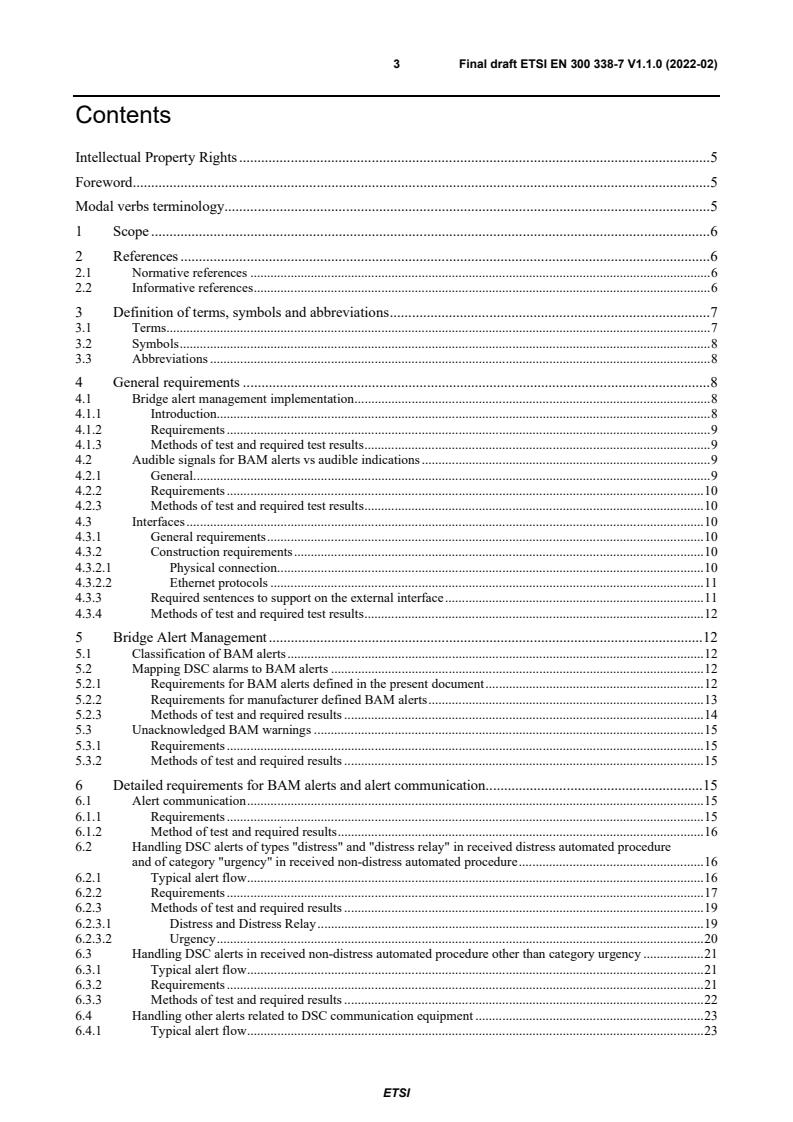
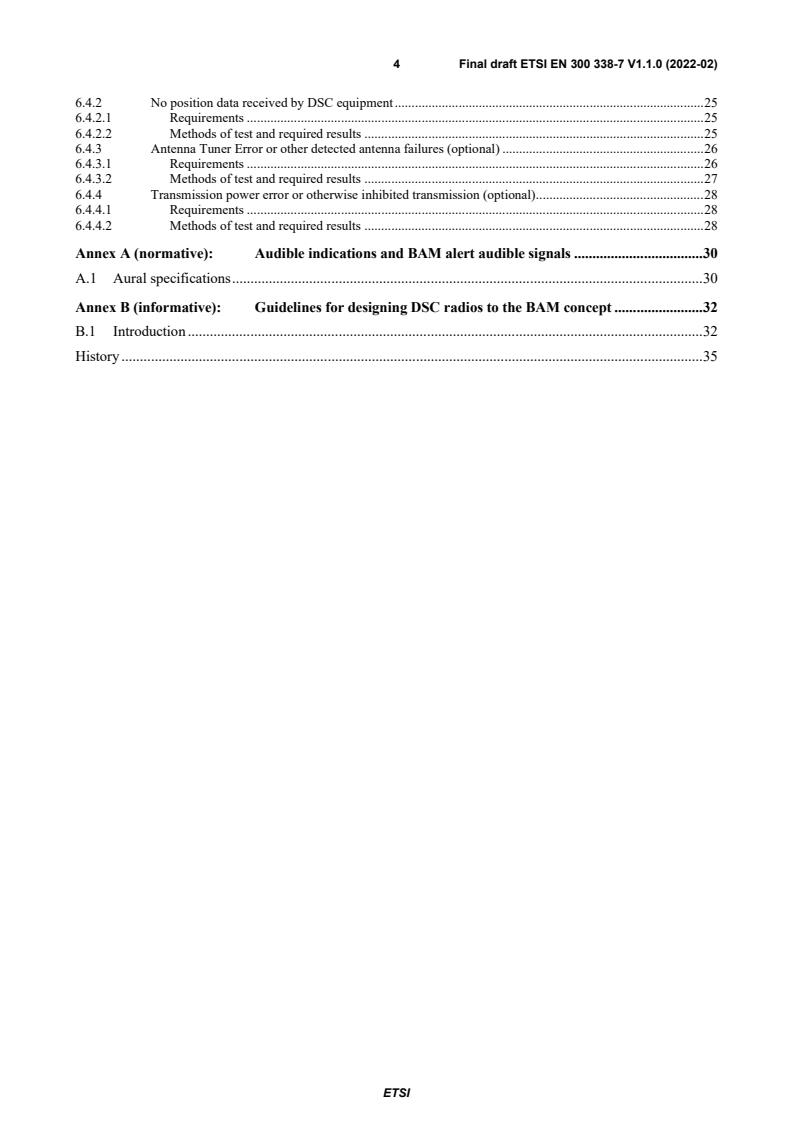
ETSI EN 300 338-7 V1.1.0 (2022-02) - Technical characteristics and methods of measurement for equipment for generation, transmission and reception of Digital Selective Calling (DSC) in the maritime MF, MF/HF and/or VHF mobile service; Part 7: Implementation of Bridge Alert Management (BAM) in DSC radio equipment
ETSI EN 300 338-7 V1.1.1 (2022-04) - Technical characteristics and methods of measurement for equipment for generation, transmission and reception of Digital Selective Calling (DSC) in the maritime MF, MF/HF and/or VHF mobile service; Part 7: Implementation of Bridge Alert Management (BAM) in DSC radio equipment

Overview
SIST EN 300 338-7 V1.1.1:2022 defines the minimum technical requirements, methods of measurement, and implementation guidelines for Digital Selective Calling (DSC) radio equipment used in maritime MF, MF/HF, and VHF mobile services. This part of the standard specifically focuses on the implementation of Bridge Alert Management (BAM) in accordance with the IMO performance standards, supporting SOLAS regulation V/15 for maritime safety. The document ensures that DSC equipment, compliant with GMDSS (Global Maritime Distress and Safety System), integrates BAM functionality, enhancing the management, prioritization, and response of alerts on vessel bridges.
Key Topics
Bridge Alert Management (BAM):
BAM provides a unified and prioritized system for handling alarms and alerts on ship bridges. This standard addresses how DSC Class A radio equipment generates, transmits, and receives alerts according to BAM concepts, ensuring that all abnormal situations are efficiently communicated and managed.DSC Equipment Compliance:
The standard outlines requirements for DSC equipment to comply with BAM as defined by IMO MSC.302(87) and references key IEC standards (e.g., IEC 62923-1, IEC 62923-2) for operational performance.Interfaces and Integration:
DSC equipment must support digital interfaces, such as those specified in IEC 61162-1, IEC 61162-2, and IEC 61162-450, for reliable communication between the radio and other onboard systems, including Central Alert Management (CAM) systems.Audible and Visual Alerts:
Clear differentiation between audible BAM alerts (for emergencies and warnings) and less-intrusive audible indications is mandatory, improving the clarity and effectiveness of bridge alerts and operator responses.Classification and Mapping of Alerts:
The standard details the mapping of DSC events to BAM alert categories (emergency alarm, warning, caution), ensuring proper prioritization and response in accordance with international regulations.
Applications
GMDSS and SOLAS Bridge Operations:
DSC radio equipment meeting the requirements of SIST EN 300 338-7 ensures seamless integration with Bridge Alert Management protocols, supporting compliance with SOLAS regulation V/15 and the IMO’s safety framework.Safety and Distress Communication:
The standard enhances shipboard safety by standardizing how DSC alarms-such as distress, urgency, equipment errors, and loss of position data-are prioritized and managed within BAM systems, facilitating rapid and effective incident response.Fleet and Vessel Management:
Manufacturers who implement this standard in their radio equipment enable ship owners, operators, and fleet managers to maintain compliance with international maritime safety standards, reduce alert fatigue, and improve situational awareness for officers on watch.Integrated Bridge Systems:
With defined protocols for data interfaces, this standard ensures DSC radios can be part of complex integrated bridge or ship-wide monitoring and alarm systems, supporting efficient maritime operations.
Related Standards
ETSI EN 300 338-2:
Technical characteristics and methods of measurement for Class A DSC equipment in maritime services.IEC 62923-1 / IEC 62923-2:
Operational and performance requirements, and additional features for Bridge Alert Management in navigation and radiocommunication equipment.IEC 61162-1 / IEC 61162-2 / IEC 61162-450:
Standards for digital communication interfaces between maritime navigation and radiocommunication equipment.IMO MSC.302(87):
Performance standards for Bridge Alert Management adopted by the International Maritime Organization.SOLAS (Safety Of Life At Sea) Regulation V/15:
Regulations for bridge design, alarms, warnings, and indicators for ship safety.
By adhering to SIST EN 300 338-7, maritime radio equipment manufacturers and ship operators can ensure interoperability, regulatory compliance, and enhanced safety through standardized implementation of Bridge Alert Management in DSC systems. This supports efficient alert handling during routine operations and critical emergencies at sea.
Buy Documents
ETSI EN 300 338-7 V1.0.0 (2021-07) - Technical characteristics and methods of measurement for equipment for generation, transmission and reception of Digital Selective Calling (DSC) in the maritime MF, MF/HF and/or VHF mobile service; Part 7: Implementation of Bridge Alert Management (BAM) in DSC radio equipment
ETSI EN 300 338-7 V1.1.0 (2022-02) - Technical characteristics and methods of measurement for equipment for generation, transmission and reception of Digital Selective Calling (DSC) in the maritime MF, MF/HF and/or VHF mobile service; Part 7: Implementation of Bridge Alert Management (BAM) in DSC radio equipment
ETSI EN 300 338-7 V1.1.1 (2022-04) - Technical characteristics and methods of measurement for equipment for generation, transmission and reception of Digital Selective Calling (DSC) in the maritime MF, MF/HF and/or VHF mobile service; Part 7: Implementation of Bridge Alert Management (BAM) in DSC radio equipment
Get Certified
Connect with accredited certification bodies for this standard

DNV
DNV is an independent assurance and risk management provider.

Lloyd's Register
Lloyd's Register is a global professional services organisation specialising in engineering and technology.

FSC International
Forest Stewardship Council certification.
Sponsored listings
Frequently Asked Questions
SIST EN 300 338-7 V1.1.1:2022 is a standard published by the Slovenian Institute for Standardization (SIST). Its full title is "Technical characteristics and methods of measurement for equipment for generation, transmission and reception of Digital Selective Calling (DSC) in the maritime MF, MF/HF and/or VHF mobile service - Part 7: Implementation of Bridge Alert Management (BAM) in DSC radio equipment". This standard covers: The present document specifies the minimum requirements for GMDSS radiocommunication system using Digital Selective Calling (DSC) Class A, with the capability to operate on a SOLAS bridge with the application of SOLAS regulation V/15 [i.4] and thus implementing the BAM concept defined by IMO in MSC.302(87) [8].
The present document specifies the minimum requirements for GMDSS radiocommunication system using Digital Selective Calling (DSC) Class A, with the capability to operate on a SOLAS bridge with the application of SOLAS regulation V/15 [i.4] and thus implementing the BAM concept defined by IMO in MSC.302(87) [8].
SIST EN 300 338-7 V1.1.1:2022 is classified under the following ICS (International Classification for Standards) categories: 33.060.20 - Receiving and transmitting equipment; 47.020.70 - Navigation and control equipment. The ICS classification helps identify the subject area and facilitates finding related standards.
SIST EN 300 338-7 V1.1.1:2022 is available in PDF format for immediate download after purchase. The document can be added to your cart and obtained through the secure checkout process. Digital delivery ensures instant access to the complete standard document.
Standards Content (Sample)
Draft ETSI EN 300 338-7 V1.0.0 (2021-07)
EUROPEAN STANDARD
Technical characteristics and methods of measurement
for equipment for generation, transmission
and reception of Digital Selective Calling (DSC)
in the maritime MF, MF/HF and/or VHF mobile service;
Part 7: Implementation of Bridge Alert Management (BAM)
in DSC radio equipment
2 Draft ETSI EN 300 338-7 V1.0.0 (2021-07)
Reference
DEN/ERM-TGMAR-087-7
Keywords
DSC, GMDSS, maritime, radio, SAR
ETSI
650 Route des Lucioles
F-06921 Sophia Antipolis Cedex - FRANCE
Tel.: +33 4 92 94 42 00 Fax: +33 4 93 65 47 16
Siret N° 348 623 562 00017 - APE 7112B
Association à but non lucratif enregistrée à la
Sous-Préfecture de Grasse (06) N° w061004871
Important notice
The present document can be downloaded from:
http://www.etsi.org/standards-search
The present document may be made available in electronic versions and/or in print. The content of any electronic and/or
print versions of the present document shall not be modified without the prior written authorization of ETSI. In case of any
existing or perceived difference in contents between such versions and/or in print, the prevailing version of an ETSI
deliverable is the one made publicly available in PDF format at www.etsi.org/deliver.
Users of the present document should be aware that the document may be subject to revision or change of status.
Information on the current status of this and other ETSI documents is available at
https://portal.etsi.org/TB/ETSIDeliverableStatus.aspx
If you find errors in the present document, please send your comment to one of the following services:
https://portal.etsi.org/People/CommiteeSupportStaff.aspx
Notice of disclaimer & limitation of liability
The information provided in the present deliverable is directed solely to professionals who have the appropriate degree of
experience to understand and interpret its content in accordance with generally accepted engineering or
other professional standard and applicable regulations.
No recommendation as to products and services or vendors is made or should be implied.
In no event shall ETSI be held liable for loss of profits or any other incidental or consequential damages.
Any software contained in this deliverable is provided "AS IS" with no warranties, express or implied, including but not
limited to, the warranties of merchantability, fitness for a particular purpose and non-infringement of intellectual property
rights and ETSI shall not be held liable in any event for any damages whatsoever (including, without limitation, damages
for loss of profits, business interruption, loss of information, or any other pecuniary loss) arising out of or related to the use
of or inability to use the software.
Copyright Notification
No part may be reproduced or utilized in any form or by any means, electronic or mechanical, including photocopying and
microfilm except as authorized by written permission of ETSI.
The content of the PDF version shall not be modified without the written authorization of ETSI.
The copyright and the foregoing restriction extend to reproduction in all media.
© ETSI 2021.
All rights reserved.
ETSI
3 Draft ETSI EN 300 338-7 V1.0.0 (2021-07)
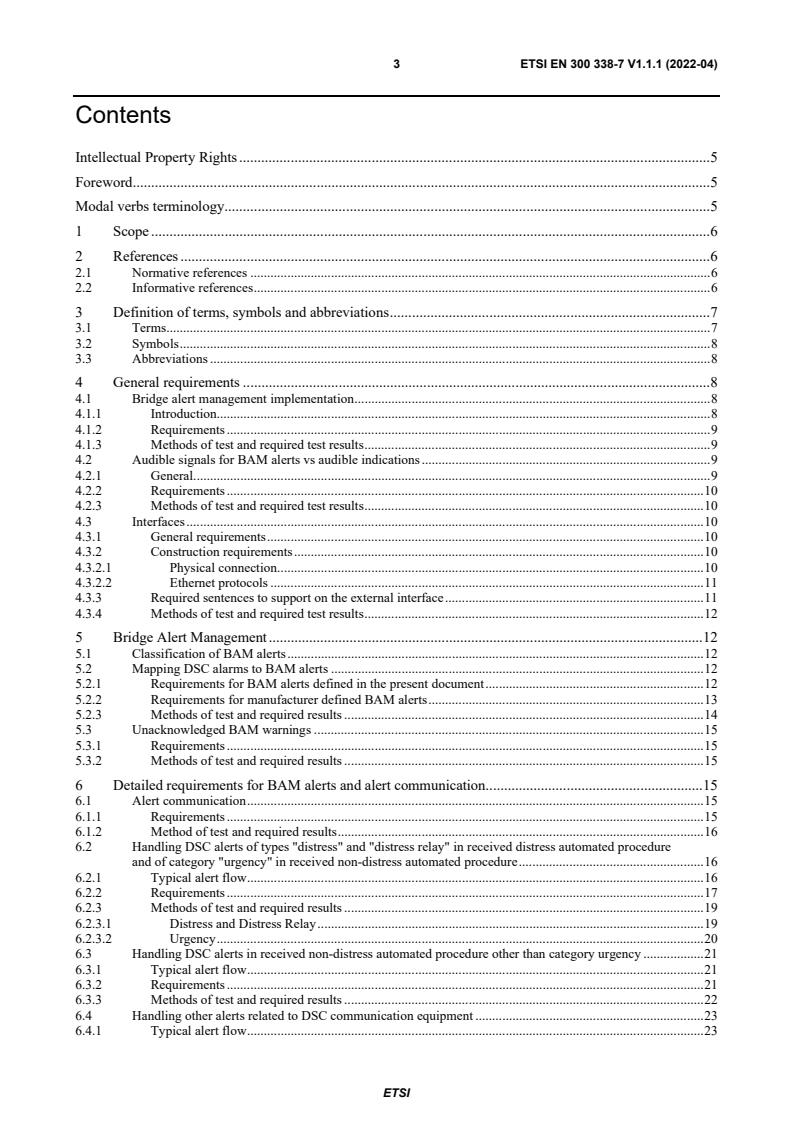
Contents
Intellectual Property Rights . 5
Foreword . 5
Modal verbs terminology . 5
1 Scope . 6
2 References . 6
2.1 Normative references . 6
2.2 Informative references . 6
3 Definition of terms, symbols and abbreviations . 7
3.1 Terms . 7
3.2 Symbols . 8
3.3 Abbreviations . 8
4 General requirements . 9
4.1 Bridge alert management implementation . 9
4.1.1 Requirements . 9
4.1.2 Methods of test and required test results . 9
4.2 Audible signals for BAM alerts vs audible indications . 9
4.2.1 General . 9
4.2.2 Requirements . 10
4.2.3 Methods of test and required test results . 10
4.3 Interfaces . 10
4.3.1 General requirements . 10
4.3.2 Construction requirements . 11
4.3.2.1 Physical connection . 11
4.3.2.2 Ethernet protocols . 11
4.3.3 Required sentences to support on the interface . 11
4.3.4 Methods of test and required test results . 12
5 Bridge Alert Management . 12
5.1 Classification of BAM alerts . 12
5.2 Mapping DSC alarms to BAM alerts . 12
5.2.1 Requirements for BAM alerts defined in the present document . 12
5.2.2 Requirements for manufacturer defined BAM alerts . 13
5.2.3 Methods of test and required results . 14
5.3 Unacknowledged BAM warnings . 15
5.3.1 Requirements . 15
5.3.2 Methods of test and required results . 15
6 Detailed requirements for BAM alerts and alert communication . 15
6.1 Alert communication . 15
6.1.1 Requirements . 15
6.1.2 Method of test and required results . 16
6.2 Handling DSC alerts of types "distress" and "distress relay" in received distress automated procedure
and of category "urgency" in received non-distress automated procedure . 16
6.2.1 Typical alert flow . 16
6.2.2 Requirements . 17
6.2.3 Methods of test and required results . 19
6.2.3.1 Distress and Distress Relay . 19
6.2.3.2 Urgency . 20
6.3 Handling DSC alerts in received non-distress automated procedure other than category urgency . 21
6.3.1 Typical alert flow . 21
6.3.2 Requirements . 21
6.3.3 Methods of test and required results . 22
6.4 Handling other alerts related to DSC communication equipment . 23
6.4.1 Typical alert flow . 23
6.4.2 No position data received by DSC equipment . 25
ETSI
4 Draft ETSI EN 300 338-7 V1.0.0 (2021-07)
6.4.2.1 Requirements . 25
6.4.2.2 Methods of test and required results . 25
6.4.3 Antenna Tuner Error or other detected antenna failures (optional) . 26
6.4.3.1 Requirements . 26
6.4.3.2 Methods of test and required results . 27
6.4.4 Transmission power error or otherwise inhibited transmission (optional) . 28
6.4.4.1 Requirements . 28
6.4.4.2 Methods of test and required results . 28
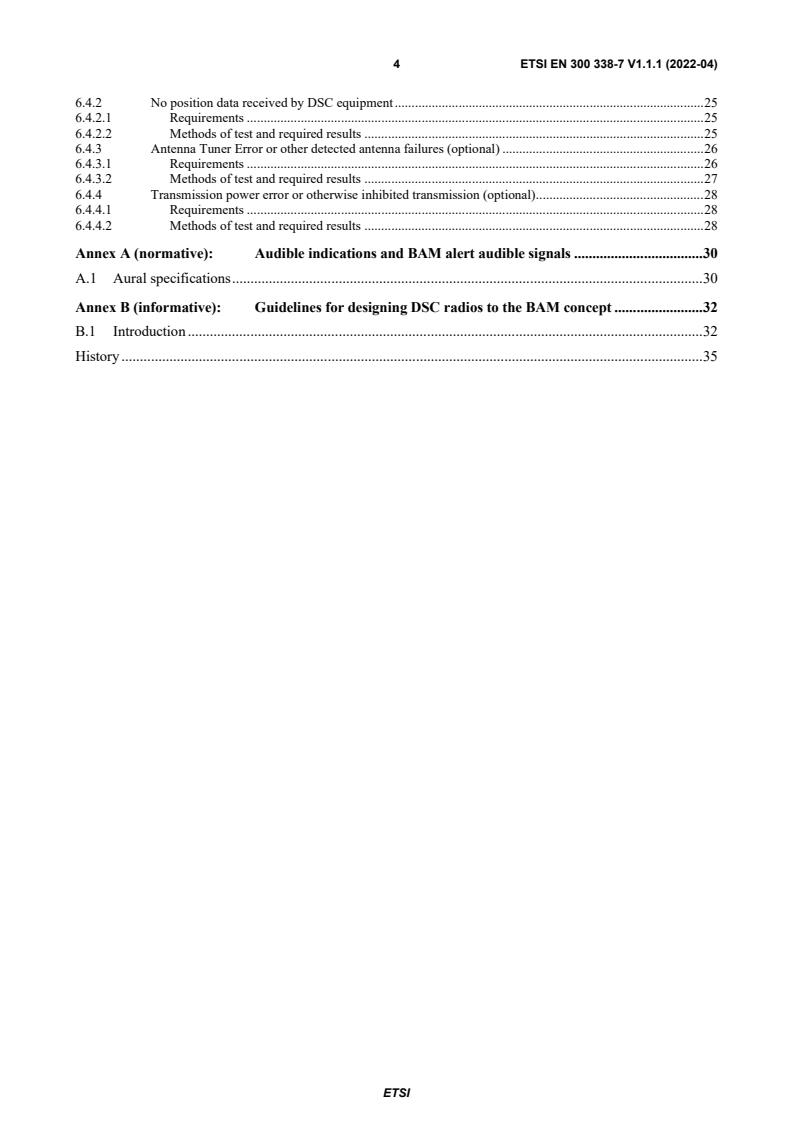
Annex A (normative): Audible indications and BAM alert audible signals . 30
A.1 Aural specifications . 30
Annex B (informative): Guidelines for designing DSC radios to the BAM concept . 32
B.1 Introduction . 32
History . 35
ETSI
5 Draft ETSI EN 300 338-7 V1.0.0 (2021-07)
Intellectual Property Rights
Essential patents
IPRs essential or potentially essential to normative deliverables may have been declared to ETSI. The declarations
pertaining to these essential IPRs, if any, are publicly available for ETSI members and non-members, and can be
found in ETSI SR 000 314: "Intellectual Property Rights (IPRs); Essential, or potentially Essential, IPRs notified to
ETSI in respect of ETSI standards", which is available from the ETSI Secretariat. Latest updates are available on the
ETSI Web server (https://ipr.etsi.org/).
Pursuant to the ETSI Directives including the ETSI IPR Policy, no investigation regarding the essentiality of IPRs,
including IPR searches, has been carried out by ETSI. No guarantee can be given as to the existence of other IPRs not
referenced in ETSI SR 000 314 (or the updates on the ETSI Web server) which are, or may be, or may become,
essential to the present document.
Trademarks
The present document may include trademarks and/or tradenames which are asserted and/or registered by their owners.
ETSI claims no ownership of these except for any which are indicated as being the property of ETSI, and conveys no
right to use or reproduce any trademark and/or tradename. Mention of those trademarks in the present document does
not constitute an endorsement by ETSI of products, services or organizations associated with those trademarks.
DECT™, PLUGTESTS™, UMTS™ and the ETSI logo are trademarks of ETSI registered for the benefit of its
Members. 3GPP™ and LTE™ are trademarks of ETSI registered for the benefit of its Members and of the 3GPP
Organizational Partners. oneM2M™ logo is a trademark of ETSI registered for the benefit of its Members and of the ®
oneM2M Partners. GSM and the GSM logo are trademarks registered and owned by the GSM Association.
Foreword
This draft European Standard (EN) has been produced by ETSI Technical Committee Electromagnetic compatibility
and Radio spectrum Matters (ERM), and is now submitted for the combined Public Enquiry and Vote phase of the ETSI
standards EN Approval Procedure.
The present document is part 7 of a multi-part deliverable. Full details of the entire series can be found in ETSI
EN 300 338-1 [i.1].
Proposed national transposition dates
Date of latest announcement of this EN (doa): 3 months after ETSI publication
Date of latest publication of new National Standard
or endorsement of this EN (dop/e): 6 months after doa
Date of withdrawal of any conflicting National Standard (dow): 18 months after doa
Modal verbs terminology
In the present document "shall", "shall not", "should", "should not", "may", "need not", "will", "will not", "can" and
"cannot" are to be interpreted as described in clause 3.2 of the ETSI Drafting Rules (Verbal forms for the expression of
provisions).
"must" and "must not" are NOT allowed in ETSI deliverables except when used in direct citation.
ETSI
6 Draft ETSI EN 300 338-7 V1.0.0 (2021-07)
1 Scope
The present document specifies the minimum requirements for GMDSS radiocommunication system using Digital
Selective Calling (DSC) Class A, with the capability to operate on a SOLAS bridge with the application of SOLAS
regulation V/15 [i.5] and thus implementing the BAM concept defined by IMO in MSC.302(87) [8].
2 References
2.1 Normative references
References are either specific (identified by date of publication and/or edition number or version number) or
non-specific. For specific references, only the cited version applies. For non-specific references, the latest version of the
referenced document (including any amendments) applies.
Referenced documents which are not found to be publicly available in the expected location might be found at
http://docbox.etsi.org/Reference.
NOTE: While any hyperlinks included in this clause were valid at the time of publication, ETSI cannot guarantee
their long term validity.
The following referenced documents are necessary for the application of the present document.
[1] Recommendation ITU-R M.493-15: "Digital selective-calling system for use in the maritime
mobile service".
[2] ETSI EN 300 338-2: "Technical characteristics and methods of measurement for equipment for
generation, transmission and reception of Digital Selective Calling (DSC) in the maritime MF,
MF/HF and/or VHF mobile service; Part 2: Class A DSC".
[3] IEC 62923-1 (Ed. 1) (2018): "Maritime navigation and radiocommunication equipment and
systems - Bridge alert management - Part 1: Operational and performance requirements, methods
of testing and required test results".
[4] IEC 61162-1 (Ed. 5) (2016): "Maritime navigation and radiocommunication equipment and
systems - Digital interfaces - Part 1: Single talker and multiple listeners".
[5] IEC 61162-2: "Maritime navigation and radiocommunication equipment and systems - Digital
interfaces - Part 2: Single talker and multiple listeners, high-speed transmission".
[6] IEC 61162-450 (Ed. 2) (2018): "Maritime navigation and radiocommunication equipment and
systems - Digital interfaces - Part 450: Multiple talkers and multiple listeners - Ethernet
interconnection".
[7] IEC 62923-2 (Ed. 1) (2018): "Maritime navigation and radiocommunication equipment and
systems - Bridge alert management - Part 2: Alert and cluster identifiers and other additional
features".
[8] IMO Resolution MSC.302(87): "Adoption of performance standards for bridge alert
management".
2.2 Informative references
References are either specific (identified by date of publication and/or edition number or version number) or
non-specific. For specific references, only the cited version applies. For non-specific references, the latest version of the
referenced document (including any amendments) applies.
NOTE: While any hyperlinks included in this clause were valid at the time of publication, ETSI cannot guarantee
their long term validity.
ETSI
7 Draft ETSI EN 300 338-7 V1.0.0 (2021-07)
The following referenced documents are not necessary for the application of the present document but they assist the
user with regard to a particular subject area.
[i.1] ETSI EN 300 338-1: "Technical characteristics and methods of measurement for equipment for
generation, transmission and reception of Digital Selective Calling (DSC) in the maritime MF,
MF/HF and/or VHF mobile service; Part 1: Common requirements".
[i.2] IEC 62940:2016: "Maritime navigation and radiocommunication equipment and systems -
Integrated communication system (ICS) - Operational and performance requirements, methods of
testing and required test results".
[i.3] IEC 61097-3 (Ed. 2) (2017): "Global maritime distress and safety system (GMDSS) - Part 3:
Digital selective calling (DSC) equipment - Operational and performance requirements, methods
of testing and required results".
[i.4] ETSI EN 300 338-8: "Technical characteristics and methods of measurement for equipment for
generation, transmission and reception of Digital Selective Calling (DSC) in the maritime MF,
MF/HF and/or VHF mobile service; Part 8: Enabling DSC radio equipment with remote control
capabilities".
[i.5] SOLAS: "International Convention for the Safety Of Life At Sea", 1974 (as amended).
[i.6] IMO Resolution A.1021(26) (2009): "Code on alerts and indicators".
3 Definition of terms, symbols and abbreviations
3.1 Terms
For the purposes of the present document, the terms given in ETSI EN 300 338-1 [i.1] and the following apply:
acknowledge: BAM alert acknowledge
audible indication: sound from the EUT that is not associated with raising a BAM alert of priority alarm or warning in
the list of active alerts of the EUT
NOTE: BAM alerts of priority caution and emergency alarm do not have a BAM audible signal, nor have states to
handle acknowledgement or silencing.
EXAMPLE 1: A sound indicating a change of control position.
EXAMPLE 2: Table 7.1.1 of IMO Resolution A.1021(26):2009, "Code on Alerts and Indicators" [i.6].
BAM alert: announcement of abnormal situations and conditions requiring attention
NOTE: BAM alerts are divided in four priorities: emergency alarms, alarms, warnings and cautions.
distress event: unique distress situation identified by two (VHF) or three (MF/HF) parameters of the distress
information; the MMSI of the vessel in distress and the nature of distress and on MF/HF the mode of subsequent
communication
DSC acknowledge: DSC procedure acknowledge
DSC alarm: event in DSC equipment as specified in ETSI EN 300 338-2 [2]
DSC distress acknowledgement: distress DSC message of type Alert Acknowledgement
DSC distress alert: distress DSC message of type Alert
DSC distress relay: distress DSC message of type Relay
DSC urgency message: non-distress DSC message of category Urgency
ETSI
8 Draft ETSI EN 300 338-7 V1.0.0 (2021-07)
non-distress DSC message: DSC messages or DSC acknowledgements that do not have the format specifier or
category of "distress"
3.2 Symbols
Void.
3.3 Abbreviations
For the purposes of the present document, the following abbreviations apply:
A Assembly
BAM Bridge Alert Management
CAM Central Alert Management
DSC Digital Selective Calling
ED Edition
EN European Norm
ETSI European Telecommunications Standards Institute
EUT Equipment Under Test
GMDSS Global Maritime Distress and Safety System
HF High Frequency
HMI Human Machine Interface
ICS Integrated Communication System
ID Identity
IEC International Electrotechnical Commission
IMO International Maritime Organization
IP Internet Protocol
ITU International Telecommunications Union
ITU-R ITU - Radiocommunications sector
MF Medium Frequency
MMSI Maritime Mobile Service Identity
MSC Marine Safety Committee
N North/Northern latitude
NM Nautical Mile
OOW Officer Of the Watch
RX Receive(d)/Receiving
S South/Southern latitude
SAR Search And Rescue
SFI System Function ID
SNMP Simple Network Management Protocol
SOLAS International convention on the Safety Of Life At Sea 1974
STF Specialist Task Force
TAG Transport Annotate and Group
TCP Transmission Control Protocol
TX Transmit(ted)/Transmitting
UDP User Datagram Protocol
VHF Very High Frequency
ETSI
9 Draft ETSI EN 300 338-7 V1.0.0 (2021-07)
4 General requirements
4.1 Bridge alert management implementation
4.1.1 Requirements
Compliance with the BAM concept, including the interfaces required for BAM, is a functional and conceptual extension
to, not a substitution of, facilities as required in ETSI EN 300 338-2 [2]. Compliance with ETSI EN 300 338-2 [2] is
required unless the present document requires otherwise. According to MSC.302(87) [8] and IEC 62923-1 [3], in case
of conflict between the alert requirements of ETSI EN 300 338-2 [2] and the present document, the requirements and
tests of the present document and of MSC.302(87) [8], IEC 62923-1 [3] and IEC 62923-2 [7] shall take precedence.
According to the BAM concept it is necessary to prioritize BAM alerts and the priorities shall be determined by the
DSC equipment. The BAM concept poses requirements on the alert definition concept, alert properties and the Human
Machine Interface (HMI). For guidance see IEC 62923-1 [3], Annex E.
Further a signalling interface and a protocol are defined for interfacing equipment to a CAM system or to other BAM
compliant equipment according to IEC 62923-1 [3], IEC 61162-1 [4] and IEC 62923-2 [7]. The present document
adopts the signalling protocol and allows, within limits, for DSC alarms from radio equipment to be part of the BAM
concept or otherwise facilitates these.
The EUT shall comply with the requirements of ETSI EN 300 338-2 [2], IEC 62923-1 [3] and IEC 62923-2 [7].
Informative guidance on implementing Bridge Alert Management can be found in Annex B to the present document.
4.1.2 Methods of test and required test results
It shall be confirmed that the EUT complies with the tests in ETSI EN 300 338-2 [2], IEC 62923-1 [3] and
IEC 62923-2 [7].
4.2 Audible signals for BAM alerts vs audible indications
4.2.1 General
BAM alerts are alerts falling into the concept of Bridge Alert Management (BAM) (see MSC.302(87) [8] and
IEC 62923-1 [3]). BAM applies to all alerts presented on, or transferred to, the bridge of a vessel (the concept can also
be applied in other areas). The visual and audible announcements of BAM alerts are always handled on the EUT, and,
within limitations, additionally on the CAM system. The latter of which is not covered in the present document (see
IEC 62923-1 [3] and IEC 62923-2 [7]).
The BAM concept provides amongst others human machine interface requirements and provides a standardized method
to disseminate the information to the CAM system, thus requiring the support of the alert signalling interface and
protocol as defined in IEC 61162-1 [4] and IEC 62923-1 [3].
BAM alerts are distinct from matters such as DSC aural alarms. For the purpose of the present document the audible
presentation and handling of DSC aurals defined in Recommendation ITU-R M.493-15 [1] and ETSI EN 300 338-2 [2]
includes:
• audible signals. An audible signal is intended to recognize the existence and priority of a BAM alert and to
identify the equipment where an audible BAM alert can be handled. In the present document some audible
signals are directly based on DSC aurals, see Annex A and Table A.1;
• sound in the time allotted for speech output. Speech output is intended to recognize the specific BAM alert.
Some DSC aurals are allowed or required for this purpose, see Annex A and Table A.1; and
• audible indications (see also IEC 62923-1 [3]). Most DSC aurals are audible indications for the purpose of the
present document. The audible indications that occur together with a caution are listed in Annex A and
Table A.1.
ETSI
10 Draft ETSI EN 300 338-7 V1.0.0 (2021-07)
Audible indications indicating DSC aural alarms or other situations may be applied in the EUT for functionality that
does not warrant a BAM alert, for example a tone for pressing the dedicated distress button, or for situations that do not
warrant an audible BAM alert, for example when the corresponding BAM alerts raised are only characterized as a
caution (thus without audible signal). Situations where ITU has defined sounds that need to be detached from alert
management altogether are therefore not defined in the present document.
Audible indications (mandatory or manufacturer specific) may be applied subject to the requirements defined in
clause 4.2.2.
4.2.2 Requirements
BAM alerts of priority warning and alarm shall not be accompanied with an audible indication (only the audible
presentation defined in IEC 62923-1 [3] is allowed).
All sounds provided by the EUT that are not required by the present document as (part of the) audible presentation of a
BAM alert (i.e. an audible signal for a BAM alert and the signal in the time for 'speech output') are audible indications.
When an audible indication is provided, it shall:
• not be possible to be confused with a BAM alert;
• not be startling;
• be less disturbing then BAM alerts; and
• be either:
- momentary or temporary without user interaction, or
- stop after a defined user action on the equipment, which action is not related to alert management (this
user action shall not involve the alert acknowledgement or silencing features). See also clause A.1.
4.2.3 Methods of test and required test results
It shall be confirmed by inspection of the EUT that BAM alerts of priority warning and alarm are not accompanied with
an audible indication, thus only the audible presentation defined in IEC 62923-1 [3] shall occur.
It shall be confirmed by inspection of the EUT that when an audible indication is provided, e.g. along with a caution
raised or detached from alert management, the audible indication:
• cannot be confused with a BAM alert;
• is not startling;
• is less disturbing then BAM alerts; and
• is either:
- momentary or temporary without user interaction, or
- stops after a defined user action on the equipment, which action is not related to alert management (this
user action shall not involve the alert acknowledgement or silencing features). See also clause A.1.
4.3 Interfaces
4.3.1 General requirements
Data interfaces for Bridge Alert Management purposes for the connection with a CAM system, and optionally other
BAM compliant equipment, shall be provided and shall comply with at least one of IEC 61162-1 [4], IEC 61162-2 [5]
or IEC 61162-450 [6]. The manufacturer shall specify which alternative(s) (defined in IEC 61162-1 [4],
IEC 61162-2 [5] and IEC 61162-450 [6]) the physical interface(s) of the EUT supports.
ETSI
11 Draft ETSI EN 300 338-7 V1.0.0 (2021-07)
4.3.2 Construction requirements
4.3.2.1 Physical connection
The general required interface may be:
• physically part of the individual equipment/function; and/or
• connected using an internal (optionally proprietary) interface to a system supporting the required interfaces
towards the CAM (e.g. when the individual equipment/function is part of an ICS, see IEC 62940 [i.2]).
Any of these configurations shall constitute the EUT and compliance with the BAM standard IEC 62923-1 [3] shall be
demonstrated, presented as a whole including the required external interfaces (see clause 4.3.1). The manufacturer shall
declare for which configuration(s) the EUT is suitable. The EUT shall be tested for compliance with the requirements of
the present document in all supported configurations.
In case equipment is also capable of being operated without a larger system, such as an ICS, the equipment shall also be
capable of being configured to comply with the requirements of the present document, including the interfaces, by
itself. In that case, the equipment shall be tested for compliance both as stand-alone equipment and as part of the larger
system.
4.3.2.2 Ethernet protocols
The IEC 61162-1 [4] sentences sent over the ethernet IEC 61162-450 [6] are using the UDP multicast datagrams. The
traffic limitations and requirements shall be kept as specified in IEC 61162-450 [6].
Other protocols/logical connections may exist on the same physical connection (including TCP/IP or SNMP) if the
equipment support these layers. Such extra logical connections may include the possibility of secure remote controlling
of the equipment (e.g. remote controllers as defined in ETSI EN 300 338-8 [i.4]).
4.3.3 Required sentences to support on the interface
The sentences to be used by the EUT over the BAM interface(s) shall be the ones specified in Table 1 and Table 2
below (see also IEC 61162-1 [4] and IEC 62923-1 [3]).
Table 1: IEC 61162-1 [4] sentences transmitted by the DSC equipment for BAM
Mnemonic Interface Name Comment
ALC CAM Cyclic alert list List of current BAM alerts
AGL (note 2) CAM Alert group list Definition of a functional group
ALF CAM Alert sentence Details of a new or current BAM alert
ARC CAM Alert command Alert command not accepted
refused
HBT (note 1) CAM Heartbeat Supports reliable alert related
communication
NOTE 1: Required for BAM compliant equipment, if that is able to request responsibility transfer of a BAM
alert from an external alert source.
NOTE 2: Mandatory for functional alert group sources.
ETSI
12 Draft ETSI EN 300 338-7 V1.0.0 (2021-07)
Table 2: IEC 61162-1 [4] sentences received by the DSC equipment for BAM
Mnemonic Interface Name Comment
ACN CAM Alert command Alert command e.g. acknowledge
AGL (note 2) Functional alert group sources Alert group list Definition of a functional group
HBT (note 1) CAM Heartbeat Supports reliable alert related
communication
NOTE 1: Mandatory for BAM compliant equipment, if that is able to accept a request for responsibility
transfer (see IEC 62923-1 [3] clause 6.9.2.2) from external equipment for BAM alerts of the
EUT. DSC equipment is such able equipment.
NOTE 2: Mandatory for equipment that supports displaying functional alert groups.
Connection failure of, or failure within, any connected equipment, shall not affect the required performance of the DSC
equipment.
4.3.4 Methods of test and required test results
It shall be determined by inspection of the manufacturer's documentation if the equipment is capable to operate as
stand-alone BAM compliant equipment and/or is capable to act as part of a BAM compliant system (e.g. an ICS).
The following tests should be performed for all configurations of which the equipment is capable:
• stand-alone BAM compliant equipment; and/or
• part of a BAM compliant system (e.g. ICS).
It shall be confirmed by analytical evaluation that at least one interface compliant with at least one of IEC 61162-1 [4],
IEC 61162-2 [5] and/or IEC 61162-450 [6] is available.
It shall be confirmed by inspection that the mandatory sentences in Table 1 can be transmitted by the EUT and that the
mandatory sentences in Table 2 can be received and processed by the EUT.
It shall be confirmed by inspection that all supported sentences are transmitted or received in compliance with
IEC 61162-1 [4] and IEC 62923-1 [3].
It shall be confirmed by analytical evaluation that connection failure of, or failure within, any connected equipment
does not affect the required performance of the EUT.
5 Bridge Alert Management
5.1 Classification of BAM alerts
The priority and categorization of BAM alerts are fully defined and explained in MSC.302(87) [8] and IEC 62923-1 [3].
5.2 Mapping DSC alarms to BAM alerts
5.2.1 Requirements for BAM alerts defined in the present document
For BAM alerts defined in the present document the DSC equipment shall use the alert classification in Table 3. The
manufacturer shall provide a document listing all available BAM alerts and their classification in the DSC equipment.
The ALF sentence is used to report details of BAM alerts. For easy identification of BAM alerts defined in the present
document the ALF sentences shall be filled according to the following bullets:
• fields Alert identifier, priority and category as specified in Table 3;
• field Alert text for the first ALF sentence shall be as specified in clause 6, including Tables 4 to 8 Alert Title
columns.
ETSI
13 Draft ETSI EN 300 338-7 V1.0.0 (2021-07)
EXAMPLE: "DISTRESS:RX".
• field Alert text for second ALF sentence shall be defined by the manufacturer in accordance with the
requirements in clause 6, including Tables 4 to 8 Alert Description text columns. The manufacturer shall
provide a detailed description of the alert description texts provided.
NOTE: The source ID of a BAM alert, for example "VHF", "VHF number 1", "MF", "HF", "MF/HF", etc. is
available in IEC 61162-1 [4] or IEC 61162-2 [5] as a combination of talker ID and physical serial
interface (i.e. configuration parameter within receiver). For the IEC 61162-450 [6] the source ID is
available as combination of talker ID and TAG block parameter source identification (see
IEC 62923-1 [3]).
Table 3: Classification of DSC equipment alerts for BAM alert management purposes
Unique
BAM BAM
Category Category identifier at
DSC alert source Cause (note 2) priority priority
A B alert source
Warning Caution
(note 3)
Receipt of distress or urgency
VHF DSC radio DSC call for a new (distress) 3122
x x
MF/HF DSC radio event (310)
(note 5).
VHF DSC radio Receipt of DSC calls other than 3123
x x
MF/HF DSC radio distress or urgency. (311)
VHF DSC radio No position data received by 3016
x x
MF/HF DSC radio equipment. (312)
Antenna Tuner Error or other
MF/HF DSC radio 3115
detected antenna system x x
(note 1) (313)
failure.
VHF DSC radio
Transmission power error or
(note 1) 3008
otherwise inhibited x x
MF/HF DSC radio (314)
transmission.
(note 1)
NOTE 1: Optional (where the facility to detect this alert is available).
NOTE 2: See clause 6 for further details regarding the alert causes defined in the present document.
NOTE 3: The alert identifiers in brackets are legacy identifiers as published in IEC 62940 [i.2] and IEC 61097-3 [i.3].
These shall not be used for BAM alerts raised by the EUT, but can occasionally still be encountered in
legacy equipment.
NOTE 4: A simplified description of the alert categories according to IMO Resolution MSC.302(87) [8] is:
− Category A: Acknowledge possible only at source or when full graphical information is available. Audible
announcement only at location at which acknowledge is possible.
− Category B: Acknowledge possible both at source and at central panel of BAM. Audible announcement
in every location at which acknowledge is possible.
NOTE 5: For each new (distress) event a new automated procedure is triggered. See clause 6.1 for 'DSC parallelism'.
The BAM alerts defined in the present document (see Table 3) shall additionally comply with the requirements of
clause 6.
The audible presentation of BAM alerts listed in Table 3 shall comply with the requirements of Annex A, Table A.1.
All DSC alerts/DSC aural alerts not listed in Table 3 are not part of the BAM concept and are for the purpose of the
present document (audible) indications (see clause 4.2).
5.2.2 Requirements for manufacturer defined BAM alerts
The manufacturer may define BAM alerts in addition to those defined in Table 3. These additional BAM alerts shall not
regard DSC alerts/DSC aural alerts. If available, the additional BAM alerts shall also comply with MSC.302(87) [8],
IEC 62923-1 [3] and IEC 62923-2 [7] and be assigned a priority and category accordingly. The manufacturer shall
provide a list of these BAM alerts in the user manual, including at least their alert title, alert description text, priority,
category, alert identifier and alert escalation behaviour.
The alert title and description text of each alert shall be functional for the operator and the description text shall "as far
as practicable" (see MSC.302(87) [8] clause 8.1 and IEC 62923-1 [3] clause 6.4.3) provide guidance for decision
making.
ETSI
14 Draft ETSI EN 300 338-7 V1.0.0 (2021-07)
BAM alerts that match with those defined in Table A.1 of IEC 62923-2 [7] shall use the corresponding alert identifiers.
For BAM alerts not defined in Table A.1 of IEC 62923-2 [7], manufacturer specified unique alert identifiers shall be
assigned within the range 10000 - 9999999 (see IEC 62923-2 [7]). The alert identifiers in the free range shall use the
same numbering concept for the last digit as described in Annex A.1 of IEC 62923-2 [7] for alert identifiers above
0300.
5.2.3 Methods of test and required results
The test procedure shall be as follows:
• Refer to the manufacturer's documentation.
• Confirm by inspection of the manufacturer's documentation that the BAM alerts described in Table 3 have the
correct alert identifier, priority and category.
• Cause the BAM alerts in Table 3.
• Confirm by observation of the EUT and of a CAM emulator that the BAM alerts have the same priority,
category and alert identifiers as listed in the manufacturer's documentation.
• Confirm by observation of the EUT and of a CAM emulator that the alerts listed in Table 3 have the prescribed
alert titles according to clause 6, including Tables 4 to 8.
• Confirm by observation of the EUT and of a CAM emulator that the alert description texts of the alerts listed
in Table 3 comply with the requirements listed in clause 6 and Tables 4 to 8 of the present document.
• Confirm by inspection of the user manual that the alert description texts are described in detail.
• Raise a BAM alert in Table 3.
• Confirm by observation that the audible presentation of the BAM alert complies with Annex A, Table A.1.
• Terminate the BAM alert.
• Repeat this test for all BAM alerts defined in Table 3.
• Confirm by analytical evaluation that all DSC alerts/DSC aural alerts that are not listed in Table 3 are (audible)
indications and comply with clause 4.2.
• Refer to the user manual for a list of all manufacturer defined BAM alerts, including at least their title, alert
description text, priority, category and alert identifier.
• Confirm by analytical evaluation that these manufacturer defined BAM alerts have been assigned a priority
and category in accordance with MSC.302(87) [8] and IEC 62923-1 [3].
• Confirm by analytical evaluation that the alert title and description of the manufacturer defined BAM alerts are
functional for the operator and that the alert description texts "as far as practicable" (see MSC.302(87) [8]
clause 8.1 and IEC 62923-1 [3] clause 6.4.3) provide guidance for decision making.
• Confirm by observation that the manufacturer defined BAM alerts that match the alerts defined in Table A.1 of
IEC 62923-2 [7] have been assigned the corresponding alert identifiers.
• Confirm by observation that the remaining BAM alerts have been assigned alert identifiers in the range of
10000 - 9999999 (see IEC 62923-2 [7]) and that the numbering concept for the last digit as described in
Annex A.1 of IEC 62923-2 [7] has been implemented for BAM alerts with alert identifiers above 0300.
• Refer to the user manual for a list of all manufacturer defined BAM alerts. If applicable select 12 BAM alerts,
to represent all combinations of priority and category. If, for BAM alerts, distinct alert sounds have been
defined, include the BAM alerts that represent each distinct alert sound. For these alerts:
- Raise a selected manufacturer defined BAM alert.
- For all the selected manufacturer defined BAM alerts, confirm by observation that the audible
presentation of the BAM alert complies with IEC 62923-1 [3].
ETSI
15 Draft ETSI EN 300 338-7 V1.0.0 (2021-07)
- Terminate the BAM alert.
- Repeat this test for all selected manufacturer defined BAM alerts.
For further tests on the properties and definition of BAM alerts listed in Table 3 see clause 6 of the present document.
5.3 Unacknowledged BAM warnings
5.3.1 Requirements
An unacknowledged BAM warning shall be repeated as a BAM warning after a limited time period not exceeding
5 min. Unacknowledged BAM warnings shall not be escalated to BAM alarm priority. See also IEC 62940 [i.2].
5.3.2 Methods of test and required results
The test procedure shall be as follows:
• Refer to the manufacturer's documentation, including the user manual.
• Confirm by inspection of the manufacturer's documentation that all BAM alerts of priority warning do not
escalate to alarm priority.
• Confirm by inspection of the manufacturer's documentation that all BAM alerts of priority warning escalate to
a BAM alert of p
...
Final draft ETSI EN 300 338-7 V1.1.0 (2022-02)
EUROPEAN STANDARD
Technical characteristics and methods of measurement
for equipment for generation, transmission
and reception of Digital Selective Calling (DSC)
in the maritime MF, MF/HF and/or VHF mobile service;
Part 7: Implementation of Bridge Alert Management (BAM)
in DSC radio equipment
2 Final draft ETSI EN 300 338-7 V1.1.0 (2022-02)
Reference
DEN/ERM-TGMAR-087-7
Keywords
DSC, GMDSS, maritime, radio, SAR
ETSI
650 Route des Lucioles
F-06921 Sophia Antipolis Cedex - FRANCE
Tel.: +33 4 92 94 42 00 Fax: +33 4 93 65 47 16
Siret N° 348 623 562 00017 - APE 7112B
Association à but non lucratif enregistrée à la
Sous-Préfecture de Grasse (06) N° w061004871
Important notice
The present document can be downloaded from:
http://www.etsi.org/standards-search
The present document may be made available in electronic versions and/or in print. The content of any electronic and/or
print versions of the present document shall not be modified without the prior written authorization of ETSI. In case of any
existing or perceived difference in contents between such versions and/or in print, the prevailing version of an ETSI
deliverable is the one made publicly available in PDF format at www.etsi.org/deliver.
Users of the present document should be aware that the document may be subject to revision or change of status.
Information on the current status of this and other ETSI documents is available at
https://portal.etsi.org/TB/ETSIDeliverableStatus.aspx
If you find errors in the present document, please send your comment to one of the following services:
https://portal.etsi.org/People/CommiteeSupportStaff.aspx
Notice of disclaimer & limitation of liability
The information provided in the present deliverable is directed solely to professionals who have the appropriate degree of
experience to understand and interpret its content in accordance with generally accepted engineering or
other professional standard and applicable regulations.
No recommendation as to products and services or vendors is made or should be implied.
In no event shall ETSI be held liable for loss of profits or any other incidental or consequential damages.
Any software contained in this deliverable is provided "AS IS" with no warranties, express or implied, including but not
limited to, the warranties of merchantability, fitness for a particular purpose and non-infringement of intellectual property
rights and ETSI shall not be held liable in any event for any damages whatsoever (including, without limitation, damages
for loss of profits, business interruption, loss of information, or any other pecuniary loss) arising out of or related to the use
of or inability to use the software.
Copyright Notification
No part may be reproduced or utilized in any form or by any means, electronic or mechanical, including photocopying and
microfilm except as authorized by written permission of ETSI.
The content of the PDF version shall not be modified without the written authorization of ETSI.
The copyright and the foregoing restriction extend to reproduction in all media.
© ETSI 2022.
All rights reserved.
ETSI
3 Final draft ETSI EN 300 338-7 V1.1.0 (2022-02)
Contents
Intellectual Property Rights . 5
Foreword . 5
Modal verbs terminology . 5
1 Scope . 6
2 References . 6
2.1 Normative references . 6
2.2 Informative references . 6
3 Definition of terms, symbols and abbreviations . 7
3.1 Terms . 7
3.2 Symbols . 8
3.3 Abbreviations . 8
4 General requirements . 8
4.1 Bridge alert management implementation . 8
4.1.1 Introduction. 8
4.1.2 Requirements . 9
4.1.3 Methods of test and required test results . 9
4.2 Audible signals for BAM alerts vs audible indications . 9
4.2.1 General . 9
4.2.2 Requirements . 10
4.2.3 Methods of test and required test results . 10
4.3 Interfaces . 10
4.3.1 General requirements . 10
4.3.2 Construction requirements . 10
4.3.2.1 Physical connection . 10
4.3.2.2 Ethernet protocols . 11
4.3.3 Required sentences to support on the external interface . 11
4.3.4 Methods of test and required test results . 12
5 Bridge Alert Management . 12
5.1 Classification of BAM alerts . 12
5.2 Mapping DSC alarms to BAM alerts . 12
5.2.1 Requirements for BAM alerts defined in the present document . 12
5.2.2 Requirements for manufacturer defined BAM alerts . 13
5.2.3 Methods of test and required results . 14
5.3 Unacknowledged BAM warnings . 15
5.3.1 Requirements . 15
5.3.2 Methods of test and required results . 15
6 Detailed requirements for BAM alerts and alert communication . 15
6.1 Alert communication . 15
6.1.1 Requirements . 15
6.1.2 Method of test and required results . 16
6.2 Handling DSC alerts of types "distress" and "distress relay" in received distress automated procedure
and of category "urgency" in received non-distress automated procedure . 16
6.2.1 Typical alert flow . 16
6.2.2 Requirements . 17
6.2.3 Methods of test and required results . 19
6.2.3.1 Distress and Distress Relay . 19
6.2.3.2 Urgency . 20
6.3 Handling DSC alerts in received non-distress automated procedure other than category urgency . 21
6.3.1 Typical alert flow . 21
6.3.2 Requirements . 21
6.3.3 Methods of test and required results . 22
6.4 Handling other alerts related to DSC communication equipment . 23
6.4.1 Typical alert flow . 23
ETSI
4 Final draft ETSI EN 300 338-7 V1.1.0 (2022-02)
6.4.2 No position data received by DSC equipment . 25
6.4.2.1 Requirements . 25
6.4.2.2 Methods of test and required results . 25
6.4.3 Antenna Tuner Error or other detected antenna failures (optional) . 26
6.4.3.1 Requirements . 26
6.4.3.2 Methods of test and required results . 27
6.4.4 Transmission power error or otherwise inhibited transmission (optional) . 28
6.4.4.1 Requirements . 28
6.4.4.2 Methods of test and required results . 28
Annex A (normative): Audible indications and BAM alert audible signals . 30
A.1 Aural specifications . 30
Annex B (informative): Guidelines for designing DSC radios to the BAM concept . 32
B.1 Introduction . 32
History . 35
ETSI
5 Final draft ETSI EN 300 338-7 V1.1.0 (2022-02)
Intellectual Property Rights
Essential patents
IPRs essential or potentially essential to normative deliverables may have been declared to ETSI. The declarations
pertaining to these essential IPRs, if any, are publicly available for ETSI members and non-members, and can be
found in ETSI SR 000 314: "Intellectual Property Rights (IPRs); Essential, or potentially Essential, IPRs notified to
ETSI in respect of ETSI standards", which is available from the ETSI Secretariat. Latest updates are available on the
ETSI Web server (https://ipr.etsi.org/).
Pursuant to the ETSI Directives including the ETSI IPR Policy, no investigation regarding the essentiality of IPRs,
including IPR searches, has been carried out by ETSI. No guarantee can be given as to the existence of other IPRs not
referenced in ETSI SR 000 314 (or the updates on the ETSI Web server) which are, or may be, or may become,
essential to the present document.
Trademarks
The present document may include trademarks and/or tradenames which are asserted and/or registered by their owners.
ETSI claims no ownership of these except for any which are indicated as being the property of ETSI, and conveys no
right to use or reproduce any trademark and/or tradename. Mention of those trademarks in the present document does
not constitute an endorsement by ETSI of products, services or organizations associated with those trademarks.
DECT™, PLUGTESTS™, UMTS™ and the ETSI logo are trademarks of ETSI registered for the benefit of its
Members. 3GPP™ and LTE™ are trademarks of ETSI registered for the benefit of its Members and of the 3GPP
Organizational Partners. oneM2M™ logo is a trademark of ETSI registered for the benefit of its Members and of the ®
oneM2M Partners. GSM and the GSM logo are trademarks registered and owned by the GSM Association.
Foreword
This final draft European Standard (EN) has been produced by ETSI Technical Committee Electromagnetic
compatibility and Radio spectrum Matters (ERM), and is now submitted for the Vote phase of the ETSI standards EN
Approval Procedure.
The present document is part 7 of a multi-part deliverable. Full details of the entire series can be found in ETSI
EN 300 338-1 [i.1].
Proposed national transposition dates
Date of latest announcement of this EN (doa): 3 months after ETSI publication
Date of latest publication of new National Standard
or endorsement of this EN (dop/e): 6 months after doa
Date of withdrawal of any conflicting National Standard (dow): 18 months after doa
Modal verbs terminology
In the present document "shall", "shall not", "should", "should not", "may", "need not", "will", "will not", "can" and
"cannot" are to be interpreted as described in clause 3.2 of the ETSI Drafting Rules (Verbal forms for the expression of
provisions).
"must" and "must not" are NOT allowed in ETSI deliverables except when used in direct citation.
ETSI
6 Final draft ETSI EN 300 338-7 V1.1.0 (2022-02)
1 Scope
The present document specifies the minimum requirements for GMDSS radiocommunication system using Digital
Selective Calling (DSC) Class A, with the capability to operate on a SOLAS bridge with the application of SOLAS
regulation V/15 [i.4] and thus implementing the BAM concept defined by IMO in MSC.302(87) [8].
2 References
2.1 Normative references
References are either specific (identified by date of publication and/or edition number or version number) or
non-specific. For specific references, only the cited version applies. For non-specific references, the latest version of the
referenced document (including any amendments) applies.
Referenced documents which are not found to be publicly available in the expected location might be found at
https://docbox.etsi.org/Reference/.
NOTE: While any hyperlinks included in this clause were valid at the time of publication, ETSI cannot guarantee
their long term validity.
The following referenced documents are necessary for the application of the present document.
[1] Recommendation ITU-R M.493-15: "Digital selective-calling system for use in the maritime
mobile service".
[2] ETSI EN 300 338-2: "Technical characteristics and methods of measurement for equipment for
generation, transmission and reception of Digital Selective Calling (DSC) in the maritime MF,
MF/HF and/or VHF mobile service; Part 2: Class A DSC".
[3] IEC 62923-1 (Ed. 1) (2018): "Maritime navigation and radiocommunication equipment and
systems - Bridge alert management - Part 1: Operational and performance requirements, methods
of testing and required test results".
[4] IEC 61162-1 (Ed. 5) (2016): "Maritime navigation and radiocommunication equipment and
systems - Digital interfaces - Part 1: Single talker and multiple listeners".
[5] IEC 61162-2: "Maritime navigation and radiocommunication equipment and systems - Digital
interfaces - Part 2: Single talker and multiple listeners, high-speed transmission".
[6] IEC 61162-450 (Ed. 2) (2018): "Maritime navigation and radiocommunication equipment and
systems - Digital interfaces - Part 450: Multiple talkers and multiple listeners - Ethernet
interconnection".
[7] IEC 62923-2 (Ed. 1) (2018): "Maritime navigation and radiocommunication equipment and
systems - Bridge alert management - Part 2: Alert and cluster identifiers and other additional
features".
[8] IMO Resolution MSC.302(87): "Adoption of performance standards for bridge alert
management".
2.2 Informative references
References are either specific (identified by date of publication and/or edition number or version number) or
non-specific. For specific references, only the cited version applies. For non-specific references, the latest version of the
referenced document (including any amendments) applies.
NOTE: While any hyperlinks included in this clause were valid at the time of publication, ETSI cannot guarantee
their long term validity.
ETSI
7 Final draft ETSI EN 300 338-7 V1.1.0 (2022-02)
The following referenced documents are not necessary for the application of the present document but they assist the
user with regard to a particular subject area.
[i.1] ETSI EN 300 338-1: "Technical characteristics and methods of measurement for equipment for
generation, transmission and reception of Digital Selective Calling (DSC) in the maritime MF,
MF/HF and/or VHF mobile service; Part 1: Common requirements".
[i.2] IEC 62940:2016: "Maritime navigation and radiocommunication equipment and systems -
Integrated communication system (ICS) - Operational and performance requirements, methods of
testing and required test results".
[i.3] IEC 61097-3 (Ed. 2) (2017): "Global maritime distress and safety system (GMDSS) - Part 3:
Digital selective calling (DSC) equipment - Operational and performance requirements, methods
of testing and required results".
[i.4] SOLAS: "International Convention for the Safety Of Life At Sea", 1974 (as amended).
[i.5] IMO Resolution A.1021(26) (2009): "Code on alerts and indicators".
3 Definition of terms, symbols and abbreviations
3.1 Terms
For the purposes of the present document, the terms given in ETSI EN 300 338-1 [i.1] and the following apply:
acknowledge: BAM alert acknowledge
audible indication: sound from the EUT that is not associated with raising a BAM alert of priority alarm or warning in
the list of active alerts of the EUT
NOTE: BAM alerts of priority caution and emergency alarm do not have a BAM audible signal, nor have states to
handle acknowledgement or silencing.
EXAMPLE 1: A sound indicating a change of control position.
EXAMPLE 2: Table 7.1.1 of IMO Resolution A.1021(26):2009, "Code on Alerts and Indicators" [i.5].
BAM alert: announcement of abnormal situations and conditions requiring attention
NOTE: BAM alerts are divided in four priorities: emergency alarms, alarms, warnings and cautions.
distress event: unique distress situation identified by two (VHF) or three (MF/HF) parameters of the distress
information; the MMSI of the vessel in distress and the nature of distress and on MF/HF the mode of subsequent
communication
DSC acknowledge: DSC procedure acknowledge
DSC alarm: event in DSC equipment as specified in ETSI EN 300 338-2 [2]
DSC distress acknowledgement: distress DSC message of type Alert Acknowledgement
DSC distress alert: distress DSC message of type Alert
DSC distress relay: distress DSC message of type Relay
DSC urgency message: non-distress DSC message of category Urgency
non-distress DSC message: DSC messages or DSC acknowledgements that do not have the format specifier or
category of "distress"
ETSI
8 Final draft ETSI EN 300 338-7 V1.1.0 (2022-02)
3.2 Symbols
Void.
3.3 Abbreviations
For the purposes of the present document, the following abbreviations apply:
A Assembly
BAM Bridge Alert Management
CAM Central Alert Management
DSC Digital Selective Calling
Ed Edition
EN European Norm
ETSI European Telecommunications Standards Institute
EUT Equipment Under Test
GMDSS Global Maritime Distress and Safety System
HF High Frequency
HMI Human Machine Interface
ICS Integrated Communication System
ID Identity
IEC International Electrotechnical Commission
IMO International Maritime Organization
IP Internet Protocol
ITU International Telecommunications Union
ITU-R ITU - Radiocommunications sector
MF Medium Frequency
MMSI Maritime Mobile Service Identity
MSC Marine Safety Committee
N North/Northern latitude
NM Nautical Mile
OOW Officer Of the Watch
RX Receive(d)/Receiving
S South/Southern latitude
SAR Search And Rescue
SFI System Function ID
SNMP Simple Network Management Protocol
SOLAS International convention on the Safety Of Life At Sea 1974
TAG Transport Annotate and Group
TCP Transmission Control Protocol
TX Transmit(ted)/Transmitting
UDP User Datagram Protocol
VHF Very High Frequency
4 General requirements
4.1 Bridge alert management implementation
4.1.1 Introduction
Compliance with the BAM concept, including the interfaces required for BAM, is a functional and conceptual extension
to, not a substitution of, facilities as required in ETSI EN 300 338-2 [2]. Compliance with ETSI EN 300 338-2 [2] is
required unless the present document requires otherwise. According to MSC.302(87) [8] and IEC 62923-1 [3], in case
of conflict between the alert requirements of ETSI EN 300 338-2 [2] and the present document, the requirements and
tests of the present document and of MSC.302(87) [8], IEC 62923-1 [3] and IEC 62923-2 [7] shall take precedence.
ETSI
9 Final draft ETSI EN 300 338-7 V1.1.0 (2022-02)
According to the BAM concept it is necessary to prioritize BAM alerts and the priorities shall be determined by the
DSC equipment. The BAM concept poses requirements on the alert definition concept, alert properties and the Human
Machine Interface (HMI). For guidance see IEC 62923-1 [3], Annex E. Further a signalling interface and a protocol are
defined for interfacing equipment to a CAM system or to other BAM compliant equipment according to
IEC 62923-1 [3], IEC 61162-1 [4] and IEC 62923-2 [7]. The present document adopts the signalling protocol and
allows, within limits, for DSC alarms from radio equipment to be part of the BAM concept or otherwise facilitates
these.
4.1.2 Requirements
The EUT shall comply with the requirements of ETSI EN 300 338-2 [2], IEC 62923-1 [3] and IEC 62923-2 [7].
Informative guidance on implementing Bridge Alert Management can be found in Annex B to the present document.
4.1.3 Methods of test and required test results
It shall be confirmed that the EUT complies with the tests in ETSI EN 300 338-2 [2], IEC 62923-1 [3] and
IEC 62923-2 [7].
4.2 Audible signals for BAM alerts vs audible indications
4.2.1 General
BAM alerts are alerts falling into the concept of Bridge Alert Management (BAM) (see MSC.302(87) [8] and
IEC 62923-1 [3]). BAM applies to all alerts presented on, or transferred to, the bridge of a vessel (the concept can also
be applied in other areas). The visual and audible announcements of BAM alerts are always handled on the EUT, and,
within limitations, additionally on the CAM system. The latter of which is not covered in the present document (see
IEC 62923-1 [3] and IEC 62923-2 [7]).
The BAM concept provides, amongst others, requirements for a human machine interface and provides a standardized
method to disseminate the information to the CAM system, thus requiring the support of the alert signalling interface
and protocol as defined in IEC 61162-1 [4] and IEC 62923-1 [3].
BAM alerts are distinct from matters such as DSC aural alarms. For the purpose of the present document the audible
presentation and handling of DSC aurals defined in Recommendation ITU-R M.493-15 [1] and ETSI EN 300 338-2 [2]
includes:
• audible signals. An audible signal is intended to recognize the existence and priority of a BAM alert and to
identify the equipment where an audible BAM alert can be handled. In the present document some audible
signals are directly based on DSC aurals, see Annex A and Table A.1;
• sound in the time allotted for speech output. Speech output is intended to recognize the specific BAM alert.
Some DSC aurals are allowed or required for this purpose, see Annex A and Table A.1; and
• audible indications (see also IEC 62923-1 [3]). Most DSC aurals are audible indications for the purpose of the
present document. The audible indications that occur together with a caution are listed in Annex A and
Table A.1.
Audible indications indicating DSC aural alarms or other situations may be applied in the EUT for functionality that
does not warrant a BAM alert, for example a tone for pressing the dedicated distress button, or for situations that do not
warrant an audible BAM alert, for example when the corresponding BAM alerts raised are only characterized as a
caution (thus without audible signal). Situations where ITU has defined sounds that need to be detached from alert
management altogether are therefore not defined in the present document.
Audible indications (mandatory or manufacturer specific) may be applied subject to the requirements defined in
clause 4.2.2.
ETSI
10 Final draft ETSI EN 300 338-7 V1.1.0 (2022-02)
4.2.2 Requirements
BAM alerts of priority warning and alarm shall not be accompanied with an audible indication (only the audible
presentation defined in IEC 62923-1 [3] is allowed).
All sounds provided by the EUT that are not required by the present document as (part of the) audible presentation of a
BAM alert (i.e. an audible signal for a BAM alert and the signal in the time for 'speech output') are audible indications.
When an audible indication is provided, it shall:
• not be possible to be misinterpreted as a BAM alert;
• not be startling;
• be less disturbing then BAM alerts; and
• be either:
- momentary or temporary without user interaction; or
- stop after a defined user action on the equipment, which action is not related to alert management (this
user action shall not involve the alert acknowledgement or silencing features). See also clause A.1.
4.2.3 Methods of test and required test results
It shall be confirmed by inspection of the EUT that BAM alerts of priority warning and alarm are not accompanied with
an audible indication, thus only the audible presentation defined in IEC 62923-1 [3] shall occur.
It shall be confirmed by inspection of the EUT that when an audible indication is provided, e.g. along with a caution
raised or detached from alert management, the audible indication:
• cannot be misinterpreted as a BAM alert;
• is not startling;
• is less disturbing then BAM alerts; and
• is either:
- momentary or temporary without user interaction; or
- stops after a defined user action on the equipment, which action is not related to alert management (this
user action shall not involve the alert acknowledgement or silencing features). See also clause A.1.
4.3 Interfaces
4.3.1 General requirements
Data interfaces for Bridge Alert Management purposes for the connection with a CAM system, and optionally other
BAM compliant equipment, shall be provided and shall comply with at least one of the following standards
IEC 61162-1 [4], IEC 61162-2 [5] or IEC 61162-450 [6]. The manufacturer shall specify which alternative(s) (defined
in IEC 61162-1 [4], IEC 61162-2 [5] and IEC 61162-450 [6]) the physical interface(s) of the EUT supports.
4.3.2 Construction requirements
4.3.2.1 Physical connection
The general required interface may be:
• physically part of the individual equipment/function; and/or
ETSI
11 Final draft ETSI EN 300 338-7 V1.1.0 (2022-02)
• connected using an internal (optionally proprietary) interface to a system supporting the required interfaces
towards the CAM (e.g. when the individual equipment/function is part of an ICS, see IEC 62940 [i.2]).
Any of these configurations shall constitute the EUT and compliance with the BAM standard IEC 62923-1 [3] shall be
demonstrated, presented as a whole including the required external interfaces (see clause 4.3.1). The manufacturer shall
declare for which configuration(s) the EUT is suitable. The EUT shall be tested for compliance with the requirements of
the present document in all supported configurations.
In case equipment is also capable of being operated without a larger system, such as an ICS, the equipment shall also be
capable of being configured to comply with the requirements of the present document, including the interfaces, by
itself. In that case, the equipment shall be tested for compliance both as stand-alone equipment and as part of the larger
system.
4.3.2.2 Ethernet protocols
The IEC 61162-1 [4] sentences sent over the ethernet IEC 61162-450 [6] are using the UDP multicast datagrams. The
traffic limitations and requirements shall be kept as specified in IEC 61162-450 [6].
Other protocols/logical connections may exist on the same physical connection (including TCP/IP or SNMP) if the
equipment support these layers. Such extra logical connections may include the possibility of secure remote controlling
of the equipment.
4.3.3 Required sentences to support on the external interface
The sentences to be used by the EUT over the BAM interface(s) shall be the ones specified in Table 1 and Table 2
below (see also IEC 61162-1 [4] and IEC 62923-1 [3]).
Table 1: IEC 61162-1 [4] sentences transmitted by the DSC equipment for BAM
Mnemonic Interface Name Comment
ALC CAM Cyclic alert list List of current BAM alerts
AGL (note 2) CAM Alert group list Definition of a functional group
ALF CAM Alert sentence Details of a new or current BAM alert
ARC CAM Alert command refused Alert command not accepted
HBT (note 1) Alert source Heartbeat Supports reliable alert related
communication
NOTE 1: Required for BAM compliant equipment, if that is able to request responsibility transfer of a BAM
alert from an external alert source.
NOTE 2: Mandatory for functional alert group sources.
Table 2: IEC 61162-1 [4] sentences received by the DSC equipment for BAM
Mnemonic Interface Name Comment
ACN CAM Alert command Alert command e.g. acknowledge
AGL (note 2) Functional alert group sources Alert group list Definition of a functional group
HBT (note 1) Alert source with function type R Heartbeat Supports reliable alert related
communication
NOTE 1: Mandatory for BAM compliant equipment, if that is able to accept a request for responsibility
transfer (see IEC 62923-1 [3] clause 6.9.2.2) from external equipment for BAM alerts of the
EUT. DSC equipment is such able equipment.
NOTE 2: Mandatory for equipment that supports displaying functional alert groups.
Connection failure of, or failure within, any connected equipment, shall not affect the required performance of the DSC
equipment.
ETSI
12 Final draft ETSI EN 300 338-7 V1.1.0 (2022-02)
4.3.4 Methods of test and required test results
It shall be determined by inspection of the manufacturer's documentation if the equipment is capable to operate as
stand-alone BAM compliant equipment and/or is capable to act as part of a BAM compliant system (e.g. an ICS).
The following tests should be performed for all configurations of which the equipment is capable:
• stand-alone BAM compliant equipment; and/or
• part of a BAM compliant system (e.g. ICS).
It shall be confirmed by analytical evaluation that at least one interface compliant with at least one of IEC 61162-1 [4],
IEC 61162-2 [5] and/or IEC 61162-450 [6] is available.
It shall be confirmed by inspection that the mandatory sentences in Table 1 can be transmitted by the EUT and that the
mandatory sentences in Table 2 can be received and processed by the EUT.
It shall be confirmed by inspection that all supported sentences are transmitted or received in compliance with
IEC 61162-1 [4] and IEC 62923-1 [3].
It shall be confirmed by analytical evaluation that connection failure of, or failure within, any connected equipment
does not affect the required performance of the EUT.
5 Bridge Alert Management
5.1 Classification of BAM alerts
The priority and categorization of BAM alerts are fully defined and explained in MSC.302(87) [8] and IEC 62923-1 [3].
5.2 Mapping DSC alarms to BAM alerts
5.2.1 Requirements for BAM alerts defined in the present document
For BAM alerts defined in the present document the DSC equipment shall use the alert classification in Table 3. The
manufacturer shall provide a document listing all available BAM alerts and their classification in the DSC equipment.
The ALF sentence is used to report details of BAM alerts. For easy identification of BAM alerts defined in the present
document the ALF sentences shall be filled according to the following bullets:
• fields Alert identifier, priority and category as specified in Table 3;
• field Alert text for the first ALF sentence shall be as specified in clause 6, including Tables 4 to 8 Alert Title
columns.
EXAMPLE: "DISTRESS:RX".
• field Alert text for second ALF sentence shall be defined by the manufacturer in accordance with the
requirements in clause 6, including Tables 4 to 8 Alert Description text columns. The manufacturer shall
provide a detailed description of the alert description texts provided.
NOTE: The source ID of a BAM alert, for example "VHF", "VHF number 1", "MF", "HF", "MF/HF", etc. is
available in IEC 61162-1 [4] or IEC 61162-2 [5] as a combination of talker ID and physical serial
interface (i.e. configuration parameter within receiver). For the IEC 61162-450 [6] the source ID is
available as combination of talker ID and TAG block parameter source identification (see
IEC 62923-1 [3]).
ETSI
13 Final draft ETSI EN 300 338-7 V1.1.0 (2022-02)
Table 3: Classification of DSC equipment alerts for BAM alert management purposes
Unique
BAM BAM
Cause Category Category identifier at
DSC alert source priority priority
(note 2) A B alert source
Warning Caution
(note 3)
Receipt of distress or urgency
VHF DSC radio DSC call for a new (distress) 3122
x x
MF/HF DSC radio event (310)
(note 5).
VHF DSC radio Receipt of DSC calls other than 3123
x x
MF/HF DSC radio distress or urgency. (311)
VHF DSC radio No position data received by 3016
x x
MF/HF DSC radio equipment. (312)
Antenna Tuner Error or other
MF/HF DSC radio 3115
detected antenna system x x
(note 1) (313)
failure.
VHF DSC radio
Transmission power error or
(note 1) 3008
otherwise inhibited x x
MF/HF DSC radio (314)
transmission.
(note 1)
NOTE 1: Optional (where the facility to detect this alert is available).
NOTE 2: See clause 6 for further details regarding the alert causes defined in the present document.
NOTE 3: The alert identifiers in brackets are legacy identifiers as published in IEC 62940 [i.2] and IEC 61097-3 [i.3].
These shall not be used for BAM alerts raised by the EUT, but can occasionally still be encountered in
legacy equipment.
NOTE 4: A simplified description of the alert categories according to IMO Resolution MSC.302(87) [8] is:
− Category A: Acknowledge possible only at source or when full graphical information is available. Audible
announcement only at location at which acknowledge is possible.
− Category B: Acknowledge possible both at source and at a CAM system, if fitted. Audible
announcement in every location at which acknowledge is possible.
NOTE 5: For each new (distress) event a new automated procedure is triggered. See clause 6.1 for 'DSC parallelism'.
The BAM alerts defined in the present document (see Table 3) shall additionally comply with the requirements of
clause 6.
The audible presentation of BAM alerts listed in Table 3 shall comply with the requirements of Annex A, Table A.1.
All DSC alerts/DSC aural alerts not listed in Table 3 are not part of the BAM concept and are for the purpose of the
present document (audible) indications (see clause 4.2).
5.2.2 Requirements for manufacturer defined BAM alerts
The manufacturer may define BAM alerts in addition to those defined in Table 3. These additional BAM alerts shall not
regard DSC alerts/DSC aural alerts. If available, the additional BAM alerts shall also comply with MSC.302(87) [8],
IEC 62923-1 [3] and IEC 62923-2 [7] and be assigned a priority and category accordingly. The manufacturer shall
provide a list of these BAM alerts in the user manual, including at least their alert title, alert description text, priority,
category, alert identifier and alert escalation behaviour.
The alert title and description text of each alert shall be functional for the operator and the description text shall "as far
as practicable" (see MSC.302(87) [8] clause 8.1 and IEC 62923-1 [3] clause 6.4.3) provide guidance for decision
making.
BAM alerts that match with those defined in Table A.1 of IEC 62923-2 [7] shall use the corresponding alert identifiers.
For BAM alerts not defined in Table A.1 of IEC 62923-2 [7], the manufacturer shall specify unique alert identifiers.
These alert identifiers shall be assigned within the range 10000 - 9999999 (see IEC 62923-2 [7]). The alert identifiers in
this free range shall use the same numbering concept for the last digit as described in Annex A.1 of IEC 62923-2 [7] for
alert identifiers above 0300.
ETSI
14 Final draft ETSI EN 300 338-7 V1.1.0 (2022-02)
5.2.3 Methods of test and required results
The test procedure shall be as follows:
• Refer to the manufacturer's documentation.
• Confirm by inspection of the manufacturer's documentation that the BAM alerts described in Table 3 have the
correct alert identifier, priority and category.
• Cause the BAM alerts in Table 3.
• Confirm by observation of the EUT and of a CAM emulator that the BAM alerts have the same priority,
category and alert identifiers as listed in the manufacturer's documentation.
• Confirm by observation of the EUT and of a CAM emulator that the alerts listed in Table 3 have the prescribed
alert titles according to clause 6, including Tables 4 to 8.
• Confirm by observation of the EUT and of a CAM emulator that the alert description texts of the alerts listed
in Table 3 comply with the requirements listed in clause 6 and Tables 4 to 8 of the present document.
• Confirm by inspection of the user manual that the alert description texts are described in detail.
• Raise a BAM alert in Table 3.
• Confirm by observation that the audible presentation of the BAM alert complies with Annex A, Table A.1.
• Terminate the BAM alert.
• Repeat this test for all BAM alerts defined in Table 3.
• Confirm by analytical evaluation that all DSC alerts/DSC aural alerts that are not listed in Table 3 are (audible)
indications and comply with clause 4.2.
• Refer to the user manual for a list of all manufacturer defined BAM alerts, including at least their title, alert
description text, priority, category and alert identifier.
• Confirm by analytical evaluation that these manufacturer defined BAM alerts have been assigned a priority
and category in accordance with MSC.302(87) [8] and IEC 62923-1 [3].
• Confirm by analytical evaluation that the alert title and description of the manufacturer defined BAM alerts are
functional for the operator and that the alert description texts "as far as practicable" (see MSC.302(87) [8]
clause 8.1 and IEC 62923-1 [3] clause 6.4.3) provide guidance for decision making.
• Confirm by observation that the manufacturer defined BAM alerts that match the alerts defined in Table A.1 of
IEC 62923-2 [7] have been assigned the corresponding alert identifiers.
• Confirm by observation that the remaining BAM alerts have been assigned alert identifiers in the range of
10000 - 9999999 (see IEC 62923-2 [7]) and that the numbering concept for the last digit as described in
Annex A.1 of IEC 62923-2 [7] for BAM alerts with alert identifiers above 0300 has been implemented.
• Refer to the user manual for a list of all manufacturer defined BAM alerts. If applicable select 12 BAM alerts,
to represent all combinations of priority and category. If, for BAM alerts, distinct alert sounds have been
defined, include the BAM alerts that represent each distinct alert sound. For these alerts:
- Raise a selected manufacturer defined BAM alert.
- For all the selected manufacturer defined BAM alerts, confirm by observation that the audible
presentation of the BAM alert complies with IEC 62923-1 [3].
- Terminate the BAM alert.
- Repeat this test for all selected manufacturer defined BAM alerts.
For further tests on the properties and definition of BAM alerts listed in Table 3 see clause 6 of the present document.
ETSI
15 Final draft ETSI EN 300 338-7 V1.1.0 (2022-02)
5.3 Unacknowledged BAM warnings
5.3.1 Requirements
An unacknowledged BAM warning shall be repeated as a BAM warning after a limited time period not exceeding
5 min. Unacknowledged BAM warnings shall not be escalated to BAM alarm priority. See also IEC 62940 [i.2].
5.3.2 Methods of test and required results
The test procedure shall be as follows:
• Refer to the manufacturer's documentation, including the user manual.
• Confirm by inspection of the manufacturer's documentation that all BAM alerts of priority warning do not
escalate to alarm priority.
• Confirm by inspection of the manufacturer's documentation that all BAM alerts of priority warning escalate to
a BAM alert of p
...
EUROPEAN STANDARD
Technical characteristics and methods of measurement
for equipment for generation, transmission
and reception of Digital Selective Calling (DSC)
in the maritime MF, MF/HF and/or VHF mobile service;
Part 7: Implementation of Bridge Alert Management (BAM)
in DSC radio equipment
2 ETSI EN 300 338-7 V1.1.1 (2022-04)
Reference
DEN/ERM-TGMAR-087-7
Keywords
DSC, GMDSS, maritime, radio, SAR
ETSI
650 Route des Lucioles
F-06921 Sophia Antipolis Cedex - FRANCE
Tel.: +33 4 92 94 42 00 Fax: +33 4 93 65 47 16
Siret N° 348 623 562 00017 - APE 7112B
Association à but non lucratif enregistrée à la
Sous-Préfecture de Grasse (06) N° w061004871
Important notice
The present document can be downloaded from:
http://www.etsi.org/standards-search
The present document may be made available in electronic versions and/or in print. The content of any electronic and/or
print versions of the present document shall not be modified without the prior written authorization of ETSI. In case of any
existing or perceived difference in contents between such versions and/or in print, the prevailing version of an ETSI
deliverable is the one made publicly available in PDF format at www.etsi.org/deliver.
Users of the present document should be aware that the document may be subject to revision or change of status.
Information on the current status of this and other ETSI documents is available at
https://portal.etsi.org/TB/ETSIDeliverableStatus.aspx
If you find errors in the present document, please send your comment to one of the following services:
https://portal.etsi.org/People/CommiteeSupportStaff.aspx
If you find a security vulnerability in the present document, please report it through our
Coordinated Vulnerability Disclosure Program:
https://www.etsi.org/standards/coordinated-vulnerability-disclosure
Notice of disclaimer & limitation of liability
The information provided in the present deliverable is directed solely to professionals who have the appropriate degree of
experience to understand and interpret its content in accordance with generally accepted engineering or
other professional standard and applicable regulations.
No recommendation as to products and services or vendors is made or should be implied.
In no event shall ETSI be held liable for loss of profits or any other incidental or consequential damages.
Any software contained in this deliverable is provided "AS IS" with no warranties, express or implied, including but not
limited to, the warranties of merchantability, fitness for a particular purpose and non-infringement of intellectual property
rights and ETSI shall not be held liable in any event for any damages whatsoever (including, without limitation, damages
for loss of profits, business interruption, loss of information, or any other pecuniary loss) arising out of or related to the use
of or inability to use the software.
Copyright Notification
No part may be reproduced or utilized in any form or by any means, electronic or mechanical, including photocopying and
microfilm except as authorized by written permission of ETSI.
The content of the PDF version shall not be modified without the written authorization of ETSI.
The copyright and the foregoing restriction extend to reproduction in all media.
© ETSI 2022.
All rights reserved.
ETSI
3 ETSI EN 300 338-7 V1.1.1 (2022-04)
Contents
Intellectual Property Rights . 5
Foreword . 5
Modal verbs terminology . 5
1 Scope . 6
2 References . 6
2.1 Normative references . 6
2.2 Informative references . 6
3 Definition of terms, symbols and abbreviations . 7
3.1 Terms . 7
3.2 Symbols . 8
3.3 Abbreviations . 8
4 General requirements . 8
4.1 Bridge alert management implementation . 8
4.1.1 Introduction. 8
4.1.2 Requirements . 9
4.1.3 Methods of test and required test results . 9
4.2 Audible signals for BAM alerts vs audible indications . 9
4.2.1 General . 9
4.2.2 Requirements . 10
4.2.3 Methods of test and required test results . 10
4.3 Interfaces . 10
4.3.1 General requirements . 10
4.3.2 Construction requirements . 10
4.3.2.1 Physical connection . 10
4.3.2.2 Ethernet protocols . 11
4.3.3 Required sentences to support on the external interface . 11
4.3.4 Methods of test and required test results . 12
5 Bridge Alert Management . 12
5.1 Classification of BAM alerts . 12
5.2 Mapping DSC alarms to BAM alerts . 12
5.2.1 Requirements for BAM alerts defined in the present document . 12
5.2.2 Requirements for manufacturer defined BAM alerts . 13
5.2.3 Methods of test and required results . 14
5.3 Unacknowledged BAM warnings . 15
5.3.1 Requirements . 15
5.3.2 Methods of test and required results . 15
6 Detailed requirements for BAM alerts and alert communication . 15
6.1 Alert communication . 15
6.1.1 Requirements . 15
6.1.2 Method of test and required results . 16
6.2 Handling DSC alerts of types "distress" and "distress relay" in received distress automated procedure
and of category "urgency" in received non-distress automated procedure . 16
6.2.1 Typical alert flow . 16
6.2.2 Requirements . 17
6.2.3 Methods of test and required results . 19
6.2.3.1 Distress and Distress Relay . 19
6.2.3.2 Urgency . 20
6.3 Handling DSC alerts in received non-distress automated procedure other than category urgency . 21
6.3.1 Typical alert flow . 21
6.3.2 Requirements . 21
6.3.3 Methods of test and required results . 22
6.4 Handling other alerts related to DSC communication equipment . 23
6.4.1 Typical alert flow . 23
ETSI
4 ETSI EN 300 338-7 V1.1.1 (2022-04)
6.4.2 No position data received by DSC equipment . 25
6.4.2.1 Requirements . 25
6.4.2.2 Methods of test and required results . 25
6.4.3 Antenna Tuner Error or other detected antenna failures (optional) . 26
6.4.3.1 Requirements . 26
6.4.3.2 Methods of test and required results . 27
6.4.4 Transmission power error or otherwise inhibited transmission (optional) . 28
6.4.4.1 Requirements . 28
6.4.4.2 Methods of test and required results . 28
Annex A (normative): Audible indications and BAM alert audible signals . 30
A.1 Aural specifications . 30
Annex B (informative): Guidelines for designing DSC radios to the BAM concept . 32
B.1 Introduction . 32
History . 35
ETSI
5 ETSI EN 300 338-7 V1.1.1 (2022-04)
Intellectual Property Rights
Essential patents
IPRs essential or potentially essential to normative deliverables may have been declared to ETSI. The declarations
pertaining to these essential IPRs, if any, are publicly available for ETSI members and non-members, and can be
found in ETSI SR 000 314: "Intellectual Property Rights (IPRs); Essential, or potentially Essential, IPRs notified to
ETSI in respect of ETSI standards", which is available from the ETSI Secretariat. Latest updates are available on the
ETSI Web server (https://ipr.etsi.org/).
Pursuant to the ETSI Directives including the ETSI IPR Policy, no investigation regarding the essentiality of IPRs,
including IPR searches, has been carried out by ETSI. No guarantee can be given as to the existence of other IPRs not
referenced in ETSI SR 000 314 (or the updates on the ETSI Web server) which are, or may be, or may become,
essential to the present document.
Trademarks
The present document may include trademarks and/or tradenames which are asserted and/or registered by their owners.
ETSI claims no ownership of these except for any which are indicated as being the property of ETSI, and conveys no
right to use or reproduce any trademark and/or tradename. Mention of those trademarks in the present document does
not constitute an endorsement by ETSI of products, services or organizations associated with those trademarks.
DECT™, PLUGTESTS™, UMTS™ and the ETSI logo are trademarks of ETSI registered for the benefit of its
Members. 3GPP™ and LTE™ are trademarks of ETSI registered for the benefit of its Members and of the 3GPP
Organizational Partners. oneM2M™ logo is a trademark of ETSI registered for the benefit of its Members and of the ®
oneM2M Partners. GSM and the GSM logo are trademarks registered and owned by the GSM Association.
Foreword
This European Standard (EN) has been produced by ETSI Technical Committee Electromagnetic compatibility and
Radio spectrum Matters (ERM).
The present document is part 7 of a multi-part deliverable. Full details of the entire series can be found in ETSI
EN 300 338-1 [i.1].
National transposition dates
Date of adoption of this EN: 4 April 2022
Date of latest announcement of this EN (doa): 31 July 2022
Date of latest publication of new National Standard
or endorsement of this EN (dop/e): 31 January 2023
Date of withdrawal of any conflicting National Standard (dow): 31 January 2024
Modal verbs terminology
In the present document "shall", "shall not", "should", "should not", "may", "need not", "will", "will not", "can" and
"cannot" are to be interpreted as described in clause 3.2 of the ETSI Drafting Rules (Verbal forms for the expression of
provisions).
"must" and "must not" are NOT allowed in ETSI deliverables except when used in direct citation.
ETSI
6 ETSI EN 300 338-7 V1.1.1 (2022-04)
1 Scope
The present document specifies the minimum requirements for GMDSS radiocommunication system using Digital
Selective Calling (DSC) Class A, with the capability to operate on a SOLAS bridge with the application of SOLAS
regulation V/15 [i.4] and thus implementing the BAM concept defined by IMO in MSC.302(87) [8].
2 References
2.1 Normative references
References are either specific (identified by date of publication and/or edition number or version number) or
non-specific. For specific references, only the cited version applies. For non-specific references, the latest version of the
referenced document (including any amendments) applies.
Referenced documents which are not found to be publicly available in the expected location might be found at
https://docbox.etsi.org/Reference/.
NOTE: While any hyperlinks included in this clause were valid at the time of publication, ETSI cannot guarantee
their long term validity.
The following referenced documents are necessary for the application of the present document.
[1] Recommendation ITU-R M.493-15: "Digital selective-calling system for use in the maritime
mobile service".
[2] ETSI EN 300 338-2: "Technical characteristics and methods of measurement for equipment for
generation, transmission and reception of Digital Selective Calling (DSC) in the maritime MF,
MF/HF and/or VHF mobile service; Part 2: Class A DSC".
[3] IEC 62923-1 (Ed. 1) (2018): "Maritime navigation and radiocommunication equipment and
systems - Bridge alert management - Part 1: Operational and performance requirements, methods
of testing and required test results".
[4] IEC 61162-1 (Ed. 5) (2016): "Maritime navigation and radiocommunication equipment and
systems - Digital interfaces - Part 1: Single talker and multiple listeners".
[5] IEC 61162-2: "Maritime navigation and radiocommunication equipment and systems - Digital
interfaces - Part 2: Single talker and multiple listeners, high-speed transmission".
[6] IEC 61162-450 (Ed. 2) (2018): "Maritime navigation and radiocommunication equipment and
systems - Digital interfaces - Part 450: Multiple talkers and multiple listeners - Ethernet
interconnection".
[7] IEC 62923-2 (Ed. 1) (2018): "Maritime navigation and radiocommunication equipment and
systems - Bridge alert management - Part 2: Alert and cluster identifiers and other additional
features".
[8] IMO Resolution MSC.302(87): "Adoption of performance standards for bridge alert
management".
2.2 Informative references
References are either specific (identified by date of publication and/or edition number or version number) or
non-specific. For specific references, only the cited version applies. For non-specific references, the latest version of the
referenced document (including any amendments) applies.
NOTE: While any hyperlinks included in this clause were valid at the time of publication, ETSI cannot guarantee
their long term validity.
ETSI
7 ETSI EN 300 338-7 V1.1.1 (2022-04)
The following referenced documents are not necessary for the application of the present document but they assist the
user with regard to a particular subject area.
[i.1] ETSI EN 300 338-1: "Technical characteristics and methods of measurement for equipment for
generation, transmission and reception of Digital Selective Calling (DSC) in the maritime MF,
MF/HF and/or VHF mobile service; Part 1: Common requirements".
[i.2] IEC 62940:2016: "Maritime navigation and radiocommunication equipment and systems -
Integrated communication system (ICS) - Operational and performance requirements, methods of
testing and required test results".
[i.3] IEC 61097-3 (Ed. 2) (2017): "Global maritime distress and safety system (GMDSS) - Part 3:
Digital selective calling (DSC) equipment - Operational and performance requirements, methods
of testing and required results".
[i.4] SOLAS: "International Convention for the Safety Of Life At Sea", 1974 (as amended).
[i.5] IMO Resolution A.1021(26) (2009): "Code on alerts and indicators".
3 Definition of terms, symbols and abbreviations
3.1 Terms
For the purposes of the present document, the terms given in ETSI EN 300 338-1 [i.1] and the following apply:
acknowledge: BAM alert acknowledge
audible indication: sound from the EUT that is not associated with raising a BAM alert of priority alarm or warning in
the list of active alerts of the EUT
NOTE: BAM alerts of priority caution and emergency alarm do not have a BAM audible signal, nor have states to
handle acknowledgement or silencing.
EXAMPLE 1: A sound indicating a change of control position.
EXAMPLE 2: Table 7.1.1 of IMO Resolution A.1021(26):2009, "Code on Alerts and Indicators" [i.5].
BAM alert: announcement of abnormal situations and conditions requiring attention
NOTE: BAM alerts are divided in four priorities: emergency alarms, alarms, warnings and cautions.
distress event: unique distress situation identified by two (VHF) or three (MF/HF) parameters of the distress
information; the MMSI of the vessel in distress and the nature of distress and on MF/HF the mode of subsequent
communication
DSC acknowledge: DSC procedure acknowledge
DSC alarm: event in DSC equipment as specified in ETSI EN 300 338-2 [2]
DSC distress acknowledgement: distress DSC message of type Alert Acknowledgement
DSC distress alert: distress DSC message of type Alert
DSC distress relay: distress DSC message of type Relay
DSC urgency message: non-distress DSC message of category Urgency
non-distress DSC message: DSC messages or DSC acknowledgements that do not have the format specifier or
category of "distress"
ETSI
8 ETSI EN 300 338-7 V1.1.1 (2022-04)
3.2 Symbols
Void.
3.3 Abbreviations
For the purposes of the present document, the following abbreviations apply:
A Assembly
BAM Bridge Alert Management
CAM Central Alert Management
DSC Digital Selective Calling
Ed Edition
EN European Norm
ETSI European Telecommunications Standards Institute
EUT Equipment Under Test
GMDSS Global Maritime Distress and Safety System
HF High Frequency
HMI Human Machine Interface
ICS Integrated Communication System
ID Identity
IEC International Electrotechnical Commission
IMO International Maritime Organization
IP Internet Protocol
ITU International Telecommunications Union
ITU-R ITU - Radiocommunications sector
MF Medium Frequency
MMSI Maritime Mobile Service Identity
MSC Marine Safety Committee
N North/Northern latitude
NM Nautical Mile
OOW Officer Of the Watch
RX Receive(d)/Receiving
S South/Southern latitude
SAR Search And Rescue
SFI System Function ID
SNMP Simple Network Management Protocol
SOLAS International convention on the Safety Of Life At Sea 1974
TAG Transport Annotate and Group
TCP Transmission Control Protocol
TX Transmit(ted)/Transmitting
UDP User Datagram Protocol
VHF Very High Frequency
4 General requirements
4.1 Bridge alert management implementation
4.1.1 Introduction
Compliance with the BAM concept, including the interfaces required for BAM, is a functional and conceptual extension
to, not a substitution of, facilities as required in ETSI EN 300 338-2 [2]. Compliance with ETSI EN 300 338-2 [2] is
required unless the present document requires otherwise. According to MSC.302(87) [8] and IEC 62923-1 [3], in case
of conflict between the alert requirements of ETSI EN 300 338-2 [2] and the present document, the requirements and
tests of the present document and of MSC.302(87) [8], IEC 62923-1 [3] and IEC 62923-2 [7] shall take precedence.
ETSI
9 ETSI EN 300 338-7 V1.1.1 (2022-04)
According to the BAM concept it is necessary to prioritize BAM alerts and the priorities shall be determined by the
DSC equipment. The BAM concept poses requirements on the alert definition concept, alert properties and the Human
Machine Interface (HMI). For guidance see IEC 62923-1 [3], Annex E. Further a signalling interface and a protocol are
defined for interfacing equipment to a CAM system or to other BAM compliant equipment according to
IEC 62923-1 [3], IEC 61162-1 [4] and IEC 62923-2 [7]. The present document adopts the signalling protocol and
allows, within limits, for DSC alarms from radio equipment to be part of the BAM concept or otherwise facilitates
these.
4.1.2 Requirements
The EUT shall comply with the requirements of ETSI EN 300 338-2 [2], IEC 62923-1 [3] and IEC 62923-2 [7].
Informative guidance on implementing Bridge Alert Management can be found in Annex B to the present document.
4.1.3 Methods of test and required test results
It shall be confirmed that the EUT complies with the tests in ETSI EN 300 338-2 [2], IEC 62923-1 [3] and
IEC 62923-2 [7].
4.2 Audible signals for BAM alerts vs audible indications
4.2.1 General
BAM alerts are alerts falling into the concept of Bridge Alert Management (BAM) (see MSC.302(87) [8] and
IEC 62923-1 [3]). BAM applies to all alerts presented on, or transferred to, the bridge of a vessel (the concept can also
be applied in other areas). The visual and audible announcements of BAM alerts are always handled on the EUT, and,
within limitations, additionally on the CAM system. The latter of which is not covered in the present document (see
IEC 62923-1 [3] and IEC 62923-2 [7]).
The BAM concept provides, amongst others, requirements for a human machine interface and provides a standardized
method to disseminate the information to the CAM system, thus requiring the support of the alert signalling interface
and protocol as defined in IEC 61162-1 [4] and IEC 62923-1 [3].
BAM alerts are distinct from matters such as DSC aural alarms. For the purpose of the present document the audible
presentation and handling of DSC aurals defined in Recommendation ITU-R M.493-15 [1] and ETSI EN 300 338-2 [2]
includes:
• audible signals. An audible signal is intended to recognize the existence and priority of a BAM alert and to
identify the equipment where an audible BAM alert can be handled. In the present document some audible
signals are directly based on DSC aurals, see Annex A and Table A.1;
• sound in the time allotted for speech output. Speech output is intended to recognize the specific BAM alert.
Some DSC aurals are allowed or required for this purpose, see Annex A and Table A.1; and
• audible indications (see also IEC 62923-1 [3]). Most DSC aurals are audible indications for the purpose of the
present document. The audible indications that occur together with a caution are listed in Annex A and
Table A.1.
Audible indications indicating DSC aural alarms or other situations may be applied in the EUT for functionality that
does not warrant a BAM alert, for example a tone for pressing the dedicated distress button, or for situations that do not
warrant an audible BAM alert, for example when the corresponding BAM alerts raised are only characterized as a
caution (thus without audible signal). Situations where ITU has defined sounds that need to be detached from alert
management altogether are therefore not defined in the present document.
Audible indications (mandatory or manufacturer specific) may be applied subject to the requirements defined in
clause 4.2.2.
ETSI
10 ETSI EN 300 338-7 V1.1.1 (2022-04)
4.2.2 Requirements
BAM alerts of priority warning and alarm shall not be accompanied with an audible indication (only the audible
presentation defined in IEC 62923-1 [3] is allowed).
All sounds provided by the EUT that are not required by the present document as (part of the) audible presentation of a
BAM alert (i.e. an audible signal for a BAM alert and the signal in the time for 'speech output') are audible indications.
When an audible indication is provided, it shall:
• not be possible to be misinterpreted as a BAM alert;
• not be startling;
• be less disturbing then BAM alerts; and
• be either:
- momentary or temporary without user interaction; or
- stop after a defined user action on the equipment, which action is not related to alert management (this
user action shall not involve the alert acknowledgement or silencing features). See also clause A.1.
4.2.3 Methods of test and required test results
It shall be confirmed by inspection of the EUT that BAM alerts of priority warning and alarm are not accompanied with
an audible indication, thus only the audible presentation defined in IEC 62923-1 [3] shall occur.
It shall be confirmed by inspection of the EUT that when an audible indication is provided, e.g. along with a caution
raised or detached from alert management, the audible indication:
• cannot be misinterpreted as a BAM alert;
• is not startling;
• is less disturbing then BAM alerts; and
• is either:
- momentary or temporary without user interaction; or
- stops after a defined user action on the equipment, which action is not related to alert management (this
user action shall not involve the alert acknowledgement or silencing features). See also clause A.1.
4.3 Interfaces
4.3.1 General requirements
Data interfaces for Bridge Alert Management purposes for the connection with a CAM system, and optionally other
BAM compliant equipment, shall be provided and shall comply with at least one of the following standards
IEC 61162-1 [4], IEC 61162-2 [5] or IEC 61162-450 [6]. The manufacturer shall specify which alternative(s) (defined
in IEC 61162-1 [4], IEC 61162-2 [5] and IEC 61162-450 [6]) the physical interface(s) of the EUT supports.
4.3.2 Construction requirements
4.3.2.1 Physical connection
The general required interface may be:
• physically part of the individual equipment/function; and/or
ETSI
11 ETSI EN 300 338-7 V1.1.1 (2022-04)
• connected using an internal (optionally proprietary) interface to a system supporting the required interfaces
towards the CAM (e.g. when the individual equipment/function is part of an ICS, see IEC 62940 [i.2]).
Any of these configurations shall constitute the EUT and compliance with the BAM standard IEC 62923-1 [3] shall be
demonstrated, presented as a whole including the required external interfaces (see clause 4.3.1). The manufacturer shall
declare for which configuration(s) the EUT is suitable. The EUT shall be tested for compliance with the requirements of
the present document in all supported configurations.
In case equipment is also capable of being operated without a larger system, such as an ICS, the equipment shall also be
capable of being configured to comply with the requirements of the present document, including the interfaces, by
itself. In that case, the equipment shall be tested for compliance both as stand-alone equipment and as part of the larger
system.
4.3.2.2 Ethernet protocols
The IEC 61162-1 [4] sentences sent over the ethernet IEC 61162-450 [6] are using the UDP multicast datagrams. The
traffic limitations and requirements shall be kept as specified in IEC 61162-450 [6].
Other protocols/logical connections may exist on the same physical connection (including TCP/IP or SNMP) if the
equipment support these layers. Such extra logical connections may include the possibility of secure remote controlling
of the equipment.
4.3.3 Required sentences to support on the external interface
The sentences to be used by the EUT over the BAM interface(s) shall be the ones specified in Table 1 and Table 2
below (see also IEC 61162-1 [4] and IEC 62923-1 [3]).
Table 1: IEC 61162-1 [4] sentences transmitted by the DSC equipment for BAM
Mnemonic Interface Name Comment
ALC CAM Cyclic alert list List of current BAM alerts
AGL (note 2) CAM Alert group list Definition of a functional group
ALF CAM Alert sentence Details of a new or current BAM alert
ARC CAM Alert command refused Alert command not accepted
HBT (note 1) Alert source Heartbeat Supports reliable alert related
communication
NOTE 1: Required for BAM compliant equipment, if that is able to request responsibility transfer of a BAM
alert from an external alert source.
NOTE 2: Mandatory for functional alert group sources.
Table 2: IEC 61162-1 [4] sentences received by the DSC equipment for BAM
Mnemonic Interface Name Comment
ACN CAM Alert command Alert command e.g. acknowledge
AGL (note 2) Functional alert group sources Alert group list Definition of a functional group
HBT (note 1) Alert source with function type R Heartbeat Supports reliable alert related
communication
NOTE 1: Mandatory for BAM compliant equipment, if that is able to accept a request for responsibility
transfer (see IEC 62923-1 [3] clause 6.9.2.2) from external equipment for BAM alerts of the
EUT. DSC equipment is such able equipment.
NOTE 2: Mandatory for equipment that supports displaying functional alert groups.
Connection failure of, or failure within, any connected equipment, shall not affect the required performance of the DSC
equipment.
ETSI
12 ETSI EN 300 338-7 V1.1.1 (2022-04)
4.3.4 Methods of test and required test results
It shall be determined by inspection of the manufacturer's documentation if the equipment is capable to operate as
stand-alone BAM compliant equipment and/or is capable to act as part of a BAM compliant system (e.g. an ICS).
The following tests should be performed for all configurations of which the equipment is capable:
• stand-alone BAM compliant equipment; and/or
• part of a BAM compliant system (e.g. ICS).
It shall be confirmed by analytical evaluation that at least one interface compliant with at least one of IEC 61162-1 [4],
IEC 61162-2 [5] and/or IEC 61162-450 [6] is available.
It shall be confirmed by inspection that the mandatory sentences in Table 1 can be transmitted by the EUT and that the
mandatory sentences in Table 2 can be received and processed by the EUT.
It shall be confirmed by inspection that all supported sentences are transmitted or received in compliance with
IEC 61162-1 [4] and IEC 62923-1 [3].
It shall be confirmed by analytical evaluation that connection failure of, or failure within, any connected equipment
does not affect the required performance of the EUT.
5 Bridge Alert Management
5.1 Classification of BAM alerts
The priority and categorization of BAM alerts are fully defined and explained in MSC.302(87) [8] and IEC 62923-1 [3].
5.2 Mapping DSC alarms to BAM alerts
5.2.1 Requirements for BAM alerts defined in the present document
For BAM alerts defined in the present document the DSC equipment shall use the alert classification in Table 3. The
manufacturer shall provide a document listing all available BAM alerts and their classification in the DSC equipment.
The ALF sentence is used to report details of BAM alerts. For easy identification of BAM alerts defined in the present
document the ALF sentences shall be filled according to the following bullets:
• fields Alert identifier, priority and category as specified in Table 3;
• field Alert text for the first ALF sentence shall be as specified in clause 6, including Tables 4 to 8 Alert Title
columns.
EXAMPLE: "DISTRESS:RX".
• field Alert text for second ALF sentence shall be defined by the manufacturer in accordance with the
requirements in clause 6, including Tables 4 to 8 Alert Description text columns. The manufacturer shall
provide a detailed description of the alert description texts provided.
NOTE: The source ID of a BAM alert, for example "VHF", "VHF number 1", "MF", "HF", "MF/HF", etc. is
available in IEC 61162-1 [4] or IEC 61162-2 [5] as a combination of talker ID and physical serial
interface (i.e. configuration parameter within receiver). For the IEC 61162-450 [6] the source ID is
available as combination of talker ID and TAG block parameter source identification (see
IEC 62923-1 [3]).
ETSI
13 ETSI EN 300 338-7 V1.1.1 (2022-04)
Table 3: Classification of DSC equipment alerts for BAM alert management purposes
Unique
BAM BAM
Cause Category Category identifier at
DSC alert source priority priority
(note 2) A B alert source
Warning Caution
(note 3)
Receipt of distress or urgency
VHF DSC radio DSC call for a new (distress) 3122
x x
MF/HF DSC radio event (310)
(note 5).
VHF DSC radio Receipt of DSC calls other than 3123
x x
MF/HF DSC radio distress or urgency. (311)
VHF DSC radio No position data received by 3016
x x
MF/HF DSC radio equipment. (312)
Antenna Tuner Error or other
MF/HF DSC radio 3115
detected antenna system x x
(note 1) (313)
failure.
VHF DSC radio
Transmission power error or
(note 1) 3008
otherwise inhibited x x
MF/HF DSC radio (314)
transmission.
(note 1)
NOTE 1: Optional (where the facility to detect this alert is available).
NOTE 2: See clause 6 for further details regarding the alert causes defined in the present document.
NOTE 3: The alert identifiers in brackets are legacy identifiers as published in IEC 62940 [i.2] and IEC 61097-3 [i.3].
These shall not be used for BAM alerts raised by the EUT, but can occasionally still be encountered in
legacy equipment.
NOTE 4: A simplified description of the alert categories according to IMO Resolution MSC.302(87) [8] is:
− Category A: Acknowledge possible only at source or when full graphical information is available. Audible
announcement only at location at which acknowledge is possible.
− Category B: Acknowledge possible both at source and at a CAM system, if fitted. Audible
announcement in every location at which acknowledge is possible.
NOTE 5: For each new (distress) event a new automated procedure is triggered. See clause 6.1 for 'DSC parallelism'.
The BAM alerts defined in the present document (see Table 3) shall additionally comply with the requirements of
clause 6.
The audible presentation of BAM alerts listed in Table 3 shall comply with the requirements of Annex A, Table A.1.
All DSC alerts/DSC aural alerts not listed in Table 3 are not part of the BAM concept and are for the purpose of the
present document (audible) indications (see clause 4.2).
5.2.2 Requirements for manufacturer defined BAM alerts
The manufacturer may define BAM alerts in addition to those defined in Table 3. These additional BAM alerts shall not
regard DSC alerts/DSC aural alerts. If available, the additional BAM alerts shall also comply with MSC.302(87) [8],
IEC 62923-1 [3] and IEC 62923-2 [7] and be assigned a priority and category accordingly. The manufacturer shall
provide a list of these BAM alerts in the user manual, including at least their alert title, alert description text, priority,
category, alert identifier and alert escalation behaviour.
The alert title and description text of each alert shall be functional for the operator and the description text shall "as far
as practicable" (see MSC.302(87) [8] clause 8.1 and IEC 62923-1 [3] clause 6.4.3) provide guidance for decision
making.
BAM alerts that match with those defined in Table A.1 of IEC 62923-2 [7] shall use the corresponding alert identifiers.
For BAM alerts not defined in Table A.1 of IEC 62923-2 [7], the manufacturer shall specify unique alert identifiers.
These alert identifiers shall be assigned within the range 10000 - 9999999 (see IEC 62923-2 [7]). The alert identifiers in
this free range shall use the same numbering concept for the last digit as described in Annex A.1 of IEC 62923-2 [7] for
alert identifiers above 0300.
ETSI
14 ETSI EN 300 338-7 V1.1.1 (2022-04)
5.2.3 Methods of test and required results
The test procedure shall be as follows:
• Refer to the manufacturer's documentation.
• Confirm by inspection of the manufacturer's documentation that the BAM alerts described in Table 3 have the
correct alert identifier, priority and category.
• Cause the BAM alerts in Table 3.
• Confirm by observation of the EUT and of a CAM emulator that the BAM alerts have the same priority,
category and alert identifiers as listed in the manufacturer's documentation.
• Confirm by observation of the EUT and of a CAM emulator that the alerts listed in Table 3 have the prescribed
alert titles according to clause 6, including Tables 4 to 8.
• Confirm by observation of the EUT and of a CAM emulator that the alert description texts of the alerts listed
in Table 3 comply with the requirements listed in clause 6 and Tables 4 to 8 of the present document.
• Confirm by inspection of the user manual that the alert description texts are described in detail.
• Raise a BAM alert in Table 3.
• Confirm by observation that the audible presentation of the BAM alert complies with Annex A, Table A.1.
• Terminate the BAM alert.
• Repeat this test for all BAM alerts defined in Table 3.
• Confirm by analytical evaluation that all DSC alerts/DSC aural alerts that are not listed in Table 3 are (audible)
indications and comply with clause 4.2.
• Refer to the user manual for a list of all manufacturer defined BAM alerts, including at least their title, alert
description text, priority, category and alert identifier.
• Confirm by analytical evaluation that these manufacturer defined BAM alerts have been assigned a priority
and category in accordance with MSC.302(87) [8] and IEC 62923-1 [3].
• Confirm by analytical evaluation that the alert title and description of the manufacturer defined BAM alerts are
functional for the operator and that the alert description texts "as far as practicable" (see MSC.302(87) [8]
clause 8.1 and IEC 62923-1 [3] clause 6.4.3) provide guidance for decision making.
• Confirm by observation that the manufacturer defined BAM alerts that match the alerts defined in Table A.1 of
IEC 62923-2 [7] have been assigned the corresponding alert identifiers.
• Confirm by observation that the remaining BAM alerts have been assigned alert identifiers in the range of
10000 - 9999999 (see IEC 62923-2 [7]) and that the numbering concept for the last digit as described in
Annex A.1 of IEC 62923-2 [7] for BAM alerts with alert identifiers above 0300 has been implemented.
• Refer to the user manual for a list of all manufacturer defined BAM alerts. If applicable select 12 BAM alerts,
to represent all combinations of priority and category. If, for BAM alerts, distinct alert sounds have been
defined, include the BAM alerts that represent each distinct alert sound. For these alerts:
- Raise a selected manufacturer defined BAM alert.
- For all the selected manufacturer defined BAM alerts, confirm by observation that the audible
presentation of the BAM alert complies with IEC 62923-1 [3].
- Terminate the BAM alert.
- Repeat this test for all selected manufacturer defined BAM alerts.
For further tests on the properties and definition of BAM alerts listed in Table 3 see clause 6 of the present document.
ETSI
15 ETSI EN 300 338-7 V1.1.1 (2022-04)
5.3 Unacknowledged BAM warnings
5.3.1 Requirements
An unacknowledged BAM warning shall be repeated as a BAM warning after a limited time period not exceeding
5 min. Unacknowledged BAM warnings shall not be escalated to BAM alarm priority. See also IEC 62940 [i.2].
5.3.2 Methods of test and required results
The test procedure shall be as follows:
• Refer to the manufacturer's documentation, including the user manual.
• Confirm by inspection of the manufacturer's documentation that all BAM alerts of priority warning do not
escalate to alarm priority.
• Confirm by inspection of the manufacturer's documentation that all BAM alerts of priority warning escalate to
a BAM alert of priority warning after a limited time period not exceeding 5 m
...
SLOVENSKI STANDARD
01-junij-2022
Tehnične karakteristike in merilne metode za naprave, ki generirajo, oddajajo in
sprejemajo digitalni selektivni klic (DSC) v pomorski mobilni storitvi, ki deluje v
območju MF, MF/HF oziroma VHF - 7. del: Izvedba upravljanja z opozorili na mostu
(BAM) v radijski opremi DSC
Technical characteristics and methods of measurement for equipment for generation,
transmission and reception of Digital Selective Calling (DSC) in the maritime MF, MF/HF
and/or VHF mobile service - Part 7: Implementation of Bridge Alert Management (BAM)
in DSC radio equipment
Ta slovenski standard je istoveten z: ETSI EN 300 338-7 V1.1.1 (2022-04)
ICS:
33.060.20 Sprejemna in oddajna Receiving and transmitting
oprema equipment
47.020.70 Navigacijska in krmilna Navigation and control
oprema equipment
2003-01.Slovenski inštitut za standardizacijo. Razmnoževanje celote ali delov tega standarda ni dovoljeno.
EUROPEAN STANDARD
Technical characteristics and methods of measurement
for equipment for generation, transmission
and reception of Digital Selective Calling (DSC)
in the maritime MF, MF/HF and/or VHF mobile service;
Part 7: Implementation of Bridge Alert Management (BAM)
in DSC radio equipment
2 ETSI EN 300 338-7 V1.1.1 (2022-04)
Reference
DEN/ERM-TGMAR-087-7
Keywords
DSC, GMDSS, maritime, radio, SAR
ETSI
650 Route des Lucioles
F-06921 Sophia Antipolis Cedex - FRANCE
Tel.: +33 4 92 94 42 00 Fax: +33 4 93 65 47 16
Siret N° 348 623 562 00017 - APE 7112B
Association à but non lucratif enregistrée à la
Sous-Préfecture de Grasse (06) N° w061004871
Important notice
The present document can be downloaded from:
http://www.etsi.org/standards-search
The present document may be made available in electronic versions and/or in print. The content of any electronic and/or
print versions of the present document shall not be modified without the prior written authorization of ETSI. In case of any
existing or perceived difference in contents between such versions and/or in print, the prevailing version of an ETSI
deliverable is the one made publicly available in PDF format at www.etsi.org/deliver.
Users of the present document should be aware that the document may be subject to revision or change of status.
Information on the current status of this and other ETSI documents is available at
https://portal.etsi.org/TB/ETSIDeliverableStatus.aspx
If you find errors in the present document, please send your comment to one of the following services:
https://portal.etsi.org/People/CommiteeSupportStaff.aspx
If you find a security vulnerability in the present document, please report it through our
Coordinated Vulnerability Disclosure Program:
https://www.etsi.org/standards/coordinated-vulnerability-disclosure
Notice of disclaimer & limitation of liability
The information provided in the present deliverable is directed solely to professionals who have the appropriate degree of
experience to understand and interpret its content in accordance with generally accepted engineering or
other professional standard and applicable regulations.
No recommendation as to products and services or vendors is made or should be implied.
In no event shall ETSI be held liable for loss of profits or any other incidental or consequential damages.
Any software contained in this deliverable is provided "AS IS" with no warranties, express or implied, including but not
limited to, the warranties of merchantability, fitness for a particular purpose and non-infringement of intellectual property
rights and ETSI shall not be held liable in any event for any damages whatsoever (including, without limitation, damages
for loss of profits, business interruption, loss of information, or any other pecuniary loss) arising out of or related to the use
of or inability to use the software.
Copyright Notification
No part may be reproduced or utilized in any form or by any means, electronic or mechanical, including photocopying and
microfilm except as authorized by written permission of ETSI.
The content of the PDF version shall not be modified without the written authorization of ETSI.
The copyright and the foregoing restriction extend to reproduction in all media.
© ETSI 2022.
All rights reserved.
ETSI
3 ETSI EN 300 338-7 V1.1.1 (2022-04)
Contents
Intellectual Property Rights . 5
Foreword . 5
Modal verbs terminology . 5
1 Scope . 6
2 References . 6
2.1 Normative references . 6
2.2 Informative references . 6
3 Definition of terms, symbols and abbreviations . 7
3.1 Terms . 7
3.2 Symbols . 8
3.3 Abbreviations . 8
4 General requirements . 8
4.1 Bridge alert management implementation . 8
4.1.1 Introduction. 8
4.1.2 Requirements . 9
4.1.3 Methods of test and required test results . 9
4.2 Audible signals for BAM alerts vs audible indications . 9
4.2.1 General . 9
4.2.2 Requirements . 10
4.2.3 Methods of test and required test results . 10
4.3 Interfaces . 10
4.3.1 General requirements . 10
4.3.2 Construction requirements . 10
4.3.2.1 Physical connection . 10
4.3.2.2 Ethernet protocols . 11
4.3.3 Required sentences to support on the external interface . 11
4.3.4 Methods of test and required test results . 12
5 Bridge Alert Management . 12
5.1 Classification of BAM alerts . 12
5.2 Mapping DSC alarms to BAM alerts . 12
5.2.1 Requirements for BAM alerts defined in the present document . 12
5.2.2 Requirements for manufacturer defined BAM alerts . 13
5.2.3 Methods of test and required results . 14
5.3 Unacknowledged BAM warnings . 15
5.3.1 Requirements . 15
5.3.2 Methods of test and required results . 15
6 Detailed requirements for BAM alerts and alert communication . 15
6.1 Alert communication . 15
6.1.1 Requirements . 15
6.1.2 Method of test and required results . 16
6.2 Handling DSC alerts of types "distress" and "distress relay" in received distress automated procedure
and of category "urgency" in received non-distress automated procedure . 16
6.2.1 Typical alert flow . 16
6.2.2 Requirements . 17
6.2.3 Methods of test and required results . 19
6.2.3.1 Distress and Distress Relay . 19
6.2.3.2 Urgency . 20
6.3 Handling DSC alerts in received non-distress automated procedure other than category urgency . 21
6.3.1 Typical alert flow . 21
6.3.2 Requirements . 21
6.3.3 Methods of test and required results . 22
6.4 Handling other alerts related to DSC communication equipment . 23
6.4.1 Typical alert flow . 23
ETSI
4 ETSI EN 300 338-7 V1.1.1 (2022-04)
6.4.2 No position data received by DSC equipment . 25
6.4.2.1 Requirements . 25
6.4.2.2 Methods of test and required results . 25
6.4.3 Antenna Tuner Error or other detected antenna failures (optional) . 26
6.4.3.1 Requirements . 26
6.4.3.2 Methods of test and required results . 27
6.4.4 Transmission power error or otherwise inhibited transmission (optional) . 28
6.4.4.1 Requirements . 28
6.4.4.2 Methods of test and required results . 28
Annex A (normative): Audible indications and BAM alert audible signals . 30
A.1 Aural specifications . 30
Annex B (informative): Guidelines for designing DSC radios to the BAM concept . 32
B.1 Introduction . 32
History . 35
ETSI
5 ETSI EN 300 338-7 V1.1.1 (2022-04)
Intellectual Property Rights
Essential patents
IPRs essential or potentially essential to normative deliverables may have been declared to ETSI. The declarations
pertaining to these essential IPRs, if any, are publicly available for ETSI members and non-members, and can be
found in ETSI SR 000 314: "Intellectual Property Rights (IPRs); Essential, or potentially Essential, IPRs notified to
ETSI in respect of ETSI standards", which is available from the ETSI Secretariat. Latest updates are available on the
ETSI Web server (https://ipr.etsi.org/).
Pursuant to the ETSI Directives including the ETSI IPR Policy, no investigation regarding the essentiality of IPRs,
including IPR searches, has been carried out by ETSI. No guarantee can be given as to the existence of other IPRs not
referenced in ETSI SR 000 314 (or the updates on the ETSI Web server) which are, or may be, or may become,
essential to the present document.
Trademarks
The present document may include trademarks and/or tradenames which are asserted and/or registered by their owners.
ETSI claims no ownership of these except for any which are indicated as being the property of ETSI, and conveys no
right to use or reproduce any trademark and/or tradename. Mention of those trademarks in the present document does
not constitute an endorsement by ETSI of products, services or organizations associated with those trademarks.
DECT™, PLUGTESTS™, UMTS™ and the ETSI logo are trademarks of ETSI registered for the benefit of its
Members. 3GPP™ and LTE™ are trademarks of ETSI registered for the benefit of its Members and of the 3GPP
Organizational Partners. oneM2M™ logo is a trademark of ETSI registered for the benefit of its Members and of the ®
oneM2M Partners. GSM and the GSM logo are trademarks registered and owned by the GSM Association.
Foreword
This European Standard (EN) has been produced by ETSI Technical Committee Electromagnetic compatibility and
Radio spectrum Matters (ERM).
The present document is part 7 of a multi-part deliverable. Full details of the entire series can be found in ETSI
EN 300 338-1 [i.1].
National transposition dates
Date of adoption of this EN: 4 April 2022
Date of latest announcement of this EN (doa): 31 July 2022
Date of latest publication of new National Standard
or endorsement of this EN (dop/e): 31 January 2023
Date of withdrawal of any conflicting National Standard (dow): 31 January 2024
Modal verbs terminology
In the present document "shall", "shall not", "should", "should not", "may", "need not", "will", "will not", "can" and
"cannot" are to be interpreted as described in clause 3.2 of the ETSI Drafting Rules (Verbal forms for the expression of
provisions).
"must" and "must not" are NOT allowed in ETSI deliverables except when used in direct citation.
ETSI
6 ETSI EN 300 338-7 V1.1.1 (2022-04)
1 Scope
The present document specifies the minimum requirements for GMDSS radiocommunication system using Digital
Selective Calling (DSC) Class A, with the capability to operate on a SOLAS bridge with the application of SOLAS
regulation V/15 [i.4] and thus implementing the BAM concept defined by IMO in MSC.302(87) [8].
2 References
2.1 Normative references
References are either specific (identified by date of publication and/or edition number or version number) or
non-specific. For specific references, only the cited version applies. For non-specific references, the latest version of the
referenced document (including any amendments) applies.
Referenced documents which are not found to be publicly available in the expected location might be found at
https://docbox.etsi.org/Reference/.
NOTE: While any hyperlinks included in this clause were valid at the time of publication, ETSI cannot guarantee
their long term validity.
The following referenced documents are necessary for the application of the present document.
[1] Recommendation ITU-R M.493-15: "Digital selective-calling system for use in the maritime
mobile service".
[2] ETSI EN 300 338-2: "Technical characteristics and methods of measurement for equipment for
generation, transmission and reception of Digital Selective Calling (DSC) in the maritime MF,
MF/HF and/or VHF mobile service; Part 2: Class A DSC".
[3] IEC 62923-1 (Ed. 1) (2018): "Maritime navigation and radiocommunication equipment and
systems - Bridge alert management - Part 1: Operational and performance requirements, methods
of testing and required test results".
[4] IEC 61162-1 (Ed. 5) (2016): "Maritime navigation and radiocommunication equipment and
systems - Digital interfaces - Part 1: Single talker and multiple listeners".
[5] IEC 61162-2: "Maritime navigation and radiocommunication equipment and systems - Digital
interfaces - Part 2: Single talker and multiple listeners, high-speed transmission".
[6] IEC 61162-450 (Ed. 2) (2018): "Maritime navigation and radiocommunication equipment and
systems - Digital interfaces - Part 450: Multiple talkers and multiple listeners - Ethernet
interconnection".
[7] IEC 62923-2 (Ed. 1) (2018): "Maritime navigation and radiocommunication equipment and
systems - Bridge alert management - Part 2: Alert and cluster identifiers and other additional
features".
[8] IMO Resolution MSC.302(87): "Adoption of performance standards for bridge alert
management".
2.2 Informative references
References are either specific (identified by date of publication and/or edition number or version number) or
non-specific. For specific references, only the cited version applies. For non-specific references, the latest version of the
referenced document (including any amendments) applies.
NOTE: While any hyperlinks included in this clause were valid at the time of publication, ETSI cannot guarantee
their long term validity.
ETSI
7 ETSI EN 300 338-7 V1.1.1 (2022-04)
The following referenced documents are not necessary for the application of the present document but they assist the
user with regard to a particular subject area.
[i.1] ETSI EN 300 338-1: "Technical characteristics and methods of measurement for equipment for
generation, transmission and reception of Digital Selective Calling (DSC) in the maritime MF,
MF/HF and/or VHF mobile service; Part 1: Common requirements".
[i.2] IEC 62940:2016: "Maritime navigation and radiocommunication equipment and systems -
Integrated communication system (ICS) - Operational and performance requirements, methods of
testing and required test results".
[i.3] IEC 61097-3 (Ed. 2) (2017): "Global maritime distress and safety system (GMDSS) - Part 3:
Digital selective calling (DSC) equipment - Operational and performance requirements, methods
of testing and required results".
[i.4] SOLAS: "International Convention for the Safety Of Life At Sea", 1974 (as amended).
[i.5] IMO Resolution A.1021(26) (2009): "Code on alerts and indicators".
3 Definition of terms, symbols and abbreviations
3.1 Terms
For the purposes of the present document, the terms given in ETSI EN 300 338-1 [i.1] and the following apply:
acknowledge: BAM alert acknowledge
audible indication: sound from the EUT that is not associated with raising a BAM alert of priority alarm or warning in
the list of active alerts of the EUT
NOTE: BAM alerts of priority caution and emergency alarm do not have a BAM audible signal, nor have states to
handle acknowledgement or silencing.
EXAMPLE 1: A sound indicating a change of control position.
EXAMPLE 2: Table 7.1.1 of IMO Resolution A.1021(26):2009, "Code on Alerts and Indicators" [i.5].
BAM alert: announcement of abnormal situations and conditions requiring attention
NOTE: BAM alerts are divided in four priorities: emergency alarms, alarms, warnings and cautions.
distress event: unique distress situation identified by two (VHF) or three (MF/HF) parameters of the distress
information; the MMSI of the vessel in distress and the nature of distress and on MF/HF the mode of subsequent
communication
DSC acknowledge: DSC procedure acknowledge
DSC alarm: event in DSC equipment as specified in ETSI EN 300 338-2 [2]
DSC distress acknowledgement: distress DSC message of type Alert Acknowledgement
DSC distress alert: distress DSC message of type Alert
DSC distress relay: distress DSC message of type Relay
DSC urgency message: non-distress DSC message of category Urgency
non-distress DSC message: DSC messages or DSC acknowledgements that do not have the format specifier or
category of "distress"
ETSI
8 ETSI EN 300 338-7 V1.1.1 (2022-04)
3.2 Symbols
Void.
3.3 Abbreviations
For the purposes of the present document, the following abbreviations apply:
A Assembly
BAM Bridge Alert Management
CAM Central Alert Management
DSC Digital Selective Calling
Ed Edition
EN European Norm
ETSI European Telecommunications Standards Institute
EUT Equipment Under Test
GMDSS Global Maritime Distress and Safety System
HF High Frequency
HMI Human Machine Interface
ICS Integrated Communication System
ID Identity
IEC International Electrotechnical Commission
IMO International Maritime Organization
IP Internet Protocol
ITU International Telecommunications Union
ITU-R ITU - Radiocommunications sector
MF Medium Frequency
MMSI Maritime Mobile Service Identity
MSC Marine Safety Committee
N North/Northern latitude
NM Nautical Mile
OOW Officer Of the Watch
RX Receive(d)/Receiving
S South/Southern latitude
SAR Search And Rescue
SFI System Function ID
SNMP Simple Network Management Protocol
SOLAS International convention on the Safety Of Life At Sea 1974
TAG Transport Annotate and Group
TCP Transmission Control Protocol
TX Transmit(ted)/Transmitting
UDP User Datagram Protocol
VHF Very High Frequency
4 General requirements
4.1 Bridge alert management implementation
4.1.1 Introduction
Compliance with the BAM concept, including the interfaces required for BAM, is a functional and conceptual extension
to, not a substitution of, facilities as required in ETSI EN 300 338-2 [2]. Compliance with ETSI EN 300 338-2 [2] is
required unless the present document requires otherwise. According to MSC.302(87) [8] and IEC 62923-1 [3], in case
of conflict between the alert requirements of ETSI EN 300 338-2 [2] and the present document, the requirements and
tests of the present document and of MSC.302(87) [8], IEC 62923-1 [3] and IEC 62923-2 [7] shall take precedence.
ETSI
9 ETSI EN 300 338-7 V1.1.1 (2022-04)
According to the BAM concept it is necessary to prioritize BAM alerts and the priorities shall be determined by the
DSC equipment. The BAM concept poses requirements on the alert definition concept, alert properties and the Human
Machine Interface (HMI). For guidance see IEC 62923-1 [3], Annex E. Further a signalling interface and a protocol are
defined for interfacing equipment to a CAM system or to other BAM compliant equipment according to
IEC 62923-1 [3], IEC 61162-1 [4] and IEC 62923-2 [7]. The present document adopts the signalling protocol and
allows, within limits, for DSC alarms from radio equipment to be part of the BAM concept or otherwise facilitates
these.
4.1.2 Requirements
The EUT shall comply with the requirements of ETSI EN 300 338-2 [2], IEC 62923-1 [3] and IEC 62923-2 [7].
Informative guidance on implementing Bridge Alert Management can be found in Annex B to the present document.
4.1.3 Methods of test and required test results
It shall be confirmed that the EUT complies with the tests in ETSI EN 300 338-2 [2], IEC 62923-1 [3] and
IEC 62923-2 [7].
4.2 Audible signals for BAM alerts vs audible indications
4.2.1 General
BAM alerts are alerts falling into the concept of Bridge Alert Management (BAM) (see MSC.302(87) [8] and
IEC 62923-1 [3]). BAM applies to all alerts presented on, or transferred to, the bridge of a vessel (the concept can also
be applied in other areas). The visual and audible announcements of BAM alerts are always handled on the EUT, and,
within limitations, additionally on the CAM system. The latter of which is not covered in the present document (see
IEC 62923-1 [3] and IEC 62923-2 [7]).
The BAM concept provides, amongst others, requirements for a human machine interface and provides a standardized
method to disseminate the information to the CAM system, thus requiring the support of the alert signalling interface
and protocol as defined in IEC 61162-1 [4] and IEC 62923-1 [3].
BAM alerts are distinct from matters such as DSC aural alarms. For the purpose of the present document the audible
presentation and handling of DSC aurals defined in Recommendation ITU-R M.493-15 [1] and ETSI EN 300 338-2 [2]
includes:
• audible signals. An audible signal is intended to recognize the existence and priority of a BAM alert and to
identify the equipment where an audible BAM alert can be handled. In the present document some audible
signals are directly based on DSC aurals, see Annex A and Table A.1;
• sound in the time allotted for speech output. Speech output is intended to recognize the specific BAM alert.
Some DSC aurals are allowed or required for this purpose, see Annex A and Table A.1; and
• audible indications (see also IEC 62923-1 [3]). Most DSC aurals are audible indications for the purpose of the
present document. The audible indications that occur together with a caution are listed in Annex A and
Table A.1.
Audible indications indicating DSC aural alarms or other situations may be applied in the EUT for functionality that
does not warrant a BAM alert, for example a tone for pressing the dedicated distress button, or for situations that do not
warrant an audible BAM alert, for example when the corresponding BAM alerts raised are only characterized as a
caution (thus without audible signal). Situations where ITU has defined sounds that need to be detached from alert
management altogether are therefore not defined in the present document.
Audible indications (mandatory or manufacturer specific) may be applied subject to the requirements defined in
clause 4.2.2.
ETSI
10 ETSI EN 300 338-7 V1.1.1 (2022-04)
4.2.2 Requirements
BAM alerts of priority warning and alarm shall not be accompanied with an audible indication (only the audible
presentation defined in IEC 62923-1 [3] is allowed).
All sounds provided by the EUT that are not required by the present document as (part of the) audible presentation of a
BAM alert (i.e. an audible signal for a BAM alert and the signal in the time for 'speech output') are audible indications.
When an audible indication is provided, it shall:
• not be possible to be misinterpreted as a BAM alert;
• not be startling;
• be less disturbing then BAM alerts; and
• be either:
- momentary or temporary without user interaction; or
- stop after a defined user action on the equipment, which action is not related to alert management (this
user action shall not involve the alert acknowledgement or silencing features). See also clause A.1.
4.2.3 Methods of test and required test results
It shall be confirmed by inspection of the EUT that BAM alerts of priority warning and alarm are not accompanied with
an audible indication, thus only the audible presentation defined in IEC 62923-1 [3] shall occur.
It shall be confirmed by inspection of the EUT that when an audible indication is provided, e.g. along with a caution
raised or detached from alert management, the audible indication:
• cannot be misinterpreted as a BAM alert;
• is not startling;
• is less disturbing then BAM alerts; and
• is either:
- momentary or temporary without user interaction; or
- stops after a defined user action on the equipment, which action is not related to alert management (this
user action shall not involve the alert acknowledgement or silencing features). See also clause A.1.
4.3 Interfaces
4.3.1 General requirements
Data interfaces for Bridge Alert Management purposes for the connection with a CAM system, and optionally other
BAM compliant equipment, shall be provided and shall comply with at least one of the following standards
IEC 61162-1 [4], IEC 61162-2 [5] or IEC 61162-450 [6]. The manufacturer shall specify which alternative(s) (defined
in IEC 61162-1 [4], IEC 61162-2 [5] and IEC 61162-450 [6]) the physical interface(s) of the EUT supports.
4.3.2 Construction requirements
4.3.2.1 Physical connection
The general required interface may be:
• physically part of the individual equipment/function; and/or
ETSI
11 ETSI EN 300 338-7 V1.1.1 (2022-04)
• connected using an internal (optionally proprietary) interface to a system supporting the required interfaces
towards the CAM (e.g. when the individual equipment/function is part of an ICS, see IEC 62940 [i.2]).
Any of these configurations shall constitute the EUT and compliance with the BAM standard IEC 62923-1 [3] shall be
demonstrated, presented as a whole including the required external interfaces (see clause 4.3.1). The manufacturer shall
declare for which configuration(s) the EUT is suitable. The EUT shall be tested for compliance with the requirements of
the present document in all supported configurations.
In case equipment is also capable of being operated without a larger system, such as an ICS, the equipment shall also be
capable of being configured to comply with the requirements of the present document, including the interfaces, by
itself. In that case, the equipment shall be tested for compliance both as stand-alone equipment and as part of the larger
system.
4.3.2.2 Ethernet protocols
The IEC 61162-1 [4] sentences sent over the ethernet IEC 61162-450 [6] are using the UDP multicast datagrams. The
traffic limitations and requirements shall be kept as specified in IEC 61162-450 [6].
Other protocols/logical connections may exist on the same physical connection (including TCP/IP or SNMP) if the
equipment support these layers. Such extra logical connections may include the possibility of secure remote controlling
of the equipment.
4.3.3 Required sentences to support on the external interface
The sentences to be used by the EUT over the BAM interface(s) shall be the ones specified in Table 1 and Table 2
below (see also IEC 61162-1 [4] and IEC 62923-1 [3]).
Table 1: IEC 61162-1 [4] sentences transmitted by the DSC equipment for BAM
Mnemonic Interface Name Comment
ALC CAM Cyclic alert list List of current BAM alerts
AGL (note 2) CAM Alert group list Definition of a functional group
ALF CAM Alert sentence Details of a new or current BAM alert
ARC CAM Alert command refused Alert command not accepted
HBT (note 1) Alert source Heartbeat Supports reliable alert related
communication
NOTE 1: Required for BAM compliant equipment, if that is able to request responsibility transfer of a BAM
alert from an external alert source.
NOTE 2: Mandatory for functional alert group sources.
Table 2: IEC 61162-1 [4] sentences received by the DSC equipment for BAM
Mnemonic Interface Name Comment
ACN CAM Alert command Alert command e.g. acknowledge
AGL (note 2) Functional alert group sources Alert group list Definition of a functional group
HBT (note 1) Alert source with function type R Heartbeat Supports reliable alert related
communication
NOTE 1: Mandatory for BAM compliant equipment, if that is able to accept a request for responsibility
transfer (see IEC 62923-1 [3] clause 6.9.2.2) from external equipment for BAM alerts of the
EUT. DSC equipment is such able equipment.
NOTE 2: Mandatory for equipment that supports displaying functional alert groups.
Connection failure of, or failure within, any connected equipment, shall not affect the required performance of the DSC
equipment.
ETSI
12 ETSI EN 300 338-7 V1.1.1 (2022-04)
4.3.4 Methods of test and required test results
It shall be determined by inspection of the manufacturer's documentation if the equipment is capable to operate as
stand-alone BAM compliant equipment and/or is capable to act as part of a BAM compliant system (e.g. an ICS).
The following tests should be performed for all configurations of which the equipment is capable:
• stand-alone BAM compliant equipment; and/or
• part of a BAM compliant system (e.g. ICS).
It shall be confirmed by analytical evaluation that at least one interface compliant with at least one of IEC 61162-1 [4],
IEC 61162-2 [5] and/or IEC 61162-450 [6] is available.
It shall be confirmed by inspection that the mandatory sentences in Table 1 can be transmitted by the EUT and that the
mandatory sentences in Table 2 can be received and processed by the EUT.
It shall be confirmed by inspection that all supported sentences are transmitted or received in compliance with
IEC 61162-1 [4] and IEC 62923-1 [3].
It shall be confirmed by analytical evaluation that connection failure of, or failure within, any connected equipment
does not affect the required performance of the EUT.
5 Bridge Alert Management
5.1 Classification of BAM alerts
The priority and categorization of BAM alerts are fully defined and explained in MSC.302(87) [8] and IEC 62923-1 [3].
5.2 Mapping DSC alarms to BAM alerts
5.2.1 Requirements for BAM alerts defined in the present document
For BAM alerts defined in the present document the DSC equipment shall use the alert classification in Table 3. The
manufacturer shall provide a document listing all available BAM alerts and their classification in the DSC equipment.
The ALF sentence is used to report details of BAM alerts. For easy identification of BAM alerts defined in the present
document the ALF sentences shall be filled according to the following bullets:
• fields Alert identifier, priority and category as specified in Table 3;
• field Alert text for the first ALF sentence shall be as specified in clause 6, including Tables 4 to 8 Alert Title
columns.
EXAMPLE: "DISTRESS:RX".
• field Alert text for second ALF sentence shall be defined by the manufacturer in accordance with the
requirements in clause 6, including Tables 4 to 8 Alert Description text columns. The manufacturer shall
provide a detailed description of the alert description texts provided.
NOTE: The source ID of a BAM alert, for example "VHF", "VHF number 1", "MF", "HF", "MF/HF", etc. is
available in IEC 61162-1 [4] or IEC 61162-2 [5] as a combination of talker ID and physical serial
interface (i.e. configuration parameter within receiver). For the IEC 61162-450 [6] the source ID is
available as combination of talker ID and TAG block parameter source identification (see
IEC 62923-1 [3]).
ETSI
13 ETSI EN 300 338-7 V1.1.1 (2022-04)
Table 3: Classification of DSC equipment alerts for BAM alert management purposes
Unique
BAM BAM
Cause Category Category identifier at
DSC alert source priority priority
(note 2) A B alert source
Warning Caution
(note 3)
Receipt of distress or urgency
VHF DSC radio DSC call for a new (distress) 3122
x x
MF/HF DSC radio event (310)
(note 5).
VHF DSC radio Receipt of DSC calls other than 3123
x x
MF/HF DSC radio distress or urgency. (311)
VHF DSC radio No position data received by 3016
x x
MF/HF DSC radio equipment. (312)
Antenna Tuner Error or other
MF/HF DSC radio 3115
detected antenna system x x
(note 1) (313)
failure.
VHF DSC radio
Transmission power error or
(note 1) 3008
otherwise inhibited x x
MF/HF DSC radio (314)
transmission.
(note 1)
NOTE 1: Optional (where the facility to detect this alert is available).
NOTE 2: See clause 6 for further details regarding the alert causes defined in the present document.
NOTE 3: The alert identifiers in brackets are legacy identifiers as published in IEC 62940 [i.2] and IEC 61097-3 [i.3].
These shall not be used for BAM alerts raised by the EUT, but can occasionally still be encountered in
legacy equipment.
NOTE 4: A simplified description of the alert categories according to IMO Resolution MSC.302(87) [8] is:
− Category A: Acknowledge possible only at source or when full graphical information is available. Audible
announcement only at location at which acknowledge is possible.
− Category B: Acknowledge possible both at source and at a CAM system, if fitted. Audible
announcement in every location at which acknowledge is possible.
NOTE 5: For each new (distress) event a new automated procedure is triggered. See clause 6.1 for 'DSC parallelism'.
The BAM alerts defined in the present document (see Table 3) shall additionally comply with the requirements of
clause 6.
The audible presentation of BAM alerts listed in Table 3 shall comply with the requirements of Annex A, Table A.1.
All DSC alerts/DSC aural alerts not listed in Table 3 are not part of the BAM concept and are for the purpose of the
present document (audible) indications (see clause 4.2).
5.2.2 Requirements for manufacturer defined BAM alerts
The manufacturer may define BAM alerts in addition to those defined in Table 3. These additional BAM alerts shall not
regard DSC alerts/DSC aural alerts. If available, the additional BAM alerts shall also comply with MSC.302(87) [8],
IEC 62923-1 [3] and IEC 62923-2 [7] and be assigned a priority and category accordingly. The manufacturer shall
provide a list of these BAM alerts in the user manual, including at least their alert title, alert description text, priority,
category, alert identifier and alert escalation behaviour.
The alert title and description text of each alert shall be functional for the operator and the description text shall "as far
as practicable" (see MSC.302(87) [8] clause 8.1 and IEC 62923-1 [3] clause 6.4.3) provide guidance for decision
making.
BAM alerts that match with those defined in Table A.1 of IEC 62923-2 [7] shall use the corresponding alert identifiers.
For BAM alerts not defined in Table A.1 of IEC 62923-2 [7], the manufacturer shall specify unique alert identifiers.
These alert identifiers shall be assigned within the range 10000 - 9999999 (see IEC 62923-2 [7]). The alert identifiers in
this free range shall use the same numbering concept for the last digit as described in Annex A.1 of IEC 62923-2 [7] for
alert identifiers above 0300.
ETSI
14 ETSI EN 300 338-7 V1.1.1 (2022-04)
5.2.3 Methods of test and required results
The test procedure shall be as follows:
• Refer to the manufacturer's documentation.
• Confirm by inspection of the manufacturer's documentation that the BAM alerts described in Table 3 have the
correct alert identifier, priority and category.
• Cause the BAM alerts in Table 3.
• Confirm by observation of the EUT and of a CAM emulator that the BAM alerts have the same priority,
category and alert identifiers as listed in the manufacturer's documentation.
• Confirm by observation of the EUT and of a CAM emulator that the alerts listed in Table 3 have the prescribed
alert titles according to clause 6, including Tables 4 to 8.
• Confirm by observation of the EUT and of a CAM emulator that the alert description texts of the alerts listed
in Table 3 comply with the requirements listed in clause 6 and Tables 4 to 8 of the present document.
• Confirm by inspection of the user manual that the alert description texts are described in detail.
• Raise a BAM alert in Table 3.
• Confirm by observation that the audible presentation of the BAM alert complies with Annex A, Table A.1.
• Terminate the BAM alert.
• Repeat this test for all BAM alerts defined in Table 3.
• Confirm by analytical evaluation that all DSC alerts/DSC aural alerts that are not listed in Table 3 are (audible)
indications and comply with clause 4.2.
• Refer to the user manual for a list of all manufacturer defined BAM alerts, including at least their title, alert
description text, priority, category and alert identifier.
• Confirm by analytical evaluation that these manufacturer defined BAM alerts have been assigned a priority
and category in accordance with MSC.302(87) [8] and IEC 62923-1 [3].
• Confirm by analytical evaluation that the alert title and description of the manufacturer defined BAM alerts are
functional for the operator and that the alert description texts "as far as practicable" (see MSC.302(87) [8]
clause 8.1 and IEC 62923-1 [3] clause 6.4.3) provide guidance for decision making.
• Confirm by observation that the manufacturer defined BAM alerts that match the alerts defined in Table A.1 of
IEC 62923-2 [7] have been assigned the corresponding alert identifiers.
• Confirm by observation that the remaining BAM alerts have been assigned alert identifiers in the range of
10000 - 9999999 (see IEC 62923-2 [7]) and that the numbering concept for the last digit as described in
Annex A.1 of IEC 62923-2 [7] for BAM alerts with alert identifiers above 0300 has been implemented.
• Refe
...