

SIST EN 300 338-1 V1.6.1:2021
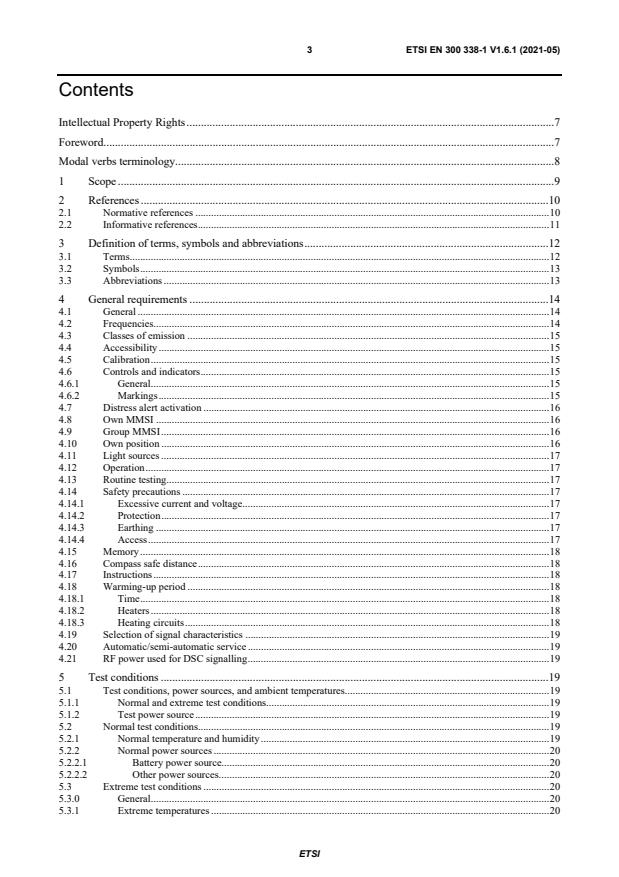
(Main)Technical characteristics and methods of measurement for equipment for generation, transmission and reception of Digital Selective Calling (DSC) in the maritime MF, MF/HF and/or VHF mobile service - Part 1: Common requirements
General Information
- Abstract
The present document states the minimum requirements for equipment to be used for generation, transmission and
reception of Digital Selective Calling (DSC) for use on board ships.
DSC is intended to be used in the Medium Frequency (MF), High Frequency (HF) and Very High Frequency (VHF)
bands of the Maritime Mobile Service (MMS), for distress, urgency and safety communication and general
communications.
The present document is part 1 of a multi-part deliverable that covers the requirements to be fulfilled by:
• DSC equipment integrated with a transmitter and/or a receiver;
• DSC equipment not integrated with a transmitter and/or a receiver.
These requirements include the relevant provisions of the ITU Radio Regulations [i.15] and Recommendations ITU-R
M.493-15 [2], M.541-10 [3], M.689-3 [4] and M.1082-1 [5], the International Convention for the Safety Of Life At Sea
(SOLAS) [i.14], and the following resolutions/circulars of the International Maritime Organization (IMO):
A.694(17) [14], A.803(19) [15] amended by MSC.68(68) Annex 1 [17], A.804(19) [16], MSC.68(68) Annex 2 [17],
A.806(19) [18], MSC.68(68) Annex 3 [17], MSC 302(87) [12] and MSC/Circ.862 [19].
Equipment for generation, transmission and reception of DSC designed according to the following equipment classes:
• Class A: includes all the facilities defined in annex 1 of Recommendation ITU-R M.493-15 [2] and complies
Performance Standards A.803(19) for VHF [15], A.804(19) for MF [16] and A.806(19) for MF/HF equipment
capable of voice and DSC [18].
• Class D: provides minimum facilities for VHF DSC distress, urgency and safety as well as routine calling and
reception as recommended by IMO MSC/Circ.803 [i.2] for non-SOLAS vessels participating in the GMDSS
and defined by Recommendation ITU-R M.493-15 [2].
• Class E: provides minimum facilities for MF and/or HF DSC distress, urgency and safety as well as routine
calling and reception as recommended by IMO MSC/Circ.803 [i.2] for non-SOLAS vessels participating in the
GMDSS and Recommendation ITU-R M.493-15 [2].
• Class H: provides minimum facilities for handheld VHF DSC distress, urgency and safety as well as routine
calling and reception as recommended by IMO MSC/Circ.803 [i.2] for non-SOLAS vessels participating in the
GMDSS and Recommendation ITU-R M.493-15 [2].
• Class M: provides minimum facilities for VHF Man Overboard devices as defined in Recommendation
ITU-R M.493-15 [2].
NOTE 1: Class A equipment may support the optional semi-automatic/automatic service in accordance with
Recommendations ITU-R M.689-3 [4], M.1082-1 [5] and M.493-15 [2], tables A1-4.10.1 and A1-4.10.2
and are encouraged to do so.
NOTE 2: Class D and Class E equipment may also support the optional semi-automatic/automatic service.
NOTE 3: Class D, Class E, Class H should provide a defined list of functions as a closed list for these classes of
equipment is the preferable approach to ensure safe and simple operation. Optional functions should be
avoided, with the intention to provide the same functionality of all equipment of one class.
- Status
- Published
- Public Enquiry End Date
- 13-Sep-2020
- Publication Date
- 01-Jun-2021
- Technical Committee
- MOC - Mobile Communications
- Current Stage
- 6060 - National Implementation/Publication (Adopted Project)
- Start Date
- 31-May-2021
- Due Date
- 05-Aug-2021
- Completion Date
- 02-Jun-2021
Buy Documents

ETSI EN 300 338-1 V1.5.2 (2020-06) - Technical characteristics and methods of measurement for equipment for generation, transmission and reception of Digital Selective Calling (DSC) in the maritime MF, MF/HF and/or VHF mobile service; Part 1: Common requirements
ETSI EN 300 338-1 V1.6.0 (2021-03) - Technical characteristics and methods of measurement for equipment for generation, transmission and reception of Digital Selective Calling (DSC) in the maritime MF, MF/HF and/or VHF mobile service; Part 1: Common requirements

ETSI EN 300 338-1 V1.6.1 (2021-05) - Technical characteristics and methods of measurement for equipment for generation, transmission and reception of Digital Selective Calling (DSC) in the maritime MF, MF/HF and/or VHF mobile service; Part 1: Common requirements

Overview
SIST EN 300 338-1 V1.6.1:2021 establishes the minimum requirements and testing methods for equipment used in the generation, transmission, and reception of Digital Selective Calling (DSC) in maritime Medium Frequency (MF), High Frequency (HF), and Very High Frequency (VHF) mobile services. Developed by SIST and based on the European Standard EN 300 338-1, this document details the common requirements for DSC equipment onboard ships-essential for maritime safety, distress alerting, and general maritime communication.
DSC, as part of the Maritime Mobile Service (MMS) and the Global Maritime Distress and Safety System (GMDSS), is critical for ensuring quick and reliable emergency communication at sea. This standard covers integrated and non-integrated DSC equipment and aligns with key international regulations and recommendations, including ITU Radio Regulations, ITU-R Recommendations, and IMO resolutions.
Key Topics
- Equipment Classes: The standard defines mandatory features and performance benchmarks for different classes of DSC equipment:
- Class A: Fully-featured equipment meeting the most comprehensive requirements for vessels subject to SOLAS.
- Class D: Minimum feature set for non-SOLAS VHF DSC devices.
- Class E: Minimum facilities for non-SOLAS MF and/or HF DSC equipment.
- Class H: Handheld VHF DSC units aimed at non-SOLAS vessels.
- Class M: VHF Man Overboard (MoB) devices.
- Regulatory Alignment: Incorporates relevant ITU-R Recommendations (e.g., M.493-15, M.541-10) and IMO resolutions to ensure regulatory compliance and interoperability.
- General Requirements:
- Radio frequency use and emission standards
- Distress alert activation and routine testing
- Identification via MMSI (Maritime Mobile Service Identity)
- Controls, operational safety, and environmental testing (vibration, temperature, corrosion for certain classes)
- Testing Methods: Defines standardized measurement techniques to verify technical performance, error correction, and environmental durability of DSC equipment.
- Interface and Integration: Specifies requirements for data input/output, operational integration with ship systems, and support for automated and semi-automated services where applicable.
Applications
Adherence to SIST EN 300 338-1 V1.6.1:2021 ensures that maritime DSC equipment:
- Supports Distress and Safety Communication: Reliable transmission and reception of distress, urgency, and safety signals, crucial for marine safety and compliance with GMDSS.
- Facilitates Maritime Operations: Enables effective general communication and calling procedures between ships and shore stations.
- Ensures Equipment Interoperability: Compliance ensures equipment compatibility across different vessel classes and international marine networks.
- Meets Regulatory Requirements: Fulfills obligations under SOLAS and other international conventions, reducing the risk of non-compliance for ship operators and manufacturers.
- Enhances Operational Reliability: Environmental and electrical requirements ensure continued performance in harsh maritime environments.
- Supplies Manufacturers with Clear Benchmarks: Provides standardized test conditions and performance measures for equipment development and certification.
Related Standards
- EN 300 338 Parts 2-8: Detailed requirements for each DSC equipment class and additional functionalities such as bridge alert management and remote control integration.
- ITU-R M.493-15: Defines technical parameters and operational procedures for DSC.
- International Maritime Organization (IMO) Resolutions: Standards for maritime radio equipment as required by the Safety of Life at Sea (SOLAS) Convention.
- ITU Radio Regulations: International framework for radio frequency use and interoperability.
- IEC 60945: General requirements for maritime navigation and radio communication equipment (environmental testing).
- GMDSS Standards: Regulations for the global system supporting distress and safety communications at sea.
By following SIST EN 300 338-1 V1.6.1:2021, ship operators, equipment manufacturers, and certifying authorities help maintain a robust, interoperable, and safety-focused communication network across the global maritime industry.
Buy Documents
ETSI EN 300 338-1 V1.5.2 (2020-06) - Technical characteristics and methods of measurement for equipment for generation, transmission and reception of Digital Selective Calling (DSC) in the maritime MF, MF/HF and/or VHF mobile service; Part 1: Common requirements
ETSI EN 300 338-1 V1.6.0 (2021-03) - Technical characteristics and methods of measurement for equipment for generation, transmission and reception of Digital Selective Calling (DSC) in the maritime MF, MF/HF and/or VHF mobile service; Part 1: Common requirements
ETSI EN 300 338-1 V1.6.1 (2021-05) - Technical characteristics and methods of measurement for equipment for generation, transmission and reception of Digital Selective Calling (DSC) in the maritime MF, MF/HF and/or VHF mobile service; Part 1: Common requirements
Get Certified
Connect with accredited certification bodies for this standard

DNV
DNV is an independent assurance and risk management provider.

Lloyd's Register
Lloyd's Register is a global professional services organisation specialising in engineering and technology.

FSC International
Forest Stewardship Council certification.
Sponsored listings
Frequently Asked Questions
SIST EN 300 338-1 V1.6.1:2021 is a standard published by the Slovenian Institute for Standardization (SIST). Its full title is "Technical characteristics and methods of measurement for equipment for generation, transmission and reception of Digital Selective Calling (DSC) in the maritime MF, MF/HF and/or VHF mobile service - Part 1: Common requirements". This standard covers: The present document states the minimum requirements for equipment to be used for generation, transmission and reception of Digital Selective Calling (DSC) for use on board ships. DSC is intended to be used in the Medium Frequency (MF), High Frequency (HF) and Very High Frequency (VHF) bands of the Maritime Mobile Service (MMS), for distress, urgency and safety communication and general communications. The present document is part 1 of a multi-part deliverable that covers the requirements to be fulfilled by: • DSC equipment integrated with a transmitter and/or a receiver; • DSC equipment not integrated with a transmitter and/or a receiver. These requirements include the relevant provisions of the ITU Radio Regulations [i.15] and Recommendations ITU-R M.493-15 [2], M.541-10 [3], M.689-3 [4] and M.1082-1 [5], the International Convention for the Safety Of Life At Sea (SOLAS) [i.14], and the following resolutions/circulars of the International Maritime Organization (IMO): A.694(17) [14], A.803(19) [15] amended by MSC.68(68) Annex 1 [17], A.804(19) [16], MSC.68(68) Annex 2 [17], A.806(19) [18], MSC.68(68) Annex 3 [17], MSC 302(87) [12] and MSC/Circ.862 [19]. Equipment for generation, transmission and reception of DSC designed according to the following equipment classes: • Class A: includes all the facilities defined in annex 1 of Recommendation ITU-R M.493-15 [2] and complies Performance Standards A.803(19) for VHF [15], A.804(19) for MF [16] and A.806(19) for MF/HF equipment capable of voice and DSC [18]. • Class D: provides minimum facilities for VHF DSC distress, urgency and safety as well as routine calling and reception as recommended by IMO MSC/Circ.803 [i.2] for non-SOLAS vessels participating in the GMDSS and defined by Recommendation ITU-R M.493-15 [2]. • Class E: provides minimum facilities for MF and/or HF DSC distress, urgency and safety as well as routine calling and reception as recommended by IMO MSC/Circ.803 [i.2] for non-SOLAS vessels participating in the GMDSS and Recommendation ITU-R M.493-15 [2]. • Class H: provides minimum facilities for handheld VHF DSC distress, urgency and safety as well as routine calling and reception as recommended by IMO MSC/Circ.803 [i.2] for non-SOLAS vessels participating in the GMDSS and Recommendation ITU-R M.493-15 [2]. • Class M: provides minimum facilities for VHF Man Overboard devices as defined in Recommendation ITU-R M.493-15 [2]. NOTE 1: Class A equipment may support the optional semi-automatic/automatic service in accordance with Recommendations ITU-R M.689-3 [4], M.1082-1 [5] and M.493-15 [2], tables A1-4.10.1 and A1-4.10.2 and are encouraged to do so. NOTE 2: Class D and Class E equipment may also support the optional semi-automatic/automatic service. NOTE 3: Class D, Class E, Class H should provide a defined list of functions as a closed list for these classes of equipment is the preferable approach to ensure safe and simple operation. Optional functions should be avoided, with the intention to provide the same functionality of all equipment of one class.
The present document states the minimum requirements for equipment to be used for generation, transmission and reception of Digital Selective Calling (DSC) for use on board ships. DSC is intended to be used in the Medium Frequency (MF), High Frequency (HF) and Very High Frequency (VHF) bands of the Maritime Mobile Service (MMS), for distress, urgency and safety communication and general communications. The present document is part 1 of a multi-part deliverable that covers the requirements to be fulfilled by: • DSC equipment integrated with a transmitter and/or a receiver; • DSC equipment not integrated with a transmitter and/or a receiver. These requirements include the relevant provisions of the ITU Radio Regulations [i.15] and Recommendations ITU-R M.493-15 [2], M.541-10 [3], M.689-3 [4] and M.1082-1 [5], the International Convention for the Safety Of Life At Sea (SOLAS) [i.14], and the following resolutions/circulars of the International Maritime Organization (IMO): A.694(17) [14], A.803(19) [15] amended by MSC.68(68) Annex 1 [17], A.804(19) [16], MSC.68(68) Annex 2 [17], A.806(19) [18], MSC.68(68) Annex 3 [17], MSC 302(87) [12] and MSC/Circ.862 [19]. Equipment for generation, transmission and reception of DSC designed according to the following equipment classes: • Class A: includes all the facilities defined in annex 1 of Recommendation ITU-R M.493-15 [2] and complies Performance Standards A.803(19) for VHF [15], A.804(19) for MF [16] and A.806(19) for MF/HF equipment capable of voice and DSC [18]. • Class D: provides minimum facilities for VHF DSC distress, urgency and safety as well as routine calling and reception as recommended by IMO MSC/Circ.803 [i.2] for non-SOLAS vessels participating in the GMDSS and defined by Recommendation ITU-R M.493-15 [2]. • Class E: provides minimum facilities for MF and/or HF DSC distress, urgency and safety as well as routine calling and reception as recommended by IMO MSC/Circ.803 [i.2] for non-SOLAS vessels participating in the GMDSS and Recommendation ITU-R M.493-15 [2]. • Class H: provides minimum facilities for handheld VHF DSC distress, urgency and safety as well as routine calling and reception as recommended by IMO MSC/Circ.803 [i.2] for non-SOLAS vessels participating in the GMDSS and Recommendation ITU-R M.493-15 [2]. • Class M: provides minimum facilities for VHF Man Overboard devices as defined in Recommendation ITU-R M.493-15 [2]. NOTE 1: Class A equipment may support the optional semi-automatic/automatic service in accordance with Recommendations ITU-R M.689-3 [4], M.1082-1 [5] and M.493-15 [2], tables A1-4.10.1 and A1-4.10.2 and are encouraged to do so. NOTE 2: Class D and Class E equipment may also support the optional semi-automatic/automatic service. NOTE 3: Class D, Class E, Class H should provide a defined list of functions as a closed list for these classes of equipment is the preferable approach to ensure safe and simple operation. Optional functions should be avoided, with the intention to provide the same functionality of all equipment of one class.
SIST EN 300 338-1 V1.6.1:2021 is classified under the following ICS (International Classification for Standards) categories: 33.060.20 - Receiving and transmitting equipment; 47.020.70 - Navigation and control equipment. The ICS classification helps identify the subject area and facilitates finding related standards.
SIST EN 300 338-1 V1.6.1:2021 is available in PDF format for immediate download after purchase. The document can be added to your cart and obtained through the secure checkout process. Digital delivery ensures instant access to the complete standard document.
Standards Content (Sample)
Draft ETSI EN 300 338-1 V1.5.2 (2020-06)
EUROPEAN STANDARD
Technical characteristics and methods of measurement
for equipment for generation, transmission
and reception of Digital Selective Calling (DSC)
in the maritime MF, MF/HF and/or VHF mobile service;
Part 1: Common requirements
2 Draft ETSI EN 300 338-1 V1.5.2 (2020-06)
Reference
REN/ERM-TGMAR-610
Keywords
DSC, GMDSS, maritime, radio
ETSI
650 Route des Lucioles
F-06921 Sophia Antipolis Cedex - FRANCE
Tel.: +33 4 92 94 42 00 Fax: +33 4 93 65 47 16
Siret N° 348 623 562 00017 - NAF 742 C
Association à but non lucratif enregistrée à la
Sous-Préfecture de Grasse (06) N° 7803/88
Important notice
The present document can be downloaded from:
http://www.etsi.org/standards-search
The present document may be made available in electronic versions and/or in print. The content of any electronic and/or
print versions of the present document shall not be modified without the prior written authorization of ETSI. In case of any
existing or perceived difference in contents between such versions and/or in print, the prevailing version of an ETSI
deliverable is the one made publicly available in PDF format at www.etsi.org/deliver.
Users of the present document should be aware that the document may be subject to revision or change of status.
Information on the current status of this and other ETSI documents is available at
https://portal.etsi.org/TB/ETSIDeliverableStatus.aspx
If you find errors in the present document, please send your comment to one of the following services:
https://portal.etsi.org/People/CommiteeSupportStaff.aspx
Copyright Notification
No part may be reproduced or utilized in any form or by any means, electronic or mechanical, including photocopying
and microfilm except as authorized by written permission of ETSI.
The content of the PDF version shall not be modified without the written authorization of ETSI.
The copyright and the foregoing restriction extend to reproduction in all media.
© ETSI 2020.
All rights reserved.
DECT™, PLUGTESTS™, UMTS™ and the ETSI logo are trademarks of ETSI registered for the benefit of its Members.
3GPP™ and LTE™ are trademarks of ETSI registered for the benefit of its Members and
of the 3GPP Organizational Partners.
oneM2M™ logo is a trademark of ETSI registered for the benefit of its Members and
of the oneM2M Partners. ®
GSM and the GSM logo are trademarks registered and owned by the GSM Association.
ETSI
3 Draft ETSI EN 300 338-1 V1.5.2 (2020-06)
Contents
Intellectual Property Rights . 7
Foreword . 7
Modal verbs terminology . 8
1 Scope . 9
2 References . 9
2.1 Normative references . 9
2.2 Informative references . 10
3 Definition of terms, symbols and abbreviations . 11
3.1 Terms . 11
3.2 Symbols . 12
3.3 Abbreviations . 12
4 General requirements . 13
4.1 General . 13
4.2 Frequencies. 14
4.3 Classes of emission . 14
4.4 Accessibility . 14
4.5 Calibration . 14
4.6 Controls and indicators . 15
4.6.1 General . 15
4.6.2 Markings . 15
4.7 Distress alert activation . 15
4.8 Own MMSI . 15
4.9 Group MMSI . 16
4.10 Own position . 16
4.11 Light sources . 16
4.12 Operation . 16
4.13 Routine testing . 16
4.14 Safety precautions . 17
4.14.1 Excessive current and voltage . 17
4.14.2 Protection . 17
4.14.3 Earthing . 17
4.14.4 Access . 17
4.15 Memory . 17
4.16 Compass safe distance . 17
4.17 Instructions . 17
4.18 Warming-up period . 18
4.18.1 Time . 18
4.18.2 Heaters . 18
4.18.3 Heating circuits . 18
4.19 Selection of signal characteristics . 18
4.20 Automatic/semi-automatic service . 18
4.21 RF power used for DSC signalling . 18
5 Test conditions . 18
5.1 Test conditions, power sources, and ambient temperatures . 18
5.1.1 Normal and extreme test conditions. 18
5.1.2 Test power source . 19
5.2 Normal test conditions . 19
5.2.1 Normal temperature and humidity . 19
5.2.2 Normal power sources . 19
5.2.2.1 Battery power source. 19
5.2.2.2 Other power sources . 19
5.3 Extreme test conditions . 19
5.3.0 General . 19
5.3.1 Extreme temperatures . 19
ETSI
4 Draft ETSI EN 300 338-1 V1.5.2 (2020-06)
5.3.2 Extreme values of test power sources . 19
5.3.2.1 Battery power source. 19
5.3.2.2 Other power sources . 20
5.3.3 Procedure for tests at extreme temperatures . 20
5.4 Standard test signals . 20
5.4.1 References to standard test signals . 20
5.4.2 Standard test signal no. 1 . 20
5.4.3 Standard test signal no. 2 . 20
5.4.4 Standard test signal no. 3 . 20
5.4.5 Standard test signal no. 4 . 20
5.5 Determination of the symbol error rate in the output of the receiving part . 21
5.6 Test Impedances . 21
6 RF test or baseband test of DSC equipment . 21
6.1 RF test of integrated DSC equipment . 21
6.1.1 SOLAS VHF class A . 21
6.1.2 Non-SOLAS VHF class D . 21
6.1.3 SOLAS MF/HF class A . 21
6.1.4 Non-SOLAS MF/HF class E . 21
6.1.5 Non-SOLAS VHF class H . 21
6.1.6 MoB class M . 21
6.2 Baseband test of non integrated DSC equipment . 22
6.2.1 VHF Encoder . 22
6.2.1.1 Frequency error . 22
6.2.1.1.1 Definition. 22
6.2.1.1.2 Method of measurements. 22
6.2.1.1.3 Limits . 22
6.2.1.2 Output voltage . 22
6.2.1.2.1 Definition. 22
6.2.1.2.2 Method of measurement . 22
6.2.1.2.3 Limits . 22
6.2.1.3 Bit stream speed . 22
6.2.1.3.1 Definition. 22
6.2.1.3.2 Method of measurement . 23
6.2.1.3.3 Limits . 23
6.2.1.4 Unwanted spectral components of the output signal . 23
6.2.1.4.1 Definition. 23
6.2.1.4.2 Method of measurement . 23
6.2.1.4.3 Limits . 23
6.2.1.5 Residual frequency modulation . 24
6.2.1.5.1 Definition. 24
6.2.1.5.2 Method of measurement . 24
6.2.1.5.3 Limits . 24
6.2.2 VHF DSC decoder . 24
6.2.2.1 Dynamic range . 24
6.2.2.1.1 Definition. 24
6.2.2.1.2 Method of measurement . 24
6.2.2.1.3 Limits . 25
6.2.2.2 Noise immunity . 25
6.2.2.2.1 Definition. 25
6.2.2.2.2 Method of test . 25
6.2.2.2.3 Limits . 25
6.2.3 MF/HF DSC encoder . 25
6.2.3.1 Frequency error . 25
6.2.3.1.1 Definition. 25
6.2.3.1.2 Method of measurement . 25
6.2.3.1.3 Limits . 25
6.2.3.2 Output voltage . 25
6.2.3.2.1 Definition. 25
6.2.3.2.2 Method of measurement . 25
6.2.3.2.3 Limits . 26
6.2.3.3 Bit stream speed . 26
ETSI
5 Draft ETSI EN 300 338-1 V1.5.2 (2020-06)
6.2.3.3.1 Definition. 26
6.2.3.3.2 Method of measurement . 26
6.2.3.3.3 Limits . 26
6.2.3.4 Unwanted spectral components of the output signal . 26
6.2.3.4.1 Definition. 26
6.2.3.4.2 Method of measurement . 26
6.2.3.4.3 Limits . 26
6.2.3.5 Residual frequency modulation . 27
6.2.3.5.1 Definition. 27
6.2.3.5.2 Method of measurement . 27
6.2.3.5.3 Limits . 27
6.2.4 MF/HF DSC decoder . 28
6.2.4.1 Interface for scanning . 28
6.2.4.2 Scanning efficiency . 28
6.2.4.2.1 Definition. 28
6.2.4.2.2 Method of measurement . 28
6.2.4.2.3 Limits . 28
6.2.4.3 Dynamic range . 28
6.2.4.3.1 Definition. 28
6.2.4.3.2 Method of measurement . 29
6.2.4.4 Noise Immunity . 29
6.2.4.4.1 Definition. 29
6.2.4.4.2 Method of test . 29
6.2.4.4.3 Limits . 29
7 Environmental tests . 29
7.1 Environmental tests . 29
7.1.1 Introduction. 29
7.1.2 Procedure . 30
7.1.3 Performance check . 30
7.1.4 Vibration test (all classes) . 30
7.1.4.1 Method of measurement . 30
7.1.4.2 Requirement . 31
7.1.5 Temperature tests . 31
7.1.5.1 Dry heat for externally mounted equipment (all classes) . 31
7.1.5.1.1 Method of measurement . 31
7.1.5.1.2 Requirement . 31
7.1.5.2 Damp heat cycle (all classes) . 31
7.1.5.2.1 Method of measurement . 31
7.1.5.2.2 Requirement . 31
7.1.5.3 Low temperature cycle . 31
7.1.5.3.1 Method of measurement for externally mounted equipment (all classes) . 31
7.1.5.3.2 Method of measurement for internally mounted equipment . 32
7.1.5.3.3 Requirement . 32
7.1.6 Corrosion test (class A) . 32
7.1.6.1 General . 32
7.1.6.2 Method of measurement . 32
7.1.6.3 Requirements . 33
7.1.7 Rain test (externally mounted, class A) . 33
7.1.7.1 General . 33
7.1.7.2 Method of measurement . 33
7.1.7.3 Requirements . 33
8 Decoding and error correction . 34
8.1 Reception of DSC messages . 34
8.2 Error handling in the automated procedures . 35
8.2.1 General . 35
8.2.2 Distress automated procedures . 35
8.2.3 Non distress automated procedures . 36
9 Interfaces . 36
9.1 DSC signals input/output: analogue signals . 36
9.2 DSC signals input/output: digital signals . 36
ETSI
6 Draft ETSI EN 300 338-1 V1.5.2 (2020-06)
9.3 Entry of position information . 36
9.4 Interfaces between DSC equipment and external circuits . 37
9.4.1 Operational interfaces . 37
9.4.2 Printer output . 37
9.4.3 Other interfaces . 37
10 Multiple operator positions . 37
10.1 Priority . 37
10.2 Alarms . 37
10.3 Specific functionality . 37
11 Multiple radio installations . 38
12 Channel and frequency coding . 38
12.1 Frequency information in DSC messages . 38
13 Call set-up procedures . 39
Annex A (normative): DSC Message Detection and Decoding . 41
History . 42
ETSI
7 Draft ETSI EN 300 338-1 V1.5.2 (2020-06)
Intellectual Property Rights
Essential patents
IPRs essential or potentially essential to normative deliverables may have been declared to ETSI. The information
pertaining to these essential IPRs, if any, is publicly available for ETSI members and non-members, and can be found
in ETSI SR 000 314: "Intellectual Property Rights (IPRs); Essential, or potentially Essential, IPRs notified to ETSI in
respect of ETSI standards", which is available from the ETSI Secretariat. Latest updates are available on the ETSI Web
server (https://ipr.etsi.org/).
Pursuant to the ETSI IPR Policy, no investigation, including IPR searches, has been carried out by ETSI. No guarantee
can be given as to the existence of other IPRs not referenced in ETSI SR 000 314 (or the updates on the ETSI Web
server) which are, or may be, or may become, essential to the present document.
Trademarks
The present document may include trademarks and/or tradenames which are asserted and/or registered by their owners.
ETSI claims no ownership of these except for any which are indicated as being the property of ETSI, and conveys no
right to use or reproduce any trademark and/or tradename. Mention of those trademarks in the present document does
not constitute an endorsement by ETSI of products, services or organizations associated with those trademarks.
Foreword
This draft European Standard (EN) has been produced by ETSI Technical Committee Electromagnetic compatibility
and Radio spectrum Matters (ERM), and is now submitted for the combined Public Enquiry and Vote phase of the ETSI
standards EN Approval Procedure.
The present document is part 1 of a multi-part deliverable covering Digital Selective Calling (DSC), as identified
below:
Part 1: "Common requirements";
Part 2: "Class A DSC";
Part 3: "Class D DSC";
Part 4: "Class E DSC";
Part 5: "Handheld VHF Class H DSC";
Part 6: "Class M DSC";
Part 7: "Interfacing DSC radio equipment to Bridge Alert Management systems (BAM)";
Part 8: "Enabling DSC radio equipment with remote control capabilities".
The present document covers the common requirements for all classes of DSC equipment. Operator interfaces and
operating system details are class specific and will be found in the appropriate part.
Proposed national transposition dates
Date of latest announcement of this EN (doa): 3 months after ETSI publication
Date of latest publication of new National Standard
or endorsement of this EN (dop/e): 6 months after doa
Date of withdrawal of any conflicting National Standard (dow): 18 months after doa
ETSI
8 Draft ETSI EN 300 338-1 V1.5.2 (2020-06)
Modal verbs terminology
In the present document "shall", "shall not", "should", "should not", "may", "need not", "will", "will not", "can" and
"cannot" are to be interpreted as described in clause 3.2 of the ETSI Drafting Rules (Verbal forms for the expression of
provisions).
"must" and "must not" are NOT allowed in ETSI deliverables except when used in direct citation.
ETSI
9 Draft ETSI EN 300 338-1 V1.5.2 (2020-06)
1 Scope
The present document states the minimum requirements for equipment to be used for generation, transmission and
reception of Digital Selective Calling (DSC) for use on board ships.
DSC is intended to be used in the Medium Frequency (MF), High Frequency (HF) and Very High Frequency (VHF)
bands of the Maritime Mobile Service (MMS), for distress, urgency and safety communication and general
communications.
The present document is part 1 of a multi-part deliverable that covers the requirements to be fulfilled by:
• DSC equipment integrated with a transmitter and/or a receiver;
• DSC equipment not integrated with a transmitter and/or a receiver.
These requirements include the relevant provisions of the ITU Radio Regulations [i.17] and Recommendations ITU-R
M.493-15 [2], M.541-10 [3], M.689-3 [4] and M.1082-1 [5], the International Convention for the Safety Of Life At Sea
(SOLAS) [i.16], and the relevant resolutions of the International Maritime Organization (IMO).
Equipment for generation, transmission and reception of DSC designed according to the following equipment classes:
• Class A: includes all the facilities defined in annex 1 of Recommendation ITU-R M.493-15 [2] and complies
with the IMO Global Maritime Distress and Safety System (GMDSS) carriage requirements for MF/HF
installations and/or VHF installations.
• Class D: provides minimum facilities for VHF DSC distress, urgency and safety as well as routine calling and
reception as recommended by IMO MSC/Circ.803 [i.2] for non-SOLAS vessels participating in the GMDSS.
• Class E: provides minimum facilities for MF and/or HF DSC distress, urgency and safety as well as routine
calling and reception as recommended by IMO MSC/Circ.803 [i.2] for non-SOLAS vessels participating in the
GMDSS.
• Class H: provides minimum facilities for handheld VHF DSC distress, urgency and safety as well as routine
calling and reception as recommended by IMO MSC/Circ.803 [i.2] for non-SOLAS vessels participating in the
GMDSS.
• Class M: provides minimum facilities for VHF Man Overboard devices as defined in Recommendation
ITU-R M.493-15 [2].
NOTE 1: Class A equipment may support the optional semi-automatic/automatic service in accordance with
Recommendations ITU-R M.689-3 [4], M.1082-1 [5] and M.493-15 [2], tables A1-4.10.1 and A1-4.10.2
and are encouraged to do so.
NOTE 2: Class D and Class E equipment may also support the optional semi-automatic/automatic service.
2 References
2.1 Normative references
References are either specific (identified by date of publication and/or edition number or version number) or
non-specific. For specific references, only the cited version applies. For non-specific references, the latest version of the
referenced document (including any amendments) applies.
Referenced documents which are not found to be publicly available in the expected location might be found at
https://docbox.etsi.org/Reference/.
NOTE: While any hyperlinks included in this clause were valid at the time of publication, ETSI cannot guarantee
their long term validity.
ETSI
10 Draft ETSI EN 300 338-1 V1.5.2 (2020-06)
The following referenced documents are necessary for the application of the present document.
[1] Recommendation ITU-T E.161: "Arrangement of digits, letters and symbols on telephones and
other devices that can be used for gaining access to a telephone network".
[2] Recommendation ITU-R M.493-15 (2019): "Digital selective-calling system for use in the
maritime mobile service".
[3] Recommendation ITU-R M.541-10 (2015): "Operational procedures for the use of digital
selective-calling equipment in the maritime mobile service".
[4] Recommendation ITU-R M.689-3 (2012): "International maritime VHF radiotelephone system
with automatic facilities based on DSC signalling format".
[5] Recommendation ITU-R M.1082-1 (1997): "International maritime MF/HF radiotelephone system
with automatic facilities based on digital selective calling signalling format".
[6] Recommendation ITU-T V.11 (1996): "Electrical characteristics for balanced double-current
interchange circuits operating at data signalling rates up to 10 Mbit/s".
[7] IEC 61162-1:2016: "Maritime navigation and radiocommunication equipment and systems -
Digital interfaces - Part 1: Single talker and multiple listeners".
[8] IEC 61162-2:1998 (Ed. 1.0): "Maritime navigation and radiocommunication equipment and
systems - Digital interfaces - Part 2: Single talker and multiple listeners, high-speed transmission".
[9] IEC 61162-3:2008+AMD1:2010+AMD2:2014 (Ed. 1.2): "Maritime navigation and
radiocommunication equipment and systems - Digital interfaces - Part 3: Serial data instrument
network".
[10] IEC 61162-450:2018: "Maritime navigation and radiocommunication equipment and systems -
Digital interfaces - Part 450: Multiple talkers and multiple listeners - Ethernet interconnection".
[11] Recommendation ITU-R M.1080 (1994): "Digital selective calling system enhancement for
multiple equipment installations".
2.2 Informative references
References are either specific (identified by date of publication and/or edition number or version number) or
non-specific. For specific references, only the cited version applies. For non-specific references, the latest version of the
referenced document (including any amendments) applies.
NOTE: While any hyperlinks included in this clause were valid at the time of publication, ETSI cannot guarantee
their long term validity.
The following referenced documents are not necessary for the application of the present document but they assist the
user with regard to a particular subject area.
[i.1] IEC 60529:2001 (Ed. 2.1): "Degrees of protection provided by enclosures (IP Code)".
[i.2] IMO Circular MSC/Circ.803: "Participation of non-SOLAS ships in the Global Maritime Distress
and Safety System (GMDSS)".
[i.3] Report Recommendation ITU-R M.501: "Digital selective-calling system for future operational
requirements of the maritime mobile service".
[i.4] Void.
[i.5] Recommendation ITU-R M.821-1 (1997): "Optional expansion of the digital selective-calling
system for use in the maritime mobile service".
[i.6] ETSI EN 301 925: "Radiotelephone transmitters and receivers for the maritime mobile service
operating in VHF bands; Technical characteristics and methods of measurement".
ETSI
11 Draft ETSI EN 300 338-1 V1.5.2 (2020-06)
[i.7] ETSI EN 301 033: "Electromagnetic compatibility and Radio spectrum Matters (ERM); Technical
characteristics and methods of measurement for shipborne watchkeeping receivers for reception of
Digital Selective Calling (DSC) in the maritime MF, MF/HF and VHF bands".
[i.8] ETSI EN 301 025: "VHF radiotelephone equipment for general communications and associated
equipment for Class "D" Digital Selective Calling (DSC); Harmonised Standard covering the
essential requirements of articles 3.2 and 3.3(g) of Directive 2014/53/EU".
[i.9] ETSI EN 300 373-1: "Electromagnetic compatibility and Radio spectrum Matters (ERM);
Maritime mobile transmitters and receivers for use in the MF and HF bands; Part 1: Technical
characteristics and methods of measurement".
[i.10] ETSI EN 303 402: "Maritime mobile transmitters and receivers for use in the MF and HF bands;
Harmonised Standard covering the essential requirements of articles 3.2 and 3.3(g) of Directive
2014/53/EU".
[i.11] ETSI EN 302 885: "Portable Very High Frequency (VHF) radiotelephone equipment for the
maritime mobile service operating in the VHF bands with integrated handheld class H DSC;
Harmonised Standard covering the essential requirements of articles 3.2 and 3.3(g) of Directive
2014/53/EU".
[i.12] ISO 3791: "Office machines and data processing equipment - Keyboard layouts for numeric
applications".
[i.13] MSC 302(87): "Adoption of performance standards for bridge alert management".
[i.14] IEC 62923 (parts 1 and 2): "Maritime navigation and radiocommunication equipment and systems
- Bridge alert management".
[i.15] ETSI EN 303 132: "Maritime low power VHF personal locating beacons employing Digital
Selective Calling (DSC); Harmonised Standard covering the essential r
...
Final draft ETSI EN 300 338-1 V1.6.0 (2021-03)
EUROPEAN STANDARD
Technical characteristics and methods of measurement
for equipment for generation, transmission
and reception of Digital Selective Calling (DSC)
in the maritime MF, MF/HF and/or VHF mobile service;
Part 1: Common requirements
2 Final draft ETSI EN 300 338-1 V1.6.0 (2021-03)
Reference
REN/ERM-TGMAR-610
Keywords
DSC, GMDSS, maritime, radio
ETSI
650 Route des Lucioles
F-06921 Sophia Antipolis Cedex - FRANCE
Tel.: +33 4 92 94 42 00 Fax: +33 4 93 65 47 16
Siret N° 348 623 562 00017 - NAF 742 C
Association à but non lucratif enregistrée à la
Sous-Préfecture de Grasse (06) N° 7803/88
Important notice
The present document can be downloaded from:
http://www.etsi.org/standards-search
The present document may be made available in electronic versions and/or in print. The content of any electronic and/or
print versions of the present document shall not be modified without the prior written authorization of ETSI. In case of any
existing or perceived difference in contents between such versions and/or in print, the prevailing version of an ETSI
deliverable is the one made publicly available in PDF format at www.etsi.org/deliver.
Users of the present document should be aware that the document may be subject to revision or change of status.
Information on the current status of this and other ETSI documents is available at
https://portal.etsi.org/TB/ETSIDeliverableStatus.aspx
If you find errors in the present document, please send your comment to one of the following services:
https://portal.etsi.org/People/CommiteeSupportStaff.aspx
Copyright Notification
No part may be reproduced or utilized in any form or by any means, electronic or mechanical, including photocopying
and microfilm except as authorized by written permission of ETSI.
The content of the PDF version shall not be modified without the written authorization of ETSI.
The copyright and the foregoing restriction extend to reproduction in all media.
© ETSI 2021.
All rights reserved.
DECT™, PLUGTESTS™, UMTS™ and the ETSI logo are trademarks of ETSI registered for the benefit of its Members.
3GPP™ and LTE™ are trademarks of ETSI registered for the benefit of its Members and
of the 3GPP Organizational Partners.
oneM2M™ logo is a trademark of ETSI registered for the benefit of its Members and
of the oneM2M Partners. ®
GSM and the GSM logo are trademarks registered and owned by the GSM Association.
ETSI
3 Final draft ETSI EN 300 338-1 V1.6.0 (2021-03)
Contents
Intellectual Property Rights . 7
Foreword . 7
Modal verbs terminology . 8
1 Scope . 9
2 References . 10
2.1 Normative references . 10
2.2 Informative references . 11
3 Definition of terms, symbols and abbreviations . 12
3.1 Terms . 12
3.2 Symbols . 13
3.3 Abbreviations . 13
4 General requirements . 14
4.1 General . 14
4.2 Frequencies. 14
4.3 Classes of emission . 15
4.4 Accessibility . 15
4.5 Calibration . 15
4.6 Controls and indicators . 15
4.6.1 General . 15
4.6.2 Markings . 15
4.7 Distress alert activation . 16
4.8 Own MMSI . 16
4.9 Group MMSI . 16
4.10 Own position . 16
4.11 Light sources . 17
4.12 Operation . 17
4.13 Routine testing . 17
4.14 Safety precautions . 17
4.14.1 Excessive current and voltage . 17
4.14.2 Protection . 17
4.14.3 Earthing . 17
4.14.4 Access . 17
4.15 Memory . 18
4.16 Compass safe distance . 18
4.17 Instructions . 18
4.18 Warming-up period . 18
4.18.1 Time . 18
4.18.2 Heaters . 18
4.18.3 Heating circuits . 19
4.19 Selection of signal characteristics . 19
4.20 Automatic/semi-automatic service . 19
4.21 RF power used for DSC signalling . 19
5 Test conditions . 19
5.1 Test conditions, power sources, and ambient temperatures . 19
5.1.1 Normal and extreme test conditions. 19
5.1.2 Test power source . 19
5.2 Normal test conditions . 20
5.2.1 Normal temperature and humidity . 20
5.2.2 Normal power sources . 20
5.2.2.1 Battery power source. 20
5.2.2.2 Other power sources . 20
5.3 Extreme test conditions . 20
5.3.0 General . 20
5.3.1 Extreme temperatures . 20
ETSI
4 Final draft ETSI EN 300 338-1 V1.6.0 (2021-03)
5.3.2 Extreme values of test power sources . 20
5.3.2.1 Battery power source. 20
5.3.2.2 Other power sources . 20
5.3.3 Procedure for tests at extreme temperatures . 20
5.4 Standard test signals . 21
5.4.1 References to standard test signals . 21
5.4.2 Standard test signal no. 1 . 21
5.4.3 Standard test signal no. 2 . 21
5.4.4 Standard test signal no. 3 . 21
5.4.5 Standard test signal no. 4 . 21
5.5 Determination of the symbol error rate in the output of the receiving part . 21
5.6 Test Impedances . 21
6 RF test or baseband test of DSC equipment . 22
6.1 RF test of integrated DSC equipment . 22
6.1.1 SOLAS VHF class A . 22
6.1.2 Non-SOLAS VHF class D . 22
6.1.3 SOLAS MF/HF class A . 22
6.1.4 Non-SOLAS MF/HF class E . 22
6.1.5 Non-SOLAS VHF class H . 22
6.1.6 MoB class M . 22
6.2 Baseband test of non-integrated DSC equipment . 22
6.2.1 VHF Encoder . 22
6.2.1.1 Frequency error . 22
6.2.1.1.1 Definition. 22
6.2.1.1.2 Method of measurements. 22
6.2.1.1.3 Limits . 23
6.2.1.2 Output voltage . 23
6.2.1.2.1 Definition. 23
6.2.1.2.2 Method of measurement . 23
6.2.1.2.3 Limits . 23
6.2.1.3 Bit stream speed . 23
6.2.1.3.1 Definition. 23
6.2.1.3.2 Method of measurement . 23
6.2.1.3.3 Limits . 23
6.2.1.4 Unwanted spectral components of the output signal . 23
6.2.1.4.1 Definition. 23
6.2.1.4.2 Method of measurement . 24
6.2.1.4.3 Limits . 24
6.2.1.5 Residual frequency modulation . 24
6.2.1.5.1 Definition. 24
6.2.1.5.2 Method of measurement . 24
6.2.1.5.3 Limits . 25
6.2.2 VHF DSC decoder . 25
6.2.2.1 Dynamic range . 25
6.2.2.1.1 Definition. 25
6.2.2.1.2 Method of measurement . 25
6.2.2.1.3 Limits . 25
6.2.2.2 Noise immunity . 25
6.2.2.2.1 Definition. 25
6.2.2.2.2 Method of test . 25
6.2.2.2.3 Limits . 26
6.2.3 MF/HF DSC encoder . 26
6.2.3.1 Frequency error . 26
6.2.3.1.1 Definition. 26
6.2.3.1.2 Method of measurement . 26
6.2.3.1.3 Limits . 26
6.2.3.2 Output voltage . 26
6.2.3.2.1 Definition. 26
6.2.3.2.2 Method of measurement . 26
6.2.3.2.3 Limits . 26
6.2.3.3 Bit stream speed . 26
ETSI
5 Final draft ETSI EN 300 338-1 V1.6.0 (2021-03)
6.2.3.3.1 Definition. 26
6.2.3.3.2 Method of measurement . 27
6.2.3.3.3 Limits . 27
6.2.3.4 Unwanted spectral components of the output signal . 27
6.2.3.4.1 Definition. 27
6.2.3.4.2 Method of measurement . 27
6.2.3.4.3 Limits . 27
6.2.3.5 Residual frequency modulation . 28
6.2.3.5.1 Definition. 28
6.2.3.5.2 Method of measurement . 28
6.2.3.5.3 Limits . 28
6.2.4 MF/HF DSC decoder . 29
6.2.4.1 Interface for scanning . 29
6.2.4.2 Scanning efficiency . 29
6.2.4.2.1 Definition. 29
6.2.4.2.2 Method of measurement . 29
6.2.4.2.3 Limits . 29
6.2.4.3 Dynamic range . 29
6.2.4.3.1 Definition. 29
6.2.4.3.2 Method of measurement . 30
6.2.4.4 Noise Immunity . 30
6.2.4.4.1 Definition. 30
6.2.4.4.2 Method of test . 30
6.2.4.4.3 Limits . 30
7 Environmental tests . 30
7.1 Environmental tests . 30
7.1.1 Introduction. 30
7.1.2 Procedure . 31
7.1.3 Performance check . 31
7.1.4 Vibration test (all classes) . 31
7.1.4.1 Method of measurement . 31
7.1.4.2 Requirement . 32
7.1.5 Temperature tests . 32
7.1.5.1 Dry heat for externally mounted equipment (all classes) . 32
7.1.5.1.1 Method of measurement . 32
7.1.5.1.2 Requirement . 32
7.1.5.2 Damp heat cycle (all classes) . 32
7.1.5.2.1 Method of measurement . 32
7.1.5.2.2 Requirement . 32
7.1.5.3 Low temperature cycle . 32
7.1.5.3.1 Method of measurement for externally mounted equipment (all classes) . 32
7.1.5.3.2 Method of measurement for internally mounted equipment . 33
7.1.5.3.3 Requirement . 33
7.1.6 Corrosion test (class A) . 33
7.1.6.1 General . 33
7.1.6.2 Method of measurement . 33
7.1.6.3 Requirements . 34
7.1.7 Rain test (externally mounted, class A) . 34
7.1.7.1 General . 34
7.1.7.2 Method of measurement . 34
7.1.7.3 Requirements . 34
8 Decoding and error correction . 35
8.1 Reception of DSC messages . 35
8.2 Error handling in the automated procedures . 36
8.2.1 General . 36
8.2.2 Distress automated procedures . 36
8.2.3 Non distress automated procedures . 37
9 Interfaces . 37
9.1 DSC signals input/output: analogue signals . 37
9.2 DSC signals input/output: digital signals . 37
ETSI
6 Final draft ETSI EN 300 338-1 V1.6.0 (2021-03)
9.3 Entry of position information . 37
9.4 Interfaces between DSC equipment and external circuits . 38
9.4.1 Operational interfaces . 38
9.4.2 Printer output . 38
9.4.3 Other interfaces . 38
10 Multiple operator positions . 38
10.1 Priority . 38
10.2 Alarms . 38
10.3 Specific functionality . 38
11 Multiple radio installations . 39
12 Channel and frequency coding . 39
12.1 Frequency information in DSC messages . 39
13 Call set-up procedures . 40
Annex A (normative): DSC Message Detection and Decoding . 42
History . 43
ETSI
7 Final draft ETSI EN 300 338-1 V1.6.0 (2021-03)
Intellectual Property Rights
Essential patents
IPRs essential or potentially essential to normative deliverables may have been declared to ETSI. The information
pertaining to these essential IPRs, if any, is publicly available for ETSI members and non-members, and can be found
in ETSI SR 000 314: "Intellectual Property Rights (IPRs); Essential, or potentially Essential, IPRs notified to ETSI in
respect of ETSI standards", which is available from the ETSI Secretariat. Latest updates are available on the ETSI Web
server (https://ipr.etsi.org/).
Pursuant to the ETSI IPR Policy, no investigation, including IPR searches, has been carried out by ETSI. No guarantee
can be given as to the existence of other IPRs not referenced in ETSI SR 000 314 (or the updates on the ETSI Web
server) which are, or may be, or may become, essential to the present document.
Trademarks
The present document may include trademarks and/or tradenames which are asserted and/or registered by their owners.
ETSI claims no ownership of these except for any which are indicated as being the property of ETSI, and conveys no
right to use or reproduce any trademark and/or tradename. Mention of those trademarks in the present document does
not constitute an endorsement by ETSI of products, services or organizations associated with those trademarks.
Foreword
This final draft European Standard (EN) has been produced by ETSI Technical Committee Electromagnetic
compatibility and Radio spectrum Matters (ERM), and is now submitted for the Vote phase of the ETSI standards EN
Approval Procedure.
The present document is part 1 of a multi-part deliverable covering Digital Selective Calling (DSC), as identified
below:
Part 1: "Common requirements";
Part 2: "Class A DSC";
Part 3: "Class D DSC";
Part 4: "Class E DSC";
Part 5: "Handheld VHF Class H DSC";
Part 6: "Class M DSC";
Part 7: "Interfacing DSC radio equipment to Bridge Alert Management systems (BAM)";
Part 8: "Enabling DSC radio equipment with remote control capabilities".
The present document covers the common requirements for all classes of DSC equipment. Operator interfaces and
operating system details are class specific and will be found in the appropriate part.
Proposed national transposition dates
Date of latest announcement of this EN (doa): 3 months after ETSI publication
Date of latest publication of new National Standard
or endorsement of this EN (dop/e): 6 months after doa
Date of withdrawal of any conflicting National Standard (dow): 18 months after doa
ETSI
8 Final draft ETSI EN 300 338-1 V1.6.0 (2021-03)
Modal verbs terminology
In the present document "shall", "shall not", "should", "should not", "may", "need not", "will", "will not", "can" and
"cannot" are to be interpreted as described in clause 3.2 of the ETSI Drafting Rules (Verbal forms for the expression of
provisions).
"must" and "must not" are NOT allowed in ETSI deliverables except when used in direct citation.
ETSI
9 Final draft ETSI EN 300 338-1 V1.6.0 (2021-03)
1 Scope
The present document states the minimum requirements for equipment to be used for generation, transmission and
reception of Digital Selective Calling (DSC) for use on board ships.
DSC is intended to be used in the Medium Frequency (MF), High Frequency (HF) and Very High Frequency (VHF)
bands of the Maritime Mobile Service (MMS), for distress, urgency and safety communication and general
communications.
The present document is part 1 of a multi-part deliverable that covers the requirements to be fulfilled by:
• DSC equipment integrated with a transmitter and/or a receiver;
• DSC equipment not integrated with a transmitter and/or a receiver.
These requirements include the relevant provisions of the ITU Radio Regulations [i.15] and Recommendations
ITU-R M.493-15 [2], M.541-10 [3], M.689-3 [4] and M.1082-1 [5], the International Convention for the Safety Of Life
At Sea (SOLAS) [i.14], and the following resolutions/circulars of the International Maritime Organization (IMO):
A.694(17) [14], A.803(19) [15] amended by MSC.68(68) Annex 1 [17], A.804(19) [16], MSC.68(68) Annex 2 [17],
A.806(19) [18], MSC.68(68) Annex 3 [17], MSC 302(87) [12] and MSC/Circ.862 [19].
Equipment for generation, transmission and reception of DSC designed according to the following equipment classes:
• Class A: includes all the facilities defined in annex 1 of Recommendation ITU-R M.493-15 [2] and complies
Performance Standards A.803(19) for VHF [15], A.804(19) for MF [16] and A.806(19) for MF/HF equipment
capable of voice and DSC [18].
• Class D: provides minimum facilities for VHF DSC distress, urgency and safety as well as routine calling and
reception as recommended by IMO MSC/Circ.803 [i.2] for non-SOLAS vessels participating in the GMDSS
and defined by Recommendation ITU-R M.493-15 [2].
• Class E: provides minimum facilities for MF and/or HF DSC distress, urgency and safety as well as routine
calling and reception as recommended by IMO MSC/Circ.803 [i.2] for non-SOLAS vessels participating in the
GMDSS and Recommendation ITU-R M.493-15 [2].
• Class H: provides minimum facilities for handheld VHF DSC distress, urgency and safety as well as routine
calling and reception as recommended by IMO MSC/Circ.803 [i.2] for non-SOLAS vessels participating in the
GMDSS and Recommendation ITU-R M.493-15 [2].
• Class M: provides minimum facilities for VHF Man Overboard devices as defined in Recommendation
ITU-R M.493-15 [2].
NOTE 1: Class A equipment may support the optional semi-automatic/automatic service in accordance with
Recommendations ITU-R M.689-3 [4], M.1082-1 [5] and M.493-15 [2], tables A1-4.10.1 and A1-4.10.2
and are encouraged to do so.
NOTE 2: Class D and Class E equipment may also support the optional semi-automatic/automatic service.
NOTE 3: Class D, Class E, Class H should provide a defined list of functions as a closed list for these classes of
equipment is the preferable approach to ensure safe and simple operation. Optional functions should be
avoided, with the intention to provide the same functionality of all equipment of one class.
ETSI
10 Final draft ETSI EN 300 338-1 V1.6.0 (2021-03)
2 References
2.1 Normative references
References are either specific (identified by date of publication and/or edition number or version number) or
non-specific. For specific references, only the cited version applies. For non-specific references, the latest version of the
referenced document (including any amendments) applies.
Referenced documents which are not found to be publicly available in the expected location might be found at
https://docbox.etsi.org/Reference/.
NOTE: While any hyperlinks included in this clause were valid at the time of publication, ETSI cannot guarantee
their long term validity.
The following referenced documents are necessary for the application of the present document.
[1] Recommendation ITU-T E.161: "Arrangement of digits, letters and symbols on telephones and
other devices that can be used for gaining access to a telephone network".
[2] Recommendation ITU-R M.493-15 (2019): "Digital selective-calling system for use in the
maritime mobile service".
[3] Recommendation ITU-R M.541-10 (2015): "Operational procedures for the use of digital
selective-calling equipment in the maritime mobile service".
[4] Recommendation ITU-R M.689-3 (2012): "International maritime VHF radiotelephone system
with automatic facilities based on DSC signalling format".
[5] Recommendation ITU-R M.1082-1 (1997): "International maritime MF/HF radiotelephone system
with automatic facilities based on digital selective calling signalling format".
[6] Recommendation ITU-T V.11 (1996): "Electrical characteristics for balanced double-current
interchange circuits operating at data signalling rates up to 10 Mbit/s".
[7] IEC 61162-1:2016: "Maritime navigation and radiocommunication equipment and systems -
Digital interfaces - Part 1: Single talker and multiple listeners".
[8] IEC 61162-2:1998 (Ed. 1.0): "Maritime navigation and radiocommunication equipment and
systems - Digital interfaces - Part 2: Single talker and multiple listeners, high-speed transmission".
[9] IEC 61162-3:2008+AMD1:2010+AMD2:2014 (Ed. 1.2): "Maritime navigation and
radiocommunication equipment and systems - Digital interfaces - Part 3: Serial data instrument
network".
[10] IEC 61162-450:2018: "Maritime navigation and radiocommunication equipment and systems -
Digital interfaces - Part 450: Multiple talkers and multiple listeners - Ethernet interconnection".
[11] Recommendation ITU-R M.1080 (1994): "Digital selective calling system enhancement for
multiple equipment installations".
[12] IMO Resolution MSC.302(87): "Adoption of performance standards for bridge alert
management".
[13] IEC 62923 (parts 1 and 2): "Maritime navigation and radiocommunication equipment and systems
- Bridge alert management".
[14] IMO Resolution A.694(17): "General Requirements for Shipborne Radio Equipment Forming Part
of The Global Maritime Distress and Safety System (GMDSS) and for Electronic Navigational
Aids".
[15] IMO Resolution A.803(19): "Performance Standards for Shipborne VHF Radio Installations
Capable of Voice Communication and Digital Selective Calling".
ETSI
11 Final draft ETSI EN 300 338-1 V1.6.0 (2021-03)
[16] IMO Resolution A.804(19): "Performance Standards for Shipborne MF Radio Installations
Capable of Voice Communication and Digital Selective Calling".
[17] IMO Resolution MSC.68(68): "Adoption of Amendments to Performance Standards for Shipborne
Radio Communication Equipment".
[18] IMO Resolution A.806(19): "Performance Standards for Shipborne MF/HF Radio Installations
Capable of Voice Communication, Narrow-Band Direct-Printing and Digital Selective Calling".
[19] IMO Circular MSC 862: "Clarifications of Certain Requirements in IMO Performance Standards
for GMDSS Equipment".
[20] Recommendation ITU-R M.821-1 (1997): "Optional expansion of the digital selective-calling
system for use in the maritime mobile service".
2.2 Informative references
References are either specific (identified by date of publication and/or edition number or version number) or
non-specific. For specific references, only the cited version applies. For non-specific references, the latest version of the
referenced document (including any amendments) applies.
NOTE: While any hyperlinks included in this clause were valid at the time of publication, ETSI cannot guarantee
their long term validity.
The following referenced documents are not necessary for the application of the present document but they assist the
user with regard to a particular subject area.
[i.1] IEC 60529:2001 (Ed. 2.1): "Degrees of protection provided by enclosures (IP Code)".
[i.2] IMO Circular MSC/Circ.803: "Participation of non-SOLAS ships in the Global Maritime Distress
and Safety System (GMDSS)".
[i.3] Void.
[i.4] Void.
[i.5] Void.
[i.6] ETSI EN 301 925: "Radiotelephone transmitters and receivers for the maritime mobile service
operating in VHF bands; Technical characteristics and methods of measurement".
[i.7] ETSI EN 301 03
...
EUROPEAN STANDARD
Technical characteristics and methods of measurement
for equipment for generation, transmission
and reception of Digital Selective Calling (DSC)
in the maritime MF, MF/HF and/or VHF mobile service;
Part 1: Common requirements
2 ETSI EN 300 338-1 V1.6.1 (2021-05)
Reference
REN/ERM-TGMAR-610
Keywords
DSC, GMDSS, maritime, radio
ETSI
650 Route des Lucioles
F-06921 Sophia Antipolis Cedex - FRANCE
Tel.: +33 4 92 94 42 00 Fax: +33 4 93 65 47 16
Siret N° 348 623 562 00017 - APE 7112B
Association à but non lucratif enregistrée à la
Sous-Préfecture de Grasse (06) N° w061004871
Important notice
The present document can be downloaded from:
http://www.etsi.org/standards-search
The present document may be made available in electronic versions and/or in print. The content of any electronic and/or
print versions of the present document shall not be modified without the prior written authorization of ETSI. In case of any
existing or perceived difference in contents between such versions and/or in print, the prevailing version of an ETSI
deliverable is the one made publicly available in PDF format at www.etsi.org/deliver.
Users of the present document should be aware that the document may be subject to revision or change of status.
Information on the current status of this and other ETSI documents is available at
https://portal.etsi.org/TB/ETSIDeliverableStatus.aspx
If you find errors in the present document, please send your comment to one of the following services:
https://portal.etsi.org/People/CommiteeSupportStaff.aspx
Notice of disclaimer & limitation of liability
The information provided in the present deliverable is directed solely to professionals who have the appropriate degree of
experience to understand and interpret its content in accordance with generally accepted engineering or
other professional standard and applicable regulations.
No recommendation as to products and services or vendors is made or should be implied.
In no event shall ETSI be held liable for loss of profits or any other incidental or consequential damages.
Any software contained in this deliverable is provided "AS IS" with no warranties, express or implied, including but not
limited to, the warranties of merchantability, fitness for a particular purpose and non-infringement of intellectual property
rights and ETSI shall not be held liable in any event for any damages whatsoever (including, without limitation, damages
for loss of profits, business interruption, loss of information, or any other pecuniary loss) arising out of or related to the use
of or inability to use the software.
Copyright Notification
No part may be reproduced or utilized in any form or by any means, electronic or mechanical, including photocopying and
microfilm except as authorized by written permission of ETSI.
The content of the PDF version shall not be modified without the written authorization of ETSI.
The copyright and the foregoing restriction extend to reproduction in all media.
© ETSI 2021.
All rights reserved.
ETSI
3 ETSI EN 300 338-1 V1.6.1 (2021-05)
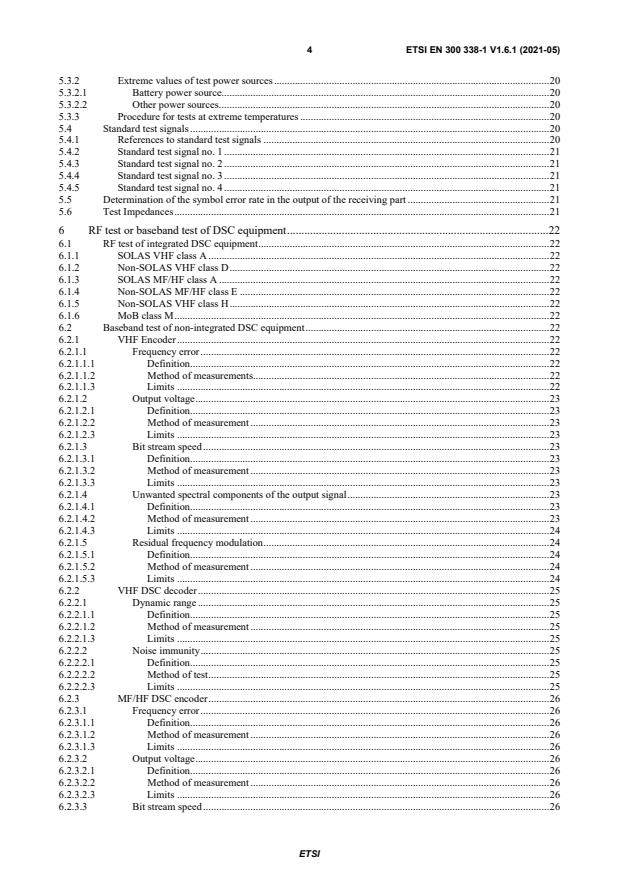
Contents
Intellectual Property Rights . 7
Foreword . 7
Modal verbs terminology . 8
1 Scope . 9
2 References . 10
2.1 Normative references . 10
2.2 Informative references . 11
3 Definition of terms, symbols and abbreviations . 12
3.1 Terms . 12
3.2 Symbols . 13
3.3 Abbreviations . 13
4 General requirements . 14
4.1 General . 14
4.2 Frequencies. 14
4.3 Classes of emission . 15
4.4 Accessibility . 15
4.5 Calibration . 15
4.6 Controls and indicators . 15
4.6.1 General . 15
4.6.2 Markings . 15
4.7 Distress alert activation . 16
4.8 Own MMSI . 16
4.9 Group MMSI . 16
4.10 Own position . 16
4.11 Light sources . 17
4.12 Operation . 17
4.13 Routine testing . 17
4.14 Safety precautions . 17
4.14.1 Excessive current and voltage . 17
4.14.2 Protection . 17
4.14.3 Earthing . 17
4.14.4 Access . 17
4.15 Memory . 18
4.16 Compass safe distance . 18
4.17 Instructions . 18
4.18 Warming-up period . 18
4.18.1 Time . 18
4.18.2 Heaters . 18
4.18.3 Heating circuits . 18
4.19 Selection of signal characteristics . 19
4.20 Automatic/semi-automatic service . 19
4.21 RF power used for DSC signalling . 19
5 Test conditions . 19
5.1 Test conditions, power sources, and ambient temperatures . 19
5.1.1 Normal and extreme test conditions. 19
5.1.2 Test power source . 19
5.2 Normal test conditions . 19
5.2.1 Normal temperature and humidity . 19
5.2.2 Normal power sources . 20
5.2.2.1 Battery power source. 20
5.2.2.2 Other power sources . 20
5.3 Extreme test conditions . 20
5.3.0 General . 20
5.3.1 Extreme temperatures . 20
ETSI
4 ETSI EN 300 338-1 V1.6.1 (2021-05)
5.3.2 Extreme values of test power sources . 20
5.3.2.1 Battery power source. 20
5.3.2.2 Other power sources . 20
5.3.3 Procedure for tests at extreme temperatures . 20
5.4 Standard test signals . 20
5.4.1 References to standard test signals . 20
5.4.2 Standard test signal no. 1 . 21
5.4.3 Standard test signal no. 2 . 21
5.4.4 Standard test signal no. 3 . 21
5.4.5 Standard test signal no. 4 . 21
5.5 Determination of the symbol error rate in the output of the receiving part . 21
5.6 Test Impedances . 21
6 RF test or baseband test of DSC equipment . 22
6.1 RF test of integrated DSC equipment . 22
6.1.1 SOLAS VHF class A . 22
6.1.2 Non-SOLAS VHF class D . 22
6.1.3 SOLAS MF/HF class A . 22
6.1.4 Non-SOLAS MF/HF class E . 22
6.1.5 Non-SOLAS VHF class H . 22
6.1.6 MoB class M . 22
6.2 Baseband test of non-integrated DSC equipment . 22
6.2.1 VHF Encoder . 22
6.2.1.1 Frequency error . 22
6.2.1.1.1 Definition. 22
6.2.1.1.2 Method of measurements. 22
6.2.1.1.3 Limits . 22
6.2.1.2 Output voltage . 23
6.2.1.2.1 Definition. 23
6.2.1.2.2 Method of measurement . 23
6.2.1.2.3 Limits . 23
6.2.1.3 Bit stream speed . 23
6.2.1.3.1 Definition. 23
6.2.1.3.2 Method of measurement . 23
6.2.1.3.3 Limits . 23
6.2.1.4 Unwanted spectral components of the output signal . 23
6.2.1.4.1 Definition. 23
6.2.1.4.2 Method of measurement . 23
6.2.1.4.3 Limits . 24
6.2.1.5 Residual frequency modulation . 24
6.2.1.5.1 Definition. 24
6.2.1.5.2 Method of measurement . 24
6.2.1.5.3 Limits . 24
6.2.2 VHF DSC decoder . 25
6.2.2.1 Dynamic range . 25
6.2.2.1.1 Definition. 25
6.2.2.1.2 Method of measurement . 25
6.2.2.1.3 Limits . 25
6.2.2.2 Noise immunity . 25
6.2.2.2.1 Definition. 25
6.2.2.2.2 Method of test . 25
6.2.2.2.3 Limits . 25
6.2.3 MF/HF DSC encoder . 26
6.2.3.1 Frequency error . 26
6.2.3.1.1 Definition. 26
6.2.3.1.2 Method of measurement . 26
6.2.3.1.3 Limits . 26
6.2.3.2 Output voltage . 26
6.2.3.2.1 Definition. 26
6.2.3.2.2 Method of measurement . 26
6.2.3.2.3 Limits . 26
6.2.3.3 Bit stream speed . 26
ETSI
5 ETSI EN 300 338-1 V1.6.1 (2021-05)
6.2.3.3.1 Definition. 26
6.2.3.3.2 Method of measurement . 26
6.2.3.3.3 Limits . 27
6.2.3.4 Unwanted spectral components of the output signal . 27
6.2.3.4.1 Definition. 27
6.2.3.4.2 Method of measurement . 27
6.2.3.4.3 Limits . 27
6.2.3.5 Residual frequency modulation . 28
6.2.3.5.1 Definition. 28
6.2.3.5.2 Method of measurement . 28
6.2.3.5.3 Limits . 28
6.2.4 MF/HF DSC decoder . 28
6.2.4.1 Interface for scanning . 28
6.2.4.2 Scanning efficiency . 28
6.2.4.2.1 Definition. 28
6.2.4.2.2 Method of measurement . 29
6.2.4.2.3 Limits . 29
6.2.4.3 Dynamic range . 29
6.2.4.3.1 Definition. 29
6.2.4.3.2 Method of measurement . 29
6.2.4.4 Noise Immunity . 29
6.2.4.4.1 Definition. 29
6.2.4.4.2 Method of test . 30
6.2.4.4.3 Limits . 30
7 Environmental tests . 30
7.1 Environmental tests . 30
7.1.1 Introduction. 30
7.1.2 Procedure . 30
7.1.3 Performance check . 30
7.1.4 Vibration test (all classes) . 31
7.1.4.1 Method of measurement . 31
7.1.4.2 Requirement . 31
7.1.5 Temperature tests . 31
7.1.5.1 Dry heat for externally mounted equipment (all classes) . 31
7.1.5.1.1 Method of measurement . 31
7.1.5.1.2 Requirement . 31
7.1.5.2 Damp heat cycle (all classes) . 32
7.1.5.2.1 Method of measurement . 32
7.1.5.2.2 Requirement . 32
7.1.5.3 Low temperature cycle . 32
7.1.5.3.1 Method of measurement for externally mounted equipment (all classes) . 32
7.1.5.3.2 Method of measurement for internally mounted equipment . 32
7.1.5.3.3 Requirement . 32
7.1.6 Corrosion test (class A) . 32
7.1.6.1 General . 32
7.1.6.2 Method of measurement . 33
7.1.6.3 Requirements . 33
7.1.7 Rain test (externally mounted, class A) . 33
7.1.7.1 General . 33
7.1.7.2 Method of measurement . 34
7.1.7.3 Requirements . 34
8 Decoding and error correction . 34
8.1 Reception of DSC messages . 34
8.2 Error handling in the automated procedures . 35
8.2.1 General . 35
8.2.2 Distress automated procedures . 36
8.2.3 Non distress automated procedures . 36
9 Interfaces . 37
9.1 DSC signals input/output: analogue signals . 37
9.2 DSC signals input/output: digital signals . 37
ETSI
6 ETSI EN 300 338-1 V1.6.1 (2021-05)
9.3 Entry of position information . 37
9.4 Interfaces between DSC equipment and external circuits . 37
9.4.1 Operational interfaces . 37
9.4.2 Printer output . 37
9.4.3 Other interfaces . 38
10 Multiple operator positions . 38
10.1 Priority . 38
10.2 Alarms . 38
10.3 Specific functionality . 38
11 Multiple radio installations . 38
12 Channel and frequency coding . 39
12.1 Frequency information in DSC messages . 39
13 Call set-up procedures . 40
Annex A (normative): DSC Message Detection and Decoding . 42
History . 43
ETSI
7 ETSI EN 300 338-1 V1.6.1 (2021-05)
Intellectual Property Rights
Essential patents
IPRs essential or potentially essential to normative deliverables may have been declared to ETSI. The declarations
pertaining to these essential IPRs, if any, are publicly available for ETSI members and non-members, and can be
found in ETSI SR 000 314: "Intellectual Property Rights (IPRs); Essential, or potentially Essential, IPRs notified to
ETSI in respect of ETSI standards", which is available from the ETSI Secretariat. Latest updates are available on the
ETSI Web server (https://ipr.etsi.org/).
Pursuant to the ETSI Directives including the ETSI IPR Policy, no investigation regarding the essentiality of IPRs,
including IPR searches, has been carried out by ETSI. No guarantee can be given as to the existence of other IPRs not
referenced in ETSI SR 000 314 (or the updates on the ETSI Web server) which are, or may be, or may become,
essential to the present document.
Trademarks
The present document may include trademarks and/or tradenames which are asserted and/or registered by their owners.
ETSI claims no ownership of these except for any which are indicated as being the property of ETSI, and conveys no
right to use or reproduce any trademark and/or tradename. Mention of those trademarks in the present document does
not constitute an endorsement by ETSI of products, services or organizations associated with those trademarks.
DECT™, PLUGTESTS™, UMTS™ and the ETSI logo are trademarks of ETSI registered for the benefit of its
Members. 3GPP™ and LTE™ are trademarks of ETSI registered for the benefit of its Members and of the 3GPP
Organizational Partners. oneM2M™ logo is a trademark of ETSI registered for the benefit of its Members and of the ®
oneM2M Partners. GSM and the GSM logo are trademarks registered and owned by the GSM Association.
Foreword
This European Standard (EN) has been produced by ETSI Technical Committee Electromagnetic compatibility and
Radio spectrum Matters (ERM).
The present document is part 1 of a multi-part deliverable covering Digital Selective Calling (DSC), as identified
below:
Part 1: "Common requirements";
Part 2: "Class A DSC";
Part 3: "Class D DSC";
Part 4: "Class E DSC";
Part 5: "Handheld VHF Class H DSC";
Part 6: "Class M DSC";
Part 7: "Interfacing DSC radio equipment to Bridge Alert Management systems (BAM)";
Part 8: "Enabling DSC radio equipment with remote control capabilities".
The present document covers the common requirements for all classes of DSC equipment. Operator interfaces and
operating system details are class specific and will be found in the appropriate part.
ETSI
8 ETSI EN 300 338-1 V1.6.1 (2021-05)
National transposition dates
Date of adoption of this EN: 18 May 2021
Date of latest announcement of this EN (doa): 31 August 2021
Date of latest publication of new National Standard
or endorsement of this EN (dop/e): 28 February 2022
Date of withdrawal of any conflicting National Standard (dow): 28 February 2023
Modal verbs terminology
In the present document "shall", "shall not", "should", "should not", "may", "need not", "will", "will not", "can" and
"cannot" are to be interpreted as described in clause 3.2 of the ETSI Drafting Rules (Verbal forms for the expression of
provisions).
"must" and "must not" are NOT allowed in ETSI deliverables except when used in direct citation.
ETSI
9 ETSI EN 300 338-1 V1.6.1 (2021-05)
1 Scope
The present document states the minimum requirements for equipment to be used for generation, transmission and
reception of Digital Selective Calling (DSC) for use on board ships.
DSC is intended to be used in the Medium Frequency (MF), High Frequency (HF) and Very High Frequency (VHF)
bands of the Maritime Mobile Service (MMS), for distress, urgency and safety communication and general
communications.
The present document is part 1 of a multi-part deliverable that covers the requirements to be fulfilled by:
• DSC equipment integrated with a transmitter and/or a receiver;
• DSC equipment not integrated with a transmitter and/or a receiver.
These requirements include the relevant provisions of the ITU Radio Regulations [i.15] and Recommendations ITU-R
M.493-15 [2], M.541-10 [3], M.689-3 [4] and M.1082-1 [5], the International Convention for the Safety Of Life At Sea
(SOLAS) [i.14], and the following resolutions/circulars of the International Maritime Organization (IMO):
A.694(17) [14], A.803(19) [15] amended by MSC.68(68) Annex 1 [17], A.804(19) [16], MSC.68(68) Annex 2 [17],
A.806(19) [18], MSC.68(68) Annex 3 [17], MSC 302(87) [12] and MSC/Circ.862 [19].
Equipment for generation, transmission and reception of DSC designed according to the following equipment classes:
• Class A: includes all the facilities defined in annex 1 of Recommendation ITU-R M.493-15 [2] and complies
Performance Standards A.803(19) for VHF [15], A.804(19) for MF [16] and A.806(19) for MF/HF equipment
capable of voice and DSC [18].
• Class D: provides minimum facilities for VHF DSC distress, urgency and safety as well as routine calling and
reception as recommended by IMO MSC/Circ.803 [i.2] for non-SOLAS vessels participating in the GMDSS
and defined by Recommendation ITU-R M.493-15 [2].
• Class E: provides minimum facilities for MF and/or HF DSC distress, urgency and safety as well as routine
calling and reception as recommended by IMO MSC/Circ.803 [i.2] for non-SOLAS vessels participating in the
GMDSS and Recommendation ITU-R M.493-15 [2].
• Class H: provides minimum facilities for handheld VHF DSC distress, urgency and safety as well as routine
calling and reception as recommended by IMO MSC/Circ.803 [i.2] for non-SOLAS vessels participating in the
GMDSS and Recommendation ITU-R M.493-15 [2].
• Class M: provides minimum facilities for VHF Man Overboard devices as defined in Recommendation
ITU-R M.493-15 [2].
NOTE 1: Class A equipment may support the optional semi-automatic/automatic service in accordance with
Recommendations ITU-R M.689-3 [4], M.1082-1 [5] and M.493-15 [2], tables A1-4.10.1 and A1-4.10.2
and are encouraged to do so.
NOTE 2: Class D and Class E equipment may also support the optional semi-automatic/automatic service.
NOTE 3: Class D, Class E, Class H should provide a defined list of functions as a closed list for these classes of
equipment is the preferable approach to ensure safe and simple operation. Optional functions should be
avoided, with the intention to provide the same functionality of all equipment of one class.
ETSI
10 ETSI EN 300 338-1 V1.6.1 (2021-05)
2 References
2.1 Normative references
References are either specific (identified by date of publication and/or edition number or version number) or
non-specific. For specific references, only the cited version applies. For non-specific references, the latest version of the
referenced document (including any amendments) applies.
Referenced documents which are not found to be publicly available in the expected location might be found at
https://docbox.etsi.org/Reference/.
NOTE: While any hyperlinks included in this clause were valid at the time of publication, ETSI cannot guarantee
their long term validity.
The following referenced documents are necessary for the application of the present document.
[1] Recommendation ITU-T E.161: "Arrangement of digits, letters and symbols on telephones and
other devices that can be used for gaining access to a telephone network".
[2] Recommendation ITU-R M.493-15 (2019): "Digital selective-calling system for use in the
maritime mobile service".
[3] Recommendation ITU-R M.541-10 (2015): "Operational procedures for the use of digital
selective-calling equipment in the maritime mobile service".
[4] Recommendation ITU-R M.689-3 (2012): "International maritime VHF radiotelephone system
with automatic facilities based on DSC signalling format".
[5] Recommendation ITU-R M.1082-1 (1997): "International maritime MF/HF radiotelephone system
with automatic facilities based on digital selective calling signalling format".
[6] Recommendation ITU-T V.11 (1996): "Electrical characteristics for balanced double-current
interchange circuits operating at data signalling rates up to 10 Mbit/s".
[7] IEC 61162-1:2016: "Maritime navigation and radiocommunication equipment and systems -
Digital interfaces - Part 1: Single talker and multiple listeners".
[8] IEC 61162-2:1998 (Ed. 1.0): "Maritime navigation and radiocommunication equipment and
systems - Digital interfaces - Part 2: Single talker and multiple listeners, high-speed transmission".
[9] IEC 61162-3:2008+AMD1:2010+AMD2:2014 (Ed. 1.2): "Maritime navigation and
radiocommunication equipment and systems - Digital interfaces - Part 3: Serial data instrument
network".
[10] IEC 61162-450:2018: "Maritime navigation and radiocommunication equipment and systems -
Digital interfaces - Part 450: Multiple talkers and multiple listeners - Ethernet interconnection".
[11] Recommendation ITU-R M.1080 (1994): "Digital selective calling system enhancement for
multiple equipment installations".
[12] IMO Resolution MSC.302(87): "Adoption of performance standards for bridge alert
management".
[13] IEC 62923 (parts 1 and 2): "Maritime navigation and radiocommunication equipment and systems
- Bridge alert management".
[14] IMO Resolution A.694(17): "General Requirements for Shipborne Radio Equipment Forming Part
of The Global Maritime Distress and Safety System (GMDSS) and for Electronic Navigational
Aids".
[15] IMO Resolution A.803(19): "Performance Standards for Shipborne VHF Radio Installations
Capable of Voice Communication and Digital Selective Calling".
ETSI
11 ETSI EN 300 338-1 V1.6.1 (2021-05)
[16] IMO Resolution A.804(19): "Performance Standards for Shipborne MF Radio Installations
Capable of Voice Communication and Digital Selective Calling".
[17] IMO Resolution MSC.68(68): "Adoption of Amendments to Performance Standards for Shipborne
Radio Communication Equipment".
[18] IMO Resolution A.806(19): "Performance Standards for Shipborne MF/HF Radio Installations
Capable of Voice Communication, Narrow-Band Direct-Printing and Digital Selective Calling".
[19] IMO Circular MSC 862: "Clarifications of Certain Requirements in IMO Performance Standards
for GMDSS Equipment".
[20] Recommendation ITU-R M.821-1 (1997): "Optional expansion of the digital selective-calling
system for use in the maritime mobile service".
2.2 Informative references
References are either specific (identified by date of publication and/or edition number or version number) or
non-specific. For specific
...
SLOVENSKI STANDARD
01-julij-2021
Tehnične karakteristike in merilne metode za naprave, ki generirajo, oddajajo in
sprejemajo digitalni selektivni klic (DSC) v pomorski mobilni storitvi, ki deluje v
območju MF, MF/HF oziroma VHF - 1. del: Splošne zahteve
Technical characteristics and methods of measurement for equipment for generation,
transmission and reception of Digital Selective Calling (DSC) in the maritime MF, MF/HF
and/or VHF mobile service - Part 1: Common requirements
Ta slovenski standard je istoveten z: ETSI EN 300 338-1 V1.6.1 (2021-05)
ICS:
33.060.20 Sprejemna in oddajna Receiving and transmitting
oprema equipment
47.020.70 Navigacijska in krmilna Navigation and control
oprema equipment
2003-01.Slovenski inštitut za standardizacijo. Razmnoževanje celote ali delov tega standarda ni dovoljeno.
EUROPEAN STANDARD
Technical characteristics and methods of measurement
for equipment for generation, transmission
and reception of Digital Selective Calling (DSC)
in the maritime MF, MF/HF and/or VHF mobile service;
Part 1: Common requirements
2 ETSI EN 300 338-1 V1.6.1 (2021-05)
Reference
REN/ERM-TGMAR-610
Keywords
DSC, GMDSS, maritime, radio
ETSI
650 Route des Lucioles
F-06921 Sophia Antipolis Cedex - FRANCE
Tel.: +33 4 92 94 42 00 Fax: +33 4 93 65 47 16
Siret N° 348 623 562 00017 - APE 7112B
Association à but non lucratif enregistrée à la
Sous-Préfecture de Grasse (06) N° w061004871
Important notice
The present document can be downloaded from:
http://www.etsi.org/standards-search
The present document may be made available in electronic versions and/or in print. The content of any electronic and/or
print versions of the present document shall not be modified without the prior written authorization of ETSI. In case of any
existing or perceived difference in contents between such versions and/or in print, the prevailing version of an ETSI
deliverable is the one made publicly available in PDF format at www.etsi.org/deliver.
Users of the present document should be aware that the document may be subject to revision or change of status.
Information on the current status of this and other ETSI documents is available at
https://portal.etsi.org/TB/ETSIDeliverableStatus.aspx
If you find errors in the present document, please send your comment to one of the following services:
https://portal.etsi.org/People/CommiteeSupportStaff.aspx
Notice of disclaimer & limitation of liability
The information provided in the present deliverable is directed solely to professionals who have the appropriate degree of
experience to understand and interpret its content in accordance with generally accepted engineering or
other professional standard and applicable regulations.
No recommendation as to products and services or vendors is made or should be implied.
In no event shall ETSI be held liable for loss of profits or any other incidental or consequential damages.
Any software contained in this deliverable is provided "AS IS" with no warranties, express or implied, including but not
limited to, the warranties of merchantability, fitness for a particular purpose and non-infringement of intellectual property
rights and ETSI shall not be held liable in any event for any damages whatsoever (including, without limitation, damages
for loss of profits, business interruption, loss of information, or any other pecuniary loss) arising out of or related to the use
of or inability to use the software.
Copyright Notification
No part may be reproduced or utilized in any form or by any means, electronic or mechanical, including photocopying and
microfilm except as authorized by written permission of ETSI.
The content of the PDF version shall not be modified without the written authorization of ETSI.
The copyright and the foregoing restriction extend to reproduction in all media.
© ETSI 2021.
All rights reserved.
ETSI
3 ETSI EN 300 338-1 V1.6.1 (2021-05)
Contents
Intellectual Property Rights . 7
Foreword . 7
Modal verbs terminology . 8
1 Scope . 9
2 References . 10
2.1 Normative references . 10
2.2 Informative references . 11
3 Definition of terms, symbols and abbreviations . 12
3.1 Terms . 12
3.2 Symbols . 13
3.3 Abbreviations . 13
4 General requirements . 14
4.1 General . 14
4.2 Frequencies. 14
4.3 Classes of emission . 15
4.4 Accessibility . 15
4.5 Calibration . 15
4.6 Controls and indicators . 15
4.6.1 General . 15
4.6.2 Markings . 15
4.7 Distress alert activation . 16
4.8 Own MMSI . 16
4.9 Group MMSI . 16
4.10 Own position . 16
4.11 Light sources . 17
4.12 Operation . 17
4.13 Routine testing . 17
4.14 Safety precautions . 17
4.14.1 Excessive current and voltage . 17
4.14.2 Protection . 17
4.14.3 Earthing . 17
4.14.4 Access . 17
4.15 Memory . 18
4.16 Compass safe distance . 18
4.17 Instructions . 18
4.18 Warming-up period . 18
4.18.1 Time . 18
4.18.2 Heaters . 18
4.18.3 Heating circuits . 18
4.19 Selection of signal characteristics . 19
4.20 Automatic/semi-automatic service . 19
4.21 RF power used for DSC signalling . 19
5 Test conditions . 19
5.1 Test conditions, power sources, and ambient temperatures . 19
5.1.1 Normal and extreme test conditions. 19
5.1.2 Test power source . 19
5.2 Normal test conditions . 19
5.2.1 Normal temperature and humidity . 19
5.2.2 Normal power sources . 20
5.2.2.1 Battery power source. 20
5.2.2.2 Other power sources . 20
5.3 Extreme test conditions . 20
5.3.0 General . 20
5.3.1 Extreme temperatures . 20
ETSI
4 ETSI EN 300 338-1 V1.6.1 (2021-05)
5.3.2 Extreme values of test power sources . 20
5.3.2.1 Battery power source. 20
5.3.2.2 Other power sources . 20
5.3.3 Procedure for tests at extreme temperatures . 20
5.4 Standard test signals . 20
5.4.1 References to standard test signals . 20
5.4.2 Standard test signal no. 1 . 21
5.4.3 Standard test signal no. 2 . 21
5.4.4 Standard test signal no. 3 . 21
5.4.5 Standard test signal no. 4 . 21
5.5 Determination of the symbol error rate in the output of the receiving part . 21
5.6 Test Impedances . 21
6 RF test or baseband test of DSC equipment . 22
6.1 RF test of integrated DSC equipment . 22
6.1.1 SOLAS VHF class A . 22
6.1.2 Non-SOLAS VHF class D . 22
6.1.3 SOLAS MF/HF class A . 22
6.1.4 Non-SOLAS MF/HF class E . 22
6.1.5 Non-SOLAS VHF class H . 22
6.1.6 MoB class M . 22
6.2 Baseband test of non-integrated DSC equipment . 22
6.2.1 VHF Encoder . 22
6.2.1.1 Frequency error . 22
6.2.1.1.1 Definition. 22
6.2.1.1.2 Method of measurements. 22
6.2.1.1.3 Limits . 22
6.2.1.2 Output voltage . 23
6.2.1.2.1 Definition. 23
6.2.1.2.2 Method of measurement . 23
6.2.1.2.3 Limits . 23
6.2.1.3 Bit stream speed . 23
6.2.1.3.1 Definition. 23
6.2.1.3.2 Method of measurement . 23
6.2.1.3.3 Limits . 23
6.2.1.4 Unwanted spectral components of the output signal . 23
6.2.1.4.1 Definition. 23
6.2.1.4.2 Method of measurement . 23
6.2.1.4.3 Limits . 24
6.2.1.5 Residual frequency modulation . 24
6.2.1.5.1 Definition. 24
6.2.1.5.2 Method of measurement . 24
6.2.1.5.3 Limits . 24
6.2.2 VHF DSC decoder . 25
6.2.2.1 Dynamic range . 25
6.2.2.1.1 Definition. 25
6.2.2.1.2 Method of measurement . 25
6.2.2.1.3 Limits . 25
6.2.2.2 Noise immunity . 25
6.2.2.2.1 Definition. 25
6.2.2.2.2 Method of test . 25
6.2.2.2.3 Limits . 25
6.2.3 MF/HF DSC encoder . 26
6.2.3.1 Frequency error . 26
6.2.3.1.1 Definition. 26
6.2.3.1.2 Method of measurement . 26
6.2.3.1.3 Limits . 26
6.2.3.2 Output voltage . 26
6.2.3.2.1 Definition. 26
6.2.3.2.2 Method of measurement . 26
6.2.3.2.3 Limits . 26
6.2.3.3 Bit stream speed . 26
ETSI
5 ETSI EN 300 338-1 V1.6.1 (2021-05)
6.2.3.3.1 Definition. 26
6.2.3.3.2 Method of measurement . 26
6.2.3.3.3 Limits . 27
6.2.3.4 Unwanted spectral components of the output signal . 27
6.2.3.4.1 Definition. 27
6.2.3.4.2 Method of measurement . 27
6.2.3.4.3 Limits . 27
6.2.3.5 Residual frequency modulation . 28
6.2.3.5.1 Definition. 28
6.2.3.5.2 Method of measurement . 28
6.2.3.5.3 Limits . 28
6.2.4 MF/HF DSC decoder . 28
6.2.4.1 Interface for scanning . 28
6.2.4.2 Scanning efficiency . 28
6.2.4.2.1 Definition. 28
6.2.4.2.2 Method of measurement . 29
6.2.4.2.3 Limits . 29
6.2.4.3 Dynamic range . 29
6.2.4.3.1 Definition. 29
6.2.4.3.2 Method of measurement . 29
6.2.4.4 Noise Immunity . 29
6.2.4.4.1 Definition. 29
6.2.4.4.2 Method of test . 30
6.2.4.4.3 Limits . 30
7 Environmental tests . 30
7.1 Environmental tests . 30
7.1.1 Introduction. 30
7.1.2 Procedure . 30
7.1.3 Performance check . 30
7.1.4 Vibration test (all classes) . 31
7.1.4.1 Method of measurement . 31
7.1.4.2 Requirement . 31
7.1.5 Temperature tests . 31
7.1.5.1 Dry heat for externally mounted equipment (all classes) . 31
7.1.5.1.1 Method of measurement . 31
7.1.5.1.2 Requirement . 31
7.1.5.2 Damp heat cycle (all classes) . 32
7.1.5.2.1 Method of measurement . 32
7.1.5.2.2 Requirement . 32
7.1.5.3 Low temperature cycle . 32
7.1.5.3.1 Method of measurement for externally mounted equipment (all classes) . 32
7.1.5.3.2 Method of measurement for internally mounted equipment . 32
7.1.5.3.3 Requirement . 32
7.1.6 Corrosion test (class A) . 32
7.1.6.1 General . 32
7.1.6.2 Method of measurement . 33
7.1.6.3 Requirements . 33
7.1.7 Rain test (externally mounted, class A) . 33
7.1.7.1 General . 33
7.1.7.2 Method of measurement . 34
7.1.7.3 Requirements . 34
8 Decoding and error correction . 34
8.1 Reception of DSC messages . 34
8.2 Error handling in the automated procedures . 35
8.2.1 General . 35
8.2.2 Distress automated procedures . 36
8.2.3 Non distress automated procedures . 36
9 Interfaces . 37
9.1 DSC signals input/output: analogue signals . 37
9.2 DSC signals input/output: digital signals . 37
ETSI
6 ETSI EN 300 338-1 V1.6.1 (2021-05)
9.3 Entry of position information . 37
9.4 Interfaces between DSC equipment and external circuits . 37
9.4.1 Operational interfaces . 37
9.4.2 Printer output . 37
9.4.3 Other interfaces . 38
10 Multiple operator positions . 38
10.1 Priority . 38
10.2 Alarms . 38
10.3 Specific functionality . 38
11 Multiple radio installations . 38
12 Channel and frequency coding . 39
12.1 Frequency information in DSC messages . 39
13 Call set-up procedures . 40
Annex A (normative): DSC Message Detection and Decoding . 42
History . 43
ETSI
7 ETSI EN 300 338-1 V1.6.1 (2021-05)
Intellectual Property Rights
Essential patents
IPRs essential or potentially essential to normative deliverables may have been declared to ETSI. The declarations
pertaining to these essential IPRs, if any, are publicly available for ETSI members and non-members, and can be
found in ETSI SR 000 314: "Intellectual Property Rights (IPRs); Essential, or potentially Essential, IPRs notified to
ETSI in respect of ETSI standards", which is available from the ETSI Secretariat. Latest updates are available on the
ETSI Web server (https://ipr.etsi.org/).
Pursuant to the ETSI Directives including the ETSI IPR Policy, no investigation regarding the essentiality of IPRs,
including IPR searches, has been carried out by ETSI. No guarantee can be given as to the existence of other IPRs not
referenced in ETSI SR 000 314 (or the updates on the ETSI Web server) which are, or may be, or may become,
essential to the present document.
Trademarks
The present document may include trademarks and/or tradenames which are asserted and/or registered by their owners.
ETSI claims no ownership of these except for any which are indicated as being the property of ETSI, and conveys no
right to use or reproduce any trademark and/or tradename. Mention of those trademarks in the present document does
not constitute an endorsement by ETSI of products, services or organizations associated with those trademarks.
DECT™, PLUGTESTS™, UMTS™ and the ETSI logo are trademarks of ETSI registered for the benefit of its
Members. 3GPP™ and LTE™ are trademarks of ETSI registered for the benefit of its Members and of the 3GPP
Organizational Partners. oneM2M™ logo is a trademark of ETSI registered for the benefit of its Members and of the ®
oneM2M Partners. GSM and the GSM logo are trademarks registered and owned by the GSM Association.
Foreword
This European Standard (EN) has been produced by ETSI Technical Committee Electromagnetic compatibility and
Radio spectrum Matters (ERM).
The present document is part 1 of a multi-part deliverable covering Digital Selective Calling (DSC), as identified
below:
Part 1: "Common requirements";
Part 2: "Class A DSC";
Part 3: "Class D DSC";
Part 4: "Class E DSC";
Part 5: "Handheld VHF Class H DSC";
Part 6: "Class M DSC";
Part 7: "Interfacing DSC radio equipment to Bridge Alert Management systems (BAM)";
Part 8: "Enabling DSC radio equipment with remote control capabilities".
The present document covers the common requirements for all classes of DSC equipment. Operator interfaces and
operating system details are class specific and will be found in the appropriate part.
ETSI
8 ETSI EN 300 338-1 V1.6.1 (2021-05)
National transposition dates
Date of adoption of this EN: 18 May 2021
Date of latest announcement of this EN (doa): 31 August 2021
Date of latest publication of new National Standard
or endorsement of this EN (dop/e): 28 February 2022
Date of withdrawal of any conflicting National Standard (dow): 28 February 2023
Modal verbs terminology
In the present document "shall", "shall not", "should", "should not", "may", "need not", "will", "will not", "can" and
"cannot" are to be interpreted as described in clause 3.2 of the ETSI Drafting Rules (Verbal forms for the expression of
provisions).
"must" and "must not" are NOT allowed in ETSI deliverables except when used in direct citation.
ETSI
9 ETSI EN 300 338-1 V1.6.1 (2021-05)
1 Scope
The present document states the minimum requirements for equipment to be used for generation, transmission and
reception of Digital Selective Calling (DSC) for use on board ships.
DSC is intended to be used in the Medium Frequency (MF), High Frequency (HF) and Very High Frequency (VHF)
bands of the Maritime Mobile Service (MMS), for distress, urgency and safety communication and general
communications.
The present document is part 1 of a multi-part deliverable that covers the requirements to be fulfilled by:
• DSC equipment integrated with a transmitter and/or a receiver;
• DSC equipment not integrated with a transmitter and/or a receiver.
These requirements include the relevant provisions of the ITU Radio Regulations [i.15] and Recommendations ITU-R
M.493-15 [2], M.541-10 [3], M.689-3 [4] and M.1082-1 [5], the International Convention for the Safety Of Life At Sea
(SOLAS) [i.14], and the following resolutions/circulars of the International Maritime Organization (IMO):
A.694(17) [14], A.803(19) [15] amended by MSC.68(68) Annex 1 [17], A.804(19) [16], MSC.68(68) Annex 2 [17],
A.806(19) [18], MSC.68(68) Annex 3 [17], MSC 302(87) [12] and MSC/Circ.862 [19].
Equipment for generation, transmission and reception of DSC designed according to the following equipment classes:
• Class A: includes all the facilities defined in annex 1 of Recommendation ITU-R M.493-15 [2] and complies
Performance Standards A.803(19) for VHF [15], A.804(19) for MF [16] and A.806(19) for MF/HF equipment
capable of voice and DSC [18].
• Class D: provides minimum facilities for VHF DSC distress, urgency and safety as well as routine calling and
reception as recommended by IMO MSC/Circ.803 [i.2] for non-SOLAS vessels participating in the GMDSS
and defined by Recommendation ITU-R M.493-15 [2].
• Class E: provides minimum facilities for MF and/or HF DSC distress, urgency and safety as well as routine
calling and reception as recommended by IMO MSC/Circ.803 [i.2] for non-SOLAS vessels participating in the
GMDSS and Recommendation ITU-R M.493-15 [2].
• Class H: provides minimum facilities for handheld VHF DSC distress, urgency and safety as well as routine
calling and reception as recommended by IMO MSC/Circ.803 [i.2] for non-SOLAS vessels participating in the
GMDSS and Recommendation ITU-R M.493-15 [2].
• Class M: provides minimum facilities for VHF Man Overboard devices as defined in Recommendation
ITU-R M.493-15 [2].
NOTE 1: Class A equipment may support the optional semi-automatic/automatic service in accordance with
Recommendations ITU-R M.689-3 [4], M.1082-1 [5] and M.493-15 [2], tables A1-4.10.1 and A1-4.10.2
and are encouraged to do so.
NOTE 2: Class D and Class E equipment may also support the optional semi-automatic/automatic service.
NOTE 3: Class D, Class E, Class H should provide a defined list of functions as a closed list for these classes of
equipment is the preferable approach to ensure safe and simple operation. Optional functions should be
avoided, with the intention to provide the same functionality of all equipment of one class.
ETSI
10 ETSI EN 300 338-1 V1.6.1 (2021-05)
2 References
2.1 Normative references
References are either specific (identified by date of publication and/or edition number or version number) or
non-specific. For specific references, only the cited version applies. For non-specific references, the latest version of the
referenced document (including any amendments) applies.
Referenced documents which are not found to be publicly available in the expected location might be found at
https://docbox.etsi.org/Reference/.
NOTE: While any hyperlinks included in this clause were valid at the time of publication, ETSI cannot guarantee
their long term validity.
The following referenced documents are necessary for the application of the present document.
[1] Recommendation ITU-T E.161: "Arrangement of digits, letters and symbols on telephones and
other devices that can be used for gaining access to a telephone network".
[2] Recommendation ITU-R M.493-15 (2019): "Digital selective-calling system for use in the
maritime mobile service".
[3] Recommendation ITU-R M.541-10 (2015): "Operational procedures for the use of digital
selective-calling equipment in the maritime mobile service".
[4] Recommendation ITU-R M.689-3 (2012): "International maritime VHF radiotelephone system
with automatic facilities based on DSC signalling format".
[5] Recommendation ITU-R M.1082-1 (1997): "International maritime MF/HF radiotelephone system
with automatic facilities based on digital selective calling signalling format".
[6] Recommendation ITU-T V.11 (1996): "Electrical characteristics for balanced double-current
interchange circuits operating at data signalling rates up to 10 Mbit/s".
[7] IEC 61162-1:2016: "Maritime navigation and radiocommunication equipment and systems -
Digital interfaces - Part 1: Single talker and multiple listeners".
[8] IEC 61162-2:1998 (Ed. 1.0): "Maritime navigation and radiocommunication equipment and
systems - Digital interfaces - Part 2: Single talker and multiple listeners, high-speed transmission".
[9] IEC 61162-3:2008+AMD1:2010+AMD2:2014 (Ed. 1.2): "Maritime navigation and
radiocommunication equipment and systems - Digital interfaces - Part 3: Serial data instrument
network".
[10] IEC 61162-450:2018: "Maritime navigation and radiocommunication equipment and systems -
Digital interfaces - Part 450: Multiple talkers and multiple listeners - Ethernet interconnection".
[11] Recommendation ITU-R M.1080 (1994): "Digital selective calling system enhancement for
multiple equipment installations".
[12] IMO Resolution MSC.302(87): "Adoption of performance standards for bridge alert
management".
[13] IEC 62923 (parts 1 and 2): "Maritime navigation and radiocommunication equipment and systems
- Bridge alert management".
...