

kSIST FprEN 17766:2026
(Main)Organic and organo-mineral fertilizers - Extraction by water for subsequent determination of elements
- Abstract
This document specifies the procedure for extraction of different organic and organo-mineral fertilizers with water to enable a subsequent determination of boron (B), cobalt (Co), copper (Cu), iron (Fe), manganese (Mn), molybdenum (Mo), phosphorous (P) and zinc (Zn).
NOTE Extracts prepared by the procedure given in this document can also be applied for determination of other elements.
This document is applicable to the fertilizing products blends where a blend is a mix of at least two of the following components: fertilizers, liming materials, soil improvers, growing media, inhibitors, plant biostimulants, and where the following category: organic fertilizers, organo-mineral fertilizers is the highest % in the blend by mass or volume, or in the case of liquid form by dry mass. If the organic fertilizer or the organo-mineral fertilizer is not the highest % in the blend, the European Standard for the highest % of the blend applies. In case a fertilizing product blend is composed of components in equal quantity, the user decides which standard to apply. Variations in analytical methods for fertilizing product blends can lead to differing results as some components or matrix interactions can affect the outcome. Validation procedures have shown that developed standard methods are robust and reliable across diverse product compositions, but possible interferences and unexpected results when analysing fertilizing product blends are possible.
- Status
- Not Published
- Public Enquiry End Date
- 01-Mar-2026
- Technical Committee
- KAT - Soil quality
- Current Stage
- 5020 - Formal vote (FV) (Adopted Project)
- Start Date
- 17-Nov-2026
- Due Date
- 05-Jan-2027

kSIST FprEN 17766:2026 is a draft European standard published by SIST for extracting organic and organo-mineral fertilizers with water before measuring selected elements. It specifies a laboratory extraction procedure for boron (B), cobalt (Co), copper (Cu), iron (Fe), manganese (Mn), molybdenum (Mo), phosphorous (P) and zinc (Zn), and it is written for laboratories and others who need comparable analytical results from these products.
What does kSIST FprEN 17766:2026 specify?
kSIST FprEN 17766:2026 specifies how to prepare a water extract from different organic and organo-mineral fertilizers so the extract can be used for later element determination. The document also sets the application limits for fertilizing product blends and gives the structure of the method from principle through reporting.
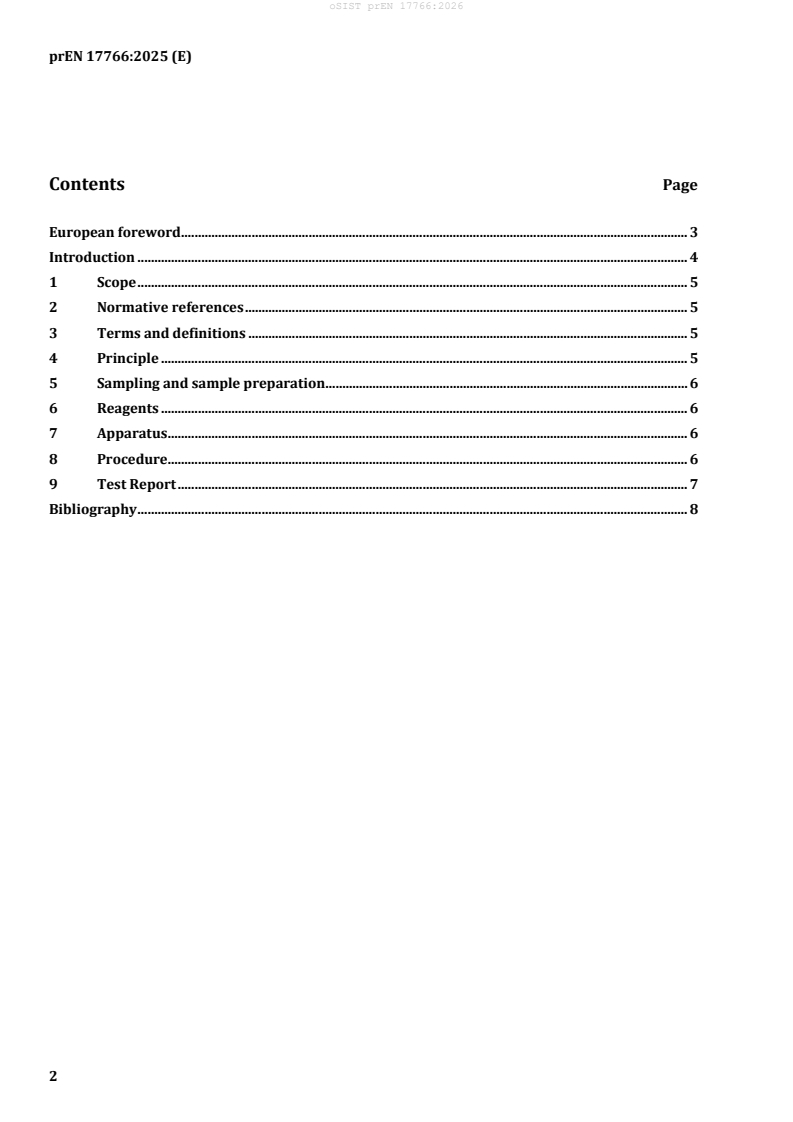
The document is organized into these main parts: Scope, Normative references, Terms and definitions, Principle, Sampling and sample preparation, Reagents, Apparatus, Procedure, and Test report. That structure matters because the standard separates the extraction step from sampling, from the analytical measurement, and from reporting.
What are the key requirements of kSIST FprEN 17766:2026?
Clause 1 limits the method to the right product type. kSIST FprEN 17766:2026 applies to organic and organo-mineral fertilizers, and to fertilizing product blends only when that category is the highest share by mass or volume, or by dry mass for liquids. In practice, the user must first decide which standard fits the dominant component of a blend.
Clause 4 defines the extraction principle. The elements are extracted by shaking the sample with water under specified conditions, and the extract is then analysed according to prEN 17774. This means the standard covers sample preparation for analysis, not the final measurement itself.
Clause 5 requires representative sampling and proper sample preparation. Sampling is outside this method, but the sample must represent the product and must not have been altered during transport or storage. Sample preparation is carried out in accordance with EN 1482-2, so the lab needs a fit-for-purpose prepared test portion.
Clause 6 sets the water and acid requirements. The extraction water must have low conductivity and be free from the elements to be determined, and nitric acid is specified for later acidification if storage is extended. In practice, this reduces contamination and helps keep stored extracts stable.
Clause 7 focuses on clean equipment and boron control. The method uses a shaker, extraction vessels, ash-free filter paper, and clean laboratory glassware or plastic ware. For boron, the document specifically warns to minimize contact with borosilicate glassware, which matters because glass can contaminate boron results.
Clause 8 gives the working extraction procedure. A prepared sample is weighed, mixed with water at 20 ± 2 °C, shaken for 60 minutes, and filtered if needed. The same section also covers the blank test, same-day analysis, short refrigerated storage, and acidification for longer storage.
Clause 9 defines what must go into the test report. The report must identify the sample, state the method used, record the sampling date if known, give the extraction completion date, and note any optional details or incidents. This helps users trace results and understand anything that may have influenced them.
What terms does kSIST FprEN 17766:2026 define?
Organic fertilizers - In this document’s context, these are fertilizers covered by the method when they are the main component of the product or blend.
Organo-mineral fertilizers - These are mixed fertilizers with both organic and mineral characteristics, and they are one of the main product categories the method addresses.
Fertilizing product blends - This means a mix of at least two components such as fertilizers, liming materials, soil improvers, growing media, inhibitors, and plant biostimulants.
Inductively coupled plasma atomic emission spectrometry (ICP-AES) - This is the measurement technique named in the introduction for analysing the extracted elements after water extraction.
Blank test solution - This is a control solution prepared by the same procedure as the sample, used to check contamination from reagents, vessels, or handling.
Who uses kSIST FprEN 17766:2026?
kSIST FprEN 17766:2026 is used by laboratory analysts who determine trace and nutrient elements in fertilizer extracts. It is also relevant to fertilizer manufacturers, quality control teams, contract testing laboratories, and buyers who need comparable analytical data for organic and organo-mineral fertilizers or fertilizer blends.
The document is especially useful when a lab must prepare an extract for later instrumental analysis and needs a repeatable extraction step that can be cited in a test report. It also supports method selection when a product blend may fall under more than one fertilizer standard.
What changed in kSIST FprEN 17766:2026 from the previous edition?
Compared with CEN/TS 17766:2022, this draft adopts the technical specification as a European Standard. It also adds an introduction, clarifies the scope for fertilizing product blends and method selection, adds nitric acid to the reagents, gives more detail on apparatus and glassware quality, expands the procedure, and updates the bibliography.
Which standards are used with kSIST FprEN 17766:2026?
| Standard | What it contributes |
|---|---|
| EN 12944-1 | General fertilizer and liming material vocabulary |
| EN 12944-2 | Terms relating specifically to fertilizers |
| EN 1482-2 | General sample preparation provisions |
| EN 1482-1 | Recommended general sampling method |
| EN 1482-3 | Sampling of static heaps |
| prEN 17774 | The determination step after extraction, using ICP-AES |
What does the kSIST FprEN 17766:2026 document contain?
The document contains the extraction principle, the sample handling and preparation requirements, the reagent and apparatus specifications, and a step-by-step extraction procedure. It gives the operating conditions that matter most in practice, including sample mass, water volume, temperature, shaking time, filtration, blank preparation, and short-term extract storage.
It also sets out the minimum test report content so the extraction can be documented consistently. The bibliography points to the related sampling and measurement standards used with this method.
Relations
- Effective Date
- 01-Feb-2026
Get Certified
Connect with accredited certification bodies for this standard

Control Union Certifications
Global certification for agriculture and sustainability.

ECOCERT
Organic and sustainability certification.

FSC International
Forest Stewardship Council certification.
Sponsored listings
Frequently Asked Questions
kSIST FprEN 17766:2026 is a draft published by the Slovenian Institute for Standardization (SIST). Its full title is "Organic and organo-mineral fertilizers - Extraction by water for subsequent determination of elements". This standard covers: This document specifies the procedure for extraction of different organic and organo-mineral fertilizers with water to enable a subsequent determination of boron (B), cobalt (Co), copper (Cu), iron (Fe), manganese (Mn), molybdenum (Mo), phosphorous (P) and zinc (Zn). NOTE Extracts prepared by the procedure given in this document can also be applied for determination of other elements. This document is applicable to the fertilizing products blends where a blend is a mix of at least two of the following components: fertilizers, liming materials, soil improvers, growing media, inhibitors, plant biostimulants, and where the following category: organic fertilizers, organo-mineral fertilizers is the highest % in the blend by mass or volume, or in the case of liquid form by dry mass. If the organic fertilizer or the organo-mineral fertilizer is not the highest % in the blend, the European Standard for the highest % of the blend applies. In case a fertilizing product blend is composed of components in equal quantity, the user decides which standard to apply. Variations in analytical methods for fertilizing product blends can lead to differing results as some components or matrix interactions can affect the outcome. Validation procedures have shown that developed standard methods are robust and reliable across diverse product compositions, but possible interferences and unexpected results when analysing fertilizing product blends are possible.
This document specifies the procedure for extraction of different organic and organo-mineral fertilizers with water to enable a subsequent determination of boron (B), cobalt (Co), copper (Cu), iron (Fe), manganese (Mn), molybdenum (Mo), phosphorous (P) and zinc (Zn). NOTE Extracts prepared by the procedure given in this document can also be applied for determination of other elements. This document is applicable to the fertilizing products blends where a blend is a mix of at least two of the following components: fertilizers, liming materials, soil improvers, growing media, inhibitors, plant biostimulants, and where the following category: organic fertilizers, organo-mineral fertilizers is the highest % in the blend by mass or volume, or in the case of liquid form by dry mass. If the organic fertilizer or the organo-mineral fertilizer is not the highest % in the blend, the European Standard for the highest % of the blend applies. In case a fertilizing product blend is composed of components in equal quantity, the user decides which standard to apply. Variations in analytical methods for fertilizing product blends can lead to differing results as some components or matrix interactions can affect the outcome. Validation procedures have shown that developed standard methods are robust and reliable across diverse product compositions, but possible interferences and unexpected results when analysing fertilizing product blends are possible.
kSIST FprEN 17766:2026 is classified under the following ICS (International Classification for Standards) categories: 65.080 - Fertilizers. The ICS classification helps identify the subject area and facilitates finding related standards.
kSIST FprEN 17766:2026 has the following relationships with other standards: It is inter standard links to SIST-TS CEN/TS 17766:2023. Understanding these relationships helps ensure you are using the most current and applicable version of the standard.
kSIST FprEN 17766:2026 is associated with the following European legislation: EU Directives/Regulations: 2019/1009; Standardization Mandates: M/564. When a standard is cited in the Official Journal of the European Union, products manufactured in conformity with it benefit from a presumption of conformity with the essential requirements of the corresponding EU directive or regulation.
kSIST FprEN 17766:2026 is available in PDF format for immediate download after purchase. The document can be added to your cart and obtained through the secure checkout process. Digital delivery ensures instant access to the complete standard document.
Standards Content (Sample)
Contents
- Introduction
- 1 Scope
- 2 Normative references
- 3 Terms and definitions
- 4 Principle
- 5 Sampling and sample preparation
- 6 Reagents
- 7 Apparatus
- 7.4 Common laboratory glassware
- 8 Procedure
- 9 Test report
- Bibliography
Introduction
Water is applied to extract available fraction of micronutrients from different matrices for their subsequent determination by inductively coupled plasma atomic emission spectrometry (ICP-AES). A similar procedure was applied for extraction of micronutrients from mineral fertilizers [2]. WARNING — Persons using this document should be familiar with usual laboratory practice. This document does not purport to address all of the safety issues, if any, associated with its use. It is the responsibility of the user to establish appropriate health and safety practices and to ensure compliance with any national regulatory conditions.
IMPORTANT — It is absolutely essential that tests conducted according to this document are carried out by suitably trained staff.
oSIST prEN 17766:2026 prEN 17766:2025 (E)
1 Scope
This document specifies the procedure for extraction of different organic and organo-mineral fertilizers with water to enable a subsequent determination of boron (B), cobalt (Co), copper (Cu), iron (Fe), manganese (Mn), molybdenum (Mo), phosphorous (P) and zinc (Zn). NOTE Extracts prepared by the procedure given in this document can also be applied for determination of other elements.
This document is applicable to the fertilizing products blends where a blend is a mix of at least two of the following components: fertilizers, liming materials, soil improvers, growing media, inhibitors, plant biostimulants, and where the following category: organic fertilizers, organo-mineral fertilizers is the highest % in the blend by mass or volume, or in the case of liquid form by dry mass. If the organic fertilizer or the organo-mineral fertilizer is not the highest % in the blend, the European Standard for the highest % of the blend applies. In case a fertilizing product blend is composed of components in equal quantity, the user decides which standard to apply. Variations in analytical methods for fertilizing product blends can lead to differing results as some components or matrix interactions can affect the outcome. Validation procedures have shown that developed standard methods are robust and reliable across diverse product compositions, but possible interferences and unexpected results when analysing fertilizing product blends are possible.
...