

SIST EN ISO 13144:2026
(Main)Textiles - Determination of quinoline, isoquinoline and certain derivatives (ISO 13144:2025)
General Information
- Abstract
This document specifies a method for the qualification and quantification of certain quinoline derivatives in textile products by means of extraction with methanol and gas chromatography with mass selective detector or liquid chromatography with mass selective detector.
The method is applicable to all kinds of textile products consisting of natural or artificially dyed textile fibres and fabrics. It is further applicable to dyestuff powder used as textile auxiliary for dyeing and printing.
- Status
- Published
- Public Enquiry End Date
- 29-Apr-2025
- Publication Date
- 13-Jan-2026
- Technical Committee
- ITEK - Textile and textile products
- Current Stage
- 6060 - National Implementation/Publication (Adopted Project)
- Start Date
- 05-Jan-2026
- Due Date
- 12-Mar-2026
- Completion Date
- 14-Jan-2026

Overview
SIST EN ISO 13144:2026 - Textiles - Determination of quinoline, isoquinoline and certain derivatives (ISO 13144:2025) - is an international standard that outlines a reliable method for the determination of quinoline, isoquinoline, and selected derivatives in textile products. The standard, issued by the Slovenski inštitut za standardizacijo (SIST), details procedures involving extraction with methanol and subsequent analysis using gas chromatography with mass selective detectors (GC-MS, GC-MS/MS) or liquid chromatography with mass selective detectors (LC-MS, LC-MS/MS).
This method is applicable to a broad range of textile products, including all natural or dyed textile fibers and fabrics, as well as dyestuff powders used for dyeing and printing. The standard is critical for ensuring textile safety by monitoring potentially harmful substances, supporting regulatory compliance and consumer protection.
Key Topics
- Target Compounds: Focuses on the determination of quinoline, isoquinoline, and a defined set of their derivatives in textiles, due to their recognized toxicity and regulatory restrictions, especially in the European Union.
- Scope of Application: Encompasses textiles made of natural or synthetic fibers, dyed or printed textiles, and dyestuffs in powder form.
- Analytical Technique:
- Extraction of analytes from test specimens using methanol and ultrasonic baths.
- Detection and quantification using GC-MS, GC-MS/MS, LC-MS, or LC-MS/MS techniques.
- Preparation of calibration curves and quantification of compounds at low concentration levels, supporting compliance with stringent regulations.
- Safety Notice: The standard includes warnings about safe handling of hazardous substances inherent to both textile samples and reagents used in the testing process.
Applications
Implementing SIST EN ISO 13144:2026 brings several practical benefits to industry stakeholders:
- Regulatory Compliance: Helps manufacturers, importers, and retailers of textiles demonstrate adherence to European and international legislation concerning carcinogenic substances in consumer products (e.g., REACH regulations).
- Consumer Safety: Protects end-users by ensuring textiles are free from harmful concentrations of quinoline and its derivatives, which can be carcinogenic or pose ecological risks.
- Quality Assurance: Assists laboratories and quality control teams in establishing robust, standardized analytical protocols for consistent detection of regulated substances in a range of textile products.
- Trade Facilitation: Ensures that textiles can enter markets with strict chemical safety standards, supporting international trade and reducing barriers related to product safety and certification.
- Environmental Protection: Indirectly supports reduction of harmful chemical residues released into water systems during textile manufacturing processes.
Related Standards
The SIST EN ISO 13144:2026 standard is closely connected to several other international standards and regulations:
- ISO 3696: Specifies requirements for water used in analytical laboratory settings, referenced in reagent preparation.
- ISO 4787: Details specifications for laboratory glass and plastic volumetric instruments, ensuring equipment accuracy.
- REACH Regulation (EC) No 1907/2006: The European Union's framework for evaluating and restricting chemicals, including quinoline derivatives classified as carcinogenic.
- Other ISO/CEN Textile Standards: Various standards in the ICS 59.080.01 group concerning textile testing and chemical analysis for hazardous substances.
By adhering to SIST EN ISO 13144:2026, organizations strengthen their commitment to product safety, regulatory compliance, and overall quality in the textile industry, thereby reinforcing trust and reliability across global markets.
Relations
- Effective Date
- 09-Feb-2026
- Effective Date
- 28-Jan-2026
- Effective Date
- 28-Jan-2026
- Effective Date
- 28-Jan-2026
Get Certified
Connect with accredited certification bodies for this standard

Control Union Certifications
Global certification for agriculture and sustainability.

Hohenstein Institut
Textile testing and certification.

Bureau Veritas Bangladesh
Bureau Veritas certification services in Bangladesh.
Sponsored listings
Frequently Asked Questions
SIST EN ISO 13144:2026 is a standard published by the Slovenian Institute for Standardization (SIST). Its full title is "Textiles - Determination of quinoline, isoquinoline and certain derivatives (ISO 13144:2025)". This standard covers: This document specifies a method for the qualification and quantification of certain quinoline derivatives in textile products by means of extraction with methanol and gas chromatography with mass selective detector or liquid chromatography with mass selective detector. The method is applicable to all kinds of textile products consisting of natural or artificially dyed textile fibres and fabrics. It is further applicable to dyestuff powder used as textile auxiliary for dyeing and printing.
This document specifies a method for the qualification and quantification of certain quinoline derivatives in textile products by means of extraction with methanol and gas chromatography with mass selective detector or liquid chromatography with mass selective detector. The method is applicable to all kinds of textile products consisting of natural or artificially dyed textile fibres and fabrics. It is further applicable to dyestuff powder used as textile auxiliary for dyeing and printing.
SIST EN ISO 13144:2026 is classified under the following ICS (International Classification for Standards) categories: 59.080.01 - Textiles in general. The ICS classification helps identify the subject area and facilitates finding related standards.
SIST EN ISO 13144:2026 has the following relationships with other standards: It is inter standard links to SIST ISO 3696:1995, SIST EN ISO 15995:2021/A1:2024, SIST EN ISO 27548:2025, SIST EN ISO 16000-11:2024. Understanding these relationships helps ensure you are using the most current and applicable version of the standard.
SIST EN ISO 13144:2026 is available in PDF format for immediate download after purchase. The document can be added to your cart and obtained through the secure checkout process. Digital delivery ensures instant access to the complete standard document.
Standards Content (Sample)
SLOVENSKI STANDARD
01-februar-2026
Tekstilije - Ugotavljanje kvinolina, izokvinolina in nekaterih derivatov (ISO
13144:2025)
Textiles - Determination of quinoline, isoquinoline and certain derivatives (ISO
13144:2025)
Textilien - Bestimmung von Chinolin, Isochinolin und bestimmten Derivaten (ISO
13144:2025)
Textiles - Détermination de la quinoléine, de l’isoquinoléine et de certains dérivés (ISO
13144:2025)
Ta slovenski standard je istoveten z: EN ISO 13144:2025
ICS:
59.080.01 Tekstilije na splošno Textiles in general
2003-01.Slovenski inštitut za standardizacijo. Razmnoževanje celote ali delov tega standarda ni dovoljeno.
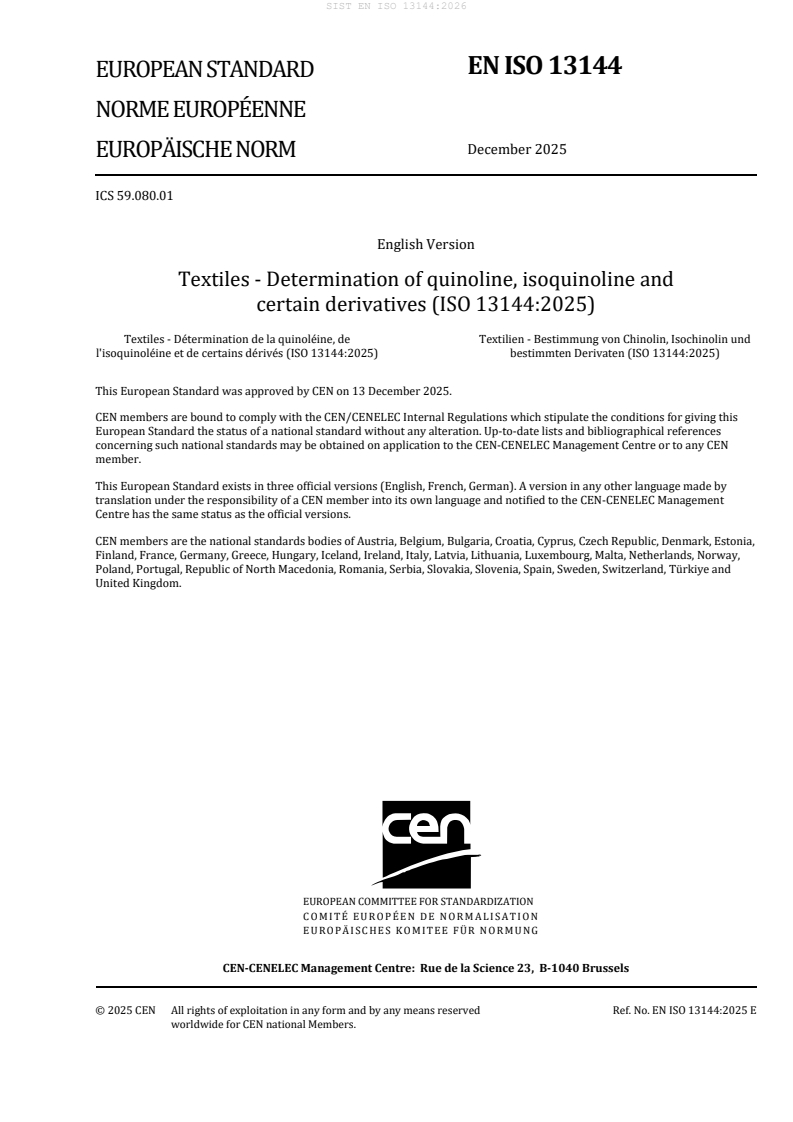
EN ISO 13144
EUROPEAN STANDARD
NORME EUROPÉENNE
December 2025
EUROPÄISCHE NORM
ICS 59.080.01
English Version
Textiles - Determination of quinoline, isoquinoline and
certain derivatives (ISO 13144:2025)
Textiles - Détermination de la quinoléine, de Textilien - Bestimmung von Chinolin, Isochinolin und
l'isoquinoléine et de certains dérivés (ISO 13144:2025) bestimmten Derivaten (ISO 13144:2025)
This European Standard was approved by CEN on 13 December 2025.
CEN members are bound to comply with the CEN/CENELEC Internal Regulations which stipulate the conditions for giving this
European Standard the status of a national standard without any alteration. Up-to-date lists and bibliographical references
concerning such national standards may be obtained on application to the CEN-CENELEC Management Centre or to any CEN
member.
This European Standard exists in three official versions (English, French, German). A version in any other language made by
translation under the responsibility of a CEN member into its own language and notified to the CEN-CENELEC Management
Centre has the same status as the official versions.
CEN members are the national standards bodies of Austria, Belgium, Bulgaria, Croatia, Cyprus, Czech Republic, Denmark, Estonia,
Finland, France, Germany, Greece, Hungary, Iceland, Ireland, Italy, Latvia, Lithuania, Luxembourg, Malta, Netherlands, Norway,
Poland, Portugal, Republic of North Macedonia, Romania, Serbia, Slovakia, Slovenia, Spain, Sweden, Switzerland, Türkiye and
United Kingdom.
EUROPEAN COMMITTEE FOR STANDARDIZATION
COMITÉ EUROPÉEN DE NORMALISATION
EUROPÄISCHES KOMITEE FÜR NORMUNG
CEN-CENELEC Management Centre: Rue de la Science 23, B-1040 Brussels
© 2025 CEN All rights of exploitation in any form and by any means reserved Ref. No. EN ISO 13144:2025 E
worldwide for CEN national Members.
Contents Page
European foreword . 3
European foreword
This document (EN ISO 13144:2025) has been prepared by Technical Committee ISO/TC 38 "Textiles"
in collaboration with Technical Committee CEN/TC 248 “Textiles and textile products” the secretariat of
which is held by BSI.
This European Standard shall be given the status of a national standard, either by publication of an
identical text or by endorsement, at the latest by June 2026, and conflicting national standards shall be
withdrawn at the latest by June 2026.
Attention is drawn to the possibility that some of the elements of this document may be the subject of
patent rights. CEN shall not be held responsible for identifying any or all such patent rights.
Any feedback and questions on this document should be directed to the users’ national standards
body/national committee. A complete listing of these bodies can be found on the CEN website.
According to the CEN-CENELEC Internal Regulations, the national standards organizations of the
following countries are bound to implement this European Standard: Austria, Belgium, Bulgaria,
Croatia, Cyprus, Czech Republic, Denmark, Estonia, Finland, France, Germany, Greece, Hungary, Iceland,
Ireland, Italy, Latvia, Lithuania, Luxembourg, Malta, Netherlands, Norway, Poland, Portugal, Republic of
North Macedonia, Romania, Serbia, Slovakia, Slovenia, Spain, Sweden, Switzerland, Türkiye and the
United Kingdom.
Endorsement notice
The text of ISO 13144:2025 has been approved by CEN as EN ISO 13144:2025 without any modification.
International
Standard
ISO 13144
First edition
Textiles — Determination of
2025-12
quinoline, isoquinoline and certain
derivatives
Textiles — Détermination de la quinoléine, de l’isoquinoléine et
de certains dérivés
Reference number
ISO 13144:2025(en) © ISO 2025
ISO 13144:2025(en)
© ISO 2025
All rights reserved. Unless otherwise specified, or required in the context of its implementation, no part of this publication may
be reproduced or utilized otherwise in any form or by any means, electronic or mechanical, including photocopying, or posting on
the internet or an intranet, without prior written permission. Permission can be requested from either ISO at the address below
or ISO’s member body in the country of the requester.
ISO copyright office
CP 401 • Ch. de Blandonnet 8
CH-1214 Vernier, Geneva
Phone: +41 22 749 01 11
Email: copyright@iso.org
Website: www.iso.org
Published in Switzerland
ii
ISO 13144:2025(en)
Contents Page
Foreword .iv
Introduction .v
1 Scope . 1
2 Normative references . 1
3 Terms and definitions . 1
4 Principle . 1
5 Reagents . 2
6 Apparatus . 2
7 Preparation of test specimens . 3
7.1 Fibre and fabric test specimens.3
7.2 Dyestuff test specimens .3
8 Procedure . 3
8.1 Preparation of standard solutions .3
8.1.1 Preparation of stock standard solutions .3
8.1.2 Preparation of calibration solutions .4
8.2 Extraction procedure .4
8.2.1 Extraction procedure for textile test specimens .4
8.2.2 Extraction procedure for dyestuff test specimens .4
8.3 Sample analysis . .4
9 Expression of results . 4
9.1 Calibration curve .4
9.2 Calculation of quinoline derivatives .5
9.3 Reliability of the test method .5
9.4 Limit of quantification of the test method .5
10 Test report . 5
Annex A (informative) Examples of chromatographic method — GC-MS and GC-MS/MS . 6
Annex B (informative) Examples of chromatographic method — LC-MS .11
Annex C (informative) Reliability of the method .15
Bibliography .16
iii
ISO 13144:2025(en)
Foreword
ISO (the International Organization for Standardization) is a worldwide federation of national standards
bodies (ISO member bodies). The work of preparing International Standards is normally carried out through
ISO technical committees. Each member body interested in a subject for which a technical committee
has been established has the right to be represented on that committee. International organizations,
governmental and non-governmental, in liaison with ISO, also take part in the work. ISO collaborates closely
with the International Electrotechnical Commission (IEC) on all matters of electrotechnical standardization.
The procedures used to develop this document and those intended for its further maintenance are described
in the ISO/IEC Directives, Part 1. In particular, the different approval criteria needed for the different types
of ISO document should be noted. This document was drafted in accordance with the editorial rules of the
ISO/IEC Directives, Part 2 (see www.iso.org/directives).
ISO draws attention to the possibility that the implementation of this document may involve the use of (a)
patent(s). ISO takes no position concerning the evidence, validity or applicability of any claimed patent
rights in respect thereof. As of the date of publication of this document, ISO had not received notice of (a)
patent(s) which may be required to implement this document. However, implementers are cautioned that
this may not represent the latest information, which may be obtained from the patent database available at
www.iso.org/patents.ISO shall not be held responsible for identifying any or all such patent rights.
Any trade name used in this document is information given for the convenience of users and does not
constitute an endorsement.
For an explanation of the voluntary nature of standards, the meaning of ISO specific terms and expressions
related to conformity assessment, as well as information about ISO's adherence to the World Trade
Organization (WTO) principles in the Technical Barriers to Trade (TBT), see www.iso.org/iso/foreword.html.
This document was prepared by Technical Committee ISO/TC38, Textiles, in collaboration with the European
Committee for Standardization (CEN) Technical Committee CEN/TC 248, Textiles and textile products, in
accordance with the Agreement on technical cooperation between ISO and CEN (Vienna Agreement).
Any feedback or questions on this document should be directed to the user’s national standards body. A
complete listing of these bodies can be found at www.iso.org/members.html.
iv
ISO 13144:2025(en)
Introduction
Quinoline, which is used in certain dyes, is classified as a carcinogenic substance. It has a high solubility in
water and this tendency makes it of concern in manufacturing processes where the dyed textiles are washed.
It can also be found as residue in textiles and textile products where it can easily come into skin contact. A
series of studies have shown the potential harm to humans as well as downstream aquatic life. Quinoline is
thus restricted in the European Union in:
a) clothing or related accessories;
b) textiles other than clothing which, under normal or reasonably foreseeable conditions of use, come into
contact with human skin to an extent similar to clothing;
[1]
c) footwear .
Quinoline derivatives are compounds that can be synthesized from a quinoline compound by replacement
of one atom with another atom or group of atoms. Considering their toxicity on several animal species, it is
important to set up an effective and precise test method to determine the content of them.
The test method described in this document is based on the use of gas chromatography with mass
spectrometry (GC-MS) or liquid chromatography with mass spectrometry (LC-MS).
v
International Standard ISO 13144:2025(en)
Textiles — Determination of quinoline, isoquinoline and
certain derivatives
1 Scope
This document specifies a method for the qualification and quantification of certain quinoline derivatives
in textile products by means of extraction with methanol and gas chromatography with mass selective
detector or liquid chromatography with mass selective detector.
The method is applicable to all kinds of textile products consisting of natural or artificially dyed textile
fibres and fabrics. It is further applicable to dyestuff powder used as textile auxiliary for dyeing and printing.
WARNING — The use of this document involves hazardous substances, operations and equipment.
It does not purport to address all of the safety or environmental problems associated with its use.
It refers only to technical suitability and does not absolve the user from legal obligations relating to
health and safety/environment at any stage.
2 Normative references
The following documents are referred to in the text in such a way that some or all of their content constitutes
requirements of this document. For dated references, only the edition cited applies. For undated references,
the latest edition of the referenced document (including any amendments) applies.
ISO 3696, Water for analytical laboratory use — Specification and test methods
ISO 4787, Laboratory glass and plastic ware — Volumetric instruments — Methods for testing of capacity and
for use
3 Terms and definitions
No terms and definitions are listed in this document.
ISO and IEC maintain terminological databases for use in standardization at the following addresses:
— ISO Online browsing platform: available at http:// www .iso .org/ obp
— IEC Electropedia: available at http:// www .electropedia .org/
4 Principle
The quinoline derivatives are extracted from textile fibres and fabrics or dyestuff with methanol in an
ultrasonic water bath. The extract is analysed by means of gas chromatograph with mass selective detector
or liquid chromatograph with mass selective detector.
Table 1 indicates the list of quinoline derivatives which can be analysed with the method described in this
document.
...