

SIST EN 772-2:1999
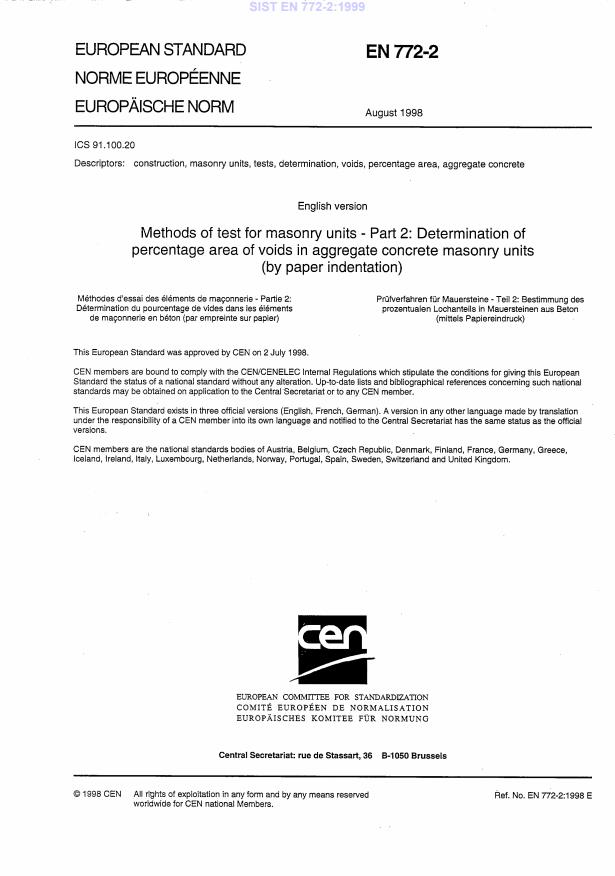
(Main)Methods of test for masonry units - Part 2: Determination of percentage area of voids in aggregate concrete masonry units (by paper indentation)
General Information
- Abstract
This European Standard specifies a method of determining the percentage area of voids in aggregate concrete masonry units.
- Status
- Published
- Publication Date
- 31-Dec-1998
- Technical Committee
- CAA - Mineral binders and masonry
- Current Stage
- 6060 - National Implementation/Publication (Adopted Project)
- Start Date
- 01-Jan-1999
- Due Date
- 01-Jan-1999
- Completion Date
- 01-Jan-1999


Overview
EN 772-2:1998 - Methods of test for masonry units, Part 2 - specifies a standardized procedure for determining the percentage area of voids in aggregate concrete masonry units using the paper indentation technique. Published by CEN and adopted by national bodies (for example as SIST EN 772-2:1999), this European Standard provides a repeatable approach for quantifying open void area in concrete blocks and other aggregate concrete masonry units.
Key Topics and Requirements
- Scope: Applies to aggregate concrete masonry units where the percentage area of voids is a relevant quality parameter.
- Test principle: Uses a paper indentation method to obtain a two‑dimensional imprint of the unit’s void pattern; the imprint is then used to determine void area as a percentage of the unit’s face area.
- Sample handling: Requires representative samples and defined preparation to ensure consistent imprints (clean, undamaged faces).
- Measurement and calculation: Specifies how to derive the area of voids from the imprint and calculate the percentage area of voids relative to the unit face.
- Reporting: Calls for clear reporting of test conditions, sample identification, measurement method, and results to ensure traceability and comparability.
- Limitations: Intended for aggregate concrete masonry units and for two‑dimensional area assessment; it does not directly measure internal porosity or three‑dimensional pore volume.
Applications
- Quality control in manufacturing of concrete masonry units: monitor consistency of block core/void patterns that affect weight, thermal properties, and material usage.
- Design and specification verification: help specifiers and contractors confirm that units meet project or regulatory requirements relating to void area.
- Comparative testing: provide a standardized basis for comparing products from different batches or suppliers.
- Research and product development: support evaluation of new mixes, block geometries, or production processes with respect to void distribution.
Who Should Use This Standard
- Masonry unit manufacturers and production quality teams
- Construction materials testing laboratories
- Structural and masonry engineers specifying or verifying block properties
- Building inspectors and regulatory authorities assessing compliance
Related Standards
- Other parts of the EN 772 series (methods of test for masonry units)
- National adoptions and translations (e.g., SIST EN 772-2:1999)
Keywords: EN 772-2:1998, methods of test for masonry units, percentage area of voids, aggregate concrete masonry units, paper indentation, masonry testing, CEN, concrete block quality control.
Relations
- Effective Date
- 28-Jan-2026
- Effective Date
- 28-Jan-2026
- Effective Date
- 28-Jan-2026
- Effective Date
- 28-Jan-2026
- Referred By
SIST EN 771-2:2011 - Specification for masonry units - Part 2: Calcium silicate masonry units - Effective Date
- 28-Jan-2026
- Effective Date
- 28-Jan-2026
- Effective Date
- 22-Dec-2008
Get Certified
Connect with accredited certification bodies for this standard

DIBt (Deutsches Institut für Bautechnik)
German Institute for Building Technology.
DIN CERTCO
DIN Group product certification.

Aboma Certification B.V.
Specialized in construction, metal, and transport sectors.
Sponsored listings
Frequently Asked Questions
SIST EN 772-2:1999 is a standard published by the Slovenian Institute for Standardization (SIST). Its full title is "Methods of test for masonry units - Part 2: Determination of percentage area of voids in aggregate concrete masonry units (by paper indentation)". This standard covers: This European Standard specifies a method of determining the percentage area of voids in aggregate concrete masonry units.
This European Standard specifies a method of determining the percentage area of voids in aggregate concrete masonry units.
SIST EN 772-2:1999 is classified under the following ICS (International Classification for Standards) categories: 91.100.15 - Mineral materials and products; 91.100.30 - Concrete and concrete products. The ICS classification helps identify the subject area and facilitates finding related standards.
SIST EN 772-2:1999 has the following relationships with other standards: It is inter standard links to SIST EN 772-1:2011+A1:2015, SIST EN 771-2:2011+A1:2015, SIST EN 772-1:2011, SIST EN 771-3:2011+A1:2015, SIST EN 771-2:2011, SIST EN 771-3:2011, SIST EN 772-2:1999/A1:2005. Understanding these relationships helps ensure you are using the most current and applicable version of the standard.
SIST EN 772-2:1999 is associated with the following European legislation: EU Directives/Regulations: 305/2011, 89/106/EEC. When a standard is cited in the Official Journal of the European Union, products manufactured in conformity with it benefit from a presumption of conformity with the essential requirements of the corresponding EU directive or regulation.
SIST EN 772-2:1999 is available in PDF format for immediate download after purchase. The document can be added to your cart and obtained through the secure checkout process. Digital delivery ensures instant access to the complete standard document.
Standards Content (Sample)
2003-01.Slovenski inštitut za standardizacijo. Razmnoževanje celote ali delov tega standarda ni dovoljeno.Metode preskušanja zidakov - 2. del: Ugotavljanje odstotnega deleža lukenj v betonskih zidakih (z odtisom na papirju)Prüfverfahren für Mauersteine - Teil 2: Bestimmung des prozentualen Lochanteils in Mauersteinen aus Beton (mittels Papiereindruck)Méthodes d'essai des éléments de maçonnerie - Partie 2: Détermination du pourcentage de vides dans les éléments de maçonnerie en béton (par empreinte sur papier)Methods
...