

SIST EN 13920-4:2004
(Main)Aluminium and aluminium alloys - Scrap - Part 4: Scrap consisting of one single wrought alloy
- Abstract
This part of this European Standard specifies, characteristics, chemical composition and metal yield of scrap consisting of one single wrought aluminium alloy. It does not apply to turnings which are covered by part 12 of this Standard. EXAMPLE Production scraps of sheet, strip, tubes, extruded or drawn profiles, ends of extrusion ingots etc..
- Status
- Published
- Publication Date
- 31-Dec-2003
- Technical Committee
- INEK - Nonferrous metals
- Current Stage
- 6060 - National Implementation/Publication (Adopted Project)
- Start Date
- 01-Jan-2004
- Due Date
- 01-Jan-2004
- Completion Date
- 01-Jan-2004


SIST EN 13920-4:2004 is the Slovenian adoption of EN 13920-4:2003, published by SIST for aluminium and aluminium alloys scrap. It specifies the characteristics, chemical composition and metal yield of scrap consisting of one single wrought aluminium alloy, so suppliers and purchasers can describe and check this scrap in the same way. The standard is used when ordering, classifying, sampling and accepting this scrap before delivery.
What does SIST EN 13920-4:2004 specify?
SIST EN 13920-4:2004 covers scrap consisting of one single wrought aluminium alloy. In practice, that means production scrap such as sheet, strip, tubes, extruded or drawn profiles, and ends of extrusion ingots.
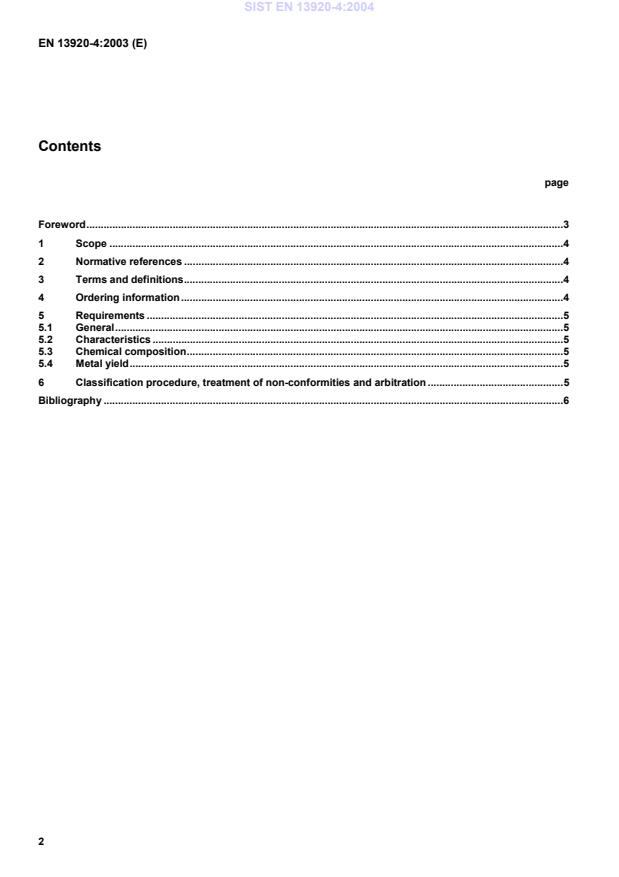
SIST EN 13920-4:2004 does not apply to turnings; those are covered by EN 13920-12. The document is organised into scope, normative references, terms and definitions, ordering information, requirements, classification procedure, treatment of non-conformities and arbitration, followed by a bibliography.
What are the key requirements of SIST EN 13920-4:2004?
SIST EN 13920-4:2004 builds on EN 13920-1 and then adds the specific rules for this scrap category. The most important points are the scrap condition, alloy identification, metal yield, and the information that must be agreed before shipment.
Ordering and delivery information
Clause 4 requires the order to identify the standard, the scrap category, the aluminium alloy, the gross mass of the consignment, the delivery period, and any characteristics that differ from the standard requirements. In practice, this means buyer and supplier need a clear written description before the scrap moves.
Clause 4 also says the order should include the origin of the scrap and, where useful, its size and surface condition. That helps the receiver judge whether the material will fit the intended recycling process.
Physical condition of the scrap
Clause 5.2 requires pieces with a minimum thickness of 0.20 mm. The scrap must also be free from oil, grease, powder, plastics and other foreign material. In practice, the material has to be sorted and cleaned well enough to avoid contamination and processing problems.
Chemical composition
Clause 5.3 requires the scrap to have the chemical composition of a wrought alloy as specified in EN 573-3, or another registered alloy if the supplier and purchaser agree. If it does not meet that condition, it falls outside the scope of this standard. For buyers, this means alloy identity matters, not just the shape of the scrap.
Metal yield
Clause 5.4 requires a metal yield of at least 95%, determined in accordance with EN 13920-1. This is the practical recovery measure that tells the buyer how much usable metal can be expected from the scrap. The note in this clause also shows that more contaminated or exceptional material can lower the yield.
Deviations and non-conformities
Clause 5.1 requires the supplier to notify the purchaser when the scrap deviates from the stated requirements, for example if it is coated, anodized, or includes foil or thin strip with coatings or laminates. Agreement is needed before shipment. That makes deviations a commercial and technical decision, not something to discover only on arrival.
Clause 6 states that classification, sampling, tests, treatment of non-conformities and arbitration follow EN 13920-1 as appropriate. In practice, this means the parent part controls how the scrap is checked and how disputes are handled.
What terms does SIST EN 13920-4:2004 define?
SIST EN 13920-4:2004 uses terms from prEN 12258-3:2000 and EN 13920-1:2003. The key terms are:
- Scrap - aluminium material intended for recycling, classified here as one single wrought alloy.
- Wrought alloy - an aluminium alloy used for wrought products such as sheet, strip, tubes and profiles.
- Metal yield - the proportion of usable metal obtained from the scrap after assessment under EN 13920-1.
- Foreign material - unwanted matter such as oil, grease, powder or plastics mixed with the scrap.
- Gross mass of the consignment - the total mass of the delivered scrap lot before processing.
- Classification procedure - the sampling, testing and decision process used to place scrap in this category.
Who uses SIST EN 13920-4:2004?
SIST EN 13920-4:2004 is used by aluminium scrap suppliers, scrap buyers, recyclers, processors and quality managers. It helps them write purchase descriptions, inspect incoming lots, classify scrap, and decide whether a consignment matches the agreed category.
It is also relevant to laboratories and inspection teams that perform sampling and tests under EN 13920-1. For them, the standard gives the product category they are checking and the acceptance points that matter in practice.
Which standards are used with SIST EN 13920-4:2004?
- EN 573-3 - provides the chemical composition limits for wrought aluminium alloys.
- prEN 12258-3:2000 - provides terms and definitions for scrap.
- EN 13920-1:2003 - provides the general requirements, sampling, tests, treatment of non-conformities and arbitration.
- EN 13920-12 - covers turnings consisting of one single alloy, which are excluded from this part.
What does the SIST EN 13920-4:2004 document contain?
The document contains a short technical specification focused on one scrap category. It sets out the scope, the references that support its terminology and alloy identification, the information needed when ordering, and the acceptance requirements for thickness, cleanliness, composition and metal yield.
It also points the reader to EN 13920-1 for classification, sampling, testing and dispute handling. The bibliography links the reader to EN 13920-12 for the excluded turnings category.
Relations
- Effective Date
- 25-Mar-2026
- Effective Date
- 28-Jan-2026
- Effective Date
- 28-Jan-2026
- Effective Date
- 28-Jan-2026
Get Certified
Connect with accredited certification bodies for this standard

Element Materials Technology
Materials testing and product certification.

CIS Institut d.o.o.
Personal Protective Equipment (PPE) certification body. Notified Body NB-2890 for EU Regulation 2016/425 PPE.
Inštitut za kovinske materiale in tehnologije
Institute of Metals and Technology. Materials testing, metallurgical analysis, NDT.
Sponsored listings
Frequently Asked Questions
SIST EN 13920-4:2004 is a standard published by the Slovenian Institute for Standardization (SIST). Its full title is "Aluminium and aluminium alloys - Scrap - Part 4: Scrap consisting of one single wrought alloy". This standard covers: This part of this European Standard specifies, characteristics, chemical composition and metal yield of scrap consisting of one single wrought aluminium alloy. It does not apply to turnings which are covered by part 12 of this Standard. EXAMPLE Production scraps of sheet, strip, tubes, extruded or drawn profiles, ends of extrusion ingots etc..
This part of this European Standard specifies, characteristics, chemical composition and metal yield of scrap consisting of one single wrought aluminium alloy. It does not apply to turnings which are covered by part 12 of this Standard. EXAMPLE Production scraps of sheet, strip, tubes, extruded or drawn profiles, ends of extrusion ingots etc..
SIST EN 13920-4:2004 is classified under the following ICS (International Classification for Standards) categories: 13.030.50 - Recycling; 77.120.10 - Aluminium and aluminium alloys. The ICS classification helps identify the subject area and facilitates finding related standards.
SIST EN 13920-4:2004 has the following relationships with other standards: It is inter standard links to SIST EN 573-3:2026, SIST EN 12258-3:2004, SIST EN 573-3:2019+A2:2024, SIST EN 13920-1:2004. Understanding these relationships helps ensure you are using the most current and applicable version of the standard.
SIST EN 13920-4:2004 is available in PDF format for immediate download after purchase. The document can be added to your cart and obtained through the secure checkout process. Digital delivery ensures instant access to the complete standard document.
Standards Content (Sample)
2003-01.Slovenski inštitut za standardizacijo. Razmnoževanje celote ali delov tega standarda ni dovoljeno.Aluminij in aluminijeve zlitine – Odpadni aluminij – 4. del: Odpadni aluminij iz ene gnetne zlitineAluminium und Aluminiumlegierungen - Schrott - Teil 4: Schrott aus einer einzigen KnetlegierungAluminium et alliages d'aluminium - Scrap (matieres premieres pour recyclage) - Partie 4: Scrap en un seul alliage de corroyageAluminium and aluminium alloys - Scrap - Part 4: Scrap consisting of one single wrought alloy77.120.10Aluminij in aluminijeve zlitineAluminium and aluminium alloys13.030.50RecikliranjeRecyclingICS:Ta slovenski standard je istoveten z:EN 13920-4:2003SIST EN 13920-4:2004en01-januar-2004SIST EN 13920-4:2004SLOVENSKI
STANDARD
EUROPEAN STANDARDNORME EUROPÉENNEEUROPÄISCHE NORMEN 13920-4April 2003ICS 13.030.50; 77.120.10English versionAluminium and aluminium alloys - Scrap - Part 4: Scrapconsisting of one single wrought alloyAluminium et alliages d'aluminium - Scrap (matièrespremières pour recyclage) - Partie 4: Scrap en un seulalliage de corroyageAluminium und Aluminiumlegierungen - Schrott - Teil 4:Schrott aus einer einzigen KnetlegierungThis European Standard was approved by CEN on 28 February 2003.CEN members are bound to comply with the CEN/CENELEC Internal Regulations which stipulate the conditions for giving this EuropeanStandard the status of a national standard without any alteration. Up-to-date lists and bibliographical references concerning such nationalstandards may be obtained on application to the Management Centre or to any CEN member.This European Standard exists in three official versions (English, French, German). A version in any other language made by translationunder the responsibility of a CEN member into its own language and notified to the Management Centre has the same status as the officialversions.CEN members are the national standards bodies of Austria, Belgium, Czech Republic, Denmark, Finland, France, Germany, Greece,Hungary, Iceland, Ireland, Italy, Luxembourg, Malta, Netherlands, Norway, Portugal, Slovakia, Spain, Sweden, Switzerland and UnitedKingdom.EUROPEAN COMMITTEE FOR STANDARDIZATIONCOMITÉ EUROPÉEN DE NORMALISATIONEUROPÄISCHES KOMITEE FÜR NORMUNGManagement Centre: rue de Stassart, 36
B-1050 Brussels© 2003 CENAll rights of exploitation in any form and by any means reservedworldwide for CEN national Members.Ref. No. EN 13920-4:2003 ESIST EN 13920-4:2004
...