

SIST EN 13920-1:2004
(Main)Aluminium and aluminium alloys - Scrap - Part 1: General requirements, sampling and tests
General Information
- Abstract
This European Standard specifies general requirements and guidelines for the delivery and classification of the different categories of aluminium scrap, including quality requirements, sampling and tests.
NOTE Special requirements and guidelines for each of the scrap categories are specified in prEN 13920 2 to prEN 13920 16.
- Status
- Published
- Publication Date
- 31-Dec-2003
- Technical Committee
- INEK - Nonferrous metals
- Current Stage
- 6060 - National Implementation/Publication (Adopted Project)
- Start Date
- 01-Jan-2004
- Due Date
- 01-Jan-2004
- Completion Date
- 01-Jan-2004

Overview
EN 13920-1:2003 - published by CEN - defines general requirements, sampling and tests for aluminium and aluminium-alloy scrap. It sets out how scrap deliveries should be described, inspected and classified to support transparent trade and consistent recycling performance. The standard is the Part 1 foundation for the EN 13920 series; Parts 2–16 contain category‑specific rules (e.g., turnings, skimmings, beverage cans).
Key topics and requirements
- Ordering information: contracts should identify scrap category (reference to the relevant EN 13920 part), condition (moisture, contamination, size), expected metal yield, required chemical composition and required documentation.
- Hazardous contaminants: scrap must not contain asbestos, cadmium, mercury, lithium, selenium, PCBs, explosives, radioactive or medical wastes. Any suspicion of these must be notified to the purchaser.
- Condition and size limits: unless otherwise agreed, scrap is supplied loose; individual pieces should not exceed 600 × 600 × 400 mm or 200 kg.
- Foreign materials: scrap shall be free from foreign material unless otherwise specified for a category.
- Mass tolerances: contractual mass tolerances are specified (e.g., ±5 % for certain single-shipment orders as stated in the standard; multi‑shipment total deviations and per‑shipment verification limits are also defined).
- Sampling principles: samples must represent the inspection lot to determine average chemical composition, foreign‑material percentages and metal yield.
- Granulated scrap/turnings: take 1–5 % of the lot during/after unloading, quartering and reduce to a 2–5 kg test sample.
- Skimmings/dross: three alternative procedures - bulk sample (~500 kg) with grinding and sieving, split‑fraction sampling (blocks vs fines) with a block sample ≥100 kg and concentrated metallics sample ≥20 kg, or melting a representative sample/lot.
- Representative sampling of other scrap categories is prescribed (see Part 1 for minimum sizes).
- Tests:
- Moisture/volatile removal: oven drying at ~105 °C for water; ~360 °C for oil/emulsion‑containing turnings.
- Free iron removal: magnetic separation for ferrous iron; manual removal for stainless/non‑magnetic iron; possible shredding or sweating furnace when needed.
- Metal yield & chemical analysis: melt representative, use covering salts (salt mass ~50 % of scrap mass in crucible tests), cast and sample the metal for composition; grind salt slag to check for metallic inclusions.
Applications and users
- Primary users: scrap traders, recyclers, aluminium smelters, foundries, quality inspectors and procurement professionals.
- Practical uses: defining contract terms, acceptance criteria for incoming scrap, laboratory sampling protocols, determining metal yield for process planning and pricing, and resolving shipment disputes through classification and arbitration procedures.
Related standards
- EN 13920 series (Parts 2–16) - category‑specific requirements.
- prEN 12258-3:2000 - terms and definitions for aluminium scrap.
Keywords: EN 13920-1:2003, aluminium scrap, sampling, tests, metal yield, chemical composition, dross, skimmings, turnings, CEN, recycling, scrap classification.
Relations
- Effective Date
- 28-Jan-2026
- Referred By
SIST EN 13920-2:2004 - Aluminium and aluminium alloys - Scrap - Part 2: Unalloyed aluminium scrap - Effective Date
- 28-Jan-2026
- Referred By
SIST EN 13920-3:2004 - Aluminium and aluminium alloys - Scrap - Part 3: Wire and cable scrap - Effective Date
- 28-Jan-2026
- Effective Date
- 28-Jan-2026
- Effective Date
- 28-Jan-2026
- Effective Date
- 28-Jan-2026
- Effective Date
- 28-Jan-2026
- Referred By
SIST EN 13920-7:2004 - Aluminium and aluminium alloys - Scrap - Part 7: Scrap consisting of castings - Effective Date
- 28-Jan-2026
- Effective Date
- 28-Jan-2026
- Effective Date
- 28-Jan-2026
- Effective Date
- 28-Jan-2026
- Effective Date
- 28-Jan-2026
- Effective Date
- 28-Jan-2026
- Effective Date
- 28-Jan-2026
- Effective Date
- 28-Jan-2026
Get Certified
Connect with accredited certification bodies for this standard

Element Materials Technology
Materials testing and product certification.

CIS Institut d.o.o.
Personal Protective Equipment (PPE) certification body. Notified Body NB-2890 for EU Regulation 2016/425 PPE.
Inštitut za kovinske materiale in tehnologije
Institute of Metals and Technology. Materials testing, metallurgical analysis, NDT.
Sponsored listings
Frequently Asked Questions
SIST EN 13920-1:2004 is a standard published by the Slovenian Institute for Standardization (SIST). Its full title is "Aluminium and aluminium alloys - Scrap - Part 1: General requirements, sampling and tests". This standard covers: This European Standard specifies general requirements and guidelines for the delivery and classification of the different categories of aluminium scrap, including quality requirements, sampling and tests. NOTE Special requirements and guidelines for each of the scrap categories are specified in prEN 13920 2 to prEN 13920 16.
This European Standard specifies general requirements and guidelines for the delivery and classification of the different categories of aluminium scrap, including quality requirements, sampling and tests. NOTE Special requirements and guidelines for each of the scrap categories are specified in prEN 13920 2 to prEN 13920 16.
SIST EN 13920-1:2004 is classified under the following ICS (International Classification for Standards) categories: 13.030.50 - Recycling; 77.120.10 - Aluminium and aluminium alloys. The ICS classification helps identify the subject area and facilitates finding related standards.
SIST EN 13920-1:2004 has the following relationships with other standards: It is inter standard links to SIST EN 12258-3:2004, SIST EN 13920-2:2004, SIST EN 13920-3:2004, SIST EN 13920-8:2004, SIST EN 13920-16:2004, SIST EN 13920-4:2004, SIST EN 13920-10:2004, SIST EN 13920-7:2004, SIST EN 13920-11:2004, SIST EN 15088:2006, SIST EN 13920-9:2004, SIST EN 13920-13:2004, SIST EN 13920-12:2004, SIST EN 13920-15:2004, SIST EN 13920-6:2004. Understanding these relationships helps ensure you are using the most current and applicable version of the standard.
SIST EN 13920-1:2004 is available in PDF format for immediate download after purchase. The document can be added to your cart and obtained through the secure checkout process. Digital delivery ensures instant access to the complete standard document.
Standards Content (Sample)
2003-01.Slovenski inštitut za standardizacijo. Razmnoževanje celote ali delov tega standarda ni dovoljeno.Aluminium und Aluminiumlegierungen - Schrott - Teil 1: Allgemeine Anforderungen, Probenahme und PrüfungenAluminium et alliages d'aluminium - Scrap (matieres premieres pour recyclage) - Partie 1: Exigences générales, échantillonnage et essaisAluminium and aluminium alloys - Scrap - Part 1: General requirements, sampling and tests77.120.10Aluminij in aluminijeve zlitineAluminium and aluminium alloys13.030.50RecikliranjeRecyclingICS:Ta slovenski standard je istoveten z:EN 13920-1:2003SIST EN 13920-1:2004en01-januar-2004SIST EN 13920-1:2004SLOVENSKI
STANDARD
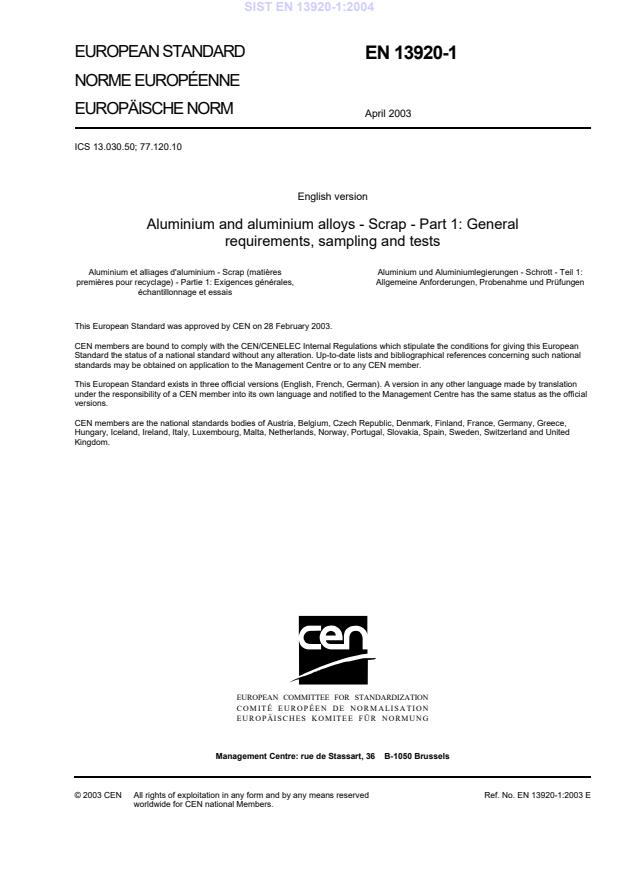
EUROPEAN STANDARDNORME EUROPÉENNEEUROPÄISCHE NORMEN 13920-1April 2003ICS 13.030.50; 77.120.10English versionAluminium and aluminium alloys - Scrap - Part 1: Generalrequirements, sampling and testsAluminium et alliages d'aluminium - Scrap (matièrespremières pour recyclage) - Partie 1: Exigences générales,échantillonnage et essaisAluminium und Aluminiumlegierungen - Schrott - Teil 1:Allgemeine Anforderungen, Probenahme und PrüfungenThis European Standard was approved by CEN on 28 February 2003.CEN members are bound to comply with the CEN/CENELEC Internal Regulations which stipulate the conditions for giving this EuropeanStandard the status of a national standard without any alteration. Up-to-date lists and bibliographical references concerning such nationalstandards may be obtained on application to the Management Centre or to any CEN member.This European Standard exists in three official versions (English, French, German). A version in any other language made by translationunder the responsibility of a CEN member into its own language and notified to the Management Centre has the same status as the officialversions.CEN members are the national standards bodies of Austria, Belgium, Czech Republic, Denmark, Finland, France, Germany, Greece,Hungary, Iceland, Ireland, Italy, Luxembourg, Malta, Netherlands, Norway, Portugal, Slovakia, Spain, Sweden, Switzerland and UnitedKingdom.EUROPEAN COMMITTEE FOR STANDARDIZATIONCOMITÉ EUROPÉEN DE NORMALISATIONEUROPÄISCHES KOMITEE FÜR NORMUNGManagement Centre: rue de Stassart, 36
B-1050 Brussels© 2003 CENAll rights of exploitation in any form and by any means reservedworldwide for CEN national Members.Ref. No. EN 13920-1:2003 ESIST EN 13920-1:2004
...