

SIST EN 1023-2:2001
(Main)Office furniture - Screens - Part 2: Mechanical safety requirements
- Abstract
This part of EN 1023 specifies the mechanical safety requirements of office screens which are divided into general safety requirements and structural safety requirements.
- Status
- Published
- Publication Date
- 31-Jan-2001
- Withdrawal Date
- 31-Jan-2001
- Technical Committee
- POH - Furniture
- Current Stage
- 6060 - National Implementation/Publication (Adopted Project)
- Start Date
- 01-Feb-2001
- Due Date
- 01-Feb-2001
- Completion Date
- 01-Feb-2001



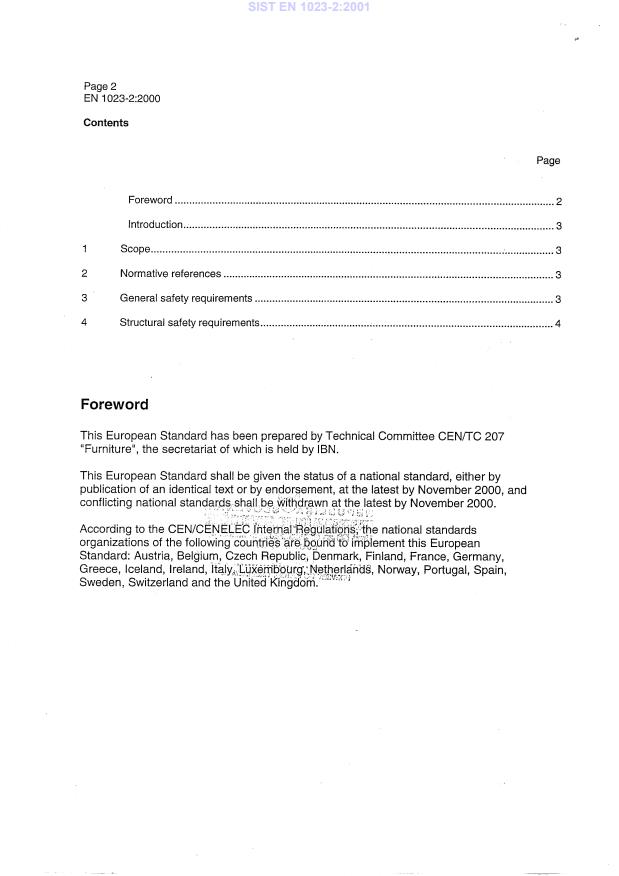
SIST EN 1023-2:2001 is the Slovenian national standard for the mechanical safety requirements of office screens. It is identical to EN 1023-2:2000 and tells manufacturers, specifiers and testers what a screen has to satisfy from a safety point of view in office furniture use.
What does SIST EN 1023-2:2001 specify?
SIST EN 1023-2:2001 specifies the mechanical safety requirements for office screens. The standard treats these requirements in two groups: general safety requirements and structural safety requirements.
In practice, that means the document is used to judge whether an office screen is mechanically safe as a product and whether its structure is suitable for normal use in an office setting. The focus is on safety performance, not on appearance or other furniture characteristics.
The document is part 2 of the EN 1023 series. Its subject is clearly limited to screens used in office furniture applications, so it is the reference to use when the question is mechanical safety for that product type.
What are the key requirements of SIST EN 1023-2:2001?
SIST EN 1023-2:2001 organizes its requirements around two main safety areas. For anyone designing, testing or buying office screens, the important point is that both the general safety aspect and the structural safety aspect have to be considered.
General safety requirements
The standard first groups requirements under general safety requirements. This tells the reader that an office screen must be safe in ordinary use as a whole product.
In practice, this is the part a manufacturer or buyer would use to check the screen as delivered and installed, not just as separate parts. It is the starting point for verifying that the product is mechanically safe for office use.
Structural safety requirements
The second group is structural safety requirements. This means the standard also looks at the screen as a structure and not only as a visible partition element.
For practical work, this matters when checking how the screen holds together in service. A supplier or test laboratory would use this part when assessing the structure of the screen as a product that has to remain safe in use.
Mechanical safety focus
SIST EN 1023-2:2001 is specifically about mechanical safety. That tells the reader that the standard addresses physical safety-related performance, rather than non-mechanical topics.
For a buyer or quality manager, this helps decide whether the document is the right one when the concern is physical safety of office screens. For a test engineer, it signals that the verification work belongs to mechanical assessment.
Use as a product-specific safety reference
Because the standard is limited to office screens, it is the relevant safety reference for that furniture category. The reader should use it when the product under review is an office screen, not a different kind of office furniture.
That matters in procurement and compliance work: it helps match the standard to the actual product, so the wrong furniture category is not assessed against the wrong requirements.
What does the document contain?
SIST EN 1023-2:2001 contains the technical specification for mechanical safety of office screens, with the requirements split into general and structural safety parts. The front matter identifies it as a Slovene standard and shows that it is identical to EN 1023-2:2000.
The document is catalogued under furniture, with ICS 97.140. That classification helps libraries, purchasers and standards databases place it in the office furniture area.
For a reader using the standard in practice, the key takeaway is simple: this part of EN 1023 is the safety document for office screens, and its content is centered on mechanical safety requirements for that product type.
Relations
- Effective Date
- 28-Jan-2026
- Effective Date
- 28-Jan-2026
- Effective Date
- 28-Jan-2026
- Effective Date
- 28-Jan-2026
- Effective Date
- 28-Jan-2026
Frequently Asked Questions
SIST EN 1023-2:2001 is a standard published by the Slovenian Institute for Standardization (SIST). Its full title is "Office furniture - Screens - Part 2: Mechanical safety requirements". This standard covers: This part of EN 1023 specifies the mechanical safety requirements of office screens which are divided into general safety requirements and structural safety requirements.
This part of EN 1023 specifies the mechanical safety requirements of office screens which are divided into general safety requirements and structural safety requirements.
SIST EN 1023-2:2001 is classified under the following ICS (International Classification for Standards) categories: 97.140 - Furniture. The ICS classification helps identify the subject area and facilitates finding related standards.
SIST EN 1023-2:2001 has the following relationships with other standards: It is inter standard links to SIST EN ISO 21301-2:2019, SIST EN 1023-3:2001, SIST EN ISO 10350-2:2020, SIST EN ISO 10350-1:2018, SIST EN ISO 23153-2:2020. Understanding these relationships helps ensure you are using the most current and applicable version of the standard.
SIST EN 1023-2:2001 is available in PDF format for immediate download after purchase. The document can be added to your cart and obtained through the secure checkout process. Digital delivery ensures instant access to the complete standard document.
Standards Content (Sample)
2003-01.Slovenski inštitut za standardizacijo. Razmnoževanje celote ali delov tega standarda ni dovoljeno.Pisarniško pohištvo - Pregrade - 2. del: Mehanske varnostne zahteveBüromöbel - Raumgliederungselemente - Teil 2: Mechanische SicherheitsanforderungenMobilier de bureau - Cloisons - Partie 2: Exigences mécaniques de sécuritéO
...