


oSIST prEN ISO 14097:2026
(Main)Greenhouse gas management and related activities - Framework including principles and requirements for assessing and reporting investments and financing activities related to climate change (ISO 14097:2021)
Greenhouse gas management and related activities - Framework including principles and requirements for assessing and reporting investments and financing activities related to climate change (ISO 14097:2021)
This document specifies a general framework, including principles, requirements and guidance for assessing, measuring, monitoring and reporting on investments and financing activities in relation to climate change and the transition into a low-carbon economy. The assessment includes the following items:
the alignment (or lack thereof) of investment and financing decisions taken by the financier with low-carbon transition pathways, adaptation pathways, and climate goals;
the impact of actions through the financier’s investment and lending decisions towards the achievement of climate goals in the real economy, i.e. mitigation (greenhouse gas emissions) and adaptation (resilience);
the risks to owners of financial assets (e.g. private equities, listed stocks, bonds, loans) arising from climate change.
To support the financier’s assessment of the impact of investment and lending decisions, this document provides guidance for the financier on how to:
set targets and determine metrics to be used for tracking progress related to the low-carbon transition pathways of investees;
determine low-carbon transition and adaptation trajectories of investees;
document the causality or linkage between its climate action and its outputs, outcomes and impacts.
This document is applicable to financiers, i.e. investors and lenders. It guides their reporting activities to the following third parties: shareholders, clients, policymakers, financial supervisory authorities and non-governmental organizations.
Rahmenbedingungen und Grundsätze für die Bewertung und Berichterstattung von Investitionen und Finanzierungstätigkeiten im Zusammenhang mit dem Klimawandel (ISO 14097:2021)
Gestion des gaz à effet de serre et activités associées - Cadre comprenant les principes et les exigences pour l’évaluation et la déclaration des investissements et des activités de financement au regard du changement climatique (ISO 14097:2021)
Le présent document spécifie un cadre général comprenant les principes, les exigences et les recommandations pour l’évaluation, la mesure, la surveillance et la déclaration des investissements et des activités de financement au regard du changement climatique et de la transition vers une économie bas-carbone. L’évaluation comprend les éléments suivants:
l’alignement (ou l’absence d’alignement) des décisions d’investissement et de financement prises par l’institution financière sur les voies de transition bas-carbone, les voies d’adaptation et les objectifs climatiques;
l’impact des actions menées par le biais des décisions d’investissement et de prêt de l’institution financière en vue d’atteindre les objectifs climatiques dans l’économie réelle, c’est-à-dire l’atténuation (émissions de gaz à effet de serre) et l’adaptation (résilience);
les risques pour les propriétaires d’actifs financiers (par exemple, les placements privés, les actions cotées en bourse, les obligations, les prêts) découlant du changement climatique.
Pour aider l’institution financière à évaluer l’impact de ses décisions d’investissement et de prêt, le présent document fournit des recommandations sur la manière de:
définir des objectifs et déterminer les paramètres à utiliser pour suivre les progrès liés aux voies de transition bas-carbone des bénéficiaires;
déterminer les trajectoires de transition et d’adaptation bas-carbone des bénéficiaires;
documenter la causalité ou le lien entre ses actions climatiques et ses éléments de sortie, ses résultats et ses impacts.
Le présent document est applicable aux institutions financières, c’est-à-dire aux investisseurs et aux prêteurs. Il guide leurs activités de déclaration aux tiers suivants: les actionnaires, les clients, les décideurs politiques, les autorités de surveillance financière et les organisations non gouvernementales.
Upravljanje toplogrednih plinov in povezane dejavnosti - Okvir, ki vključuje načela in zahteve za ocenjevanje in poročanje o naložbah in financiranju dejavnosti, povezanih s podnebnimi spremembami (ISO 14097:2021)
General Information
- Status
- Not Published
- Public Enquiry End Date
- 29-Apr-2026
- Technical Committee
- I13 - Imaginarni 13
- Current Stage
- 4020 - Public enquire (PE) (Adopted Project)
- Start Date
- 20-Feb-2026
- Due Date
- 10-Jul-2026
Overview
oSIST prEN ISO 14097:2026 defines an international framework for greenhouse gas (GHG) management, specifically focusing on the assessment and reporting of investments and financing activities related to climate change. Developed by CEN alongside ISO, this standard outlines principles and requirements for evaluating how financial activities impact climate outcomes, ensuring alignment with global climate goals and low-carbon transition pathways. ISO 14097:2021 is aimed at financial institutions, investors, lenders, asset managers, and any party making investment decisions that could affect climate change mitigation and adaptation.
Key Topics
- Climate Change Integration: Offers guidance on incorporating climate considerations into investment and lending decisions, assessing their impacts on GHG emissions and climate resilience.
- Risk and Opportunity Assessment: Enables financiers to identify, measure, and disclose climate-related risks and opportunities linked to their portfolios in the short, medium, and long term.
- Alignment with Climate Goals: Assists organizations in evaluating their activities against benchmarks for low-carbon transition and adaptation, supporting goals set under international agreements like the Paris Agreement.
- Setting Targets and Metrics: Provides a methodology for setting science-based targets and metrics to monitor progress towards climate and sustainability objectives.
- Transparency and Reporting: Requires comprehensive and transparent reporting of climate-related actions, impacts, and risks to stakeholders – including clients, regulators, and policy-makers.
- Climate Action Planning: Describes how to define, document, and monitor climate actions, including their intended outputs, outcomes, and real-world impacts.
- Verification and Validation: Recommends systems for ensuring the accuracy, consistency, and credibility of reported information through independent verification where feasible.
Applications
ISO 14097 is highly relevant for a wide range of organizations in the finance sector, including:
- Banks and Lenders: To assess lending and credit portfolios for climate risks and alignment with low-carbon pathways.
- Investors and Asset Managers: For integrating climate impact and risk assessment practices across equities, bonds, funds, and other financial instruments.
- Pension Funds and Insurers: To align investment policies and fiduciary responsibilities with climate change mitigation and adaptation objectives.
- Corporate Treasurers: Helping corporations meet disclosure requirements and demonstrate due diligence in climate-related financial decisions.
- Policy Makers and Regulators: As a reference for designing climate-related disclosure, stewardship, and investment standards.
- Non-Governmental Organizations: To assess and compare financiers' contributions to climate change mitigation and adaptation goals.
By adopting ISO 14097, organizations demonstrate responsible governance, meet regulatory expectations, and contribute to the global low-carbon transition, strengthening both financial resilience and societal trust.
Related Standards
For a comprehensive approach to environmental and sustainability management, ISO 14097 should be applied alongside other related standards, including:
- ISO 14064 – Greenhouse gases: guidance for quantification and reporting of GHG emissions and removals.
- ISO 14065 – Requirements for GHG validation and verification bodies.
- ISO 14080 – Framework and principles for climate action management.
- ISO 14090 – Principles and guidance for climate change adaptation.
- TCFD Recommendations – Task Force on Climate-related Financial Disclosures, widely regarded as a best-practice framework for climate risk and opportunity reporting.
Leveraging these standards together enables a holistic approach to climate change management in financial services, supporting sustainability strategies and regulatory compliance.
Keywords: ISO 14097, climate change investment, green finance, GHG management, low carbon transition, climate risk assessment, sustainability disclosure, financial sector climate standards, Paris Agreement alignment.


Get Certified
Connect with accredited certification bodies for this standard

BSI Group
BSI (British Standards Institution) is the business standards company that helps organizations make excellence a habit.

Bureau Veritas
Bureau Veritas is a world leader in laboratory testing, inspection and certification services.

DNV
DNV is an independent assurance and risk management provider.
Sponsored listings
Frequently Asked Questions
oSIST prEN ISO 14097:2026 is a draft published by the Slovenian Institute for Standardization (SIST). Its full title is "Greenhouse gas management and related activities - Framework including principles and requirements for assessing and reporting investments and financing activities related to climate change (ISO 14097:2021)". This standard covers: This document specifies a general framework, including principles, requirements and guidance for assessing, measuring, monitoring and reporting on investments and financing activities in relation to climate change and the transition into a low-carbon economy. The assessment includes the following items: the alignment (or lack thereof) of investment and financing decisions taken by the financier with low-carbon transition pathways, adaptation pathways, and climate goals; the impact of actions through the financier’s investment and lending decisions towards the achievement of climate goals in the real economy, i.e. mitigation (greenhouse gas emissions) and adaptation (resilience); the risks to owners of financial assets (e.g. private equities, listed stocks, bonds, loans) arising from climate change. To support the financier’s assessment of the impact of investment and lending decisions, this document provides guidance for the financier on how to: set targets and determine metrics to be used for tracking progress related to the low-carbon transition pathways of investees; determine low-carbon transition and adaptation trajectories of investees; document the causality or linkage between its climate action and its outputs, outcomes and impacts. This document is applicable to financiers, i.e. investors and lenders. It guides their reporting activities to the following third parties: shareholders, clients, policymakers, financial supervisory authorities and non-governmental organizations.
This document specifies a general framework, including principles, requirements and guidance for assessing, measuring, monitoring and reporting on investments and financing activities in relation to climate change and the transition into a low-carbon economy. The assessment includes the following items: the alignment (or lack thereof) of investment and financing decisions taken by the financier with low-carbon transition pathways, adaptation pathways, and climate goals; the impact of actions through the financier’s investment and lending decisions towards the achievement of climate goals in the real economy, i.e. mitigation (greenhouse gas emissions) and adaptation (resilience); the risks to owners of financial assets (e.g. private equities, listed stocks, bonds, loans) arising from climate change. To support the financier’s assessment of the impact of investment and lending decisions, this document provides guidance for the financier on how to: set targets and determine metrics to be used for tracking progress related to the low-carbon transition pathways of investees; determine low-carbon transition and adaptation trajectories of investees; document the causality or linkage between its climate action and its outputs, outcomes and impacts. This document is applicable to financiers, i.e. investors and lenders. It guides their reporting activities to the following third parties: shareholders, clients, policymakers, financial supervisory authorities and non-governmental organizations.
oSIST prEN ISO 14097:2026 is classified under the following ICS (International Classification for Standards) categories: 03.060 - Finances. Banking. Monetary systems. Insurance; 13.020.20 - Environmental economics. Sustainability. The ICS classification helps identify the subject area and facilitates finding related standards.
oSIST prEN ISO 14097:2026 is available in PDF format for immediate download after purchase. The document can be added to your cart and obtained through the secure checkout process. Digital delivery ensures instant access to the complete standard document.
Standards Content (Sample)
SLOVENSKI STANDARD
01-april-2026
Upravljanje toplogrednih plinov in povezane dejavnosti - Okvir, ki vključuje načela
in zahteve za ocenjevanje in poročanje o naložbah in financiranju dejavnosti,
povezanih s podnebnimi spremembami (ISO 14097:2021)
Greenhouse gas management and related activities - Framework including principles
and requirements for assessing and reporting investments and financing activities
related to climate change (ISO 14097:2021)
Rahmenbedingungen und Grundsätze für die Bewertung und Berichterstattung von
Investitionen und Finanzierungstätigkeiten im Zusammenhang mit dem Klimawandel
(ISO 14097:2021)
Gestion des gaz à effet de serre et activités associées - Cadre comprenant les principes
et les exigences pour l’évaluation et la déclaration des investissements et des activités
de financement au regard du changement climatique (ISO 14097:2021)
Ta slovenski standard je istoveten z: prEN ISO 14097
ICS:
03.060 Finance. Bančništvo. Finances. Banking. Monetary
Monetarni sistemi. systems. Insurance
Zavarovanje
13.020.20 Okoljska ekonomija. Environmental economics.
Trajnostnost Sustainability
2003-01.Slovenski inštitut za standardizacijo. Razmnoževanje celote ali delov tega standarda ni dovoljeno.
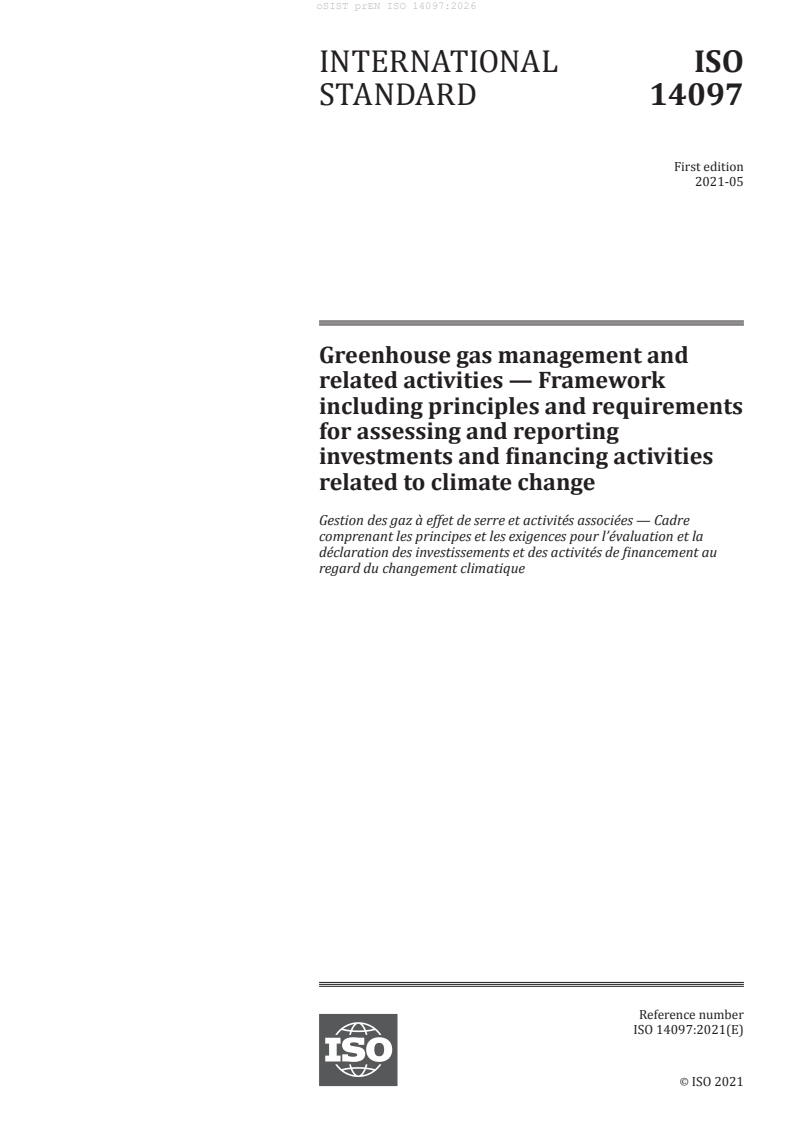
INTERNATIONAL ISO
STANDARD 14097
First edition
2021-05
Greenhouse gas management and
related activities — Framework
including principles and requirements
for assessing and reporting
investments and financing activities
related to climate change
Gestion des gaz à effet de serre et activités associées — Cadre
comprenant les principes et les exigences pour l’évaluation et la
déclaration des investissements et des activités de financement au
regard du changement climatique
Reference number
ISO 14097:2021(E)
©
ISO 2021
ISO 14097:2021(E)
© ISO 2021
All rights reserved. Unless otherwise specified, or required in the context of its implementation, no part of this publication may
be reproduced or utilized otherwise in any form or by any means, electronic or mechanical, including photocopying, or posting
on the internet or an intranet, without prior written permission. Permission can be requested from either ISO at the address
below or ISO’s member body in the country of the requester.
ISO copyright office
CP 401 • Ch. de Blandonnet 8
CH-1214 Vernier, Geneva
Phone: +41 22 749 01 11
Email: copyright@iso.org
Website: www.iso.org
Published in Switzerland
ii © ISO 2021 – All rights reserved
ISO 14097:2021(E)
Contents Page
Foreword .v
Introduction .vi
1 Scope . 1
2 Normative references . 1
3 Terms and definitions . 1
4 Principles . 7
4.1 General . 7
4.2 Description of principles . 7
4.2.1 Relevance . . 7
4.2.2 Consistency . 7
4.2.3 Completeness . 7
4.2.4 Conservativeness . 7
4.2.5 Long-term orientation . 8
4.2.6 Transparency . 8
4.2.7 Verifiability . 8
4.2.8 Accuracy . 8
4.2.9 Synergy . 8
4.2.10 Coherence . 8
4.2.11 Ability to influence . 8
4.2.12 Effectiveness . 8
4.2.13 Evidence-based . 8
4.2.14 Goal-oriented . 8
4.2.15 Additionality-based . 8
5 Framework for disclosing a financier’s climate change risks and opportunities .9
5.1 General . 9
5.2 Financier’s business strategy and financial planning over the short, medium and
long term . 9
5.2.1 Identification of climate change risks and opportunities over the short,
medium and long term . 9
5.2.2 Financiers’ governance of climate change risks and opportunities . 9
5.2.3 Influence of climate change risks on financier’s business and strategy .10
5.2.4 Investees’ climate change risks and opportunities .11
5.3 Targets related to climate change risks and opportunities .11
5.4 Managing climate change risks .11
5.5 Metrics and methodologies used over the short, medium and long term .12
6 Framework for assessing, monitoring and reporting the impact of a financier’s
climate action on climate goals .13
6.1 General .13
6.2 Climate strategy and policy .13
6.3 Climate action planning and documentation .14
6.3.1 General.14
6.3.2 Defining attributes of the climate action taken .14
6.3.3 Defining the climate action .15
6.3.4 Expected outputs of the climate action .16
6.3.5 Expected outcomes of the climate action .16
6.3.6 Expected impact of the climate action .18
6.4 Monitoring of the climate action and respective outputs, outcomes and impacts .19
6.4.1 Monitoring plan .19
6.4.2 Documentation of expected outputs, outcomes and impacts .19
6.5 Assessment of the impact of the financier’s climate action .20
6.6 Reporting on the financier’s climate action(s) .21
6.6.1 General.21
ISO 14097:2021(E)
6.6.2 Required information .21
6.7 Recommended information .23
6.7.1 General.23
6.7.2 Defining the climate action .24
6.7.3 Expected output of the climate action .24
6.7.4 Expected outcome of the climate action .24
6.7.5 Expected impact of the investee’s actions on the achievement of the
climate goals .24
7 Assessing and reporting the GHG emissions associated with the actions of the
financier without climate objectives .25
8 Document retention and record-keeping .25
9 Verification and validation .25
Annex A (informative) Flow chart of the relationship between Clauses 6 and 7 .27
Annex B (informative) Indicative list of actions for the financier .29
Annex C (informative) Guidance on the selection of scenarios .32
Annex D (informative) Guidance on outcome and emissions trajectory quantification .34
Annex E (informative) Examples of opportunities, positive impact and sectoral activities
associated with climate action .39
Bibliography .43
iv © ISO 2021 – All rights reserved
ISO 14097:2021(E)
Foreword
ISO (the International Organization for Standardization) is a worldwide federation of national standards
bodies (ISO member bodies). The work of preparing International Standards is normally carried out
through ISO technical committees. Each member body interested in a subject for which a technical
committee has been established has the right to be represented on that committee. International
organizations, governmental and non-governmental, in liaison with ISO, also take part in the work.
ISO collaborates closely with the International Electrotechnical Commission (IEC) on all matters of
electrotechnical standardization.
The procedures used to develop this document and those intended for its further maintenance are
described in the ISO/IEC Directives, Part 1. In particular, the different approval criteria needed for the
different types of ISO documents should be noted. This document was drafted in accordance with the
editorial rules of the ISO/IEC Directives, Part 2 (see www .iso .org/ directives).
Attention is drawn to the possibility that some of the elements of this document may be the subject of
patent rights. ISO shall not be held responsible for identifying any or all such patent rights. Details of
any patent rights identified during the development of the document will be in the Introduction and/or
on the ISO list of patent declarations received (see www .iso .org/ patents).
Any trade name used in this document is information given for the convenience of users and does not
constitute an endorsement.
For an explanation of the voluntary nature of standards, the meaning of ISO specific terms and
expressions related to conformity assessment, as well as information about ISO’s adherence to the
World Trade Organization (WTO) principles in the Technical Barriers to Trade (TBT), see www .iso .org/
iso/ foreword .html.
This document was prepared by Technical Committee ISO/TC 207, Environmental management,
Subcommittee SC 7, Greenhouse gas management and related activities.
Any feedback or questions on this document should be directed to the user’s national standards body. A
complete listing of these bodies can be found at www .iso .org/ members .html.
ISO 14097:2021(E)
Introduction
0.1 The impact of financiers’ actions on the achievement of climate goals
Every financing or investment decision has an impact, whether positive or negative, on the climate and/
or can in turn be affected by climate change. This dual impact is considered as a “double materiality”,
i.e. how climate change affects the value of a company and how a company’s activities have an impact
on the climate by reducing greenhouse gas (GHG) emissions in the real economy, reducing vulnerability
to the impacts of climate change and increasing resilience.
[12]
To achieve the goals of the 2015 Paris Agreement and to maintain stability in the financial system,
the world needs to transition to a low-carbon and climate-resilient economy. To support this transition,
there is a need to undertake a vast reallocation of the investee capital from high-carbon to low-carbon
assets, assets with negative emissions and assets that are resilient in the short, medium and long term.
In addition to promoting financing for an already de-carbonized or low carbon activity (e.g. in the
area of renewable energy), it is important to promote financing for transition actions towards the de-
carbonization of GHG emitting industries and sectors as well, as a part of climate finance contributing
to the mitigation of climate change. Climate transition finance should be considered as financing
for businesses on a transition path towards achieving the ambition of the Paris Agreement and the
reduction target of each country based on the Paris Agreement. While green investments expand across
borders worldwide, transition pathways aligned with the Paris Agreement can differ from region to
region and from country to country, depending on the industrial structure, and/or the role played in the
overall global value chain. Therefore, “financing for a transition” should adopt an inclusive and flexible
approach that can be applied to various circumstances of countries and regions without excluding
specific sectors, industries or technologies from its scope, and further details should be considered by
each country or region based on its respective circumstances.
Financiers have a key role to play in this transformation because their day-to-day decisions can
influence the behaviour of “investees” (e.g. companies, clients, borrowers) in the real economy. Such an
influence can include capital and research and development expenditure plans, the decision to retire (or
not) high-carbon assets, or other aspects of corporate strategies. Similarly, financiers can influence the
investment decisions of their clients due to their potentially broad-ranging roles as creditors, financial
advisors or asset managers. The day-to-day decisions of financiers can have both positive and negative
consequences on the achievement of climate goals.
Most financiers manage their assets without an explicit objective or specific strategy related to climate
change. These financiers’ decisions and related actions can affect investees that have an impact on the
climate and can be exposed to climate-related risks. Any resulting effect, which can be thought of as
unintentional, can have positive or negative consequences both for the climate and for the assets of the
financiers. This document refers to these financiers as “financiers without climate objectives”.
In contrast, some financiers explicitly aim to support climate goals either by setting explicit objectives
or by creating specific strategies related to climate change. This document refers to these financiers as
“financiers with climate objectives”. These financiers influence investees through “climate actions” that
will lead to mitigation of climate change or enhancement of adaptation, including but not limited to:
— the use of voting rights associated with share ownership;
— the use of influencing power as creditors;
— setting conditionality associated with lending or security issuance;
— making preferential financing available for targeted activities that face a financing gap;
— conducting policy advocacy.
vi © ISO 2021 – All rights reserved
ISO 14097:2021(E)
The finance sector’s active role in supporting the global concerted efforts to achieve international
[12]
climate goals has been acknowledged in Article 2.1c of the Paris Agreement and by the following
non-exhaustive list of organizations and initiatives:
— the United Nations (United Nations Environmental Programme Inquiry, Non-state Actors Zone for
Climate Action platform hosted by UN Climate Change);
— the Organization for Economic Cooperation and Development (OECD):
— the G20 (Green Finance Study Group);
[16]
— the European Commission through the Action Plan on Financing Sustainable Growth (2018) ;
[17]
the Guidelines on Reporting Climate-related Information (2019) , the Non-Financial Reporting
[18] [19]
Directive (2014) and the Non-Binding Guidelines on Non-Financial Reporting (2017) ;
— various financial supervisors and central banks across the world who joined forces in the Network
for Greening the Financial System (NGFS);
— the UN Principles for Responsible Banking;
— the UN-convened Net-Zero Asset Owner Alliance.
In this context, this document provides principles, requirements and guidance to define, monitor, assess
and report on financial institutions’ actions related to climate change and their respective contribution
to the achievement of the climate goals. The framework can be applied by financiers who undertake
deliberate climate actions, as well as by financiers without climate objectives or strategies.
For financiers with climate objectives, the framework is built around the theory of change (TOC)
approach, illustrated in Figure 1.
Figure 1 — Theory of change approach
The TOC process depends on defining all of the necessary and sufficient conditions required to bring
about a given long-term outcome and impact. The TOC explains the intended path the climate action
will take to achieve the (expected) impact. This is done by describing the causal linkages between
the objective established by the financier, the climate action the financier plans to take to achieve the
objective, the output(s) of the action and finally the outcome that will lead to the impact.
For financiers without climate objectives, the framework describes how to disclose on the GHG
emissions changes of investees in their financial portfolio and the decisions and actions taken that can
relate to the investees who are responsible for an increase or decrease in emissions.
ISO 14097:2021(E)
0.2 The financial implications of climate change for the finance sector
For the finance sector, both the transition to a low-carbon emission and climate-resilient economy and
the negative impact arising from environmental upheavals and civil society preferences can influence
asset valuation and thus result in risks and opportunities for financiers.
In 2016, the G20’s Financial Stability Board (FSB) initiated a private sector-led group, the Task Force
on Climate-Related Financial Disclosures (TCFD), which explored these climate-related risks and
opportunities and developed a set of high-level recommendations regarding their disclosure of the
assessment and management of climate-related risks and opportunities.
These climate-related risks and opportunities for the finance sector have also been acknowledged
by many financial regulators and supervisory authorities across the world, including the European
Commission, the G20 and the NGFS.
[13]
Following the release of the TCFD recommendations in 2017 , a number of methodological, reporting
and disclosure frameworks have been and are in the process of being produced by various organizations
to facilitate stakeholders to measure and report on climate-related risks and opportunities.
[13]
In this context, this document contributes to the implementation of the TCFD recommendations ,
by providing guidance on the disclosure of the identification, assessment and management of climate-
related risks and opportunities and related climate actions.
This document can also be used to correlate climate performance and financial performance.
0.3 How to approach this document
As mentioned, a financier has financial and other objectives underpinning its business activities. In
relation to climate change, the financier can have different motivations for integrating climate-related
issues in its investment and lending processes. Objectives can include, but are not limited to:
a) understanding and managing climate change risks and leveraging opportunities;
b) contributing to the achievement of climate goals through the influence they have on investees.
This document provides the following requirements and related guidance for the processes
implemented to achieve these objectives. Depending on its objectives, the financier applies the clauses
indicated for the following purposes.
— Managing climate change risks and leveraging opportunities: Clause 5 provides requirements and
guidance on the identification, assessment and disclosure of climate change risks and opportunities.
— Understanding its contribution to the achievement of climate goals: Clause 6 provides a framework to
identify, monitor and assess the impact of climate action and estimate the GHG emissions associated
with investment, as well as for financing activities related to investees for which no climate action
is carried out.
NOTE See Annex A for a flow chart on the different clauses and subclauses of this document.
A financier’s business decisions can be driven only by financially related objectives (or at least no
climate objectives). However, these financier decisions can also have an impact on the climate and,
consequently, on the achievement of its climate goals, as well as exposing its business to climate-related
risks. In this instance, the financier shall follow Clause 7 to understand the GHG emissions changes and
trends associated with the investees in its portfolio and Clause 5 for disclosing climate-related risks.
Since the framework can be used for a variety of purposes, and also by financiers without climate
objectives or strategies, it is important to note that conformity does not equate to high ambition or
success with regard to climate actions. Users of the framework are encouraged to observe this caveat in
their reporting to third parties.
Clause 9 recommends verification and validation as the preferred approaches for conformity
assessment.
viii © ISO 2021 – All rights reserved
INTERNATIONAL STANDARD ISO 14097:2021(E)
Greenhouse gas management and related activities —
Framework including principles and requirements
for assessing and reporting investments and financing
activities related to climate change
1 Scope
This document specifies a general framework, including principles, requirements and guidance for
assessing, measuring, monitoring and reporting on investments and financing activities in relation
to climate change and the transition into a low-carbon economy. The assessment includes the
following items:
— the alignment (or lack thereof) of investment and financing decisions taken by the financier with
low-carbon transition pathways, adaptation pathways, and climate goals;
— the impact of actions through the financier’s investment and lending decisions towards the
achievement of climate goals in the real economy, i.e. mitigation (greenhouse gas emissions) and
adaptation (resilience);
— the risks to owners of financial assets (e.g. private equities, listed stocks, bonds, loans) arising from
climate change.
To support the financier’s assessment of the impact of investment and lending decisions, this document
provides guidance for the financier on how to:
— set targets and determine metrics to be used for tracking progress related to the low-carbon
transition pathways of investees;
— determine low-carbon transition and adaptation trajectories of investees;
— document the causality or linkage between its climate action and its outputs, outcomes and impacts.
This document is applicable to financiers, i.e. investors and lenders. It guides their reporting activities
to the following third parties: shareholders, clients, policymakers, financial supervisory authorities
and non-governmental organizations.
2 Normative references
There are no normative references in this document.
3 Terms and definitions
For the purposes of this document, the following terms and definitions apply.
ISO and IEC maintain terminological databases for use in standardization at the following addresses:
— ISO Online browsing platform: available at https:// www .iso .org/ obp
— IEC Electropedia: available at http:// www .electropedia .org/
ISO 14097:2021(E)
3.1
climate goals
international long-term goals based on mitigation and adaptation priorities
Note 1 to entry: International climate goals are defined under the Paris Agreement.
Note 2 to entry: The Paris Agreement defines the following mitigation and adaptation goals: a) holding the
increase in the global average temperature to well below 2 °C above pre-industrial levels and pursuing efforts
to limit the temperature increase to 1,5 °C above pre-industrial levels, recognizing that this would significantly
reduce the risks and impacts of climate change (3.2); b) increasing the ability to adapt to the adverse impacts
of climate change and foster climate resilience (3.5) and low greenhouse gas emissions development, in a
manner which does not threaten food production; c) making finance flows aligned with a pathway towards low
greenhouse gas emissions and climate-resilient development.
[12]
[SOURCE: Paris Agreement , Article 2.1]
3.2
climate change
change in climate that persists for an extended period, typically decades or longer
[15]
[SOURCE: Intergovernmental Panel on Climate Change (IPCC) , modified]
3.3
climate change mitigation
human intervention to reduce the emission sources or enhance the sinks of greenhouse gases (GHGs)
[SOURCE: ISO 14080:2018, 3.1.2.1, modified — The word “emission” has been added to the definition.]
3.4
climate change adaptation
adaptation to climate change
process of adjustment to actual or expected climate and its effects
EXAMPLE Changes to human infrastructure and/or some natural systems to reduce the impacts of
increased/decreased rainfall, higher temperatures, scarce water or more frequent storms.
Note 1 to entry: In human systems, adaptation seeks to moderate or avoid harm to human livelihoods or exploit
beneficial economic opportunities (3.13).
Note 2 to entry: In some natural systems, human intervention can facilitate adjustment expected climate and its
effects.
[SOURCE: ISO 14090:2019, 3.1, modified — The term “climate change adaptation” has been made the
preferred term, the example has been added, and “to human livelihoods” and “economic” have been
added to Note 1 to entry.]
3.5
resilience
adaptive capacity (3.6) of an organization in a complex and changing environment
[15]
Note 1 to entry: Intergovernmental Panel on Climate Change (IPCC) defines resilience as “capacity of social,
economic, and environmental systems to cope with a hazardous event or trend or disturbance, responding or
reorganizing in ways that maintain their essential function, identity and structure, while also maintaining the
capacity for adaptation, learning and transformation”.
[SOURCE: ISO Guide 73:2009, 3.8.1.7, modified — Note 1 to entry has been added.]
3.6
adaptive capacity
ability of systems, institutions, humans and other organisms to adjust to potential damage, to take
advantage of opportunities (3.13) or to respond to consequences
[15]
[SOURCE: Intergovernmental Panel on Climate Change (IPCC) ]
2 © ISO 2021 – All rights reserved
ISO 14097:2021(E)
3.7
financier
investor (3.8) and lender (3.10)
3.8
investor
individual or organization holding equity or debt categorized as financial assets, including but not
limited to asset owners (e.g. pension funds, insurance companies), asset managers and banks
EXAMPLE A fund holding an equity share is one of the investors of the company that issued the share.
3.9
investment
allocation of resources to achieve defined objectives and other benefits
Note 1 to entry: Investments relate to three different types: a) real assets (e.g. factory, mine, building); b) financial
assets (e.g. any form of debt, equity or other financing); c) intangible assets (e.g. assets related to research and
development).
3.10
lender
individual or organization that loans money to a borrower to finance consumption or investment
(3.9), on the expectation of repayment on contractual terms, usually within a stated period and with
interest payment
3.11
investee
organization other than financiers (3.7) that implements its activities using equity or debt investments
(3.9), the latter categorized as liabilities
EXAMPLE A company issuing a bond is the investee of the bond investor (3.8).
3.12
client
professional or non-professional stakeholder of a financier (3.7) that subscribes to its financial products
(e.g. investment (3.9)/insurance products, savings accounts) or institutional investor (3.8) that uses the
financier’s services
3.13
opportunity
situation from which an organization can derive benefit
Note 1 to entry: In this document, the focus is on opportunities that arise from climate change (3.2), i.e. the
positive impacts related to climate change (e.g. new markets, new or improved supply chains, research and
development and technology development)
Note 2 to entry: Opportunities for an organization can be a result of taking action to adapt to the physical impacts
of climate change and to mitigate climate change (e.g. efforts to improve resource efficiency and cost savings, the
adoption and utilization of low-emission energy sources, the development of new products and services, building
resilience (3.5) along the supply chain).
Note 3 to entry: Opportunities for an organization can arise from the implementation of climate policy
Note 4 to entry: Opportunities for an organization can arise from expanding, evolving or emerging markets and
from contributions (3.16) to the organization’s sustainability. Opportunities can include: new products, services,
customers and markets; reputational benefits; supply chain security; improved resilience; improved processes;
and innovation. Opportunities can be identified across value chains and their respective enabling environments.
Note 5 to entry: Climate-related opportunities will vary depending on the region, market and industry in which
an organization operates.
ISO 14097:2021(E)
3.14
share in total financing
quantitative indicator measuring the weight of a financier (3.7) or category of financiers in the total
amount of financing received by an investee (3.11)
Note 1 to entry: Share in total financing can relate to the share in the total debt or total liabilities accounted on
the balance sheet of the investee or the share in the flow of financing received during any defined period of time.
EXAMPLE Bank A holds 80 % of the outstanding debt of a company. Bank B holds 30 % of the debt raised by
the company in the past six months. The shares in total financing related to “outstanding debt of a company” and
“debt raised by the company in the past six months” are respectively 80 % and 30 %.
3.15
climate action
initiative of a financier (3.7) to achieve climate goals (3.1) based on mitigation and adaptation priorities
Note 1 to entry: Climate action intends to a) reduce or prevent emissions of greenhouse gases or enhance
removals, and b) reduce vulnerability, maintain and increase the resilience (3.5) from, and increase the adaptive
capacity (3.6) of, human and ecological systems to adverse climate change (3.2) impacts.
Note 2 to entry: The initiative refers to a decision made by the financier or a group of financiers to exercise
its influence in a way that aims at achieving climate goals. It can be a specific investment/lending decision, a
permanent change in the investment/lending strategy, policy and processes of the financier(s), or actions that
aim at mobilizing other financiers to weigh in and use their influence.
Note 3 to entry: The achievement is characterized by changes in the real economy that are aligned with
climate goals.
EXAMPLE Use of shareholder voting rights to support a climate-related resolution, changes in the climate-
related conditions associated with the provision of a loan (see Annex B for more examples).
Note 4 to entry: Climate action(s) can be collective or individual.
Note 5 to entry: A climate action can consist of multiple activities (e.g. providing finance, sending letters to
investees (3.11), having bilateral meetings, exercising shareholder rights) substantiating a general action (e.g.
shareholder engagement).
[SOURCE: ISO 14080:2018, 3.1.1.1, modified — The definition has replaced “initiative to achieve climate
change measures or goals based on mitigation and/or adaptation priorities under climate change
policies”, “of greenhouse gases” has been added to Note 1 to entry, and Notes 2 to 5 to entry and the
example have been added.]
3.16
contribution
overall effect of a financier’s (3.7) actions on the achievement of climate goals (3.1)
Note 1 to entry: Climate contribution accounts for the effect caused by both a) climate passive decisions and b)
deliberate climate actions (3.15) driven by an objective that supports the achievement of climate goals.
Note 2 to entry: For climate change mitigation (3.3), it is usually expressed in GHG emission units. For climate
change adaptation (3.4), it may be expressed in terms of financial metrics, e.g. the reduction of the costs incurred
by climate-related natural disasters.
Note 3 to entry: Contribution can be positive or negative.
3.17
output of the climate action
change(s) arising from a financier’s (3.7) climate action (3.15) that influences the investee (3.11)
decision making
Note 1 to entry: The output can be quantitative or qualitative.
4 © ISO 2021 – All rights reserved
ISO 14097:2021(E)
EXAMPLE The available equity for an emerging clean technology is dramatically increased; a shareholder
resolution on climate-related issues is passed at the annual general meeting; a legal process on climate-related
issues has been started.
3.18
outcome of the climate action
actual measurable change(s) observed in the activities of an investee (3.11), as a result of the output of
the climate action (3.17)
Note 1 to entry: The outcome is measured as an effect of the financier’s (3.7) influence in the activities of the
investee.
3.19
impact of the climate action
consequence of an outcome, which measures the extent to which the climate action (3.15) contributes to
the climate goals (3.1)
Note 1 to entry: For mitigation, the impact of the climate action is usually measured in physical units such as tons
of GHG emission reductions.
Note 2 to entry: The impact of the climate action can lead to a decrease in the financier’s (3.7) exposure to climate-
related financial risks and opportunities (3.13).
3.20
target
measurable outcome and impact a financier (3.7) intends to achieve with its climate
action(s) (3.15) with the ultimate goal being to maximize the financier’s impact given available market
opportunities (3.13)
Note 1 to entry: A mitigation target for a financier is considered science-based when it aims for a change in the
investee’s (3.11) behaviour, contributing to reducing GHG emissions in the real economy at a scale and pace that is
commensurate with climate goals (3.1).
Note 2 to entry: To achieve the target, the financier can carry out one or several climate actions.
Note 3 to entry: A target can be set at the portfolio level and cascaded into individual climate actions. It can be set
for an individual climate action or a series of climate actions.
3.21
investee target
measurable outcome and impact of investee (3.11) activities
3.22
external factor
factor affecting outputs, outcomes and impacts, but that is beyond the scope of influence of the climate
actions (3.15) and/or activities of a financier (3.7)
EXAMPLE 1 The removal of a coal-based power plant from the investment (3.9) plan of the investee (3.11) as a
consequence of a new public policy prohibiting operation of coal-based power plants.
EXAMPLE 2 Non-governmental organization pressure; changes in technology prices; subsidies; natural
disasters; locked out strikes.
3.23
science-based mitigation target
target (3.20) adopted by investees (3.11) to reduce GHG emissions in line with the scientifically defined
level of decarbonization required by climate change mitigation (3.3) goals
ISO 14097:2021(E)
3.24
trajectory
expected future outcome and GHG emissions pathway of an investee (3.11) against which changes in
emissions or outcomes are measured
Note 1 to entry: There are different types of trajectories: a) the business as usual trajectory, which is the
expected future outcome and related GHG trajectory of the investee before climate action (3.15) takes place; b)
the targeted trajectory, which is the expected outcome and related GHG trajectory resulting from climate action;
and c) the science-based trajectory, which is an expected future outcome and related GHG trajectory in line with
the scientifically defined level of decarbonization required by climate change mitigation (3.3) goals.
Note 2 to entry: The business as usual trajectory can be considered as the baseline trajectory for comparison and
monitoring purposes.
3.25
transition risk
risk related to the transition to a lower-carbon economy
Note 1 to entry: The transition risk is related to policy/political initiatives, legal and regulatory obligations,
contractual obligations, technology and market changes to address mitigation and adaptation requirements
related to climate change (3.2).
Note 2 to entry: Transition risk results in varying levels of impact on the financial performance and reputation of
the financier (3.7).
Note 3 to entry: Transition risks are related to current and anticipated policy constraints and incentives in
relevant jurisdictions, technology changes and availability, and market changes.
[13]
[SOURCE: Task Force on Climate-Related Financial Disclosures (TCFD) ]
3.26
physical risk
risk resulting from event-driven (acute) or longer-term shifts (chronic) in climate patterns associated
with climate change (3.2)
Note 1 to entry: Physical risks can have financial implications for organizations, such as direct impact to assets
and indirect impacts on supply chains owing to changes in water availability, sourcing and quality, food s
...
Questions, Comments and Discussion
Ask us and Technical Secretary will try to provide an answer. You can facilitate discussion about the standard in here.
Loading comments...