

kSIST FprEN 17779:2026
(Main)Organo-mineral fertilizers - Extraction of phosphorus soluble in a neutral ammonium citrate solution
- Abstract
This document specifies the procedure for the extraction of different organic and organo-mineral fertilizers with a solution of neutral ammonium citrate to enable a subsequent determination of phosphorus.
This document is applicable to fertilizing product blends, where the blend is a mix of at least two of the following components: fertilizers, liming materials, soil Improvers, growing media, inhibitors, plant biostimulants, and where the following category: organic fertilizers, organo-mineral fertilizers is the highest % in the blend by mass or volume, or in the case of liquid form by dry mass. If the organic fertilizer or the organo-mineral fertilizer is not the highest % in the blend, the European Standard for the highest % of the blend applies. In case a fertilizing product blend is composed of components in equal quantity, the user decides which standard to apply.
NOTE Variations in analytical methods for fertilizing product blends can lead to differing results as some components or matrix interactions can affect the outcome. Validation procedures have shown that developed standard methods are robust and reliable across diverse product compositions, but possible interferences and unexpected results when analysing fertilizing product blends are possible.
- Status
- Not Published
- Public Enquiry End Date
- 01-Apr-2026
- Technical Committee
- KAT - Soil quality
- Current Stage
- 5020 - Formal vote (FV) (Adopted Project)
- Start Date
- 17-Nov-2026
- Due Date
- 05-Jan-2027

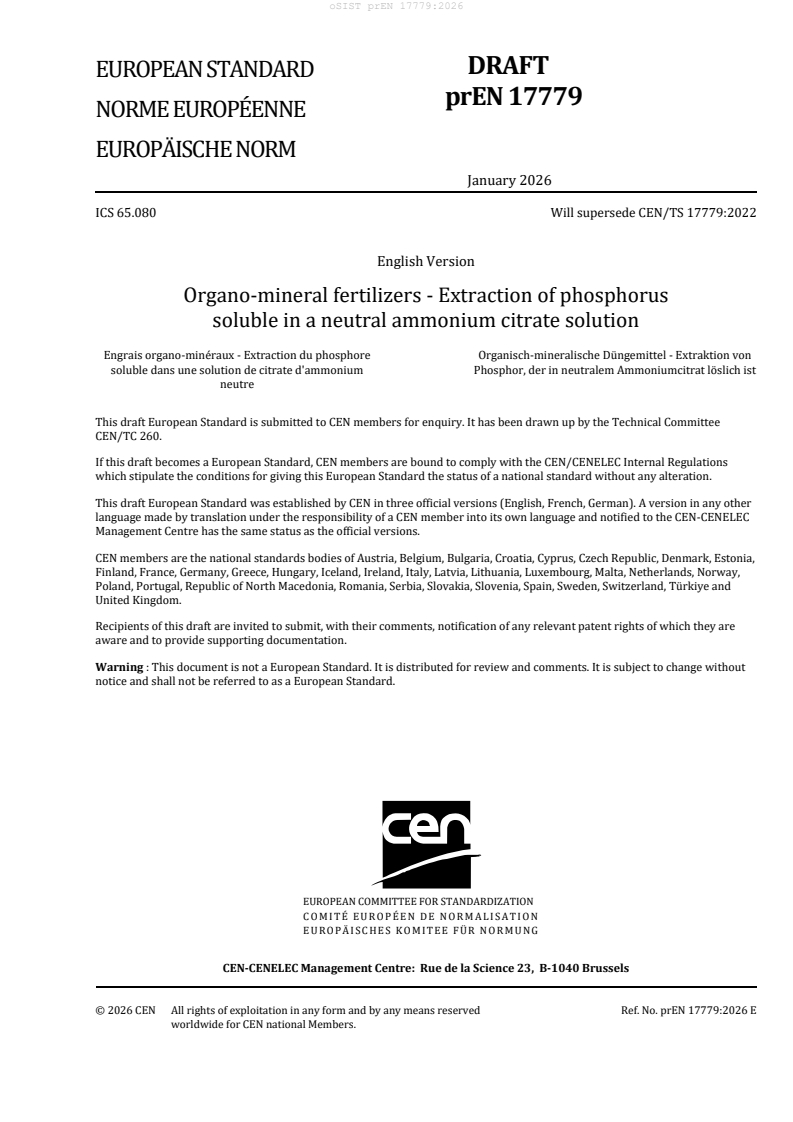
kSIST FprEN 17779:2026 is a draft European Standard from CEN for extracting phosphorus from organic and organo-mineral fertilizers with neutral ammonium citrate. It specifies the laboratory procedure used before phosphorus is determined, so it is mainly for testing laboratories, manufacturers, and quality or conformity-checking teams working with these fertilizing products.
What does kSIST FprEN 17779:2026 specify?
kSIST FprEN 17779:2026 specifies the extraction of phosphorus from different organic and organo-mineral fertilizers using a neutral ammonium citrate solution. The purpose is to prepare the sample for a subsequent phosphorus determination.
The scope also covers certain fertilizing product blends. The document applies when the blend contains at least two component types from the listed group and the organic fertilizer or organo-mineral fertilizer category is the highest percentage in the blend by mass, by volume, or, for liquids, by dry mass. If another component category is dominant, the relevant European Standard for that highest-share category applies. When components are present in equal quantity, the user decides which standard to use.
The document is organized into a short analytical method:
- Clause 1 Scope
- Clause 2 Normative references
- Clause 3 Terms and definitions
- Clause 4 Principle
- Clause 5 Sampling and sample preparation
- Clause 6 Reagents
- Clause 7 Apparatus
- Clause 8 Procedure
- Clause 9 Test report
What are the key requirements of kSIST FprEN 17779:2026?
kSIST FprEN 17779:2026 is a sample-preparation and extraction method, so the critical points are the reagent conditions, temperature control, timing, and how the extract is handled before analysis.
Extraction principle and downstream analysis
Clause 4 states that phosphorus is extracted under specified conditions with neutral ammonium citrate at pH 7. The extract is then analysed according to prEN 17774. In practice, the extraction step is not the final measurement - it prepares the solution for the phosphorus test that follows.
Sampling and sample preparation
Clause 5 says sampling is outside the method, while sample preparation follows EN 1482-2. It also points users to EN 1482-1 and EN 1482-3 for recommended sampling methods. This matters because a representative sample is needed before any extraction result can be trusted.
Reagent quality
Clause 6 requires water with low conductivity and free from the elements to be determined, ammonium hydroxide solution, citric acid, and a neutral ammonium citrate solution at pH 7. The standard gives a preparation route and allows a commercially certified solution as an alternative. In practice, users must keep the reagent at the correct pH, because the extraction depends on that chemical condition.
Apparatus and temperature control
Clause 7 calls for ordinary laboratory equipment plus a pH-meter, flasks, a water bath set to (65 ± 2) °C, and phosphate-free filter paper. The controlled temperature and clean filtration are important because they affect extraction efficiency and reduce contamination.
Test portion and extraction step
Clause 8 specifies the mass of test portion, the volume of ammonium citrate solution, the heating, stirring, and extraction time of (60 ± 1) min. It also sets the handling sequence after extraction: cool, transfer quantitatively, make up to volume, mix, and filter. For pure or partially digested rock phosphate, a larger test portion is used. These steps matter because the method depends on consistent suspension, contact time, and complete transfer.
Timing before determination
Clause 8 says the phosphorus determination should be done on the same day as extraction, or the extract may be kept closed at (4 ± 3) °C for up to two days. This limits storage effects on the extract and helps keep results comparable.
Test report
Clause 9 requires identification details for the sample, the method reference, sampling information if known, the extraction finish date, and any optional details or incidents that could affect the result. This supports traceability in laboratory records and audits.
What terms does kSIST FprEN 17779:2026 define?
The document uses the vocabulary from EN 12944-1 and EN 12944-2. Key terms include:
- Neutral ammonium citrate solution - the citrate-based extractant adjusted to pH 7 and used to remove phosphorus from the fertilizer sample.
- Fertilizing product blends - mixtures of at least two listed component types, where the standard to use depends on which category is dominant.
- Organic fertilizers - one of the product categories covered by the scope when it is the highest-share component category in a blend.
- Organo-mineral fertilizers - the main product category covered by the method when it is the highest-share component category in a blend.
- Test portion - the measured amount of laboratory sample actually placed into the extraction flask.
- Extract - the liquid obtained after the extraction step and before phosphorus determination.
- Laboratory sample - the sample received for analysis, which should be representative of the product under test.
Who uses kSIST FprEN 17779:2026?
kSIST FprEN 17779:2026 is used by laboratories that analyse fertilizers and fertilizer blends, especially where phosphorus in organic or organo-mineral products must be measured after extraction. It is also relevant to manufacturers, quality control teams, and regulatory or conformity-assessment users who need a common extraction step for product checking. The scope also makes it relevant to teams working with liming materials, soil improvers, growing media, inhibitors, and plant biostimulants when these appear in fertilizing product blends.
What changed in kSIST FprEN 17779:2026 from the previous edition?
kSIST FprEN 17779:2026 supersedes CEN/TS 17779:2022. The foreword states these significant changes:
- the CEN Technical Specification has been adopted as a European Standard
- the title was adapted
- an Introduction was added
- Clause 1 Scope was updated, including clarification of fertilizing product blends and the analytical method to be used
- Clause 6 Reagents was added
- Clause 9 Test report was added
- the Bibliography was updated
Which standards are used with kSIST FprEN 17779:2026?
The document names these normative references:
- prEN 17774 - used for the determination of phosphorus after extraction by ICP-AES after extraction by water and weak solvents
- EN 12944-1 - provides general fertilizer and liming material vocabulary
- EN 12944-2 - provides fertilizer-specific terms and definitions
- EN 1482-2 - gives general sample preparation provisions
The document also points users to:
- EN 1482-1 - recommended general sampling provisions
- EN 1482-3 - sampling of static heaps
- Regulation (EU) 2019/1009 - cited in the bibliography as the EU fertilising products regulation
What does the kSIST FprEN 17779:2026 document contain?
kSIST FprEN 17779:2026 contains a principle section, reagent specifications, apparatus requirements, and a step-by-step extraction procedure. It gives the pH, temperature, timing, flask sizes, filtration step, and storage conditions used before phosphorus determination.
It also includes a test report section that tells laboratories what information to record for traceability. The bibliography points to the related sampling standards and the EU fertilising products regulation.
Relations
- Effective Date
- 01-Mar-2026
Get Certified
Connect with accredited certification bodies for this standard

Control Union Certifications
Global certification for agriculture and sustainability.

ECOCERT
Organic and sustainability certification.

FSC International
Forest Stewardship Council certification.
Sponsored listings
Frequently Asked Questions
kSIST FprEN 17779:2026 is a draft published by the Slovenian Institute for Standardization (SIST). Its full title is "Organo-mineral fertilizers - Extraction of phosphorus soluble in a neutral ammonium citrate solution". This standard covers: This document specifies the procedure for the extraction of different organic and organo-mineral fertilizers with a solution of neutral ammonium citrate to enable a subsequent determination of phosphorus. This document is applicable to fertilizing product blends, where the blend is a mix of at least two of the following components: fertilizers, liming materials, soil Improvers, growing media, inhibitors, plant biostimulants, and where the following category: organic fertilizers, organo-mineral fertilizers is the highest % in the blend by mass or volume, or in the case of liquid form by dry mass. If the organic fertilizer or the organo-mineral fertilizer is not the highest % in the blend, the European Standard for the highest % of the blend applies. In case a fertilizing product blend is composed of components in equal quantity, the user decides which standard to apply. NOTE Variations in analytical methods for fertilizing product blends can lead to differing results as some components or matrix interactions can affect the outcome. Validation procedures have shown that developed standard methods are robust and reliable across diverse product compositions, but possible interferences and unexpected results when analysing fertilizing product blends are possible.
This document specifies the procedure for the extraction of different organic and organo-mineral fertilizers with a solution of neutral ammonium citrate to enable a subsequent determination of phosphorus. This document is applicable to fertilizing product blends, where the blend is a mix of at least two of the following components: fertilizers, liming materials, soil Improvers, growing media, inhibitors, plant biostimulants, and where the following category: organic fertilizers, organo-mineral fertilizers is the highest % in the blend by mass or volume, or in the case of liquid form by dry mass. If the organic fertilizer or the organo-mineral fertilizer is not the highest % in the blend, the European Standard for the highest % of the blend applies. In case a fertilizing product blend is composed of components in equal quantity, the user decides which standard to apply. NOTE Variations in analytical methods for fertilizing product blends can lead to differing results as some components or matrix interactions can affect the outcome. Validation procedures have shown that developed standard methods are robust and reliable across diverse product compositions, but possible interferences and unexpected results when analysing fertilizing product blends are possible.
kSIST FprEN 17779:2026 is classified under the following ICS (International Classification for Standards) categories: 65.080 - Fertilizers. The ICS classification helps identify the subject area and facilitates finding related standards.
kSIST FprEN 17779:2026 has the following relationships with other standards: It is inter standard links to SIST-TS CEN/TS 17779:2023. Understanding these relationships helps ensure you are using the most current and applicable version of the standard.
kSIST FprEN 17779:2026 is associated with the following European legislation: EU Directives/Regulations: 2019/1009; Standardization Mandates: M/564. When a standard is cited in the Official Journal of the European Union, products manufactured in conformity with it benefit from a presumption of conformity with the essential requirements of the corresponding EU directive or regulation.
kSIST FprEN 17779:2026 is available in PDF format for immediate download after purchase. The document can be added to your cart and obtained through the secure checkout process. Digital delivery ensures instant access to the complete standard document.
Standards Content (Sample)
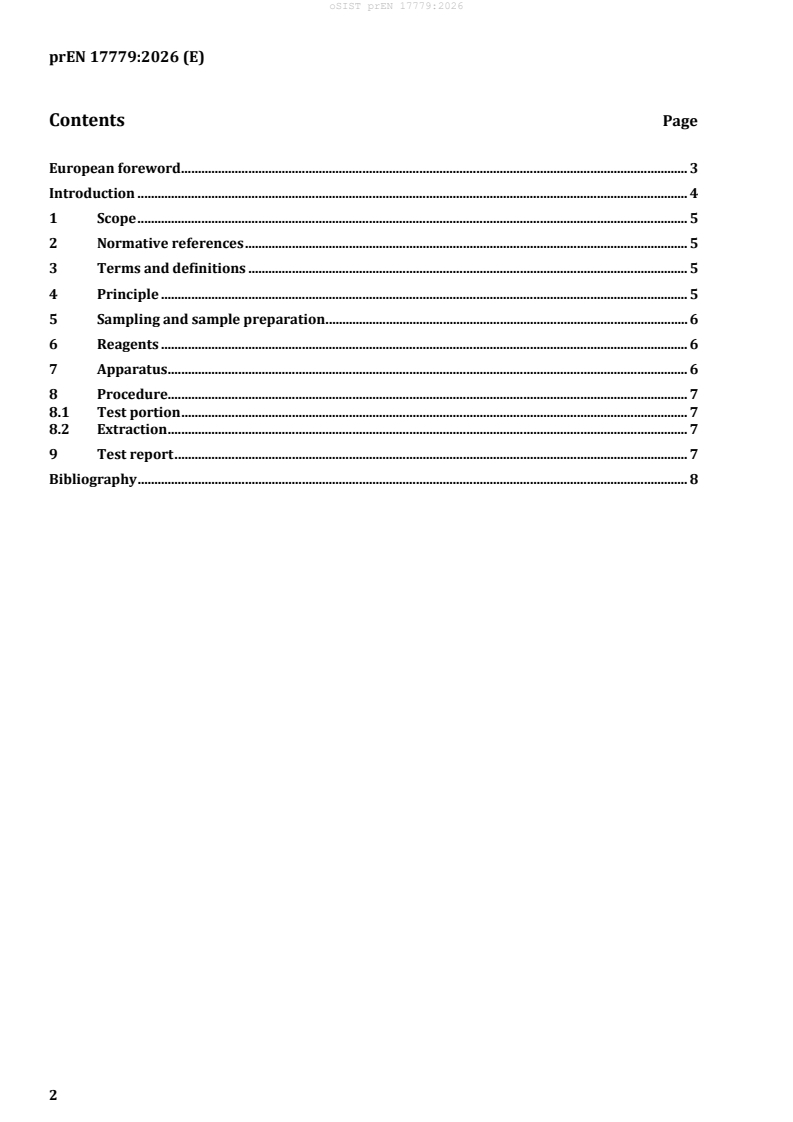
Contents
- Introduction
- 1 Scope
- 2 Normative references
- 3 Terms and definitions
- 4 Principle
- 5 Sampling and sample preparation
- 6 Reagents
- 7 Apparatus
- 8 Procedure
- 8.1 Test portion
- 8.2 Extraction
- 9 Test report
- Bibliography
Introduction
WARNING — Persons using this document should be familiar with usual laboratory practice. This document does not purport to address all of the safety issues, if any, associated with its use. It is the responsibility of the user to establish appropriate health and safety practices and to ensure compliance with any national regulatory conditions.
IMPORTANT — It is absolutely essential that tests conducted according to this document are carried out by suitably trained staff.
oSIST prEN 17779:2026 prEN 17779:2026 (E)
1 Scope
This document specifies the procedure for the extraction of different organic and organo-mineral fertilizers with a solution of neutral ammonium citrate to enable a subsequent determination of phosphorus.
This document is applicable to the fertilizing products blends where a blend is a mix of at least two of the following components: fertilizers, liming materials, soil Improvers, growing media, inhibitors, plant biostimulants, and where the following category: organic fertilizers, organo-mineral fertilizers is the highest % in the blend by mass or volume, or in the case of liquid form by dry mass. If the organic fertilizer or the organo-mineral fertilizer is not the highest % in the blend, the European Standard for the highest % of the blend applies. In case a fertilizing product blend is composed of components in equal quantity, the user decides which standard to apply. Variations in analytical methods for fertilizing product blends can lead to differing results as some components or matrix interactions can affect the outcome. Validation procedures have shown that developed standard methods are robust and reliable across diverse product compositions, but possible interferences and unexpected results when analysing fertilizing product blends are possible.
2 Normative references
The following documents are referred to in the text in such a way that some or all of their content constitutes requirements of this document. For dated references, only the edition cited applies. For undated references, the latest edition of the referenced document (including any amendments) applies. prEN 17774, Organic and organo-mineral fertilizers — Determination of the content of specific elements by ICP-AES after extraction by water and weak solvents EN 12944-1, Fertilizers and liming materials — Vocabulary — Part 1: General terms EN 12944-2, Fertilizers and liming materials — Vocabulary — Part 2: Terms relating to fertilizers EN 1482-2, Fertilizers, liming materials and inhibitors — Sampling and sample preparation — Part 2:
General sample preparation provisions
...