

SIST EN 18207:2026
(Main)Algae and algae products - Determination of the uronic acids content of brown seaweed and alginate products
General Information
- Abstract
This document specifies a method for the quantitative determination of total uronic acids by High Performance Anion Exchange Chromatography coupled with Pulsed Amperometric Detection (HPAEC-PAD) after acid hydrolysis of the samples for algae and algae products. It specifies a method for the determination in one single analysis of mannuronic, glucuronic and guluronic acids in brown seaweed, and mannuronic and guluronic acids in alginate products. The sum of the individual uronic acid values is used for determining the total uronic acid content.
- Status
- Published
- Public Enquiry End Date
- 09-Sep-2025
- Publication Date
- 15-Jun-2026
- Technical Committee
- I13 - Imaginarni 13
- Current Stage
- 6060 - National Implementation/Publication (Adopted Project)
- Start Date
- 02-Jun-2026
- Due Date
- 07-Aug-2026
- Completion Date
- 16-Jun-2026

Overview
SIST EN 18207:2026 sets out the standardized method for quantifying the total uronic acids in brown seaweed and alginate products using High Performance Anion Exchange Chromatography with Pulsed Amperometric Detection (HPAEC-PAD). This standard, developed by SIST in cooperation with CEN/TC 454, ensures reliable and reproducible measurement of uronic acids after acid hydrolysis, critical for quality control in the biobased products and algae industry. It covers the simultaneous determination of mannuronic, glucuronic, and guluronic acids in brown seaweed and the measurement of mannuronic and guluronic acids in alginate derivatives.
Accurate assessment of uronic acid content enables consistent product characterization, compliance with regulatory requirements, and supports traceability throughout the algae and bioproducts supply chain.
Key Topics
- Sample Preparation: Dried and milled samples are required, ensuring consistency per EN 17605:2022.
- Acid Hydrolysis: Polysaccharides are hydrolyzed under controlled acidic conditions (e.g., formic and trifluoroacetic acid) at 50°C to release uronic acids from the biomass matrix.
- Chromatographic Analysis: Application of HPAEC-PAD allows highly selective and sensitive determination of target uronic acids through their separation and electrochemical detection.
- Calibration and Quantification: Use of standard calibration curves for each uronic acid type ensures quantitative accuracy.
- Data Integrity: Integration, calculation, and reporting principles are specified for consistent results across laboratories.
- Precision & Trueness: The method’s precision and reliability were validated via interlaboratory studies, improving confidence in results within the sector.
Applications
SIST EN 18207:2026 is essential for businesses and laboratories involved in the manufacture, quality assurance, or research of:
- Brown Seaweed: Ensuring standardized quantification of uronic acid content in raw algal materials used in food, pharmaceuticals, and cosmetics.
- Alginate Products: Key to confirming the composition and functionality of commercial alginate extracts, gels, and additives.
- Algae-derived Bioproducts: Facilitates product labeling compliance, process optimization, and product development for a range of biobased applications.
- Research and Development: Provides a scientifically robust tool for analyzing polysaccharide composition, supporting innovation in biomaterials and biotechnology.
- Regulatory Compliance & Certification: Assists stakeholders in meeting regulatory standards related to ingredient authenticity, safety, and traceability.
- Market Access: Supports alignment with harmonized European analytical methods, facilitating trade of algae and alginate products.
By adhering to this standard, organizations can ensure reliable assessment of uronic acid composition, fostering transparency and quality in the growing algae sector.
Related Standards
For effective implementation of SIST EN 18207:2026, reference to the following standards is recommended:
- EN 17605:2022 - Algae and algae products - Methods of sampling and analysis - Sample treatment
- EN 17399:2024 - Algae and algae products - Vocabulary
- ISO 5725-2 - Accuracy (trueness and precision) of measurement methods and results - Basic method for the determination of repeatability and reproducibility
- ISO 5725-5 - Alternative methods for the determination of the precision of a standard measurement method
These related standards provide complementary guidance on sample processing, terminology, and analytical quality assurance, reinforcing the value of SIST EN 18207:2026 for the algae and bioproducts industry.
Get Certified
Connect with accredited certification bodies for this standard

BSI Group
BSI (British Standards Institution) is the business standards company that helps organizations make excellence a habit.

Bureau Veritas
Bureau Veritas is a world leader in laboratory testing, inspection and certification services.

DNV
DNV is an independent assurance and risk management provider.
Sponsored listings
Frequently Asked Questions
SIST EN 18207:2026 is a standard published by the Slovenian Institute for Standardization (SIST). Its full title is "Algae and algae products - Determination of the uronic acids content of brown seaweed and alginate products". This standard covers: This document specifies a method for the quantitative determination of total uronic acids by High Performance Anion Exchange Chromatography coupled with Pulsed Amperometric Detection (HPAEC-PAD) after acid hydrolysis of the samples for algae and algae products. It specifies a method for the determination in one single analysis of mannuronic, glucuronic and guluronic acids in brown seaweed, and mannuronic and guluronic acids in alginate products. The sum of the individual uronic acid values is used for determining the total uronic acid content.
This document specifies a method for the quantitative determination of total uronic acids by High Performance Anion Exchange Chromatography coupled with Pulsed Amperometric Detection (HPAEC-PAD) after acid hydrolysis of the samples for algae and algae products. It specifies a method for the determination in one single analysis of mannuronic, glucuronic and guluronic acids in brown seaweed, and mannuronic and guluronic acids in alginate products. The sum of the individual uronic acid values is used for determining the total uronic acid content.
SIST EN 18207:2026 is classified under the following ICS (International Classification for Standards) categories: 13.020.55 - Biobased products. The ICS classification helps identify the subject area and facilitates finding related standards.
SIST EN 18207:2026 is associated with the following European legislation: Standardization Mandates: M/547. When a standard is cited in the Official Journal of the European Union, products manufactured in conformity with it benefit from a presumption of conformity with the essential requirements of the corresponding EU directive or regulation.
SIST EN 18207:2026 is available in PDF format for immediate download after purchase. The document can be added to your cart and obtained through the secure checkout process. Digital delivery ensures instant access to the complete standard document.
Standards Content (Sample)
SLOVENSKI STANDARD
01-julij-2026
Alge in izdelki iz alg - Ugotavljanje vsebnosti uronskih kislin v rjavih morskih algah
in alginatnih izdelkih
Algae and algae products - Determination of the uronic acids content of brown seaweed
and alginate products
Algen und Algenprodukte - Bestimmung des Uronsäuregehalts von braunem Seetang
und Alginatprodukten
Algues et produits d’algues - Détermination de la teneur en acides uroniques des algues
brunes et des produits à base d’alginate
Ta slovenski standard je istoveten z: EN 18207:2026
ICS:
13.020.55 Biološki izdelki Biobased products
2003-01.Slovenski inštitut za standardizacijo. Razmnoževanje celote ali delov tega standarda ni dovoljeno.
EN 18207
EUROPEAN STANDARD
NORME EUROPÉENNE
May 2026
EUROPÄISCHE NORM
ICS 13.020.55
English Version
Algae and algae products - Determination of the uronic
acids content of brown seaweed and alginate products
Algues et produits d'algues - Détermination de la Algen und Algenprodukte - Bestimmung des
teneur en acides uroniques des algues brunes et des Uronsäuregehalts von braunem Seetang und
produits à base d'alginate Alginatprodukten
This European Standard was approved by CEN on 13 April 2026.
CEN members are bound to comply with the CEN/CENELEC Internal Regulations which stipulate the conditions for giving this
European Standard the status of a national standard without any alteration. Up-to-date lists and bibliographical references
concerning such national standards may be obtained on application to the CEN-CENELEC Management Centre or to any CEN
member.
This European Standard exists in three official versions (English, French, German). A version in any other language made by
translation under the responsibility of a CEN member into its own language and notified to the CEN-CENELEC Management
Centre has the same status as the official versions.
CEN members are the national standards bodies of Austria, Belgium, Bulgaria, Croatia, Cyprus, Czech Republic, Denmark, Estonia,
Finland, France, Germany, Greece, Hungary, Iceland, Ireland, Italy, Latvia, Lithuania, Luxembourg, Malta, Netherlands, Norway,
Poland, Portugal, Republic of North Macedonia, Romania, Serbia, Slovakia, Slovenia, Spain, Sweden, Switzerland, Türkiye and
United Kingdom.
EUROPEAN COMMITTEE FOR STANDARDIZATION
COMITÉ EUROPÉEN DE NORMALISATION
EUROPÄISCHES KOMITEE FÜR NORMUNG
CEN-CENELEC Management Centre: Rue de la Science 23, B-1040 Brussels
© 2026 CEN All rights of exploitation in any form and by any means reserved Ref. No. EN 18207:2026 E
worldwide for CEN national Members.
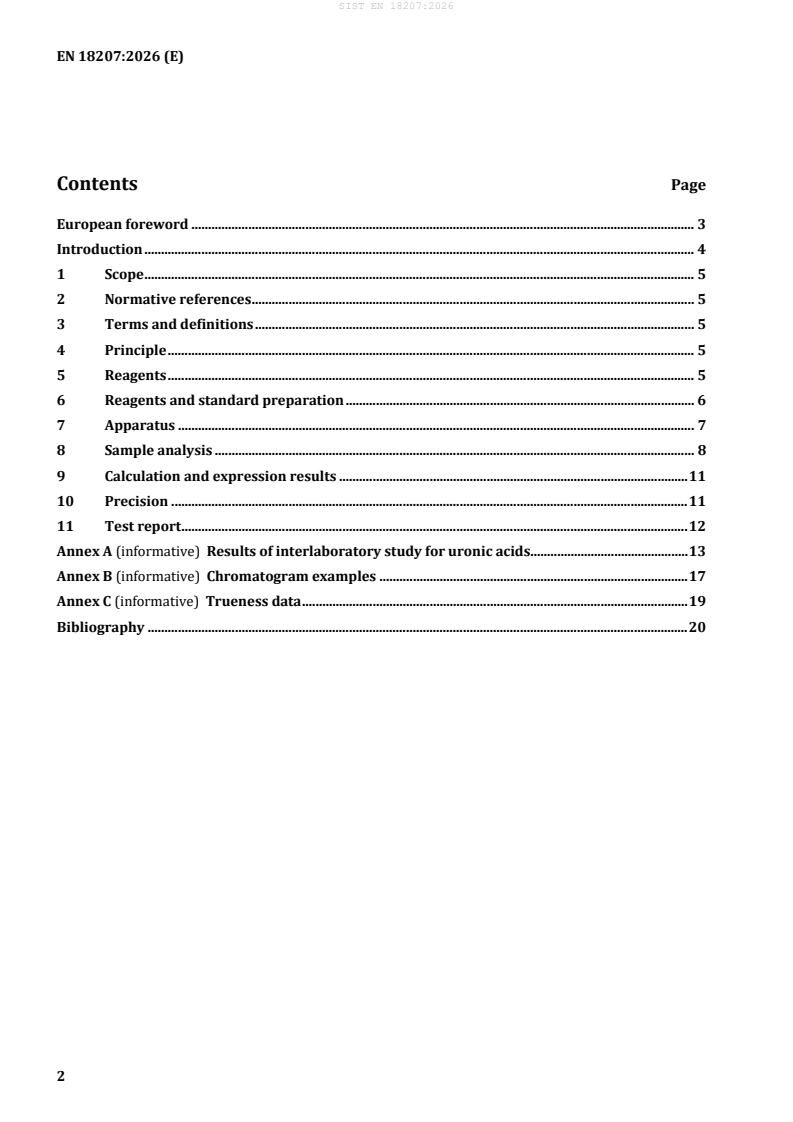
Contents Page
European foreword . 3
Introduction . 4
1 Scope . 5
2 Normative references . 5
3 Terms and definitions . 5
4 Principle . 5
5 Reagents . 5
6 Reagents and standard preparation . 6
7 Apparatus . 7
8 Sample analysis . 8
9 Calculation and expression results . 11
10 Precision . 11
11 Test report . 12
Annex A (informative) Results of interlaboratory study for uronic acids. 13
Annex B (informative) Chromatogram examples . 17
Annex C (informative) Trueness data . 19
Bibliography . 20
European foreword
This document (EN 18207:2026) has been prepared by Technical Committee CEN/TC 454 “Algae and
algae products”, the secretariat of which is held by NEN.
This European Standard shall be given the status of a national standard, either by publication of an
identical text or by endorsement, at the latest by November 2026, and conflicting national standards shall
be withdrawn at the latest by November 2026.
Attention is drawn to the possibility that some of the elements of this document may be the subject of
patent rights. CEN shall not be held responsible for identifying any or all such patent rights.
This document has been prepared under a standardization request addressed to CEN by the European
Commission. The Standing Committee of the EFTA States subsequently approves these requests for its
Member States.
Any feedback and questions on this document should be directed to the users’ national standards body.
A complete listing of these bodies can be found on the CEN website.
According to the CEN-CENELEC Internal Regulations, the national standards organisations of the
following countries are bound to implement this European Standard: Austria, Belgium, Bulgaria, Croatia,
Cyprus, Czech Republic, Denmark, Estonia, Finland, France, Germany, Greece, Hungary, Iceland, Ireland,
Italy, Latvia, Lithuania, Luxembourg, Malta, Netherlands, Norway, Poland, Portugal, Republic of North
Macedonia, Romania, Serbia, Slovakia, Slovenia, Spain, Sweden, Switzerland, Türkiye and the United
Kingdom.
Introduction
This document has been prepared by the experts of CEN/TC 454 'Algae and algae products'.
The European Committee for Standardization (CEN) was requested by the European Commission (EC) to
draft European standards or European standardization deliverables to support the implementation of
Article 3 of Directive 2009/28/EC for algae and algae-based products or intermediates.
This request, presented as Mandate M/547, also contributes to the Communication on “Innovating for
Sustainable Growth: A Bio economy for Europe”.
The former working group CEN Technical Board Working Group 218 “Algae”, was created in 2016 to
develop a work programme as part of this Mandate. The technical committee CEN/TC 454 'Algae and
algae products' was established to carry out the work programme that will prepare a series of standards.
The interest in algae and algae-based products or intermediates has increased significantly in Europe as
a valuable source including but not limited to, carbohydrates, proteins, lipids, and several pigments.
These materials are suitable for use in a wide range of applications from food and feed purposes to other
sectors, such as textile, cosmetics, biopolymers, biofuel and fertilizer/biostimulants. Standardization was
identified as having an important role in order to promote the use of algae and algae products.
The work of CEN/TC 454 should improve the reliability of the supply chain, thereby improving the
confidence of industry and consumers in algae, which include macroalgae, microalgae, cyanobacteria,
Labyrinthulomycetes, algae-based products or intermediates and will promote and support
commercialisation of the European algae industry.
The goal of this document is to give algae producers and algae products industries a recommendation for
an analysis method for uronics which can be utilized for algae.
1 Scope
This document specifies a method for the quantitative determination of total uronic acids by High
Performance Anion Exchange Chromatography coupled with Pulsed Amperometric Detection (HPAEC-
PAD) after acid hydrolysis of the samples for algae and algae products. It specifies a method for the
determination in one single analysis of mannuronic, glucuronic and guluronic acids in brown seaweed,
and mannuronic and guluronic acids in alginate products. The sum of the individual uronic acid values is
used for determining the total uronic acid content.
2 Normative references
The following documents are referred to in the text in such a way that some or all of their content
constitutes requirements of this document. For dated references, only the edition cited applies. For
undated references, the latest edition of the referenced document (including any amendments) applies.
EN 17605, Algae and algae products — Methods of sampling and analysis — Sample treatment
EN 17399, Algae and algae products — Vocabulary
3 Terms and definitions
For the purposes of this document, the terms and definitions in EN 17399 apply.
ISO and IEC maintain terminology databases for use in standardization at the following addresses:
— ISO Online browsing platform: available at https://www.iso.org/obp/
— IEC Electropedia: available at https://www.electropedia.org/
4 Principle
Polysaccharides are hydrolysed under acidic conditions at 50 °C. Hydrolysis duration depends on the
matrix to analyse (Table 2). Hydrolysates are then diluted according to the sample type before injection
to the chromatographic system.
5 Reagents
5.1 General
Before using chemicals, refer to the safety data sheets and ensure that the safety precautions are applied.
®1
5.2 Trifluoroacetic acid, CAS Registry Number 76-05-1, HPLC grade
5.3 Formic acid, CAS 64-18-6, HPLC grade
5.4 Sulfuric acid 18 M, CAS 7664-93-9, HPLC grade
5.5 Sodium Tetraborate decahydrate, CAS 1303-96-4
1 ®
CAS Registry Number is a trademark of CAS corporation. This information is given for the convenience of users
of this document and does not constitute an endorsement by CEN of the product named. Equivalent products may
be used if they can be shown to lead to the same results.
5.6 Sodium hydroxide solution of mass fraction 50 %, CAS 1310-73-2, HPLC grade
5.7 Sodium acetate trihydrate, CAS 6131-90-4
5.8 Ultra-pure water with a resistivity of 18,2 MΩ-cm
5.9 Mannuronic acid (ManA) standard, CAS 6906-37-2
5.10 Guluronic acid (GulA) standard, CAS 1986-15-8
5.11 Glucuronic (GlcA) acid standard, CAS 6556-12-3
6 Reagents and standard preparation
6.1 Primary hydrolysis solution (labelled SH)
Mix 2 volumes of ultra-pure water to 3 volumes of formic acid and thereafter add 1 volume of TFA (e.g.
20 ml of water + 30 ml of formic acid + 10 ml of TFA). Store solutions at room temperature until use.
6.2 Secondary hydrolysis solution (labelled SA1)
Dissolve (2,845 ± 0,005) g of sodium tetraborate decahydrate to 100 ml with HPLC sulfuric acid 18 M.
Mix overnight for complete dissolution.
6.3 Uronic acid standards and calibration curve preparation
Prepare a 1 mg/ml stock solution for each uronic acid separately by weighing 10 mg of standard into a
10 ml volumetric flask and make up to the volume with ultra-pure water. Aliquot and store at –20 °C until
use.
Prepare, in a volumetric flask, a solution containing each uronic acid at 100 µg/ml by adding 100 μl of
each 1 mg/ml stock solution and adjusting the volume to 1 ml with ultra-pure water.
Prepare the calibration samples using Table 1.
Table 1 — Uronic acids samples for calibration curve
Volume of the 100 μg/ml Volume
Label
solution of ultra-pure water
Mix - 5 μg/ml 25 475
Mix - 10 μg/ml 50 450
Mix - 25 μg/ml 125 375
Mix - 50 μg/ml 250 250
Mix - 75 μg/ml 375 125
Mix - 100 μg/ml 500 0
6.4 Chromatography solvents (mobile phases)
6.4.1 Sodium hydroxide (NaOH) solution at 200 mM, HPLC grade
Use 16 ml of NaOH 50 % solution for 1 l. Water shall be degassed before the addition of NaOH.
6.4.2 Sodium acetate solution at 250 mM
In a volumetric flask, dissolve 34 g of sodium acetate trihydrate (or alternatively 20,5 g of anhydrous
sodium acetate) and make the volume to 1 l with ultra-pure water.
7 Apparatus
7.1 IC System
Ion chromatography system equipped with a quaternary pump and a pulsed amperometric detector.
Helium gas should also be available to pressurize and degas the eluents.
7.2 Chromatography column
CarboPac™ SA10, 4 X 250 mm and the corresponding guard column, or equivalent.
7.3 Adjustable micropipettes
Volume 200 μl and 1 000 μl and tips.
7.4 Vortex mixer
7.5 Analytical balance
Able to accurately measure 10 mg with a precision of 0,1 mg.
7.6 Heating block
Able to maintain a temperature of 50 °C ± 2 °C.
This is an example of a suitable product available commercially. This information is given for the convenience of
users of this document and does not constitute an endorsement by CEN of the product named.
7.7 Screw cap microtubes
Volume 2 ml.
7.8 Vial with screw cap
Adapted to the autosampler used.
7.9 Centrifuge
13 400 × g for microtubes.
8 Sample analysis
8.1 Sample preparation
Samples shall be dried and ground at 500 μm particle size maximum according to protocol described in
EN 17605 ‘Algae and algae products - Methods of sampling and analysis - Sample treatment’.
Weigh 20 mg ± 0,5 mg of sample into a 2 ml screw cap microtube and note the exact weight.
8.2 Hydrolysis
For each sample matrix (brown seaweed and purified alginate), hyd
...