

SIST EN 18198:2026
(Main)Algae and algae products - Nitrogen content measurement and protein content calculation for micro- and macroalgae
General Information
- Abstract
This document describes the application of Kjeldahl and Dumas methods for the determination of nitrogen content in algae and their relevant products.
The method was initially tested and evaluated on the algae species Nannochloropsis sp. and Palmaria palmata. The study validated this document for both algae species. This method can also be used for other algae species.
- Status
- Published
- Public Enquiry End Date
- 30-Jul-2025
- Publication Date
- 15-Jun-2026
- Technical Committee
- I13 - Imaginarni 13
- Current Stage
- 6060 - National Implementation/Publication (Adopted Project)
- Start Date
- 02-Jun-2026
- Due Date
- 07-Aug-2026
- Completion Date
- 16-Jun-2026

Overview
SIST EN 18198:2026 - Algae and Algae Products: Nitrogen Content Measurement and Protein Content Calculation for Micro- and Macroalgae is an international standard developed by SIST. It provides clear methodologies for determining nitrogen content in both microalgae and macroalgae, as well as their derived products. The document outlines the application of the Kjeldahl and Dumas methods for nitrogen analysis, procedures that are foundational for calculating protein content in algae products. Originally, these methods were validated using the algae species Nannochloropsis sp. and Palmaria palmata, but the approach applies broadly across other algae types.
Key Topics
- Nitrogen Determination Methods: Detailed procedures for the Kjeldahl method (based on acid digestion/distillation and titration) and the Dumas method (combustion and detection via thermal conductivity).
- Protein Content Calculation: Use of standardized nitrogen-to-protein conversion factors, in line with regulatory requirements for food and feed products.
- Sampling and Sample Preparation: Guidance on representative sampling and sample handling to maintain integrity for reliable nitrogen determination.
- Precision and Reporting: Requirements for method validation, repeatability, and reproducibility to ensure accurate and reliable data.
- Comparison of Methods: Insights into differences between Kjeldahl and Dumas techniques, highlighting their respective advantages and limitations.
- Calculation of Conversion Factors: Guidance for establishing matrix-specific nitrogen-to-protein conversion factors when more accurate protein content is required.
Applications
The standard is valuable for organizations and laboratories involved in:
- Food and Feed Production: Accurate measurement of protein content in algae and algae-derived ingredients is crucial for nutritional labeling, compliance, and quality control.
- Biotechnology and Bioeconomy Sectors: Algae serve as a sustainable resource for proteins, biopolymers, and other biomaterials. Reliable nitrogen and protein data support research, product development, and commercialization.
- Regulatory Compliance: The standard aligns with European requirements for food and feed labeling, supporting organizations in meeting regulatory obligations (e.g., EU Regulation No 1169/2011).
- Research and Development: Useful for academic and industrial research focusing on nutritional analysis, new algae species assessment, and method validation.
- Sustainability and Supply Chain Transparency: Standardized measurement methods enhance confidence among suppliers, manufacturers, and consumers regarding the consistency and quality of algae-based products.
Related Standards
- EN ISO 5983-1:2005: Animal feeding stuffs - Determination of nitrogen content and calculation of crude protein content (Kjeldahl method).
- EN ISO 16634-2:2016: Food products - Determination of total nitrogen content by combustion according to the Dumas principle and calculation of crude protein content.
- EN 17399: Algae and algae products - Vocabulary.
- EN 17605: Algae and algae products - Methods of sampling and analysis - Sample treatment.
- prEN 18197: Algae and algae products - Determination of the amino acid profile.
- EU Regulation No 1169/2011: Food information to consumers (nutrition labeling requirements).
- Commission Regulation (EC) No 152/2009: Feed official controls.
By following SIST EN 18198:2026, organizations can ensure precise, repeatable, and compliant measurement of nitrogen and protein in a wide range of algae products, fostering quality assurance and supporting the expanding applications of algae in food, feed, and biotechnology industries.
Keywords: algae standard, nitrogen measurement, protein calculation, Kjeldahl method, Dumas method, algae products, food labeling, feed compliance, protein content, laboratory standards.
Relations
- Effective Date
- 10-Jun-2026
- Refers
SIST EN 17605:2022 - Algae and algae products - Methods of sampling and analysis - Sample treatment - Effective Date
- 10-Jun-2026
Get Certified
Connect with accredited certification bodies for this standard

BSI Group
BSI (British Standards Institution) is the business standards company that helps organizations make excellence a habit.

Bureau Veritas
Bureau Veritas is a world leader in laboratory testing, inspection and certification services.

DNV
DNV is an independent assurance and risk management provider.
Sponsored listings
Frequently Asked Questions
SIST EN 18198:2026 is a standard published by the Slovenian Institute for Standardization (SIST). Its full title is "Algae and algae products - Nitrogen content measurement and protein content calculation for micro- and macroalgae". This standard covers: This document describes the application of Kjeldahl and Dumas methods for the determination of nitrogen content in algae and their relevant products. The method was initially tested and evaluated on the algae species Nannochloropsis sp. and Palmaria palmata. The study validated this document for both algae species. This method can also be used for other algae species.
This document describes the application of Kjeldahl and Dumas methods for the determination of nitrogen content in algae and their relevant products. The method was initially tested and evaluated on the algae species Nannochloropsis sp. and Palmaria palmata. The study validated this document for both algae species. This method can also be used for other algae species.
SIST EN 18198:2026 is classified under the following ICS (International Classification for Standards) categories: 13.020.55 - Biobased products. The ICS classification helps identify the subject area and facilitates finding related standards.
SIST EN 18198:2026 has the following relationships with other standards: It is inter standard links to SIST EN 17399:2024, SIST EN 17605:2022. Understanding these relationships helps ensure you are using the most current and applicable version of the standard.
SIST EN 18198:2026 is associated with the following European legislation: Standardization Mandates: M/547. When a standard is cited in the Official Journal of the European Union, products manufactured in conformity with it benefit from a presumption of conformity with the essential requirements of the corresponding EU directive or regulation.
SIST EN 18198:2026 is available in PDF format for immediate download after purchase. The document can be added to your cart and obtained through the secure checkout process. Digital delivery ensures instant access to the complete standard document.
Standards Content (Sample)
SLOVENSKI STANDARD
01-julij-2026
Alge in izdelki iz alg - Merjenje vsebnosti dušika in izračun vsebnosti beljakovin v
mikro- in makroalgah
Algae and algae products - Nitrogen content measurement and protein content
calculation for micro- and macroalgae
Algen und Algenprodukte - Messung des Stickstoffgehaltes und Berechnung des
Proteingehaltes von Mikro- und Makroalgen
Algues et produits à base d'algues - Mesure de la teneur en azote et calcul de la teneur
en protéines des micro et macroalgues
Ta slovenski standard je istoveten z: EN 18198:2026
ICS:
13.020.55 Biološki izdelki Biobased products
2003-01.Slovenski inštitut za standardizacijo. Razmnoževanje celote ali delov tega standarda ni dovoljeno.
EN 18198
EUROPEAN STANDARD
NORME EUROPÉENNE
May 2026
EUROPÄISCHE NORM
ICS 13.020.55
English Version
Algae and algae products - Nitrogen content measurement
and protein content calculation for micro- and microalgae
Algues et produits à base d'algues - Mesure de la Algen und Algenprodukte - Messung des
teneur en azote et calcul de la teneur en protéines des Stickstoffgehaltes und Berechnung des Proteingehaltes
micro et macroalgues von Mikro- und Makroalgen
This European Standard was approved by CEN on 13 April 2026.
CEN members are bound to comply with the CEN/CENELEC Internal Regulations which stipulate the conditions for giving this
European Standard the status of a national standard without any alteration. Up-to-date lists and bibliographical references
concerning such national standards may be obtained on application to the CEN-CENELEC Management Centre or to any CEN
member.
This European Standard exists in three official versions (English, French, German). A version in any other language made by
translation under the responsibility of a CEN member into its own language and notified to the CEN-CENELEC Management
Centre has the same status as the official versions.
CEN members are the national standards bodies of Austria, Belgium, Bulgaria, Croatia, Cyprus, Czech Republic, Denmark, Estonia,
Finland, France, Germany, Greece, Hungary, Iceland, Ireland, Italy, Latvia, Lithuania, Luxembourg, Malta, Netherlands, Norway,
Poland, Portugal, Republic of North Macedonia, Romania, Serbia, Slovakia, Slovenia, Spain, Sweden, Switzerland, Türkiye and
United Kingdom.
EUROPEAN COMMITTEE FOR STANDARDIZATION
COMITÉ EUROPÉEN DE NORMALISATION
EUROPÄISCHES KOMITEE FÜR NORMUNG
CEN-CENELEC Management Centre: Rue de la Science 23, B-1040 Brussels
© 2026 CEN All rights of exploitation in any form and by any means reserved Ref. No. EN 18198:2026 E
worldwide for CEN national Members.
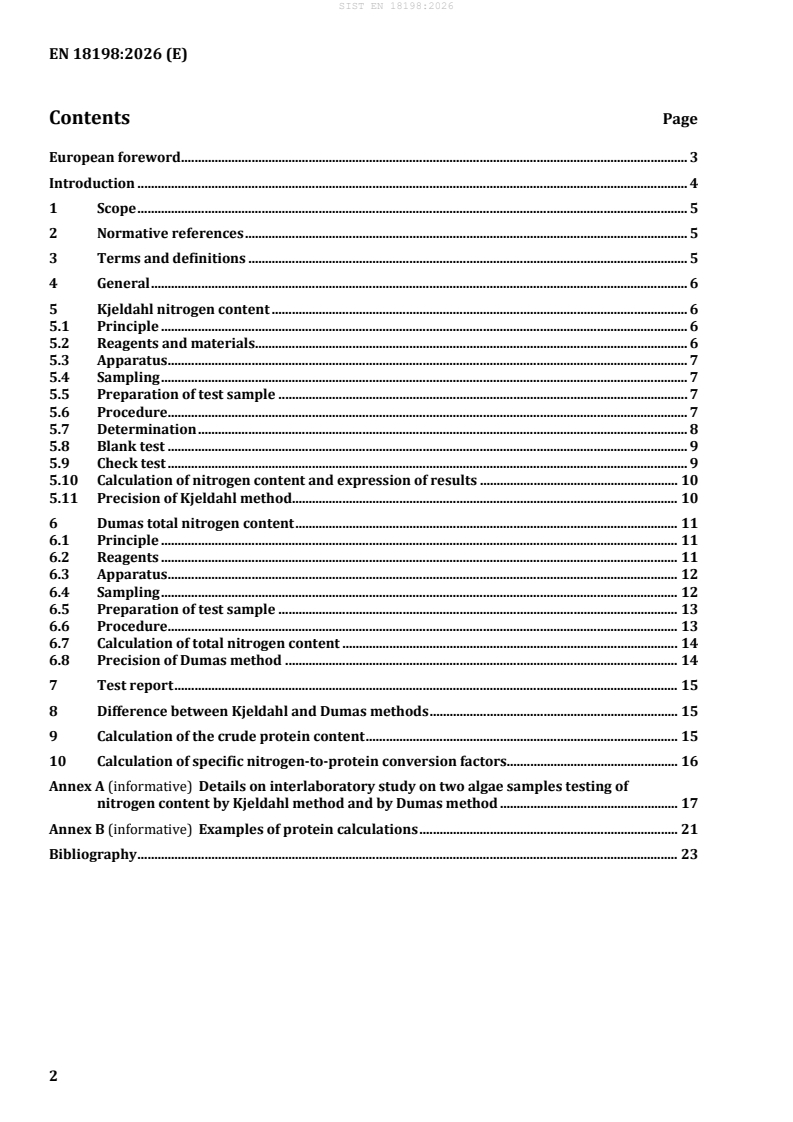
Contents Page
European foreword . 3
Introduction . 4
1 Scope . 5
2 Normative references . 5
3 Terms and definitions . 5
4 General . 6
5 Kjeldahl nitrogen content . 6
5.1 Principle . 6
5.2 Reagents and materials . 6
5.3 Apparatus . 7
5.4 Sampling . 7
5.5 Preparation of test sample . 7
5.6 Procedure. 7
5.7 Determination . 8
5.8 Blank test . 9
5.9 Check test . 9
5.10 Calculation of nitrogen content and expression of results . 10
5.11 Precision of Kjeldahl method. 10
6 Dumas total nitrogen content . 11
6.1 Principle . 11
6.2 Reagents . 11
6.3 Apparatus . 12
6.4 Sampling . 12
6.5 Preparation of test sample . 13
6.6 Procedure. 13
6.7 Calculation of total nitrogen content . 14
6.8 Precision of Dumas method . 14
7 Test report . 15
8 Difference between Kjeldahl and Dumas methods . 15
9 Calculation of the crude protein content . 15
10 Calculation of specific nitrogen-to-protein conversion factors. 16
Annex A (informative) Details on interlaboratory study on two algae samples testing of
nitrogen content by Kjeldahl method and by Dumas method . 17
Annex B (informative) Examples of protein calculations . 21
Bibliography . 23
European foreword
This document (EN 18198:2026) has been prepared by Technical Committee CEN/TC 454 “Algae and
algae products”, the secretariat of which is held by NEN.
This European Standard shall be given the status of a national standard, either by publication of an
identical text or by endorsement, at the latest by November 2026, and conflicting national standards shall
be withdrawn at the latest by November 2026.
Attention is drawn to the possibility that some of the elements of this document may be the subject of
patent rights. CEN shall not be held responsible for identifying any or all such patent rights.
This document has been prepared under a standardization request addressed to CEN by the European
Commission. The Standing Committee of the EFTA States subsequently approves these requests for its
Member States.
Any feedback and questions on this document should be directed to the users’ national standards body.
A complete listing of these bodies can be found on the CEN website.
According to the CEN-CENELEC Internal Regulations, the national standards organisations of the
following countries are bound to implement this European Standard: Austria, Belgium, Bulgaria, Croatia,
Cyprus, Czech Republic, Denmark, Estonia, Finland, France, Germany, Greece, Hungary, Iceland, Ireland,
Italy, Latvia, Lithuania, Luxembourg, Malta, Netherlands, Norway, Poland, Portugal, Republic of North
Macedonia, Romania, Serbia, Slovakia, Slovenia, Spain, Sweden, Switzerland, Türkiye and the United
Kingdom.
Introduction
This document has been prepared by the experts of CEN/TC 454 'Algae and algae products'.
The European Committee for Standardization (CEN) was requested by the European Commission (EC) to
draft European standards or European standardization deliverables to support the implementation of
Article 3 of Directive 2009/28/EC for algae and algae-based products or intermediates.
This request, presented as Mandate M/547, also contributes to the Communication on “Innovating for
Sustainable Growth: A Bio economy for Europe”.
The former working group CEN Technical Board Working Group 218 “Algae”, was created in 2016 to
develop a work programme as part of this Mandate. The technical committee CEN/TC 454 'Algae and
algae products' was established to carry out the work programme that will prepare a series of standards.
The interest in algae and algae-based products or intermediates has increased significantly in Europe as
a valuable source including but not limited to, carbohydrates, proteins, lipids, and several pigments.
These materials are suitable for use in a wide range of applications from food and feed purposes to other
sectors, such as textile, cosmetics, biopolymers, biofuel, fertilizers and biostimulants. Standardization
was identified as having an important role in order to promote the use of algae and algae products.
The work of CEN/TC 454 should improve the reliability of the supply chain, thereby improving the
confidence of industry and consumers in algae, which include macroalgae, microalgae, cyanobacteria,
Labyrinthulomycetes, algae-based products or intermediates and will promote and support
commercialisation of the European algae industry.
Determining the nitrogen content of algae and algae products is an important method in the algae
industry. It is needed to calculate protein content, biomass gross composition, nutritional value, and also
to evaluate mass balances along algae farming.
The goal of this document is to give algae producers and algae products industries recommendations for
analytical methods for nitrogen content in compliance with food and feed regulations [1]. This document,
based on EN ISO 5983-1:2005 Animal feeding stuffs — Determination of nitrogen content and calculation
of crude protein content — Part 1: Kjeldahl method and EN ISO 16634-2:2016, Food products —
Determination of the total nitrogen content by combustion according to the Dumas principle and calculation
of the crude protein content — Part 2: Cereals, pulses and milled cereal products, demonstrates the
suitability of both methods for the determination of nitrogen in micro- and macroalgae and highlight
potential differences between the two methods. This document also provides recommendations for the
calculation of protein content and guidance to establish accurate nitrogen to protein conversion factors
in conjunction with total amino acid analyses according to EN 18197:2026, Algae and algae products —
Determination of the amino acid profile of micro- and macroalgae when required.
1 Scope
This document describes the application of Kjeldahl and Dumas methods for the determination of
nitrogen content in algae and their relevant products.
The method was initially tested and evaluated on the algae species Nannochloropsis sp. and Palmaria
palmata. The study validated this document for both algae species. This method can also be used for other
algae species.
2 Normative references
The following documents are referred to in the text in such a way that some or all of their content
constitutes requirements of this document. For dated references, only the edition cited applies. For
undated references, the latest edition of the referenced document (including any amendments) applies.
EN 17399, Algae and algae products — Vocabulary
EN 17605:2022, Algae and algae products — Methods of sampling and analysis — Sample treatment
3 Terms and definitions
For the purposes of this document, the terms and definitions in EN 17399 and the following apply.
ISO and IEC maintain terminology databases for use in standardization at the following addresses:
— ISO Online browsing platform: available at https://www.iso.org/obp
— IEC Electropedia: available at https://www.electropedia.org/
3.1
Kjeldahl nitrogen content
mass fraction of the Kjeldahl nitrogen content in the sample
Note 1 to entry: Determined by the procedure specified in Clause 5.
Note 2 to entry: Unless otherwise specified, the nitrogen content is expressed on as is basis, not on dry weight.
3.2
Dumas total nitrogen content
mass fraction of the total nitrogen content in the sample
Note 1 to entry: Determined by the procedure specified in Clause 6.
Note 2 to entry: Unless otherwise specified, the nitrogen content is expressed on as is basis, not on dry weight.
3.3
crude protein content
nitrogen content (either Kjeldahl or Dumas) multiplied by a conversion factor
Note 1 to entry: The nitrogen content measurement method and the conversion factor shall be specified.
4 General
The Kjeldahl method for the determination of nitrogen content in microalgae and macroalgae and their
relevant products is based on EN ISO 5983-1:2005.
The Kjeldahl method does not measure oxidized forms of nitrogen or heterocyclic nitrogen compounds.
The Dumas method for the determination of nitrogen content in microalgae and macroalgae and their
relevant products is based on EN ISO 16634-2.
The Dumas method measures all forms of nitrogen present in the sample.
The selection between Kjeldahl or Dumas method is left to the user’s discretion since either method has
advantages and drawbacks. However, the nitrogen content determined can differ depending on the
amount of oxidized nitrogen in the sample. The selected method shall be specified in the test report.
The methods described in EN ISO 5983-1:2005 and EN ISO 16634-2 do not distinguish between protein
nitrogen and non-protein nitrogen.
The utilization of a conversion factor of 6,25 is required in regulatory documents such as regulation (EU)
No 1169/2011 (food, nutrition labelling) and commission regulation (EC) No 152/2009 (feed, official
control) to convert the nitrogen content of a product (food, feed) into a protein value.
A more accurate protein content can be obtained by calculating the sum of all amino acyls, and this
protein content can then be divided by the total nitrogen content to obtain appropriate nitrogen-to-
protein conversion factors (NCFs) for the matrices of interest [4]. These matrix-specific NCFs can be
useful when a more accurate protein content needs to be calculated from their nitrogen content. Guidance
for the calculation of those nitrogen to protein conversion factors is provided in this document (Clause 10
and Annex B).
5 Kjeldahl nitrogen content
5.1 Principle
The organic matter is digested by sulfuric acid in the presence of a catalyst. The reaction product is
rendered alkaline, then the liberated ammonia is distilled and titrated. The nitrogen content is calculated.
The result can be multiplied by a conversion factor to obtain the crude protein content.
5.2 Reagents and materials
Use only reagents of recognized analytical grade, unless otherwise specified, and distilled or deionized
water or water of equivalent purity.
The reagents [except the standard materials (5.2.6)] shall be free from nitrogenous compounds.
5.2.1 Potassium sulfate.
5.2.2 Catalyst
5.2.2.1 Copper(II) oxide (CuO).
5.2.2.2 Copper(II) sulfate pentahydrate (CuSO ·5H O).
4 2
5.2.3 Sulfuric acid, c(H SO ) = 18 mol/l.
2 4
5.2.4 Paraffin wax.
5.2.5 Saccharose.
5.2.6 Standard materials
5.2.6.1 Acetanilide, with melting point 114 °C; nitrogen (N) content 103,6 g/kg.
5.2.6.2 Tryptophan, with melting point 282 °C; nitrogen (N) content 137,2 g/kg. Dry before use.
5.2.7 Sodium hydroxide solution, w(NaOH) = 330 g/kg.
5.2.8 Collecting liquid
5.2.8.1 Sulfuric acid, standard volumetric solution, c(H SO ) = 0,05 mol/l or c(H SO ) = 0,125 mol/l.
2 4 2 4
5.2.8.2 Boric acid, 𝜌𝜌(H BO ) = 40 g/l.
3 3
5.2.9 Solutions for titration
5.2.9.1 Sodium hydroxide, standard volumetric solution, c(NaOH) = 0,1 mol/l or
c(NaOH) = 0,25 mol/l.
5.2.9.2 Sulfuric acid, standard volumetric solution, c(H SO ) = 0,05 mol/l or c(H SO ) = 0,125 mol/l.
2 4 2 4
The molarity of standard volumetric solutions should be known to the fourth decimal point.
5.2.10 Mixed indicator, neutral point at pH 4,4 to 5,8.
Dissolve 2 g of methyl red and 1 g of methylene blue in 1 000 ml of ethanol [c(C H OH) = 950 ml/l].
2 5
5.2.11 pH indicator paper.
5.2.12 Boiling aids, such as granulated pumice stone, or glass beads of diameter 5 mm to 7 mm, or
carborundum chips, washed in hydrochloric acid and in distilled water, and ashed.
5.3 Apparatus
Usual laboratory apparatus and, in particular, the following.
5.3.1 Analytical balance.
5.3.2 Digestion, distillation and titration apparatus.
5.4 Sampling
A representative sample should have been sent to the laboratory. It should not have been damaged or
changed during transport or storage.
Sampling is not part of the method specified in this document. A recommended sampling method is given
in EN 17980 and EN 17605:2022.
Store the sample closed in tight container at refrigerated temperature (−20 °C to +4 °C) in such a way that
deterioration and change in its composition are prevented.
5.5 Preparation of test sample
The test sample shall be dry i.e. with a moisture content < 150 g/kg, and preferably below 100 g/kg
homogeneous and finely ground according to EN 17605:2022, 3.7, 3.9 and 3.13.
5.6 Procedure
WARNING — The operations described in 5.6.1 and 5.6.2 should be carried out under a well-ventilated
hood or in a fume cupboard which is resistant to sulfuric acid.
5.6.1 General
For general directions on the application of the Kjeldahl method, see ISO 1871:2009 [7].
5.6.2 Test portion
Weigh, to the nearest 1 mg, a mass of the test sample chosen according to the expected nitrogen content
so that the test portion contains between 0,005 g and 0,2 g of nitrogen and, preferably, more than 0,02 g.
The mass of the test portion of homogeneous air-dry sample should be between 0,5 g and 2,0 g.
5.7 Determination
5.7.1 Digestion of organic matter
Transfer the test portion quantitatively into a Kjeldahl digestion flask of suitable size (usually 800 ml).
Add 15 g of potassium sulfate (5.2.1).
Add an appropriate quantity of catalyst as follows: 0,3 g of copper(II) oxide (5.2.2.1) or 0,9 g to 1,2 g of
copper(II) sulfate pentahydrate (5.2.2.2).
Add 25 ml of sulfuric acid (5.2.3) for the first gram of dry matter of the test portion and 6 ml to 12 ml for
each additional gram of dry matter. Mix thoroughly, ensuring complete wetting of the test portion.
Support the flask so that its axis is inclined at an angle of 30° to 45° to the vertical. Maintain the flask in
this position throughout heating.
Heat the flask moderately at first to prevent foam from rising into the neck of the flask or escaping from
the flask.
NOTE 1 It can be advisable to add an anti-foaming agent such as paraffin wax (5.2.4).
Heat moderately, swirling from time to time, until the mass has carbonized and the foam has disappeared.
Then heat more intensively until the liquid is boiling steadily.
NOTE 2 Heating is adequate if the boiling acid condenses towards the middle of the neck of the Kjeldahl flask.
Avoid overheating of the walls of the flask not in contact with liquid.
NOTE 3 If a naked flame is used, such overheating can be prevented by placing the flask on a sheet of heat-
resistant material with an aperture of diameter slightly less than that of the flask at the liquid level.
After the liquid has become clear with a light green-blue colour, heat for another 2 h.
Leave to cool. If the digest starts to solidify, add some water and mix by swirling.
5.7.2 Distillation of ammonia
5.7.2.1 Carefully add 250 ml to 350 ml of water to dissolve the sulfates completely. If necessary,
facilitate dissolving by heating the flask in warm water. Mix by swirling and allow to cool.
Add a few boiling aids (5.2.12).
For some specific samples, the sulfates might not completely dissolve in the added water. In that case, it
is recommended to repeat the digestion with a reduced mass of potassium sulfate (5.2.1).
Pipette, into the collecting flask of the distillation apparatus, 25 ml of the sulfuric acid (5.2.8.1), choosing
the concentration according to the expected nitrogen content of the test portion. Add 100 ml to 150 ml of
water. Add a few drops of the mixed indicator (5.2.10). Proceed in accordance with 5.7.2.3.
5.7.2.2 Alternatively, transfer into the collecting flask 100 ml to 250 ml of boric acid (5.2.8.2). Add a
few drops of mixed indicator (5.2.10).
Simultaneous titration of the ammonia (5.7.3.3) during distillation is recommended since it facilitates
verification of the end of distillation.
5.7.2.3 Immerse the end of the condenser in the liquid contained in the collecting flask, to a depth of
at least 1 cm.
Slowly pour 100 ml of sodium hydroxide solution (5.2.7) into the digestion flask along the wall.
Immediately connect the flask to the distillation apparatus.
Heat the flask in such a manner that approximately 150 ml of distillate is collected in 30 min. At the end
of this time, check the pH of the distillate at the tip of the condenser using litmus paper (5.2.11). If the
reaction is alkaline, continue distillation.
WARNING — Lift the condenser from the liquid just before the end of the distillation, to prevent backflow.
If, during distillation using sulfuric acid as collecting liquid, the contents of the collecting flask become
alkaline, recommence the determination, making appropriate adjustments.
5.7.3 Titration
5.7.3.1 Titration with automatic end point indication using a pH-meter is recommended. Otherwise,
the end point is indicated by the change in colour of the mixed indicator (5.2.10) added in 5.7.2.
5.7.3.2 If sulfuric acid is used as the collecting liquid, titrate, in the collecting flask, the excess sulfuric
acid with sodium hydroxide solution (5.2.9.1), c(NaOH) = 0,1 mol/l or c(NaOH) = 0,25 mol/l as
appropriate, until the end point is indicated by the pH-meter or until the colour changes from violet to
green.
5.7.3.3 If boric acid is used as the collecting liquid, titrate the ammonia with sulfuric acid (5.2.9.2),
c(H SO ) = 0,05 mol/l or c(H SO ) = 0,125 mol/l as appropriate, until the end point is indicated by the pH-
2 4 2 4
meter or the colour changes from green to violet.
If simultaneous titration is not possible (see 5.7.2.3), the titration should be carried out as soon as
possible after the distillation is complete, ensuring that the temperature of the distillate does not exceed
25 °C. Under these conditions, losses of ammonia are avoided.
5.8 Blank test
Perform a blank test using about 1 g of saccharose (5.2.5) in place of the test portion.
5.9 Check test
Perform a check test by determining the nitrogen content of acetanilide (5.2.6.1) or tryptophan (5.2.6.2)
after addition of 1 g of saccharose (5.2.5).
The choice of the substance for the check test should be related to the digestibility of the samples to be
analysed. Acetanilide is easily digested, whereas the digestion of tryptophan is more difficult, e.g. the case
may be dealing with microalgae with strong cell wall.
The recovery of nitrogen from acetanilide or tryptophan should be at least 995 g/kg for acetanilide and
at least 990 g/kg for tryptophan.
5.10 Calculation of nitrogen content and expression of results
5.10.1 Distillate collected in sulfuric acid
Provided that the volumes of sulfuric acid used to collect the ammonia for the determination (5.7) and
for the blank test (5.8) are equal, calculate the nitrogen content, w , in grams per kilogram of the test
n1
sample, by Formula (1):
VV– ××c M
( )
01 1
w = (1)
n1
m
where
is the volume, in millilitres, of the sodium hydroxide solution (5.2.9.1) required for the blank test;
V0
V is the volume, in millilitres, of the sodium hydroxide solution (5.2.9.1) required for the
determination;
c is the concentration, in moles per litre, of the sodium hydroxide solution (5.2.9.1) used for the
titrations;
M is the molar mass, in grams per mole, of nitrogen (M = 14 g/mol);
m is the mass, in grams, of the test portion.
Report the result to the nearest 0,01 g/kg.
5.10.2 Distillate collected in boric acid
Calculate the nitrogen content of the test sample by Formula (2):
VV− ××c M
( )
3 2 2
w = (2)
n2
m
where
w is the nitrogen content, in grams per kilogram, of the test sample;
n2
V is the volume, in millilitres, of the sulfuric acid (5.2.9.2) required for the blank test;
V is the volume, in millilitres, of the sulfuric acid (5.2.9.2) required for the determination;
M is the molar mass, in grams per mole, of nitrogen (M = 14 g/mol);
c is the concentration, in moles per litre, of the sulfuric acid (5.2.9.2) used for the titrations.
Report the result to the nearest 0,01 g/kg.
5.11 Precision of Kjeldahl method
5.11.1 Interlaboratory te
...