


SIST EN 16994:2018
(Main)Clay Geosynthetic Barriers - Characteristics required for use in the construction of underground structures (other than tunnels and associated structures)
Clay Geosynthetic Barriers - Characteristics required for use in the construction of underground structures (other than tunnels and associated structures)
This document specifies the characteristics of clay geosynthetic barriers (GBR-C) as well as multicomponent geosynthetic clay barriers (e.g. a GBR-C with a polymeric or bituminous geosynthetic barrier attached to it), when used as fluid barriers and separation layer in the construction of underground structures (other than tunnels and associated structures), and the appropriate test methods to determine these characteristics.
If in a multicomponent GBR-C, the GBR-P or GBR-B is the predominant hydraulic barrier then the appropriate standard should be used.
The intended use of these products is to control the leakage of fluid through the construction wall.
This document is not applicable to geotextiles or geotextile-related products as defined in EN ISO 10318 1.
This document provides for the assessment and verification of constancy of performance (AVCP) of the product to this European Standard including factory production control procedures.
This document defines characteristics to be considered with regard to the presentation of performance.
This document does not cover applications where the geosynthetic barrier is to be in contact with water that has been treated for human consumption.
NOTE Where potable water is or can be in direct contact with the product, other relevant standards, requirements and/or regulations can be considered for the design.
Geosynthetische Tondichtungsbahnen - Eigenschaften, die für die Anwendung beim Bau von Tiefbauwerken (andere als Tunnel und damit verbundene Tiefbauwerke) erforderlich sind
Dieses Dokument legt die Eigenschaften von geosynthetischen Tondichtungsbahnen (GBR-C), sowie geosynthetischen Tondichtungsbahnen aus Verbundwerkstoffen (z. B. eine GBR-C mit einer angebundenen Kunststoff- oder Bitumendichtungsbahn), die als Abdichtung und Trennschicht beim Bau von Tiefbauwerken (mit Ausnahme von Tunneln und verbundenen Strukturen) eingesetzt werden, sowie die geeigneten Prüfverfahren zur Bestimmung dieser Eigenschaften fest.
Wenn bei einer GBR-C aus Verbundwerkstoffen, die GBR-P oder GBR-B die überwiegende, hydraulische Dichtungsbahn darstellt, dann sollte die entsprechende Norm für diese angewendet werden.
Die bestimmungsgemäße Anwendung dieser Produkte ist das Durchsickern von Flüssigkeiten durch die Bauwerkswand zu kontrollieren.
Dieses Dokument ist nicht anwendbar auf Geotextilien oder geotextilverwandte Produkte im Sinne der Definition von EN ISO 10318 1.
Dieses Dokument behandelt die Bewertung und Überprüfung der Leistungsbeständigkeit (AVCP) des Produkts nach dieser Europäischen Norm, einschließlich der Verfahren für die werkseigene Produktions-kontrolle.
Dieses Dokument legt Eigenschaften fest, die in Bezug auf die Darstellung der Produkteigenschaften berücksichtigt werden müssen.
Dieses Dokument umfasst nicht die Anwendungen, bei denen die geosynthetische Dichtungsbahn in Kontakt mit Trinkwasser kommt, das für den unmittelbaren menschlichen Gebrauch behandelt wurde.
ANMERKUNG Wo Trinkwasser in direkten Kontakt mit dem Produkt kommt oder kommen kann, können andere einschlägige Normen, Anforderungen und/oder Bestimmungen bei der Planung berücksichtigt werden.
Géosynthétiques bentonitiques - Caractéristiques requises pour l'utilisation comme barrière aux fluides dans la construction de structures souterraines (hors tunnels)
Le présent document spécifie les caractéristiques applicables aux géosynthétiques d'étanchéité incluant les géosynthétiques bentonitiques (GSB) et les géosynthétiques bentonitiques multicomposants (par exemple, GSB auquel est fixée une géomembrane polymérique ou bitumineuse), lorsque ces éléments sont utilisés comme barrières aux fluides dans la construction de structures souterraines (hors tunnels et structures associées), ainsi que les méthodes d'essai qui permettent de déterminer ces caractéristiques.
Si, dans un GSB multicomposants, la GMB-P ou la GMB-B est la barrière hydraulique à long terme prédominante, il convient d'appliquer la norme appropriée.
Ces produits sont destinés à contrôler les fuites de fluide à travers le mur de construction.
Le présent document ne s'applique pas aux géotextiles ou produits apparentés, tels que définis dans l'EN ISO 10318 1.
Le présent document permet d'évaluer et de vérifier la constance des performances du produit à la présente Norme européenne et les procédures de contrôle de la production en usine.
Le présent document définit les exigences que les fabricants et leurs représentants agréés doivent satisfaire concernant la présentation des propriétés du produit.
Le présent document ne couvre pas les cas où le géosynthétique bentonitique doit être en contact avec une eau traitée destinée à la consommation humaine.
Si de l'eau potable est ou peut être en contact direct avec le produit, il convient que le concepteur se réfère également aux normes, exigences et/ou règlements applicables.
Geosintetične zapore - Zahtevane lastnosti pri gradnji podzemnih objektov (razen predorov in pripadajočih konstrukcij)
Ta evropski standard določa ustrezne lastnosti geosintetičnih zapor, vključno s polimernimi, opečnati in bitumenskimi geosintetičnimi zaporami, če se uporabljajo za zaščito pred tekočinami pri podzemnih gradnjah (z izjemo tunelov), in ustrezne preskusne metode za določanje teh lastnosti.
Ti proizvodi se predvidoma uporabljajo za nadzor uhajanja vode skozi steno konstrukcije.
Ta standard ne velja za geotekstilije ali sorodne izdelke.
Ta standard omogoča vrednotenje skladnosti izdelka s tem evropskim standardom.
Ta standard določa zahteve, ki jih morajo izpolniti proizvajalci in distributerji glede predstavitve lastnosti izdelka.
Ta standard ne zajema uporabe, kjer bodo geosintetične zapore v stiku s pitno vodo, ki je namenjena ljudem.
OPOMBA: Če je oz. bo lahko proizvod v stiku s pitno vodo, mora projektant upoštevati tudi druge ustrezne standarde, zahteve in/ali predpise.
General Information
- Status
- Published
- Public Enquiry End Date
- 05-Jul-2016
- Publication Date
- 15-Apr-2018
- Technical Committee
- ITEK - Textile and textile products
- Current Stage
- 6060 - National Implementation/Publication (Adopted Project)
- Start Date
- 28-Mar-2018
- Due Date
- 02-Jun-2018
- Completion Date
- 16-Apr-2018
- Directive
- 89/106/EEC - Construction products
Overview
EN 16994:2018 specifies the required characteristics and test methods for clay geosynthetic barriers (GBR-C) and multicomponent geosynthetic clay barriers when used as fluid barriers and separation layers in the construction of underground structures (other than tunnels and associated structures). The standard defines how manufacturers declare performance, and it provides procedures for assessment and verification of constancy of performance (AVCP) including factory production control (FPC).
Key limitations:
- Not applicable to geotextiles or geotextile-related products as defined in EN ISO 10318‑1.
- Does not cover applications where the product is in contact with water treated for human consumption (potable water) - other regulations may apply in that case.
- For multicomponent products where a polymeric (GBR‑P) or bituminous (GBR‑B) layer is the predominant hydraulic barrier, the appropriate GBR‑P/GBR‑B standard should be used.
Key topics and requirements
- Declared characteristics and test methods: Specifies which product characteristics are relevant for use as a fluid barrier or separation layer and references appropriate test methods to determine them.
- Multicomponent GBR‑C: Covers combined systems (clay layer with attached polymeric or bituminous barriers) and clarifies when other standards take precedence.
- Durability and service life: Includes requirements and guidance (Annex A) on durability testing, ageing, weathering and expected service life considerations.
- AVCP and factory production control: Defines the processes for type testing, ongoing FPC and evidence needed to demonstrate constancy of performance for CE marking and specification compliance.
- Environmental and safety aspects: Addresses release of dangerous substances and gives guidance on presentation of performance data.
Applications and who uses this standard
EN 16994:2018 is used by:
- Manufacturers of clay geosynthetic barriers to define product specifications, perform required testing and implement factory production control.
- Designers and engineers specifying fluid-tight or separation layers in underground construction (e.g., basements, retaining structures, utility vaults and similar sub-surface works).
- Contractors and installers verifying product conformity and performance claims during procurement and installation.
- Testing laboratories and conformity assessment bodies conducting type testing and AVCP activities.
- Regulators and owners assessing long-term performance, environmental compatibility and compliance with European construction product rules.
Related standards
EN 16994 references and complements other geosynthetics standards and test methods, including (but not limited to) EN 14196, EN 14151, EN 12226 and multiple EN standards covering durability, mass per unit area and tensile properties. Annex ZA links the standard to Regulation (EU) No. 305/2011 for construction products.
Keywords: EN 16994:2018, clay geosynthetic barriers, GBR‑C, fluid barrier, multicomponent geosynthetic clay barrier, AVCP, factory production control, durability, underground structures.



Frequently Asked Questions
SIST EN 16994:2018 is a standard published by the Slovenian Institute for Standardization (SIST). Its full title is "Clay Geosynthetic Barriers - Characteristics required for use in the construction of underground structures (other than tunnels and associated structures)". This standard covers: This document specifies the characteristics of clay geosynthetic barriers (GBR-C) as well as multicomponent geosynthetic clay barriers (e.g. a GBR-C with a polymeric or bituminous geosynthetic barrier attached to it), when used as fluid barriers and separation layer in the construction of underground structures (other than tunnels and associated structures), and the appropriate test methods to determine these characteristics. If in a multicomponent GBR-C, the GBR-P or GBR-B is the predominant hydraulic barrier then the appropriate standard should be used. The intended use of these products is to control the leakage of fluid through the construction wall. This document is not applicable to geotextiles or geotextile-related products as defined in EN ISO 10318 1. This document provides for the assessment and verification of constancy of performance (AVCP) of the product to this European Standard including factory production control procedures. This document defines characteristics to be considered with regard to the presentation of performance. This document does not cover applications where the geosynthetic barrier is to be in contact with water that has been treated for human consumption. NOTE Where potable water is or can be in direct contact with the product, other relevant standards, requirements and/or regulations can be considered for the design.
This document specifies the characteristics of clay geosynthetic barriers (GBR-C) as well as multicomponent geosynthetic clay barriers (e.g. a GBR-C with a polymeric or bituminous geosynthetic barrier attached to it), when used as fluid barriers and separation layer in the construction of underground structures (other than tunnels and associated structures), and the appropriate test methods to determine these characteristics. If in a multicomponent GBR-C, the GBR-P or GBR-B is the predominant hydraulic barrier then the appropriate standard should be used. The intended use of these products is to control the leakage of fluid through the construction wall. This document is not applicable to geotextiles or geotextile-related products as defined in EN ISO 10318 1. This document provides for the assessment and verification of constancy of performance (AVCP) of the product to this European Standard including factory production control procedures. This document defines characteristics to be considered with regard to the presentation of performance. This document does not cover applications where the geosynthetic barrier is to be in contact with water that has been treated for human consumption. NOTE Where potable water is or can be in direct contact with the product, other relevant standards, requirements and/or regulations can be considered for the design.
SIST EN 16994:2018 is classified under the following ICS (International Classification for Standards) categories: 59.080.70 - Geotextiles; 91.100.50 - Binders. Sealing materials. The ICS classification helps identify the subject area and facilitates finding related standards.
SIST EN 16994:2018 is associated with the following European legislation: EU Directives/Regulations: 305/2011, 89/106/EEC; Standardization Mandates: M/107. When a standard is cited in the Official Journal of the European Union, products manufactured in conformity with it benefit from a presumption of conformity with the essential requirements of the corresponding EU directive or regulation.
SIST EN 16994:2018 is available in PDF format for immediate download after purchase. The document can be added to your cart and obtained through the secure checkout process. Digital delivery ensures instant access to the complete standard document.
Standards Content (Sample)
2003-01.Slovenski inštitut za standardizacijo. Razmnoževanje celote ali delov tega standarda ni dovoljeno.Geosynthetische Tondichtungsbahnen - Eigenschaften, die für die Anwendung beim Bau von Tiefbauwerken (andere als Tunnel und damit verbundene Tiefbauwerke) erforderlich sindGéosynthétiques bentonitiques - Caractéristiques requises pour l'utilisation comme barrière aux fluides dans la construction de structures souterraines (hors tunnels)Clay Geosynthetic Barriers - Characteristics required for use in the construction of underground structures (other than tunnels and associated structures)91.100.50Veziva. Tesnilni materialiBinders. Sealing materials59.080.70GeotekstilijeGeotextilesICS:Ta slovenski standard je istoveten z:EN 16994:2018SIST EN 16994:2018en,fr,de01-maj-2018SIST EN 16994:2018SLOVENSKI
STANDARD
EUROPEAN STANDARD NORME EUROPÉENNE EUROPÄISCHE NORM
EN 16994
March
t r s z ICS
w {ä r z rä y râ
{ sä s r rä w r English Version
Clay Geosynthetic Barriers æ Characteristics required for Geosynthétiques Bentonitiques æ Caractéristiques requises pour l 5utilisation dans la construction de
Geosynthetische Tondichtungsbahnen æ Eigenschaftená die für die Anwendung beim Bau von Tiefbauwerken This European Standard was approved by CEN on
t u October
t r s yä
egulations which stipulate the conditions for giving this European Standard the status of a national standard without any alterationä Upætoædate lists and bibliographical references concerning such national standards may be obtained on application to the CENæCENELEC Management Centre or to any CEN memberä
translation under the responsibility of a CEN member into its own language and notified to the CENæCENELEC Management Centre has the same status as the official versionsä
CEN members are the national standards bodies of Austriaá Belgiumá Bulgariaá Croatiaá Cyprusá Czech Republicá Denmarká Estoniaá Finlandá Former Yugoslav Republic of Macedoniaá Franceá Germanyá Greeceá Hungaryá Icelandá Irelandá Italyá Latviaá Lithuaniaá Luxembourgá Maltaá Netherlandsá Norwayá Polandá Portugalá Romaniaá Serbiaá Slovakiaá Sloveniaá Spainá Swedená Switzerlandá Turkey and United Kingdomä
EUROPEAN COMMITTEE FOR STANDARDIZATION COMITÉ EUROPÉEN DE NORMALISATION EUROPÄISCHES KOMITEE FÜR NORMUNG
CEN-CENELEC Management Centre:
Rue de la Science 23,
B-1040 Brussels
t r s z CEN All rights of exploitation in any form and by any means reserved worldwide for CEN national Membersä Refä Noä EN
s x { { vã t r s z ESIST EN 16994:2018
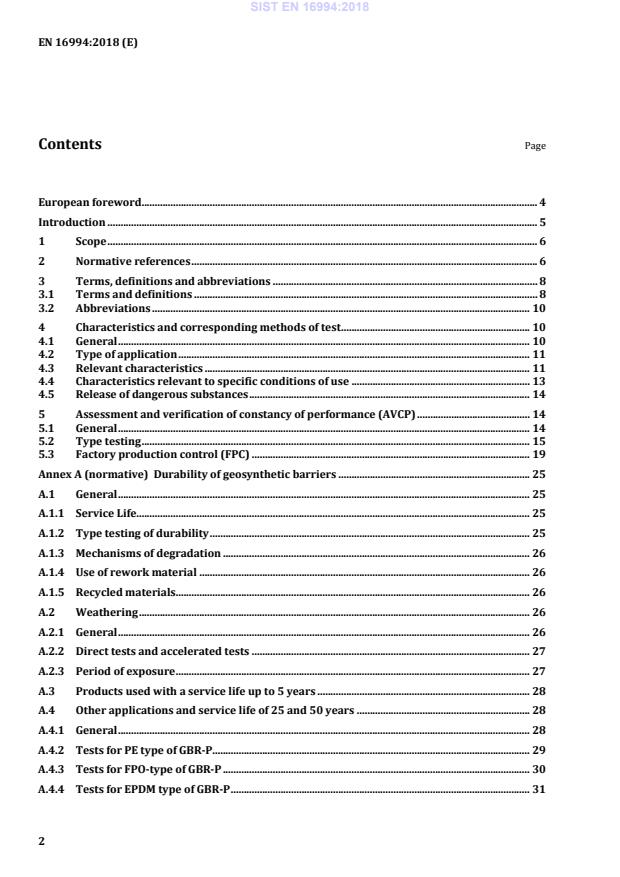
European foreword . 4 Introduction . 5 1 Scope . 6 2 Normative references . 6 3 Terms, definitions and abbreviations . 8 3.1 Terms and definitions . 8 3.2 Abbreviations . 10 4 Characteristics and corresponding methods of test . 10 4.1 General . 10 4.2 Type of application . 11 4.3 Relevant characteristics . 11 4.4 Characteristics relevant to specific conditions of use . 13 4.5 Release of dangerous substances . 14 5 Assessment and verification of constancy of performance (AVCP) . 14 5.1 General . 14 5.2 Type testing . 15 5.3 Factory production control (FPC) . 19 Annex A (normative)
Durability of geosynthetic barriers . 25 A.1 General . 25 A.1.1 Service Life. 25 A.1.2 Type testing of durability . 25 A.1.3 Mechanisms of degradation . 26 A.1.4 Use of rework material . 26 A.1.5 Recycled materials . 26 A.2 Weathering . 26 A.2.1 General . 26 A.2.2 Direct tests and accelerated tests . 27 A.2.3 Period of exposure . 27 A.3 Products used with a service life up to 5 years . 28 A.4 Other applications and service life of 25 and 50 years . 28 A.4.1 General . 28 A.4.2 Tests for PE type of GBR-P. 29 A.4.3 Tests for FPO-type of GBR-P . 30 A.4.4 Tests for EPDM type of GBR-P . 31 SIST EN 16994:2018
Relationship of this European Standard with Regulation (EU) No. 305/2011 . 48 ZA.1 Scope and relevant characteristics . 48 ZA.2 System of Assessment and Verification of Constancy of Performance (AVCP) . 49 ZA.3 Assignment of AVCP tasks . 50 Bibliography . 51
ASTM D5890, Standard test method for swell index of clay mineral component of geosynthetic clay liners ASTM D7409, Standard Test Method for Carboxyl End Group Content of Polyethylene Terephthalate (PET) Yarns
3 Terms, definitions and abbreviations 3.1 Terms and definitions For the purposes of this document, the terms and definitions given in EN ISO 10318-1 and the following apply. 3.1.1 product geosynthetic barrier, including polymeric, bituminous and clay barriers SIST EN 16994:2018
Key 1 underground structure 2 subgrade 3 clay geosynthetic barrier Figure 1 — Geosynthetic barrier in an underground structure as moisture and fluid barrier 4.3 Relevant characteristics The characteristics, their relevance to the conditions of use, and the test methods to be used, are specified in Table 1. The list of characteristics in Table 1 includes those relevant to all conditions of use (A) (essential characteristics are listed in Table ZA.1), and those relevant to specific conditions of use (S). The indication “–” means that the characteristic is not relevant for that function. Where, for the same property, data for more than one function shall be provided, the following ranking order shall be observed: A overrules S, and S overrules “–”. The functions and conditions of use, corresponding with the S-coded characteristics in Table 1, are specified in 4.4. The performances of the characteristics are given on basis of the results of tests specified in this document and, where relevant, in accordance with 5.1. Information on how functioning joints can be made should be provided. Where products are jointed in the factory the liquid tightness and if relevant the strength of the joints shall be tested and data presented. Prehydrated GBR-C should not be stored or installed when the ambient temperature is below 0 °C. SIST EN 16994:2018
Geosynthetic barrier Test methods Remarks No Property to be testeda
GBR-C GBR-C
Physical properties
1 Thickness A EN ISO 9863-1
2 Mass per unit area A EN 14196
Hydraulic properties
3 Liquid tightnessa A EN 16416 Test liquid is water. Report value index flux for GBR-C 4 Swell Index A ASTM D5890
Mechanical properties
6 Tensile strength A EN ISO 10319 Report in all cases the tensile strength at break measured according to the test method 7 Elongation A EN ISO 10319
8 Static Puncture A EN ISO 12236
9 Burst strength and elongation S
EN 14151 This test applies to GBR-C only if they contain a polymeric or bituminous barrier element. 10 Tear strength — —
Thermal properties
11 Low temperature behaviour (flexure) — —
12 Thermal expansion — —
Durability
13 Weathering — — In accordance with Annex A 14 Microorganisms S EN 12225 In accordance with Annex A 15 Oxidation A EN ISO 13438 In accordance with Annex A EN ISO 13438 is applicable for the geotextile elements and reinforcement yarns of GBR-C 16 Environmental stress cracking S EN 14576 In accordance with Annex A EN 14576 is applicable to GBR-P with a semi-crystalline structure. If GPR-P is between 0,5 mm and 1,0 mm the test EN 14576 shall be SIST EN 16994:2018
Geosynthetic barrier Test methods Remarks performed with the same composition at a thickness greater than 1,0 mm. 17 Chemical resistance S EN 14414 In accordance with Annex A Chemical resistance testing should be conducted in line with site specific circumstances. This should be restricted to a consideration of the substrate onto which the material is laid and/or chemicals contained. 18 Wetting/drying S CEN/TS 14417 In accordance with Annex A To determine the property of wetting/drying the test method EN 16416 is required. 19 Freezing/thawing S CEN/TS 14418 In accordance with Annex A To determine the property of freezing/thawing the test method EN 16416 is required. a NOTE The 95 % confidence level corresponds to the mean value minus (and/or plus) a tolerance value (see Annex ZA, Table ZA.1 column Notes). Both the mean value and the tolerance value are defined by the manufacturer to be representative of the performance of the product for the corresponding characteristic (these two values are not necessarily based on a statistical calculation). Relevance of codes:
A: relevant to all conditions of use
S: relevant to specific conditions of use
“—”: indicates that the characteristic is not relevant for that product Particular site-specific application cases may contain requirements for additional properties and - preferably standardized - test methods, if they are technically relevant and not conflicting with European Standards. The design life of the product should be determined, since its function may be temporary, as construction expediency, or permanent, for the lifetime of the structure. 4.4 Characteristics relevant to specific conditions of use 4.4.1 General The necessary data based on the test requirements and test methods described in this document for the functions and conditions of use described as relevant (see Table 1) in the project specification shall be provided. The list of characteristics in Table 1 includes those relevant to all conditions of use (A) (essential characteristics are listed in Table ZA.1), and those relevant to specific conditions of use (S). These specific conditions of use (S) are listed from 4.4.2 to 4.4.5. If the product under consideration is a multicomponent barrier, the performance of the claimed GBR shall dictate the characteristics listed in Table 1. SIST EN 16994:2018
(CBR test) 4.3, Table1 According to 4.3, Table 1 5 Not defined Liquid tightness (Water flux index) 4.3, Table 1 According to 4.3, Table 1 1 Not defined Elongation 4.3, Table 1 According to 4.3, Table 1 5 MD/5 CMD Not defined Durability 4.3, Table 1 and Annex A According to 4.3, Table 1 and Annex A See Annex A See Annex A 5.2.3 Test reports The results of the determination of the product type shall be documented in test reports. All test reports shall be retained by the manufacturer for at least 10 years after the last date of production of the clay geosynthetic barriers for use in the construction of underground structures (other than tunnels and associated structures) to which they relate. 5.2.4 Shared other party results A manufacturer may use the results of the product type determination (in consistency with this standard) obtained by someone else (e.g. by another manufacturer, as a common service to manufacturers, or by a product developer), to justify his own declaration of performance regarding a product that is manufactured according to the same design (e.g. dimensions) and with raw materials, constituents and manufacturing methods of the same kind, provided that: — the results are known to be valid for products with the same essential characteristics relevant for the product performance; — in addition to any information essential for confirming that the product has such same performances related to specific essential characteristics, the other party who has carried out the determination of the product type concerned or has had it carried out, has expressly accepted 1) to transmit to the manufacturer the results and the test report to be used for the latter’s product type determination, as well as information regarding production facilities and the production control process that can be taken into account for FPC; — the manufacturer using other party results accepts to remain responsible for the product having the declared performances and he also: a) ensures that the product has the same characteristics relevant for performance as the one that has been subjected to the determination of the product type, and that there are no significant
1) The formulation of such an agreement can be done by license, contract, or any other type of written consent. SIST EN 16994:2018
2) This can be, for instance, a contract, license or whatever kind of written agreement, which should also contain clear provisions with regard to responsibility and liability of the component producer (system house, on the one hand, and the assembler of the finished product, on the other hand. SIST EN 16994:2018
...
Questions, Comments and Discussion
Ask us and Technical Secretary will try to provide an answer. You can facilitate discussion about the standard in here.
Loading comments...