

SIST EN 15663:2017+A1:2019/kFprA2:2024
(Amendment)Railway applications - Vehicle reference masses
General Information
- Abstract
This European Standard defines a set of reference masses for specifying the requirements for the design, testing, acceptance, marking, delivery and operation of rail vehicles.
The reference masses defined in this document are as follows:
- dead mass;
- design mass in working order;
- design mass under normal payload;
- design mass under exceptional payload;
- operational mass in working order;
- operational mass under normal payload.
These reference masses are defined with respect to the whole vehicle, but they can also apply to a specific system or component.
The specification of values for tolerances applicable to reference masses is not in the scope of this standard. Tolerances can be required by an application standard.
Additional loadings due to environmental factors, for example snow and retained or absorbed rainwater, are not in the scope of this European Standard.
- Status
- Not Published
- Public Enquiry End Date
- 28-Sep-2022
- Technical Committee
- IŽNP - Reilway applications
- Current Stage
- 98 - Abandoned project (Adopted Project)
- Start Date
- 06-Jan-2025
- Due Date
- 11-Jan-2025
- Completion Date
- 06-Jan-2025

Overview
SIST EN 15663:2017+A1:2019/kFprA2:2024 is a European Standard developed by SIST for railway applications, specifically defining a consistent method for determining and applying reference masses for rail vehicles. The standard establishes a clear framework for specifying masses essential at different stages of the vehicle lifecycle, including design, testing, acceptance, marking, delivery, and operation. By standardizing the terminology and categorization of vehicle masses, SIST EN 15663 helps ensure interoperability and safety across railway networks and aligns with the requirements of EU Directive 2016/797 on rail system interoperability.
Key Topics
This standard covers the following main types of reference masses for railway vehicles:
- Dead mass - Mass of the vehicle in its 'as built' state, excluding consumables and staff
- Design mass in working order - Mass including consumables under specific (design) conditions
- Design mass under normal payload - Mass with a typical operational payload included
- Design mass under exceptional payload - Maximum possible payload considered for exceptional circumstances
- Operational mass in working order - Actual mass during typical service, including average consumables
- Operational mass under normal payload - Operational mass including a typical payload
Additional definitions are included for special purpose calculations as referenced by other application standards. The document does not address the specification of tolerances or environmental factors (such as snow or absorbed water), as these are governed by separate application standards.
Applications
SIST EN 15663 is crucial for professionals involved in the railway rolling stock industry, including manufacturers, operators, assessors, and regulators. Key practical uses include:
- Design and Engineering: Ensures that vehicles are designed to comply with relevant mass limits for safety and infrastructure compatibility.
- Testing and Acceptance: Sets a common baseline for reference masses during acceptance testing, supporting consistent, fair, and efficient certification.
- Marking and Delivery: Standardizes the data included on vehicle markings, facilitating interoperability across European rail networks.
- Operational Management: Provides reliable reference data for railway operators to plan services, manage maintenance, and optimize operational efficiency.
- Regulatory Compliance: Assists stakeholders in meeting the Essential Requirements of Directive (EU) 2016/797 and the Technical Specifications for Interoperability (TSI) for freight wagons, locomotives, passenger coaches, and infrastructure.
By harmonizing definitions and procedures, the standard supports safe, efficient, and interoperable railway operations across borders.
Related Standards
SIST EN 15663:2017+A1:2019/kFprA2:2024 is complemented by a range of related European and international standards, including:
- EN 17343:2020 – General railway terms and definitions
- EN 13103-1, EN 13103-2 – Wheelsets and bogies design methods
- EN 13452, EN 13749, EN 13979 – Requirements for braking systems and wheel components
- EN 14478, EN 14750, EN 15179 – Brake systems and air conditioning requirements
- EN 15227, EN 15273 – Crashworthiness and vehicle/infrastructure gauge compatibility
- EN 15528, EN 15595 – Managing vehicle and infrastructure interfaces
- EN 15654, EN 15877, EN 16185 – Measurement, marking, and testing standards
The standard also references relevant Technical Specifications for Interoperability (TSI) regulations and other supporting documentation to ensure robust integration with the European regulatory system.
Summary
By providing a unified framework for determining and applying railway vehicle reference masses, SIST EN 15663:2017+A1:2019/kFprA2:2024 is an essential tool for maintaining interoperability, safety, and regulatory compliance within the European railway sector. Its adoption ensures clarity, operational consistency, and supports efficient cross-border rail traffic across the EU and EFTA member states.
Relations
- Referred By
SIST EN 15227:2020+A1:2024 - Railway applications - Crashworthiness requirements for rail vehicles - Effective Date
- 28-Jan-2026
- Effective Date
- 01-Mar-2025
- Effective Date
- 24-Nov-2021
- Effective Date
- 28-Jul-2021
Get Certified
Connect with accredited certification bodies for this standard

IRIS Certification (UNIFE)
International Railway Industry Standard certification.

TÜV SÜD Rail GmbH
TÜV SÜD railway certification services.

Bureau Veritas Railway Certification
Railway and transportation certification.
Sponsored listings
Frequently Asked Questions
SIST EN 15663:2017+A1:2019/kFprA2:2024 is a draft published by the Slovenian Institute for Standardization (SIST). Its full title is "Railway applications - Vehicle reference masses". This standard covers: This European Standard defines a set of reference masses for specifying the requirements for the design, testing, acceptance, marking, delivery and operation of rail vehicles. The reference masses defined in this document are as follows: - dead mass; - design mass in working order; - design mass under normal payload; - design mass under exceptional payload; - operational mass in working order; - operational mass under normal payload. These reference masses are defined with respect to the whole vehicle, but they can also apply to a specific system or component. The specification of values for tolerances applicable to reference masses is not in the scope of this standard. Tolerances can be required by an application standard. Additional loadings due to environmental factors, for example snow and retained or absorbed rainwater, are not in the scope of this European Standard.
This European Standard defines a set of reference masses for specifying the requirements for the design, testing, acceptance, marking, delivery and operation of rail vehicles. The reference masses defined in this document are as follows: - dead mass; - design mass in working order; - design mass under normal payload; - design mass under exceptional payload; - operational mass in working order; - operational mass under normal payload. These reference masses are defined with respect to the whole vehicle, but they can also apply to a specific system or component. The specification of values for tolerances applicable to reference masses is not in the scope of this standard. Tolerances can be required by an application standard. Additional loadings due to environmental factors, for example snow and retained or absorbed rainwater, are not in the scope of this European Standard.
SIST EN 15663:2017+A1:2019/kFprA2:2024 is classified under the following ICS (International Classification for Standards) categories: 45.060.01 - Railway rolling stock in general. The ICS classification helps identify the subject area and facilitates finding related standards.
SIST EN 15663:2017+A1:2019/kFprA2:2024 has the following relationships with other standards: It is inter standard links to SIST EN 15227:2020+A1:2024, SIST EN 15663:2017+A2:2025, SIST EN 15663:2017+A1:2019, SIST EN 15663:2017+A1:2019. Understanding these relationships helps ensure you are using the most current and applicable version of the standard.
SIST EN 15663:2017+A1:2019/kFprA2:2024 is associated with the following European legislation: EU Directives/Regulations: 2016/797/EU; Standardization Mandates: M/483, M/591. When a standard is cited in the Official Journal of the European Union, products manufactured in conformity with it benefit from a presumption of conformity with the essential requirements of the corresponding EU directive or regulation.
SIST EN 15663:2017+A1:2019/kFprA2:2024 is available in PDF format for immediate download after purchase. The document can be added to your cart and obtained through the secure checkout process. Digital delivery ensures instant access to the complete standard document.
Standards Content (Sample)
SLOVENSKI STANDARD
SIST EN 15663:2017+A1:2019/oprA2:2022
01-september-2022
Železniške naprave - Določitev mase železniškega vozila
Railway applications - Vehicle reference masses
Bahnanwendungen - Fahrzeugreferenzmassen
Applications ferroviaires - Masses de référence des véhicules
Ta slovenski standard je istoveten z: EN 15663:2017+A1:2018/prA2:2022
ICS:
45.060.01 Železniška vozila na splošno Railway rolling stock in
general
SIST EN en,fr,de
15663:2017+A1:2019/oprA2:2022
2003-01.Slovenski inštitut za standardizacijo. Razmnoževanje celote ali delov tega standarda ni dovoljeno.
SIST EN 15663:2017+A1:2019/oprA2:2022
SIST EN 15663:2017+A1:2019/oprA2:2022
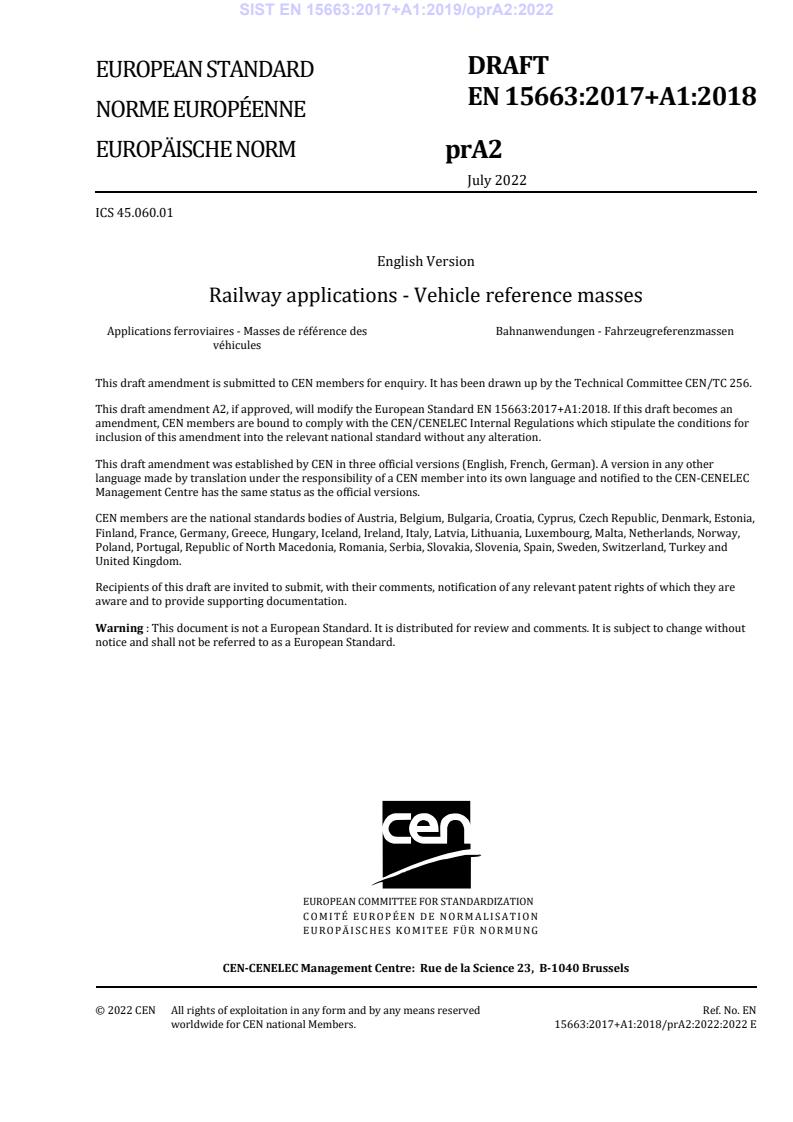
DRAFT
EUROPEAN STANDARD
EN 15663:2017+A1:2018
NORME EUROPÉENNE
EUROPÄISCHE NORM
prA2
July 2022
ICS 45.060.01
English Version
Railway applications - Vehicle reference masses
Applications ferroviaires - Masses de référence des Bahnanwendungen - Fahrzeugreferenzmassen
véhicules
This draft amendment is submitted to CEN members for enquiry. It has been drawn up by the Technical Committee CEN/TC 256.
This draft amendment A2, if approved, will modify the European Standard EN 15663:2017+A1:2018. If this draft becomes an
amendment, CEN members are bound to comply with the CEN/CENELEC Internal Regulations which stipulate the conditions for
inclusion of this amendment into the relevant national standard without any alteration.
This draft amendment was established by CEN in three official versions (English, French, German). A version in any other
language made by translation under the responsibility of a CEN member into its own language and notified to the CEN-CENELEC
Management Centre has the same status as the official versions.
CEN members are the national standards bodies of Austria, Belgium, Bulgaria, Croatia, Cyprus, Czech Republic, Denmark, Estonia,
Finland, France, Germany, Greece, Hungary, Iceland, Ireland, Italy, Latvia, Lithuania, Luxembourg, Malta, Netherlands, Norway,
Poland, Portugal, Republic of North Macedonia, Romania, Serbia, Slovakia, Slovenia, Spain, Sweden, Switzerland, Turkey and
United Kingdom.
Recipients of this draft are invited to submit, with their comments, notification of any relevant patent rights of which they are
aware and to provide supporting documentation.
Warning : This document is not a European Standard. It is distributed for review and comments. It is subject to change without
notice and shall not be referred to as a European Standard.
EUROPEAN COMMITTEE FOR STANDARDIZATION
COMITÉ EUROPÉEN DE NORMALISATION
EUROPÄISCHES KOMITEE FÜR NORMUNG
CEN-CENELEC Management Centre: Rue de la Science 23, B-1040 Brussels
© 2022 CEN All rights of exploitation in any form and by any means reserved Ref. No. EN
worldwide for CEN national Members. 15663:2017+A1:2018/prA2:2022:2022 E
SIST EN 15663:2017+A1:2019/oprA2:2022
EN 15663:2017+A1:2018/prA2:2022 (E)
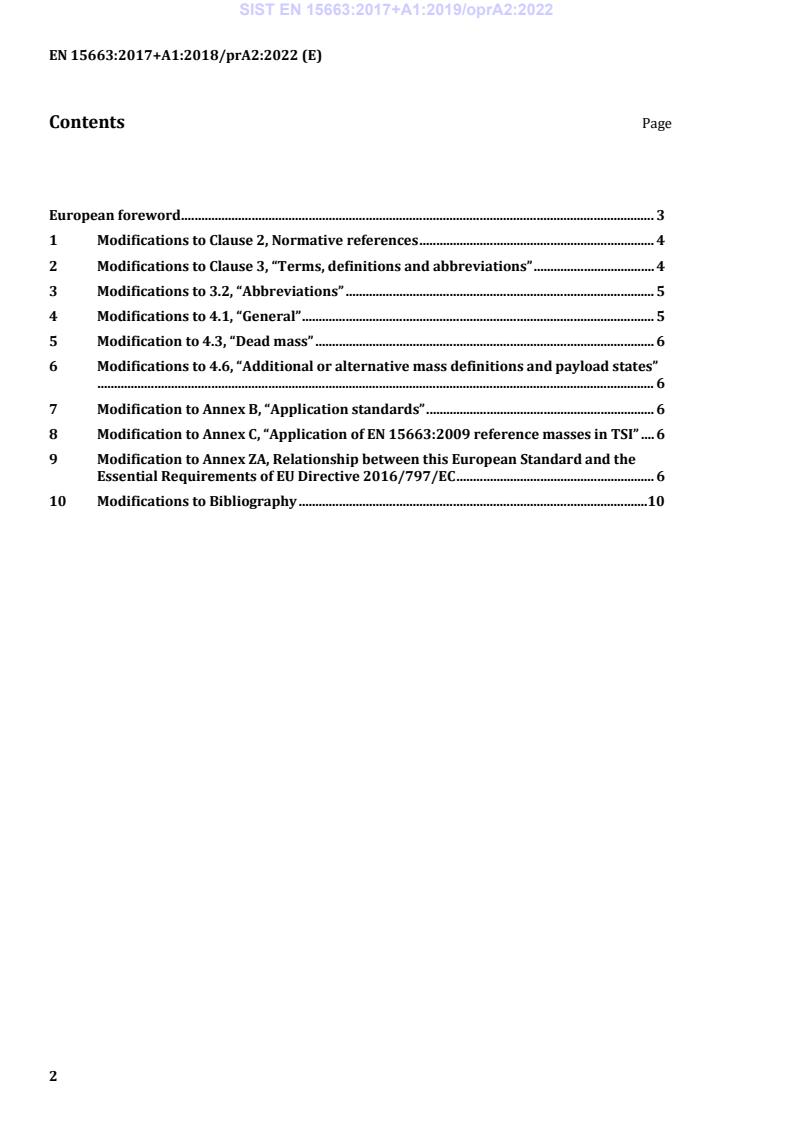
Contents Page
European foreword . 3
1 Modifications to Clause 2, Normative references . 4
2 Modifications to Clause 3, “Terms, definitions and abbreviations” . 4
3 Modifications to 3.2, “Abbreviations” . 5
4 Modifications to 4.1, “General” . 5
5 Modification to 4.3, “Dead mass” . 6
6 Modifications to 4.6, “Additional or alternative mass definitions and payload states”
...................................................................................................................................................................... 6
7 Modification to Annex B, “Application standards” . 6
8 Modification to Annex C, “Application of EN 15663:2009 reference masses in TSI” . 6
9 Modification to Annex ZA, Relationship between this European Standard and the
Essential Requirements of EU Directive 2016/797/EC . 6
10 Modifications to Bibliography .10
SIST EN 15663:2017+A1:2019/oprA2:2022
EN 15663:2017+A1:2018/prA2:2022 (E)
European foreword
This document (EN 15663:2017+A1:2018/prA2:2022) has been prepared by Technical Committee
CEN/TC 256 “Railway applications”, the secretariat of which is held by DIN.
This document is currently submitted to the CEN Enquiry.
This document has been prepared under a Standardization Request given to CEN by the European
Commission and the European Free Trade Association, and supports essential requirements of EU
Directive(s) / Regulation(s).
For relationship with EU Directive(s) / Regulation(s), see informative Annex ZA, which is an integral part
of this document.
SIST EN 15663:2017+A1:2019/oprA2:2022
EN 15663:2017+A1:2018/prA2:2022 (E)
1 Modifications to Clause 2, Normative references
Replace “There are no normative references in this document” with the following:
“The following documents are referred to in the text in such a way that some or all of their content
constitutes requirements of this document. For dated references, only the edition cited applies. For
undated references, the latest edition of the referenced document (including any amendments) applies.
EN 17343:2020, Railway applications — General terms and definitions”
2 Modifications to Clause 3, “Terms, definitions and abbreviations”
Replace “For the purposes of this document, the following terms and definitions apply.” with the following:
“For the purposes of this document, the terms and definition defined in EN 17343:2020 and the following
terms and definitions apply.”
Add the following new terms and definitions”:
3.1.11
dead mass
mass of the vehicle in the 'as built' condition without consumables and without staff
Note 1 to entry: 4.3 gives a detailed definition.
3.1.12
working order
typical payload seen on a regular basis
Note 1 to entry: The amount of consumables depends on the vehicle condition (design condition or operational
condition) as given in Table 6.
Note 2 to entry: This state is also described as unladen or tare,
3.1.13
normal payload
quantity of mass that is assumed to be lost in service due to abrasion and mechanical wear
Note 1 to entry: The normal payload depends on the vehicle condition (design or operational condition) as given
in Table 4.
Note 2 to entry: 4.4 gives a detailed definition.
Note 3 to entry: For freight vehicles, the payload is always taken as the maximum payload as specified in the
loading table of the vehicle.
3.1.14
exceptional payload
maximum possible payload that can be carried and that will be experienced only under exceptional
conditions
Note 1 to entry: The exceptional payload is only defined for the design condition.
Note 2 to entry: 4.4 gives a detailed definition.,
3.1.15
design condition
theoretical state for analysis and calculation
SIST EN 15663:2017+A1:2019/oprA2:2022
EN 15663:2017+A1:2018/prA2:2022 (E)
3.1.16
operational condition
assumed average state when in service
3.1.17
special purpose mass
mass, specified in an application standard based on the reference mass definitions in accordance with
this standard
Note 1 to entry: In accordance with this definition, a reference mass used directly by an application standard is
not considered as a special purpose mass.
Note 2 to entry: 4.6 gives detailed information about the application mass definitions,
“
3 Modifications to 3.2, “Abbreviations”
Replace “The unused letters of the alphabet are available to denote a mass or payload condition that is
defined by an application standard (see 4.6).”
with the following:
“The unused letters of the alphabet are available to denote a special purpose mass or payload condition
that is defined by an application standard (see 4.6).”
Replace “If the default values for standing areas in passenger and catering areas set out in 7.2 and 7.3 are
not used, the abbreviations shall be extended to indicate the values used in kg/m (e.g. MXD160).”
with the following:
“If the default values for standing areas in passenger and catering areas set out in 7.2 and 7.3 are not used,
the abbreviations shall be extended to indicate the particular values used in kg/m (e.g. MXD160).”
4 Modifications to 4.1, “General”
Delete “The design condition is a theoretical state for analysis and calculation; the operational condition
is an assumed average state when in service.”
Replace
“Methods are given in this document together with standard values and assumptions to be used. It is
permissible to deviate from the standard values within the ranges given in 7.2 and 7.3. The vehicle
specification together with an application standard gives these deviations.”
with the following:
“Methods are given in this document together with values and assumptions to be used. It is permissible
to deviate from the standard default values and specify particular values within the ranges given in 7.2
and 7.3. The vehicle specification together with an application standard gives these deviations.
In specifying particular values for determining reference masses, consideration should be given to:
— consistency between payload states. For example, if the mass per square metre is modified for an
exceptional payload, the value to be used for normal payload might also require modification;
— ensuring that any reference mass is applied consistently to applicable system components (for
example body loads and bogie loads).”
SIST EN 15663:2017+A1:2019/oprA2:2022
EN 15663:2017+A1:2018/prA2:2022 (E)
5 Modification to 4.3, “Dead mass”
Delete “Dead mass is the mass of the vehicle in the “as built” condition without consumables and without
staff (see Clause 5)”
6 Modifications to 4.6, “Additional or alternative mass definitions and payload
states”
Replace title of 4.6 “Additional or alternative mass definitions and payload states” with the following:
“Special purpose mass definitions and payload states”
Replace
“Non-standard reference masses, specified as additional or alternative mass or payload states shall be
defined and justified in the application standard. In such cases the mass and payload definitions set out
in 4.4 and 4.5 should be used as a basis wherever possible. This can be achieved for example by applying
factors or by including a specific mass or payload increment. In such cases, a suitable notation should be
defined following the principles of the system set out in 3.2. For this notation, the unused letters of the
alphabet are available. In specifying particular values for determining reference masses, consideration
should be given to:
— consistency between payload states. For example, if the mass per square metre is modified for an
exceptional payload, the value to be used for normal payload might also require modification;
— ensuring that any reference mass is applied consistently to applicable system components (for
example body loads and bogie loads).”
with the following:
“If technically necessary, special purpose masses or payload states shall be defined and justified in the
application standard.
EXAMPLE “Maximum braking load” as defined and used in EN 16185-1:2014+A1:2020 is an example of a
special purpose mass specified by this application standard.
In such cases the mass and payload definitions set out in 4.4 and 4.5 should be used as a basis wherever
possible. This can be achieved for example by applying factors or by including a specific mass or payload
increment. In such cases, a suitable notation should be defined following the principles of the system set
out in 3.2. For this notation, the unused letters of the alphabet are available.”
7 Modification to Annex B, “Application standards”
Delete Annex B.
8 Modification to Annex C, “Application of EN 15663:2009 reference masses in
TSI”
Delete Annex C.
9 Modification to Annex ZA, Relationship between this European Standard and
the Essential Requirements of EU Directive 2016/797/EC
Replace the current Annex ZA with the following:
SIST EN 15663:2017+A1:2019/oprA2:2022
EN 15663:2017+A1:2018/prA2:2022 (E)
Annex ZA
(informative)
Relationship between this European Standard and the Essential
Requirements of EU Directive (EU) 2016/797 aimed to be covered
This European Standard has been prepared under a Commission’s standardization reque
...