

SIST ISO 37005:2024
(Main)Governance of organizations - Developing Indicators for effective governance
General Information
- Abstract
This document provides guidance to governing bodies on how to approach the development and use of indicators in their governing activities.
This document is primarily written for use by governing bodies, it is also written to be of relevance to a range of other stakeholders inside and outside of the organization to help them improve the quality of the information on which they assess and make decisions regarding the organization’s governance.
It is applicable to all organizations regardless of type, size, location, structure or purpose. This document does not cover indicators of effective governance.
- Status
- Published
- Public Enquiry End Date
- 29-Nov-2023
- Publication Date
- 18-Aug-2024
- Technical Committee
- VZK - Quality management and quality assurance
- Current Stage
- 6060 - National Implementation/Publication (Adopted Project)
- Start Date
- 05-Aug-2024
- Due Date
- 10-Oct-2024
- Completion Date
- 19-Aug-2024
Buy Documents



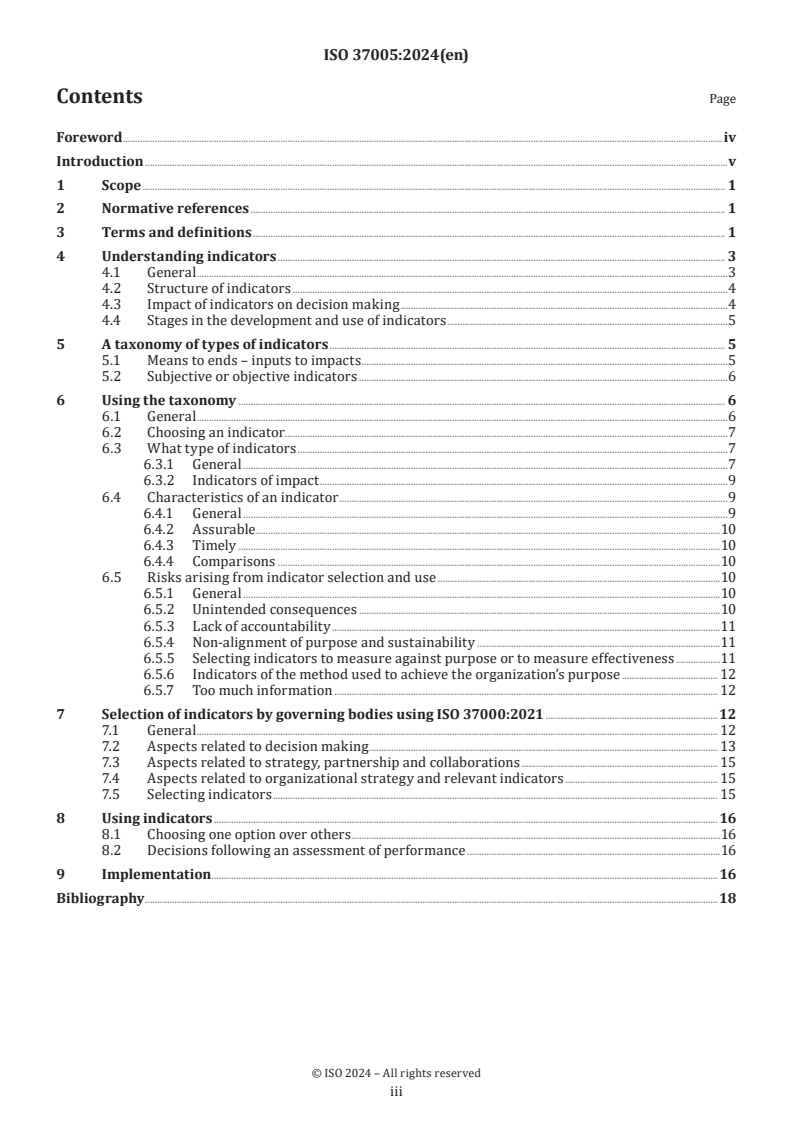

ISO 37005:2024 - Governance of organizations — Developing indicators for effective governance Released:31. 07. 2024

ISO 37005:2024 - Governance of organizations — Developing indicators for effective governance
Overview
ISO 37005:2024, "Governance of organizations - Developing indicators for effective governance," is ISO guidance for governing bodies on developing and using indicators that inform governance decisions. Applicable to all organizations regardless of type, size, location or purpose, the document helps boards and other governance actors design, select and apply measurable representations of decisions, activities and stakeholder expectations. Note: ISO 37005 provides guidance on indicator design and use; it does not itself set indicators of effective governance.
Key topics
- Purpose and scope: Guidance tailored primarily for governing bodies but relevant to internal and external stakeholders who assess governance information.
- Indicator concepts and structure: Definitions and taxonomy covering input indicators, output indicators, activities, processes, outcomes and impacts.
- Taxonomy of indicator types: Classification by means-to-ends (inputs → impacts) and by subjective vs objective measures to support clarity in measurement and interpretation.
- Stages of development and use: Guidance on stages-from design, selection and validation to ongoing use and review of indicators.
- Characteristics of good indicators: Emphasis on attributes such as assurability, timeliness, comparability and relevance to organizational purpose and risk appetite.
- Risk considerations: Identification of risks arising from indicator selection and use, including unintended consequences, lack of accountability, non-alignment with purpose/sustainability, information overload, and method‑vs‑purpose measurement trade-offs.
- Decision-making integration: How indicators support option appraisal and choices by governing bodies, aligning measurement with strategy, partnerships and stakeholder materiality.
- Implementation guidance: Practical steps for governing bodies to embed indicators into governance frameworks and into the monitoring of organizational outcomes and impacts.
Applications and users
Who benefits:
- Board members and governing bodies designing governance monitoring frameworks.
- Risk and compliance officers, corporate secretaries and audit committees seeking robust performance and governance metrics.
- Senior management and strategy teams who need decision-useful indicators aligned to organizational purpose.
- External stakeholders (investors, regulators, auditors, civil society) who require clearer, comparable governance information.
Practical uses:
- Selecting indicators to monitor strategic objectives and stakeholder impacts.
- Designing KPI systems that respect risk appetite and materiality.
- Avoiding common measurement pitfalls (misaligned metrics, perverse incentives).
- Enhancing transparency, assurance and decision quality in governance processes.
Related standards
- ISO 37000:2021 - Governance of organizations - Guidance (primary reference for governance principles).
- Other referenced standards for terms and processes include ISO 37301 and ISO 9000 (terminology and measurement context).
Keywords: ISO 37005, governance indicators, organizational governance, governing bodies, indicator taxonomy, indicator selection, ISO 37000, performance measurement, risk appetite.
Buy Documents
ISO 37005:2024 - Governance of organizations — Developing indicators for effective governance Released:31. 07. 2024
ISO 37005:2024 - Governance of organizations — Developing indicators for effective governance
Get Certified
Connect with accredited certification bodies for this standard

BSI Group
BSI (British Standards Institution) is the business standards company that helps organizations make excellence a habit.

Bureau Veritas
Bureau Veritas is a world leader in laboratory testing, inspection and certification services.

DNV
DNV is an independent assurance and risk management provider.
Sponsored listings
Frequently Asked Questions
SIST ISO 37005:2024 is a standard published by the Slovenian Institute for Standardization (SIST). Its full title is "Governance of organizations - Developing Indicators for effective governance". This standard covers: This document provides guidance to governing bodies on how to approach the development and use of indicators in their governing activities. This document is primarily written for use by governing bodies, it is also written to be of relevance to a range of other stakeholders inside and outside of the organization to help them improve the quality of the information on which they assess and make decisions regarding the organization’s governance. It is applicable to all organizations regardless of type, size, location, structure or purpose. This document does not cover indicators of effective governance.
This document provides guidance to governing bodies on how to approach the development and use of indicators in their governing activities. This document is primarily written for use by governing bodies, it is also written to be of relevance to a range of other stakeholders inside and outside of the organization to help them improve the quality of the information on which they assess and make decisions regarding the organization’s governance. It is applicable to all organizations regardless of type, size, location, structure or purpose. This document does not cover indicators of effective governance.
SIST ISO 37005:2024 is classified under the following ICS (International Classification for Standards) categories: 03.100.02 - Governance and ethics. The ICS classification helps identify the subject area and facilitates finding related standards.
SIST ISO 37005:2024 is available in PDF format for immediate download after purchase. The document can be added to your cart and obtained through the secure checkout process. Digital delivery ensures instant access to the complete standard document.
Standards Content (Sample)
SLOVENSKI STANDARD
01-september-2024
Upravljanje organizacij – Razvoj kazalnikov za učinkovito upravljanje
Governance of organizations - Developing Indicators for effective governance
Titre manque
Ta slovenski standard je istoveten z: ISO 37005:2024
ICS:
03.100.02 Upravljanje in etika Governance and ethics
2003-01.Slovenski inštitut za standardizacijo. Razmnoževanje celote ali delov tega standarda ni dovoljeno.
International
Standard
ISO 37005
First edition
Governance of organizations —
2024-07
Developing indicators for effective
governance
Gouvernance des organismes — Élaboration d'indicateurs d'une
gouvernance efficace
Reference number
© ISO 2024
All rights reserved. Unless otherwise specified, or required in the context of its implementation, no part of this publication may
be reproduced or utilized otherwise in any form or by any means, electronic or mechanical, including photocopying, or posting on
the internet or an intranet, without prior written permission. Permission can be requested from either ISO at the address below
or ISO’s member body in the country of the requester.
ISO copyright office
CP 401 • Ch. de Blandonnet 8
CH-1214 Vernier, Geneva
Phone: +41 22 749 01 11
Email: copyright@iso.org
Website: www.iso.org
Published in Switzerland
ii
Contents Page
Foreword .iv
Introduction .v
1 Scope . 1
2 Normative references . 1
3 Terms and definitions . 1
4 Understanding indicators . 3
4.1 General .3
4.2 Structure of indicators .4
4.3 Impact of indicators on decision making .4
4.4 Stages in the development and use of indicators .5
5 A taxonomy of types of indicators . 5
5.1 Means to ends – inputs to impacts . .5
5.2 Subjective or objective indicators .6
6 Using the taxonomy . 6
6.1 General .6
6.2 Choosing an indicator .7
6.3 What type of indicators .7
6.3.1 General .7
6.3.2 Indicators of impact .9
6.4 Characteristics of an indicator .9
6.4.1 General .9
6.4.2 Assurable .10
6.4.3 Timely .10
6.4.4 Comparisons .10
6.5 Risks arising from indicator selection and use .10
6.5.1 General .10
6.5.2 Unintended consequences .10
6.5.3 Lack of accountability .11
6.5.4 Non-alignment of purpose and sustainability .11
6.5.5 Selecting indicators to measure against purpose or to measure effectiveness .11
6.5.6 Indicators of the method used to achieve the organization’s purpose . 12
6.5.7 Too much information . 12
7 Selection of indicators by governing bodies using ISO 37000:2021 .12
7.1 General . 12
7.2 Aspects related to decision making . . 13
7.3 Aspects related to strategy, partnership and collaborations . 15
7.4 Aspects related to organizational strategy and relevant indicators . 15
7.5 Selecting indicators . 15
8 Using indicators . 16
8.1 Choosing one option over others .16
8.2 Decisions following an assessment of performance .16
9 Implementation . .16
Bibliography .18
iii
Foreword
ISO (the International Organization for Standardization) is a worldwide federation of national standards
bodies (ISO member bodies). The work of preparing International Standards is normally carried out through
ISO technical committees. Each member body interested in a subject for which a technical committee
has been established has the right to be represented on that committee. International organizations,
governmental and non-governmental, in liaison with ISO, also take part in the work. ISO collaborates closely
with the International Electrotechnical Commission (IEC) on all matters of electrotechnical standardization.
The procedures used to develop this document and those intended for its further maintenance are described
in the ISO/IEC Directives, Part 1. In particular, the different approval criteria needed for the different types
of ISO document should be noted. This document was drafted in accordance with the editorial rules of the
ISO/IEC Directives, Part 2 (see www.iso.org/directives).
ISO draws attention to the possibility that the implementation of this document may involve the use of (a)
patent(s). ISO takes no position concerning the evidence, validity or applicability of any claimed patent
rights in respect thereof. As of the date of publication of this document, ISO had not received notice of (a)
patent(s) which may be required to implement this document. However, implementers are cautioned that
this may not represent the latest information, which may be obtained from the patent database available at
www.iso.org/patents. ISO shall not be held responsible for identifying any or all such patent rights.
Any trade name used in this document is information given for the convenience of users and does not
constitute an endorsement.
For an explanation of the voluntary nature of standards, the meaning of ISO specific terms and expressions
related to conformity assessment, as well as information about ISO's adherence to the World Trade
Organization (WTO) principles in the Technical Barriers to Trade (TBT), see www.iso.org/iso/foreword.html.
This document was prepared by Technical Committee ISO/TC 309, Governance of organizations.
Any feedback or questions on this document should be directed to the user’s national standards body. A
complete listing of these bodies can be found atwww.iso.org/members.html.
iv
Introduction
The purpose of indicators is to enable measurement that helps an organization to establish, implement,
maintain, and improve an effective governance framework and the conditions and practices enabling the
organization to fulfil its purpose. By following the guidance in this document organizations can realize the
governance principles as set out in ISO 37000.
This document provides a means to assess how an organization’s governance framework contributes most
effectively to the fulfilment of the organization's purpose. It covers:
— a taxonomy for the classification of different types of indicators;
— the context in which they are used, including the purpose of the organization and its appetite for risk
given impacts on all stakeholders;
— the risk appetite and tolerance of the organization and stakeholders;
— the limitations of indicators;
— choosing or developing meaningful indicators.
The role of an organization’s governing body is to establish, implement and maintain the organizational
governance framework, conditions and practices so that the organization can fulfil its purpose. In
performing this role the governing body has to make decisions and choose between available options,
as many times there will not be one solution. The indicators used will be part of the process to generate
those options and part of the mechanism to guide the choice between options. Governing bodies should
measure performance against objectives, which requires indicators. ISO 37000 helps to create cross-sector
international consensus on the role and results of organizational governance. However, the organizational
outcomes of organizational governance depend on the decisions made by governing bodies, the information
used to support those decisions as well as their execution. These decisions mean making choices between
the intended performance of alternative options for the same organizational purpose. A mechanism is
required to compare these options, in order to choose the optimal one for the specific context.
There is always the possibility that the choice made between options does not represent the "best"
choice or that the execution is not effective. Effective governance therefore requires an understanding of
appropriate indicators in the context of that possibility and the risk appetite of the governing body. Effective
consideration of indicators linked to organizational purpose, stakeholder issues, materiality and risk
appetite/tolerance reduces the extent to which a governing body can make decisions without the full range
of material information. It also enhances a dynamic monitoring approach.
Indicators are used and understood in various ways. Ultimately the governing body is seeking to achieve the
organizational purpose in the way intended. If this is done well then over time the governing body would
expect its organizational purpose and financial results to become aligned with sustainable development
and well-being as it considers the principles in ISO 37000, including social responsibility and viability and
performance over time. The pursuit of a purpose with consequences that detracts from ISO 37000 principles
would neither be responsible nor viable.
Unless otherwise indicated, all "principles" in this document refer to the principles in ISO 37000.
v
International Standard ISO 37005:2024(en)
Governance of organizations — Developing indicators for
effective governance
1 Scope
This document provides guidance to governing bodies on how to approach the development and use of
indicators in their governing activities.
This document is primarily written for use by governing bodies, it is also written to be of relevance to a
range of other stakeholders inside and outside of the organization to help them improve the quality of the
information on which they assess and make decisions regarding the organization’s governance.
It is applicable to all organizations regardless of type, size, location, structure or purpose. This document
does not cover indicators of effective governance.
2 Normative references
The following documents are referred to in the text in such a way that some or all of their content constitutes
requirements of this document. For dated references, only the edition cited applies. For undated references,
the latest edition of the referenced document (including any amendments) applies.
ISO 37000:2021, Governance of organizations — Guidance
3 Terms and definitions
For the purposes of this document, the terms and definitions given in ISO 37000 and the following apply.
ISO and IEC maintain terminology databases for use in standardization at the following addresses:
— ISO Online browsing platform: available at https:// www .iso .org/ obp
— IEC Electropedia: available at https:// www .electropedia .org/
3.1
indicator
measurable representation of the condition or status of governing body decisions, organizational actions or
activities (3.4), and stakeholder expectations
Note 1 to entry: Indicators can be measured, calculated, and described.
3.2
input indicator
indicator (3.1) of all types of resources on which the organization depends, irrespective of how they have
been sourced
Note 1 to entry: Examples of these resources include air, biodiversity, unpaid labour etc, including resources used
across the supply chain.
3.3
output indicator
indicator (3.1) for measuring activities (3.4)
Note 1 to entry: Can be qualitative or quantitative.
3.4
activity
way in which resources are used
3.5
objective
result to be achieved
Note 1 to entry: An objective can be strategic, tactical or operational.
Note 2 to entry: An objective can be, for example, organization-wide or specific to a project, product or process (3.6).
Note 3 to entry: Result in this document can refer to output (3.7), organizational outcome (3.8), or impact (3.9)
[SOURCE: ISO 37301:2021, 3.6 modified – Note 2 to entry has been modified, Note 3 to entry has been
replaced and Note 4 to entry has been deleted]
3.6
process
set of interrelated or interacting activities (3.4) that uses or transforms inputs to deliver an intended result
Note 1 to entry: Result in this document can refer to output (3.7), organizational outcomes (3.8), or impact (3.9)
[SOURCE: ISO 9000:2015, 3.4.1 modified – Note 1 to entry has been modified, Notes 2 to 6 to entry have been
deleted]
3.7
output
result of a process (3.6)
Note 1 to entry: This result can be intended or unintended
[SOURCE: ISO 9000:2015, 3.7.15, modified – Note 1 to entry has been modified]
3.8
organizational outcome
something, including aspects of well-being (3.14), that has the potential to change following a governing
body’s decisions
3.9
impact
positive or negative change in an organizational outcome (3.8) because of a governing body´s decision,
execution and the consequences of those decisions
Note 1 to entry: Taking account of other causes of any change in those outcomes.
Note 2 to entry: The change in an outcome can be positive or negative depending on its relation to a threshold.
Note 3 to entry: There may be interim points between actions and impacts where measurement can support
management towards achieving organizational purpose.
Note 4 to entry: If the change is in a well-being (3.14) outcome then this would be a well-being impact
3.10
impact valuation
measurement (3.11) of the relative importance of impacts (3.9)
3.11
measurement
process (3.6) to determine a value
Note 1 to entry: Impact valuation (3.10) is one type of measurement.
[SOURCE: ISO 37301:2021, 3.19, modified – Note 1 to entry has been added]
3.12
uncertainty
state, even partial, of deficiency of information related to understanding or knowledge
Note 1 to entry: In some cases, uncertainty can be related to the organization´s context as well as to its objectives (3.5).
Note 2 to entry: Uncertainty is the root source of risk, namely any kind of “deficiency of information” that matters in
relation to objectives (and objectives, in turn, relate to all relevant interested parties´ needs and expectations).
[SOURCE: ISO 31073:2022, 3.1.3]
3.13
materiality assessment
identification of information that would influence the decisions of a governing body in the context of the
principles in ISO 37000
3.14
well-being
positive state of being where people’s needs are met, such that they have the capacity and opportunity to
lead fulfilling lives
Note 1 to entry: Well-being is also referred to as a state of flourishing or a “good life”.
Note 2 to entry: Well-being exists at the individual, household, country and global level and can be applied to people
and nature, and to individuals and systems.
Note 3 to entry: Well-being can be achieved on varying timescales and to varying degrees.
Note 4 to entry: Sustainable development underpins the achievement of well-being at a point in time and for present
and future generations.
3.15
performance
measurable result
Note 1 to entry: Performance can relate either to quantitative or qualitative findings.
[SOURCE: ISO 37301:2021, 3.11, modified – Note 2 to entry has been deleted]
3.16
effectiveness
extent to which planned activities (3.4) are realized and planned results are achieved
Note 1 to entry: Result in this document can refer to output (3.7), organizational outcomes (3.8), or impact (3.9).
[SOURCE: ISO 37301:2021, 3.13, modified – Note 1 to entry has been added]
4 Understanding indicators
4.1 General
Governing bodies are responsible for "the fulfilment of the purpose of the organization in an ethical, effective
and responsible manner in line with stakeholder expectations" (ISO 37000:2021).
ISO 37000:2021, 4.1 sets this out as:
a) setting and committing to the organizational purpose and organizational values;
b) determining the organization’s approach to value generation;
c) directing and engaging with strategy to generate value;
d) overseeing that the organization performs and behaves according to the expectations set by the
governing body;
e) demonstrating accountability for this performance and behaviour.
Useful indicators provide a measure of performance in line with organizational purpose. Consequently,
indicators are quantitative and qualitative conditions that can be described and measured or calculated.
4.2 Structure of indicators
Indicators are descriptive and qualitative or quantitative and are used to assess performance. Based on
ISO 37000 principles, an indicator for effective governance should provide the assurance of responsibility,
in a social, environmental and economic context, and provide the basis for accountability and assurance in
accordance with governing body decisions, organizational action and stakeholder expectations by relevance.
An indicator can be structured as shown in Figure 1:
Figure 1 — Structure of an indicator
The structure of an indicator has multiple levels of description, according to the scope (see Figure 1). These
levels can be articulated as follows:
a) A quantitative element OF a qualitative element;
b) A quantitative element OF a qualitative element BY or PER a specific principle of ISO 37000 over time;
c) A quantitative element OF a qualitative element BY context (social, environmental or economic) [or]
PER accountability (governing body decisions, organizational action and stakeholder expectations by
relevance);
d) A quantitative element OF a qualitative element BY context [and/or/not] PER accountability (where the
accountability could also precede the context).
The minimum specification of an indicator includes "quantity OF a quality/attribute" and either PER or BY.
NOTE 1 BY and PER are interchangeable.
NOTE 2 Context is described in ISO 37000 as "the natural environment, social and economic system context".
EXAMPLE Cost of customer acquisition by market segment per customer channel.
The measure associated with an indicator linked to an organizational purpose provides a measure of an
underlying condition and is always associated with some degree of uncertainty. The effect of this uncertainty
is a risk. Uncertainty changes as new data become available.
4.3 Impact of indicators on decision making
Indicators allow the governing body to make comparisons to assist in making decisions including:
— comparisons of different options or actions in order to choose the one or the combination of options that
contributes most to the organizational outcomes and to the fulfilment of the organizational purpose;
— the simple binary comparison of whether the decision has been executed or not;
— comparisons between actual and expected results to assess the effectiveness of the organization
governance framework in achieving the fulfilment of the organization's purpose at the rate required.
Indicators are required for information that is material to the comparisons that a governing body is
making to improve the organization’s effectiveness in meeting its purpose with the available resources. If
comparisons are being made which include information that is not material, or do not include information
that is material, there is a possibility that the comparison would lead to a suboptimal decision.
4.4 Stages in the development and use of indicators
Materiality assessment is a critical step before the selection and use of indicators. A materiality assessment
is designed to reduce the possibility that suboptimal decisions are being made and increase the opportunity
to generate insights that inform decisions relating to an organization´s purpose. The decisions to be made by
a governing body in providing strategic direction as part of Principle 1 of ISO 37000:2021 include considering
the risk landscape and the material impacts on the context and of the context on the organization. In addition,
the information that is material depends on that purpose and is a judgement (ISO 37000:2021, 6.8.3.2.1). It
may change over time.
Once the information that matters has been determined, suitable indicators can be selected to obtain
relevant measurements. The measures associated with the indicators require a level of accuracy for effective
monitoring and decision making.
Once indicators have been selected, measurement information can be collected. It is important that the
measures associated with the indicator be under effective governance to ensure appropriate accuracy,
completeness and repeatability - and should be verified before formalising use.
5 A taxonomy of types of indicators
5.1 Means to ends – inputs to impacts
The main taxonomy for considering indicators that can be used for the decisions in 7.1 is to categorise
indicators against:
— Input indicator/means indicators.
— Inputs.
— Activity indicators.
— Outputs.
— Impact indicator/ends indicators.
— Organizational outcomes (including well-being outcomes).
— Impacts (including impact valuations).
See also structure of a theory of change as illustrated in Figure 3.
For any purpose it defines as its overarching objective, an organization should commit resources to activities
in the expectation of progress against that purpose. The resources being committed are the inputs. These
permit the development of activities to achieve the purpose in the way intended. A measure of the activities
is the outputs. The core subjects that change, which can be both expected and unexpected (or intended
and unintended) are the organizational outcomes. Changes in those outcomes are impacts. Changes in
organizational outcomes may cause change in other organizational outcomes.
Where the intentions towards the natural environment, society and the organization’s stakeholders
are encoded in the organizational purpose, are in line with sustainable development; and the way this
organizational purpose is intended to be achieved (for example as in Principle 11), reference to ‘impacts’
should, by extension, mean changes in aspects of well-being.
If the governing body has articulated an organizational purpose that is not aligned with achieving sustainable
development, impacts may not help contribute to the well-being of current and future generations. The
decisions made to achieve the organizational purpose will affect what ultimate value is created and
destroyed but the decisions should affect people’s well-being irrespective of the quality of this purpose.
An organization that is considering sustainability in its decision-making should examine how its impacts
lead to changes in aspects of well-being. The set of organizational outcomes that relate to aspects of well-
being are termed ‘well-being outcomes’.
When a governing body needs to make comparisons between options one or more of which is a future
projection, the choice is informed by the expected impact valuation. The assessment of expected impact
valuation can be implicit or transparent, informed by the decision maker or by those experiencing the
impacts.
These expectations are implicit in, for example, Principle 10 on social responsibility requiring that decisions
are in line with broader social expectations; Principle 11 on viability and performance over time requiring
consideration of present and future generations; and Principle 6 on stakeholder engagement requiring an
unde
...
International
Standard
ISO 37005
First edition
Governance of organizations —
2024-07
Developing indicators for effective
governance
Gouvernance des organismes — Élaboration d'indicateurs d'une
gouvernance efficace
Reference number
© ISO 2024
All rights reserved. Unless otherwise specified, or required in the context of its implementation, no part of this publication may
be reproduced or utilized otherwise in any form or by any means, electronic or mechanical, including photocopying, or posting on
the internet or an intranet, without prior written permission. Permission can be requested from either ISO at the address below
or ISO’s member body in the country of the requester.
ISO copyright office
CP 401 • Ch. de Blandonnet 8
CH-1214 Vernier, Geneva
Phone: +41 22 749 01 11
Email: copyright@iso.org
Website: www.iso.org
Published in Switzerland
ii
Contents Page
Foreword .iv
Introduction .v
1 Scope . 1
2 Normative references . 1
3 Terms and definitions . 1
4 Understanding indicators . 3
4.1 General .3
4.2 Structure of indicators .4
4.3 Impact of indicators on decision making .4
4.4 Stages in the development and use of indicators .5
5 A taxonomy of types of indicators . 5
5.1 Means to ends – inputs to impacts . .5
5.2 Subjective or objective indicators .6
6 Using the taxonomy . 6
6.1 General .6
6.2 Choosing an indicator .7
6.3 What type of indicators .7
6.3.1 General .7
6.3.2 Indicators of impact .9
6.4 Characteristics of an indicator .9
6.4.1 General .9
6.4.2 Assurable .10
6.4.3 Timely .10
6.4.4 Comparisons .10
6.5 Risks arising from indicator selection and use .10
6.5.1 General .10
6.5.2 Unintended consequences .10
6.5.3 Lack of accountability .11
6.5.4 Non-alignment of purpose and sustainability .11
6.5.5 Selecting indicators to measure against purpose or to measure effectiveness .11
6.5.6 Indicators of the method used to achieve the organization’s purpose . 12
6.5.7 Too much information . 12
7 Selection of indicators by governing bodies using ISO 37000:2021 .12
7.1 General . 12
7.2 Aspects related to decision making . . 13
7.3 Aspects related to strategy, partnership and collaborations . 15
7.4 Aspects related to organizational strategy and relevant indicators . 15
7.5 Selecting indicators . 15
8 Using indicators . 16
8.1 Choosing one option over others .16
8.2 Decisions following an assessment of performance .16
9 Implementation . .16
Bibliography .18
iii
Foreword
ISO (the International Organization for Standardization) is a worldwide federation of national standards
bodies (ISO member bodies). The work of preparing International Standards is normally carried out through
ISO technical committees. Each member body interested in a subject for which a technical committee
has been established has the right to be represented on that committee. International organizations,
governmental and non-governmental, in liaison with ISO, also take part in the work. ISO collaborates closely
with the International Electrotechnical Commission (IEC) on all matters of electrotechnical standardization.
The procedures used to develop this document and those intended for its further maintenance are described
in the ISO/IEC Directives, Part 1. In particular, the different approval criteria needed for the different types
of ISO document should be noted. This document was drafted in accordance with the editorial rules of the
ISO/IEC Directives, Part 2 (see www.iso.org/directives).
ISO draws attention to the possibility that the implementation of this document may involve the use of (a)
patent(s). ISO takes no position concerning the evidence, validity or applicability of any claimed patent
rights in respect thereof. As of the date of publication of this document, ISO had not received notice of (a)
patent(s) which may be required to implement this document. However, implementers are cautioned that
this may not represent the latest information, which may be obtained from the patent database available at
www.iso.org/patents. ISO shall not be held responsible for identifying any or all such patent rights.
Any trade name used in this document is information given for the convenience of users and does not
constitute an endorsement.
For an explanation of the voluntary nature of standards, the meaning of ISO specific terms and expressions
related to conformity assessment, as well as information about ISO's adherence to the World Trade
Organization (WTO) principles in the Technical Barriers to Trade (TBT), see www.iso.org/iso/foreword.html.
This document was prepared by Technical Committee ISO/TC 309, Governance of organizations.
Any feedback or questions on this document should be directed to the user’s national standards body. A
complete listing of these bodies can be found atwww.iso.org/members.html.
iv
Introduction
The purpose of indicators is to enable measurement that helps an organization to establish, implement,
maintain, and improve an effective governance framework and the conditions and practices enabling the
organization to fulfil its purpose. By following the guidance in this document organizations can realize the
governance principles as set out in ISO 37000.
This document provides a means to assess how an organization’s governance framework contributes most
effectively to the fulfilment of the organization's purpose. It covers:
— a taxonomy for the classification of different types of indicators;
— the context in which they are used, including the purpose of the organization and its appetite for risk
given impacts on all stakeholders;
— the risk appetite and tolerance of the organization and stakeholders;
— the limitations of indicators;
— choosing or developing meaningful indicators.
The role of an organization’s governing body is to establish, implement and maintain the organizational
governance framework, conditions and practices so that the organization can fulfil its purpose. In
performing this role the governing body has to make decisions and choose between available options,
as many times there will not be one solution. The indicators used will be part of the process to generate
those options and part of the mechanism to guide the choice between options. Governing bodies should
measure performance against objectives, which requires indicators. ISO 37000 helps to create cross-sector
international consensus on the role and results of organizational governance. However, the organizational
outcomes of organizational governance depend on the decisions made by governing bodies, the information
used to support those decisions as well as their execution. These decisions mean making choices between
the intended performance of alternative options for the same organizational purpose. A mechanism is
required to compare these options, in order to choose the optimal one for the specific context.
There is always the possibility that the choice made between options does not represent the "best"
choice or that the execution is not effective. Effective governance therefore requires an understanding of
appropriate indicators in the context of that possibility and the risk appetite of the governing body. Effective
consideration of indicators linked to organizational purpose, stakeholder issues, materiality and risk
appetite/tolerance reduces the extent to which a governing body can make decisions without the full range
of material information. It also enhances a dynamic monitoring approach.
Indicators are used and understood in various ways. Ultimately the governing body is seeking to achieve the
organizational purpose in the way intended. If this is done well then over time the governing body would
expect its organizational purpose and financial results to become aligned with sustainable development
and well-being as it considers the principles in ISO 37000, including social responsibility and viability and
performance over time. The pursuit of a purpose with consequences that detracts from ISO 37000 principles
would neither be responsible nor viable.
Unless otherwise indicated, all "principles" in this document refer to the principles in ISO 37000.
v
International Standard ISO 37005:2024(en)
Governance of organizations — Developing indicators for
effective governance
1 Scope
This document provides guidance to governing bodies on how to approach the development and use of
indicators in their governing activities.
This document is primarily written for use by governing bodies, it is also written to be of relevance to a
range of other stakeholders inside and outside of the organization to help them improve the quality of the
information on which they assess and make decisions regarding the organization’s governance.
It is applicable to all organizations regardless of type, size, location, structure or purpose. This document
does not cover indicators of effective governance.
2 Normative references
The following documents are referred to in the text in such a way that some or all of their content constitutes
requirements of this document. For dated references, only the edition cited applies. For undated references,
the latest edition of the referenced document (including any amendments) applies.
ISO 37000:2021, Governance of organizations — Guidance
3 Terms and definitions
For the purposes of this document, the terms and definitions given in ISO 37000 and the following apply.
ISO and IEC maintain terminology databases for use in standardization at the following addresses:
— ISO Online browsing platform: available at https:// www .iso .org/ obp
— IEC Electropedia: available at https:// www .electropedia .org/
3.1
indicator
measurable representation of the condition or status of governing body decisions, organizational actions or
activities (3.4), and stakeholder expectations
Note 1 to entry: Indicators can be measured, calculated, and described.
3.2
input indicator
indicator (3.1) of all types of resources on which the organization depends, irrespective of how they have
been sourced
Note 1 to entry: Examples of these resources include air, biodiversity, unpaid labour etc, including resources used
across the supply chain.
3.3
output indicator
indicator (3.1) for measuring activities (3.4)
Note 1 to entry: Can be qualitative or quantitative.
3.4
activity
way in which resources are used
3.5
objective
result to be achieved
Note 1 to entry: An objective can be strategic, tactical or operational.
Note 2 to entry: An objective can be, for example, organization-wide or specific to a project, product or process (3.6).
Note 3 to entry: Result in this document can refer to output (3.7), organizational outcome (3.8), or impact (3.9)
[SOURCE: ISO 37301:2021, 3.6 modified – Note 2 to entry has been modified, Note 3 to entry has been
replaced and Note 4 to entry has been deleted]
3.6
process
set of interrelated or interacting activities (3.4) that uses or transforms inputs to deliver an intended result
Note 1 to entry: Result in this document can refer to output (3.7), organizational outcomes (3.8), or impact (3.9)
[SOURCE: ISO 9000:2015, 3.4.1 modified – Note 1 to entry has been modified, Notes 2 to 6 to entry have been
deleted]
3.7
output
result of a process (3.6)
Note 1 to entry: This result can be intended or unintended
[SOURCE: ISO 9000:2015, 3.7.15, modified – Note 1 to entry has been modified]
3.8
organizational outcome
something, including aspects of well-being (3.14), that has the potential to change following a governing
body’s decisions
3.9
impact
positive or negative change in an organizational outcome (3.8) because of a governing body´s decision,
execution and the consequences of those decisions
Note 1 to entry: Taking account of other causes of any change in those outcomes.
Note 2 to entry: The change in an outcome can be positive or negative depending on its relation to a threshold.
Note 3 to entry: There may be interim points between actions and impacts where measurement can support
management towards achieving organizational purpose.
Note 4 to entry: If the change is in a well-being (3.14) outcome then this would be a well-being impact
3.10
impact valuation
measurement (3.11) of the relative importance of impacts (3.9)
3.11
measurement
process (3.6) to determine a value
Note 1 to entry: Impact valuation (3.10) is one type of measurement.
[SOURCE: ISO 37301:2021, 3.19, modified – Note 1 to entry has been added]
3.12
uncertainty
state, even partial, of deficiency of information related to understanding or knowledge
Note 1 to entry: In some cases, uncertainty can be related to the organization´s context as well as to its objectives (3.5).
Note 2 to entry: Uncertainty is the root source of risk, namely any kind of “deficiency of information” that matters in
relation to objectives (and objectives, in turn, relate to all relevant interested parties´ needs and expectations).
[SOURCE: ISO 31073:2022, 3.1.3]
3.13
materiality assessment
identification of information that would influence the decisions of a governing body in the context of the
principles in ISO 37000
3.14
well-being
positive state of being where people’s needs are met, such that they have the capacity and opportunity to
lead fulfilling lives
Note 1 to entry: Well-being is also referred to as a state of flourishing or a “good life”.
Note 2 to entry: Well-being exists at the individual, household, country and global level and can be applied to people
and nature, and to individuals and systems.
Note 3 to entry: Well-being can be achieved on varying timescales and to varying degrees.
Note 4 to entry: Sustainable development underpins the achievement of well-being at a point in time and for present
and future generations.
3.15
performance
measurable result
Note 1 to entry: Performance can relate either to quantitative or qualitative findings.
[SOURCE: ISO 37301:2021, 3.11, modified – Note 2 to entry has been deleted]
3.16
effectiveness
extent to which planned activities (3.4) are realized and planned results are achieved
Note 1 to entry: Result in this document can refer to output (3.7), organizational outcomes (3.8), or impact (3.9).
[SOURCE: ISO 37301:2021, 3.13, modified – Note 1 to entry has been added]
4 Understanding indicators
4.1 General
Governing bodies are responsible for "the fulfilment of the purpose of the organization in an ethical, effective
and responsible manner in line with stakeholder expectations" (ISO 37000:2021).
ISO 37000:2021, 4.1 sets this out as:
a) setting and committing to the organizational purpose and organizational values;
b) determining the organization’s approach to value generation;
c) directing and engaging with strategy to generate value;
d) overseeing that the organization performs and behaves according to the expectations set by the
governing body;
e) demonstrating accountability for this performance and behaviour.
Useful indicators provide a measure of performance in line with organizational purpose. Consequently,
indicators are quantitative and qualitative conditions that can be described and measured or calculated.
4.2 Structure of indicators
Indicators are descriptive and qualitative or quantitative and are used to assess performance. Based on
ISO 37000 principles, an indicator for effective governance should provide the assurance of responsibility,
in a social, environmental and economic context, and provide the basis for accountability and assurance in
accordance with governing body decisions, organizational action and stakeholder expectations by relevance.
An indicator can be structured as shown in Figure 1:
Figure 1 — Structure of an indicator
The structure of an indicator has multiple levels of description, according to the scope (see Figure 1). These
levels can be articulated as follows:
a) A quantitative element OF a qualitative element;
b) A quantitative element OF a qualitative element BY or PER a specific principle of ISO 37000 over time;
c) A quantitative element OF a qualitative element BY context (social, environmental or economic) [or]
PER accountability (governing body decisions, organizational action and stakeholder expectations by
relevance);
d) A quantitative element OF a qualitative element BY context [and/or/not] PER accountability (where the
accountability could also precede the context).
The minimum specification of an indicator includes "quantity OF a quality/attribute" and either PER or BY.
NOTE 1 BY and PER are interchangeable.
NOTE 2 Context is described in ISO 37000 as "the natural environment, social and economic system context".
EXAMPLE Cost of customer acquisition by market segment per customer channel.
The measure associated with an indicator linked to an organizational purpose provides a measure of an
underlying condition and is always associated with some degree of uncertainty. The effect of this uncertainty
is a risk. Uncertainty changes as new data become available.
4.3 Impact of indicators on decision making
Indicators allow the governing body to make comparisons to assist in making decisions including:
— comparisons of different options or actions in order to choose the one or the combination of options that
contributes most to the organizational outcomes and to the fulfilment of the organizational purpose;
— the simple binary comparison of whether the decision has been executed or not;
— comparisons between actual and expected results to assess the effectiveness of the organization
governance framework in achieving the fulfilment of the organization's purpose at the rate required.
Indicators are required for information that is material to the comparisons that a governing body is
making to improve the organization’s effectiveness in meeting its purpose with the available resources. If
comparisons are being made which include information that is not material, or do not include information
that is material, there is a possibility that the comparison would lead to a suboptimal decision.
4.4 Stages in the development and use of indicators
Materiality assessment is a critical step before the selection and use of indicators. A materiality assessment
is designed to reduce the possibility that suboptimal decisions are being made and increase the opportunity
to generate insights that inform decisions relating to an organization´s purpose. The decisions to be made by
a governing body in providing strategic direction as part of Principle 1 of ISO 37000:2021 include considering
the risk landscape and the material impacts on the context and of the context on the organization. In addition,
the information that is material depends on that purpose and is a judgement (ISO 37000:2021, 6.8.3.2.1). It
may change over time.
Once the information that matters has been determined, suitable indicators can be selected to obtain
relevant measurements. The measures associated with the indicators require a level of accuracy for effective
monitoring and decision making.
Once indicators have been selected, measurement information can be collected. It is important that the
measures associated with the indicator be under effective governance to ensure appropriate accuracy,
completeness and repeatability - and should be verified before formalising use.
5 A taxonomy of types of indicators
5.1 Means to ends – inputs to impacts
The main taxonomy for considering indicators that can be used for the decisions in 7.1 is to categorise
indicators against:
— Input indicator/means indicators.
— Inputs.
— Activity indicators.
— Outputs.
— Impact indicator/ends indicators.
— Organizational outcomes (including well-being outcomes).
— Impacts (including impact valuations).
See also structure of a theory of change as illustrated in Figure 3.
For any purpose it defines as its overarching objective, an organization should commit resources to activities
in the expectation of progress against that purpose. The resources being committed are the inputs. These
permit the development of activities to achieve the purpose in the way intended. A measure of the activities
is the outputs. The core subjects that change, which can be both expected and unexpected (or intended
and unintended) are the organizational outcomes. Changes in those outcomes are impacts. Changes in
organizational outcomes may cause change in other organizational outcomes.
Where the intentions towards the natural environment, society and the organization’s stakeholders
are encoded in the organizational purpose, are in line with sustainable development; and the way this
organizational purpose is intended to be achieved (for example as in Principle 11), reference to ‘impacts’
should, by extension, mean changes in aspects of well-being.
If the governing body has articulated an organizational purpose that is not aligned with achieving sustainable
development, impacts may not help contribute to the well-being of current and future generations. The
decisions made to achieve the organizational purpose will affect what ultimate value is created and
destroyed but the decisions should affect people’s well-being irrespective of the quality of this purpose.
An organization that is considering sustainability in its decision-making should examine how its impacts
lead to changes in aspects of well-being. The set of organizational outcomes that relate to aspects of well-
being are termed ‘well-being outcomes’.
When a governing body needs to make comparisons between options one or more of which is a future
projection, the choice is informed by the expected impact valuation. The assessment of expected impact
valuation can be implicit or transparent, informed by the decision maker or by those experiencing the
impacts.
These expectations are implicit in, for example, Principle 10 on social responsibility requiring that decisions
are in line with broader social expectations; Principle 11 on viability and performance over time requiring
consideration of present and future generations; and Principle 6 on stakeholder engagement requiring an
understanding of the expectations of those affected.
Once the organizational purpose has been determined and the indicators that should be used to assess that
purpose selected, the organization defines a set of value generation objectives such that they fulfil each
aspect of the organizational purpose in accordance with the organizational values, the natural environment,
social and economic conte
...
Norma Internacional
ISO 37005
Primera edición
Gobernanza de las
2024-07
organizaciones — Desarrollo de
indicadores para una gobernanza
eficaz
Governance of organizations — Developing indicators for
effective governance
Publicado por la Secretaría Central de ISO en Ginebra, Suiza,
como traducción oficial en español avalada por el Translation
Management Group, que ha certificado la conformidad en
relación con las versiones inglesa y francesa.
Número de referencia
DOCUMENTO PROTEGIDO POR COPYRIGHT
© ISO 2024
Todos los derechos reservados. Salvo que se especifique de otra manera o se requiera en el contexto de su implementación, no
puede reproducirse ni utilizarse ninguna parte de esta publicación bajo ninguna forma y por ningún medio, electrónico o mecánico,
incluidos el fotocopiado, o la publicación en Internet o una Intranet, sin la autorización previa por escrito. La autorización puede
solicitarse a ISO en la siguiente dirección o al organismo miembro de ISO en el país del solicitante.
ISO copyright office
CP 401 • Ch. de Blandonnet 8
CH-1214 Vernier, Geneva
Phone: +41 22 749 01 11
Email: copyright@iso.org
Website: www.iso.org
Publicado en Suiza
Versión en español publicada en 2026
Traducción oficial
ii
Índice Página
Prólogo .iv
Prólogo de la versión en español.v
Introducción .vi
1 Objeto y campo de aplicación . 1
2 Referencias normativas . 1
3 Términos y definiciones . 1
4 Comprender los indicadores . 4
4.1 Generalidades .4
4.2 Estructura de los indicadores .4
4.3 Impacto de los indicadores en la toma de decisiones.5
4.4 Etapas del desarrollo y utilización de indicadores .5
5 Una taxonomía de tipos de indicadores . 6
5.1 De los medios a los fines – de las entradas a los impactos.6
5.2 Indicadores subjetivos u objetivos .7
6 Utilizar la taxonomía . 7
6.1 Generalidades .7
6.2 Elegir un indicador.7
6.3 Qué tipo de indicadores .7
6.3.1 Generalidades .7
6.3.2 Indicadores de impacto .10
6.4 Características de un indicador.10
6.4.1 Generalidades .10
6.4.2 Asegurable .11
6.4.3 Oportuno .11
6.4.4 Comparaciones .11
6.5 Riesgos derivados de la selección y utilización de indicadores .11
6.5.1 Generalidades .11
6.5.2 Consecuencias imprevistas. 12
6.5.3 Falta de rendición de cuentas . 12
6.5.4 Falta de alineamiento entre propósito y sostenibilidad. 12
6.5.5 Selección de indicadores para medir el propósito o la eficacia . 13
6.5.6 Indicadores del método utilizado para lograr el propósito de la organización . 13
6.5.7 Demasiada información . 13
7 Selección de indicadores por los órganos de gobierno utilizando la Norma
ISO 37000:2021 .13
7.1 Generalidades . 13
7.2 Aspectos relacionados con la toma de decisiones .14
7.3 Aspectos relacionados con la estrategia, la asociación y las colaboraciones.17
7.4 Aspectos relacionados con la estrategia organizacional e indicadores pertinentes .17
7.5 Seleccionar indicadores .17
8 Utilizar indicadores .18
8.1 Elegir una opción en lugar de otras .18
8.2 Decisiones tras una evaluación del desempeño .18
9 Implementación .18
Bibliografía. 19
Traducción oficial
iii
Prólogo
ISO (Organización Internacional de Normalización) es una federación mundial de organismos nacionales
de normalización (organismos miembros de ISO). El trabajo de elaboración de las Normas Internacionales
se lleva a cabo normalmente a través de los comités técnicos de ISO. Cada organismo miembro interesado
en una materia para la cual se haya establecido un comité técnico, tiene el derecho de estar representado
en dicho comité. Las organizaciones internacionales, gubernamentales y no gubernamentales, vinculadas
con ISO, también participan en el trabajo. ISO colabora estrechamente con la Comisión Electrotécnica
Internacional (IEC) en todos los temas de normalización electrotécnica.
En la Parte 1 de las Directivas ISO/IEC se describen los procedimientos utilizados para desarrollar este
documento y aquellos previstos para su mantenimiento posterior. En particular debería tomarse nota de los
diferentes criterios de aprobación necesarios para los distintos tipos de documentos ISO. Este documento
ha sido redactado de acuerdo con las reglas editoriales de la Parte 2 de las Directivas ISO/IEC (véase
www.iso.org/directives).
ISO llama la atención sobre la posibilidad de que la implementación de este documento pueda conllevar el uso
de una o varias patentes. ISO no se posiciona respecto a la evidencia, validez o aplicabilidad de los derechos
de patente reivindicados. A la fecha de publicación de este documento, ISO no había recibido notificación
de que una o varias patentes pudieran ser necesarias para su implementación. No obstante, se advierte a
los usuarios que esta puede no ser la información más reciente, la cual puede obtenerse de la base de datos
de patentes disponible en www.iso.org/patents. ISO no será responsable de la identificación de parte o la
totalidad de dichos derechos de patente.
Cualquier nombre comercial utilizado en este documento es información que se proporciona para comodidad
del usuario y no constituye una recomendación.
Para una explicación de la naturaleza voluntaria de las normas, el significado de los términos específicos de
ISO y las expresiones relacionadas con la evaluación de la conformidad, así como la información acerca de la
adhesión de ISO a los principios de la Organización Mundial del Comercio (OMC) respecto a los Obstáculos
Técnicos al Comercio (OTC), véase www.iso.org/iso/foreword.html.
Este documento ha sido elaborado por el Comité Técnico ISO/TC 309, Gobernanza de las organizaciones.
Cualquier comentario o pregunta sobre este documento deberían dirigirse al organismo nacional de
normalización del usuario. En www.iso.org/members.html se puede encontrar un listado completo de estos
organismos.
Traducción oficial
iv
Prólogo de la versión en español
Este documento ha sido traducido por el Grupo de Trabajo Spanish Translation Task Force (STTF) del Comité
Técnico ISO/TC 309, Gobernanza de las organizaciones, en el que participan representantes de los organismos
nacionales de normalización y otras partes interesadas, para lograr la unificación de la terminología en
lengua española en el ámbito de la gobernanza de las organizaciones.
Este documento ha sido validado por el ISO/TMBG/Spanish Translation Management Group (STMG)
conformado por los siguientes países: Argentina, Bolivia, Chile, Colombia, Costa Rica, Cuba, Ecuador, El
Salvador, España, Guatemala, Honduras, República Dominicana, México, Panamá, Paraguay, Perú y Uruguay.
Traducción oficial
v
Introducción
El propósito de los indicadores es permitir una medición que ayude a una organización a establecer,
implementar, mantener y mejorar un marco de gobernanza eficaz y las condiciones y prácticas que permitan
a la organización cumplir su propósito. Siguiendo la orientación de este documento, las organizaciones
pueden hacer realidad los principios de gobernanza establecidos en la Norma ISO 37000.
Este documento proporciona un medio para evaluar cómo el marco de gobernanza de una organización
contribuye más eficazmente al cumplimiento del propósito de la organización. Abarca:
— una taxonomía para la clasificación de los distintos tipos de indicadores;
— el contexto en el que se utilizan, incluyendo el propósito de la organización y su apetito por el riesgo,
dados los impactos sobre todas las partes interesadas;
— el apetito y la tolerancia al riesgo de la organización y las partes interesadas;
— las limitaciones de los indicadores;
— la elección o el desarrollo de indicadores significativos.
El rol del órgano de gobierno de una organización es establecer, implementar y mantener el marco de
gobernanza organizacional, las condiciones y las prácticas para que éste pueda cumplir su propósito. En
el desempeño de este rol, el órgano de gobierno tiene que tomar decisiones y elegir entre las opciones
disponibles, ya que muchas veces no habrá una única solución. Los indicadores utilizados serán parte
del proceso para generar esas opciones y parte del mecanismo para guiar la elección entre opciones. Los
órganos de gobierno deberían medir el desempeño en función de los objetivos, lo que requiere indicadores.
La Norma ISO 37000 ayuda a crear un consenso internacional entre sectores sobre el rol y los resultados de
la gobernanza organizacional. Sin embargo, los resultados organizacionales de la gobernanza organizacional
dependen de las decisiones tomadas por los órganos de gobierno, de la información utilizada para respaldar
dichas decisiones, así como de su ejecución. Estas decisiones implican elegir entre el desempeño previsto de
opciones alternativas para el mismo propósito organizacional. Se requiere un mecanismo para comparar
estas opciones, con el fin de elegir la óptima para el contexto específico.
Siempre existe la posibilidad de que la elección realizada entre las opciones no represente la "mejor"
elección o que la ejecución no sea eficaz. Por lo tanto, una gobernanza eficaz requiere una comprensión de
los indicadores adecuados en el contexto de esa posibilidad y del apetito de riesgo del órgano de gobierno.
La consideración eficaz de indicadores vinculados al propósito organizacional, las cuestiones de las partes
interesadas, la materialidad y el apetito/tolerancia al riesgo reduce el grado en que un órgano de gobierno
puede tomar decisiones sin disponer de toda la información material. También mejora un enfoque de
seguimiento dinámico.
Los indicadores se utilizan y se entienden de diversas maneras. En última instancia, el órgano de gobierno
está tratando de lograr el propósito organizacional de la manera prevista. Si esto se hace bien, entonces
con el tiempo el órgano de gobierno esperaría que su propósito organizacional y sus resultados financieros
se alinearan con el desarrollo sostenible y el bienestar al considerar los principios de la Norma ISO 37000,
incluyendo la responsabilidad social y la viabilidad y el desempeño a lo largo del tiempo. La búsqueda de un
propósito con consecuencias que desvirtúen los principios de la Norma ISO 37000 no sería ni responsable ni
viable.
A menos que se indique lo contrario, todos los "principios" de este documento hacen referencia a los
principios de la Norma ISO 37000.
Traducción oficial
vi
Norma Internacional ISO 37005:2024(es)
Gobernanza de las organizaciones — Desarrollo de
indicadores para una gobernanza eficaz
1 Objeto y campo de aplicación
Este documento proporciona orientación a los órganos de gobierno sobre cómo enfocar el desarrollo y el uso
de indicadores en sus actividades de gobierno.
Este documento está destinado principalmente a los órganos de gobierno, también se ha desarrollado para
que sea de relevancia para otras partes interesadas, tanto dentro como fuera de la organización, con el fin de
ayudarles a mejorar la calidad de la información que utilizan para evaluar y tomar decisiones en relación a la
gobernanza de la organización.
Es aplicable a todas las organizaciones, independientemente de su tipo, tamaño, ubicación, estructura o
propósito. Este documento no incluye indicadores de gobernanza eficaz.
2 Referencias normativas
En el texto se hace referencia a los siguientes documentos de manera que parte o la totalidad de su contenido
constituyen requisitos de este documento. Para las referencias con fecha, solo se aplica la edición citada.
Para las referencias sin fecha, se aplica la última edición (incluida cualquier modificación) del documento de
referencia.
ISO 37000:2021, Gobernanza de las organizaciones — Orientación
3 Términos y definiciones
Para los fines de este documento, se aplican los términos y definiciones incluidos en la Norma ISO 37000
además de los siguientes:
ISO e IEC mantienen bases de datos terminológicas para su utilización en normalización en las siguientes
direcciones:
— Plataforma de búsqueda en línea de ISO: disponible en https:// www .iso .org/ obp
— Electropedia de IEC: disponible en https:// www .electropedia .org/
3.1
indicador
representación medible de la condición o el estado de las decisiones de los órganos de gobierno, las acciones
organizacionales o actividades (3.4), y las expectativas de las partes interesadas
Nota 1 a la entrada: Los indicadores pueden medirse, calcularse y describirse.
3.2
indicador de entrada
indicador (3.1) de todos los tipos de recursos de los que depende la organización, independientemente de
cómo se hayan obtenido
Nota 1 a la entrada: Ejemplos de estos recursos son el aire, la biodiversidad, el trabajo no remunerado, etc., incluidos
los recursos utilizados a lo largo de la cadena de suministro.
Traducción oficial
3.3
indicador de salida
indicador (3.1) para medir las actividades (3.4)
Nota 1 a la entrada: Puede ser cualitativo o cuantitativo.
3.4
actividad
manera en que se utilizan los recursos
3.5
objetivo
resultado a lograr
Nota 1 a la entrada: Un objetivo puede ser estratégico, táctico u operacional.
Nota 2 a la entrada: Un objetivo puede ser, por ejemplo, de toda la organización o específico de un proyecto, producto
o proceso (3.6).
Nota 3 a la entrada: En este documento, resultado puede referirse a salida (3.7), resultado organizacional (3.8) o
impacto (3.9).
[FUENTE: ISO 37301:2021, 3.6 modificado – Se ha modificado la Nota 2 a la entrada, se ha reemplazado la
Nota 3 a la entrada y se ha eliminado la Nota 4 a la entrada]
3.6
proceso
conjunto de actividades (3.4) interrelacionadas o que interactúan entre sí, que utiliza o transforma entradas
para obtener un resultado previsto
Nota 1 a la entrada: En este documento, resultado puede referirse a salida (3.7), resultados organizacionales (3.8) o
impacto (3.9).
[FUENTE: ISO 9000:2015, 3.4.1 modificado – Se ha modificado la Nota 1 a la entrada, se han eliminado las
Notas 2 a 6 a la entrada]
3.7
salida
resultado de un proceso (3.6)
Nota 1 a la entrada: Este resultado puede ser intencionado o no.
[FUENTE: ISO 9000:2015, 3.7.15, modificado – Se ha modificado la Nota 1 a la entrada]
3.8
resultado organizacional
algo, incluidos aspectos del bienestar (3.14), que tiene el potencial de cambiar en función de las decisiones de
un órgano de gobierno
3.9
impacto
cambio positivo o negativo en un resultado organizacional (3.8) debido a la decisión de un órgano de gobierno,
la ejecución y las consecuencias de esas decisiones
Nota 1 a la entrada: Teniendo en cuenta otras causas de cualquier cambio en dichos resultados.
Nota 2 a la entrada: El cambio en un resultado puede ser positivo o negativo en función de su relación con un umbral.
Nota 3 a la entrada: Pueden haber puntos intermedios entre las acciones y los impactos en los que la medición puede
apoyar a la dirección a alcanzar el propósito organizacional.
Nota 4 a la entrada: Si el cambio se produce en un resultado de bienestar (3.14), se trataría de un impacto de bienestar.
Traducción oficial
3.10
valoración del impacto
medición (3.11) de la importancia relativa de los impactos (3.9)
3.11
medición
proceso (3.6) para determinar un valor
Nota 1 a la entrada: La valoración del impacto (3.10) es un tipo de medición.
[FUENTE: ISO 37301:2021, 3.19, modificado – Se ha añadido la Nota 1 a la entrada]
3.12
incertidumbre
estado, incluso parcial, de deficiencia de información relacionada con la comprensión o el conocimiento
Nota 1 a la entrada: En algunos casos, la incertidumbre puede estar relacionada tanto con el contexto de la organización
como con sus objetivos (3.5).
Nota 2 a la entrada: La incertidumbre es la raíz del riesgo, es decir, cualquier tipo de "deficiencia de información" que
importe en relación con los objetivos (y los objetivos, a su vez, están relacionados con las necesidades y expectativas
de todas las partes interesadas pertinentes).
[FUENTE: ISO 31073:2022, 3.1.3]
3.13
evaluación de la materialidad
identificación de la información que influiría en las decisiones de un órgano de gobierno en el contexto de los
principios de la Norma ISO 37000
3.14
bienestar
estado positivo en el que se satisfacen las necesidades de las personas, de modo que tengan la capacidad y la
oportunidad de llevar una vida plena
Nota 1 a la entrada: El bienestar también se denomina estado de florecimiento o "buena vida".
Nota 2 a la entrada: El bienestar existe a nivel personal, familiar, nacional y mundial y puede aplicarse a las personas y
la naturaleza, y a los individuos y los sistemas.
Nota 3 a la entrada: El bienestar puede alcanzarse en distintos plazos y grados.
Nota 4 a la entrada: El desarrollo sostenible sustenta el logro del bienestar en un momento dado y para las generaciones
presentes y futuras.
3.15
desempeño
resultado medible
Nota 1 a la entrada: El desempeño puede referirse a resultados cuantitativos o cualitativos.
[FUENTE: ISO 37301:2021, 3.11, modificado - Se ha eliminado la Nota 2 de la entrada]
3.16
eficacia
grado en el que se realizan las actividades (3.4) planificadas y se logran los resultados planificados
Nota 1 a la entrada: En este documento, resultado puede referirse a salida (3.7), resultados organizacionales (3.8) o
impacto (3.9).
[FUENTE: ISO 37301:2021, 3.13, modificado – Se ha añadido la Nota 1 a la entrada]
Traducción oficial
4 Comprender los indicadores
4.1 Generalidades
Los órganos de gobierno son responsables del "cumplimiento del propósito de la organización de manera
ética, eficaz y responsable, en línea con las expectativas de las partes interesadas" (ISO 37000:2021).
La Norma ISO 37000:2021, 4.1 establece lo siguiente:
a) establecer y comprometerse con el propósito y los valores organizacionales;
b) determinar el enfoque de la organización para la generación de valor;
c) dirigir y comprometerse con la estrategia para generar valor;
d) supervisar que la organización se desempeñe y se comporte de acuerdo con las expectativas establecidas
por el órgano de gobierno;
e) rendir cuentas por este desempeño y comportamiento.
Los indicadores útiles proporcionan una medida del desempeño en línea con el propósito organizacional. Por
consiguiente, los indicadores son condiciones cuantitativas y cualitativas que pueden describirse y medirse
o calcularse.
4.2 Estructura de los indicadores
Los indicadores son descriptivos y cualitativos o cuantitativos y se utilizan para evaluar el desempeño.
Basándose en los principios de la Norma ISO 37000, un indicador para una gobernanza eficaz debería
asegurar la responsabilidad en un contexto social, ambiental y económico, y proporcionar la base para
la rendición de cuentas y asegurar la conformidad con decisiones de los órganos de gobierno, acción
organizacional y expectativas de las partes interesadas por pertinencia. Un indicador puede estructurarse
como se muestra en la Figura 1:
Figura 1 — Estructura de un indicador
La estructura de un indicador tiene múltiples niveles de descripción, según el ámbito de aplicación (véase la
Figura 1). Estos niveles pueden articularse de la siguiente manera:
a) Un elemento cuantitativo DE un elemento cualitativo.
b) Un elemento cuantitativo DE un elemento cualitativo POR o PARA un principio específico de la Norma
ISO 37000 a lo largo del tiempo.
c) Un elemento cuantitativo DE un elemento cualitativo POR contexto (social, ambiental o económico) [o]
PARA rendición de cuentas (decisiones de los órganos de gobierno, acción organizacional y expectativas
de las partes interesadas por pertinencia).
d) Un elemento cuantitativo DE un elemento cualitativo POR contexto [y/o/no] PARA rendición de cuentas
(donde la rendición de cuentas también podría preceder al contexto).
La especificación mínima de un indicador incluye "cantidad DE una cualidad/atributo" y PARA o POR.
NOTA 1 POR y PARA son intercambiables.
Traducción oficial
NOTA 2 El contexto se describe en la Norma ISO 37000 como "el ambiente natural y el contexto del sistema social y
económico”.
EJEMPLO Costo de adquisición de clientes por segmento de mercado y canal de clientes.
La medida asociada a un indicador vinculado a un propósito organizacional proporciona una medida
de una condición subyacente y siempre está asociada a cierto grado de incertidumbre. El efecto de esta
incertidumbre es un riesgo. La incertidumbre cambia a medida que se dispone de nuevos datos.
4.3 Impacto de los indicadores en la toma de decisiones
Los indicadores permiten al órgano de gobierno hacer comparaciones para ayudar a tomar decisiones,
incluyendo:
— comparaciones de diferentes opciones o acciones para elegir la opción o la combinación de opciones que
más contribuya a los resultados organizacionales y al cumplimiento del propósito organizacional;
— la simple comparación binaria de si la decisión se ha ejecutado o no;
— comparaciones entre los resultados reales y los esperados para evaluar la eficacia del marco de
gobernanza de la organización para lograr el cumplimiento del propósito de la organización al ritmo
requerido.
Los indicadores son necesarios para la información que es material para las comparaciones que un órgano
de gobierno está haciendo para mejorar la eficacia de la organización en el logro de su propósito con los
recursos disponibles. Si se realizan comparaciones que incluyen información que no es material, o no
incluyen información que sí lo es, existe la posibilidad de que la comparación conduzca a una decisión que no
sea óptima.
4.4 Etapas del desarrollo y utilización de indicadores
La evaluación de la materialidad es un paso fundamental previo a la selección y al uso de indicadores. Una
evaluación de materialidad está diseñada para reducir la posibilidad de que se estén tomando decisiones
que no sean óptimas y aumentar la oportunidad de generar conocimientos que informen las decisiones
relacionadas con el propósito de una organización. Las decisiones que tiene que tomar un órgano de
gobierno al proporcionar dirección estratégica como parte del Principio 1 de la Norma ISO 37000:2021
incluyen considerar el panorama de riesgos y los impactos materiales sobre el contexto y del contexto
sobre la organización. Además, la información que es material depende de ese propósito y es un juicio
(ISO 37000:2021, 6.8.3.2.1). Puede cambiar con el tiempo.
Una vez determinada la información que importa, pueden seleccionarse los indicadores adecuados para
obtener mediciones pertinentes. Las medidas asociadas a los indicadores requieren un nivel de precisión
para que el seguimiento y la toma de decisiones sean eficaces.
Una vez seleccionados los indicadores, se puede recopilar la información de medición. Es importante que las
medidas asociadas al indicador estén bajo una gobernanza eficaz que asegure la precisión, exhaustividad y
repetibilidad adecuadas, y debería verificarse antes de formalizar su uso.
Traducción oficial
5 Una taxonomía de tipos de indicadores
5.1 De los medios a los fines – de las entradas a los impactos
La principal taxonomía para considerar los indicadores que pueden utilizarse para las decisiones del
apartado 7.1 consiste en categorizar los indicadores en función de:
— Indicador de entrada/indicadores de medios.
— Entradas.
— Indicadores de actividad.
— Salidas.
— Indicador de impacto/indicadores finales.
— Resultados organizacionales (incluidos los resultados de bienestar).
— Impactos (incluidas las valoraciones del impacto).
Véase también la estructura de una teoría del cambio, ilustrada en la Figura 3.
Para cualquier propósito que una organización defina como su objetivo principal, la organización debería
comprometer recursos en actividades con la expectativa de avanzar hacia ese propósito. Los recursos
comprometidos son las entradas. Éstos permiten el desarrollo de actividades para alcanzar el propósito de la
manera prevista. Una medida de las actividades son las salidas. Los temas centrales que cambian, que pueden
ser tanto esperados como inesperados (o previstos e imprevistos), son los resultados organizacionales.
Los cambios en esos resultados son los impactos. Los cambios en los resultados organizacionales pueden
provocar cambios en otros resultados organizacionales.
Cuando las intenciones hacia el ambiente natural, la sociedad y las partes interesadas de la organización
quedan integradas en el propósito organizacional, están alineadas con el desarrollo sostenible; y la forma en
que se pretende alcanzar este propósito organizacional (por ejemplo, como en el Principio 11), la referencia
a los "impactos" debería, por extensión, significar cambios en aspectos del bienestar.
Si el órgano de gobierno ha articulado un propósito organizacional que no está alineado con el logro del
desarrollo sostenible, es posible que los impactos no ayuden a contribuir al bienestar de las generaciones
actuales y futuras. Las decisiones que se tomen para alcanzar el propósito organizacional afectarán a la
creación y destrucción de valor final, pero las decisiones deberían afectar al bienestar de las personas
independientemente de la calidad de este propósito.
Una organización que esté considerando la sostenibilidad en su toma de decisiones debería examinar cómo
sus impactos conducen a cambios en aspectos de bienestar. El conjunto de resultados organizacionales
relacionados con aspectos del bienestar se denomina "resultados de bienestar".
Cuando un órgano de gobierno necesita comparar opciones, una o varias de las cuales son una proyección
futura, la elección se basa en la valoración del impacto esperado. La evaluación de la valoración del impacto
esperado puede ser implícita o transparente, y ser informada por el responsable de la toma de decisiones o
por quienes experimentan los impactos.
Estas expectativas están implícitas, por ejemplo, en el Principio 10 sobre responsabilidad social, que exige
que las decisiones estén alineadas con las expectativas sociales más amplias; en el Principio 11 sobre
viabilidad y desempeño a lo largo del tiempo, que exige tener en cuenta a las generaciones presentes y
futuras; y en el Principio 6 sobre involucramiento con las partes interesadas, que exige comprender las
expectativas de los afectados.
Una vez determinado el propósito organizacional y seleccionados los indicadores que deberían utilizarse
para evaluar dicho propósito, la organización define un conjunto de objetivos de generación de valor de
forma que cumplan cada aspecto del propósito organizacional de acuerdo con los valores organizacionales,
el ambiente natural y el contexto social y económico.
Traducción oficial
Para las decisiones del apartado 7.1, los indicadores de esta taxonomía permiten:
— la medición que informa las decisiones sobre qué propósito seleccionar y cómo lograrlo, sobre los
Principios 1, 2 y 3 para el propósito, la generación de valor y la estrategia;
— la medición de los avances en relación con el propósito, la estrategia y el modelo de generación de valor.
Forman parte del bucle de retroalimentación para saber si el propósito de la organización está alineado
con el valor y si cuenta con los fines, medios o métodos adecuados para alcanzar su propósito en un plazo
determinado.
5.2 Indicadores subjetivos u objetivos
Otra consideración sobre el tipo de indicadores es si son subjetivos u objetivos. Los indicadores objetivos son
los que se han utilizado en mediciones realizadas por terceros, en las que lo que se mide puede confirmarse
por referencia a una fuente independiente, por ejemplo, los ingresos de una persona o su nivel de calificación.
La información ambiental y económica puede medirse a menudo con indicadores objetivos. Los indicadores
subjetivos se centran en medir percepciones, como la sensación de satisfacción de una persona con su vida o
su confianza en conseguir un empleo. Los indicadores subjetivos pueden implicar que una persona informe
sobre los resultados que experimenta.
Una combinación de indicadores objetivos y subjetivos puede ser adecuada para reducir la incertidumbre y
crear la confianza de que el cambio se está produciendo y se mide con precisión.
6 Utilizar la taxonomía
6.1 Generalidades
La medición proporciona información que puede impulsar la toma de decisiones para aumentar la
probabilidad de alcanzar el propósito organizacional. Esta taxonomía está diseñada para ayudar a adoptar
niveles adecuados de riesgo. Una de las decisiones del órgano de gobierno es determinar el enfoque de la
medición y esto debería incluir decisiones, que pueden delegarse, sobre:
— qué medir;
— qué tipos de indicadores se necesitan;
— qué indicadores de un determinado tipo utilizar.
6.2 Elegir un indicador
La cuestión principal es la identificación de un conjunto de salidas, resultados, impactos y valoraciones del
impacto que sean pertinentes y significativos. Si este conjunto no es completo (es decir, coherente con el
requisito de que la información sea pertinente y significativa), podría faltar información que serviría para
basar la decisión o podría incluirse información que no debería servir para basar la decisión. Esto aumentaría
la posibilidad de que se tomara una decisión que no fuera óptima, independientemente de la elección de los
indicadores y la recopilación de datos relativos a dichos indicadores. Por ejemplo, si se utilizan indicadores
de salidas para decisiones que requieren información sobre impactos, aumenta la posibilidad de que se
tome una decisión que no sea óptima. Esta evaluación comienza con las actividades y debería abarcar la
consideración de los potenciales resultados organizacionales que pueden cambiar a causa de una actividad.
NOTA El proceso de evaluación de la materialidad no se incluye en el alcance de este documento.
6.3 Qué tipo de indicadores
6.3.1 Generalidades
La taxonomía del Capítulo 5 refleja tanto el tiempo como la causalidad y es una representación de la realidad
diseñada para apoyar la toma de decisiones. La realidad es compleja, no lineal y reiterativa. La inevitable
Traducción oficial
simplificación de la realidad en métodos de apoyo a la toma de decisiones reconoce el riesgo en esas
decisiones.
Una actividad, tras las decisiones tomadas por el órgano de gobierno para cualquier aspecto del marco de
gobernanza, puede conducir a muchos resultados organizacionales y no existe una lista definitiva. Además, un
cambio en un resultado organizacional puede conducir a cambios en otros resultados organizacionales (hay
una cadena de cambios) y algunos cambios tienen un efecto de retroalimentación sobre otros. La jerarquía
de objetivos a la que se hace referencia en el apartado 6.1 comenzaría con el propósito organizacional y
los impactos esperados relacionados, e iría hacia atrás identificando impactos mutuamente excluyentes y
preferentemente independientes.
El enfoque en el apartado 7.1 parte de las entradas y las dependencias. Deberían tenerse en cuenta ambas
perspectivas. Esto se muestra en la Figura 2. La Figura 2 muestra que las actividades conducen a resultados
organizacionales y que los cambios en esos resultados conducen a otros resultados organizacionales. Las
relaciones pueden ser no lineales y retroalimentar resultados anteriores (u otros puntos del modelo, aunque
no se muestren en la figura). Para poder elegir entre distintas opciones, debería requerirse cierta coherencia
en cuanto a la medida en que se persiguen estos efectos. La decisión sobre hasta dónde llegar no viene
determinada por el nivel de causalidad, ya que a) los resultados en los que hay poca causalidad pueden estar
relacionados con el propósito y b) la organización debería trabajar con otras organizaciones que contribuyan
al impacto deseado. Esto puede lograrse continuando el análisis hasta que los resultados identificados se
excluyan mutuamente y sean aspectos del bienestar. La Figura 3 se incluye como una representación de uso
común de la relación entre entradas y resultados, que sería una simplificación excesiva a efectos de la toma
de decisiones de un órgano de gobierno.
Figura 2 — Teoría básica del cambio
Traducción oficial
Leyenda
capital natural
capital social
capital humano
resultados de bienestar
bucle ilustrativo de retroalimentación potencial
Figura 3 — Teoría del cambio que reconoce la complejidad de las relaciones entre los resultados
Para la toma de decisiones en la que se comparan opciones, éstas pueden incluir diferentes conjuntos de
resultados organizacionales positivos y negativos experimentados por diferentes personas. Elegir la mejor
opción significa comparar diferentes conjuntos de posibles impactos. Esto requiere un enfoque coherente
para:
— decidir un conjunto de resultados organizacionales a comparar;
— reducir el doble cómputo en el conjunto mediante la inclusión de resultados organizacionales que
contribuyen a otros resultados en el mismo conjunto;
— asegurar la independencia de las preferencias entre los impactos que se comparan.
Como se indica en el apartado 5.1, al elegir entre opciones también debería ser necesario comparar las
expectativas relativas de los impactos, tanto dentro de una opción como entre opciones, así como los
distintos niveles de entradas (incluidas las dependencias). El proceso de medición de la importancia relativa
es la valoración.
La valoración puede aumentar la transparencia de las compensaciones entre impactos positivos y negativos,
pero no las resolverá. En algunas situaciones, debería ser posible remitirse a convenciones éticas o morales
o a investigaciones científicas para determinar si una compensación debería hacerse por referencia a una
posición normativa. En otras, el órgano de gobierno debería llegar a una conclusión basada en los valores
desarrollados como parte del Principio 1 sobre el propósito y el Principio 2 sobre el modelo de generación de
valor. Otras referencias en este documento a convenciones éticas o morales deberían hacerse por referencia
a una posición normativa.
La medición es necesaria pero no suficiente para la toma de decisiones. Por ejemplo:
— hasta qué punto debería tomarse una decisión que tiene repercusiones negativas para algunas personas;
— hasta qué punto los impactos positivos para unos pueden compensar los negativos para otros;
Traducción oficial
— qué se hace para reducir los aspectos negativos y compensarlos.
Una vez identificado este conjunto, por ejemplo, como en la Figura 4, debería ser posible seleccionar los
indicadores necesarios. El Capítulo 8 considera esta elección en el contexto de los principios de la Norma
ISO 37000.
Figura 4 — Una cadena de valor
6.3.2 Indicadores de impacto
No se exigirán indicadores de impacto para todos los aspectos del marco de gobernanza y de las decisiones
tomadas por el órgano de gobierno en el establecimiento, funcionamiento y mantenimiento de dicho marco.
Cuando se requieran indicadores de impacto, serán necesarios varios tipos de indicadores diferentes que
cubran las áreas establecidas en la Tabla 1.
Tabla 1 — Tipos de indicadores necesarios para medir el impacto
Partes interesadas y características Un indicador del número de personas con características específi-
cas que se espera que experimenten el cambio
Línea de base, umbral de resultado Un indicador para medir el cambio en el resultado organizacional
organizacional, cambio y duración en diferentes momentos para la duración del resultado esperado
por las partes interesadas.
Umbrales y asignaciones Un indicador del nivel de impacto, incluida la participación de la
organización en las necesidades sociales o ambientales, por encima
del cual el cambio se considera positivo
Causalidad y atribución Indicadores que dependen del enfoque utilizado para evaluar la
causalidad y la atribución. La causalidad es la contribución de un
evento, proceso, estado u objeto (una causa) a la producción de
otro evento, proceso, estado u objeto. La atribución es la evaluación
del grado en que un evento, proceso, estado u objeto (una causa)
ha contribuido a la producción de otro evento, proceso, estado u
objeto
Valoración Un indicador de la importancia relativa de los impactos
Apetito y tolerancia al riesgo Indicadores del nivel de riesgo
6.4 Características de un indicador
6.4.1 Generalidades
Uno de los requisitos que se suelen utilizar para los indicadores es que estos deberían ser SMART (por sus
siglas en inglés). SMART es un acrónimo, pero se utiliza de diferentes maneras, por ejemplo, para abarcar
que sean:
— Específicos.
— Medibles.
— Alcanzables.
— Pertinentes.
Traducción oficial
...