

oSIST prEN 15450:2026
(Main)Heating systems in buildings - Design of heat pump heating systems
General Information
- Abstract
This document specifies design criteria for heating and cooling systems in buildings using electrically driven heat pumps for heating and cooling alone or in combination with other heat generators. The heat pump systems considered in this document (source system/sink system) are listed in Table 1. For cooling purposes, energy source and energy sink can be reversed.
This document also applies to other energy sources such as wastewater, massive absorbers, ice storage systems, as well as heat pump systems using more than one energy source.
This document takes into account the heating requirements of attached systems (e.g. domestic hot water) in the design of the heat supply but does not cover the design of these systems. This document covers the aspects dealing with the heat pump, the interface with the heat distribution system and heat emission system, the control of the whole system and the aspects dealing with energy source of the system.
Design criteria for reversible heat pump systems for heating and cooling are also included in this document.
Table 1 - Heat pump systems used for heating (within the scope)
- Status
- Not Published
- Public Enquiry End Date
- 31-Mar-2026
- Technical Committee
- OGS - Heating for buildings
- Current Stage
- 4020 - Public enquire (PE) (Adopted Project)
- Start Date
- 04-Feb-2026
- Due Date
- 24-Jun-2026
- Completion Date
- 26-Mar-2026

Overview
oSIST prEN 15450:2026:2026 - Heating Systems in Buildings: Design of Heat Pump Heating Systems is a draft European standard developed by CEN/TC 228. This document outlines comprehensive design criteria for heating and cooling systems in buildings using electrically driven heat pumps. The standard is relevant to systems providing space heating and cooling, either as standalone solutions or in combination with other heat generators, such as hybrid heat pumps. It also covers reversible heat pump systems and solutions drawing thermal energy from various sources, including outdoor air, ground, water, wastewater, and innovative sources like ice storage systems.
Aiming to support energy efficiency and lower carbon emissions in building HVAC, oSIST prEN 15450:2026 provides guidance for integration, sizing, performance assessment, and control of heat pump systems. The standard covers interface requirements with heat distribution and emission components as well as essential safety, operational, and environmental considerations.
Key Topics
System Types and Sources
- Electrically driven heat pumps for heating and cooling
- Reversible and hybrid heat pumps (combining with boilers or other generators)
- Multiple energy sources: air, water, ground, wastewater, ice storage, massive absorbers
Design Phases
- Structured into preliminary and final design
- Collection of user requirements, building data, heat/cooling load calculation
- Assessment of available resources and integration potential for renewables
Interface and Sizing
- Interface of heat pumps with building’s heat distribution and emission systems
- Correct sizing for both heating and cooling loads
- Storage volume and hydraulic connection considerations
System Controls
- Strategies for efficient control and sequencing of components
- Guidelines for integration with on-site renewable generation (e.g. solar PV)
- Operational safety and environmental impact
Performance Metrics
- Use of key indicators: COP (Coefficient of Performance), EER (Energy Efficiency Ratio), SCOP, SEER, SPF
- Simplified and normative methods for design heat load and performance evaluation
Documentation and Handover
- Design checklists and comprehensive documentation for system handover
Applications
oSIST prEN 15450:2026 is valuable for a range of stakeholders in building services engineering, energy management, and sustainable construction, including:
- Designers and Consultants: Use as a primary reference for designing heat pump-based heating and cooling systems that comply with European standards.
- Building Owners and Developers: Understand design criteria to ensure energy efficiency, comfort, and return on investment when upgrading or implementing new HVAC systems.
- Installers and Contractors: Reference for best practices when integrating heat pumps with other building services, ensuring safe and efficient operation.
- Regulatory Bodies: Offers a framework for evaluating compliance with building energy performance regulations and sustainability goals.
The standard supports both new buildings and retrofit projects, making it central to decarbonization strategies in residential, commercial, and institutional sectors.
Related Standards
For complete building HVAC design and compliance, oSIST prEN 15450:2026 should be used alongside other key standards:
- EN 12828: Design for water-based heating systems in buildings.
- EN 442: Radiators and convectors requirements.
- EN 12831-1 & EN 12831-3: Calculation methods for design heat loads and domestic hot water systems.
- EN 16798-1: Indoor environmental input parameters (air quality, thermal environment, etc.).
- EN 14825: Energy performance and testing of air conditioners and heat pumps.
oSIST prEN 15450:2026:2026 ensures harmonization with current European norms, incorporating recent advances in heat pump technology and supporting the integration of renewable energy sources for building heating and cooling applications. It is an essential resource for the energy-efficient, low-carbon design of modern buildings.
Relations
- Effective Date
- 21-Aug-2024
Get Certified
Connect with accredited certification bodies for this standard

DNV
DNV is an independent assurance and risk management provider.

Lloyd's Register
Lloyd's Register is a global professional services organisation specialising in engineering and technology.

DIBt (Deutsches Institut für Bautechnik)
German Institute for Building Technology.
Sponsored listings
Frequently Asked Questions
oSIST prEN 15450:2026 is a draft published by the Slovenian Institute for Standardization (SIST). Its full title is "Heating systems in buildings - Design of heat pump heating systems". This standard covers: This document specifies design criteria for heating and cooling systems in buildings using electrically driven heat pumps for heating and cooling alone or in combination with other heat generators. The heat pump systems considered in this document (source system/sink system) are listed in Table 1. For cooling purposes, energy source and energy sink can be reversed. This document also applies to other energy sources such as wastewater, massive absorbers, ice storage systems, as well as heat pump systems using more than one energy source. This document takes into account the heating requirements of attached systems (e.g. domestic hot water) in the design of the heat supply but does not cover the design of these systems. This document covers the aspects dealing with the heat pump, the interface with the heat distribution system and heat emission system, the control of the whole system and the aspects dealing with energy source of the system. Design criteria for reversible heat pump systems for heating and cooling are also included in this document. Table 1 - Heat pump systems used for heating (within the scope)
This document specifies design criteria for heating and cooling systems in buildings using electrically driven heat pumps for heating and cooling alone or in combination with other heat generators. The heat pump systems considered in this document (source system/sink system) are listed in Table 1. For cooling purposes, energy source and energy sink can be reversed. This document also applies to other energy sources such as wastewater, massive absorbers, ice storage systems, as well as heat pump systems using more than one energy source. This document takes into account the heating requirements of attached systems (e.g. domestic hot water) in the design of the heat supply but does not cover the design of these systems. This document covers the aspects dealing with the heat pump, the interface with the heat distribution system and heat emission system, the control of the whole system and the aspects dealing with energy source of the system. Design criteria for reversible heat pump systems for heating and cooling are also included in this document. Table 1 - Heat pump systems used for heating (within the scope)
oSIST prEN 15450:2026 is classified under the following ICS (International Classification for Standards) categories: 27.080 - Heat pumps; 91.140.10 - Central heating systems. The ICS classification helps identify the subject area and facilitates finding related standards.
oSIST prEN 15450:2026 has the following relationships with other standards: It is inter standard links to SIST EN 15450:2007. Understanding these relationships helps ensure you are using the most current and applicable version of the standard.
oSIST prEN 15450:2026 is available in PDF format for immediate download after purchase. The document can be added to your cart and obtained through the secure checkout process. Digital delivery ensures instant access to the complete standard document.
Standards Content (Sample)
SLOVENSKI STANDARD
01-marec-2026
Grelni sistemi v stavbah - Načrtovanje toplotno črpalnih ogrevalnih sistemov
Heating systems in buildings - Design of heat pump heating systems
Heizungsanlagen in Gebäuden - Planung von Heizungsanlagen mit Wärmepumpen
Systèmes de chauffage dans les bâtiments - Conception des systèmes de chauffage par
pompe à chaleur
Ta slovenski standard je istoveten z: prEN 15450
ICS:
27.080 Toplotne črpalke Heat pumps
91.140.10 Sistemi centralnega Central heating systems
ogrevanja
2003-01.Slovenski inštitut za standardizacijo. Razmnoževanje celote ali delov tega standarda ni dovoljeno.
DRAFT
EUROPEAN STANDARD
NORME EUROPÉENNE
EUROPÄISCHE NORM
January 2026
ICS 27.080 Will supersede EN 15450:2007
English Version
Heating systems in buildings - Design of heat pump
heating systems
Systèmes de chauffage dans les bâtiments - Conception Heizungsanlagen in Gebäuden - Planung von
des systèmes de chauffage par pompe à chaleur Heizungsanlagen mit Wärmepumpen
This draft European Standard is submitted to CEN members for enquiry. It has been drawn up by the Technical Committee
CEN/TC 228.
If this draft becomes a European Standard, CEN members are bound to comply with the CEN/CENELEC Internal Regulations
which stipulate the conditions for giving this European Standard the status of a national standard without any alteration.
This draft European Standard was established by CEN in three official versions (English, French, German). A version in any other
language made by translation under the responsibility of a CEN member into its own language and notified to the CEN-CENELEC
Management Centre has the same status as the official versions.
CEN members are the national standards bodies of Austria, Belgium, Bulgaria, Croatia, Cyprus, Czech Republic, Denmark, Estonia,
Finland, France, Germany, Greece, Hungary, Iceland, Ireland, Italy, Latvia, Lithuania, Luxembourg, Malta, Netherlands, Norway,
Poland, Portugal, Republic of North Macedonia, Romania, Serbia, Slovakia, Slovenia, Spain, Sweden, Switzerland, Türkiye and
United Kingdom.
Recipients of this draft are invited to submit, with their comments, notification of any relevant patent rights of which they are
aware and to provide supporting documentation.
Warning : This document is not a European Standard. It is distributed for review and comments. It is subject to change without
notice and shall not be referred to as a European Standard.
EUROPEAN COMMITTEE FOR STANDARDIZATION
COMITÉ EUROPÉEN DE NORMALISATION
EUROPÄISCHES KOMITEE FÜR NORMUNG
CEN-CENELEC Management Centre: Rue de la Science 23, B-1040 Brussels
© 2026 CEN All rights of exploitation in any form and by any means reserved Ref. No. prEN 15450:2026 E
worldwide for CEN national Members.
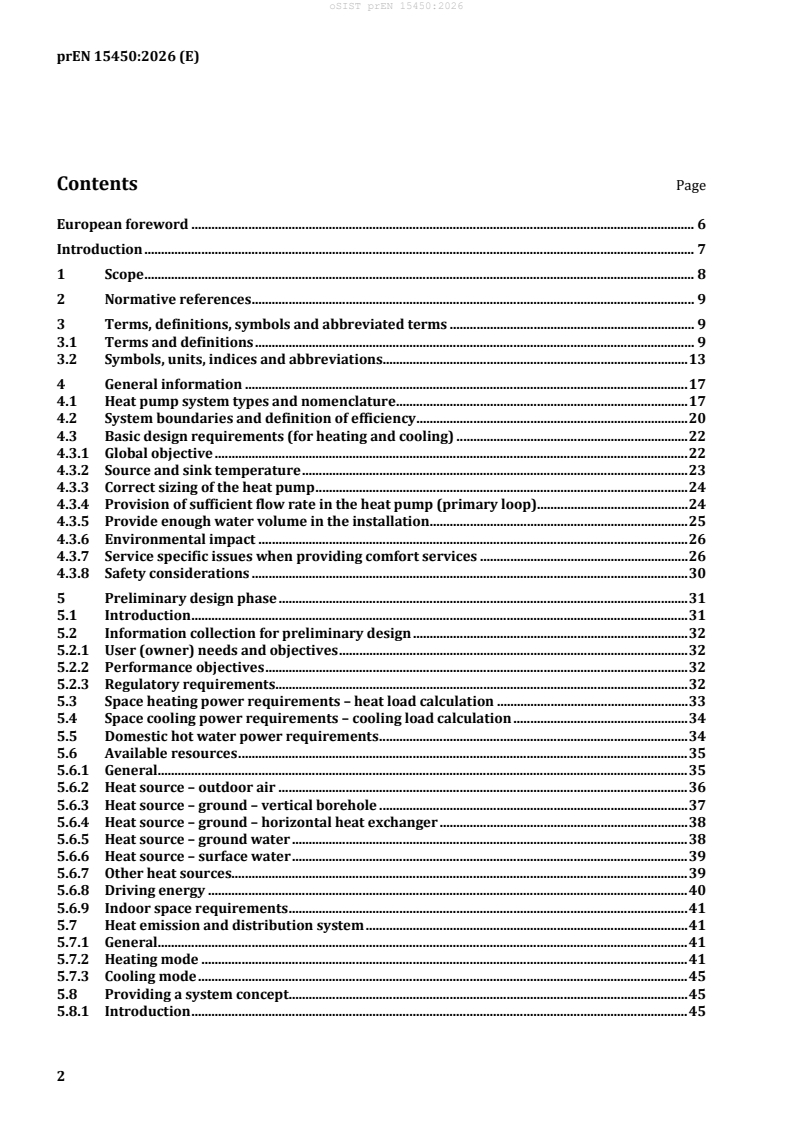
Contents Page
European foreword . 6
Introduction . 7
1 Scope . 8
2 Normative references . 9
3 Terms, definitions, symbols and abbreviated terms . 9
3.1 Terms and definitions . 9
3.2 Symbols, units, indices and abbreviations. 13
4 General information . 17
4.1 Heat pump system types and nomenclature . 17
4.2 System boundaries and definition of efficiency . 20
4.3 Basic design requirements (for heating and cooling) . 22
4.3.1 Global objective . 22
4.3.2 Source and sink temperature . 23
4.3.3 Correct sizing of the heat pump . 24
4.3.4 Provision of sufficient flow rate in the heat pump (primary loop). 24
4.3.5 Provide enough water volume in the installation . 25
4.3.6 Environmental impact . 26
4.3.7 Service specific issues when providing comfort services . 26
4.3.8 Safety considerations . 30
5 Preliminary design phase . 31
5.1 Introduction . 31
5.2 Information collection for preliminary design . 32
5.2.1 User (owner) needs and objectives . 32
5.2.2 Performance objectives . 32
5.2.3 Regulatory requirements. 32
5.3 Space heating power requirements – heat load calculation . 33
5.4 Space cooling power requirements – cooling load calculation . 34
5.5 Domestic hot water power requirements . 34
5.6 Available resources . 35
5.6.1 General. 35
5.6.2 Heat source – outdoor air . 36
5.6.3 Heat source – ground – vertical borehole . 37
5.6.4 Heat source – ground – horizontal heat exchanger . 38
5.6.5 Heat source – ground water . 38
5.6.6 Heat source – surface water . 39
5.6.7 Other heat sources. 39
5.6.8 Driving energy . 40
5.6.9 Indoor space requirements . 41
5.7 Heat emission and distribution system . 41
5.7.1 General. 41
5.7.2 Heating mode . 41
5.7.3 Cooling mode . 45
5.8 Providing a system concept. 45
5.8.1 Introduction . 45
5.8.2 Functional diagram selection . 46
5.8.3 Integration with on-site renewable electricity generation . 46
5.8.4 Preliminary heat pump sizing . 47
5.8.5 Preliminary storage volume sizing . 57
5.8.6 Provisional layout . 60
5.8.7 Control rationale . 61
5.8.8 Expected performances . 61
5.8.9 Economic evaluation . 61
5.9 Decision to proceed . 61
6 Final design . 62
6.1 Introduction and general provisions . 62
6.2 Information collection for final design . 64
6.3 Space heating requirements – heat load . 64
6.4 Space cooling power requirements - cooling load . 64
6.5 Domestic hot water power requirements . 66
6.6 Available resources - heat source selection and sizing . 66
6.6.1 General . 66
6.6.2 Heat source – outdoor air . 66
6.6.3 Heat source – ground – vertical borehole . 67
6.6.4 Heat source – ground horizontal heat exchanger . 67
6.6.5 Heat source – ground water . 68
6.6.6 Heat source – surface water . 69
6.6.7 Heat rejection . 70
6.6.8 Free cooling or heating using the ground heat exchanger . 70
6.7 Heat emission and distribution system . 71
6.7.1 General . 71
6.7.2 Heating mode . 71
6.7.3 Cooling mode . 73
6.8 Final heat pump system design . 73
6.8.1 Heat pump selection . 73
6.8.2 Hydraulic connections and flow rates . 74
6.8.3 Usage of renewable energy and electrical storage . 75
6.8.4 Heat pump sizing . 75
6.8.5 Storage volume sizing . 76
6.8.6 System layout . 76
6.8.7 Control logics and sequence . 77
6.8.8 Instructions for operation maintenance and use . 77
6.8.9 Authorizations and permits . 77
6.9 Deliverables . 78
6.9.1 Final design . 78
6.9.2 Hand-over documentation . 79
Annex A (normative) Input data, structure for default values . 80
A.1 General . 80
A.2 Input Data for preliminary design phase (5) . 80
Annex B (normative) Input data, default values . 85
B.1 General . 85
B.2 Input Data for preliminary design phase (5) . 85
B.3 Input data for simplified heat load calculation . 86
B.4 Input data for simplified DHW design requirements . 89
B.5 Input data for simplified cooling load design requirements . 107
Annex C (normative) Simplified methods for determining the building heat load . 110
C.1 General. 110
C.2 Building envelope method based on EN 12831-1 . 110
C.3 Heat load calculation based on measured energy use . 112
C.4 Heat load calculation by energy performance calculation . 116
Annex D (informative) Simplified methods for determining the heat load and storage
volume for domestic hot water . 118
D.1 General. 118
D.2 Simplified method for DHW design requirements based on energy needs . 120
D.3 Simplified summation curve method taken from EN 12831-3 . 121
D.4 Conversion tables Energy – Storage Volume for DHW . 122
Annex E (informative) Simplified method for determining the cooling load of a building . 125
E.1 General description of the method . 125
E.2 Solar radiation through transparent elements Φ . 126
S,tr
E.3 Solar heat transmission through poorly insulated opaque structures Φ . 126
S,op
E.4 Orientation and simultaneity of solar radiation . 127
E.5 Internal loads . 127
E.6 Cooling effect from heat capacity in structures . 128
Annex F (normative) Guidelines for determining design parameters . 130
F.1 Definitions . 130
F.2 Design parameters for heat pumps using water as a heat source . 130
F.3 Design parameters for heat pumps using ground as a heat source . 130
Annex G (informative) Basic hydraulic circuits . 135
G.1 General. 135
G.2 Basic (standard) hydraulic heat pump circuits (systems) . 138
G.3 Hydraulic heat source connections . 151
Annex H (informative) Calculation requirements for seasonal performance factors . 153
H.1 Minimum and target SPF-values for heat pumps . 153
Annex I (informative) Simplified calculation Method for determining the degree of
coverage and power share of heat pumps . 154
I.1 General aim . 154
I.2 Method of calculation . 154
I.3 Degree of coverage and power share for 3 European climate zones . 160
Annex J (informative) Example Building – Preliminary Design of a heat pump system . 167
J.1 Introduction . 167
J.2 Building data – Information collection . 168
J.3 Heat load calculation . 168
J.4 Cooling Load calculation . 175
J.5 Domestic hot water power requirements . 178
J.6 Available resources – heat source outdoor air . 178
J.7 Heat emission and distribution system . 179
J.8 System concept . 182
Annex K (informative) Design Check Lists . 186
K.1 Introduction . 186
K.2 Information collection . 186
K.3 System concept and preliminary design (Clause 5) . 188
K.4 Final design deliverable (Clause 6) . 188
K.5 Hand over design package deliverable (see 6.9). 189
Bibliography . 191
European foreword
This document (prEN 15450:2026) has been prepared by Technical Committee CEN/TC 228 “Heating
systems and water based cooling systems in buildings”, the secretariat of which is held by DIN.
This document is currently submitted to the CEN Enquiry.
This document will supersede EN 15450:2007.
This document includes the following significant technical changes with respect to EN 15450:2007:
a) the content has been brought in line with current European Standards and regulations;
b) the latest developments on heat pump technology have been incorporated into the document such
as reversible and speed-controlled heat pumps;
c) the document it is now structured into clauses on general information (Clause 4), a preliminary
design phase (Clause 5) and the final design (Clause 6);
d) the design includes cooling applications;
e) the normative Annexes A to C specifying input data and simplified methods for determining the
building heat load have been included.
f) an informative Annex I on how to determine the degree of coverage values for heat pumps based on
weather data has been introduced.
Introduction
Heat pump systems have the potential to significantly reduce primary energy usage and CO emissions
for building heating and cooling applications. By means of transferring energy to a higher temperature
level instead of converting it, these systems reduce the electrical and fossil fuel energy required to heat
the building in winter. In summer, heat pump systems are needed for active cooling purposes. In this
case, solar energy can be used as an energy source to drive the heat pump via photovoltaic systems.
A careful and correct design of such systems is paramount, if high system efficiency and low electrical
consumption is to be ensured. Poorly designed heat pump systems do not contribute to the reduction in
primary energy and CO emissions.
This document provides design criteria for heating and cooling systems with integrated heat pump
technology with respect to:
— heat source;
— electrical supply;
— strategy;
— hydraulic circuits;
— positioning;
— noise level;
— heat supply;
— dimensioning.
This document introduces a preliminary design phase to support a go/no go decision before proceeding
with the final design of the heat pump system. This is intended primarily for the case of the upgrade of a
heating system including the switch from combustion to heat pump technology, which will be a
common task in the coming years.
Energy performance calculation criteria are dealt with in another document of this technical committee.
1 Scope
This document specifies design criteria for heating and cooling systems in buildings using electrically
driven heat pumps for heating and cooling alone or in combination with other heat generators. The heat
pump systems considered in this document (source system/sink system) are listed in Table 1. For
cooling purposes, energy source and energy sink can be reversed.
This document also applies to other energy sources such as wastewater, massive absorbers, ice storage
systems, as well as heat pump systems using more than one energy source.
This document takes into account the heating requirements of attached systems (e.g. domestic hot
water) in the design of the heat supply but does not cover the design of these systems. This document
covers the aspects dealing with the heat pump, the interface with the heat distribution system and heat
emission system, the control of the whole system and the aspects dealing with energy source of the
system.
Design criteria for reversible heat pump systems for heating and cooling are also included in this
document.
Table 1 — Heat pump systems used for heating (within the scope)
Source-system Sink-system
a b c
Energy source Medium Medium Energy sink
air indoor air
exhaust air
air
indoor air
outdoor air
water
water
indoor air
water
surface water
water
water
ground water
air indoor air
air indoor air
water/brine
indoor air
water
water
ground
indoor air
water
water
refrigerant
refrigerant indoor air
a
Energy source is the location where the energy is extracted.
b
Medium is the fluid transported in the corresponding distribution system.
c
Energy sink is the location where the energy is used; this can be the heated space or water in case of
domestic hot water production.
2 Normative references
The following documents are referred to in the text in such a way that some or all of their content
constitutes requirements of this document. For dated references, only the edition cited applies. For
undated references, the latest edition of the referenced document (including any amendments) applies.
EN 442 (all parts), Radiators and convectors
EN 12828:2012+A1:2014, Heating systems in buildings — Design for water-based heating systems
EN 12831-1:2017, Energy performance of buildings — Method for calculation of the design heat load —
Part 1: Space heating load, Module M3-3
EN 12831-3:2017, Energy performance of buildings — Method for calculation of the design heat load —
Part 3: Domestic hot water systems heat load and characterisation of needs, Module M8-2, M8-3
EN 16798-1, Energy performance of buildings — Ventilation for buildings — Part 1: Indoor environmental
input parameters for design and assessment of energy performance of buildings addressing indoor air
quality, thermal environment, lighting and acoustics — Module M1-6
3 Terms, definitions, symbols and abbreviated terms
3.1 Terms and definitions
For the purposes of this document, the terms and definitions given in EN 12828:2012+A1:2014 and the
following apply.
ISO and IEC maintain terminology databases for use in standardization at the following addresses:
— ISO Online browsing platform: available at https://www.iso.org/obp/
— IEC Electropedia: available at https://www.electropedia.org/
3.1.1
coefficient of performance
COP
ratio of the net heating capacity to the effective power input of the equipment at any given set of rating
conditions [ISO OBP]
3.1.2
energy efficiency ratio
EER
ratio of the net cooling capacity to the effective power input of the equipment at any given set of rating
conditions [ISO OBP]
3.1.3
seasonal coefficient of performance
SCOP
overall coefficient of performance of the unit, representative for the whole designated heating season
Note 1 to entry: The value of SCOP pertains to a designated heating season. SCOP is calculated as the reference
annual heating demand divided by the annual energy consumption for heating.
Note 2 to entry: Expressed in kWh/kWh.
3.1.4
seasonal energy efficiency ratio
SEER
overall energy efficiency ratio of the unit, representative for the whole cooling season
Note 1 to entry: The seasonal energy efficiency ratio is calculated as the reference annual cooling demand
divided by the annual energy consumption for cooling.
Note 2 to entry: Expressed in kWh/kWh.
[SOURCE: EN 14825:2022, 3.1.77]
3.1.5
seasonal performance factor
SPF
ratio of the measured total annual energy delivered by the heat pump to the distribution subsystem for
space heating and/or other services (e.g. domestic hot water) to the total measured annual
consumption of electrical energy, including the total annual input of auxiliary energy Q
HP
Note 1 to entry: The seasonal performance factor is based on actual measurements.
Note 2 to entry: A similar performance factor can also be defined for the cooling season.
Note 3 to entry: Expressed in kWh/kWh.
3.1.6
bivalent temperature
lowest outdoor temperature point at which the unit has the capacity able to meet 100 % of the heating
load without supplementary heater, whether it is integrated in the unit or not
Note 1 to entry: Below the bivalent temperature, the unit may still provide capacity, but additional
supplementary heating is necessary to fulfil the full heating load.
3.1.7
hybrid heat pump
encased assembly or assemblies designed as a unit consisting of an air/water, ground/water or direct
expansion-to-water electrically driven heat pump with a second heat generator using fossil fuel or
electricity, and managed by a common controller providing an optimized operation of the heat
generators for space heating
Note 1 to entry: The unit may also provide domestic hot water and/or space cooling.
3.1.8
operation limit temperature
TOL
outdoor temperature below which the declared heating capacity of the heat pump is equal to zero
Note 1 to entry: Expressed in °C.
3.1.9
monovalent mode
operational mode in which the heat pump is designed to cover the entire heat demand of the heating
system including other attached systems
Note 1 to entry: The heat pump output capacity has to be at least equal to the design heat load calculated
according to EN 12831-1.
3.1.10
bivalent alternative mode
form of operation in which the heat pump supplies the entire thermal power up to a defined output
power or external air temperature and where, from this point onwards, a second heat generator
capable of supplying the entire heat load, takes over the required heating capacity while switching off
the heat pump
3.1.11
bivalent parallel mode
form of operation in which the heat pump supplies the entire thermal power up to a defined output
power or external air temperature and where, from this point onwards, a second heat generator is
additionally switched on, so that both heat generators working in parallel supply the required heating
capacity
3.1.12
bivalent semi-parallel mode
form of operation in which the heat pump supplies the entire thermal power up to a defined output
power or external air temperature and where, from this point onwards, a second heat generator
capable of supplying the entire heat load is additionally switched on with both heat generators working
in parallel until the heat pump reaches its application limit from where on the second heat generator
takes over the required heating capacity completely
3.1.13
backup heater
supplementary heating which is used to supply heat when the capacity of the heat pump is insufficient
Note 1 to entry: The backup heater can be an electrical heater or a combustion burner (second generator).
3.1.14
multivalent source
heat pump system using more than one energy source either in an alternative or parallel operational
mode (e.g. external air and horizontal ground heat exchangers)
3.1.15
reversible heat pump
heat pump capable of providing both heating and active cooling energy
3.1.16
fixed speed heat pump
heat pump capable of operating in on/off mode only, and in which the adjustment to the heating load
takes place in cycling operation
3.1.17
variable speed heat pump
heat pump capable of operating at variable compressor frequencies and in which the adjustment to the
heating load occurs continuously within set limits
Note 1 to entry: Also known as Inverter heat pump.
3.1.18
maximum capacity of the heat pump
cooling and heating output capacity of a heat pump at maximum compressor speed and at certain
specified source and sink temperature conditions
Note 1 to entry: The maximum compressor speed may depend on the source and sink temperature condition.
3.1.19
low impact cooling
low power cooling function, usually but not necessarily realised by passive cooling in combination with
floor heating
Note 1 to entry: Usually the cooling capacity is not calculated or guaranteed. In practice, the cooling-down effect
of this operational mode is approximately 2 K.
3.1.20
technical water
non potable water
3.1.21
brine
water based liquid, to which additives have been inserted with the main goal of lowering the freezing
point of the liquid
3.1.22
power share
proportion of the thermal output of a heat pump at design external air temperature in relation to the
maximum required thermal output of the sum of the heat load and any attached systems at design
external air temperature
3.2 Symbols, units, indices and abbreviations
For the purposes of this document, the following symbols and units (Table 2), indices (Table 3) and
abbreviations (Table 4) apply.
Table 2 — Symbols and units
Symbol Description Unit
A area m
B amount of input fuel kg, VN3 or l
C heat capacity Wh/K
c specific heat capacity Wh/m K
E energy (fuels) kWh
F, f multiplication factor —
FK distribution function of heat pump operational time (summation —
line)
fx temperature adjustment factor for building elements (ie, iu, ig, ij) —
g energy transmittance factor —
g gravitational constant m/s
gtot total energy transmittance factor (including sun shades) —
H calorific value of input fuel kJ/kg or VN3 or l
h external heat transfer coefficient of a surface W/m K
H heat transfer coefficient (ventilation and/or transmission) W/K
h height m
IS solar irradiance W/m
l length m
m slope (of a curve) —
n air exchange rate h−1
n compressor speed (n = 100 % = full speed; n = 30 % = minimum %
speed)
n number —
n radiator exponent —
n50 air exchange rate at 50 Pa pressure difference h−1
nmin minimum air exchange rate h−1
P power (electrical) W
Q energy (thermal) kWh
S solar cooling factor —
T temperature K
Symbol Description Unit
t time sec/h
U heat transfer coefficient (building element) W/m K
V volume m
volume flow rate m /s
V
W energy (electrical) kWh
α degree of coverage value —
α solar absorption coefficient —
β load factor —
ΔϑH K
ϑϑ−
SR
heating medium overtemperature: ∆ϑ =
H
ϑϑ−
Si
ln
ϑϑ−
Ri
η efficiency —
ϑ temperature °C
ϑBP bivalence point temperature °C
ϑe,d heating limit temperature °C
ϑe,des,C design external air temperature for cooling case °C
ϑe,des,H design external air temperature for heating case °C
μ power share —
ρ density kg/m
σ temperature spread (ϑS − ϑR) K
τ building time constant h
Φ power (thermal) W
Φ′ length-related power W/m
Φ″ area-related power W/m
Table 3 introduces the indices used within this document. These indices can be used individually and in
combinations with the symbols given in Table 2.
Table 3 — Indices (subscripts)
Index Meaning/Use
HP, hp heat pump
GEN, g generation
SRC heat source
aux auxiliary
ext, e external
int internal
i room, space
bu backup unit
H heating
C cooling
DHW domestic hot water
AS attached system
STO/sto storage
em emmitters (heating or cooling)
eff effective (i.e. effective heat capacity of the building)
HL heat load
CL cooling load
build building
gain gain (heat gains)
w water
ww warm water
cold cold water
f final (energy)
day/d 1 day
BH borehole
des design
max maximum (value)
min minimum (value)
G,g ground
s supply (distribution pipes)
r return (distribution pipes)
disc disconnection (time), typically the disconnection time from the electricity grid
Index Meaning/Use
op operation
BP bivalence point (a temperature)
sel selected (value, or operational point)
sim simulation
req required
orient orientation (cardinal directions)
win/WIN window
hd head (applies to pump delivery height)
lift height for lifting ground water to the heat pump
hyst hysteresis
FLH full load hours (operational time)
m mean
tot total
k building element
TB thermal bridge
u unheated space
f factor
i,j heat transfer from space/room (i) to space/room (j)
s soil
m slope
P/p person
n number
S solar (radiation)
T,tr transmission
V ventilation
op opaque
c,th cooling effect from thermal building heat capacity
F frame (window)
tot total
S sunshade factor
se surface emission (as used in the calculation of the heat transfer coefficient for surfaces)
M machines
L light
Index Meaning/Use
Δ difference
EW external wall
IW internal wall
Rf roof
Fl floor, ceiling, internal ceiling
vis visible area (radiator)
Table 4 — Abbreviations
Abbreviation Description
AHU air handling unit
AS attached system
COP coefficient of performance (heating mode - power)
DHW domestic hot water
EER energy efficiency ratio (cooling mode – power)
GEN generation
GWP global warming potential
HP heat pump
ODP ozone depletion potential
PWC potable water cold
PWH potable water hot
PV photovoltaic
PVT photovoltaic-thermal (solar cells)
SCOP seasonal coefficient of performance (heating mode – energy)
SEER seasonal coefficient of performance (cooling mode – energy)
SPF seasonal performance factor (measured energy)
TOL temperature operating limit
VRF variable refrigerant flow
4 General information
4.1 Heat pump system types and nomenclature
A heat pump system extracts energy from a suitable heat source and forces the transfer of this energy
into a heat sink at a higher temperature.
When operating in heating mode, the heat pump extracts energy from the source and transfers it at a
higher temperature into the heating system or the building internal environment. (Figure 1).
Key
1 heat source
2 heat sink
3 additional heater (heating element, combustion heater, others)
PFL primary flow loop: temperature level 1
SFL secondary flow loop: temperature level 2
H-SCR-L heat source loop
PL primary loop
SL secondary loop
Figure 1 — Schematic example of a heat pump system in heating mode
The heat source can be:
— external air;
— ground;
— ground water;
— surface water;
— exhaust air;
— other suitable special sources (e.g. waste water, massive absorber).
The heat sink can be:
— technical water;
— indoor air;
— domestic water.
When operating in cooling mode, the heat pump extracts energy from the cooling system or the building
indoor environment and rejects it into the external environment at a higher temperature (Figure 2).
Key
1 heat source
2 heat sink
H-RE-L heat rejection loop
PL primary loop
SL secondary loop
Figure 2 — Schematic example of a heat pump system in cooling mode
The heat source can be:
— technical water;
— indoor air.
The heat sink can be:
— external air;
— ground;
— ground water;
— surface water;
— other special sinks (e.g. swimming pool).
The medium used for heat transfer on both the heat source and heat sink sides can be:
— water;
— brine;
— air;
— refrigerant.
This document covers electric motor driven, vapour compression heat pumps.
4.2 System boundaries and definition of efficiency
Heat pump efficiency can be defined based on instantaneous or seasonal values. In addition, the
necessary data can be based on calculated or measured values. Figure 3 and Figure 4 define system
boundaries and efficiency values in heating and cooling modes respectively.
Key
GEN generation system boundary (including external auxiliaries)
HP heat pump boundary (excluding external auxiliaries)
SRC source
WHP driving energy of the heat pump
Waux;ext auxiliary energy for the source and sink heat exchangers (external)
W auxiliary energy for the heat pump (internal)
aux;int
Wbu back-up heater energy input (second heat genera
...