

SIST EN 1165:2000
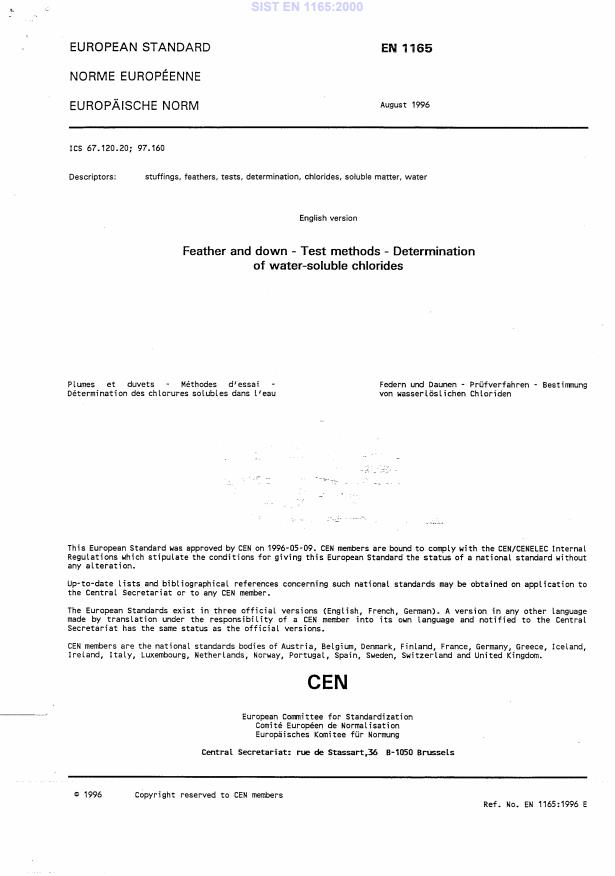
(Main)Feather and down - Test methods - Determination of water-soluble chlorides
General Information
- Abstract
This European Standard specifies a method for determining the water-soluble chloride content of feathers and down. The techniques involved are not adequate for determining significant differences where the water-soluble chlorides found by this method are below 50 mg/kg.
- Status
- Published
- Publication Date
- 30-Nov-2000
- Technical Committee
- SS SPL - Technical Board for the general field
- Current Stage
- 6060 - National Implementation/Publication (Adopted Project)
- Start Date
- 01-Dec-2000
- Due Date
- 01-Dec-2000
- Completion Date
- 01-Dec-2000


Overview
SIST EN 1165:2000 - Feather and Down - Test Methods - Determination of Water-Soluble Chlorides is a European standard issued by the Slovenski inštitut za standardizacijo (SIST). This standard outlines a precise laboratory procedure for detecting and quantifying water-soluble chloride content in feathers and down. The methodology is crucial in the textile and bedding industries, ensuring that raw feather and down materials meet established quality and safety thresholds for chloride residues. Note that this method is not suitable for identifying small differences when the content is below 50 mg/kg.
Key Topics
- Water-soluble chlorides in feathers and down: Focuses on the measurement and significance of chloride residues, which can influence product quality and user comfort.
- Standardized test methods: Provides a harmonized approach for laboratories and quality control departments to assess chloride content consistently across diverse batches and suppliers.
- Applicability: The method is reliable for detecting chloride concentrations above 50 mg/kg, which is vital for most quality assurance programs.
Applications
This standard is widely relevant to stakeholders in the textile and bedding industry, including manufacturers, suppliers, and laboratories, for the following reasons:
- Quality assurance: Verifying that feather and down materials comply with safety and quality requirements, ensuring low residual chemical levels for better consumer safety.
- Supplier selection: Enabling procurement teams to assess and compare raw material quality from different vendors based on water-soluble chloride content.
- Product labeling and certification: Supporting compliance with international export regulations and consumer labeling requirements for bedding and apparel products containing feathers and down.
- Lab accreditation: Serving as a reference test method for accredited laboratories conducting chemical analyses on textiles and textile auxiliaries.
- Risk management: Reducing the risk of product complaints or recalls related to chemical content in finished goods.
Related Standards
To ensure a holistic approach to feather and down testing and textile safety, consider referencing the following related standards:
- EN 1164: Test methods for determining other chemical residues in feather and down.
- EN ISO 139: Conditioning and testing parameters for textiles including feathers and down.
- EN 12935: Hygiene and cleanliness requirements for feather and down used as filling material.
- ISO 1833 series: Methods for analyzing the composition of textile blends, which may include feather and down fibers.
SIST EN 1165:2000 plays a key role in supporting producer and consumer confidence in feather and down products by providing a standardized, reproducible approach to analyzing water-soluble chlorides. Consistent application of this standard promotes product safety, quality improvement, and compliance with international textile regulations.
Get Certified
Connect with accredited certification bodies for this standard

Control Union Certifications
Global certification for agriculture and sustainability.

Hohenstein Institut
Textile testing and certification.

Bureau Veritas Bangladesh
Bureau Veritas certification services in Bangladesh.
Sponsored listings
Frequently Asked Questions
SIST EN 1165:2000 is a standard published by the Slovenian Institute for Standardization (SIST). Its full title is "Feather and down - Test methods - Determination of water-soluble chlorides". This standard covers: This European Standard specifies a method for determining the water-soluble chloride content of feathers and down. The techniques involved are not adequate for determining significant differences where the water-soluble chlorides found by this method are below 50 mg/kg.
This European Standard specifies a method for determining the water-soluble chloride content of feathers and down. The techniques involved are not adequate for determining significant differences where the water-soluble chlorides found by this method are below 50 mg/kg.
SIST EN 1165:2000 is classified under the following ICS (International Classification for Standards) categories: 59.040 - Textile auxiliary materials. The ICS classification helps identify the subject area and facilitates finding related standards.
SIST EN 1165:2000 is available in PDF format for immediate download after purchase. The document can be added to your cart and obtained through the secure checkout process. Digital delivery ensures instant access to the complete standard document.
Standards Content (Sample)
2003-01.Slovenski inštitut za standardizacijo. Razmnoževanje celote ali delov tega standarda ni dovoljeno.Feather and down - Test methods - Determination of water-soluble chloridesFedern und Daunen - Prüfverfahren - Bestimmung von wasserlöslichen ChloridenPlumes et duvets - Méthodes d'essai - Détermination des chlorures solubles dans l'eauFeather and down - Test methods
...