

SIST EN 12799:2001
(Main)Brazing - Non-destructive examination of brazed joints
General Information
- Abstract
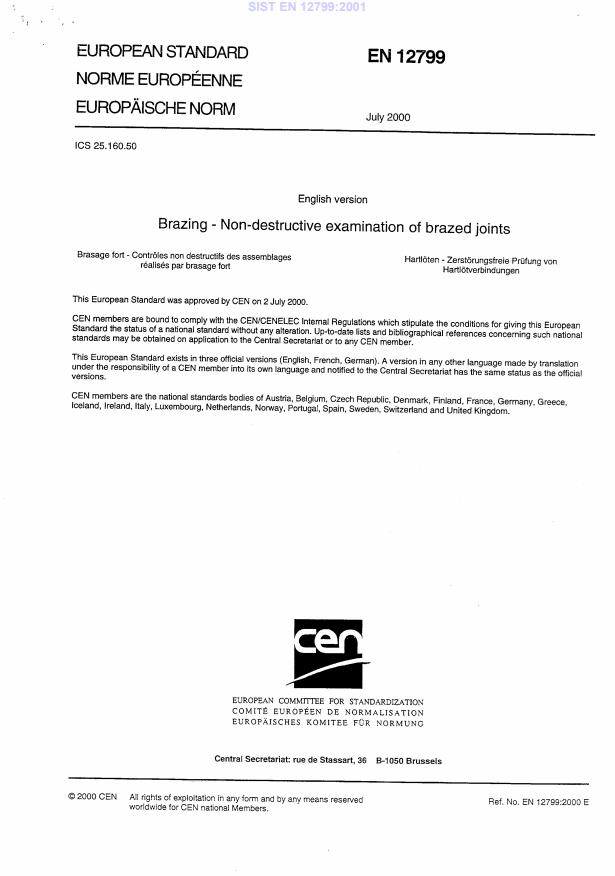
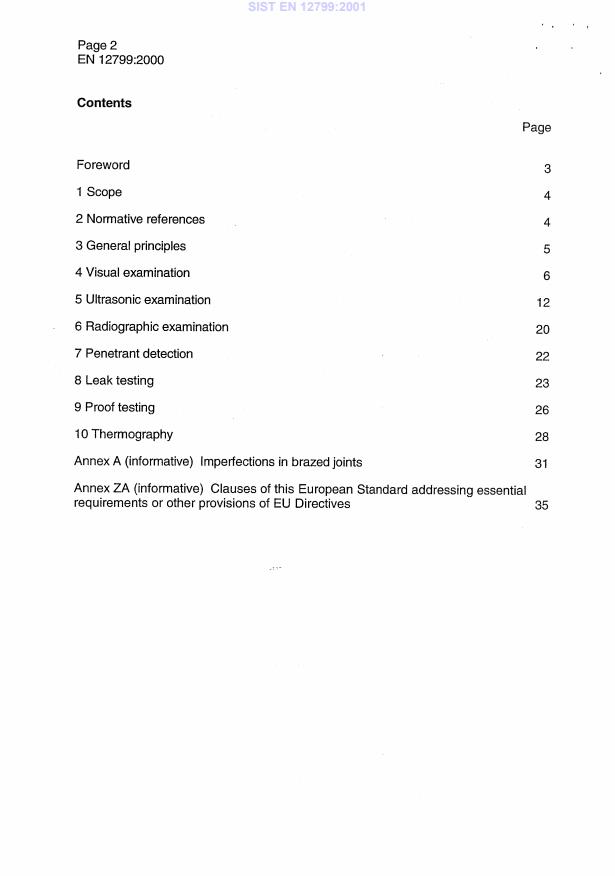
This European Standard describes non-destructive examination procedures and test piece types necessary to perform the tests on brazed joints. The non-destructive examination methods described are as follows: a) visual examination (see clause 4); b) ultrasonic examination (see clause 5); c) radiographic examination (see clause 6); d) penetrant examination (see clause 7); e) leak testing (see clause 8); f) proof testing (see clause 9); g) thermography (see clause 10). The brazed joints to which these tests are applied can either be test samples manufactured to obtain brazed joint design data, or manufactured as part of the approval testing of a brazing procedure, or parts of a brazed assembly. The type of test piece described for each test can be quoted or incorporated in engineering application standards that deal with brazed assemblies. This European Standard does not recommend the number of samples to be tested or the repeat tests allowed. Neither does it specify methods of sampling brazed joints, except to give guidance regarding the precautions necessary, nor does it comment on the acceptance criteria applicable to any of the tests. No attempt is made to define which test or tests, if any , should be applied in any situation. This is a matter to be established before any particular method of test is selected. The methods of non-destructive examination are not associated with any particular type of brazed assembly but lay down the general principles of the types of testing described. It is emphasised that a satisfactory examination method can only be developed and used after taking into account all the relevant factors regarding the equipment to be used and the characteristics of the test piece being examined.
- Status
- Published
- Publication Date
- 30-Nov-2001
- Technical Committee
- VAR - Welding
- Current Stage
- 6060 - National Implementation/Publication (Adopted Project)
- Start Date
- 01-Dec-2001
- Due Date
- 01-Dec-2001
- Completion Date
- 01-Dec-2001
- Directive
- 97/23/EC - Pressure equipment

Overview
EN 12799:2000 (CEN) - Brazing - Non-destructive examination of brazed joints - defines the non‑destructive examination (NDE) procedures and test piece types used to inspect brazed joints. It outlines the general principles for a range of NDE methods and the types of test specimens that may be used for design data, procedure approval, or inspection of brazed assemblies. The standard sets out methods without prescribing sample counts, acceptance criteria or sampling plans.
Key topics
- Scope and purpose: general principles for NDE of brazed joints and descriptions of representative test pieces.
- NDE methods included (clauses referenced):
- Visual examination (clause 4)
- Ultrasonic examination (clause 5)
- Radiographic examination (clause 6)
- Penetrant examination (clause 7)
- Leak testing (clause 8)
- Proof testing (clause 9)
- Thermography (clause 10)
- Test-piece guidance: types of samples suitable for producing brazed joint design data, procedure approval testing, or inspection of actual assemblies.
- Limitations explicitly stated by the standard:
- Does not prescribe the number of samples to test or allowable repeat tests.
- Does not set sampling procedures (only gives precautions) or acceptance criteria.
- Does not mandate which specific test(s) must be applied for a given situation.
- Emphasis on development and selection: a satisfactory examination method must account for equipment, test-piece characteristics and all relevant factors before use.
Applications
- Establishing and documenting appropriate NDE methods for brazed components in manufacturing and R&D.
- Supporting brazing procedure development and approval by specifying test-piece types for qualification trials.
- Quality control and inspection planning for brazed assemblies across industries (e.g., HVAC, automotive components, heat exchangers, precision assemblies).
- Providing a reference for specifying available NDE techniques when creating engineering application standards for brazed products.
Who uses this standard
- NDE technicians and inspectors (visual, ultrasonic, radiography, penetrant, thermography)
- Quality assurance and production engineers working with brazing and soldering
- Design and test engineers preparing brazing procedure approvals and test programs
- Standards writers and organizations that incorporate test-piece definitions into application-specific standards
Related standards
- EN 12799 provides test methods and test‑piece types that can be quoted or incorporated into other engineering application standards. Note: acceptance criteria, sampling plans and the choice of specific tests should be defined in those application‑specific or contractual documents rather than in EN 12799 itself.
Keywords: EN 12799:2000, brazing, non‑destructive examination, NDE, brazed joints, ultrasonic, radiographic, penetrant, leak testing, thermography, visual inspection, test pieces, brazing procedure approval.
Relations
- Effective Date
- 28-Jan-2026
- Effective Date
- 28-Jan-2026
- Effective Date
- 28-Jan-2026
- Effective Date
- 28-Jan-2026
- Effective Date
- 28-Jan-2026
- Effective Date
- 28-Jan-2026
- Effective Date
- 28-Jan-2026
- Effective Date
- 28-Jan-2026
- Effective Date
- 28-Jan-2026
- Effective Date
- 28-Jan-2026
- Effective Date
- 28-Jan-2026
- Refers
SIST EN 583-1:2000 - Non-destructive testing - Ultrasonic examination - Part 1: General principles - Effective Date
- 28-Jan-2026
- Effective Date
- 28-Jan-2026
- Effective Date
- 28-Jan-2026
- Effective Date
- 28-Jan-2026
Get Certified
Connect with accredited certification bodies for this standard

DVS-ZERT GmbH
German welding certification society.
CARES (UK Certification Authority for Reinforcing Steels)
UK certification for reinforcing steels and construction.
EWF/IIW (European/International Welding Federation)
International welding personnel certification.
Sponsored listings
Frequently Asked Questions
SIST EN 12799:2001 is a standard published by the Slovenian Institute for Standardization (SIST). Its full title is "Brazing - Non-destructive examination of brazed joints". This standard covers: This European Standard describes non-destructive examination procedures and test piece types necessary to perform the tests on brazed joints. The non-destructive examination methods described are as follows: a) visual examination (see clause 4); b) ultrasonic examination (see clause 5); c) radiographic examination (see clause 6); d) penetrant examination (see clause 7); e) leak testing (see clause 8); f) proof testing (see clause 9); g) thermography (see clause 10). The brazed joints to which these tests are applied can either be test samples manufactured to obtain brazed joint design data, or manufactured as part of the approval testing of a brazing procedure, or parts of a brazed assembly. The type of test piece described for each test can be quoted or incorporated in engineering application standards that deal with brazed assemblies. This European Standard does not recommend the number of samples to be tested or the repeat tests allowed. Neither does it specify methods of sampling brazed joints, except to give guidance regarding the precautions necessary, nor does it comment on the acceptance criteria applicable to any of the tests. No attempt is made to define which test or tests, if any , should be applied in any situation. This is a matter to be established before any particular method of test is selected. The methods of non-destructive examination are not associated with any particular type of brazed assembly but lay down the general principles of the types of testing described. It is emphasised that a satisfactory examination method can only be developed and used after taking into account all the relevant factors regarding the equipment to be used and the characteristics of the test piece being examined.
This European Standard describes non-destructive examination procedures and test piece types necessary to perform the tests on brazed joints. The non-destructive examination methods described are as follows: a) visual examination (see clause 4); b) ultrasonic examination (see clause 5); c) radiographic examination (see clause 6); d) penetrant examination (see clause 7); e) leak testing (see clause 8); f) proof testing (see clause 9); g) thermography (see clause 10). The brazed joints to which these tests are applied can either be test samples manufactured to obtain brazed joint design data, or manufactured as part of the approval testing of a brazing procedure, or parts of a brazed assembly. The type of test piece described for each test can be quoted or incorporated in engineering application standards that deal with brazed assemblies. This European Standard does not recommend the number of samples to be tested or the repeat tests allowed. Neither does it specify methods of sampling brazed joints, except to give guidance regarding the precautions necessary, nor does it comment on the acceptance criteria applicable to any of the tests. No attempt is made to define which test or tests, if any , should be applied in any situation. This is a matter to be established before any particular method of test is selected. The methods of non-destructive examination are not associated with any particular type of brazed assembly but lay down the general principles of the types of testing described. It is emphasised that a satisfactory examination method can only be developed and used after taking into account all the relevant factors regarding the equipment to be used and the characteristics of the test piece being examined.
SIST EN 12799:2001 is classified under the following ICS (International Classification for Standards) categories: 25.160.50 - Brazing and soldering. The ICS classification helps identify the subject area and facilitates finding related standards.
SIST EN 12799:2001 has the following relationships with other standards: It is inter standard links to SIST EN ISO 3452-1:2021, SIST EN ISO 22232-3:2021, SIST EN 13185:2002, SIST EN 1593:2001, SIST EN ISO 16823:2025, SIST EN 583-2:2001, SIST EN ISO 22232-1:2020, SIST EN 1779:2000, SIST EN ISO 5579:2014, SIST EN 12668-2:2002, SIST EN 473:1996, SIST EN 583-1:2000, SIST EN 13184:2002, SIST EN 13134:2001, SIST EN 12797:2001. Understanding these relationships helps ensure you are using the most current and applicable version of the standard.
SIST EN 12799:2001 is associated with the following European legislation: EU Directives/Regulations: 97/23/EC; Standardization Mandates: M/071. When a standard is cited in the Official Journal of the European Union, products manufactured in conformity with it benefit from a presumption of conformity with the essential requirements of the corresponding EU directive or regulation.
SIST EN 12799:2001 is available in PDF format for immediate download after purchase. The document can be added to your cart and obtained through the secure checkout process. Digital delivery ensures instant access to the complete standard document.
Standards Content (Sample)
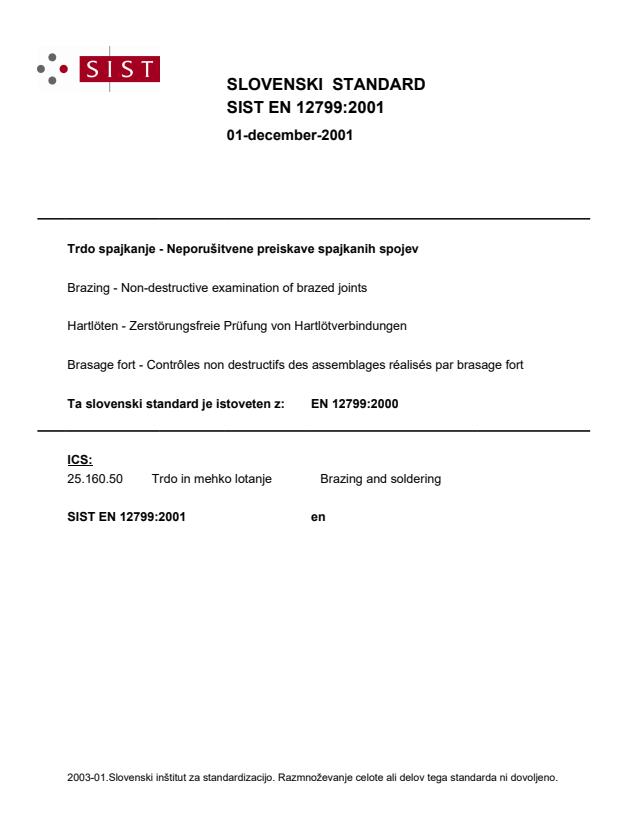
2003-01.Slovenski inštitut za standardizacijo. Razmnoževanje celote ali delov tega standarda ni dovoljeno.Trdo spajkanje - Neporušitvene preiskave spajkanih spojevHartlöten - Zerstörungsfreie Prüfung von HartlötverbindungenBrasage fort - Contrôles non destructifs des assemblages réalisés par brasage fortBrazing - Non-destructive examination of brazed joints25.160.50Trdo in mehko lotanjeBrazing and solderingICS:Ta slovenski standard je istoveten z:EN 12799:2000SIST EN 12799:2001en01-december-2001SIST EN 12799:2001SLOVENSKI
STANDARD
SIST EN 12799
...