

SIST EN 12350-4:2019
(Main)Testing fresh concrete - Part 4: Degree of compactability
General Information
- Abstract
This document specifies a method for determining the consistence of fresh concrete by determining the degree of compactability.
The test is suitable for specimens having a declared value of D of the coarsest fraction of aggregates actually used in the concrete (Dmax) not greater than 63 mm.
If the degree of compactability is less than 1,04 or more than 1,46, the concrete has a consistence for which the degree of compactability test is not suitable.
- Status
- Published
- Public Enquiry End Date
- 14-Nov-2017
- Publication Date
- 16-Jul-2019
- Technical Committee
- BBB - Concrete, reinforced concrete and prestressed concrete
- Current Stage
- 6060 - National Implementation/Publication (Adopted Project)
- Start Date
- 01-Jul-2019
- Due Date
- 05-Sep-2019
- Completion Date
- 17-Jul-2019
Buy Documents


Overview
EN 12350-4:2019 - Testing fresh concrete - Part 4: Degree of compactability - specifies a standardized laboratory method to determine the consistence of fresh concrete by measuring its degree of compactability. The method applies to concretes with a declared maximum aggregate size Dmax ≤ 63 mm. If the measured degree of compactability is less than 1.04 or greater than 1.46, the test is not suitable for that concrete consistency.
Keywords: EN 12350-4:2019, degree of compactability, testing fresh concrete, consistence, Dmax
Key topics and requirements
- Principle: Fill a vertical compaction container without tamping, strike off the top, compact by vibration, then measure the distance from the compacted surface to the container rim to calculate the compactability.
- Apparatus (per EN 12350-1 and Part 4 specifics):
- Compaction container: internal dimensions 200 ±2 mm × 200 ±2 mm base, 400 ±2 mm height; wall/base thickness ≥ 1.5 mm.
- Trowel, straight-edged scraper (>200 mm), rule, moist cloth, remixing tray, shovel.
- Compaction means: vibrating table (reference method) or internal vibrator (careful use to avoid loss of entrained air).
- Procedure:
- Moisten container, place concrete by tilting trowel from each edge without compacting, strike off without densifying, compact by vibration until no further volume reduction.
- Measure internal height h and mean distance s from compacted surface to upper edges (four sides).
- Compute degree of compactability c:
- c = h / (h − s)
- Report c to two decimal places (nearest 0.01).
- Sampling: take and remix samples according to EN 12350-1.
- Test report: must reference the standard, sample ID, location/date, compaction method, result (to two decimals), deviations and responsible signatory. Optional: temperature and test time.
- Precision: inter-laboratory data referenced (VAB round-robin document).
Applications
- Quality control and acceptance testing of fresh concrete batches on-site and in laboratories.
- Verifying mix consistence for production control and compliance with specifications.
- Comparing performance of different mixes or admixtures with respect to flow and compactability under vibration.
- Useful in precast and cast-in-place concrete operations where vibration compaction is used.
Who should use this standard
- Concrete testing laboratories and quality control engineers
- Concrete producers and batching plants
- Contractors, site supervisors and precast manufacturers
- Specifiers and consulting engineers preparing test programs or acceptance criteria
Related standards
- EN 12350-1: Sampling and common apparatus (required reference)
- Other parts of EN 12350 series: Slump (Part 2), Vebe (Part 3), Flow table (Part 5), Density (Part 6), Air content (Part 7), plus self‑compacting concrete tests (Parts 8–12).
Using EN 12350-4:2019 helps ensure consistent, reproducible measurement of concrete compactability for vibration‑based compaction processes and supports reliable quality assurance in construction projects.
Relations
- Effective Date
- 01-Sep-2019
- Effective Date
- 28-Jan-2026
- Effective Date
- 15-Apr-2026
- Referred By
SIST EN 206:2013+A2:2021 - Concrete - Specification, performance, production and conformity - Effective Date
- 28-Jan-2026
- Effective Date
- 28-Jan-2026
- Referred By
SIST EN 206:2013+A1:2016 - Concrete - Specification, performance, production and conformity - Effective Date
- 28-Jan-2026
- Effective Date
- 28-Jan-2026
- Effective Date
- 28-Jan-2026
- Referred By
SIST EN 206-1:2003 - Concrete - Part 1: Specification, performance, production and conformity - Effective Date
- 28-Jan-2026
- Effective Date
- 28-Jan-2026
- Effective Date
- 28-Jan-2026
- Effective Date
- 28-Jan-2026
Buy Documents
Get Certified
Connect with accredited certification bodies for this standard

DIBt (Deutsches Institut für Bautechnik)
German Institute for Building Technology.
DIN CERTCO
DIN Group product certification.

Aboma Certification B.V.
Specialized in construction, metal, and transport sectors.
Sponsored listings
Frequently Asked Questions
SIST EN 12350-4:2019 is a standard published by the Slovenian Institute for Standardization (SIST). Its full title is "Testing fresh concrete - Part 4: Degree of compactability". This standard covers: This document specifies a method for determining the consistence of fresh concrete by determining the degree of compactability. The test is suitable for specimens having a declared value of D of the coarsest fraction of aggregates actually used in the concrete (Dmax) not greater than 63 mm. If the degree of compactability is less than 1,04 or more than 1,46, the concrete has a consistence for which the degree of compactability test is not suitable.
This document specifies a method for determining the consistence of fresh concrete by determining the degree of compactability. The test is suitable for specimens having a declared value of D of the coarsest fraction of aggregates actually used in the concrete (Dmax) not greater than 63 mm. If the degree of compactability is less than 1,04 or more than 1,46, the concrete has a consistence for which the degree of compactability test is not suitable.
SIST EN 12350-4:2019 is classified under the following ICS (International Classification for Standards) categories: 91.100.30 - Concrete and concrete products. The ICS classification helps identify the subject area and facilitates finding related standards.
SIST EN 12350-4:2019 has the following relationships with other standards: It is inter standard links to SIST EN 12350-4:2009, SIST EN 12350-1:2019, SIST EN 206-1:2026, SIST EN 206:2013+A2:2021, SIST EN 1504-10:2004, SIST EN 206:2013+A1:2016, SIST EN 13369:2024, SIST EN 206:2013, SIST EN 206-1:2003, SIST-TS CEN/TS 12390-10:2008, SIST EN 12390-12:2020, SIST EN 14845-1:2007. Understanding these relationships helps ensure you are using the most current and applicable version of the standard.
SIST EN 12350-4:2019 is associated with the following European legislation: EU Directives/Regulations: 305/2011. When a standard is cited in the Official Journal of the European Union, products manufactured in conformity with it benefit from a presumption of conformity with the essential requirements of the corresponding EU directive or regulation.
SIST EN 12350-4:2019 is available in PDF format for immediate download after purchase. The document can be added to your cart and obtained through the secure checkout process. Digital delivery ensures instant access to the complete standard document.
Standards Content (Sample)
SLOVENSKI STANDARD
01-september-2019
Nadomešča:
SIST EN 12350-4:2009
Preskušanje svežega betona - 4. del: Stopnja zgoščenosti
Testing fresh concrete - Part 4: Degree of compactability
Prüfung von Frischbeton - Teil 4: Verdichtungsmaß
Essais pour béton frais - Partie 4 : Indice de serrage
Ta slovenski standard je istoveten z: EN 12350-4:2019
ICS:
91.100.30 Beton in betonski izdelki Concrete and concrete
products
2003-01.Slovenski inštitut za standardizacijo. Razmnoževanje celote ali delov tega standarda ni dovoljeno.
EN 12350-4
EUROPEAN STANDARD
NORME EUROPÉENNE
June 2019
EUROPÄISCHE NORM
ICS 91.100.30 Supersedes EN 12350-4:2009
English Version
Testing fresh concrete - Part 4: Degree of compactability
Essais pour béton frais - Partie 4 : Indice de serrage Prüfung von Frischbeton - Teil 4: Verdichtungsmaß
This European Standard was approved by CEN on 29 April 2019.
CEN members are bound to comply with the CEN/CENELEC Internal Regulations which stipulate the conditions for giving this
European Standard the status of a national standard without any alteration. Up-to-date lists and bibliographical references
concerning such national standards may be obtained on application to the CEN-CENELEC Management Centre or to any CEN
member.
This European Standard exists in three official versions (English, French, German). A version in any other language made by
translation under the responsibility of a CEN member into its own language and notified to the CEN-CENELEC Management
Centre has the same status as the official versions.
CEN members are the national standards bodies of Austria, Belgium, Bulgaria, Croatia, Cyprus, Czech Republic, Denmark, Estonia,
Finland, France, Germany, Greece, Hungary, Iceland, Ireland, Italy, Latvia, Lithuania, Luxembourg, Malta, Netherlands, Norway,
Poland, Portugal, Republic of North Macedonia, Romania, Serbia, Slovakia, Slovenia, Spain, Sweden, Switzerland, Turkey and
United Kingdom.
EUROPEAN COMMITTEE FOR STANDARDIZATION
COMITÉ EUROPÉEN DE NORMALISATION
EUROPÄISCHES KOMITEE FÜR NORMUNG
CEN-CENELEC Management Centre: Rue de la Science 23, B-1040 Brussels
© 2019 CEN All rights of exploitation in any form and by any means reserved Ref. No. EN 12350-4:2019 E
worldwide for CEN national Members.
Contents Page
European foreword . 3
1 Scope . 4
2 Normative references . 4
3 Terms and definitions . 4
4 Principle . 4
5 Apparatus . 4
6 Sampling . 5
7 Procedure. 6
8 Expression of results . 7
9 Test report . 7
10 Precision . 7
Bibliography . 8
European foreword
This document (EN 12350-4:2019) has been prepared by Technical Committee CEN/TC 104 “Concrete
and related products”, the secretariat of which is held by SN.
This European Standard shall be given the status of a national standard, either by publication of an
identical text or by endorsement, at the latest by December 2019, and conflicting national standards
shall be withdrawn at the latest by December 2019.
Attention is drawn to the possibility that some of the elements of this document may be the subject of
patent rights. CEN shall not be held responsible for identifying any or all such patent rights.
This document supersedes EN 12350-4:2009.
This standard is one of a series on testing concrete.
EN 12350, Testing fresh concrete, consists of the following parts:
— Part 1: Sampling and common apparatus
— Part 2: Slump test
— Part 3: Vebe test
— Part 4: Degree of compactability
— Part 5: Flow table test
— Part 6: Density
— Part 7: Air content – Pressure methods
— Part 8: Self-compacting concrete – Slump-flow test
— Part 9: Self-compacting concrete – V-funnel test
— Part 10: Self-compacting concrete – L-box test
— Part 11: Self-compacting concrete – Sieve segregation test
— Part 12: Self-compacting concrete – J-ring test
The following amendments have been made to the 2009 edition of this standard:
a) editorial revisions;
b) reference to common apparatus and specification given in EN 12350-1.
According to the CEN-CENELEC Internal Regulations, the national standards organisations of the
following countries are bound to implement this European Standard: Austria, Belgium, Bulgaria,
Croatia, Cyprus, Czech Republic, Denmark, Estonia, Finland, France, Germany, Greece, Hungary, Iceland,
Ireland, Italy, Latvia, Lith
...
SLOVENSKI STANDARD
01-september-2019
Nadomešča:
SIST EN 12350-4:2009
Preskušanje svežega betona - 4. del: Stopnja zgoščenosti
Testing fresh concrete - Part 4: Degree of compactability
Prüfung von Frischbeton - Teil 4: Verdichtungsmaß
Essais pour béton frais - Partie 4 : Indice de serrage
Ta slovenski standard je istoveten z: EN 12350-4:2019
ICS:
91.100.30 Beton in betonski izdelki Concrete and concrete
products
2003-01.Slovenski inštitut za standardizacijo. Razmnoževanje celote ali delov tega standarda ni dovoljeno.
EN 12350-4
EUROPÄISCHE NORM
EUROPEAN STANDARD
Juni 2019
NORME EUROPÉENNE
ICS 91.100.30 Ersatz für EN 12350-4:2009
Deutsche Fassung
Prüfung von Frischbeton - Teil 4: Verdichtungsmaß
Testing fresh concrete - Part 4: Degree of Essais pour béton frais - Partie 4 : Indice de serrage
compactability
Diese Europäische Norm wurde vom CEN am 29. April 2019 angenommen.
Die CEN-Mitglieder sind gehalten, die CEN/CENELEC-Geschäftsordnung zu erfüllen, in der die Bedingungen festgelegt sind, unter
denen dieser Europäischen Norm ohne jede Änderung der Status einer nationalen Norm zu geben ist. Auf dem letzten Stand
befindliche Listen dieser nationalen Normen mit ihren bibliographischen Angaben sind beim CEN-CENELEC-Management-
Zentrum oder bei jedem CEN-Mitglied auf Anfrage erhältlich.
Diese Europäische Norm besteht in drei offiziellen Fassungen (Deutsch, Englisch, Französisch). Eine Fassung in einer anderen
Sprache, die von einem CEN-Mitglied in eigener Verantwortung durch Übersetzung in seine Landessprache gemacht und dem
Management-Zentrum mitgeteilt worden ist, hat den gleichen Status wie die offiziellen Fassungen.
CEN-Mitglieder sind die nationalen Normungsinstitute von Belgien, Bulgarien, Dänemark, Deutschland, Estland, Finnland,
Frankreich, Griechenland, Irland, Island, Italien, Kroatien, Lettland, Litauen, Luxemburg, Malta, den Niederlanden, Norwegen,
Österreich, Polen, Portugal, der Republik Nordmazedonien, Rumänien, Schweden, der Schweiz, Serbien, der Slowakei, Slowenien,
Spanien, der Tschechischen Republik, der Türkei, Ungarn, dem Vereinigten Königreich und Zypern.
EUROPÄISCHES KOMITEE FÜR NORMUNG
EUROPEAN COMMITTEE FOR STANDARDIZATION
COMITÉ EUROPÉEN DE NORMALISATION
CEN-CENELEC Management-Zentrum: Rue de la Science 23, B-1040 Brüssel
© 2019 CEN Alle Rechte der Verwertung, gleich in welcher Form und in welchem Ref. Nr. EN 12350-4:2019 D
Verfahren, sind weltweit den nationalen Mitgliedern von CEN
vorbehalten.
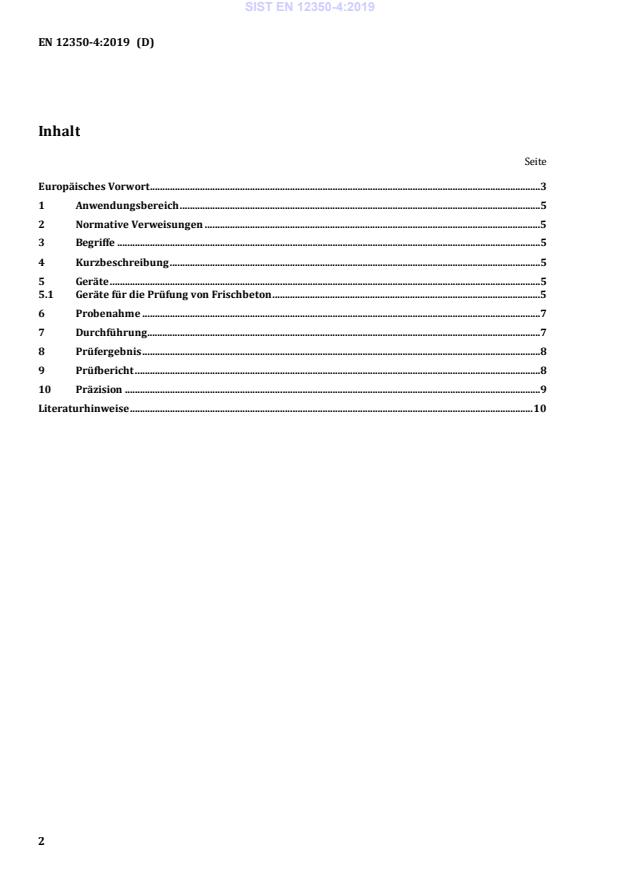
Inhalt
Seite
Europäisches Vorwort.3
1 Anwendungsbereich .5
2 Normative Verweisungen .5
3 Begriffe .5
4 Kurzbeschreibung .5
5 Geräte .5
5.1 Geräte für die Prüfung von Frischbeton .5
6 Probenahme .7
7 Durchführung.7
8 Prüfergebnis .8
9 Prüfbericht .8
10 Präzision .9
Literaturhinweise . 10
Europäisches Vorwort
Dieses Dokument (EN 12350-4:2019) wurde vom Technischen Komitee CEN/TC 104 „Beton und zugehörige
Produkte“ erarbeitet, dessen Sekretariat von SN gehalten wird.
Diese Europäische Norm muss den Status einer nationalen Norm erhalten, entweder durch Veröffentlichung
eines identischen Textes oder durch Anerkennung bis Dezember 2019, und etwaige entgegenstehende
nationale Normen müssen bis Dezember 2019 zurückgezogen werden.
Es wird auf die Möglichkeit hingewiesen, dass einige Elemente dieses Dokuments Patentrechte berühren
können. CEN ist nicht dafür verantwortlich, einige oder alle diesbezüglichen Patentrechte zu identifizieren.
Dieses Dokument ersetzt EN 12350-4:2009.
Diese Norm ist Bestandteil einer Normenreihe für die Prüfung von Beton.
EN 12350, Prüfung von Frischbeton, besteht aus den folgenden Teilen:
— Teil 1: Probenahme und Prüfgeräte
— Teil 2: Setzmaß
— Teil 3: Vébé-Prüfung
— Teil 4: Verdichtungsmaß
— Teil 5: Ausbreitmaß
— Teil 6: Frischbetonrohdichte
— Teil 7: Luftgehalt — Druckverfahren
— Teil 8: Selbstverdichtender Beton — Setzfließversuch
— Teil 9: Selbstverdichtender Beton — Auslauftrichterversuch
— Teil 10: Selbstverdichtender Beton — L-Kasten-Versuch
— Teil 11: Selbstverdichtender Beton — Bestimmung der Sedimentationsstabilität im Siebversuch
— Teil 12: Selbstverdichtender Beton — Blockierring-Versuch
Gegenüber der Ausgabe von 2009 dieser Norm wurden folgende Änderungen vorgenommen:
a) redaktionelle Überarbeitungen;
b) Verweisung auf die in EN 12350-1 angegebenen Prüfgeräte und Festlegungen.
Entsprechend der CEN-CENELEC-Geschäftsordnung sind die nationalen Normungsinstitute der folgenden
Länder gehalten, diese Europäische Norm zu übernehmen: Belgien, Bulgarien, Dänemark, Deutschland, die
Republik Nordmazedonien, Estland, Finnland, Frankreich, Grie
...