

oSIST prEN 16630:2025
(Main)Permanently installed outdoor fitness equipment - Safety requirements and test methods
- Abstract
This document specifies general safety requirements for the manufacture, installation, inspection and maintenance of permanently installed, freely accessible outdoor fitness equipment. This document does not cover electrically driven equipment, functional training facilities (typically with unrestrained weights) nor military style obstacle courses with restricted access.
The equipment is intended for youths and adults or users having an overall height greater than 1 400 mm to promote fitness by using the equipment to exercise. This document is not applicable to playground equipment for children (see EN 1176 series [1]), indoor stationary training equipment (see EN ISO 20957 series [2], EN 957 6 [18]) or free access multi-sports equipment (see EN 15312 [3]) even if it meets the requirements of each of these standards.
NOTE In this document “permanently installed outdoor fitness equipment” is simply called “fitness equipment”.
- Status
- Not Published
- Public Enquiry End Date
- 27-Mar-2025
- Technical Committee
- SPO - Sports
- Current Stage
- 4020 - Public enquire (PE) (Adopted Project)
- Start Date
- 28-Jan-2025
- Due Date
- 17-Jun-2025
- Completion Date
- 28-Mar-2025

oSIST prEN 16630:2025 is a draft European Standard from CEN for permanently installed, freely accessible outdoor fitness equipment. It specifies safety requirements and test methods for the manufacture, installation, inspection and maintenance of equipment intended for youths and adults, or users with an overall height greater than 1 400 mm.
The document gives manufacturers, installers, operators and inspectors a common safety basis for outdoor gym-type equipment. It also defines how to check the equipment, how to mark it, and what information must be supplied for safe use and upkeep.
What does oSIST prEN 16630:2025 specify?
oSIST prEN 16630:2025 covers general safety requirements for permanently installed outdoor fitness equipment and the associated test methods. It focuses on equipment that users operate unsupervised and without outside help, and it separates this product family from playground equipment, indoor stationary training equipment, free access multi-sports equipment, electrically driven equipment, functional training facilities with unrestrained weights, and military style obstacle courses with restricted access.
The document treats “permanently installed outdoor fitness equipment” simply as “fitness equipment”. Its structure is straightforward: Scope, normative references, terms and definitions, safety requirements, test methods, test report, marking, information from the manufacturer and supplier, and user information, followed by one informative annex.
| Annex | What it covers |
|---|---|
| Annex A | Guidance on installation, inspection, maintenance and operation of fitness equipment facilities |
What are the key requirements of oSIST prEN 16630:2025?
Materials and durability
oSIST prEN 16630:2025 requires materials and coatings to be chosen so the equipment stays stable until the next inspection and routine maintenance. That matters in practice because outdoor equipment is exposed to weather, wear and vandalism, so durability is part of safety, not just appearance.
The document gives material-specific rules for timber, metals, rubbers, synthetics and dangerous substances. Timber in ground contact needs suitable natural durability, construction protection, or preservative treatment; metals need corrosion protection; structural synthetic parts need protection against ultraviolet radiation and oxygen; and materials that may become brittle need a replacement interval to be stated.
Design, structure and moving parts
oSIST prEN 16630:2025 requires the intended use to be easy for the user to identify, and the equipment must be designed so that a slightly incorrect exercise does not lead to serious harm. It also prohibits equipment intended for neck press and requires attention to deadlift exercise equipment. In practice, this means the equipment has to be understandable and forgiving, not dependent on perfect technique.
Structural integrity must be shown for the worst intended combinations, using calculation, physical testing, or both. The document ties this to EN 1176-1 methods and to its own user-load model. Fitness equipment must also be permanently connected to the substrate, so anchorage and stability are part of the safety case.
Accessible surfaces, clearances and entrapment
Accessible parts must not have protruding nails, sharp edges, wire rope terminations or rough welds. Surfaces designed for stepping need slip resistance and drainage, and the tread area has to give enough foot support. This reduces the chance of cuts, slips and unstable footing during exercise.
The document also controls moving parts, clearances and end stops. It sets rules for gaps around moving elements, requires damping where parts swing or rotate, and limits moving parts that could crush or shear the user. It includes separate test methods for head and neck entrapment and for finger entrapment, using probes and templates.
Spaces, falling hazards and ground surfaces
oSIST prEN 16630:2025 distinguishes between training space, area of movement and movement space. These spaces define where the user moves, where the body needs room to exercise, and where surrounding clear space is needed for safe use. That distinction matters because safe installation depends on more than the machine footprint.
The document also links free height of fall to the need for impact-attenuating surfacing and, in some cases, barriers. It gives requirements for ground materials, foundation depth and the treatment of loose-fill surfacing. In practice, the installer has to match the surface and foundations to the equipment height and use.
Information, marking and maintenance
Each piece of equipment must carry durable instructions for use, identification details and, where relevant, the highest permissible weight. The manufacturer or supplier must also provide installation instructions, inspection and maintenance information, and user information for the facility. This helps operators set up, inspect and maintain the equipment consistently.
Clause 8 sets out inspection levels - post-installation, routine visual, operational and annual main inspection - and the document expects a competent person to carry them out. Maintenance instructions must cover tightening, lubrication, worn parts, surface repair, replacement parts and special disposal needs. Clause 9 requires a user sign with the age or height limitation, emergency contact details and the facility location.
Deadlift exercise equipment
oSIST prEN 16630:2025 gives specific requirements for deadlift exercise equipment because it creates higher technique and loading risks. The equipment must be risk assessed, restrained in the training area, marked with the lifting weight, and supported by guidance such as warm-up advice and body-position pictograms.
The document also limits heavier weights, requires a lighter alternative when heavier weights are present, and calls for warning information when weights can drop or be lifted overhead. For buyers and operators, this is the part to review first if the facility includes deadlift-type stations.
What terms does oSIST prEN 16630:2025 define?
- Fitness equipment - Permanently installed, freely accessible equipment that users operate unsupervised to maintain or improve physical and mental abilities.
- User station - The place on the equipment that the user occupies while standing, sitting, lying or hanging.
- Movement space - The space around the equipment needed for safe use.
- Area of movement - The base area of the movement space.
- Training space - The space in, above or around the equipment needed to perform the exercise.
- Free height of fall - The greatest vertical distance between the user station and the horizontal surface below it.
- Competent person - A suitably trained person with the knowledge and practical experience needed to do the task.
Who uses oSIST prEN 16630:2025?
oSIST prEN 16630:2025 is used by manufacturers who design and build outdoor fitness equipment, by suppliers who provide installation and maintenance information, and by installers who set up and anchor the equipment. It is also used by operators, inspectors and maintenance teams who manage public fitness facilities.
Quality managers, specifiers and buyers use it to check whether a product is intended for the right user group and whether it includes the needed safety information, markings and test evidence. Local authorities and facility managers use it when assessing public outdoor fitness areas, especially where inspection, surfacing and user signage are part of the procurement or operating brief.
What changed in oSIST prEN 16630:2025 from the previous edition?
oSIST prEN 16630:2025 supersedes EN 16630:2015. The foreword states these significant changes:
- “Forced movement” was removed throughout the document.
- Clause 3 was expanded with new terms.
- Clause 4.3 was revised, including clearer figures and a rewritten moving-parts section.
- Finger entrapment guidance was clarified.
- A new falling-protection requirement was added for platforms higher than 2 000 mm.
- The chain requirements were aligned with EN 1176-1:2017+A1:2023.
- The falling-distance limit on an object was increased, and hanging and climbing use were distinguished.
- Deadlift exercise equipment was added and is conditionally allowed.
- Clauses 7, 8 and 9 were restructured.
- Annex A was added to guide operators.
Which standards are used with oSIST prEN 16630:2025?
| Standard | What it contributes |
|---|---|
| EN 335 | Wood use classes for timber in contact with different exposure conditions |
| EN 350 | Natural durability classification for wood |
| EN 351-1 | Classification of preservative penetration and retention in treated wood |
| EN 636 | Suitability of plywood for outdoor use |
| EN 818-2 | Dimensional requirements for short link lifting chains, Grade 8 |
| EN 818-3 | Dimensional requirements for short link lifting chains, Grade 4 |
| EN 1176-1 | General safety requirements and test methods used for structural integrity and entrapment references |
| EN ISO 20957 series | The indoor stationary training equipment family excluded from this document |
| EN 957-6 | A specific indoor training equipment part excluded from this document |
| EN 15312 | Free access multi-sports equipment excluded from this document |
| EN 1177 | Impact attenuation testing for surfacing referenced in the ground requirements |
| EN 933-1 | Sieve method used when checking grain size of sand or gravel surfacing |
| CEN/TR 16879 | Advice on siting, positioning and separation of recreational facilities |
| CEN/TR 17994 | Inspection guidance for one post equipment |
What does the oSIST prEN 16630:2025 document contain?
oSIST prEN 16630:2025 contains detailed clauses, figures, tables and test procedures that turn the safety requirements into checkable criteria. The document includes load calculations for structural assessment, probe-based methods for head, neck and finger entrapment, and dimensions for spaces, clearances and ground surfacing.
It also includes tables for user load, training space, ground materials and free height of fall, plus figures showing spaces, grips, clearances, openings, probes and foundations. For practical work, these are the parts used in design checks, installation review, testing, inspection planning and conformity documentation.
Relations
- Effective Date
- 16-Oct-2024
Frequently Asked Questions
oSIST prEN 16630:2025 is a draft published by the Slovenian Institute for Standardization (SIST). Its full title is "Permanently installed outdoor fitness equipment - Safety requirements and test methods". This standard covers: This document specifies general safety requirements for the manufacture, installation, inspection and maintenance of permanently installed, freely accessible outdoor fitness equipment. This document does not cover electrically driven equipment, functional training facilities (typically with unrestrained weights) nor military style obstacle courses with restricted access. The equipment is intended for youths and adults or users having an overall height greater than 1 400 mm to promote fitness by using the equipment to exercise. This document is not applicable to playground equipment for children (see EN 1176 series [1]), indoor stationary training equipment (see EN ISO 20957 series [2], EN 957 6 [18]) or free access multi-sports equipment (see EN 15312 [3]) even if it meets the requirements of each of these standards. NOTE In this document “permanently installed outdoor fitness equipment” is simply called “fitness equipment”.
This document specifies general safety requirements for the manufacture, installation, inspection and maintenance of permanently installed, freely accessible outdoor fitness equipment. This document does not cover electrically driven equipment, functional training facilities (typically with unrestrained weights) nor military style obstacle courses with restricted access. The equipment is intended for youths and adults or users having an overall height greater than 1 400 mm to promote fitness by using the equipment to exercise. This document is not applicable to playground equipment for children (see EN 1176 series [1]), indoor stationary training equipment (see EN ISO 20957 series [2], EN 957 6 [18]) or free access multi-sports equipment (see EN 15312 [3]) even if it meets the requirements of each of these standards. NOTE In this document “permanently installed outdoor fitness equipment” is simply called “fitness equipment”.
oSIST prEN 16630:2025 is classified under the following ICS (International Classification for Standards) categories: 97.220.40 - Outdoor and water sports equipment. The ICS classification helps identify the subject area and facilitates finding related standards.
oSIST prEN 16630:2025 has the following relationships with other standards: It is inter standard links to SIST EN 16630:2015. Understanding these relationships helps ensure you are using the most current and applicable version of the standard.
oSIST prEN 16630:2025 is available in PDF format for immediate download after purchase. The document can be added to your cart and obtained through the secure checkout process. Digital delivery ensures instant access to the complete standard document.
Standards Content (Sample)
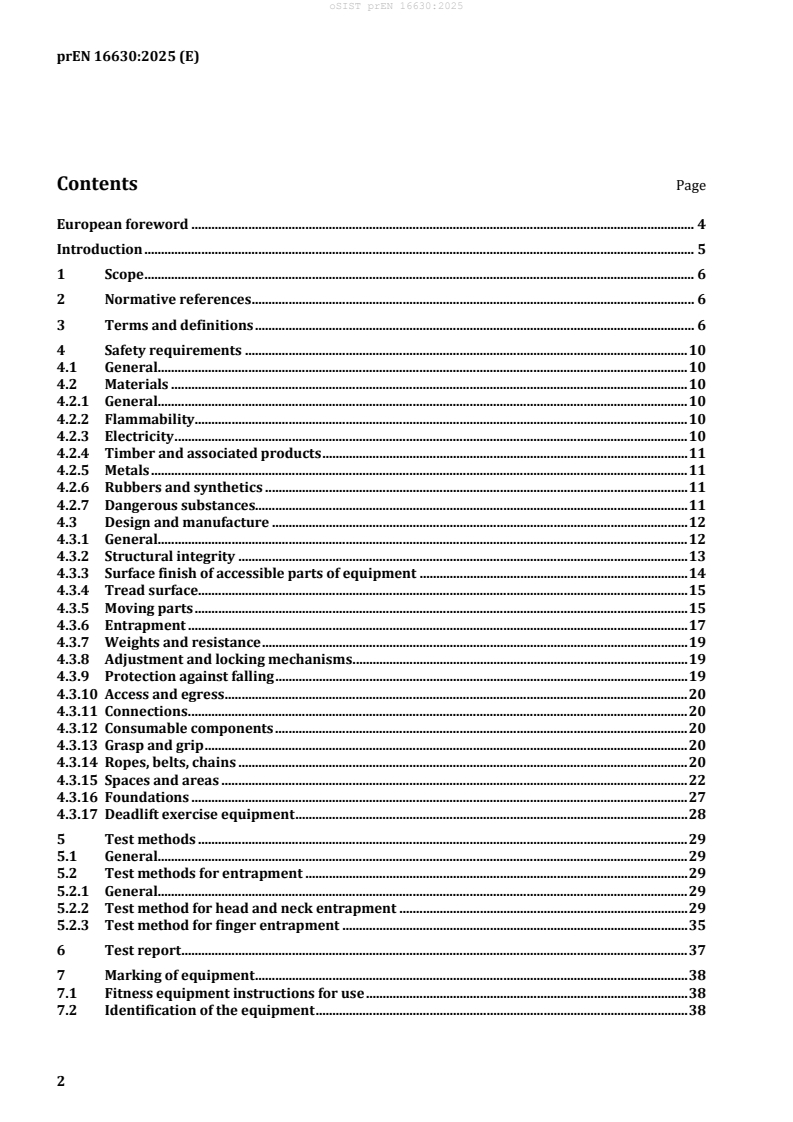
Contents
- Introduction
- 1 Scope
- 2 Normative references
- 3 Terms and definitions
- 3.1 fitness equipment
- 3.2 user station
- 3.3 movement space
- 3.4 area of movement
- 3.5 training space
- 3.6 damping
- 3.7 free height of fall
- 3.8 grasp
- 3.9 grip
- 3.10 body support
- 3.11 tread surface
- 3.12 constrained posture
- 3.13 competent person
- 3.14 barrier
- 3.15 platform
- 4 Safety requirements
- 4.1 General
- 4.2 Materials
- 4.3 Design and manufacture
- 05 Bark mulch
- 06 Woodchip
- 07 Sand or gravel 0,25 to 8 mm grain size
- 5 Test methods
- 5.1 General
- 5.2 Test methods for entrapment
- 6 Test report
- 7 Marking of equipment
- 7.1 Fitness equipment instructions for use
- 7.2 Identification of the equipment
- 7.3 Ground level marking
- 8 Information to be provided by the manufacturer and supplier
- 8.1 General
- 8.2 Installation
- 8.3 Inspection and maintenance
- 8.4 Information for use
- 9 Fitness equipment facilities - Information for users
- Annex A
- Bibliography
- 18 December 2006 concerning the Registration, Evaluation, Authorisation and Restriction of
Introduction
Outdoor fitness equipment is suitable for people who enjoy movement and want to actively engage themselves. The equipment is designed to promote physical activity across a wide range of abilities. Such activities can include cardiovascular, strength, toning, balance, coordination and flexibility exercises. When drafting this document, the difficulties have been recognized to address safety issues by age criteria alone, because the ability to handle risks is based on the individual users’ level of skill. Also, age groups other than the intended ones will almost certainly make use of the outdoor fitness equipment. Therefore, it was decided to recommend the use of the fitness equipment for youths and adults or users with an overall height greater than 1 400 mm and to specify safety requirements on this basis. This is necessary in order to produce a clear differentiation from playground equipment in accordance with the EN 1176 series. However, relevant requirements of this series have been taken into account wherever it was useful and possible.
The requirements in this document assume that all users of the fitness equipment are aware of the limits of their physical capacity and are able to use the equipment unassisted. Provided that the equipment is used as intended, i.e. in accordance with the exercise instructions attached to each individual piece of equipment, it is assumed that single or multiple body parts are moved and are not incorrectly strained. As long as there is human interaction with moving equipment there is a residual risk that cannot be further mitigated in order to maintain the function. However, a slightly incorrect execution is considered not to cause severe health consequences for the user. In the case of improper use, bruises, sprains and occasional bone fractures caused (e.g. by falls) might have to be accepted. In correspondence with the available opportunities, introductory courses can be offered at regular intervals, in which trained experts explain the individual pieces of equipment, their handling and their possible effects on the body and mind.
The design of outdoor fitness equipment is subject to constant development. Therefore, the design of particular types of equipment might not be specified in this document, however the general requirements of this document apply to all equipment.
Outdoor fitness equipment can contribute to social sustainability for healthier cities and communities according to Goal 11 ”Sustainable cities and communities” and Goal 3 “Good health and wellbeing” in order to achieve Sustainable Development Goals, Agenda 2030. The principle of this work is recognized and supported as outdoor fitness areas are places where people meet and connect together for a stronger community.
oSIST prEN 16630:2025 prEN 16630:2025 (E)
1 Scope
This document specifies general safety requirements for the manufacture, installation, inspection and maintenance of permanently installed, freely accessible outdoor fitness equipment. This document does not cover electrically driven equipment, functional training facilities (typically with unrestrained weights) nor military style obstacle courses with restricted access. The equipment is intended for youths and adults or users having an overall height greater than 1 400 mm to promote fitness by using the equipment to exercise. Equipment covered by this document is not playground equipment for children (EN 1176 series [1]), indoor stationary training equipment (EN ISO 20957 series [2], EN 957-6) or free access multi-sports equipment (EN 15312 [3]) even if it meets the requirements of each of these standards.
NOTE In this document “permanently installed outdoor fitness equipment” is simply called “fitness equipment”.
2 Normative references
The following documents are referred to in the text in such a way that some or all of their content constitutes requirements of this document. For dated references, only the edition cited applies. For undated references, the latest edition of the referenced document (including any amendments) applies. EN 335:2013, Durability of wood and wood-based products. Use classes: definitions, application to solid wood and wood-based products EN 350:2016, Durability of wood and wood-based products. Testing and classification of the durability to biological agents of wood and wood-based materials EN 351-1:2023, Durability of wood and wood-based products — Preservative-treated solid wood — Part 1:
Classification of preservative penetration and retention EN 636:2012+A1:2015, Plywood — Specifications EN 818-2:1996+A1:2008, Short link chain for lifting purposes. Safety. Part 2: Medium tolerance chain for chain slings. Grade 8 EN 818-3:1999+A1:2008, Short link chain for lifting purposes. Safety. Part 3: Medium tolerance chain for chain slings. Grade 4 EN 1176-1:2017+A1:2023, Playground equipment and surfacing — Part 1: General safety requirements and test methods
3 Terms and definitions
For the purposes of this document, the following terms and definitions apply. ISO and IEC maintain terminological databases for use in standardization at the following addresses:
- ISO Online browsing platform: available at https://www.iso.org/obp
- IEC Electropedia: available at https://electropedia.org/
oSIST prEN 16630:2025 prEN 16630:2025 (E)
3.1 fitness equipment
permanently installed, freely accessible equipment upon or with which the intended users, unsupervised and without outside help, can operate with the aim of maintaining or improving their physical and mental abilities Note 1 to entry: Some examples of this type of equipment can be referred to as outdoor gym equipment, street workout, calisthenics equipment or fitness trails.
3.2 user station
location of a piece of fitness equipment which the user can occupy while standing, sitting, lying or hanging Note 1 to entry: See Figure 1.
3.3 movement space
space around the fitness equipment necessary for safe use Note 1 to entry: See Figure 1.
3.4 area of movement
base area of movement space Note 1 to entry: See Figure 1.
3.5 training space
space in, above or around the fitness equipment which the users of the equipment need to perform their exercises Note 1 to entry: See Figure 1.
oSIST prEN 16630:2025 prEN 16630:2025 (E)
Key 1 movement space 2 training space 3 user station 4 overlapping training space (4.3.15.2) 5 area of movement Figure 1 — Spaces and area
3.6 damping
combined effect of the supporting component(s) that moderates the speed at which the equipment can move and the reduction of shock effects at the outer positions of the equipment [SOURCE: EN 1176-6:2017+AC:2019, 3.11]
3.7 free height of fall
greatest vertical distance between the user station and the horizontal surface lying directly underneath
3.8 grasp
holding of the hand round part of the circumference of a support Note 1 to entry: See Figure 2.
oSIST prEN 16630:2025 prEN 16630:2025 (E)
Figure 2 — Grasp [SOURCE: EN 1176-1:2017+A1:2023, 3.17]
3.9 grip
holding of the hand round the entire circumference of a support Note 1 to entry: See Figure 3.
[SOURCE: EN 1176-1:2017+A1:2023, 3.16]
Figure 3 — Grip
3.10 body support
surface of the user station where the user stands, sits, lies or hangs
3.11 tread surface
area accommodating one foot or both feet and moved by or with the user
3.12 constrained posture
physiologically unfavourable posture from which the users cannot free themselves without either outside help or without extreme difficultly or painful discomfort Note 1 to entry: Examples are the squat (joints involved: ankle joint, knee joint, hip joint) and the push-up (joints involved: wrist joint, elbow joint, shoulder joint).
Note 2 to entry: Most movements in everyday life and sports are multi-joint and require the use of the entire body. In strength training on equipment, there are only a limited number of multi-joint exercises (leg press, chest press, lat pulldown, rowing, shoulder press). Most equipment are single-joint (e.g. leg extension, abduction equipment, biceps curl).
oSIST prEN 16630:2025 prEN 16630:2025 (E)
3.13 competent person
person suitably trained, qualified by knowledge and practical experience to carry out the required task Note 1 to entry: Levels of knowledge to be competent for different tasks are given in e.g. CEN/TR 17207:2018 [4], 5.1, accredited person certification schemes and national specifications. Note 2 to entry: A competent person might be the operator, inspector, employee of the manufacturer or else.
3.14 barrier
device discouraging climbing and intended to prevent the user from falling and from passing beneath
3.15 platform
raised surface large enough for one or more users to walk without the need of hand support
4 Safety requirements
4.1 General
Typically, fitness equipment is not intended for installation in the immediate vicinity of children’s playgrounds in accordance with the EN 1176 series. If installed in connection with playground equipment, on playgrounds or similar installations, they should be separated from general playing activities by an appropriate distance, fencing or other structural measures. NOTE More information about positioning and separation of areas can be found in CEN/TR 16879 [5].
4.2 Materials
4.2.1 General
Materials shall be selected and treated in such a way that the stability of the equipment manufactured from them is not affected before the next operational inspection and routine maintenance. Materials should be manufactured in a professional manner.
NOTE The conditions relating to certain materials in this document do not imply that other equivalent materials are unsuitable in the manufacture of fitness equipment. The selection of materials and their use shall be in accordance with the appropriate European Standards. Special attention shall be given to surface coatings to avoid the risk of toxicity. In the choice of a material or substance for fitness equipment, consideration shall be given to the eventual disposal of the material or substance in regard to any possible environmental toxic risks.
4.2.2 Flammability
To prevent fire and similar dangers, materials known to produce surface flash shall not be used.
4.2.3 Electricity
Electric parts are covered by IEC standards, national legislation and CE marking. When these are followed, the equipment can be tested as if not having electric components. NOTE Electric parts are parts which are not driving the equipment.
oSIST prEN 16630:2025 prEN 16630:2025 (E)
4.2.4 Timber and associated products
Components from timber or timber products shall be designed in such a way that precipitation can drain or drip off freely and water accumulation is avoided.
In cases of ground contact, one or more of the following methods shall be used:
a) use of timber species with sufficient natural resistance in accordance with classes 1 and 2 of the natural durability classification given in EN 350:2016, 5.2; b) construction methods, e.g. post shoe; c) use of timber treated with wood preservatives in accordance with EN 351-1:2023, Figure A.1, and in accordance with Class 4 given in EN 335:2013, 4.5.
All components made of timber and associated products, other than those conforming to a), that affect the stability of the structure and are in constant contact with the ground shall be treated in accordance with c).
When using metal fastenings, consideration should be given to the fact that if certain species of timber and wood preservatives are in contact with each other, they will accelerate corrosion of the metal parts. Plywood shall be suitable for outdoor use in accordance with EN 636:2012+A1:2015. It is recommended to purchase only from sustainable sources. It is also recommended to avoid wood subject to deforestation. Suppliers with known problems regarding violations of human rights, use of child labour or poor labour conditions should be avoided.
4.2.5 Metals
Metal parts shall be protected against atmospheric conditions and corrosion. Metals that produce toxic oxide coatings that scale or flake shall be protected by a non-toxic coating.
4.2.6 Rubbers and synthetics
If, by maintenance, it is difficult to determine at what point a material becomes brittle, an indication of the time period after which the part or the equipment should be replaced shall be provided (see 8.3.3). All structural synthetic components shall be suitably protected to reduce influences of ultraviolet radiation and oxygen.
If rubber is used in structural components, deterioration due to ozone should be taken into consideration - either by using considerable material thicknesses, - or by leaving rubber parts visible for inspection.
Consideration should be given to weathering of structural components through ultraviolet influences.
4.2.7 Dangerous substances
Dangerous substances shall not be used in the manufacture of fitness equipment in such a way that they can cause adverse health effects to the user of the equipment. NOTE Attention is drawn to the national regulations of individual countries including:
− REACH Regulation 1907/2006/EC and its successive modifications. Restricted materials include, but are not limited to, asbestos, lead, formaldehyde, coal tar oils, carbolineums, polychlorinated biphenyls (PCBs) and polycyclic aromatic hydrocarbons (PAH compounds) [9].
oSIST prEN 16630:2025 prEN 16630:2025 (E) − RoHS Directive 2011/65/EU covering electronic devices to minimize the impact of hazardous substances to human health and environment [10].
− VOC Directive 1999/13/EU covering paints, coatings and coverings to reduce the emissions of volatile organic compounds [11].
− POP regulation 2019/1021/EU covering materials and manufacturing process to limit the use of persistent organic pollutants, such as pesticides (such as DDT), industrial chemicals (such as polychlorinated biphenyls, which were widely used in electrical equipment) or unintentional by-products formed during industrial processes, degradation or combustion (such as dioxins and furans) [12].
4.3 Design and manufacture
4.3.1 General
Fitness equipment shall be designed or set-up/assembled so that the intended use is/are easily identified by the user.
It shall be considered during the planning and design of fitness equipment that such equipment should also be accessible for people with limited capabilities and should be useable in accordance with these capabilities.
Fitness equipment shall be designed so that marginally incorrect executions of exercises do not lead to serious damage for the user. Special attention shall be drawn to equipment with the function of deadlifting (Figure 4).
Figure 4 — Deadlift Fitness equipment shall be designed so that it is in a safe position to allow the next user to gain access and does not move unexpectedly whilst the user is gaining access or dismounting. The equipment shall be designed so that the user cannot attain a constrained posture. Equipment specifically intended for the function of neck press (see Figure 5) shall be prohibited.
oSIST prEN 16630:2025 prEN 16630:2025 (E) NOTE The aim of this requirement is to avoid excessive twisting of shoulder joints.
Figure 5 — Neck press
4.3.2 Structural integrity
Fitness equipment shall be permanently connected to the substrate on which it stands. For fitness equipment, the structural integrity shall be proved for the worst case of the intended combinations. Structural integrity, including stability, of the equipment shall be evaluated by one of the following methods:
a) calculation on the basis of the applicable specifications in EN 1176-1:2017+A1:2023, Annex A and Annex B, except for Table A.1; Table 1 of this document should be used instead; b) physical testing, in accordance with EN 1176-1:2017+A1:2023, Annex C (using weights in accordance with Table 1 in this document); c) combination of a) and b).
Table 1 — Calculation of loads caused by the users Number of Mass of n Dynamic Total vertical load of Vertical load per users users factor users user
n C F F G dyn tot;v 1;v n kg N N 1 99 2 1 942 1 942 2 185 1,5 2 722 1 361
oSIST prEN 16630:2025 prEN 16630:2025 (E) Number of Mass of n Dynamic Total vertical load of Vertical load per users users factor users user
n C F F G dyn tot;v 1;v n kg N N 3 270 1,33 3 523 1 174 4 353 1,25 4 329 1 082 5 436 1,20 5 133 1 027 NOTE Values are rounded.
The loads resulting from users of fitness equipment shall be based on the following formulae:
(1) G=nm×+ 1,64×σ n n 1+ n C = (2) dyn n where is the total mass of n user (kg); G n n is the numbers of users; m is the mean mass of the user; σ is the standard deviation of the σ user.
NOTE For free accessible fitness equipment the following values can be used:
m = 78 kg (This value is based on data from age 18 to 65 of adult men 50 percentile) σ = 12,6 kg
4.3.3 Surface finish of accessible parts of equipment
There shall be no protruding nails, protruding wire rope terminations, pointed or sharp-edged components.
Wooden equipment shall be made of wood with a low susceptibility to splintering. The surface finish of equipment made of other materials (e.g. glass fibre) shall be non-splintering. Rough surfaces shall not present any risk of injury. All weld seams shall be smooth. Protruding bolt threads shall be permanently covered on all accessible parts of equipment (e.g. with dome headed nuts). Nuts and bolt heads that protrude less than 8 mm are permissible on inaccessible parts (see Figure 6 a)), provided that they are free from burrs.
Corners, edges and protruding parts within the space occupied by the user that protrude more than 8 mm, and which are not shielded by adjacent areas that are not more than 25 mm away from the end of the protruding part, shall be rounded off. The minimum radius of the curve shall be 3 mm (see Figure 6 b)).
NOTE This requirement is intended only to prevent injuries caused by unintended contact with components. Corners, edges and protruding parts with a radius less than 3 mm may be in other accessible parts of the equipment only if they are not sharp.
oSIST prEN 16630:2025 prEN 16630:2025 (E) Figure 6 shows examples of protection for nuts and bolts and of permissible protruding parts. Dimensions in millimetres
a)
b) Figure 6 — Examples of protection and permissible protruding parts
4.3.4 Tread surface
If the equipment is provided with a tread surface, this shall be equipped with a slip-resistant finish. Tread surfaces shall be designed so that liquid can drain off.
When user’s whole body weight is on feet, a tread surface with a minimum width of 100 mm and minimum length of 300 mm shall be available per foot.
Additionally, the tread surface shall provide at least a three-sided safeguard including the front that is a minimum of 10 mm high and extends over a length of 75 % of the tread perimeter. This requirement is not applicable to rotary discs with a diameter of at least 320 mm.
4.3.5 Moving parts
4.3.5.1 General
There shall be no crushing or shearing points for the user between moving and/or stationary parts of the equipment during use. Pulleys and similar parts shall be protected against body parts becoming entrapped.
4.3.5.2 Clearances
The distance from moving parts to adjacent moving or fixed parts shall be either < 8 mm or ≥ 25 mm, if only the fingers are at risk. Otherwise, it shall be either < 8 mm or ≥ 60 mm (see Figure 7). The distance between the bottom end of a moving part and the ground shall be at least 60 mm. If the vertically moving parts are found outside of the user’s field of vision, then the ground clearance shall be at least 110 mm.
oSIST prEN 16630:2025 prEN 16630:2025 (E) NOTE More information about the field of vision can be found in EN ISO 20957-2:2021 [13], Figure 7 and 8.
...