

oSIST prEN 14187-5:2014
(Main)Cold applied joint sealants - Test methods - Part 5: Determination of the resistance to hydrolysis
General Information
- Abstract
This European Standard describes a test method for determining the resistance to hydrolysis of cold applied joint sealants after treatment at elevated temperature and high humidity.
- Status
- Not Published
- Public Enquiry End Date
- 29-Dec-2014
- Technical Committee
- CES - Roads
- Current Stage
- 98 - Abandoned project (Adopted Project)
- Start Date
- 06-Mar-2017
- Due Date
- 11-Mar-2017
- Completion Date
- 06-Mar-2017

Overview
prEN 14187-5 (CEN) defines a standardized test method for determining the resistance to hydrolysis of cold applied joint sealants. The procedure evaluates how exposure to elevated temperature and high humidity affects the mechanical properties of sealants used in road and civil engineering joints. This draft European Standard is part of the EN 14187 series for cold applied joint sealants and references EN ISO 6927 (vocabulary) and EN ISO 868 (Shore hardness).
Key topics and requirements
- Scope: Tests resistance to hydrolysis after an autoclave treatment at elevated temperature/high humidity.
- Specimen preparation:
- Round polyethylene moulds, diameter 50–70 mm, depth 10 mm.
- Sealant conditioned 24 h at (23 ± 2) °C before moulding.
- Three specimens per test; avoid air bubbles and trim flush with mould edge.
- Conditioning before test: 28 days at (23 ± 2) °C and (50 ± 5) % RH to allow complete cure.
- Test exposure:
- Autoclave with 20–50 mm water layer on bottom; specimens placed above water on a support.
- Test temperatures: (60 ± 2) °C, (70 ± 2) °C, (80 ± 2) °C.
- Duration: 14 days in the autoclave inside a convection oven (60–100 °C capability).
- Water level monitored during exposure.
- Measurements:
- Shore A hardness (EN ISO 868) measured before and after hydrolysis treatment.
- After autoclave, specimens conditioned 24 h at (70 ± 2) °C prior to final hardness testing.
- Result expression:
- Resistance to hydrolysis reported as the percentage change in Shore A hardness using arithmetic mean values before and after testing.
- Test report must include: reference to standard, sealant name/type/batch, conditioning details, resistance to hydrolysis value, specimen changes, deviations, and test date.
Applications and users
- Useful for sealant manufacturers for product development and quality control.
- Employed by independent testing laboratories for conformity assessment and certification.
- Specifiers, contractors and asset owners in road construction and civil engineering use results to compare products and select sealants resistant to hydrolytic degradation.
- Relevant for regulatory compliance, procurement specifications, and durability assessments of joint sealants subject to humid, high-temperature environments.
Related standards
- EN 14187 series (Parts 1–9) - complementary test methods (rate of cure, tack-free time, fuel/chemical immersion, adhesion/cohesion, flame resistance, UV weathering, functional testing).
- EN ISO 868 - Shore hardness measurement.
- EN ISO 6927 - sealant vocabulary.
Keywords: prEN 14187-5, cold applied joint sealants, resistance to hydrolysis, Shore A hardness, autoclave test, joint sealant testing, CEN standard, road construction sealants.
Relations
- Effective Date
- 28-Jan-2026
- Effective Date
- 28-Jan-2026
- Referred By
SIST EN 959:2019 - Mountaineering equipment - Rock anchors - Safety requirements and test methods - Effective Date
- 28-Jan-2026
- Effective Date
- 28-Jan-2026
- Referred By
SIST EN 959:2008 - Mountaineering equipment - Rock anchors - Safety requirements and test methods - Effective Date
- 28-Jan-2026
- Effective Date
- 08-Jun-2022
- Effective Date
- 01-Dec-2014
Get Certified
Connect with accredited certification bodies for this standard

DIBt (Deutsches Institut für Bautechnik)
German Institute for Building Technology.
DIN CERTCO
DIN Group product certification.
Zavod za gradbeništvo Slovenije (ZAG) - Inšpekcija
ZAG inspection body for construction products, structures, and materials.
Sponsored listings
Frequently Asked Questions
oSIST prEN 14187-5:2014 is a draft published by the Slovenian Institute for Standardization (SIST). Its full title is "Cold applied joint sealants - Test methods - Part 5: Determination of the resistance to hydrolysis". This standard covers: This European Standard describes a test method for determining the resistance to hydrolysis of cold applied joint sealants after treatment at elevated temperature and high humidity.
This European Standard describes a test method for determining the resistance to hydrolysis of cold applied joint sealants after treatment at elevated temperature and high humidity.
oSIST prEN 14187-5:2014 is classified under the following ICS (International Classification for Standards) categories: 91.100.50 - Binders. Sealing materials; 93.080.20 - Road construction materials. The ICS classification helps identify the subject area and facilitates finding related standards.
oSIST prEN 14187-5:2014 has the following relationships with other standards: It is inter standard links to SIST EN ISO 19903:2007, SIST EN 16869:2018, SIST EN 959:2019, SIST EN 480-11:2005, SIST EN 959:2008, SIST EN 14187-5:2004, SIST EN 14187-5:2004. Understanding these relationships helps ensure you are using the most current and applicable version of the standard.
oSIST prEN 14187-5:2014 is available in PDF format for immediate download after purchase. The document can be added to your cart and obtained through the secure checkout process. Digital delivery ensures instant access to the complete standard document.
Standards Content (Sample)
SLOVENSKI STANDARD
01-december-2014
Hladno nanosljive tesnilne mase za stike - Preskusne metode - 5. del: Ugotavljanje
odpornosti proti hidrolizi
Cold applied joint sealants - Test methods - Part 5: Determination of the resistance to
hydrolysis
Kalt verarbeitbare Fugenmassen - Teil 5: Prüfverfahren zur Bestimmung des
Aushärtungsgrades
Mastics pour joints appliqués à froid - Méthodes d'essai - Partie 5: Détermination de la
résistance à l'hydrolyse
Ta slovenski standard je istoveten z: prEN 14187-5
ICS:
91.100.50 Veziva. Tesnilni materiali Binders. Sealing materials
93.080.20 Materiali za gradnjo cest Road construction materials
2003-01.Slovenski inštitut za standardizacijo. Razmnoževanje celote ali delov tega standarda ni dovoljeno.
EUROPEAN STANDARD
DRAFT
NORME EUROPÉENNE
EUROPÄISCHE NORM
October 2014
ICS 93.080.20 Will supersede EN 14187-5:2003
English Version
Cold applied joint sealants - Test methods - Part 5:
Determination of the resistance to hydrolysis
Mastics pour joints appliqués à froid - Méthodes d'essai - Kalt verarbeitbare Fugenmassen - Teil 5: Prüfverfahren zur
Partie 5: Détermination de la résistance à l'hydrolyse Bestimmung des Aushärtungsgrades
This draft European Standard is submitted to CEN members for enquiry. It has been drawn up by the Technical Committee CEN/TC 227.
If this draft becomes a European Standard, CEN members are bound to comply with the CEN/CENELEC Internal Regulations which
stipulate the conditions for giving this European Standard the status of a national standard without any alteration.
This draft European Standard was established by CEN in three official versions (English, French, German). A version in any other language
made by translation under the responsibility of a CEN member into its own language and notified to the CEN-CENELEC Management
Centre has the same status as the official versions.
CEN members are the national standards bodies of Austria, Belgium, Bulgaria, Croatia, Cyprus, Czech Republic, Denmark, Estonia,
Finland, Former Yugoslav Republic of Macedonia, France, Germany, Greece, Hungary, Iceland, Ireland, Italy, Latvia, Lithuania,
Luxembourg, Malta, Netherlands, Norway, Poland, Portugal, Romania, Slovakia, Slovenia, Spain, Sweden, Switzerland, Turkey and United
Kingdom.
Recipients of this draft are invited to submit, with their comments, notification of any relevant patent rights of which they are aware and to
provide supporting documentation.
Warning : This document is not a European Standard. It is distributed for review and comments. It is subject to change without notice and
shall not be referred to as a European Standard.
EUROPEAN COMMITTEE FOR STANDARDIZATION
COMITÉ EUROPÉEN DE NORMALISATION
EUROPÄISCHES KOMITEE FÜR NORMUNG
CEN-CENELEC Management Centre: Avenue Marnix 17, B-1000 Brussels
© 2014 CEN All rights of exploitation in any form and by any means reserved Ref. No. prEN 14187-5:2014 E
worldwide for CEN national Members.
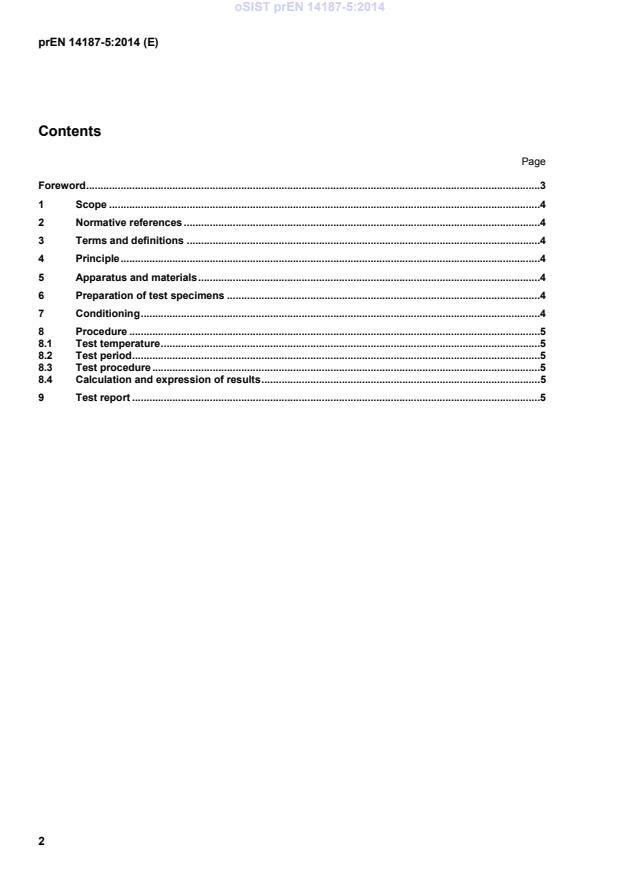
Contents
Page
Foreword .3
1 Scope .4
2 Normative references .4
3 Terms and definitions .4
4 Principle .4
5 Apparatus and materials .4
6 Preparation of test specimens .4
7 Conditioning .4
8 Procedure .5
8.1 Test temperature .5
8.2 Test period .5
8.3 Test procedure .5
8.4 Calculation and expression of results .5
9 Test report .5
prEN 1418
...