

SIST EN 4099:2005
(Main)Aerospace series - Aluminium alloy AL-P2219-T6 or T62 - Clad sheet and strip - 0,5 mm
General Information
- Abstract
This standard specifies the requirements relating to:
Aluminium alloy AL-P2219-
T6 or T62
Clad sheet and strip
0,5 mm < or = a < or = 6 mm
for aerospace application.
- Status
- Published
- Publication Date
- 31-Oct-2005
- Technical Committee
- SS SPL - Technical Board for the general field
- Current Stage
- 6060 - National Implementation/Publication (Adopted Project)
- Start Date
- 01-Nov-2005
- Due Date
- 01-Nov-2005
- Completion Date
- 01-Nov-2005

Overview
EN 4099:2005 is a CEN/AECMA aerospace material standard that defines requirements for aluminium alloy AL‑P2219 in clad sheet and strip form, thickness range 0.5 mm ≤ a ≤ 6 mm, for aerospace applications. The standard covers permitted chemical limits, production form (rolled clad sheet/strip), delivery and use conditions (O, H111; T6, T62 heat treatments), cladding specification and key mechanical requirements. It is part of the EN aerospace metallic materials series and references EN 4400‑2, EN 4258 and EN 4500‑2.
Key topics and requirements
- Material and temper: Aluminium alloy AL‑P2219 supplied in delivery conditions O or H111 and in use conditions T6 or T62 (specific heat‑treatment ranges are given).
- Form and size range: Clad sheet and strip, rolled, with thickness 0.5–6 mm.
- Cladding: Typically specified as aluminium alloy AL‑P7072 (cladding composition limits provided in the standard). Minimum cladding thickness on each face depends on sheet thickness:
- 0.5 ≤ a ≤ 1.0 mm: ≥ 8% per face
- 1.0 < a ≤ 2.5 mm: ≥ 4% per face
- 2.5 < a ≤ 6.0 mm: ≥ 2% per face
- Mechanical properties: Separate requirements for delivery condition (O / H111) and use condition (T6 / T62). Example consolidated values from the standard:
- Delivery (O/H111): proof stress Rp0.2 up to 110 MPa; tensile strength Rm up to 220 MPa; elongation A ≥ 12% (50 mm gauge).
- Use (T6/T62): proof stress and tensile strength specified as minimums that increase with thickness (e.g., Rm ≥ 305–350 MPa depending on thickness); elongation A ≥ 6–7% depending on thickness.
- Testing & inspection: Test specimens, dimensional, chemical, diffusion and marking inspections are referenced to EN 4400‑2. Note: repeated re‑solution heat treatment is not recommended because of copper diffusion from the core into the cladding, affecting elevated temperature properties.
- Qualification: Product qualification and acceptance tests are to follow EN 4400‑2 and are to be agreed between purchaser and manufacturer.
Applications and users
- Intended for aerospace structural applications where high‑strength, clad aluminium sheet is required (e.g., airframe skin, fuselage panels, secondary structures).
- Primary users:
- Aerospace material specifiers and design engineers
- Sheet and strip manufacturers and suppliers
- Procurement and quality/inspection teams in aerospace OEMs and Tier‑1 firms
- Testing laboratories performing material verification and qualification
Related standards
- EN 4400‑2 (Aluminium sheet and strip technical specification)
- EN 4258 (General organization of aerospace metallic standards)
- EN 4500‑2 (Rules for drafting aluminium alloy material standards)
Keywords: EN 4099:2005, aluminium alloy AL‑P2219, clad sheet and strip, AL‑P2219‑T6, T62, aerospace aluminium, cladding AL‑P7072, 0.5–6 mm.
Relations
- Effective Date
- 28-Jan-2026
Get Certified
Connect with accredited certification bodies for this standard

BUREAU VERITAS Certification Germany
Bureau Veritas certification in Germany.

Element Materials Technology
Materials testing and product certification.

AQMS Ltd.
AQMS provides ISO certification to SMEs across the UK.
Sponsored listings
Frequently Asked Questions
SIST EN 4099:2005 is a standard published by the Slovenian Institute for Standardization (SIST). Its full title is "Aerospace series - Aluminium alloy AL-P2219-T6 or T62 - Clad sheet and strip - 0,5 mm <a <6 mm". This standard covers: This standard specifies the requirements relating to: Aluminium alloy AL-P2219- T6 or T62 Clad sheet and strip 0,5 mm < or = a < or = 6 mm for aerospace application.
This standard specifies the requirements relating to: Aluminium alloy AL-P2219- T6 or T62 Clad sheet and strip 0,5 mm < or = a < or = 6 mm for aerospace application.
SIST EN 4099:2005 is classified under the following ICS (International Classification for Standards) categories: 49.025.20 - Aluminium. The ICS classification helps identify the subject area and facilitates finding related standards.
SIST EN 4099:2005 has the following relationships with other standards: It is inter standard links to SIST EN 4258:2024. Understanding these relationships helps ensure you are using the most current and applicable version of the standard.
SIST EN 4099:2005 is available in PDF format for immediate download after purchase. The document can be added to your cart and obtained through the secure checkout process. Digital delivery ensures instant access to the complete standard document.
Standards Content (Sample)
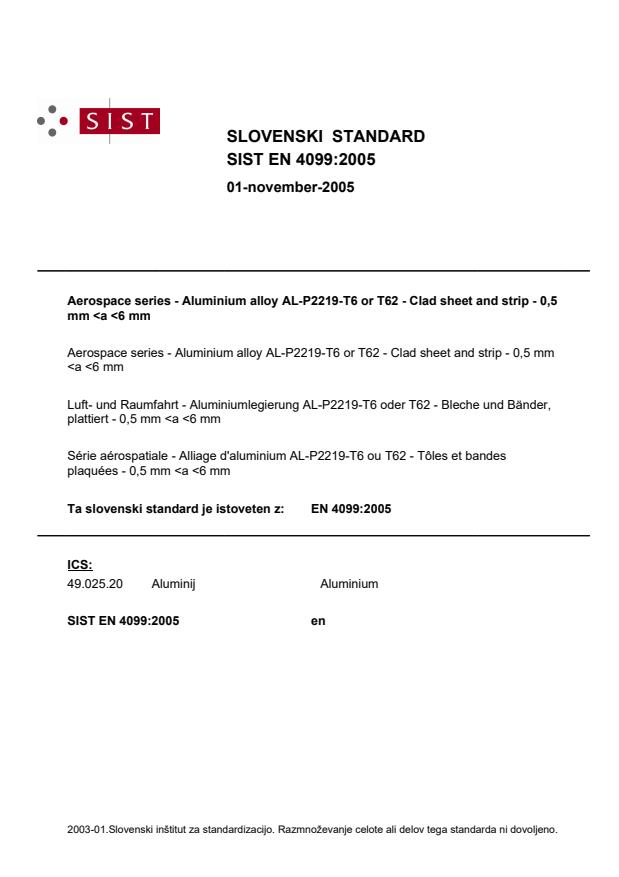
SLOVENSKI STANDARD
01-november-2005
Aerospace series - Aluminium alloy AL-P2219-T6 or T62 - Clad sheet and strip - 0,5
mm
Aerospace series - Aluminium alloy AL-P2219-T6 or T62 - Clad sheet and strip - 0,5 mm
Luft- und Raumfahrt - Aluminiumlegierung AL-P2219-T6 oder T62 - Bleche und Bänder,
plattiert - 0,5 mm
Série aérospatiale - Alliage d'aluminium AL-P2219-T6 ou T62 - Tôles et bandes
plaquées - 0,5 mm
Ta slovenski standard je istoveten z: EN 4099:2005
ICS:
49.025.20 Aluminij Aluminium
2003-01.Slovenski inštitut za standardizacijo. Razmnoževanje celote ali delov tega standarda ni dovoljeno.
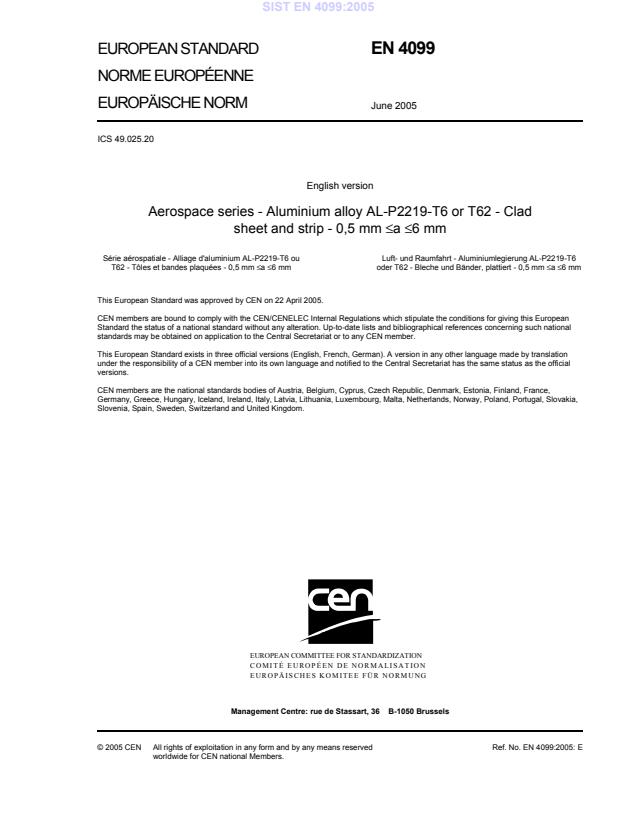
EUROPEAN STANDARD EN 4099
NORME EUROPÉENNE
EUROPÄISCHE NORM
June 2005
ICS 49.025.20
English version
Aerospace series - Aluminium alloy AL-P2219-T6 or T62 - Clad
sheet and strip - 0,5 mm ≤a ≤6 mm
Série aérospatiale - Alliage d'aluminium AL-P2219-T6 ou Luft- und Raumfahrt - Aluminiumlegierung AL-P2219-T6
T62 - Tôles et bandes plaquées - 0,5 mm ≤a ≤6 mm oder T62 - Bleche und Bänder, plattiert - 0,5 mm ≤a ≤6 mm
This European Standard was approved by CEN on 22 April 2005.
CEN members are bound to comply with the CEN/CENELEC Internal Regulations which stipulate the conditions for giving this European
Standard the status of a national standard without any alteration. Up-to-date lists and bibliographical references concerning such national
standards may be obtained on application to the Central Secretariat or to any CEN member.
This European Standard exists in three official versions (English, French, German). A version in any other language made by translation
under the responsibility of a CEN member into its own language and notified to the Central Secretariat has the same status as the official
versions.
CEN members are the national standards bodies of Austria, Belgium, Cyprus, Czech Republic, Denmark, Estonia, Finland, France,
Germany, Greece, Hungary, Iceland, Ireland, Italy, Latvia, Lithuania, Luxembourg, Malta, Netherlands, Norway, Poland, Portugal, Slovakia,
Slovenia, Spain, Sweden, Switzerland and United Kingdom.
EUROPEAN COMMITTEE FOR STANDARDIZATION
COMITÉ EUROPÉEN DE NORMALISATION
EUROPÄISCHES KOMITEE FÜR NORMUNG
Management Centre: rue de Stassart, 36 B-1050 Brussels
© 2005 CEN All rights of exploitation in any form and by any means reserved Ref. No. EN 4099:2005: E
worldwide for CEN national Members.
Foreword
This document (EN 4099:2005) has been prepared by the European Association of Aerospace
Manufacturers - Standardization (AECMA-STAN).
After enquiries and votes carried out in accordance with the rules of this Association, this Standard has
received the approval of the National Associations and the Official Services of the member countries of
AECMA, prior to its presentation to CEN.
This European Standard shall be given the status of a national standard, either by publication of an identical
text or by endorsement, at the latest by December 2005, and conflicting national standards shall be withdrawn
at the latest by December 2005.
Attention is drawn to the possibility that some of the elements of this document may be the subject of patent
rights. CEN [and/or CENELEC] shall not be held responsible for identifying any or all such patent rights.
According to the CEN/CENELEC Internal Regulations, the national standards organizations of the following
countries are bound to implement this European Standard: Austria, Belgium, Cyprus, Czech Republic,
Denmark, Estonia, Finland, France, Germany, Greece, Hungary, Iceland, Ireland, Italy, Latvia, Lithuania,
Luxembourg, Malta, Netherlands, Norway, Poland, Portugal, Slovakia, Slovenia, Spain, Sweden, Switzerland
and the United Kingdom.
EN 4099:200
...