

SIST EN 2511:2005
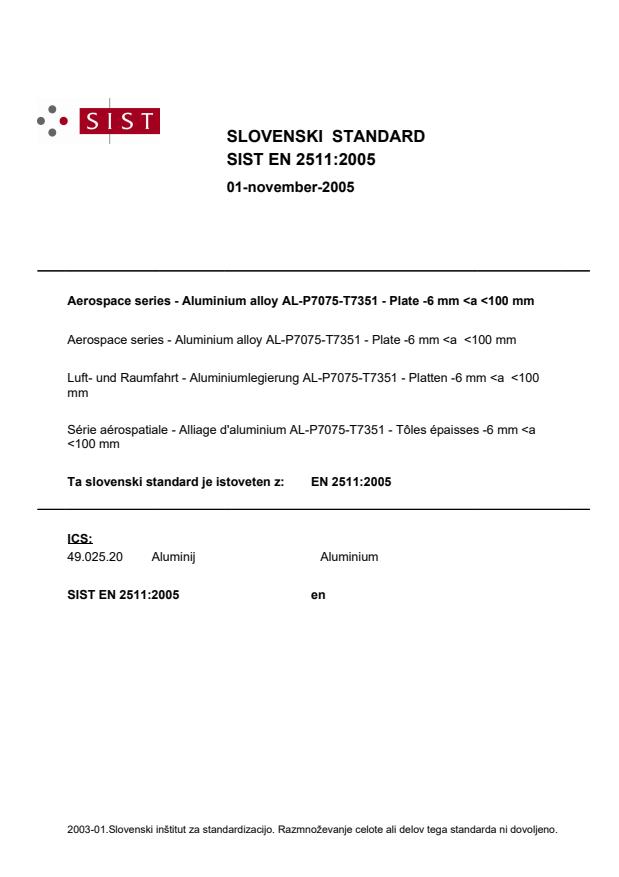
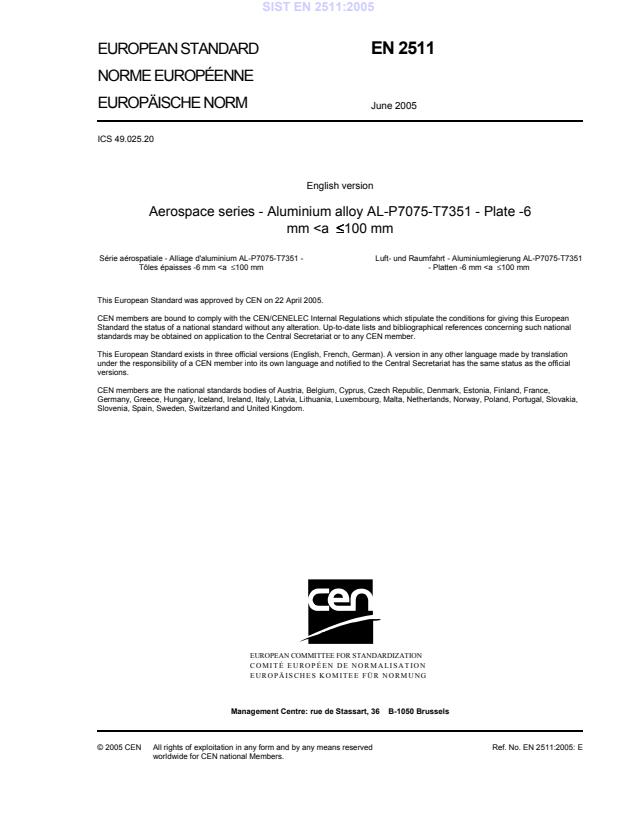
(Main)Aerospace series - Aluminium alloy AL-P7075-T7351 - Plate -6 mm
General Information
- Abstract
This standard specifies the requirements relating to:
Aluminium alloy AL-P7075-
T7351
Plate
6 mm < a < 100 mm
for aerospace application.
- Status
- Published
- Publication Date
- 31-Oct-2005
- Technical Committee
- SS SPL - Technical Board for the general field
- Current Stage
- 6060 - National Implementation/Publication (Adopted Project)
- Start Date
- 01-Nov-2005
- Due Date
- 01-Nov-2005
- Completion Date
- 01-Nov-2005

Overview
SIST EN 2511:2005 is a European standard developed by CEN covering Aerospace series aluminium alloy AL-P7075-T7351 plates with thicknesses between 6 mm and 100 mm. This standard defines stringent requirements for the chemical composition, mechanical properties, production methods, and quality controls specifically tailored for aerospace applications. It ensures uniformity and reliability in aluminium alloy plates used in critical aerospace structures, supporting high performance and safety standards in the aerospace industry.
The standard is part of a broader series of metallic material standards for aerospace applications, designed in line with EN 4258 and drafted following EN 4500-2 guidelines. SIST EN 2511:2005 has been adopted by national standards bodies across Europe, ensuring harmonized specifications for manufacturers and users of AL-P7075-T7351 aluminium alloy plates.
Key Topics
Material Specification:
Focuses on aluminium alloy AL-P7075-T7351, a high-strength alloy widely used in aerospace for its excellent mechanical properties and corrosion resistance.Plate Thickness Range:
Applies to plates with thickness greater than 6 mm and up to 100 mm, aligning with typical aerospace structural component requirements.Chemical Composition:
Specifies limits for key elements such as Silicon (Si), Iron (Fe), Copper (Cu), Magnesium (Mg), Chromium (Cr), Zinc (Zn), and Titanium (Ti) to guarantee alloy consistency.Mechanical Properties:
Defines minimum levels for proof stress (Rp0.2), tensile strength (Rm), elongation (A), and other properties at ambient temperature. These values ensure the material meets durability and strength standards required for aerospace engineering.Heat Treatment and Delivery Conditions:
Details the T7351 temper designation including solution heat treatment, quenching, controlled stretching, and artificial aging. These treatments optimize strength and stress corrosion resistance.Testing and Quality Control:
Followed according to EN 4400-1, encompassing dimensional inspections, mechanical and corrosion testing, and batch uniformity. This guarantees high-quality production and traceability.Applications Orientation:
Made to meet aerospace requirements, such as resistance to stress corrosion and external/internal defect tolerances.
Applications
The SIST EN 2511:2005 standard is instrumental for aerospace manufacturers and suppliers involved in producing and certifying aluminium alloy plates for:
Aircraft Structural Components
Wing spars, fuselage frames, and other load-bearing aerospace parts requiring high strength-to-weight ratios.Aircraft Engine Parts
Components exposed to cyclic stresses and elevated temperatures.Aerospace Assemblies
Where plate thickness and mechanical reliability conform precisely to strict aerospace design parameters.High-Performance Aerospace Materials Supply
Enables manufacturers and purchasers to ensure material compliance and uniformity across international aerospace supply chains.
Adhering to SIST EN 2511:2005 helps aerospace companies improve product safety, reduce material failure risk, and maintain compliance with internationally recognized aerospace material standards.
Related Standards
EN 4258 – Aerospace series: General organization of metallic material standards, describing classification and linkage of aerospace material standards.
EN 4400-1 – Aerospace series: Aluminium and aluminium alloy wrought products – Technical specifications for plates including test methods and quality requirements.
EN 4500-2 – Aerospace series: Rules for drafting and presentation of metallic material standards, specific to aluminium and magnesium alloys.
These standards work together to provide a comprehensive framework for aerospace alloy materials, ensuring compatibility, traceability, and quality control across the aerospace manufacturing sector.
Keywords: SIST EN 2511:2005, aerospace aluminium alloy, AL-P7075-T7351, aluminium plates aerospace, aerospace material standards, high-strength aluminium, aluminium alloy plate specification, aerospace manufacturing, aerospace structural materials, aerospace metal standards, EN 4400-1, EN 4258, aluminium plate mechanical properties.
Relations
- Effective Date
- 28-Jan-2026
Get Certified
Connect with accredited certification bodies for this standard

BUREAU VERITAS Certification Germany
Bureau Veritas certification in Germany.

Element Materials Technology
Materials testing and product certification.

AQMS Ltd.
AQMS provides ISO certification to SMEs across the UK.
Sponsored listings
Frequently Asked Questions
SIST EN 2511:2005 is a standard published by the Slovenian Institute for Standardization (SIST). Its full title is "Aerospace series - Aluminium alloy AL-P7075-T7351 - Plate -6 mm <a <100 mm". This standard covers: This standard specifies the requirements relating to: Aluminium alloy AL-P7075- T7351 Plate 6 mm < a < 100 mm for aerospace application.
This standard specifies the requirements relating to: Aluminium alloy AL-P7075- T7351 Plate 6 mm < a < 100 mm for aerospace application.
SIST EN 2511:2005 is classified under the following ICS (International Classification for Standards) categories: 49.025.20 - Aluminium. The ICS classification helps identify the subject area and facilitates finding related standards.
SIST EN 2511:2005 has the following relationships with other standards: It is inter standard links to SIST EN 4258:2024. Understanding these relationships helps ensure you are using the most current and applicable version of the standard.
SIST EN 2511:2005 is available in PDF format for immediate download after purchase. The document can be added to your cart and obtained through the secure checkout process. Digital delivery ensures instant access to the complete standard document.