


oSIST prEN 50121-2:2025
(Main)Railway applications - Electromagnetic compatibility - Part 2: Emission of the whole railway system to the outside world
General Information
- Abstract
This document is intended to define the electromagnetic environment of the whole railway system including urban mass transit and light rail systems. It describes the measurement method to verify the emissions and gives the cartography values of the fields most frequently encountered.
This document specifies the emission limits of the whole railway system to the outside world.
The emission parameters refer to the particular measuring points defined in Clause 5.
Also, the zones above and below the railway system can be affected by electromagnetic emissions and particular cases need to be considered individually (see EMC management plan in FprEN 50121 1:2026, Clause 4).
For existing railway systems, it is assumed that compliance with the emission requirements of FprEN 50121-3-1:2026, FprEN 50121-3-2:2026, FprEN 50121-4:2026 and FprEN 50121-5:2026 will ensure the compliance with the emission values given in this part.
This document gives emission limits for newly built railway systems (not yet in operation), or for modifications on providing of traction current (excluded those modifications covered with FprEN 50121 5: 2026), with different characteristics (e.g. higher design speed of the line, static switching components) in comparison with existing railway systems.
- Status
- Not Published
- Public Enquiry End Date
- 30-Sep-2025
- Technical Committee
- ŽEN - Electrical applications for railways
- Current Stage
- 4020 - Public enquire (PE) (Adopted Project)
- Start Date
- 14-May-2025
- Due Date
- 01-Oct-2025
- Completion Date
- 23-Jul-2025

Overview
oSIST prEN 50121-2:2025, developed by CLC, addresses the electromagnetic compatibility (EMC) of railway applications, specifically the emissions produced by the entire railway system and their effects on the outside world. The standard encompasses a broad scope, including urban mass transit and light rail systems, and establishes emission limits to ensure safe coexistence between railways and other infrastructure.
This document outlines standardized measurement methods for emission verification and specifies how emission values are mapped (cartography) for electric and magnetic fields most commonly encountered. It defines measuring points, addresses zones impacted above and below railway systems, and provides requirements for both new and existing railways with regard to EMC emissions.
Key Topics
Electromagnetic Emission Limits
oSIST prEN 50121-2:2025 specifies maximum allowable emission values from entire railway systems-covering both the railway track environment and substations-across defined frequency ranges. Emission parameters are established for specific measuring points, and separate provisions are made for new railway systems with advanced characteristics.Measurement Methods
The standard details measurement techniques to verify compliance, including prescribed antenna types, measurement distances (typically 10 meters from the track or substation boundary), and the correct acquisition settings. Requirements are also defined for measurement locations along tracks and at substations, with consideration for differing power supply modes and site configurations.Cartography of Fields
Guidance on mapping and typical field values is included, aiding infrastructure managers in understanding EMI exposure levels at different railway system locations.Environmental Considerations
oSIST prEN 50121-2:2025 accounts for meteorological conditions and their impact on emission measurements. It recognizes the need to adjust methods or report conditions when, for example, measurements are conducted above ground versus underground, or during adverse weather.Reporting and Documentation
The standard requires comprehensive documentation of test conditions, including details on ambient noise, site configuration, railway and substation characteristics, operation modes, and weather during tests.
Applications
oSIST prEN 50121-2:2025 is applicable in the following scenarios:
Design and Construction of New Railways
Infrastructure designers and rail operators use the standard to ensure that newly built systems, including those with higher design speeds or new switching technologies, meet essential EMC emission requirements before beginning operations.Compliance Assessment for Existing Rail Networks
Operators of established rail systems use this standard in conjunction with related standards (such as prEN 50121-3-1, prEN 50121-3-2, prEN 50121-4, and prEN 50121-5) to assess whether their systems continue to comply with current emission limits.Urban Transit Planning
The standard supports local governments and planners in evaluating the EMI impact of light rail and urban mass transit systems on city environments, thus aiding in risk management and mitigation of electromagnetic interference with other infrastructure and systems.Regulatory and Cross-sector Coordination
Regulatory bodies reference the standard to harmonize EMC requirements across rail and non-rail sectors, ensuring safe electromagnetic environments near railway corridors, substations, and neighboring installations.
Related Standards
EN 50121 Series
- Part 1: General (prEN 50121-1:2025)
- Part 3-1: Rolling stock - Train and complete vehicle (prEN 50121-3-1:2025)
- Part 3-2: Rolling stock - Apparatus (prEN 50121-3-2:2025)
- Part 4: Signaling and telecommunications apparatus (prEN 50121-4:2025)
- Part 5: Fixed power supply installations and apparatus (prEN 50121-5:2025)
EN IEC 55016 Series
Specifications for radio disturbance and immunity measuring apparatus and methods.IEC 60050-161:1990
International Electrotechnical Vocabulary for electromagnetic compatibility.
Keywords:
railway EMC standard, electromagnetic emissions, railway system emissions, EMC measurement methods, railway substations, urban rail EMC, CENELEC railway standards, railway environment electromagnetic, emission limits, railway compliance
Relations
- Effective Date
- 09-Apr-2024
Get Certified
Connect with accredited certification bodies for this standard

IMQ S.p.A. (Certification)
Italian electrical product certification.

IRIS Certification (UNIFE)
International Railway Industry Standard certification.

SLG Prüf- und Zertifizierungs GmbH
German testing and certification body.
Sponsored listings
Frequently Asked Questions
oSIST prEN 50121-2:2025 is a draft published by the Slovenian Institute for Standardization (SIST). Its full title is "Railway applications - Electromagnetic compatibility - Part 2: Emission of the whole railway system to the outside world". This standard covers: This document is intended to define the electromagnetic environment of the whole railway system including urban mass transit and light rail systems. It describes the measurement method to verify the emissions and gives the cartography values of the fields most frequently encountered. This document specifies the emission limits of the whole railway system to the outside world. The emission parameters refer to the particular measuring points defined in Clause 5. Also, the zones above and below the railway system can be affected by electromagnetic emissions and particular cases need to be considered individually (see EMC management plan in FprEN 50121 1:2026, Clause 4). For existing railway systems, it is assumed that compliance with the emission requirements of FprEN 50121-3-1:2026, FprEN 50121-3-2:2026, FprEN 50121-4:2026 and FprEN 50121-5:2026 will ensure the compliance with the emission values given in this part. This document gives emission limits for newly built railway systems (not yet in operation), or for modifications on providing of traction current (excluded those modifications covered with FprEN 50121 5: 2026), with different characteristics (e.g. higher design speed of the line, static switching components) in comparison with existing railway systems.
This document is intended to define the electromagnetic environment of the whole railway system including urban mass transit and light rail systems. It describes the measurement method to verify the emissions and gives the cartography values of the fields most frequently encountered. This document specifies the emission limits of the whole railway system to the outside world. The emission parameters refer to the particular measuring points defined in Clause 5. Also, the zones above and below the railway system can be affected by electromagnetic emissions and particular cases need to be considered individually (see EMC management plan in FprEN 50121 1:2026, Clause 4). For existing railway systems, it is assumed that compliance with the emission requirements of FprEN 50121-3-1:2026, FprEN 50121-3-2:2026, FprEN 50121-4:2026 and FprEN 50121-5:2026 will ensure the compliance with the emission values given in this part. This document gives emission limits for newly built railway systems (not yet in operation), or for modifications on providing of traction current (excluded those modifications covered with FprEN 50121 5: 2026), with different characteristics (e.g. higher design speed of the line, static switching components) in comparison with existing railway systems.
oSIST prEN 50121-2:2025 is classified under the following ICS (International Classification for Standards) categories: 29.280 - Electric traction equipment; 33.100.10 - Emission; 45.020 - Railway engineering in general. The ICS classification helps identify the subject area and facilitates finding related standards.
oSIST prEN 50121-2:2025 has the following relationships with other standards: It is inter standard links to SIST EN 50121-2:2017. Understanding these relationships helps ensure you are using the most current and applicable version of the standard.
oSIST prEN 50121-2:2025 is available in PDF format for immediate download after purchase. The document can be added to your cart and obtained through the secure checkout process. Digital delivery ensures instant access to the complete standard document.
Standards Content (Sample)
SLOVENSKI STANDARD
01-september-2025
Železniške naprave - Elektromagnetna združljivost - 2. del: Sevanje celotnega
železniškega sistema v okolje
Railway applications - Electromagnetic compatibility - Part 2: Emission of the whole
railway system to the outside world
Bahnanwendungen - Elektromagnetische Verträglichkeit - Teil 2 Störaussendungen des
gesamten Bahnsystems in die Außenwelt S
Applications ferroviaires - Compatibilité électromagnétique – Partie 2 Emission du
système ferroviaire dans son ensemble vers le monde extérieur
Ta slovenski standard je istoveten z: prEN 50121-2:2025
ICS:
33.100.10 Emisija Emission
45.020 Železniška tehnika na Railway engineering in
splošno general
2003-01.Slovenski inštitut za standardizacijo. Razmnoževanje celote ali delov tega standarda ni dovoljeno.
EUROPEAN STANDARD DRAFT
prEN 50121-2
NORME EUROPÉENNE
EUROPÄISCHE NORM
August 2025
ICS 29.280; 33.100.10; 45.020 Will supersede EN 50121-2:2017
English Version
Railway applications - Electromagnetic compatibility - Part 2:
Emission of the whole railway system to the outside world
Applications ferroviaires - Compatibilité électromagnétique - Bahnanwendungen - Elektromagnetische Verträglichkeit -
Partie 2 Emission du système ferroviaire dans son Teil 2 Störaussendungen des gesamten Bahnsystems in
ensemble vers le monde extérieur die Außenwelt S
This draft European Standard is submitted to CENELEC members for enquiry.
Deadline for CENELEC: 2025-10-24.
It has been drawn up by CLC/TC 9X.
If this draft becomes a European Standard, CENELEC members are bound to comply with the CEN/CENELEC Internal Regulations which
stipulate the conditions for giving this European Standard the status of a national standard without any alteration.
This draft European Standard was established by CENELEC in three official versions (English, French, German).
A version in any other language made by translation under the responsibility of a CENELEC member into its own language and notified to
the CEN-CENELEC Management Centre has the same status as the official versions.
CENELEC members are the national electrotechnical committees of Austria, Belgium, Bulgaria, Croatia, Cyprus, the Czech Republic,
Denmark, Estonia, Finland, France, Germany, Greece, Hungary, Iceland, Ireland, Italy, Latvia, Lithuania, Luxembourg, Malta, the
Netherlands, Norway, Poland, Portugal, Republic of North Macedonia, Romania, Serbia, Slovakia, Slovenia, Spain, Sweden, Switzerland,
Türkiye and the United Kingdom.
Recipients of this draft are invited to submit, with their comments, notification of any relevant patent rights of which they are aware and to
provide supporting documentation.
Warning : This document is not a European Standard. It is distributed for review and comments. It is subject to change without notice and
shall not be referred to as a European Standard.
European Committee for Electrotechnical Standardization
Comité Européen de Normalisation Electrotechnique
Europäisches Komitee für Elektrotechnische Normung
CEN-CENELEC Management Centre: Rue de la Science 23, B-1040 Brussels
© 2025 CENELEC All rights of exploitation in any form and by any means reserved worldwide for CENELEC Members.
Project: 79748 Ref. No. prEN 50121-2:2025 E
prEN 50121-2:2025 (E)
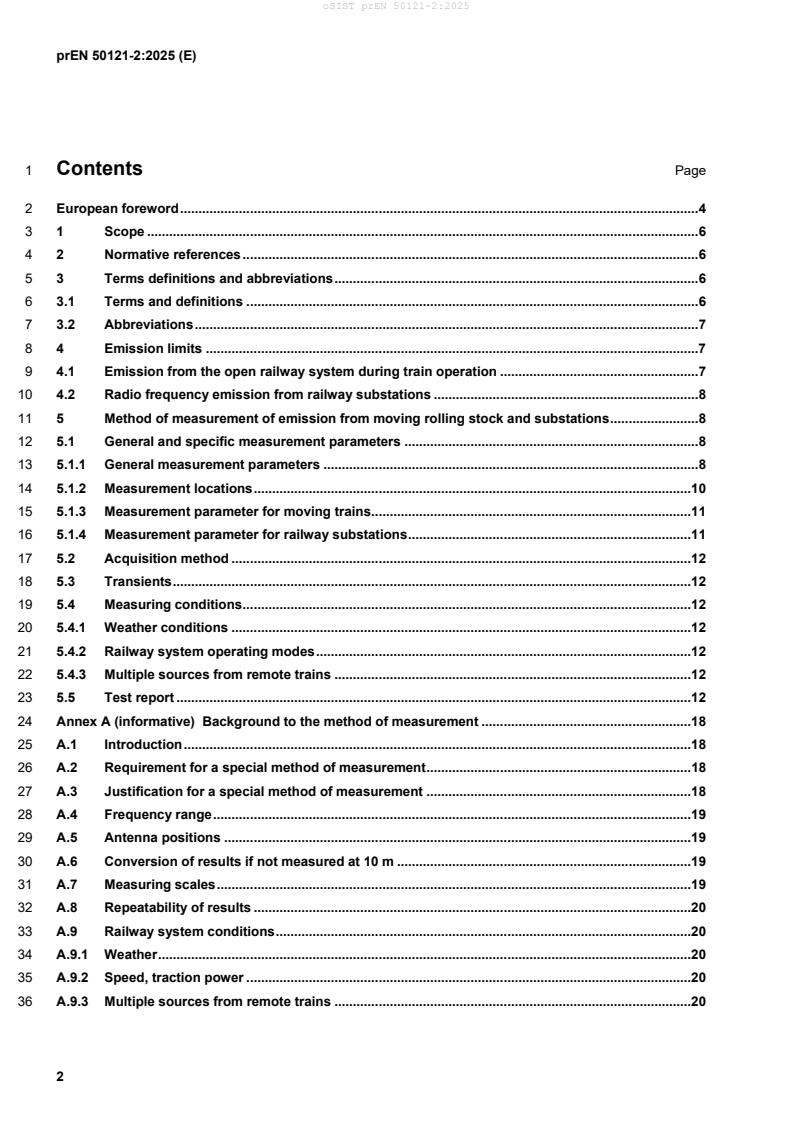
1 Contents Page
2 European foreword . 4
3 1 Scope . 6
4 2 Normative references . 6
5 3 Terms definitions and abbreviations . 6
6 3.1 Terms and definitions . 6
7 3.2 Abbreviations . 7
8 4 Emission limits . 7
9 4.1 Emission from the open railway system during train operation . 7
10 4.2 Radio frequency emission from railway substations . 8
11 5 Method of measurement of emission from moving rolling stock and substations . 8
12 5.1 General and specific measurement parameters . 8
13 5.1.1 General measurement parameters . 8
14 5.1.2 Measurement locations . 10
15 5.1.3 Measurement parameter for moving trains . 11
16 5.1.4 Measurement parameter for railway substations . 11
17 5.2 Acquisition method . 12
18 5.3 Transients . 12
19 5.4 Measuring conditions . 12
20 5.4.1 Weather conditions . 12
21 5.4.2 Railway system operating modes . 12
22 5.4.3 Multiple sources from remote trains . 12
23 5.5 Test report . 12
24 Annex A (informative) Background to the method of measurement . 18
25 A.1 Introduction . 18
26 A.2 Requirement for a special method of measurement . 18
27 A.3 Justification for a special method of measurement . 18
28 A.4 Frequency range . 19
29 A.5 Antenna positions . 19
30 A.6 Conversion of results if not measured at 10 m . 19
31 A.7 Measuring scales . 19
32 A.8 Repeatability of results . 20
33 A.9 Railway system conditions . 20
34 A.9.1 Weather . 20
35 A.9.2 Speed, traction power . 20
36 A.9.3 Multiple sources from remote trains . 20
prEN 50121-2:2025 (E)
37 A.10 Number of traction vehicles per train . 20
38 Annex B (informative) Cartography — Electric and Magnetic fields at traction frequencies . 21
39 Annex C (informative) Emission values for lower frequency range . 23
40 Bibliography . 26
prEN 50121-2:2025 (E)
42 European foreword
43 This document (prEN 50121-2:2025) has been prepared by CLC/TC 9X “Electrical and electronic applications
44 for railways”.
45 This document is currently submitted to the Enquiry.
46 The following dates are proposed:
• latest date by which the existence of this (doa) dav + 6 months
document has to be announced at national
level
• latest date by which this document has to be (dop) dav + 12 months
implemented at national level by publication of
an identical national standard or by
endorsement
• latest date by which the national standards (dow) dav + 36 months
conflicting with this document have to be (to be confirmed or
withdrawn modified when voting)
47 This document has been prepared according to Decision 69/09 taken during the TC 9X meeting.
48 This document will supersede EN 50121-2:2017.
49 prEN 50121-2:2025 includes the following significant technical change with respect to EN 50121-2:2017:
50 — clarification of scope, last paragraph;
51 — update of normative references;
52 — clarification in definition 3.1.2 and new definition 3.1.5;
53 — clarification in Clause 4.1 Emission from the open railway system during train operation;
54 — additional information included in Clause 5.1.1.4 Measurement distance and height;
55 — update of Clause 5.1.2 Measurement locations;
56 — addition of last bullet point in Clause 5.1.3 Measurement parameters for moving trains;
57 — addition of last bullet point in Clause 5.1.4 Measurement parameters for railway substations;
58 — update of Clause 5.2 Acquisition method;
59 — update of Clause 5.4.2 Railway system operating modes;
60 — update of Figures 1 and 2;
61 — addition in informative Annex A, A.5 Antenna positions;
62 — update of informative Annex A, A.10 Number of traction vehicles per train;
63 — update of informative Annex C.
64 This document is read in conjunction with prEN 50121-1:2025.
prEN 50121-2:2025 (E)
65 EN 50121, Railway applications — Electromagnetic compatibility, consists of the following parts:
66 — Part 1: General;
67 — Part 2: Emission of the whole railway system to the outside world [the present document];
68 — Part 3-1: Rolling stock — Train and complete vehicle;
69 — Part 3-2: Rolling stock — Apparatus;
70 — Part 4: Emission and immunity of the signalling and telecommunications apparatus;
71 — Part 5: Emission and immunity of fixed power supply installations and apparatus.
prEN 50121-2:2025 (E)
72 1 Scope
73 This document is intended to define the electromagnetic environment of the whole railway system including
74 urban mass transit and light rail systems. It describes the measurement method to verify the emissions and
75 gives the cartography values of the fields most frequently encountered.
76 This document specifies the emission limits of the whole railway system to the outside world.
77 The emission parameters refer to the particular measuring points defined in Clause 5.
78 Also, the zones above and below the railway system can be affected by electromagnetic emissions and
79 particular cases need to be considered individually.
80 For existing railway systems, it is assumed that compliance with the emission requirements of
81 prEN 50121-3-1:2025, prEN 50121-3-2:2025, prEN 50121-4:2025 and prEN 50121-5:2025 will ensure the
82 compliance with the emission values given in this part.
83 This document gives emission limits for newly built railway systems (not yet in operation) with different
84 characteristics (e.g. higher design speed of the line, static switching components) in comparison with existing
85 railway systems.
86 2 Normative references
87 The following documents are referred to in the text in such a way that some or all of their content constitutes
88 requirements of this document. For dated references, only the edition cited applies. For undated references, the
89 latest edition of the referenced document (including any amendments) applies.
90 EN IEC 55016-1-1:2019, Specification for radio disturbance and immunity measuring apparatus and methods -
91 Part 1-1: Radio disturbance and immunity measuring apparatus - Measuring apparatus (CISPR 16-1-1:2019)
92 EN IEC 55016-1-4:2019 , Specification for radio disturbance and immunity measuring apparatus and
93 methods — Part 1-4: Radio disturbance and immunity measuring apparatus — Antennas and test sites for
94 radiated disturbance measurements (CISPR 16-1-4:2019 + A1:2020)
95 IEC 60050-161:1990, International Electrotechnical Vocabulary — Chapter 161: Electromagnetic compatibility
96 3 Terms definitions and abbreviations
97 3.1 Terms and definitions
98 For the purposes of this document, the terms and definitions given in IEC 60050-161:1990 and the following
99 apply.
100 ISO and IEC maintain terminology databases for use in standardization at the following addresses:
101 — ISO Online browsing platform: available at https://www.iso.org/obp/
102 — IEC Electropedia: available at https://www.electropedia.org/
103 3.1.1
104 apparatus
105 device or assembly of devices which can be used as an independent unit for specific functions
106 [SOURCE: IEC 60050-151:2001, 151-11-22]
107 3.1.2
108 electromagnetic environment
109 totality of electromagnetic phenomena existing at a given location
As impacted by EN IEC 55016-1-4:2019/A1:2020 and EN IEC 55016-1-4:2019/A2:2023.
prEN 50121-2:2025 (E)
110 Source IEC 60050-161:2018; 161-01-01, modified – Note 1 to entry has been removed
111 3.1.3
112 railway substation
113 installation whose main function is to supply a contact line system at which the voltage of a primary supply
114 system, and in some cases the frequency, is transformed to the voltage and frequency of the contact line
115 3.1.4
116 rolling stock
117 all the vehicles with or without one or more motors
118 [SOURCE: IEC 60050-811:2017, 811-02-01]
119 3.1.5
120 substation boundary
121 either the fence, wall or enclosure of the substation
122 3.2 Abbreviations
123 For the purposes of this document, the following abbreviations apply.
AC Alternating Current
bw Band width
DC Direct Current
E Electric (field)
EMC Electro Magnetic Compatibility
FFT Fast Fourier Transform
H Magnetic (field)
HV High Voltage
124 4 Emission limits
125 4.1 Emission from the open railway system during train operation
126 The emission limits in the frequency range 150 kHz to 1 GHz are given in Figure 1 and the measurement method
127 is defined in Clause 5.
128 NOTE Emission values above 1 GHz are covered by measurements of apparatus as defined in EN 50121-3,
129 EN 50121-2, EN 50121-4 and EN 50121-5. This is an appropriate way to eliminate environmental disturbances that pollute
130 measurements in open air.
131 Informative Annex B gives guidance values for typical maximum field values at fundamental frequency of
132 different electrification systems which can occur. They depend on numerous geometrical and operational
133 parameters which can be obtained from the infrastructure manager.
134 It is not possible to undertake complete tests with quasi-peak detection due to the reasons stated in informative
135 Annex A.
136 Emission in the frequency range 9 kHz to 150 kHz is described with additional information in informative
137 Annex C.
138 EMC-limits and measurements as defined in this document are not applicable for underground parts of railway
139 lines.
prEN 50121-2:2025 (E)
140 4.2 Radio frequency emission from railway substations
141 Radio frequency noise emission from the railway substation to the outside environment measured according to
142 the method defined in Clause 5 shall not exceed the limits in Figure 2.
143 The limits are defined as quasi-peak values and the bandwidths are those used in EN IEC 55016-1-1:2019
Bandwidth
frequencies from 150 kHz to 30 MHz 9 kHz
frequencies above 30 MHz 120 kHz
144 The distance of 10 m defined in Clause 5 shall be measured from the boundary of the substation.
145 For other kinds of fixed installations like auto-transformers, and battery station, the same limit and measuring
146 distance shall be applied.
147 Emission in the frequency range 9 kHz to 150 kHz is described with additional information in informative
148 Annex C.
149 Conductors (overhead or underground) between the substation and the railway are part of the railway
150 installation, but because of their wide variety of positions and ampere loadings, limit values cannot be set for
151 the magnetic fields which they produce.
152 No limits are set for emissions into the active space of the underground railway due to the complexities of
153 obtaining measurements in the confined space and the lack of a precise method of relating the measured values
154 to the degree of disturbance which other apparatus would suffer.
155 EMC-limits and measurements as defined in this document are not applicable for underground parts of railway
156 substations.
157 NOTE There are cases with substation consisting of parts installed underground and parts installed above ground. In
158 such cases measurements are applicable only for the above ground parts.
159 5 Method of measurement of emission from moving rolling stock and substations
160 NOTE The method of measurement is adapted from EN 55016-2-3:2017 to a railway system with moving rolling stock
161 and substations. The background to the method of measurement of moving rolling stock is given in informative Annex A.
162 5.1 General and specific measurement parameters
163 5.1.1 General measurement parameters
164 5.1.1.1 Frequency bands
165 Frequency bands and bandwidths at –6 dB used for measurements are in accordance with
166 EN IEC 55016-1-1:2019.
167 These are:
Frequency bands: 0,15 MHz to 30 MHz 30 MHz to 300 MHz 300 MHz to 1 GHz
Bandwidth: 9 kHz 120 kHz 120 kHz
168 Other bandwidth for peak measurement can be chosen according to EN IEC 55016-1-1:2019. Data measured
169 with the reference bandwidth shall take precedence.
170 5.1.1.2 Measurement uncertainty
171 The measurement uncertainty of the used equipment shall comply with the requirements in
172 EN IEC 55016-1-1:2019 and EN IEC 55016-1-4:2019.
As impacted by EN IEC 55016-2-3:2017/A1:2019 and EN IEC 55016-2-3:2019/A2:2023.
prEN 50121-2:2025 (E)
173 5.1.1.3 Types of antennas
174 To cover the full frequency range, antennas of different design are required. Typical equipment is described
175 below:
176 — for 150 kHz to 30 MHz, a loop or frame antenna is used to measure H field (see Figure 3);
177 — for 30 MHz to 300 MHz, a biconical dipole is used to measure E field (see Figure 4);
178 — for 300 MHz to 1,0 GHz, a log-periodic antenna is used to measure E field (see Figure 5).
179 For measurements in the frequency range of 30 MHz to 1 GHz a combined antenna may be used.
180 Calibrated antenna factors are used to convert the terminal voltage of the antenna to field strength.
181 5.1.1.4 Measurement distance and height
182 The preferred distance of the measuring antenna from the centreline of the track on which the vehicle is moving
183 (Test track) is 10 m. In the case of the log-periodic antenna, the 10 m distance is measured to the mechanical
184 centre (this is also known as the “reference point of antenna calibration”) of the array.
185 The preferred distance of the measuring antenna while measuring the emission of the substation is 10 m from
186 the outer boundary of the substation, at the midpoints of the three sides, excluding the side which faces the
187 railway system, unless this side is more than 30 m from the centre of the nearest electrified railway track. In this
188 case all four sides shall be measured. If the length of the side of the substation is more than 30 m,
189 measurements shall be taken additionally in 10 m distance to the boundary at its corners.
190 Where the antennas are not at 10 m, the results can be converted to an equivalent 10 m value by using the
191 following formula:
192 E10 = Ex + n x 20 × log10 (D/10)
193 where
E is the value at 10 m;
Ex is the measured value at D m;
n is a factor taken from Table 1 below.
194 Table 1 — Conversion factor n
Frequency range n
0,15 MHz to 0,4 MHz 1,8
0,4 MHz to 1,6 MHz 1,65
1,6 MHz to 110 MHz 1,2
110 MHz to 1 000 MHz 1,0
195 The measured values (at the equivalent 10 m distance) shall not exceed the limits given in Figure 1 for the
196 appropriate system voltage.
197 The height above reference level of the antenna centre shall be within the range 1,0 m to 2,0 m for the loop
198 antenna, and within 2,5 m to 3,5 m to the centre of measuring antenna above 30 MHz. One measuring height
199 within the given range is sufficient and it is not required to do measurements with several antenna heights within
200 this range. The selected height shall be noted in the test report.
201 The reference level for the substation is the ground.
202 The reference level for moving trains is the top of the rail.
203 If the actual level of the ground at the antenna differs from the top of the rail by more than 0,5 m, the actual
204 value shall be noted in the test report.
prEN 50121-2:2025 (E)
205 It is accepted that the fixed antenna position can result in values being less than the absolute maximum at some
206 frequencies.
207 5.1.1.5 Values of measurement
208 The values measured are expressed as:
209 — dBµA/m for magnetic fields,
210 — dBµV/m for electric fields.
211 These are obtained by using the appropriate antenna factors and conversions.
212 5.1.1.6 Antenna position and orientation
213 The plane of the loop antenna shall be positioned to measure the horizontal component of the magnetic field
214 perpendicular to the track respectively to the boundary of the substation. The biconical dipole shall be placed in
215 the vertical and horizontal axis. The log periodic antenna shall be arranged to measure the vertical and
216 horizontal polarization signal, with the antenna directed towards the track respectively to the boundary of the
217 substation.
218 The test locations should whenever possible avoid objects with changing of field characteristic like turnouts,
219 walls, fences and under bridges.
220 Figures 3, 4 and 5 show the positions and vertical alignments of the antennas as an example for measurements
221 at the track.
222 5.1.1.7 Ambient noise
223 At the beginning and at the end of the test series the ambient noise shall be recorded.
224 If at specific frequencies or in specific frequency ranges the ambient noise is higher than the limit values less
225 6 dB, the measurements at these frequencies need not be considered. These frequencies shall be noted in the
226 test report.
227 5.1.2 Measurement locations
228 5.1.2.1 General
229 To draw a conclusion on the compliance at the line level, substation level, or the entire system, it is necessary
230 to carry out measurements at a representative sample of locations / configurations. These locations /
231 configurations shall meet the following conditions.
232 5.1.2.2 Measurement locations along the line
233 1) Measurement parameters for moving trains (see 5.1.3) and the operating modes indicated in chapter (see
234 5.4.2) shall be achievable at the selected measurement location.
235 2) A measurement location shall be selected for each power supply mode, such as overhead catenary or third
236 rail. Areas where the train is temporarily powered by a cable connection do not apply.
237 5.1.2.3 Measurement locations for substations
238 1) The chosen substations for measurements shall cover all different technologies in the system.
239 Special cases shall be treated in the EMC Plan.
240 2) Among each type of selected substations, those with the highest rated power shall be measured.
241 3) In case of multiple identical substations, the one with the most accessible sides shall be measured.
242 NOTE The wide variety of positions of the conductors (overhead or underground) between the substation and the
243 railway does not constitute a reason to consider additional tests.
prEN 50121-2:2025 (E)
244 5.1.3 Measurement parameter for moving trains
245 This subclause summarizes the specific conditions for the measurement of moving rolling stock.
246 — It is not considered necessary to carry out two tests to examine both sides of the rolling stock, even if it
247 contains different apparatus on the two sides, as in the majority of cases the level of fields is due to the
248 radiation of catenary and not to the direct radiation from the train. For systems with a third rail,
249 measurements shall be performed at the same side of it.
250 — The peak measurement method is used. The duration at selected frequency shall be sufficient to obtain
...