

SIST EN 18037:2025
(Main)Guidelines on a sectoral cybersecurity assessment
General Information
- Abstract
This document contains guidelines to be used in the process of drafting requirements of cybersecurity certification schemes for sectoral ICT services and systems. It includes all steps necessary to define, implement and maintain such requirements.
- Status
- Published
- Public Enquiry End Date
- 15-Feb-2024
- Publication Date
- 12-May-2025
- Technical Committee
- ITC - Information technology
- Current Stage
- 6060 - National Implementation/Publication (Adopted Project)
- Start Date
- 17-Apr-2025
- Due Date
- 22-Jun-2025
- Completion Date
- 13-May-2025

Overview
EN 18037:2025 - "Guidelines on a sectoral cybersecurity assessment" (CEN) defines a risk‑based methodology to draft and maintain cybersecurity and assurance requirements for sectoral ICT systems, services and products. It focuses on multi‑stakeholder market sectors (e.g., mobile networks, e‑health, digital identity, public transport, payments) and provides the workflow and concepts needed to create coherent cybersecurity certification schemes that align sectoral risk with appropriate security controls and assurance levels.
Key topics and technical requirements
- Sectoral risk assessment methodology: stepwise process to identify business processes, stakeholder roles, primary/supporting assets, risk scenarios, consequences and likelihood.
- Multi‑layered sectoral ICT architecture: guidance to map components, relationships and intended use across stakeholder‑operated systems.
- Cyberthreat intelligence (CTI) integration: use CTI to identify attacker types, motivations and capabilities to prioritize scenarios and estimate likelihood.
- Attack potential & meta‑risk classes: incorporate attacker capability (attack potential) into risk treatment and selection of controls.
- Common Security Levels (CSL) and consistency: define normalized security and assurance reference levels to enable consistent controls across certification schemes and re‑use of certificates.
- Assurance mapping: references to ISO/IEC 15408 concepts and mechanisms to harmonize assurance requirements and support multiple certification approaches.
- Risk transfer between frameworks: practical guidance for aligning ISO/IEC 27005‑style sectoral risk assessments with ISO/IEC 15408‑based certification needs.
- Lifecycle support: includes steps to define, implement and maintain scheme requirements and to enable inter‑scheme information exchange.
Practical applications
- Drafting sectoral cybersecurity certification schemes for ICT products, processes and services.
- Harmonizing assurance and security requirements across competing stakeholders within a sector to build trust and enable certificate re‑use.
- Prioritizing security investments by linking business objectives and attacker scenarios to concrete control and assurance levels.
- Supporting regulators, coordinating entities and standardization bodies in defining market‑oriented certification approaches.
Who should use this standard
- Regulators and coordinating entities drafting sectoral rules or certification schemes.
- Standards and certification scheme developers designing assurance levels and control baselines.
- Security architects and risk managers in sectoral stakeholders (operators, vendors, service providers).
- Conformity assessment bodies and auditors mapping evaluation criteria to sectoral risk.
- National standards organizations implementing the European standard.
Related standards
- ISO/IEC 27005 (risk management guidance)
- ISO/IEC 15408 / Common Criteria (assurance concepts)
- Relevant EU legal frameworks (e.g., Cyber Resilience Act) - consider regulatory alignment when applying EN 18037.
Keywords: sectoral cybersecurity assessment, cybersecurity certification schemes, Common Security Levels, attack potential, sectoral ICT systems, ISO/IEC 15408, ISO/IEC 27005, cyberthreat intelligence, assurance levels, risk‑based.
Relations
- Effective Date
- 28-Jan-2026
- Effective Date
- 28-Jan-2026
- Effective Date
- 28-Jan-2026
- Effective Date
- 28-Jan-2026
- Effective Date
- 28-Jan-2026
- Effective Date
- 28-Jan-2026
- Effective Date
- 28-Jan-2026
- Effective Date
- 28-Jan-2026
- Effective Date
- 28-Jan-2026
- Effective Date
- 28-Jan-2026
Get Certified
Connect with accredited certification bodies for this standard

BSI Group
BSI (British Standards Institution) is the business standards company that helps organizations make excellence a habit.

Bureau Veritas
Bureau Veritas is a world leader in laboratory testing, inspection and certification services.

DNV
DNV is an independent assurance and risk management provider.
Sponsored listings
Frequently Asked Questions
SIST EN 18037:2025 is a standard published by the Slovenian Institute for Standardization (SIST). Its full title is "Guidelines on a sectoral cybersecurity assessment". This standard covers: This document contains guidelines to be used in the process of drafting requirements of cybersecurity certification schemes for sectoral ICT services and systems. It includes all steps necessary to define, implement and maintain such requirements.
This document contains guidelines to be used in the process of drafting requirements of cybersecurity certification schemes for sectoral ICT services and systems. It includes all steps necessary to define, implement and maintain such requirements.
SIST EN 18037:2025 is classified under the following ICS (International Classification for Standards) categories: 35.030 - IT Security. The ICS classification helps identify the subject area and facilitates finding related standards.
SIST EN 18037:2025 has the following relationships with other standards: It is inter standard links to SIST EN ISO 11642:2026, SIST EN ISO 23537-2:2023, SIST EN ISO 25649-1:2025, SIST EN ISO 20701:2024, SIST EN ISO 15701:2022, SIST EN ISO 20433:2024, SIST EN ISO 11641:2026, SIST EN ISO 7979:2025, SIST EN ISO 105-C12:2024, SIST EN ISO 25089:2025. Understanding these relationships helps ensure you are using the most current and applicable version of the standard.
SIST EN 18037:2025 is associated with the following European legislation: EU Directives/Regulations: 2019/881. When a standard is cited in the Official Journal of the European Union, products manufactured in conformity with it benefit from a presumption of conformity with the essential requirements of the corresponding EU directive or regulation.
SIST EN 18037:2025 is available in PDF format for immediate download after purchase. The document can be added to your cart and obtained through the secure checkout process. Digital delivery ensures instant access to the complete standard document.
Standards Content (Sample)
SLOVENSKI STANDARD
01-junij-2025
Smernice za sektorsko oceno kibernetske varnosti
Guidelines on a sectoral cybersecurity assessment
Leitlinien für ein sektorales Cybersecurity Assessment
Lignes directrices pour l'appréciation sectorielle de la cybersécurité
Ta slovenski standard je istoveten z: EN 18037:2025
ICS:
35.030 Informacijska varnost IT Security
2003-01.Slovenski inštitut za standardizacijo. Razmnoževanje celote ali delov tega standarda ni dovoljeno.
EUROPEAN STANDARD EN 18037
NORME EUROPÉENNE
EUROPÄISCHE NORM
March 2025
ICS 35.030
English version
Guidelines on a sectoral cybersecurity assessment
Lignes directrices pour l'appréciation sectorielle de la Leitlinien für ein sektorales Cybersecurity Assessment
cybersécurité
This European Standard was approved by CEN on 15 December 2024.
CEN and CENELEC members are bound to comply with the CEN/CENELEC Internal Regulations which stipulate the conditions for
giving this European Standard the status of a national standard without any alteration. Up-to-date lists and bibliographical
references concerning such national standards may be obtained on application to the CEN-CENELEC Management Centre or to
any CEN and CENELEC member.
This European Standard exists in three official versions (English, French, German). A version in any other language made by
translation under the responsibility of a CEN and CENELEC member into its own language and notified to the CEN-CENELEC
Management Centre has the same status as the official versions.
CEN and CENELEC members are the national standards bodies and national electrotechnical committees of Austria, Belgium,
Bulgaria, Croatia, Cyprus, Czech Republic, Denmark, Estonia, Finland, France, Germany, Greece, Hungary, Iceland, Ireland, Italy,
Latvia, Lithuania, Luxembourg, Malta, Netherlands, Norway, Poland, Portugal, Republic of North Macedonia, Romania, Serbia,
Slovakia, Slovenia, Spain, Sweden, Switzerland, Türkiye and United Kingdom.
CEN-CENELEC Management Centre:
Rue de la Science 23, B-1040 Brussels
© 2025 CEN/CENELEC All rights of exploitation in any form and by any means
Ref. No. EN 18037:2025 E
reserved worldwide for CEN national Members and for
CENELEC Members.
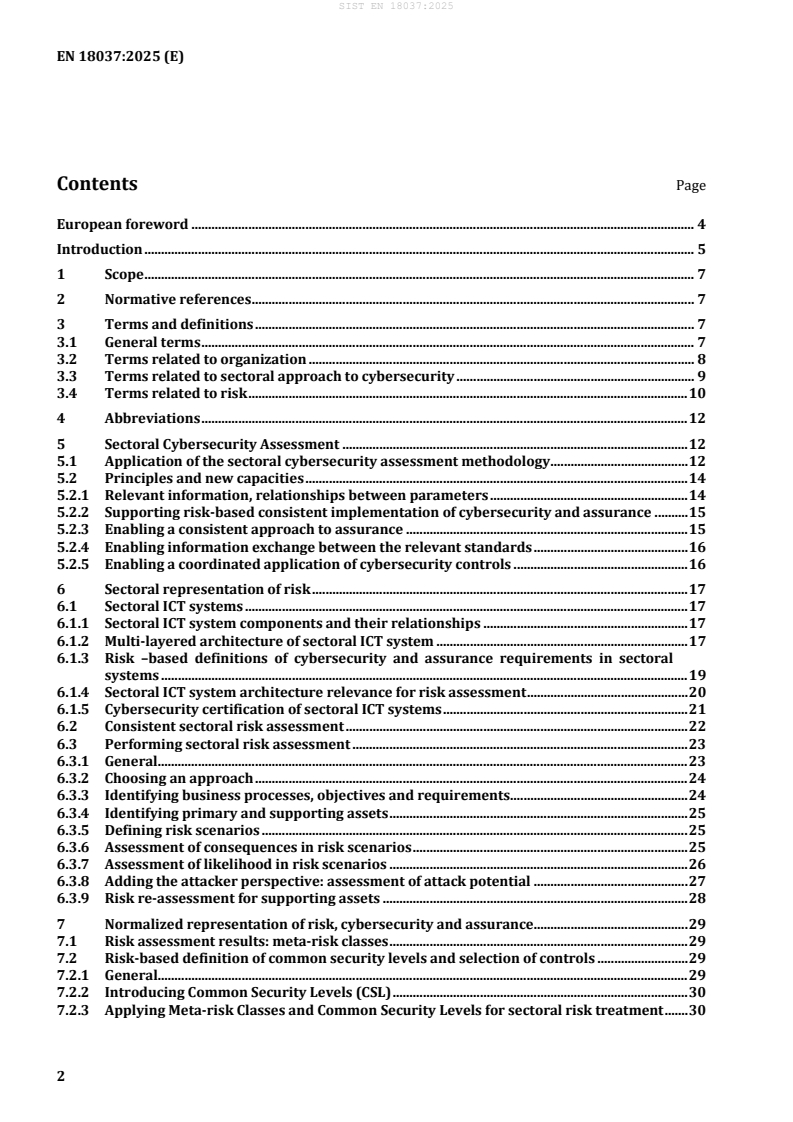
Contents Page
European foreword . 4
Introduction . 5
1 Scope . 7
2 Normative references . 7
3 Terms and definitions . 7
3.1 General terms . 7
3.2 Terms related to organization . 8
3.3 Terms related to sectoral approach to cybersecurity . 9
3.4 Terms related to risk . 10
4 Abbreviations . 12
5 Sectoral Cybersecurity Assessment . 12
5.1 Application of the sectoral cybersecurity assessment methodology . 12
5.2 Principles and new capacities . 14
5.2.1 Relevant information, relationships between parameters . 14
5.2.2 Supporting risk-based consistent implementation of cybersecurity and assurance . 15
5.2.3 Enabling a consistent approach to assurance . 15
5.2.4 Enabling information exchange between the relevant standards . 16
5.2.5 Enabling a coordinated application of cybersecurity controls . 16
6 Sectoral representation of risk . 17
6.1 Sectoral ICT systems . 17
6.1.1 Sectoral ICT system components and their relationships . 17
6.1.2 Multi-layered architecture of sectoral ICT system . 17
6.1.3 Risk –based definitions of cybersecurity and assurance requirements in sectoral
systems . 19
6.1.4 Sectoral ICT system architecture relevance for risk assessment . 20
6.1.5 Cybersecurity certification of sectoral ICT systems . 21
6.2 Consistent sectoral risk assessment . 22
6.3 Performing sectoral risk assessment . 23
6.3.1 General. 23
6.3.2 Choosing an approach . 24
6.3.3 Identifying business processes, objectives and requirements. 24
6.3.4 Identifying primary and supporting assets . 25
6.3.5 Defining risk scenarios . 25
6.3.6 Assessment of consequences in risk scenarios . 25
6.3.7 Assessment of likelihood in risk scenarios . 26
6.3.8 Adding the attacker perspective: assessment of attack potential . 27
6.3.9 Risk re-assessment for supporting assets . 28
7 Normalized representation of risk, cybersecurity and assurance . 29
7.1 Risk assessment results: meta-risk classes . 29
7.2 Risk-based definition of common security levels and selection of controls . 29
7.2.1 General. 29
7.2.2 Introducing Common Security Levels (CSL) . 30
7.2.3 Applying Meta-risk Classes and Common Security Levels for sectoral risk treatment . 30
7.2.4 Attack Potential as criterion for selecting the CSL of controls . 30
Consistent implementation of assurance . 31
7.2.5 General . 31
7.2.6 Definition of a common assurance reference concept based on ISO/IEC 15408-3 . 31
7.2.7 Applying CTI concept of attack potential to CAR . 32
8 Mapping cybersecurity and assurance requirements to scheme’s representation . 33
Annex A (informative) Examples of normalized scales in sectoral risk assessment . 34
Annex B (informative) CTI fundamentals . 38
Annex C (informative) Application of Common Security Level approach - examples . 60
Annex D (informative) Example of assurance level mapping . 64
Bibliography . 65
European foreword
This document (EN 18037:2025) has been prepared by Technical Committee CEN/CLC/JTC 13
“Cybersecurity and Data Protection”, the secretariat of which is held by DIN.
This European Standard shall be given the status of a national standard, either by publication of an
identical text or by endorsement, at the latest by September 2025, and conflicting national standards
shall be withdrawn at the latest by September 2025.
Attention is drawn to the possibility that some of the elements of this document may be the subject of
patent rights. CEN shall not be held responsible for identifying any or all such patent rights.
Any feedback and questions on this document should be directed to the users’ national standards body.
A complete listing of these bodies can be found on the CEN website.
According to the CEN-CENELEC Internal Regulations, the national standards organisations of the
following countries are bound to implement this European Standard: Austria, Belgium, Bulgaria,
Croatia, Cyprus, Czech Republic, Denmark, Estonia, Finland, France, Germany, Greece, Hungary, Iceland,
Ireland, Italy, Latvia, Lithuania, Luxembourg, Malta, Netherlands, Norway, Poland, Portugal, Republic of
North Macedonia, Romania, Serbia, Slovakia, Slovenia, Spain, Sweden, Switzerland, Türkiye and the
United Kingdom.
Introduction
This document specifies cybersecurity assessments at the level of a market sector or an application
area. It is designed to be used as a preparatory step for the drafting of cybersecurity certification
schemes for ICT products, and ICT processes and ICT systems used by a market sector for providing
sectoral services to the end users or business customer thus creating sectoral ICT systems.
Sectoral ICT systems can be found in application areas such as mobile networks, digital identity, e-
health, public transportation, or payment.
Sectoral ICT systems can involve very large numbers of stakeholder organizations from the same
market sector which cooperate in specified roles for provisioning the sectoral services. In certain roles,
like Mobile Network Operators or Public Transport Service Providers, the stakeholder organizations are
potentially competing.
The stakeholder organizations participating in a sectoral ICT system act according to rules which are
typically specified by a “coordinating entity” or a regulator and operate the ICT systems or products
under their control as functional components of the sectoral ICT system.
Cybersecurity and assurance are not only relevant from the perspective of the customers of sectoral
services. In the sectoral ICT system, a clear and consistent definition of cybersecurity and assurance
requirements in relation to the stakeholder role is important to establish trust among the sectoral
stakeholder organizations. Since ICT security deficiencies caused by one stakeholder can lead to risks
for other stakeholder's business objectives.
As with any ICT system that is intended to meet elevated cybersecurity and assurance requirements,
the sectoral stakeholder organizations need to find an appropriate balance between the need for
cybersecurity and assurance and the cost of its implementation. When it comes to the definition of
cybersecurity and certification requirements to the sectoral ICT system, it is intended to be supported
by the identification of the risks for the stakeholder’s business objectives and the attack potential of the
relevant attacker types associated with the intended use.
A sectoral ICT system supports numerous sectoral business processes and stakeholder business
objectives which can be subject to cybersecurity risks. It can also involve a wide range of stakeholder-
operated ICT systems, products and processes which usually need different evaluation and certification
approaches for the validation of the implementation of security and assurance requirements. For
trusted sectoral services, trust between sectoral stakeholders is essential. This applies also for re-using
certificates. Certified components require a definition of assurance and security that provides
consistency. For this the specification of requirements and the definition of risk levels for evaluation
and certification is the basis.
The sectoral cybersecurity assessment methodology supports the aspects and requirements by the
following features:
— The sectoral cybersecurity assessment will provide information about the business processes to be
supported by the sectoral ICT system, the related business objectives of the sectoral stakeholders. It
also identifies the primary and supporting assets which are critical for the secure implementation of
the business processes (see 5. 2 and 6.3.3).
— The stakeholder-operated ICT systems, products or processes which are relevant for the security of
the primary assets are identified. A ‘deep dive’ into the sectoral ICT system’s architecture provides
detailed information about their intended use (see 6.1).
— Cyberthreat intelligence (CTI) information is used to collect information on potentially relevant
attacker types, their motivation, and capabilities. CTI allows to prioritize those risk scenarios, which
are most relevant to be considered for further analysis. This allows the most effective use of
resources during the analysis and contributes to the information needed to assign cybersecurity
and assurance requirements to ICT systems, ICT products or ICT services, based on the risk of
intended use (see 6.3.8 and Annex B).
— Cybersecurity risks are identified and assessed based on consequences of cybersecurity incidents
on the sectoral stakeholder’s business objectives and likelihood that such incident will occur (see
6.3.6 and 6.3.7, respectively). The estimation of likelihood is derived from the potential motivation
of those attacker types who are capable to conduct attacks on the identified assets.
— The methodology offers a concept of internal risk, security, assurance, and attack potential
reference levels (see Clause 7). If commonly used, they will support consistency in the definition of
risk, cybersecurity, and assurance. The methodology provides the option to integrate sectoral,
product, process and potentially also ISMS-based cybersecurity certification schemes and it can
support and integrate ICT product certification schemes, beyond Common Criteria or other ISO/IEC
15408 series based schemes.
— The risk information obtained by an ISO/IEC 27005-conformant approach at sectoral level can be
transferred to ISO/IEC 15408 series based environments. By applying two different standards the
risk-based definition of cybersecurity and assurance requirements can be supported (see 5.2 and
Clause 8).
Based on these properties and functions, the sectoral stakeholders benefit in the following ways:
— The methodology supports the identification of risk associated with the intended use of ICT
systems, ICT services and ICT processes at any level of the sectoral ICT system architecture. The
sectoral stakeholder organizations can balance their view of risks against the investment needed to
mitigate these risks by introducing appropriate levels of security and assurance. It can be expected
that this transparent, cooperative approach will contribute significantly to the market acceptance
for these requirements and the cybersecurity certification schemes developed on this basis.
— Consistency in the implementation of assurance levels can be achieved across schemes. This will
allow the re-use of certificates issued by one scheme in other schemes, thus providing an important
benefit both to the business interests of product and infrastructure service providers and to their
customers. At the same time, the methodology’s approach to consistency is also flexible enough to
support the integration of new types of cybersecurity certification schemes, which can emerge
because of specific requirements from different markets.
— Introducing a common concept for security levels facilitates the definition of controls which can be
commonly used across cybersecurity certification schemes.
In summary, the proposed methodology does not only support the workflow of drafting market-
oriented cybersecurity certification schemes but offers also a potential for a broader use by sectors and
providers of infrastructure.
However legal and regulatory aspects should be considered when applying the sectoral cybersecurity
assessment methodology. These include:
— if used as a preparatory step for cybersecurity certification scheme drafting, the methodology
should consider the existing EU and national frameworks on the targeted market sector and on
cybersecurity certification;
— compliance with applicable legal obligations such as the Cyber Resilience Act.
The specification of evaluation or certification, assurance levels and security measures as means for risk
mitigation may have to follow national or sectoral provisions.
1 Scope
This document specifies an approach that supports the risk-based identification of cybersecurity,
certification and assurance requirements to ICT products, processes and services for complex multi-
stakeholder sectoral systems.
The sectoral cybersecurity assessment process includes all steps necessary to specify, implement and
maintain such requirements.
Process performance or quality measurement are out of the scope of this document.
2 Normative references
There are no normative references in this document.
3 Terms and definitions
For the purposes of this document, the following terms and definitions apply.
ISO and IEC maintain terminology databases for use in standardization at the following addresses:
— ISO Online browsing platform: available at https://www.iso.org/obp/
— IEC Electropedia: available at https://www.electropedia.org/
3.1 General terms
3.1.1
information security
preservation of confidentiality, integrity and availability of information
[SOURCE: EN ISO/IEC 27000:2018, 3.28]
3.1.2
cybersecurity
activities necessary to protect network and information systems, the users of such systems, and other
persons affected by cyber threat (3.4.5)
Note 1 to entry: ISO/IEC TS 27100:2020, 3.2 refers to ‘cybersecurity’ as safeguarding of people, society,
organizations and nations from cyber risks (3.4.1)
Note 2 to entry: Safeguarding means to keep cyber risks (3.4.1) at a tolerable level.
[SOURCE: [8], art. 2(1)]
3.1.3
assurance level
basis for confidence that an ICT product (3.3.4), ICT service (3.3.5) or ICT process (3.3.6) meets the
cybersecurity (3.1.2) requirements (3.2.5)
Note 1 to entry: Cybersecurity (3.1.2) requirements (3.2.5) can be established in a cybersecurity certification
scheme.
Note 2 to entry: An assurance level indicates the level at which an ICT product (3.3.4), ICT service (3.3.5) or ICT
process (3.3.6) has been evaluated.
Note 3 to entry: Assurance levels do not measure the cybersecurity of the ICT product (3.3.4), ICT service (3.3.5) or
ICT process (3.3.6) concerned (cf. [8], article 2.22).
Note 4 to entry: This document uses the relationship between assurance levels and the resistance of the target of
evaluation against certain levels of attack potential (3.4.9) as defined in ISO/IEC 15408-3 as one parameter for
consistent assurance level implementation across cybersecurity certification schemes, and for the identification of
assurance level capacities of existing schemes.
3.2 Terms related to organization
3.2.1
organization
person or group of people that has its own functions with responsibilities, authorities and relationships
to achieve its objectives (3.2.2)
Note 1 to entry: The concept of organization includes but is not limited to sole-trader, company, corporation, firm,
enterprise, authority, partnership, charity or institution, or part or combination thereof, whether incorporated or
not, public or private.
[SOURCE: EN ISO/IEC 27000:2018, 3.50]
3.2.2
objective
result to be achieved
Note 1 to entry: An objective can be strategic, tactical, or operational.
Note 2 to entry: Objectives can relate to different disciplines (such as financial, health and safety, and
environmental goals) and can apply at different levels (such as strategic, organization-wide, project, product and
process).
[SOURCE: EN ISO/IEC 27000:2018, 3.49, modified – Note 3 and Note 4 deleted]
3.2.3
policy
intentions and direction of an organization (3.2.1) as formally expressed by its top management
[SOURCE: EN ISO/IEC 27000:2018, 3.53]
3.2.4
process
set of interrelated or interacting activities which transforms inputs into outputs
[SOURCE: EN ISO/IEC 27000:2018, 3.54]
3.2.5
requirement
need or expectation that is stated, generally implied or obligatory
Note 1 to entry: “Generally implied” means that it is custom or common practice for the organization (3.2.1) and
interested parties that the need or expectation under consideration is implied.
Note 2 to entry: ISO/IEC 15408 series uses ‘requirement’ with direct relation to ‘security objectives’.
[SOURCE: EN ISO/IEC 27000:2018, 3.56, modified – Note 2 to entry deleted, new Note 2 to entry added]
3.3 Terms related to sectoral approach to cybersecurity
3.3.1
sector
market sector
area in which business processes and use cases can be implemented under largely the same boundary
conditions
Note 1 to entry: ‘Market sector ‘’and ‘application area’ can be used synonymously.
Note 2 to entry: Boundary conditions include the types of relevant stakeholders and customers, the services to be
supported, and legal and commercial aspects.
3.3.2
sectoral ICT system
system that includes ICT products (3.3.4) and ICT processes (3.3.5), as required for the provision of the
services to the users of a particular market sector
Note 1 to entry: Sectoral ICT systems can rely on ICT infrastructure services for specific functions.
Note 2 to entry: Whenever cybersecurity-relevant functions of a sectoral ICT system depend on external
ICT services, these are regarded as ICT infrastructure services.
Note 3 to entry: Sectoral ICT systems can be operated by different stakeholders.
3.3.3
sectoral ICT system architecture
specification of coordinated use of several sectoral ICT systems (3.3.2), ICT products (3.3.4),
ICT processes (3.3.5) and ICT services (3.3.6) that enable the implementation and operation of the
sector's services.
3.3.4
ICT product
element or a group of elements of a network or information system
[SOURCE: [8], art. 2(12)]
3.3.5
ICT process
set of activities performed to design, develop, deliver or maintain an ICT product (3.3.4) or ICT service
(3.3.6)
[SOURCE: [8], art. 2(14)]
3.3.6
ICT service
service consisting fully or mainly in the transmission, storing, retrieving or processing of information by
means of network and information systems
[SOURCE: [8], art. 2(13)]
3.4 Terms related to risk
3.4.1
risk
effect of uncertainty on objectives (3.2.2)
Note 1 to entry: An effect is a deviation from the expected — positive or negative.
Note 2 to entry: Objectives (3.2.2) can have different aspects and categories and can be applied at different levels.
Note 3 to entry: Uncertainty is the state, even partial, of deficiency of information related to, understanding or
knowledge of, an event, its consequence, or likelihood.
Note 4 to entry: Risk is usually expressed in terms of risk sources, potential events, their consequences, and their
likelihood.
Note 5 to entry: In the context of information security management systems, information security (3.1.1) risks can
be expressed as effect of uncertainty on information security (3.1.1) objectives (3.2.2).
Note 6 to entry: Information security (3.1.1) risks are always associated with a negative effect of uncertainty on
information security objectives.
Note 7 to entry: Information security (3.1.1) risk can be associated with the potential that threats (3.4.5) will
exploit vulnerabilities (3.4.6) of an information asset (3.4.2) or group of information assets (3.4.2) and thereby
cause harm to the sectoral stakeholders and the sectoral clients.
[SOURCE: ISO 31000:2018, 3.1, modified ─ by omitting “It can be positive, negative or both, and can
address, create or result in opportunities and threats” in Note 1, and adding Notes 3, 5, 6 and 7]
3.4.2
asset
anything that has value to the organization (3.2.1)
Note to entry 1: Two kinds of information security (3.1.1) related assets can be distinguished:
— the primary assets:
— business processes & activities;
— information;
— the supporting assets (on which the primary assets rely) of all types:
— software;
— network;
— personnel;
— site;
— organization’s structure.
[SOURCE: ISO/IEC 27002:2022, 3.1.2]
3.4.3
information security event
occurrence indicating a possible information security (3.1.1) breach or failure of controls (3.4.11)
[SOURCE: ISO/IEC 27002:2022, 3.1.14]
3.4.4
information security incident
one or multiple related and identified information security events (3.4.3) that can harm an organization’s
(3.2.1) assets (3.4.2) or compromise its operation
[SOURCE: EN ISO/IEC 27035-1:2016, 3.4]
3.4.5
threat
potential cause of an information security incident (3.4.4), which may result in harm to a system or
organization (3.2.1)
[SOURCE: ISO/IEC 27005:2022, 3.1.9]
3.4.6
vulnerability
weakness of an asset (3.4.2) or control (3.4.11) that can be exploited by one or more threats (3.4.5)
[SOURCE: ISO/IEC 27000:2018, 3.77]
3.4.7
risk scenario
description of potential events or incidents that could have a negative impact on one or more business
objectives (3.2.2)
Note 1 to entry: Risk scenarios are considered as having the potential to impact the business process and their
associated business requirements (3.2.5) that are needed to support core business operations.
3.4.8
attacker
actor that potentially uses a weakness or otherwise exploit threats (3.4.5)
Note 1 to entry: Terms ‘attacker’, ‘attacker’ and ‘threat agent’ are used as synonyms that mean factors of risk
(3.4.1) i.e. deliberate threat (3.4.5) sources.
3.4.9
attack potential
measure of the effort needed to exploit a vulnerability (3.4.6) in a target
[SOURCE: ISO/IEC 15408-1:2022, 3.8, modified – “TOE” has been replaced with “target”]
Note 1 to entry: According to CTI, the attack potential is characterized by means, opportunities and motives of the
attacker.
3.4.10
cybersecurity objective
high-level cybersecurity (3.1.2) requirement (3.2.5)
Note 1 to entry: ISO/IEC 15408-1 defines the term in its technical meaning as “statement of an intent to counter
identified threats (3.4.5) and/or satisfy identified organization security policies and/or assumptions”.
3.4.11
control
measure that is modifying risk (3.4.1)
Note 1 to entry: Controls include any process (3.2.4), policy (3.2.3), device, practice, or other actions which modify
risk (3.4.1).
[SOURCE: EN ISO/IEC 27000:2018, 3.14, modified – Note 2 has been removed]
4 Abbreviations
APL Attack potential level
AVA_VAN Assurance family defined by ISO/IEC 15408-3 that addresses the vulnerability analysis
CAR Common Assurance Reference
CSL Common security level
CTI Cyberthreat intelligence
EAL Evaluation assurance level
ICT Information and communication technology
IoT Internet of Things
ISMS Information security management system, defined in [3]
MRC Meta-risk class
SIM Subscriber Identification Module
5 Sectoral Cybersecurity Assessment
5.1 Application of the sectoral cybersecurity assessment methodology
The application of the sectoral cybersecurity assessment entails the following tasks.
The first phase focuses on understanding and documenting the sectoral context as starting point for an
ISO/IEC 27005-conformant risks assessment and the following steps of the methodology.
It encompasses a description of the targeted sectoral services to end or business customers, the
business processes required for provisioning of these services and a description of the functional
architecture. On this basis primary assets, information and functional assets which are critical for the
business processes, and supporting assets, ICT components which support and protect information and
functional assets, can be identified.
Based on the documentation of the sectoral contexts, risks to the stakeholder organization’s business
objectives which may occur in case of information security incidents in relation to integrity, availability
or confidentiality of primary assets are identified and analysed. Sectoral characteristics of threats, and
in particular, description of attacks and attacker types (cyberthreat intelligence, CTI, see Annex B) that
include an estimation of the attack potential level and attackers’ motivation, are used in this analysis.
Phase two consists of sequential assessments.
First, by the primary asset assessment, a rating of the risk information documented in the context is
conducted by using a normalised representation (meta-risk classes, MRC, see 7.1). This assessment
identifies the MRC for risks to sectoral business processes and the stakeholder organization’s business
objectives that may occur as result of incidents that affect the ICT security of primary assets.
On this basis the second assessment, the supporting asset assessment, can be carried out to support the
treatment of the identified and rated risks. It specifies requirements to cybersecurity and assurance per
supporting assets, i.e. ICT products, processes or stakeholder organization’s ICT systems. This relates to
the identification of common security levels (CSL, see 7.2.2) and common assurance reference (CAR, see
7.2.7).
The third phase is used to map the cybersecurity and assurance level requirements identified by the
sectoral cybersecurity assessment to the representation of assurance levels, cybersecurity objectives
and cybersecurity levels of the scheme that is planned for cybersecurity certification.
Figure 1 presents the outline of sectoral cybersecurity assessment.
Figure 1 — Sectoral Cybersecurity Assessment
As illustrated in Figure 1 the phases of the sectoral cybersecurity assessment process are not sequential
but interdependent. Some activities described in this document can contribute to more than one phase.
Motives that constitute one of the attack potential characteristics should be used to estimate the
likelihood of an incident based on the attacker’s level of motivation in Phase 1 (see 6.3.8) while two
other characteristics i.e., opportunities and means should be considered to determine the CSL (see
7.2.3) and the CAR level (see 7.2.7) in phase two.
5.2 Principles and new capacities
5.2.1 Relevant information, relationships between parameters
The sectoral cybersecurity assessment requires a sound and detailed documentation of the sectoral
context. On this basis, it generates information on risks related to ICT security incidents which are then,
together with other parameters like APL, used to determine appropriate cybersecurity and assurance
requirements to the critical supporting assets.
A special aspect of the methodology is that the assessment is carried out in two subsequent steps.
The primary asset assessment activities follow the risk management standard ISO/IEC 27005. It
determines risks to the stakeholder’s business objectives arising from potential cybersecurity incidents
in relation to primary information or functional assets. The second assessment step focusses on
supporting assets, i.e. ICT system components that the primary assets rely on. This assessment supports
the distinction between supporting asset that are critical for the ICT security of the primary assets and
merit dedicated cybersecurity and assurance measures and those where this is not necessary. Critical
supporting assets go through another loop of risk rating which considers the intended use, operational
environment, and the relevant attack potential before assigning appropriate security and assurance
requirements for risk treatment.
The supporting asset assessment step can also be used for optimizing the sectoral ICT system’s security
architecture, for instance as guidance if the goal is to concentrate security-relevant functions in specific
components like secure elements or high security modules.
Figure 2 provides an overview on information needed, then used and information generated by the
sectoral cybersecurity assessment.
Figure 2 — Overview on information used and generated by the sectoral cybersecurity
assessment
5.2.2 Supporting risk-based consistent implementation of cybersecurity and assurance
The definition of cybersecurity and assurance requirements is based on risk. Second, cyberthreat
intelligence (CTI) is applied to allow the input of information about attacker types and their motivation,
means and opportunities to attack targeted ICT products, ICT processes and ICT services.
This leads to the critical features of the approach i.e.:
— “attack potential levels” (APL) which rate the motivation, means and opportunities of attackers;
— “meta-risk classes” (MRC), to allow a common approach to risk assessment;
— “common security levels” (CSL), to allow a consistent approach to cybersecurity controls;
— “common assurance references” (CAR), to allow comparability between implementations of
assurance in various cybersecurity certification schemes.
In the approach, each of common security level (CSL), and each of common assurance reference (CAR)
correspond to a particular attack potential level (APL) and a meta-risk class (MRC).
5.2.3 Enabling a consistent approach to assurance
The common assurance reference (CAR) concept is derived from the AVA_VAN assurance family, which
is the basis for the vulnerability analysis in ISO/IEC 15408-3. As known from AVA_VAN, CAR is directly
linked to the parameter attack potential level (APL) which, according to this methodology, can be
identified per attacker type based on CTI information.
The capacity of an attacker type to conduct attacks, which is rated by the attacker types of APL, is
essentially independent of the type of the targeted type of supporting asset component of the sectoral
ICT system. Therefore, consistency of the assurance level implementation across all types of supporting
assets ICT products, processes and respective cybersecurity certification schemes can be achieved by
linking the CAR and the APL of the attacker types who could be motivated and capable to run attacks. In
addition, the concept of using the APL as system-wide reference supports the identification of a
cybersecurity certification scheme’s capability to validate a specific level of assurance. For this purpose,
it should be analysed up to which APL the scheme’s evaluation methodology can validate resistance
against the means and opportunity associated with an APL.
Using CAR instead of AVA_VAN should be considered as a key parameter for gaining flexibility in
comparing different implementations of assurance levels. The CAR is designed to prioritize
comparability between implementations rather than full consistency, which allows for deviations
between specific schemes' assurance level implementations. It supports the flexibility to follow market
requirements and maximizes the options to integrate certificates from different cybersecurity
certification schemes including the Common Criteria based schemes and existing industry schemes,
while maintaining a sufficient level of comparability.
NOTE This document does not refer to a specific evaluation or certification method for an implementation of
certification scheme. If CTI is unavailable, this method describes in subclause 6.3.1 how to form an expert group
composed of the relevant sectoral stakeholders estimating APL as a qualitative alternative.
5.2.4 Enabling information exchange between the relevant standards
The definition of cybersecurity and assurance requirements for ICT products, ICT processes and ICT
services reflects the cybersecurity risk associated with their intended use. The identification of this risk
is typically conducted at business system level using an ISO/IEC 27005-based information security risk
assessment. However, the specification of the cybersecurity and assurance requirements to an ICT
product is typically carried out using ISO/IEC 15408 series. Until now, there was no link between the
two standards, which could be used to transfer the information in a specified way. The specification of
cybersecurity and assurance requirements by protection profiles or security functionality specifications
has been typically based on assumptions made by the product vendor or by limited stakeholder groups
related to their views of “intended use”, not on input from the business system owner. The approach
allows the exchange of the required information between the business level, which uses ISO/IEC 27005
and related standards for defining risk-based cybersecurity requirements, and product level
specifications based on ISO/IEC 15408 series used for defining security and assurance requirements. By
extending the approach to the cybersecurity risks at the sectoral level the exchange of specific
information and relevant requirements for sectoral cybersecurity schemes can be established.
In summary, this document provides connections between existing risk assessment methods such as
these based on ISO/IEC 27005 so that it can re-use their outcomes and can focus on the existing gap
between assurance levels at the component level.
5.2.5 Enabling a coordinated application of cybersecurity controls
It is the purpose of controls to decrease risk and to prevent cybersecurity incidents. Therefore, the
control strength, which is specified in relation to common security levels, takes into account not only
the risk but also the potential of motivated attackers to cause an impact.
Based on the common security level (CSL) concept it is also possible to use already available libraries of
controls (e.g. those specified in ISO/IEC 27002) implemented and possibly scaled according to their
common security levels. These libraries could help product vendors as well as owners of ISMS to
implement a specified level of cybersecurity. Depending on the sector, additional libraries could be
considered, for example ISO/IEC 27011 for telecommunications industry, or ISO/IEC 27019 for process
control systems used by the energy utility industry.
6 Sectoral representation of risk
6.1 Sectoral ICT systems
6.1.1 Sectoral ICT system components and their relationships
A sectoral ICT System can consist of ICT products and ICT processes that supports an ICT service.
In addition, there are ICT processes, which support ICT products, for example, product development
processes. These can be different from those which support ICT services.
ICT services can be supported by both, ICT products and ICT processes, as well as the support can be
provided by ICT products to individual ICT processes.
The relationship between these elements is presented in Figure 3.
Figure 3 — Relationship between ICT services, ICT products and ICT processes
6.1.2 Multi-layered architecture of sectoral ICT system
With a view to conducting risk assessment, evaluation and certification, the sectoral ICT system
architecture should be specified. A model representation of such architecture can consist of several
layers, and these include:
a) Sectoral ICT systems
Sectoral ICT systems create the first, highest layer of the architecture used for providing ICT
services.
Whenever cybersecurity-relevant functions of a sectoral ICT system depend on external ICT
services, these are regarded as ICT infrastructure services.
b) ICT infrastructures
Sectoral ICT systems can rely on lower, second layer which is created by the ICT infrastructure
services for functions specific to a particular market sector.
ICT infrastructures can be applied for several markets, applications, and end user services.
Although they are not sector-specific, they can be integrated into sectoral ICT systems.
EXAMPLE ICT Infrastructures include mobile networks, cloud services and payment or identity
management services.
ICT infrastructures could also be regarded as providing ICT services to the sectoral ICT systems
they support. From the business perspective, this can be seen as a relationship between otherwise
unrelated organizations in the roles of an ICT infrastructure service provider and a business user.
External ICT infrastructure services should be considered in the risk assessment as they can
determine the cybersecurity and assurance levels for the sectoral ICT system.
c) Generic ICT products
ICT products can be used in both sectoral ICT systems and ICT infrastructures. From the
architectural perspective, they create the next, separate layer in the model representation.
ICT products can be used in both sectoral ICT systems and ICT infrastructures. These ICT products
should be considered as a separate layer in the model representation.
Generic ICT products that operate
...