

SIST EN 16325:2025
(Main)Guarantees of origin related to energy
General Information
- Abstract
This European Standard specifies requirements for Guarantees of Origin of electricity from all energy sources and of gaseous
hydrocarbons, Hydrogen, and heating & cooling.
This standard will establish the relevant terminology and definitions, requirements for registration, issuing, transferring and
cancellation in line with the RED and Cogeneration.
This standard will specify how to create accounts and associated ownership rights.
This standard will also cover measuring methods and auditing procedures.
These Guarantees of Origin may be traded and/or used for Disclosure/Labelling.
This standard is suitable for certification purposes.
This standard will specify the requirements on the issuing bodies and on the auditing bodies.
- Status
- Published
- Public Enquiry End Date
- 22-Feb-2023
- Publication Date
- 17-Jul-2025
- Technical Committee
- I11 - Imaginarni 11
- Current Stage
- 6060 - National Implementation/Publication (Adopted Project)
- Start Date
- 09-Jul-2025
- Due Date
- 13-Sep-2025
- Completion Date
- 18-Jul-2025

Overview
EN 16325:2025 - Guarantees of Origin related to energy (CEN) specifies a harmonized framework for electronic Guarantees of Origin (GOs) for electricity (all sources), gaseous hydrocarbons, hydrogen, and heating & cooling. The standard defines terminology, account and ownership rules, and the full lifecycle of GOs - registration, issuance, transfer, cancellation and expiry - in line with EU law (notably the Renewable Energy Directive / RED III). It also covers measurement methods, auditing procedures and requirements for issuing and auditing bodies. EN 16325:2025 replaces EN 16325:2013+A1:2015 and is suitable for certification purposes.
Key Topics and Requirements
- Scope and definitions: Unified terminology for GOs across energy carriers (electricity, gas, hydrogen, heating & cooling).
- Registration: Rules for registering Competent Bodies, Issuing Bodies, production devices and account holders; qualification, appointment and obligations.
- Issuing GOs: Format, content and issuance processes; criteria for when and how a GO can be issued, including energy carrier conversion and storage considerations.
- Measurement & calculation: Methods for measuring production and consumption, net energy calculation, and declaration of consumption.
- Transactions: Account creation, ownership rights, transferring, import/export between registries, and correction of errors.
- End of life: Cancellation, withdrawal, expiry and use for disclosure/label‑labelling.
- Monitoring & auditing: Inspection of production devices, verification of measurement data and disclosure statements, and transparent Domain GO scheme procedures.
- Carrier‑specific rules: Additional provisions for electricity (including cogeneration), gas (and hydrogen), and heating & cooling. Annexes define energy source and technology codes, coding structures and related metadata.
Practical Applications
- Energy suppliers and traders use EN 16325:2025 to issue, trade and cancel GOs for disclosure, consumer labelling and compliance reporting.
- Issuing Bodies, Competent Bodies and registries apply the standard to operate interoperable GO schemes and ensure legal compliance (e.g., RED III).
- Producers (power plants, hydrogen facilities, gas suppliers, heat networks) follow registration and measurement rules to obtain GOs.
- Auditors and certification bodies use the standard’s auditing and inspection criteria for verification and certification.
- Policy makers and market operators adopt the standard to support transparent tracking of energy origin and to enable cross‑border GO transfers.
Related Standards and Law
- Aligned with EU directives including Directive (EU) 2023/2413 (RED III), Directive (EU) 2019/944, and Directive (EU) 2023/1791.
- Supersedes EN 16325:2013+A1:2015.
- Suitable for national implementation by CEN members and for use in voluntary labelling and certification schemes.
Keywords: EN 16325:2025, Guarantees of Origin, GOs, energy certificates, renewable energy, hydrogen, gaseous hydrocarbons, heating and cooling, issuance, transfer, cancellation, registration, auditing, RED III, energy labelling.
Relations
- Effective Date
- 01-Sep-2025
- Effective Date
- 28-Jan-2026
- Effective Date
- 28-Jan-2026
Get Certified
Connect with accredited certification bodies for this standard

DNV
DNV is an independent assurance and risk management provider.

BSI Group
BSI (British Standards Institution) is the business standards company that helps organizations make excellence a habit.

Bureau Veritas
Bureau Veritas is a world leader in laboratory testing, inspection and certification services.
Sponsored listings
Frequently Asked Questions
SIST EN 16325:2025 is a standard published by the Slovenian Institute for Standardization (SIST). Its full title is "Guarantees of origin related to energy". This standard covers: This European Standard specifies requirements for Guarantees of Origin of electricity from all energy sources and of gaseous hydrocarbons, Hydrogen, and heating & cooling. This standard will establish the relevant terminology and definitions, requirements for registration, issuing, transferring and cancellation in line with the RED and Cogeneration. This standard will specify how to create accounts and associated ownership rights. This standard will also cover measuring methods and auditing procedures. These Guarantees of Origin may be traded and/or used for Disclosure/Labelling. This standard is suitable for certification purposes. This standard will specify the requirements on the issuing bodies and on the auditing bodies.
This European Standard specifies requirements for Guarantees of Origin of electricity from all energy sources and of gaseous hydrocarbons, Hydrogen, and heating & cooling. This standard will establish the relevant terminology and definitions, requirements for registration, issuing, transferring and cancellation in line with the RED and Cogeneration. This standard will specify how to create accounts and associated ownership rights. This standard will also cover measuring methods and auditing procedures. These Guarantees of Origin may be traded and/or used for Disclosure/Labelling. This standard is suitable for certification purposes. This standard will specify the requirements on the issuing bodies and on the auditing bodies.
SIST EN 16325:2025 is classified under the following ICS (International Classification for Standards) categories: 27.010 - Energy and heat transfer engineering in general. The ICS classification helps identify the subject area and facilitates finding related standards.
SIST EN 16325:2025 has the following relationships with other standards: It is inter standard links to SIST EN 16325:2014+A1:2016, SIST EN ISO 20675:2022, SIST EN ISO 13443:2005. Understanding these relationships helps ensure you are using the most current and applicable version of the standard.
SIST EN 16325:2025 is associated with the following European legislation: EU Directives/Regulations: TP283, TP283. When a standard is cited in the Official Journal of the European Union, products manufactured in conformity with it benefit from a presumption of conformity with the essential requirements of the corresponding EU directive or regulation.
SIST EN 16325:2025 is available in PDF format for immediate download after purchase. The document can be added to your cart and obtained through the secure checkout process. Digital delivery ensures instant access to the complete standard document.
Standards Content (Sample)
SLOVENSKI STANDARD
01-september-2025
Nadomešča:
SIST EN 16325:2014+A1:2016
Potrdilo o izvoru energije
Guarantees of origin related to energy
Herkunftsnachweise im Energiebereich - Herkunftsnachweise für Elektrizität, gasförmige
Kohlenwasserstoffe, Wasserstoff sowie Wärme und Kälte
Garanties d’origine liées à l’énergie - Garanties d'origine de l'électricité, des
hydrocarbures gazeux, de l’hydrogène, du chauffage et du refroidissement
Ta slovenski standard je istoveten z: EN 16325:2025
ICS:
27.010 Prenos energije in toplote na Energy and heat transfer
splošno engineering in general
2003-01.Slovenski inštitut za standardizacijo. Razmnoževanje celote ali delov tega standarda ni dovoljeno.
EUROPEAN STANDARD EN 16325
NORME EUROPÉENNE
EUROPÄISCHE NORM
July 2025
ICS 27.010
English version
Guarantees of origin related to energy
Garanties d'origine liées à l'énergie - Garanties Herkunftsnachweise im Energiebereich -
d'origine de l'électricité, des hydrocarbures gazeux, de Herkunftsnachweise für Elektrizität, gasförmige
l'hydrogène, du chauffage et du refroidissement Kohlenwasserstoffe, Wasserstoff sowie Wärme und
Kälte
This European Standard was approved by CEN on 7 April 2025.
CEN and CENELEC members are bound to comply with the CEN/CENELEC Internal Regulations which stipulate the conditions for
giving this European Standard the status of a national standard without any alteration. Up-to-date lists and bibliographical
references concerning such national standards may be obtained on application to the CEN-CENELEC Management Centre or to
any CEN and CENELEC member.
This European Standard exists in three official versions (English, French, German). A version in any other language made by
translation under the responsibility of a CEN and CENELEC member into its own language and notified to the CEN-CENELEC
Management Centre has the same status as the official versions.
CEN and CENELEC members are the national standards bodies and national electrotechnical committees of Austria, Belgium,
Bulgaria, Croatia, Cyprus, Czech Republic, Denmark, Estonia, Finland, France, Germany, Greece, Hungary, Iceland, Ireland, Italy,
Latvia, Lithuania, Luxembourg, Malta, Netherlands, Norway, Poland, Portugal, Republic of North Macedonia, Romania, Serbia,
Slovakia, Slovenia, Spain, Sweden, Switzerland, Türkiye and United Kingdom.
CEN-CENELEC Management Centre:
Rue de la Science 23, B-1040 Brussels
© 2025 CEN/CENELEC All rights of exploitation in any form and by any means
Ref. No. EN 16325:2025 E
reserved worldwide for CEN national Members and for
CENELEC Members.
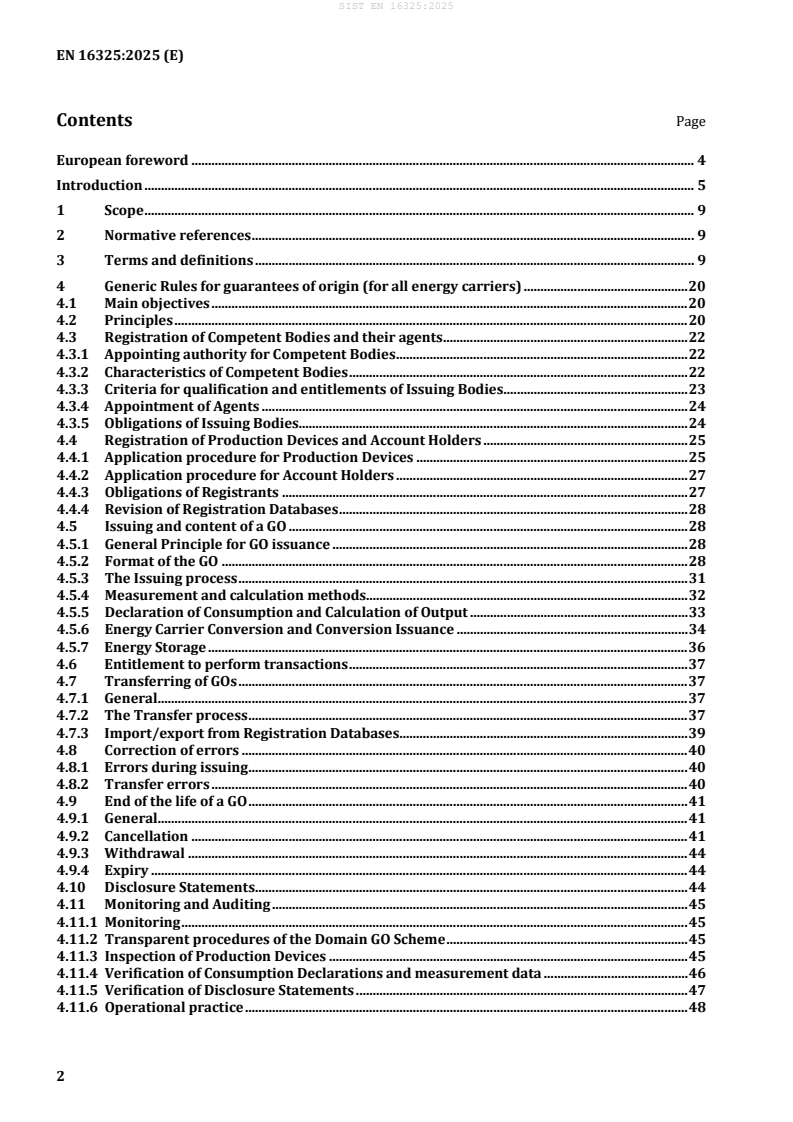
Contents Page
European foreword . 4
Introduction . 5
1 Scope . 9
2 Normative references . 9
3 Terms and definitions . 9
4 Generic Rules for guarantees of origin (for all energy carriers) . 20
4.1 Main objectives . 20
4.2 Principles . 20
4.3 Registration of Competent Bodies and their agents . 22
4.3.1 Appointing authority for Competent Bodies . 22
4.3.2 Characteristics of Competent Bodies . 22
4.3.3 Criteria for qualification and entitlements of Issuing Bodies . 23
4.3.4 Appointment of Agents . 24
4.3.5 Obligations of Issuing Bodies. 24
4.4 Registration of Production Devices and Account Holders . 25
4.4.1 Application procedure for Production Devices . 25
4.4.2 Application procedure for Account Holders . 27
4.4.3 Obligations of Registrants . 27
4.4.4 Revision of Registration Databases . 28
4.5 Issuing and content of a GO . 28
4.5.1 General Principle for GO issuance . 28
4.5.2 Format of the GO . 28
4.5.3 The Issuing process . 31
4.5.4 Measurement and calculation methods. 32
4.5.5 Declaration of Consumption and Calculation of Output . 33
4.5.6 Energy Carrier Conversion and Conversion Issuance . 34
4.5.7 Energy Storage . 36
4.6 Entitlement to perform transactions . 37
4.7 Transferring of GOs . 37
4.7.1 General . 37
4.7.2 The Transfer process . 37
4.7.3 Import/export from Registration Databases. . 39
4.8 Correction of errors . 40
4.8.1 Errors during issuing . 40
4.8.2 Transfer errors . 40
4.9 End of the life of a GO . 41
4.9.1 General . 41
4.9.2 Cancellation . 41
4.9.3 Withdrawal . 44
4.9.4 Expiry . 44
4.10 Disclosure Statements . 44
4.11 Monitoring and Auditing . 45
4.11.1 Monitoring . 45
4.11.2 Transparent procedures of the Domain GO Scheme . 45
4.11.3 Inspection of Production Devices . 45
4.11.4 Verification of Consumption Declarations and measurement data . 46
4.11.5 Verification of Disclosure Statements . 47
4.11.6 Operational practice . 48
5 Rules specific to individual energy carriers . 48
5.1 General . 48
5.2 Electricity . 48
5.2.1 Applicability . 48
5.2.2 Additional application information for the registration of a Production Device for
Electricity . 48
5.2.3 Production Devices for Electricity . 48
5.2.4 Additional provisions and calculation of output for High-Efficiency Cogeneration
Electricity . 49
5.2.5 Obligatory additional information on a GO for Electricity . 49
5.2.6 Additional optional information on a GO for Electricity. 50
5.2.7 Calculation of Net Energy Production eligible for GO issuing . 50
5.2.8 Limitations for Cancellation of GOs for Electricity . 50
5.2.9 Additional data sources for Disclosure Statements . 50
5.2.10 Residual mix calculation . 50
5.3 Gas . 50
5.3.1 Applicability . 50
5.3.2 Additional application information for the registration of a Production Device . 51
5.3.3 Production Devices for Gas . 51
5.3.4 Additional criteria for issuing GOs . 51
5.3.5 Obligatory additional information on a GO for Gas . 52
5.3.6 Additional optional information on a GO for Gas . 52
5.3.7 Inspections . 53
5.3.8 Calculation of Net Energy Production eligible for GO issuing . 54
5.3.9 Information on a cancellation request and a cancellation statement for the Gas GO . 55
5.3.10 Hydrogen . 55
5.4 Heating and Cooling . 57
5.4.1 Applicability . 57
5.4.2 Additional application information for the registration of a Production Device . 57
5.4.3 Qualification criteria for Production Devices . 58
5.4.4 Obligatory additional information on a GO for heating or cooling . 58
5.4.5 Additional optional information on a GO for heating or cooling . 58
5.4.6 Optional cancellation rules for heating or cooling GOs . 59
5.4.7 Consumption Declaration . 59
5.4.8 Calculation of Net Energy Production eligible for GO issuing . 60
Annex A (normative) Energy Source Type codes . 61
Annex B (normative) Technology codes . 70
Annex C (normative) Coding structures . 76
Annex D (normative) Cogeneration GO codes — Uses of Heat. 80
Annex E (normative) Dissemination level of the physical energy for which the GO is issued . 81
Bibliography. 82
European foreword
This document (EN 16325:2025) has been prepared by Technical Committee CEN/CLC/JTC 14 “Energy
management and energy efficiency in the framework of energy transition”, the secretariat of which is held
by UNI.
This European Standard shall be given the status of a national standard, either by publication of an
identical text or by endorsement, at the latest by January 2026, and conflicting national standards shall
be withdrawn at the latest by January 2026.
Attention is drawn to the possibility that some of the elements of this document may be the subject of
patent rights. CEN shall not be held responsible for identifying any or all such patent rights.
This document supersedes EN 16325:2013+A1:2015.
EN 16325:2013+A1:2015:
— the scope of the document is extended to guarantees of origin for gasses and heating and cooling,
— this document establishes the relevant terminology and definitions, and requirements for the
registration, issuance, transfer and cancellation of GOs in line with the following directives:
— Directive (EU) 2023/2413 on the promotion of energy from renewable sources,
— Directive (EU) 2019/944 on common rules for the internal market for electricity,
— Directive (EU) 2023/1791 on energy efficiency,
— and other relevant European Union law.
Any feedback and questions on this document should be directed to the users’ national standards body.
A complete listing of these bodies can be found on the CEN website.
According to the CEN-CENELEC Internal Regulations, the national standards organisations of the
following countries are bound to implement this European Standard: Austria, Belgium, Bulgaria, Croatia,
Cyprus, Czech Republic, Denmark, Estonia, Finland, France, Germany, Greece, Hungary, Iceland, Ireland,
Italy, Latvia, Lithuania, Luxembourg, Malta, Netherlands, Norway, Poland, Portugal, Republic of North
Macedonia, Romania, Serbia, Slovakia, Slovenia, Spain, Sweden, Switzerland, Türkiye and the United
Kingdom.
Introduction
General
This document sets out how Guarantees of Origin (GOs) are standardised in line with relevant European
Union (EU) Directives and existing voluntary schemes. The aim of the standard is, therefore, to create a
standardised transferable GO that can be used to facilitate the disclosure of the origin of energy, the
identification of particular energy sources, to its final customer, including by labelling schemes, like
environmental/ecological labels. For the purpose of the Renewable Energy Directive (EU) 2023/2413,
often and henceforth referred to as RED III, a GO means an electronic document which has the sole
function of providing evidence to a final customer that a given share or quantity of energy was produced
from renewable sources. A GO may serve other purposes where Member States have arranged to have
GOs for other types of energy.
There is a growing demand from final customers for the ability to make reliable and unique claims about
the origin of their energy use. Energy suppliers are required to provide reliable disclosure information to
final customers on the origin of the energy they supplied them by using GOs. The EU GO system already
meets many of the needs of these stakeholders and revising the EN 16325 standard on GOs can further
strengthen the current system. The EN 16325 standard on GOs is being revised to ensure that it fulfils the
requirements of the Renewable Energy Directive (EU) 2023/2413, the Directive on common rules for the
internal market for electricity (EU) 2019/944, the Directive on Energy Efficiency (EU) 2023/1791 and
other relevant European legislation. The revised standard provides a basis for the further development
of energy attribute tracking in the EU, to achieve greater harmonisation between the national systems of
EU Member States and European Economic Area (EEA) countries that are part of the CEN & CENELEC
community.
GOs are electronic certificates which can be issued, traded, and cancelled following the principles of a
book and claim system and convey the ownership of energy attributes that can be used for disclosure
through national registries. The Renewable Energy Directive and Directive on Energy Efficiency require
Member States to recognise a GO issued by another Member State unless they have “well-founded doubts
about its accuracy, reliability, or veracity” (RED III - Art. 19.9). Further, the system should prevent double-
counting and be resistant to fraud. Therefore, a European Standard for GOs for all member states is
important. As per the Renewable Energy Directive, the content of the standard applies to energy from
renewable sources, be it “electricity, or gas, including hydrogen, or heating or cooling” (RED III - Art. 19.7),
and non-renewable sources.
The elaboration and publication of European Standards allows certification bodies to develop their
activities on consensual and recognised practices and this increases the credibility of the certificates they
deliver.
Description of the Guarantee of Origin system and its components
Basic description of the GO system and its components
The purpose of a guarantee of origin (GO) system is to allocate the attributes of an amount of energy from
generation/production to its delivery to final customers. In doing so, the system allows final customers
to assign to the energy supplied to them the attributes of the energy for which the GO was issued. For
instance, this enables final customers to choose to claim energy from renewable sources or to
consume/use decarbonised and low-carbon energy. This is accomplished by energy producers or
generators requesting the issuance of a GO for each MWh of energy which they produce/generate. These
GOs can then be traded until they are cancelled by/for a final customer. This cancellation allows the final
customer to state that they have used this unit of energy. The main goal of GOs is to facilitate consumer
choice and market transparency, and indirectly, since GOs have a certain monetary value, act as a market
incentive for renewable production.
The Guarantee of Origin system for electricity was first legislated for at European level in Article 5 of
Directive 2001/77/EC on the promotion of electricity produced from renewable energy sources in the
Competent body
internal electricity market. This article was later amended by Article 15 of the Renewable Energy
Directive 2009/28/EC (often referred to as RED I). Article 15.1 states that “…Member States shall ensure
that the origin of electricity produced from renewable sources can be guaranteed… for the purpose of
proving to final customers the share or quantity of energy from renewable sources in an energy supplier’s
energy mix”. Renewable Energy Directive (EU) 2018/2001 (RED II), amended by (EU) 2023/2413, in Art.
19, extended the scope of GOs to cover gas (including hydrogen) as well as heating and cooling.
The existing Energy Type
Electricity is therefore extended to include the following Energy Types:
a) Gas; and
b) Heating and Cooling.
Article 14.10 of the Directive on Energy Efficiency determines that upon request, a Member State can
issue a GO for Electricity produced from High-Efficiency Cogeneration, for the purpose of demonstrating
that such production method leads to savings of primary energy used.
At the time of revision of this EN 16325 standard in the period 2020-2024, the European energy market
has adopted the GO system for electricity initiated by the first Renewable Electricity Directive
2001/77/EC and updated in the first, second and third Renewable Energy Directives: 2009/28/EC, (EU)
2018/2001/EU and (EU) 2023/2413.
A Guarantee of Origin system consists of certain basic components, which relate to the verification of the
underlying information, accurate generation of data, secure and electronic GO transfer as well as the use
of GOs for cancellation and disclosure. These basic components ensure accurate attribute tracking and
the avoidance of double disclosure when the same unit of energy is disclosed more than once. Table 1
describes how these basic components relate to the GO life cycle.
Table 1 — Main components of a GO system
Account Holder Registration Prevent access of fraudulent actors
Ensure rule-compliance contractually
Production Device Registration Verify plant data
Ensure data maintenance and re-verification
GO issuing Base issuing on verified meter readings
Verify shares of energy origin in multi-fuel plants
GO transfer Secure and electronic transfer independently from the
physical energy or energy trading
Non-mutability and uniqueness of certificate data
GO cancellation Where a GO is issued, claims regarding the origin of the
energy to which that GO relates can only be made if the
relevant GO is cancelled
Disclosure Disclosure of the energy origin supplied
Where applicable, calculation of the residual mix and
obligation to use it for untracked energy
Account Holder registration
GOs are held in accounts of electronic registries which are managed by Issuing Bodies. Only legitimate
companies (legal persons) with the intention of participating in the GO market (for example, producers,
traders and/or energy suppliers and end users of energy) are permitted to register as GO account holders.
By setting a registration process and required documentation for account holders, the Competent Body
or Bodies and Disclosure Authority of each country makes the necessary steps to block fraudulent actors
accessing the market. Countries or regions may, at their discretion, limit access to the GO registry further
to, for example, energy market actors established in the national or regional (as applicable) territory.
After a successful registration process, an account holder gains secure access to its GO account(s).
Production Device registration
Issuing of GOs is based on measured energy output from registered Production Devices. For this purpose,
all Production Devices, the owner/operator of which requests issuance of GOs, are registered in their
national GO registry. Prior to the approval of a registration, a Competent Body or its agent verifies the
registered standing data (such as age, capacity, location, technology, energy medium) of the Production
Device. Periodically, the registration information is re-verified to ensure the up-to-date accuracy of the
data.
GO Issuing
Issuing of GOs is made periodically (typically every month) for measured energy output from registered
Production Devices. In most countries, the energy output data are derived from the Transmission or
Distribution System Operator’s data (relating to, for example, imbalance settlements), which
automatically portrays the accurate amount of produced energy which is supplied to final customers, nett
of auxiliary consumption. Where this is not the case, the production data might come straight from the
producer, in which case the Competent Body takes the necessary additional steps to ensure the accuracy
of the data (for example, by verification of the metering diagram).
For Production Devices producing energy from multiple energy sources (for example, certain combined
heat and power plants), the measured total energy output is distributed to each energy source through a
verified declaration of the shares of different energy sources used in production. GOs are then issued for
output from each energy source in proportion to their share, so that each GO only records one energy
source. The declaration process might cause a time lag of several months for the issuance of GOs from
multi-fuel plants.
Issued GOs are deposited on the GO Account(s) of registered Account Holders. Each GO represents a value
of 1 MWh of energy, and the information content of a GO (the attributes of the unit of energy) consists of
the standing information of the Production Device as well as information specific to the unit of produced
energy, such as the energy source, production time and received support. Once the GO is issued, the
information contained on a GO is immutable (apart from possible error correction) and this GO is the only
means for final customer information related to the energy origin. The Competent Body ensures through
contractual and other means that where a GO is issued, no claims can be made regarding the origin of the
energy to which that GO relates without its cancellation. The product itself (type of energy or energy
carrier) and its physical composition as such is not an attribute. These characteristics cannot be
transferred across system boundaries through GOs.
NOTE RED III Art 19 (2) provides an obligation for Member States to ensure that the same unit of energy
from renewable sources is taken into account only once.
GO Transfer
Account Holders may access their GO Accounts to perform transactions such as the transfer of a GO to
another Account Holder’s account. GOs may be transferred independently of the energy to which they
relate (RED III (EU) 2023/2413, preamble 48).
GO Cancellation
The Cancellation (use) of a GO enables a claim on the origin of the energy supplied to a final customer.
Cancellation hence means the realisation of the value of the GO for the Disclosure of energy origin to a
final customer. An Account Holder who performs a Cancellation unambiguously designates the supplied
energy to which the Cancellation relates. This may imply a certain (renewable or decarbonised/low-
carbon) energy product or the generic mix of a supplier in a given year.
Energy disclosure and residual mix
Each electricity supplier is obliged to disclose to its customers the energy origin of electricity sold to them
(RED III (EU) 2023/2413, Article 19.8). The purpose of GOs is to enable this process, which is called
“Disclosure”. GOs are used by energy suppliers, and, in some countries, by final customers to reliably claim
the origin of the energy supplied to them by a supplier or directly purchased from a final customers. The
sale of energy from a renewable energy origin takes place accompanied by the cancellation of a GO .
The legal basis for a similar disclosure obligation exists, to some extent, for district heating and cooling
((EU) 2023/2413, Article 24.1), and can be found in (EU) 2023/2413, Article 19.8 for other types of
energy. In order to avoid double claims regarding the origin of a quantity of energy, a disclosure scheme
linked to the cancellation of GOs is needed for each energy carrier for which a GO system is in place.
The Residual Mix is the energy source mix which includes national or region (as applicable) energy
production but excludes from the generation mix any tracked energy generation attributes. The concept
of residual mix is an integral part of any energy origin disclosure system that omits an obligation to
corroborate the origin of non-renewable energy. The introduction of a GO system provides a way of
supplying energy with specific attributes, but also impacts the remaining attributes of any energy
supplied without cancellation of a GO. A Residual Mix is a logical consequence of implementing energy
attribute tracking, as it ensures that the attributes represented by GOs are not double-disclosed to other
final customers through an implicit mix. The use of uncorrected generation statistics for purposes of
disclosure should be avoided.
Energy disclosure information provided by energy suppliers to their customers is verified by a Disclosure
Supervisory Body, to ensure that: a) a sufficient quantity of GOs has been cancelled corresponding to the
suppliers’ disclosure statements; and b) the residual mix is correctly applied for the remaining part of
disclosure.
Complementing EN 16325 for agile response in changing circumstances
This document covers the essential building blocks for a reliable system of GOs and offers a basis for
reliable disclosure of the origin of supplied energy. For efficiency of operation and deeper quality
assurance, harmonisation of detailed processes is recommended, although such details may require
frequent updates to keep pace with developments in technology, legislation, the market and national
policies, among other matters.
There is need for a trade-off between the stability of a formalised standard, and the more flexible
additional agreements that can be made between issuing bodies. Ideally, this is done in a single platform,
where issuing bodies share experiences and concerns and jointly make decisions on the updates. A clear
process for such decision-making between GO issuing bodies would enable agile response to changing
circumstances for GO system management.
The only exceptions include governmental support schemes, and the remaining shares of renewable energy attributes in the
residual mix.
Or possible contractual tracking for non-renewable attributes.
1 Scope
This document specifies requirements for Guarantees of Origin (GOs) of Electricity, several gaseous
Energy Carriers, and Heating and Cooling. This document establishes the relevant terminology and
definitions, and requirements for the registration, issuance, transfer and cancellation of GOs in line with
the following directives: Renewable Energy Directive (EU) 2023/2413, the Directive on common rules for
the internal market for electricity (EU) 2019/944, the Directive on Energy Efficiency (EU) 2023/1791 and
other relevant European Union law.
This document covers measuring methods and auditing procedures.
Out of scope of this document is GO recognition by CEN & CENELEC member countries.
2 Normative references
The following documents are referred to in the text in such a way that some or all of their content
constitutes requirements of this document. For dated references, only the edition cited applies. For
undated references, the latest edition of the referenced document (including any amendments) applies.
EN ISO 13443:2005, Natural gas - Standard reference conditions (ISO 13443:1996 including Corrigendum
1:1997)
EN ISO 20675, Biogas - Biogas production, conditioning, upgrading and utilization - Terms, definitions and
classification scheme (ISO 20675)
3 Terms and definitions
For the purposes of this document, the following terms and definitions apply.
ISO and IEC maintain terminology databases for use in standardisation at the following addresses:
— ISO Online browsing platform: available at https://www.iso.org/obp
— IEC Electropedia: available at https://www.electropedia.org/
NOTE Additional terms can be found in Renewable Energy Directive (EU) 2023/2413 (RED III).
3.1
account
record on a registration database (3.51) relating to a particular account holder (3.2) in which GOs (3.32)
are held
3.2
account holder
person or organisation in respect of whom an account (3.1) is maintained on a registration database (3.51)
3.3
affiliate
stakeholder assigned by the expression “related undertaking” (in relation to the electricity market) and
directive (in relation to the gas market)
3.4
alteration
correction by the competent body (3.12) of any data of a GO (3.32) where an error has been introduced
upon issuing the GO (3.32) or during the processing of the GO (3.32)
3.5
auxiliary
item of the production device (3.47) that consumes energy and is required for the functional operation of
that production device (3.47)
Note 1 to entry: An auxiliary can consume output produced by that production device.
Note 2 to entry: An auxiliary can consume energy in the form of any energy carrier.
Note 3 to entry: Energy consumed by an auxiliary used to facilitate the process is other energy than input and is thus
not converted into the output.
3.6
authorised measurement body
person or organisation responsible for collecting and determining (on behalf of the registrant (3.50))
measured values of the import meter(s) (3.34) and export meter(s) (3.28) of a production device (3.47),
and which has been either:
— appointed under a domain GO scheme (3.20), or
— appointed by a competent body (3.12) as its agent (3.13)
for the purpose of measuring energy
3.7
attribute
data field on a GO (3.32) specifying the characteristics of an energy unit produced by a production device
(3.47) in terms of the input(s) (3.35) used and/or the details (standing data) of that production device
(3.47) and production process
3.8
biomass
biodegradable fraction of products, waste, and residues from biological origin from agriculture, including
vegetal and animal substances, from forestry and related industries, including fisheries and aquaculture,
as well as the biodegradable fraction of waste, including industrial and municipal waste of biological
origin
3.9
cancel
mark, at the request of the holder of the account on which it is held, a GO (3.32) as having been used for
the purpose of disclosure (3.16) of energy supplied to a final customer on behalf of a unique beneficiary,
and to prevent it from subsequently being:
— transferred to another account, or
— marked again in this way
3.10
cancellation statement
electronic, non-transferrable receipt which provides evidence of the cancellation of one or more GOs
(3.32) for the purpose of disclosure (3.16) of the attributes (3.7) of those GOs (3.32) for the beneficiary or
beneficiaries of the cancellation (3.9)
3.11
cogeneration
energy conversion from the same source into two or more utilized forms of energy within one common
controlled process
Note 1 to entry: Combined heat and power is a specific implementation of cogeneration used for the simultaneous
production of heat and electricity.
3.12
competent body
body duly authorised under the laws and regulations of any state (and, as the case may be, region) to
exercise or discharge any legislative, governmental, regulatory, administrative or supervisory function
associated with the administration of a domain GO scheme (3.20)
3.13
competent body’s agent
agent
person or organisation engaged by a competent body (3.12) to perform on its behalf any of its functions
associated with the administration of a domain GO scheme (3.20)
3.14
consumption declaration
declaration with respect to the inputs (3.35) of a production device (3.47), including energy used in storing
energy to be used by that production device (3.47)
3.15
conversion issuance
issuance of a GO (3.32) for output (3.43) resulted from energy carrier conversion (3.23), and for which GOs
(3.32) representing the attributes (3.7) of the input (3.35) to that production device (3.47) have been
cancelled (3.9)
3.16
disclosure
provision of information to a final customer on the share or quantity of the energy supplied to them as
having specific attributes (3.7)
3.17
disclosure authority
competent body (3.12) charged with supervision of origin disclosure (3.16) in its domain (3.19),
comprising tasks such as:
— verifying the accuracy and veracity of disclosure statements (3.18), and
— applying corrective measures with regard to disclosure statements (3.18) that do not conform to the
requirements of the relevant domain GO scheme (3.20), and
— calculating the residual mix (3.57) and possibly other fuel mixes, where applicable
3.18
disclosure statement
information provided as a result of disclosure (3.16)
3.19
domain
geographic area containing production devices (3.47) with respect to which an issuing body (3.37) is
responsible for issuing GOs (3.32) for the relevant energy carrier (3.22)
3.20
domain GO scheme
GO scheme
legislative, regulatory, administrative, supervisory, and contractual framework, in relation to any domain
(3.19), establishing a system for issuing, registration, and cancellation of GOs (3.32) and for disclosure
(3.16) in that domain (3.19)
3.21
domain GO scheme participant
GO scheme participant
registrant (3.50) and/or an account holder (3.2)
3.22
energy carrier
substance carrying the energy content of an Energy Type (3.30)
3.23
energy carrier conversion
conversion
production of an energy carrier (3.22) in a production device (3.47) from one or more inputs (3.35)
including at least one other energy carrier (3.22)
3.24
energy input factor
proportion (relating to the energy content and expressed as a factor of not more than one) of the output
(3.43) of a production device (3.47) which is from a single type of input (3.35)
3.25
energy storage
storage
device or system that is used to store energy, where the energy carrier (3.22) injected into that device or
system is the same as the energy carrier (3.22) that flows out of it
Note 1 to entry: For the purpose of this standard, energy carrier conversion is not to be understood as energy
storage.
3.26
expiry
cessation of a GO (3.32) being eligible for transfer or cancellation, as a consequence of the passage of a
given period of time since the production of the associated energy, in accordance with subclause 4.9.4
3.27
gas composition
mole fraction of each gas specie in a gas mixture
Note 1 to entry: Includes gas species that are not fuels (carbon dioxide, nitrogen, etc.), as they could be thermal
energy carriers.
3.28
export meter
one or more device(s) and supporting arrangements for determining (in whole or in part) the quantity of
output (3.43) flowing from a production device (3.47) to the point where the output (3.43) is to be made
available
3.29
GO issuing request
request by the authorised representative of a production device (3.47) to an issuing body (3.37) for the
issue (3.36) of GOs (3.32) in respect of that production device (3.47) and a specific period of time
3.30
energy type
substance that can be used to produce mechanical work or heat or to operate chemical or physical
processes and the means by which it is conveyed, being electrical energy (3.30.1), gas (3.30.2) or heating
and cooling (3.30.3)
3.30.1
electrical energy
energy type (3.30) and energy carrier (3.22) comprising energy made available by the flow of electric
charge through a conductor
3.30.2
gas
energy type (3.30) comprising all gaseous energy carriers (3.22) that consist of a chemical compound
being in a gaseous state at minimum operating temperature and at operating pressure of the relevant grid
Note 1 to entry: In the context of this document gaseous energy carriers are hydrogen, methane, ethane, propane,
butane, carbon monoxide, ammonia, dimethyl ether (DME), provided that they are in gas phase at the minimum
operating temperature and at their partial pressure (if in gas mixture) at the operating pressure of the relevant grid.
3.30.2.1
gas mixture
mix of gas (3.30.2) energy carriers (3.22) characterized by a gas composition (3.27)
Note 1 to entry: The sum of the mole fractions of the gas energy carriers present in the gas mixture may be lower
than one if gas species that are not energy carriers are also present in the gas composition.
3.30.2.2
hydrogen
energy carrier (3.22) of which the energy content is derived from the chemical compound H
3.30.2.3
methane
energy carrier (3.22) of which the energy content is derived from the chemical compound CH
3.30.2.4
ethane
energy carrier (3.22) of which the energy content is derived from the chemical compound C H
2 6
3.30.2.5
propane
energy carrier (3.22) of which the energy content is derived from the chemical compound C H
3 8
...