

SIST EN 13286-52:2005
(Main)Unbound and hydraulically bound mixtures - Part 52: Method for the manufacture of test specimens of hydraulically bound mixtures using vibrocompression
General Information
- Abstract
This document specifies a test method for making specimens of hydraulically bound mixture to a predetermined density and water content by vibrocompression compaction.
This document is appropriate to mixtures, or that part of a mixture, containing aggregate up to a maximum size of 31,5 mm.
This method is not applicable to mixtures with a high proportion of fines.
- Status
- Published
- Publication Date
- 31-May-2005
- Technical Committee
- CES - Roads
- Current Stage
- 6060 - National Implementation/Publication (Adopted Project)
- Start Date
- 01-Jun-2005
- Due Date
- 01-Jun-2005
- Completion Date
- 01-Jun-2005

Overview
EN 13286-52:2004 (CEN) defines a laboratory test method for the manufacture of test specimens of hydraulically bound mixtures using vibrocompression. The standard is intended for road construction materials containing aggregate up to 31.5 mm (not suitable for mixtures with a high proportion of fines). It specifies specimen dimensions, apparatus, compaction parameters and storage/reporting requirements to produce specimens at a predetermined dry density and water content.
Key topics and technical requirements
- Scope: Manufacture of specimens by simultaneous horizontal vibration and light axial pressure (vibrocompression compaction). Applicable to mixtures or parts with aggregate ≤ 31.5 mm; not for high-fines mixes.
- Specimen dimensions: Cylindrical specimens per Table 1 (examples: 100 mm diameter × 100/200 mm height; 160 mm diameter × 160/320 mm height). Direct tensile specimen shape is also defined.
- Apparatus:
- Rigid moulds (volume accuracy ±1.5%) with end caps to prevent moisture loss.
- Vibrator delivering horizontal vibration at ~100 Hz with amplitude 0.8–1.0 mm.
- Piston to apply pulsed axial pressure; compaction pressure shall not exceed 0.5 MPa.
- Supporting cylinder and base plate to assemble the mould setup.
- Compaction principle and limits:
- Mixture placed in mould; vibration + increasing pulsed axial pressure used to compact.
- Compaction should achieve target density within 90 s. If not achievable, adjust target density or water content and repeat.
- Typical compaction sequence: light pressure for initial 2/3 of time, increased pressure for final 1/3 to reach full compaction.
- Material dosing: Mass of mixture introduced is calculated from specimen volume, target dry density and water content (mass to be measured to ±1%).
- Formula (as in standard): m = 1 000 V × ρd × (100 + w) / 100
- V = specimen volume (mm3), ρd = dry density (Mg/m3), w = water content (%).
- Formula (as in standard): m = 1 000 V × ρd × (100 + w) / 100
- Storage: Specimens stored vertically in their moulds with caps, preventing moisture loss, at temperature within ±2 °C of specified temperature, for the time specified in the relevant mixture document.
- Test report: Must reference the standard and include mixture type/origin, specimen mass/water content/dry density after compaction, storage conditions and any deviations or incidents.
Applications and users
- Quality control and R&D laboratories testing hydraulically bound layers for roads and pavement structures.
- Material suppliers, contractors, pavement engineers and researchers who need repeatable, standardized specimens for compressive, tensile and modulus testing.
- Use cases: specimen preparation for downstream tests (compressive strength, indirect tensile strength, modulus, swelling, etc.) in pavement material characterization.
Related standards
- EN 13286 series (laboratory reference density, Proctor, vibrating hammer/table, axial compression, and test methods for strength and other properties) - e.g., EN 13286-1, -2, -3, -4, -50, -51, -53, -40 to -49.
Keywords: EN 13286-52, vibrocompression, hydraulically bound mixtures, specimen manufacture, compaction method, road construction materials, laboratory test method.
Relations
- Effective Date
- 09-Feb-2026
- Effective Date
- 09-Feb-2026
- Effective Date
- 28-Jan-2026
- Effective Date
- 28-Jan-2026
- Effective Date
- 28-Jan-2026
- Effective Date
- 28-Jan-2026
- Effective Date
- 28-Jan-2026
- Effective Date
- 28-Jan-2026
- Effective Date
- 28-Jan-2026
- Referred By
SIST EN 13199-3:2001 - Packaging - Small Load Carrier Systems - Part 3: Bond Stackable System (BSS) - Effective Date
- 28-Jan-2026
- Effective Date
- 28-Jan-2026
- Referred By
SIST EN 14227-2:2013 - Hydraulically bound mixtures - Specifications - Part 2: Slag bound mixtures - Effective Date
- 28-Jan-2026
- Effective Date
- 28-Jan-2026
- Effective Date
- 28-Jan-2026
- Referred By
SIST EN 14227-2:2004 - Hydraulically bound mixtures - Specifications - Part 2: Slag bound mixtures - Effective Date
- 28-Jan-2026
Get Certified
Connect with accredited certification bodies for this standard

Zavod za gradbeništvo Slovenije (ZAG) - Inšpekcija
ZAG inspection body for construction products, structures, and materials.
Sponsored listings
Frequently Asked Questions
SIST EN 13286-52:2005 is a standard published by the Slovenian Institute for Standardization (SIST). Its full title is "Unbound and hydraulically bound mixtures - Part 52: Method for the manufacture of test specimens of hydraulically bound mixtures using vibrocompression". This standard covers: This document specifies a test method for making specimens of hydraulically bound mixture to a predetermined density and water content by vibrocompression compaction. This document is appropriate to mixtures, or that part of a mixture, containing aggregate up to a maximum size of 31,5 mm. This method is not applicable to mixtures with a high proportion of fines.
This document specifies a test method for making specimens of hydraulically bound mixture to a predetermined density and water content by vibrocompression compaction. This document is appropriate to mixtures, or that part of a mixture, containing aggregate up to a maximum size of 31,5 mm. This method is not applicable to mixtures with a high proportion of fines.
SIST EN 13286-52:2005 is classified under the following ICS (International Classification for Standards) categories: 93.080.20 - Road construction materials. The ICS classification helps identify the subject area and facilitates finding related standards.
SIST EN 13286-52:2005 has the following relationships with other standards: It is inter standard links to SIST EN 60455-2:2002, SIST EN IEC 60455-2:2024, SIST EN ISO 14527-2:2000, SIST EN 14227-13:2006, SIST EN 14227-3:2005, SIST EN 13286-40:2004, SIST EN 14227-10:2006, SIST EN 14227-12:2006, SIST EN 13286-42:2004, SIST EN 13199-3:2001, SIST EN ISO 2039-2:2000, SIST EN 14227-2:2013, SIST EN ISO 14529-2:2000, SIST EN 14227-5:2005, SIST EN 14227-2:2004. Understanding these relationships helps ensure you are using the most current and applicable version of the standard.
SIST EN 13286-52:2005 is available in PDF format for immediate download after purchase. The document can be added to your cart and obtained through the secure checkout process. Digital delivery ensures instant access to the complete standard document.
Standards Content (Sample)
SLOVENSKI STANDARD
01-junij-2005
Nevezane in hidravlično vezane zmesi – 52. del: Postopek (metoda) za pripravo
preizkušancev iz hidravlično vezanih zmesi, pripravljenih z vibracijskim
zgoščevalnikom
Unbound and hydraulically bound mixtures - Part 52: Method for the manufacture of test
specimens of hydraulically bound mixtures using vibrocompression
Ungebundene und hydraulisch gebundene Gemische - Teil 52: Verfahren zur Herstellung
von Probekörpern von hydraulisch gebundenen Gemischen durch Vibro-Druck (Rütteln
und Druck)
Mélanges traités et mélanges non traités aux liants hydrauliques - Partie 52: Méthode de
confection par vibrocompression des éprouvettes de matériaux traités aux liants
hydrauliques
Ta slovenski standard je istoveten z: EN 13286-52:2004
ICS:
93.080.20 Materiali za gradnjo cest Road construction materials
2003-01.Slovenski inštitut za standardizacijo. Razmnoževanje celote ali delov tega standarda ni dovoljeno.
EUROPEAN STANDARD
EN 13286-52
NORME EUROPÉENNE
EUROPÄISCHE NORM
December 2004
ICS 93.080.20
English version
Unbound and hydraulically bound mixtures - Part 52: Method for
the manufacture of test specimens of hydraulically bound
mixtures using vibrocompression
Mélanges traités et mélanges non traités aux liants Ungebundene und hydraulisch gebundene Gemische - Teil
hydrauliques - Partie 52: Méthode de confection par 52: Verfahren zur Herstellung von Probekörpern von
vibrocompression des éprouvettes de matériaux traités aux hydraulisch gebundenen Gemischen durch Vibro-Druck
liants hydrauliques (Rütteln und Druck)
This European Standard was approved by CEN on 12 November 2004.
CEN members are bound to comply with the CEN/CENELEC Internal Regulations which stipulate the conditions for giving this European
Standard the status of a national standard without any alteration. Up-to-date lists and bibliographical references concerning such national
standards may be obtained on application to the Central Secretariat or to any CEN member.
This European Standard exists in three official versions (English, French, German). A version in any other language made by translation
under the responsibility of a CEN member into its own language and notified to the Central Secretariat has the same status as the official
versions.
CEN members are the national standards bodies of Austria, Belgium, Cyprus, Czech Republic, Denmark, Estonia, Finland, France,
Germany, Greece, Hungary, Iceland, Ireland, Italy, Latvia, Lithuania, Luxembourg, Malta, Netherlands, Norway, Poland, Portugal, Slovakia,
Slovenia, Spain, Sweden, Switzerland and United Kingdom.
EUROPEAN COMMITTEE FOR STANDARDIZATION
COMITÉ EUROPÉEN DE NORMALISATION
EUROPÄISCHES KOMITEE FÜR NORMUNG
Management Centre: rue de Stassart, 36 B-1050 Brussels
© 2004 CEN All rights of exploitation in any form and by any means reserved Ref. No. EN 13286-52:2004: E
worldwide for CEN national Members.
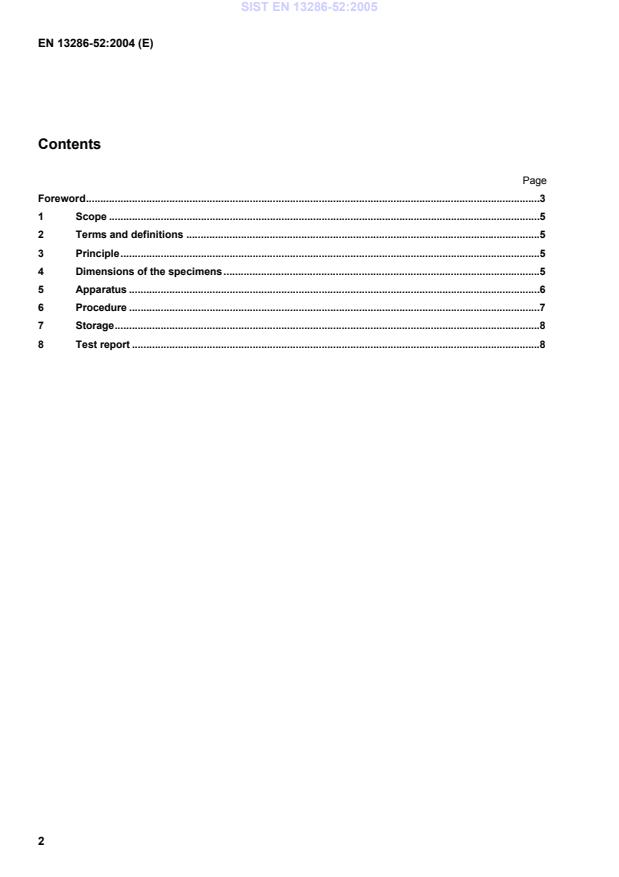
Contents
Page
Foreword.3
1 Scope .5
2 Terms and definitions .5
3 Principle.5
4 Dimensions of the specimens.5
5 Apparatus .6
6 Procedure .7
7 Storage.8
8 Test report .8
Foreword
This document (EN 13286-52:2004) has been prepared by Technical Committee CEN/TC 227 “Road
materials”, the secretariat of which is held by DIN.
This European Standard shall be given the status of a national standard, either by publication of an identical
text or by endorsement, at the latest by June 2005, and conflicting national standards shall be withdrawn at
the latest by June 2005.
This document is one of a series of documents as listed below.
EN 13286-1, Unbound and hydraulically bound mixtures Part 1: Test methods for laboratory reference
density and water content Introduction, general requirements and sampling
EN 13286-2, Unbound and hydraulically bound mixtures Part 2: Test methods for the determination of the
laboratory reference density and water content Proctor compaction
EN 13286-3, Unbound and hydraulically bound mixtures Part 3: Test methods for laboratory reference
density and water content Vibrocompression with controlled parameters
EN 13286-4, Unbound and hydraulically bound mixtures Part 4: Test methods for laboratory reference
density and water content Vibrating hammer
EN 13286-5, Unbound and hydraulically bound mixtures Part 5: Test methods for laboratory reference
density and water content Vibrating table
EN 13286-7, Unbound and hydraulically bound mixtures Part 7: Cyclic load triaxial test for unbound
mixtures
EN 13286-40, Unbound and hydraulically bound mixtures Part 40: Test method for the determination of the
direct tensile strength of hydraulically bound mixtures
EN 13286-41, Unbound and hydraulically bound mixtures Part 41: Test method for the determination of the
compressive strength of hydraulically bound mixtures
EN 13286-42, Unbound and hydraulically bound mixtures Part 42: Test method for the determination of the
indirect tensile strength of hydraulically bound mixtures
EN 13286-43, Unbound and hydraulically bound mixtures Part 43: Test method for the determination of the
modulus of elasticity of hydraulically bound mixtures
EN 13286-44, Unbound and hydraulically bound mixtures Part 44: Test method for the determination of the
alpha coefficient of vitrified blast furnace slag
EN 13286-45, Unbound and hydraulically bound mixtures Part 45: Test method for the determination of the
workability period of hydraulically bound mixtures
EN 13286-46, Unbound and hydraulically bound mixtures Part 46: Test method for the determination of the
moisture condition value
EN 13286-47, Unbound and hydraulically bound mixtures Part 47: Test method for the determination of
California bearing rati
...